Yesterday, I participated in a short teleconference with Canada’s open government advisory panel considering the next version of the country’s open government “action plan.” As readers may know, I accepted an invitation in 2012 from Canadian Minister of Parliament Tony Clement, the president of Canada’s Treasury Board, to be a member of Canada’s advisory panel on open government, joining others from Canada’s tech industry, the academy and civil society. (I shared several recommendations for open government in the first meeting, held on February 28th, 2012, and in another in 2013.)
In preparation for yesterday’s discussion, I downloaded the Open Government Partnership’s Internal Review Mechanism’s report on Canada, which highlights progress in meeting the country’s (largely self-defined) goals for open government, particularly with respect to open data, and identified significant weaknesses in the public consultation taken to date.
The consultative process during the development of the action plan was weak. The consultation, which was only done online, including a Twitter chat session with the TBS President, took place during a public holiday and no draft plan was circulated in advance for discussion. There was minimal awareness raising around the consultation process, which resulted in low participation.
The IRM researcher found minimal evidence of attempts to engage civil society during implementation of the action plan with the exception of the consultation on open data and the Open Government Licence. Consultation on commitments in these areas was seen as significantly stronger and more productive than the consultations for development of the action plan and the year one government selfRassessment.
Consultation of the self assessment report was carried out online and was not widely publicized, resulting in a limited level of participation.
Based upon this report and my own observations, I made three suggestions on yesterday’s call:
1) Adoption of an open source e-petition platform from the United Kingdom. While many people remain dubious about online petitions, the tool could be seeded with proposed open government reforms and solicit new ones.
2) Acknowledgement of ongoing debates about electronic surveillance. The Harper administration should launch a more proactive public discussion of what the Canadian people have a right to know about how their electronic communications are being collected, stored and used. Any broad consultation around open government Canada will include this issue.
3) More civic engagement with the media. If improving public consultation is a priority, government officials must go onto television and radio broadcasts, along with sitting down for print interviews. Public engagement through social media and government websites are simply not enough.
The Canadian government should also engage journalists who are making information requests, specifically data journalists, as they are key players in the ecosystem around confirming data releases and quality. If the government faces significant doubts, it will have to turn to more trusted third parties to validate its programs and their efficacy.
One of the more interesting aspects of Dave Eggers’ dystopic new novel, “The Circle,” is the introduction of the “SeaChange,” a small, powerful camera that can transmit wireless images to a networked global audience. The SeaChange is adopted by politicians who “go transparent,” broadcasting all of their interactions to the public all day long.
Regardless of whether that degree of radical transparency in beneficial for elected representatives or not, in early 2014, we’ve now seen many early glimpses of what a more networked world full of inexpensive cameras looks like when United States politicians are online and on camera more often, from scandals to threats to slurs to charged comments that may have changed a presidential election. Most of that video has been captured by small video cameras or, increasing, powerful smartphones. Over the next year, more people will be wearing Google Glass, Google’s powerful facial computing device. Even if Google Glass has led to a backlash, the next wave of mobile devices will be wearable, integrated into clothing, wristbands, shoes and other gear. This vision of the future is fast approaching, which means that looking for early signals of various aspects of it is crucial.
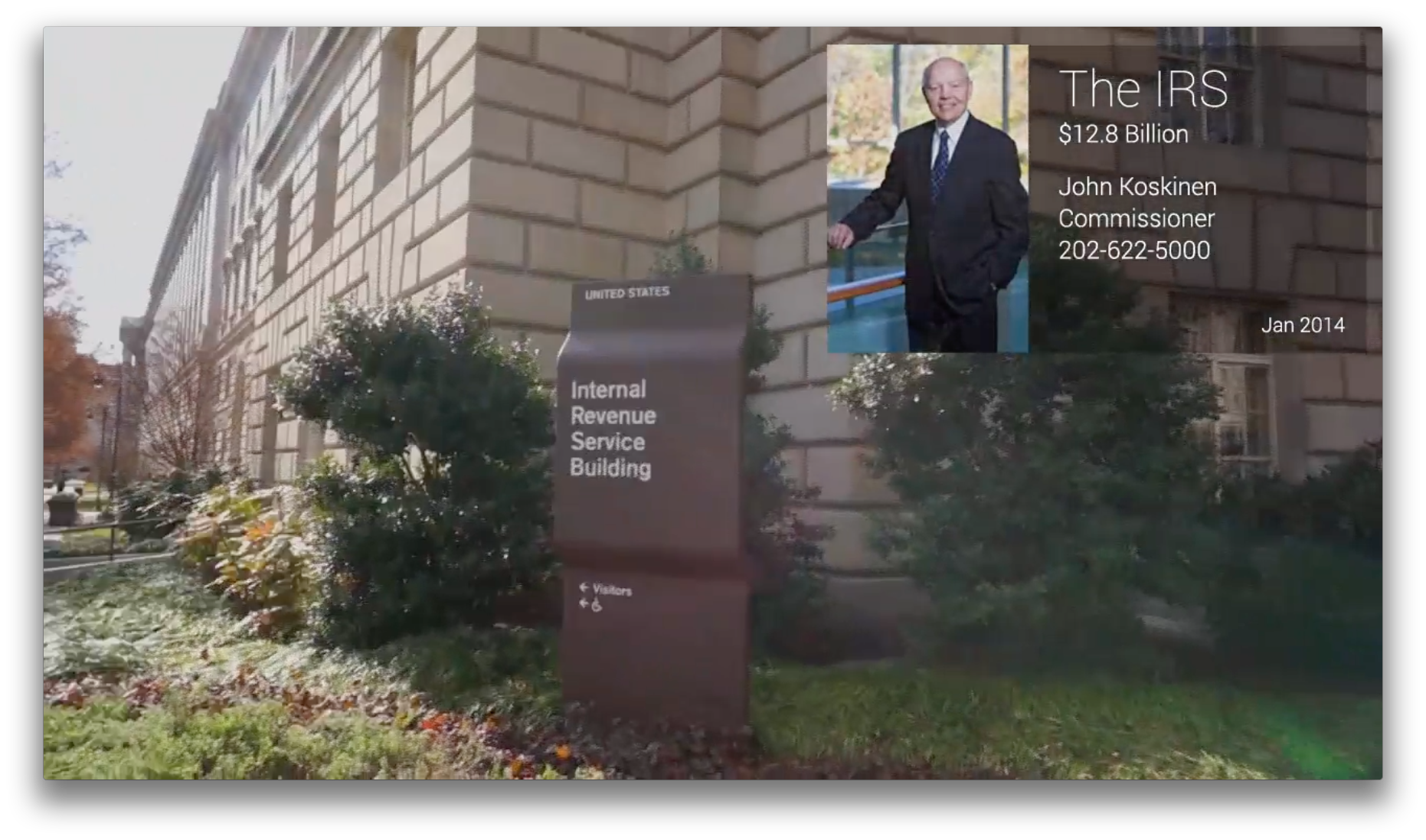
One such signal came across my desktop earlier this week, in the form of a new app for Google Glass from RedEdge, a digital advocacy consultancy based in Arlington, Virginia. Their new “augmented advocacy” application for Google Glass is a proof of concept that demonstrates how government data can be served to someone wearing glass as she moves around the world. It’s not in the GDJ Store but people interested in testing it can request the Glass application file (android 1) from RedEdge, its maker.
“While we don’t expect widespread deployment of this app, though that would be cool, this is a window into what’s possible with wearable computing just using federal department data,” said Ian Spencer, chief technology officer of RedEdge, in an interview. “The data we used to launch this app and populate the database was all sourced from publicly available information. We primarily used publications from the Office of Management and Budget for budget figures, as well as the president’s own budget, for monetary data. Location data on federal buildings was sourced from Google Maps.”
The app leverages Google Glass’s ability to detect the wearer’s location, feeding a government data through RedEdge’s API to populate a relevant card. It pulls in from open data, formatted as JSON, and provides a list of all locations.
“You can just walk around with the app running in background,” said Spencer. “It doesn’t take up a ton of battery life. With geofencing, Glass knows when you’re near a building and triggers the app, which pops in a card that shows you a phone number and budget information. You can then tap to get more information and it loads up public contact information. Eventually the GDK [Glass Developer Kit] will let you make calls and emails.”
Visitors to the White House with this app, for instance, could call the White House switchboard, though they would be unlikely to get President Obama on the phone.
The RedEdge app is currently limited by the amount of time and investment RedEdge has put into it, along with the technology of Glass itself. “Once we add more data points, we will need a more complicated API,” said Spencer. “User experience was our focus, not massive complete sets. Even if we were using a government API, which would be ideal at some point, we would need a hashing layer so that we don’t overwhelm their servers.”
The only data the developers are feeding into it is the total federal budget for a given agency, not more granular details concerning how it related to programs, their performance or who is in charge of them. It’s very much a “proof of concept.”
“We’re looking at it as a trial balloon,” said Spencer. “It started with our tech team. We haven’t had researchers go over tons of entries. If there is interest in it, we then may do more, like adding more federal data and state-level data.”
One potentially interesting application of augmented advocacy might seem to be Congress, where data from the Sunlight Foundation’s Influence Explorer or Open Congress could be integrated as the Glass wearer walked around. The technical limitations of Glass, however, mean that citizens will need to keep downloading Sunlight’s popular Congress app for smartphones.
“The problem is the precision of the GPS,” said Spencer. “If you’re wearing Glass in the Hart building, you don’t have enough accuracy. You can get building-to-building precision, but not more. There are technical problems with trying to use satellites for this, whether it’s GPS or GLONASS, the Russian version.”
That doesn’t mean such precision might not be possible in the future. As Spencer highlighted, app developers can determine “micropositioning” through wifi or Bluetooth, enabling triangulation within a room. “A classic example comes from marketing in a store –” I see you’re looking at X,” he said.
That technology is already live, as Brian Fung reported in the Washington Post: stores are using cellphones to track shopping habits. In Washington, a more palatable example might be around the Mall, where geofences and tracking trigger information about Smithsonian paintings, trees, statuary, or monuments.
The limitation on facial recognition capabilities in Glass also means that the most interesting and disturbing potential application of its gaze is still far away: looking at someone in a lobby, bar, hearing or conference and learning not only who the person is but what role he or she may play in DC’s complicated ecosystem of lobbyists, journalists, Congressional staffers, politicians, media, officials, public advocates and campaign operatives. (For now, the role of the trusted aide, whispering brief identifiers into the ears of the powerful is safe.)
When more apps like this go live in more devices, expect some fireworks to ensure around the United States and the world, as more private and semi-public spaces become recorded. Glass and its descendents will provide evidence of misbehavior by law enforcement, just as cellphones have in recent years. The cameras will be on the faces of officers, as well. While some studies suggest that police wearing cameras may improve the quality of their policing — and civil liberties advocates support their introduction — such devices aren’t popular with the New York City Police Department.
As with the dashboard cameras that supply much of the footage for “Cops” in the United States and offer some protection against corrupt police and fraud in Russia, wearable cameras look likely to end up on the helmets, glasses, lapels or shoulders of many officers in the future, from Los Angeles to London.
The aspirational view of this demo is that it will show how it’s possible to integrate more public data into the life of a citizen without requiring her to pull out a phone.
“There’s a lot of potential for this app to get people to care about an issue and take action,” said Spencer. “It’s about getting people aware. The cool thing about this is its passive nature. You start it once and it tells you when you’re near something.”
A more dystopian view is that people will see a huge budget number and call the switchboard of a given agency to angrily complain, as opposed to the constituent relations staff of their representatives in Congress.
Given the challenges that Congress already faces with the tidal wave of social media and email that has swelled up over the last decade, that would be unhelpful at best. If future digital advocates want to make the most of such tools, they’ll need to provide users with context for the data they’re being fed, from sources to more information about the issues themselves the progress of existing campaigns.
This initial foray is, after all, just a demo. More integration may be coming in the next generation of wearables.
One of the most important open government data efforts in United States history came into being in 1993, when citizen archivist Carl Malamud used a small planning grant from the National Science Foundation to license data from the Securities and Exchange Commission, published the SEC data on the Internet and then operated it for two years. At the end of the grant, the SEC decided to make the EDGAR data available itself — albeit not without some significant prodding — and has continued to do so ever since. You can read the history behind putting periodic reports of public corporations online at Malamud’s website, public.resource.org.
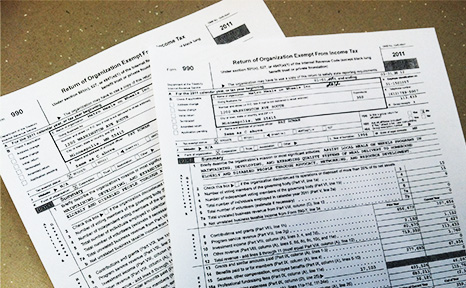
Two decades later, Malamud is working to make the law public, reform copyright, and free up government data again, buying, processing and publishing millions of public tax filings from nonprofits to the Internal Revenue Service. He has made the bulk data from these efforts available to the public and anyone else who wants to use it.
“This is exactly analogous to the SEC and the EDGAR database,” Malamud told me, in an phone interview last year. The trouble is that data has been deliberately dumbed down, he said. “If you make the data available, you will get innovation.”
November Form 990s now ready. http://t.co/HDoMzPjpY0 We have 7,335,804 Form 990s available. *STILL* no word from the IRS.
Making millions of Form 990 returns free online is not a minor public service. Despite many nonprofits file their Form 990s electronically, the IRS does not publish the data. Rather, the government agency releases images of millions of returns formatted as .TIFF files onto multiple DVDs to people and companies willing and able to pay thousands of dollars for them. Services like Guidestar, for instance, acquire the data, convert it to PDFs and use it to provide information about nonprofits. (Registered users view the returns on their website.)
As Sam Roudman reported at TechPresident, Luke Rosiak, a senior watchdog reporter for the Washington Examiner, took the files Malamud published and made them more useful. Specifically, he used credits for processing that Amazon donated to participants in the 2013 National Day of Civic Hacking to make the .TIFF files text-searchable. Rosiak then set up CItizenAudit.org a new website that makes nonprofit transparency easy.
“This is useful information to track lobbying,” Malamud told me. “A state attorney general could just search for all nonprofits that received funds from a donor.”
Malamud estimates nearly 9% of jobs in the U.S. are in this sector. “This is an issue of capital allocation and market efficiency,” he said. “Who are the most efficient players? This is more than a CEO making too much money — it’s about ensuring that investments in nonprofits get a return.
“I think inertia is behind the delay,” he told me, in our interview. “These are not the expense accounts of government employees. This is something much more fundamental about a $1.6 trillion dollar marketplace. It’s not about who gave money to a politician.”
If I order these IRS DVDs, my cost is $2910. Media and gov get them free, but none of them lifting a finger to help. http://t.co/B6m5VECV1O
When asked for comment, a spokesperson for the White House Office of Management and Budget said that the IRS “has been engaging on this topic with interested stakeholders” and that “the Administration’s Fiscal Year 2014 revenue proposals would let the IRS receive all Form 990 information electronically, allowing us to make all such data available in machine readable format.”
Today, Malamud sent a letter of complaint to Howard Shelanski, administrator of the Office of Information and Regulatory Affairs in the White House Office of Management and Budget, asking for a review of the pricing policies of the IRS after a significant increase year-over-year. Specifically, Malamud wrote that the IRS is violating the requirements of President Obama’s executive order on open data:
The current method of distribution is a clear violation of the President’s instructions to
move towards more open data formats, including the requirements of the May 9, 2013 Executive Order making “open and machine readable the new default for government
information.”
I believe the current pricing policies do not make any sense for a government
information dissemination service in this century, hence my request for your review.
There are also significant additional issues that the IRS refuses to address, including
substantial privacy problems with their database and a flat-our refusal to even
consider release of the Form 990 E-File data, a format that would greatly increase the
transparency and effectiveness of our non-profit marketplace and is required by law.
It’s not clear at all whether the continued pressure from Malamud, the obvious utility of CitizenAudit.org or the bipartisan budget deal that President Obama signed in December will push the IRS to freely release open government data about the nonprofit sector,
The furor last summer over the IRS investigating the status of conservative groups claimed tax-exempt status, however, could carry over into political pressure to reform. If political groups were tax-exempt and nonprofit e-file data were published about them, it would be possible for auditors, journalists and Congressional investigators to detect patterns. The IRS would need to be careful about scrubbing the data of personal information: last year, the IRS mistakenly exposed thousands of Social Security numbers when it posted 527 forms online — an issue that Malamud, as it turns out, discovered in an audit.
“This data is up there with EDGAR, in terms of its potential,” said Malamud. “There are lots of databases. Few are as vital to government at large. This is not just about jobs. It’s like not releasing patent data.”
If the IRS were to modernize its audit system, inspector generals could use automated predictive data analysis to find aberrations to flag for a human to examine, enabling government watchdogs and investigative journalists to potentially detect similar issues much earlier.
That level of data-driven transparency remains in the future. In the meantime, CitizenAudit.org is currently running on a server in Rosiak’s apartment.
Whether the IRS adopts it as the SEC did EDGAR remains to be seen.
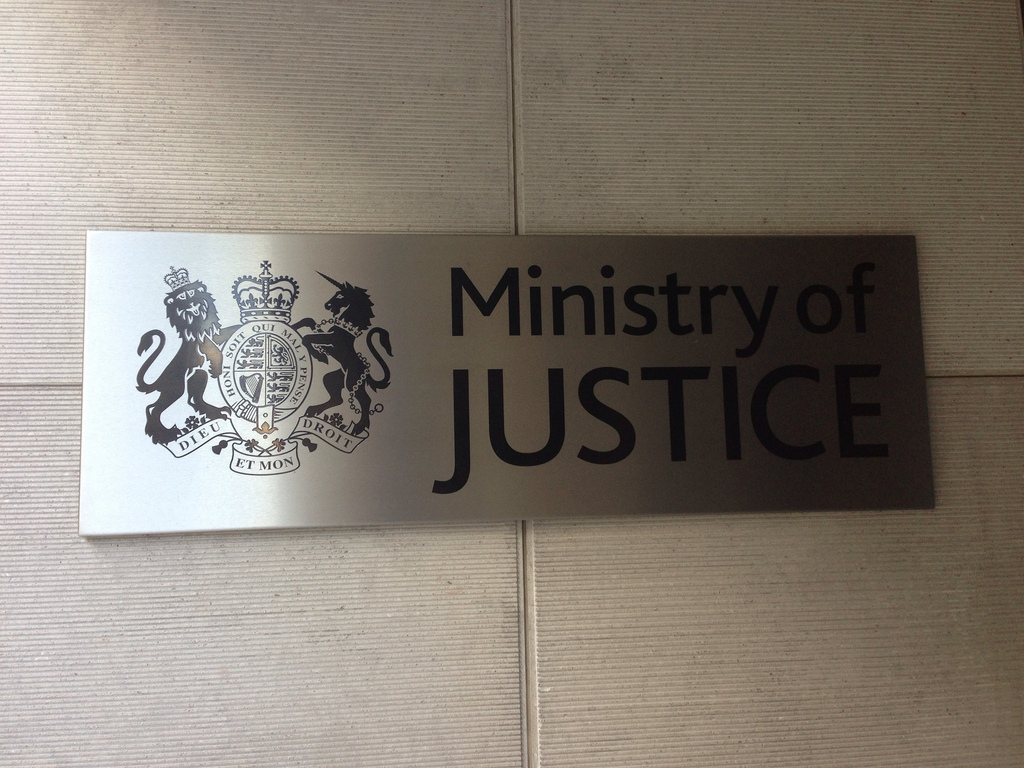
This September, I visited the United Kingdom’s Ministry of Justice and looked at the last remaining section of the Magna Carta that remains in effect. I was not, however, in a climate-controlled reading room, looking at a parchment or sheepskin.
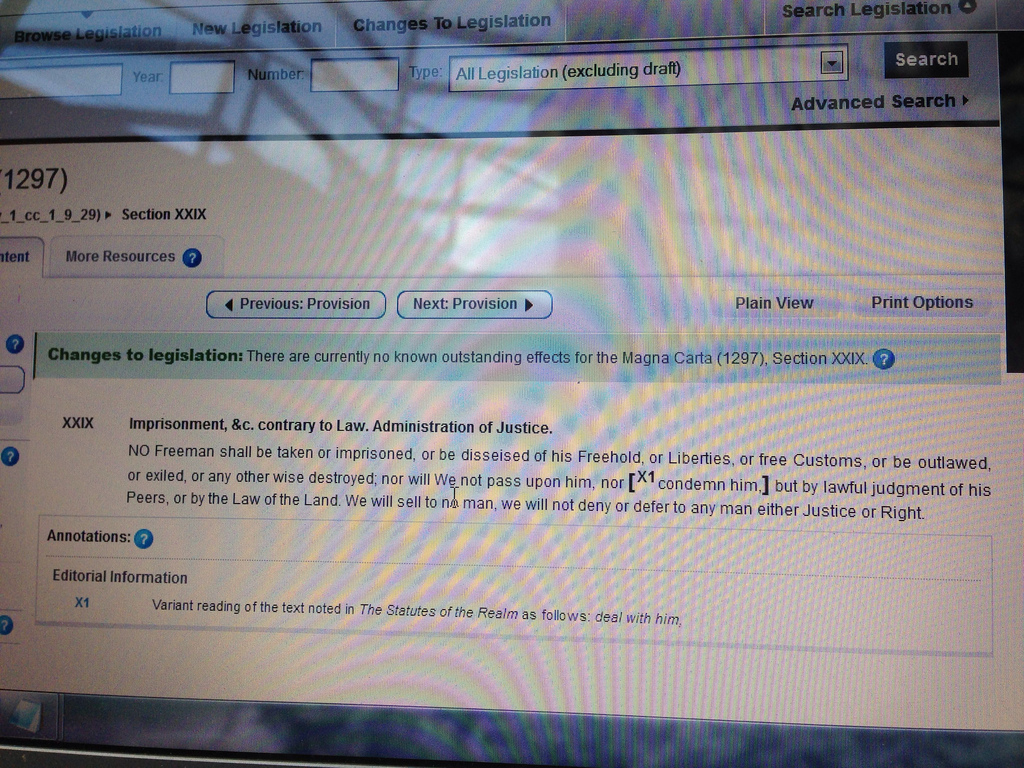
Rather, I was sitting in the Ministry’s sunny atrium, where John Sheridan was showing me the latest version of the seminal legal document, now living on online, on his laptop screen. The remaining section that is in force is rather important to Western civilization and the rule of law as many citizens in democracies now experience it:
NO Freeman shall be taken or imprisoned, or be disseised of his Freehold, or Liberties, or free Customs, or be outlawed, or exiled, or any other wise destroyed; nor will We not pass upon him, nor [X1condemn him,] but by lawful judgment of his Peers, or by the Law of the Land. We will sell to no man, we will not deny or defer to any man either Justice or Right.
From due process to eminent domain to a right to a jury trial, many of the rights that American or British citizens take as a given today have their basis in the English common law that stems from this document.
Over a cup of tea, Sheridan caught me up on the progress that his team has made in digitizing documents and improving the laws of the land. There are now 2 million monthly unique visitors to legislation.gov.uk every month, with 500+ million page views annually. People really are reading Parliament’s output, he observed, and increasingly doing so on tablets and mobile devices. The amount of content flowing into the site is considerable: according to Sheridan, the United Kingdom is passing laws at an estimated rate of 100,000 words every month, or twice as much as the complete works of Shakespeare.
Notable improvements over the years include the ability to compare the original text of legislation versus the latest version (as we did with the Magna Carta) and view a timeline of changes using a slider for navigation, exploring any given moment in time. Sheridan was particularly proud of the site’s rendering of legislation in HTML, include human-readable permanent uniform resource locators (URLS) and the capacity to produce on-demand PDFs of a given document. (This isn’t universally true: I found some orders appear still as PDFs).
More specifically, Sheridan highlighted a “good law” project, wherein the Office of the Parliamentary Counsel (OPC) of Britain is working to help develop plain language laws that are “necessary, clear, coherent, effective and accessible.” A notable component of this good law project is an effort to apply a tool used in online publishing, software development and advertising — A/B testing — to testing different versions of legislation for usability.
The video of a TedX talk embedded below by Richard Heaton, the permanent secretary of the United Kingdom’s Cabinet Office and first parliamentary counsel, explores the idea of “good law” at more length:
Sheridan went on to describe one of the more ambitious online collaborations between a government and its citizens I had heard of to date, a novel cross-Atlantic challenge co-sponsored by the UK and US governments, and a hairy legal technology challenge bearing down upon societies everywhere: what happens when software interprets the law?
For instance, he suggested, consider the increasing use of Oracle software around legislation. “As statutes are interpreted by software, what’s introduced by the code? What about quality testing?”
As this becomes a data problem, “you need information to contextualize it,” said Sheridan. “If you’re thinking about legislation as code, and as data, it raises huge questions for the rule of law.”
Sheridan has been one of the world’s foremost proponents of publishing legislative data through APIs, an approach that has come under criticism by open government data advocates after the government shutdown in the United States. (In 2014, forward-thinking governments publishing open data might consider provide basic visualization tools to site visitors, API access for third-party developers and internal users, and bulk data downloads.) One key difference between the approach of his team and other government entities might be that the National Archives are “dogfooding,” or consuming the same data through the same interface that they expect third-parties to use, as Sheridan wrote last March:
“We developed the API and then built the legislation.gov.uk website on top of it. The API isn’t a bolt-on or additional feature, it is the beating heart of the service. Thanks to this approach it is very easy to access legislation data – just add /data.xml or /data.rdf to any web page containing legislation, or /data.feed, to any list or search results. One benefit of this approach is that the website, in a way, also documents the API for developers, helping them understand this complex data.”
Perhaps because of that perspective, Sheridan, was as supportive of an APIs when we talked this September as he had been in 2012:
The legislation.gov.uk API has changed everything for us. It powers our website. It has enabled us to move to an open data business model, securing the editorial effort we need from the private sector for this important source of public data. It allows us to deliver information and services across channels and platforms through third party applications. We are developing other tools that use the API, using Linked Data – from recording the provenance of new legislation as it is converted from one format to another, to a suite of web based editorial tools for legislation, including a natural language processing capability that automatically identifies the legislative effects. Everything we do is underpinned by the API and Linked Data. With the foundations in place, the possibilities of what can be done with legislation data are now almost limitless.
Sheridan noted to me that the United Kingdom’s legislative open government data efforts are now acting as a platform for large commercial legal publishers and new entrants, like mobile legislative app, iLegal.
The iLegal app content is derived from the legislation.gov.uk API and offers handy features, like offline access to all items of legislation. iLegal currently costs £49.99/$74.99 annually or £149.99/$219.99 for a lifetime subscription, which might seem steep but is a fraction of the cost of of Halsbury’s Statutes, currently listed at £9,360.00 from Lexis-Nexis.
This approach to publishing the laws of the land online, in structured form under an open license, is an instantiation of the vision for Law.gov that citizen archivist Carl Malamud has been advocating for in the United States. 2013 saw some progress in that vein when the U.S. House of Representatives publishes U.S. Code as open government data.)
What’s notable about the United Kingdom’s example, however, is that less then a decade ago, none of this could have been possible. Why? As ScraperWiki founder Francis Irving explained, the UK’s database of laws was proprietary data until December 2006. Now, however, the law of the land is released back to the people as it is updated, a living code available in digital form to any member of the public that wishes to read or reuse it.
The United Kingdom, however, has moved beyond simply publishing legislation as open data: they’re actively soliciting civic participation in its maintenance and improvement. For the last year, the National Archives has been guiding the world’s leading commercial open data curation project.
“We are using open data as business model for fulfilling public services,” said Sheridan, in our interview. “We train people to do editorial work. They are paid to improve data. The outputs are public.”
In other words, the open government data always remains free to the people through legislation.gov.uk but any academic, nonprofit or commercial entity can act to add value to it and sell access to the resulting applications, analyses or interfaces.
Since the start of the UK project, they have doubled the number of people working on their open data, Sheridan told me. “The bottleneck is training,” he said. “We have almost unlimited editorial expertise available through our website. We define the process and rules, and then let anyone contribute. For example, we’re now working on revising legislation, identifying changes, researching it — when it comes in, what it affects — and then working with editor. Previous to this effort, government hasn’t been able to revise secondary legislation.”
Sheridan said that the next step is feedback for other editorial values.
“We’re looking for more experts,” he said. “They’re generally paid for by someone. It’s very close to open source software model. They must be able to demonstrate competence. There’s a 45-minute test, which we’re now given to thousands of people.”
If this continues to work, distributed online collaboration is a “brilliant way to help improve the quality of law,” said Sheridan.
“It’s a way to get the work done — and the work is really hard. You have to invest time and energy, and you must protect the reputation of the Archive. This is somewhat radical for the nation’s statute book. We have redesigned the process so people can work with us. It’s not a wiki, but participation is open. It’s peer production.”
A trans-Atlantic challenge to map legislative data
The U.K. National Archives and U.S. Library of Congress have asked for help mapping elements from bills to the most recent Akoma Ntoso schema. (Akoma Ntoso is an emerging global standard for machine-readable data describing parliamentary, legislative and judiciary documents.) The best algorithm that maps U.S. bill XML or UK bill XML to Akoma Ntoso XML, including necessary data files and supporting documentation, will win $10,000.
If you have both skills and interest, get cracking: the challenge closes on December 31, 2013.
As more and more governments release data around the world, the conditions under which it is published and may be used will become increasingly important. Just as open formats make data easier to put to work, open licenses make it possible for all members of the public to use it without fear.
Given that wonky but important issue, it’s important that governments that want to maximize the rewards of the work involved in cleaning and publishing open government data get the policy around its release right. Today, several open government advocates have released an updated Best-Practices Language for Making Data “License-Free”, which can found online at at theunitedstates.io/licensing.
“In short what we say is ‘Use Creative Commons Zero (CC0),’ which is a public domain dedication,” said Josh Tauberer, the founder of Govtrack.us, via email. “We provide recommended language to put on government datasets and software to put the data and code into the world-wide public domain. In a way, it’s the opposite of a license.
Tauberer, Eric Mill, developer at the Sunlight Foundation, and Jonathan Gray, director of policy and ideas at the Open Knowledge Foundation, who have been working on the guidance since May, all blogged about the new guidance:
“Back in May, the Administration’s Memorandum on Open Data created very confusing guidance for agencies about what constitutes open data by saying open data should be ‘openly licensed’,” explained Tauberer, via email. “In response to that, we began working on guidance for federal agencies for how to make sure their data in open under the definition in the 8 Principles of Open Government Data.”
The basic issue, he said, is that the memorandum directed agencies to make data open but, in the view of these advocates, told agencies the wrong thing about what open data actually means. “We’re correcting that with precise, actionable direction,” said Tauberer.
What would the consequences of United States government entities not adopting this guidance be?
“Because M-13-13 required open licensing as the new default, I worry about agencies taking the guidance too literally and applying licensing where they might not have before, even if the work is exempt from copyright,” said Tauberer. “Or they may now consider open licensing of works produced by a contractor to be the new norm, since it is permitted by M-13-13, but for certain core information produced by government this would be a major step backward.”
“Imagine if after FOIA’ing an agency’s deliberative documents, The New York Times was legally required to provide attribution to a contractor, or, worse, to the government itself,” said Tauberer. “The federal government is relying more and more on contractors and lawyers, so it’s important that we reinforce these norms now.”
While it remains to be seen if the White House Office of Management and Budget merges this best practice into its open data policy, the advocates have already had success getting it adopted.
“Since we first published the guidance in August, it’s led to three government projects using our advice,” said Tauberer. “Partly in response to our nudging, in October OSTP’s Project Open Data re-licensed its schema for federal data catalog inventory files. (It had been licensed under CC-BY because of non-governmental contributors to the schema, but now it uses CC0.) In September and October, The CFPB followed our guidance and applied CC0 to their “qu” project and their eRegs platform.”
This morning, the White House released its second action plan (PDF) for improving the state of open government in the United States. The action plan is required for U.S. participation in the Open Government Partnership, an international, multilateral initiative that seeks to push nations to make and keep commitments to open government.
“This second National Action Plan is another opportunity to set concrete and measurable goals for achieving a more transparent, participatory, and collaborative government,” wrote Nick Sinai, United States deputy chief technology officer and Gayle Smith, special assistant to the president and senior director for development and democracy, at the White House blog. “We look forward to working alongside civil society to carry out these commitments and continue identifying new ways to open our government in the future.”
As I previously reported, the action plan commits to modernizing the Freedom of Information Act, open more government data, improve the management of natural resources and engage citizens in innovation. Additionally, the final plan (a draft was released earlier this fall) includes commitments to join the Global Initiative on Fiscal Transparency (GIFT), promote participatory budgeting, increase the transparency of spending and foreign assistance, improve the participation of the public in rulemaking and a number of other measures that expand existing commitments.
Initial reactions from open government advocates — many of whom, it must be said, worked to shape the contents of the plan — are strongly positive.
“The United States helped found the Open Government Partnership to challenge other countries to make concrete commitments to make themselves more transparent and accountable to the people,” said Patrice McDermott, executive director of OpenTheGovernment.org, in a statement.
“This plan shows that the US is also serious about challenging itself. While we have been critical of some of this Administration’s decisions, particularly its continued insistence on walling off all information related to national security, this plan begins to break down that wall and advance open government.”
Sean Moulton, director of open government policy at the Center for Effective Government, was similarly positive about the plan:
We are impressed by the scope and detail of the plan, as well as the administration’s commitment to continue to engage and refine those commitments for which detailed goals are not yet available. This broad and ambitious plan tackles important open government issues that we have long been advocating, including: 1) strengthening the Freedom of Information Act (FOIA), 2) improving information about government spending, and 3) continuing to open government data to the public. Properly implemented, these commitments can make government openness work for the public and change how government operates. The Center for Effective Government looks forward to working with the administration to ensure the outlined goals are executed over the next two years.
Sunlight Foundation policy director John Wonderlich balanced good with the bad in the plan:
There are some new and meaningful commitments. The proposed FOIA advisory board and committee could be transformative, and commitments to greater transparency in the extractives industry extend the significant new commitments that began in the US’s last plan.
More disappointing are the commitments around spending transparency, which would build on existing efforts to improve federal spending transparency in Congress and the federalgovernment, but but offer only vague commitments. The National Action Plan also outlines a process to ensure federal agencies treat their data as an asset that should be open to the public, (long a Sunlight priority), but without adding much new detail to a process that is already well along its path.
And money in politics, like in the first National Action Plan, is missing entirely.
The measures that are likely to draw the most attention are those that relate to electronic surveillance and national security, and to whistleblower protections.
On that count, the second U.S. national action plan for open government includes measures to increase the transparency of foreign intelligence surveillance activities (largely mirroring the measures President Obama has already introduced this fall and repackaging the commitments made by the intelligence community) and to “strengthen and expand whistleblower protections for government personnel.” I include both below:
6. Increase Transparency of Foreign Intelligence Surveillance Activities
In June 2013, the President directed the U.S. Intelligence Community to declassify and make public as much information as possible about certain sensitive intelligence collection programs undertaken under the authority of the Foreign Intelligence Surveillance Act (FISA), while being mindful of the need to protect national security. Nearly two thousand pages of documents have since been released, including materials that were provided to Congress in conjunction with its oversight and reauthorization of these authorities. As information is declassified, the U.S. Intelligence Community is posting online materials and other information relevant to FISA, the FISA Court, and oversight and compliance efforts. The Administration has further committed to:
• Share Data on the Use of National Security Legal Authorities. The Administration will release annual public reports on the U.S. Government’s use of certain national security authorities. These reports will include the total number of orders issued during the prior twelve-month period and the number of targets affected by them.
• Review and Declassify Information Regarding Foreign Intelligence Surveillance Programs. The Director of National Intelligence will continue to review and, where appropriate, declassify information related to foreign intelligence surveillance programs.
• Consult with Stakeholders. The Administration will continue to engage with a broad group of stakeholders and seek input from the Privacy and Civil Liberties Oversight Board to ensure the Government appropriately protects privacy and civil liberties while simultaneously safeguarding
national security.
9. Strengthen and Expand Whistleblower Protections for Government Personnel
Employees with the courage to report wrongdoing through appropriate, legally authorized channels are a government’s best defense against waste, fraud, and abuse. Federal law prohibits retaliation against most government employees and contractors who act as whistleblowers, and those protections were strengthened by recent legislation and Executive action. However, some who work for the Government still have diminished statutory protections. The Government must also ensure that Federal employees know their rights. Therefore, the Administration will:
• Mandate Participation in the Office of Special Counsel Whistleblower Certification Program. To ensure that Federal employees understand their whistleblower rights and how to make protected disclosures, the Administration will require covered agencies to complete the U.S. Office of Special Counsel’s program to certify compliance with the Whistleblower Protection Act’s notification requirements.
• Implement the Presidential Directive on Protecting Whistleblowers. The U.S. Government will continue to work to implement the President’s October 2012 Policy Directive on Protecting Whistleblowers with Access to Classified Information (PPD-19), including by ensuring strong, independent due process procedures; awareness of protections; and agency understanding of the protections available to government contractors under the directive.
• Advocate for Legislation to Expand Whistleblower Protections. With the Administration’s support, Congress recently enacted legislation to strengthen whistleblower protections for most Federal Government employees and contractors, but there are still gaps in statutory protections available to certain government employees and contractors. The Administration will continue to work with Congress to enact appropriate legislation to protect these individuals.
• Explore Executive Authority to Expand Whistleblower Protections if Congress Does Not Act. While statutory protections are preferable, the Administration will explore additional options for utilizing Executive authority to further strengthen and expand whistleblower protections if Congress fails to act further.
“This is big news in my mind,” writes Nathaniel Heller, executive director of Global Integrity. “Yes, the commitments to greater disclosure around surveillance activities are largely retread and don’t go nearly far enough. But for these issues to have made their way into a US National Action Plan is an important first step towards broadening the open government agenda to include “new frontiers” or “thorny” issues. That’s a big deal and a win.”
As with so many aspects of government announcements regarding measures to hold themselves more accountable or become more transparent, the most important part of this plan will be not be the words themselves but in how they are interpreted and implemented by this administration and those to follow. To date, after bold rhetoric in 2009, the Obama administration’s record on open government is mixed, with ongoing challenges regarding transparency on Healthcare.gov’s performance. There’s also precious little acknowledgment of concerns about press freedoms in the plan. Heller would also have liked to have seen something on corporate ownership:
The administration remains silent on public registries of beneficial owners of companies,” he writes. “Sigh. David Cameron and the UK government made a pioneering commitment to public registries of who really owns UK companies at the OGP summit in London. The US is now in the awkward position of having to defend keeping this valuable data private to only government regulators and investigators. That’s an increasingly thin reed. There’s certainly opposition to public registries in Congress, but the White House could have at least committed to publicly pushing for public registries. Instead, mum’s the word.
Steven Aftergood expressed some concerns about the administration’s new goals on open government, focusing on his wheelhouse, overclassification and pervasive secrecy. As he noted, the plan also includes a measure to improve declassication:
…a new interagency Classification Review Committee is being established with White House leadership to evaluate proposals for classification reform, and to coordinate their implementation throughout the executive branch. The creation of such a body was the primary recommendation of the Public Interest Declassification Board last year, and it was strongly endorsed by public interest groups.
Both because of its interagency character and especially due to its White House leadership, the new Committee has the potential to overcome the autonomous classification practices of individual agencies that have contributed to the explosive growth in secrecy.
Positive results are naturally not guaranteed. The Administration has not embraced an explicit theory of how overclassification occurs, or even how overclassification is to be defined, and therefore it is not yet well-equipped to address the problem.
The new Plan notes that in June of this year President Obama directed the Intelligence Community to declassify and make public “as much information as possible” about intelligence surveillance programs. But in an optimally functioning classification system, the President’s directive would have been redundant and unnecessary; the system would already be declassifying as much information as possible.
Of course, the existing classification system is not functioning optimally. That is the problem. So either the President needs to issue individualized directives to all agencies on every conceivable classified topic to “declassify as much as possible,” or else the new White House interagency Committee needs to find alternate means to effectively communicate the same imperative.
Wonderlich also expressed a deeper concern about the plan: its lack of ambition, focus upon political power and personal investment or commitment of political capital from President Obama.
Unfortunately, if we imagine what a National Action Plan could be with a committed, engaged President, and senior political staff at the White House who discuss and engage with integrity issues, rather than treating them as political liabilities, we imagine a wholly different world. Incremental working groups and vaguely redundant reporting procedures would be replaced by bold proposals that affect political and state power, and we’d see a White House that talks more about the transparency we’re building than the transparency they use as a shield against critics. That’s clearly not the National Action Plan the White House released today.
All that being said, the fact that these measures are in the plan shows that the Obama administration has heard the criticism of civil society regarding secret surveillance laws, overclassification, and prosecuting whistleblowers and included elements addressing them.
That’s better. Let’s see what they do next.
This post has been updated with reactions from open government advocates over time.
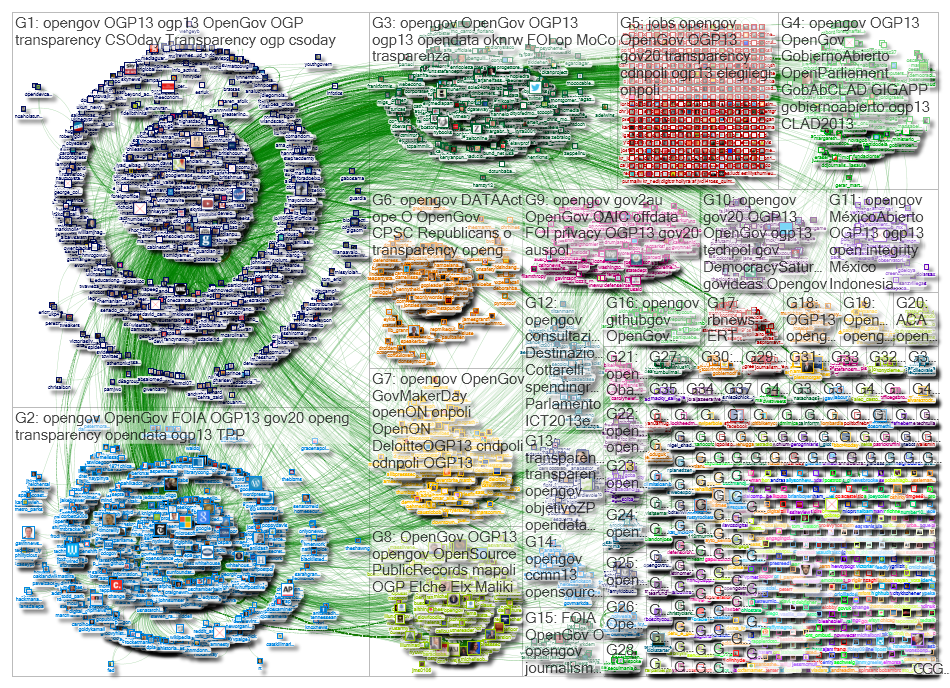
The map above was created on November 20 by researcher Marc Smith using a dataset of tweets that contained “opengov” over the past month. You can explore an interactive version of it here.
The social network analysis is, by its nature, a representation of only the data used to create it. It’s not a complete picture of open government communities offline, or even the totality of the communities online: it’s just the people who tweeted about open gov.
That said, there are some interesting insights to be gleaned.
1) The biggest network is the one for the Open Government Partnership (OGP), on the upper left (G1), which had its annual summit during the time period in question. That likely affected the data set.
2) I’m at the center of the U.S. open government community on the bottom left (G2) (I’m doing something right!) and am connected throughout these communities, though I need to work on my Spanish. This quadrant is strongly interconnected and includes many nodes linked up to OGP and around the world. (Those are represented by the green lines.)
3) Other communities include regional networks, like Spain (G4) and Spanish-speaking (G11) open government organizations, Germany (G3), Italy (G12), Canada (G7), Greece (G5) and Australia (G9), and ideological networks, like the White House @OpenGov initiative (G8) and U.S. House Majority Leader (G6). These networks have many links to one another, although Mexico looks relatively isolated. Given that Indonesia has a relatively high Twitter penetration, its relative absence from the map likely reflects users there not tweeting with “opengov.”
4) The relative sparseness of connections between the Republican open government network and other open government communities strongly suggests that, despite the overwhelming bipartisan support for the DATA Act in the House, the GOP isn’t engaging and linked up to the broader global conversation yet, an absence that should both concern its leaders and advocates in the United States that would like to see effective government rise above partisan politics. This community is also only tweeting links to its own (laudable) open government initiatives and bills in the House, as opposed to what’s happening outside of DC.
5) You can gain some insight into the events and issues that matter in these communities by looking at the top links shared. Below, I’ve shared the top links from Smith’s NodeXL analysis: Top URLs in Tweet in Entire Graph:
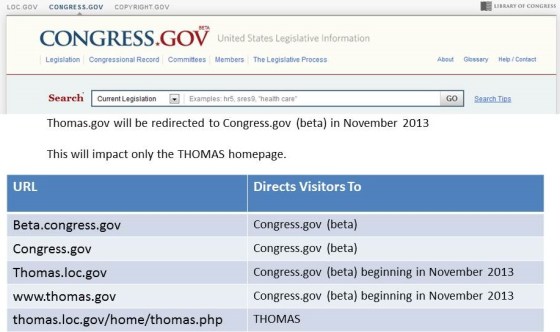
On November 19th, Thomas.gov, the venerable website of the United States Congress, will begin to redirect visitors to Congress.gov. The new site, which launched in beta in September 2012, will become the primary governmental resource for the text of legislation, past, present and future, along with reports from committees, speeches from the floor of Congress and cost estimates from the Congressional Budget Office.
THOMAS is centuries old, at least as measured in terms of Internet time. Launched in January of 1995, Thomas.gov was one of the first 23,000 websites to go online. When it went live the Internet had a worldwide user base of less than 40 million people, the majority of whom surfed the young World Wide Web using Mosaic and Netscape, checked their email on Eudora and dialed in on America Online. Watch the video below to get a sense of what life was like online nearly two decades ago.
Today, Thomas.gov receives, on average, 10 million visits every year, although I suspect many of those visits come from wonky repeat customers in or around the District of Columbia. I have no servers logs to prove that one way or another, but THOMAS has long been alternately beloved of or bemoaned by Congressional staffers and correspondents, all of whom have had to rely upon its increasingly creaky infrastructure for nearly two decades as the national repository of legislation and reports. So, too, have millions of Americans around the rest of the country who want to read proposed bills.
While incremental improvements to search and sharing in recent years have improved the site, for a decade people interested in tracking Congress have increasingly turned to sites like Govtrack or the New York Times for data created by scraping THOMAS. What does that mean, in practice? While Congress.gov will be official source of information, until its operators move to act as a platform for legislative data instead of a portal for legislative information. Open government advocates have been calling for the release of bulk legislative data for many years, culminating in frustration this September when a Library of Congress cost estimate acknowledged that Congress.gov “was not designed specifically to facilitate the extraction of the data as XML documents for bulk download.”
Tapping into a growing trend in government new media, the new Congress.gov features responsive design, adapting to desktop, tablet or smartphone screens. It’s also search-centric, with Boolean search and, in an acknowledgement that most of its visitors show up looking for information, puts a search field front and center in the interface. The site includes member profiles for U.S. Senators and Representatives, with associated legislative work. In a nod to a mainstay of social media and media websites, the new Congress.gov also has a “most viewed bills” list that lets visitors see at a glance what laws or proposals are gathering interest online.
On November 19th, when THOMAS is retired, the social media outposts of the site will also transition. @THOMASDotGov will transition its more than 15,500 followers to a new identity.
In a press release, the Library of Congress indicated that the old site will remain accessible from the Congress.gov homepage through late 2014. After that, historians may have to hope that the National Archives adopts whatever code or data retains historical interest into its servers, lest it moulder and succumb to bitrot — unfortunately, the configuration of the robots.txt file for Thomas.gov appears to have prevented the Internet Archive from preserving its iterations over the years.
If you’re interested in learning how to use the new Congress.gov, you can register at beta.congress.gov/help for training sessions scheduled for November 14, January 16, March 11 and March 16.
As I looked back at the annual Open Government Partnership Summit in London, I was struck by how much technology continues to dominate discussion, particularly when many of the issues that confront people and governments around the world are political or systemic, and thus resistant to simply “fixes.”
Given that so many of the new country commitments for the partnership either involve improving the use of technology or are enabled by technology, it’s tempting to frame the release of government data and other digital efforts as efforts that will primarily serve elites, not the poor, and to warn of the encroachment of commercial interests in that delivery.
The years ahead will be messy, full of anger, violence, ignorance and the worst of human nature, expressed in political conflicts and entrenched institutions and industries fighting against a rising tide of populism and industrial disruption fueled by an explosion of connection technologies.
Near the end of 2013, the majority of humanity is living through the consequences of wars, natural disasters, disease, food shortages or inequality in access to resources. On many days, access to healthy food, electricity and clean water are critical needs. Access to information, however, has rapidly become critical in this new millennium.
That such information will be delivered through the Internet and mobile devices is clearly one of the megatrends of this decade. Similarly, access to one another through those same devices, mediated by social media and video, is shifting how we all can understand, document and experience the world.
While 56% of American adults now own a smartphone, the rest of the world hasn’t hasn’t caught up yet. That’s changing quickly, however, as the cost of mobile hardware continues to drop. There have now been over 1 billion Android activations worldwide. As cheaper smartphones and tablets become available, and more wireless Internet access rolls out through ISPs, mesh networks and perhaps even Google blimps, the pressure to provide digital services will only increase.
Why all the hullabaloo? Isn’t this just “e-government redux,” with phones? It would also be a gross mistake to view digital government as simply rebranding or scaling the existing approaches to buying, building and maintaining government IT.
Unfortunately, the bad news here is that government technology around the world is dominated by regulations, tangled hiring practices and procurement policies that get in the way of building important software, along with politics and poor management. The good news is that the example of the United Kingdom’s new Government Digital Services team shows a potential way forward for building a digital core for 21st century government online.
Adopting a digital government strategy is not the same as moving to a system of government more open and accountable to the people, as a comparison of the democratic accountability in countries as diverse as Singapore, Denmark, Iran and Brazil demonstrate.
Given that technology can and will underpin many efforts to reduce corruption, improve accountability and empower citizen activism and public engagement, dismissing the importance of public-private partnerships or digital government initiatives as inherently “ephemeral” would be a mistake in this young century.
There will be a markup for the DATA Act (S.994) in U.S. Senate today. The bill, which passed the House, would standardize federal spending and publish it in a similar way as the Recovery Act, which proved to be a successful test case for open data. A proposed amendment to the DATA Act, however, is facing opposition from the same good government groups that supported its passage in the House of Representatives.
Update: The DATA Act passed markup with the amendment.
The amendment, which removes the “accountability platform” from the legislation, faced criticism from the author of the original bill, Hudson Hollister. Hollister emailed the following comment to Federal News Radio:
“Without the accountability platform, there will be no mechanism for inspectors general to use the newly-standardized federal spending data, combined with public and private data sources, to suss out waste and fraud. If the final version of the bill fails to expand the Recovery Operations Center to cover all federal spending, taxpayers’ interests will be hurt in two ways. First, waste and fraud that could have been illuminated and eliminated will go undetected. Second — and perhaps more important — without any internal government effort to use the newly-standardized spending data for any purpose, there will be no internal pressure to improve the quality of data published on USASpending.gov. We recognize that the accountability platform was removed in order to reduce the bill’s Congressional Budget Office score. We hope that an offset large enough to restore those provisions can be included in the bill at a later stage.”
Hollister is warning that the removal of the requirement for a data analytics platform from the bill, modeled on Recovery.gov, would be a mistake and lead to same kinds of data quality issues that exist at the SEC.
Citing a study from Columbia Business School which evaluates the state and future of interactive data at the SEC, Hollister says the platform is a key tool for government inspectors general to examine spending data, which then creates an internal incentive to correct errors. Given the reality that “armchair auditors” have yet to emerge in the United Kingdom to look at similar data, improving the capacity of the IGs to find fraud, waste and abuse is critical.
In advocating for retention of the platform (the “accountability hub”), Hollister suggested that its estimated $20 million dollar cost will be more than balanced by the amount of fraud detected.
“Open data is no good unless it’s accurate,” writes Hollister. “The SEC’s experience shows that the only way to generate internal pressure for accurate spending data will be if the federal government is actively using that data.”









 E Pluribus Unum