U.S. National Archives reminds all officials that public records on Signal must be preserved under the law

On April 25, 2025, the senior advisor to the acting Archivist of the United States (AOTUS) sent a memorandum to the heads of federal departments and agencies on the management responsibilities they have with respect to electronic messages that constitute public records.

In the memorandum (below), Jim Byron, Senior Advisor to Secretary Marco Rubio, Acting AOTUS, reminds agencies the obligation all officials have to memorialize official business conducted on a personal device or account by forwarding or copying an official account with the electronic correspondence.

Byron observes that “the use of the auto-delete function on digital messaging applications may prevent agency officials from meeting this critical obligation, possibly resulting in the permanent loss of federal records,” but this conflicts common sense.

The memorandum does not reference the March 25, 2025 guidance from the White House to staff at the U.S. DOGE Service, which is far clearer.

That policy emphasizes that “the basic rule is to preserve all work-related communications and records, regardless of format.” 

Messages that constitute public business that are sent on personal devices and on Signal must be archived, which means any auto-delete feature in the app should be disabled, not enabled by default — including those in the chat Acting Archivist Rubio was on with the National Security Advisor.
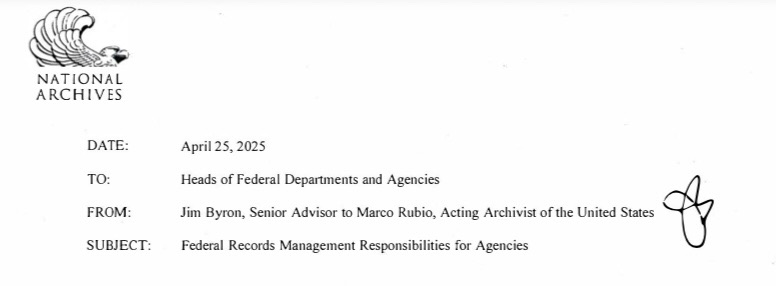

Screenshot of NARA memo header

Federal Records Management Responsibilities for Agencies

Congratulations to all of you on your recent appointments to federal service.

I write to make you aware of resources that are available to you and your employees regarding records management in your agencies.

All federal employees create and manage records as an integral part of their responsibilities in performing agency missions. Federal records protect the rights and interests of the public, allow officials to be held accountable for their actions, and document our nation’s history. Also, good records management helps your agency operate more effectively and efficiently.

It is crucial agency heads work with their Senior Agency Official for Records Management and Agency Records Officers to communicate the importance of their records management responsibilities to all staff, including political appointees.

Together, federal agencies and the National Archives work toward government transparency, public engagement, and accountability by promoting our obligations under the Federal Records Act (FRA). The FRA, at 44 U.S.C. § 3101, charges you, as the agency head, with creating and preserving federal records containing adequate and proper documentation of the agency’s activities so that the legal and financial rights of the Government and individuals affected by the agency’s activities are protected.

The emergence of —and increasing reliance upon — new forms of electronic communication can make records management more challenging, but no less important. The FRA imposes strict requirements on the use of personal accounts to conduct agency business. If any agency employee uses a personal account to engage in official business, they must copy an official account or forward their message to an official account within 20 days. 44 U.S.C. § 2911.

The use of the auto-delete function on digital messaging applications may prevent agency officials from meeting this critical obligation, possibly resulting in the permanent loss of federal records.

It is thus vital that you ensure staff are properly trained on their FRA obligations. Agency heads must ensure that their records management programs provide effective control over the creation and maintenance of records, 44 U.S.C. § 3102, and safeguard against the removal or loss of records, 44 U.S.C. § 3105.

We encourage you to take prompt action to ensure that your recordkeeping policies are up-to-date, and that they adequately educate agency staff how to create, maintain, and dispose of federal records, especially when using third-party apps. Additional details about the appropriate maintenance of electronic records, including metadata retention requirements, can be located at 36 CFR Part 1236.

Questions related to FRA compliance may also arise when agencies transfer their functions to other agencies. Agencies must ensure that:

Paper and electronic records are properly identified and segregated from non-records, as those terms are defined by federal law;

Temporary paper and electronic records are only disposed of in accordance with a NARA-approved agency-specific or General Records Schedule; and

Paper and electronic records are transferred to another federal entity, inactive storage, or NARA only in accordance with the procedures outlined in 36 CFR Parts 123 | to 1235.

NARA will be issuing additional guidance and resources to assist agencies with fulfilling their records management responsibilities when consolidating and reorganizing.

Thank you for your attention to these matters. If you have any questions about your agency’s records management responsibilities or would like to discuss anything further, I invite you to contact William Fischer, Acting Chief Records Officer at NARA, at william.fischer@nara.gov.

cc

Senior Agency Officials for Records Management Agency Records Officers

General Counsels

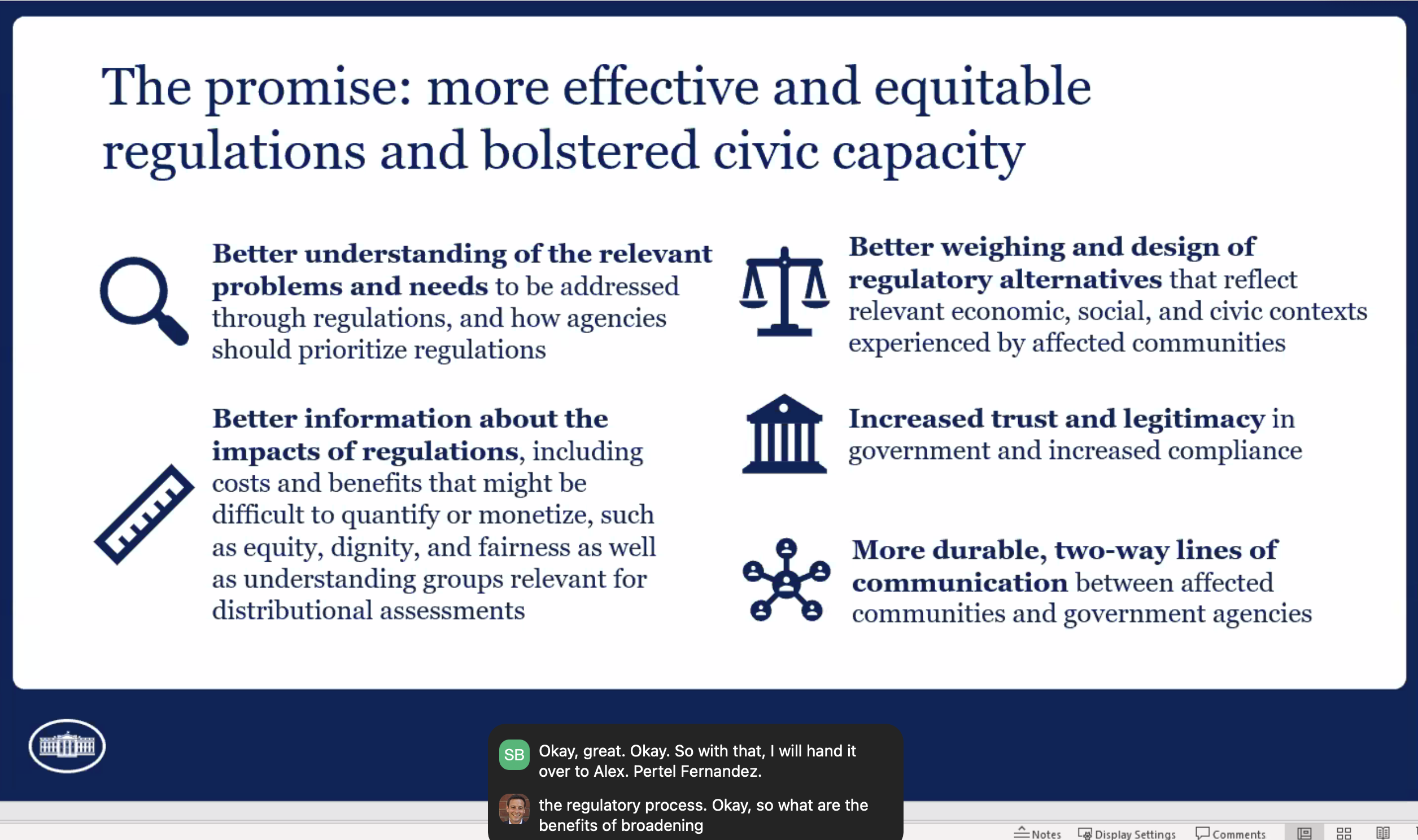
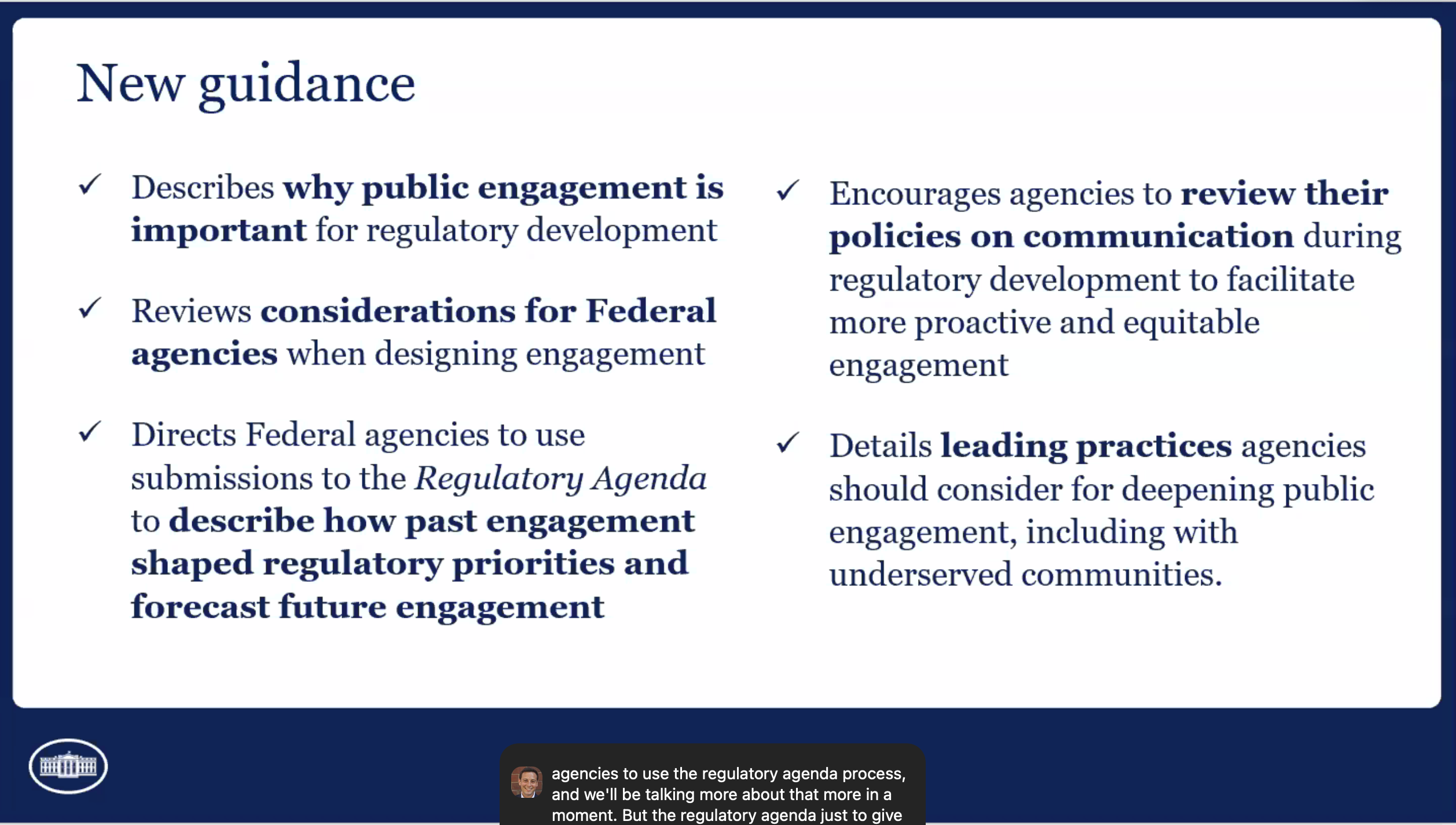
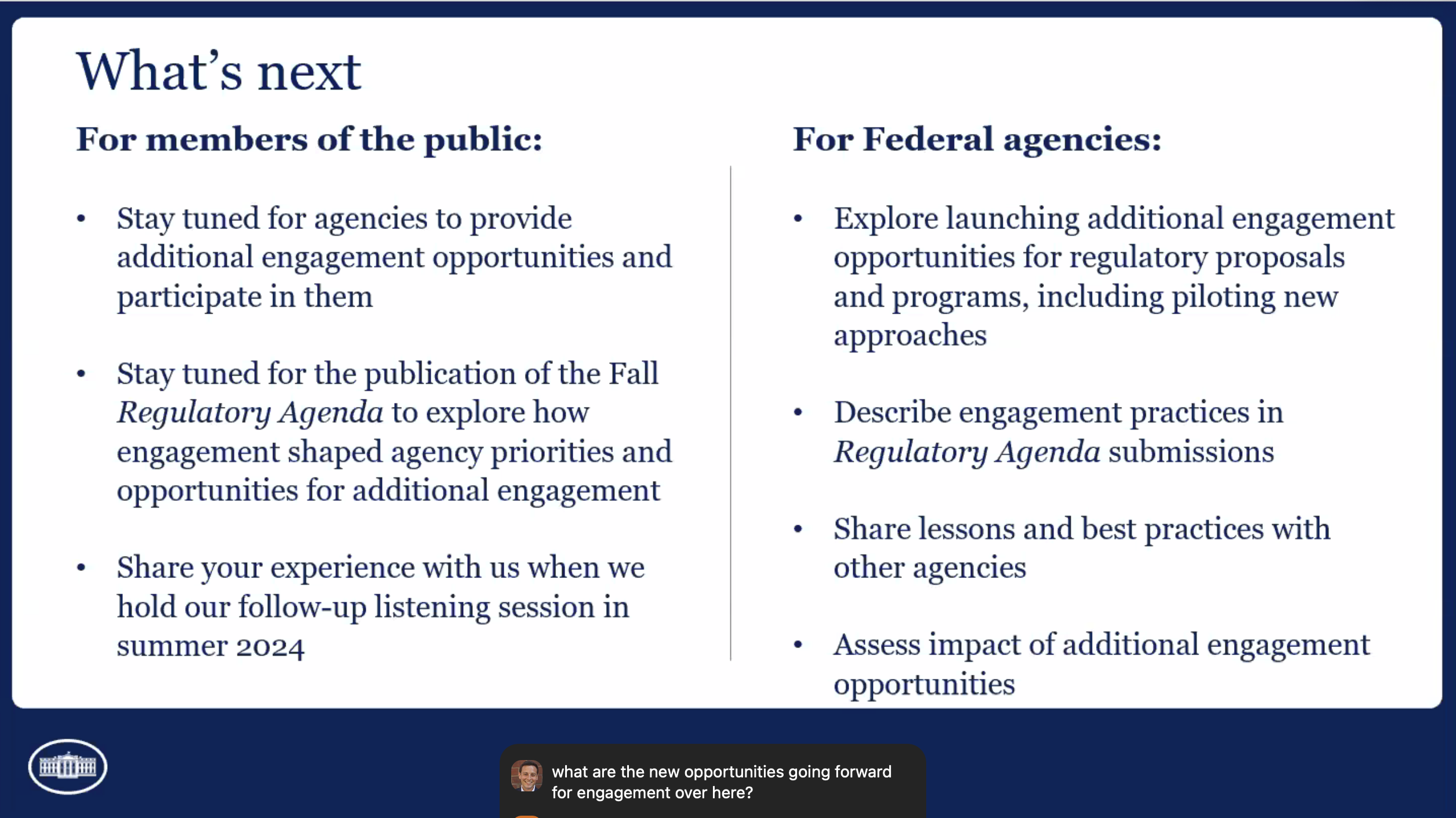
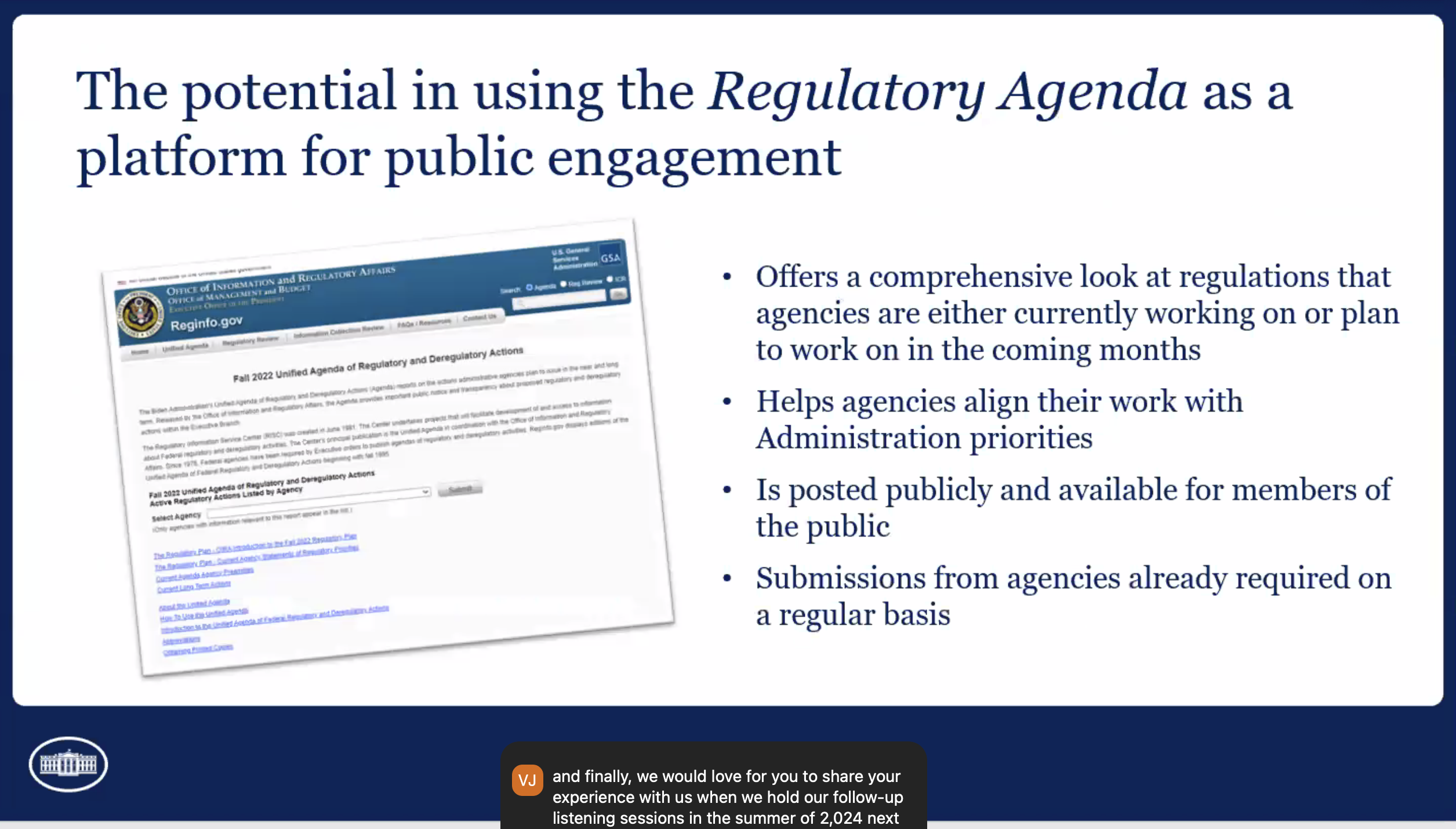
White House “virtual listening session” on new OIRA guidance on broadening public engagement in rulemaking

This post contains an audio recording (above) of a public Zoom call held on July 20, 2023 to update Americans on select commitments in the 5th U.S. National Action Plan for Open Government, more than six months after the White House published the plan online at the end of December 2022.

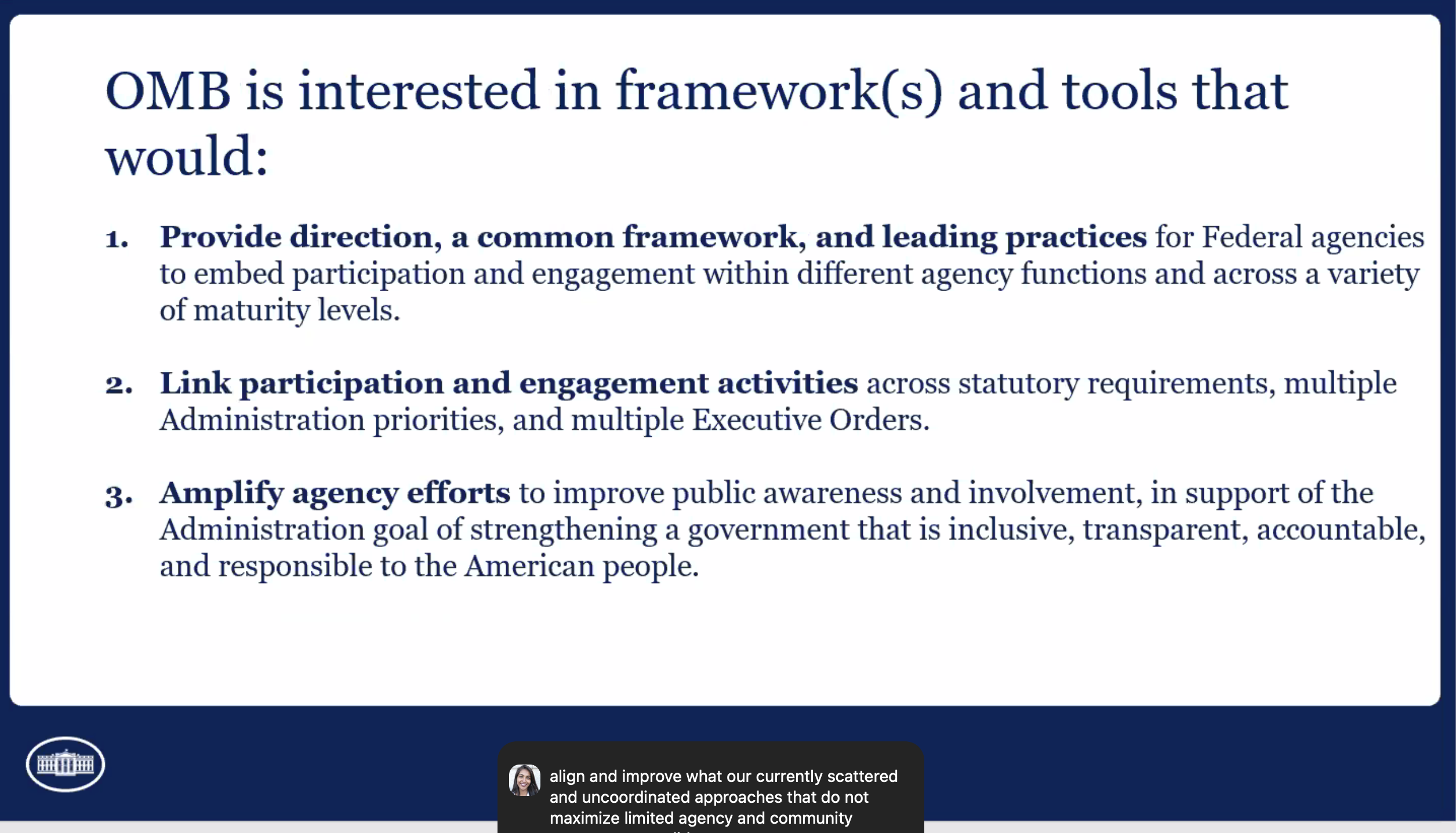
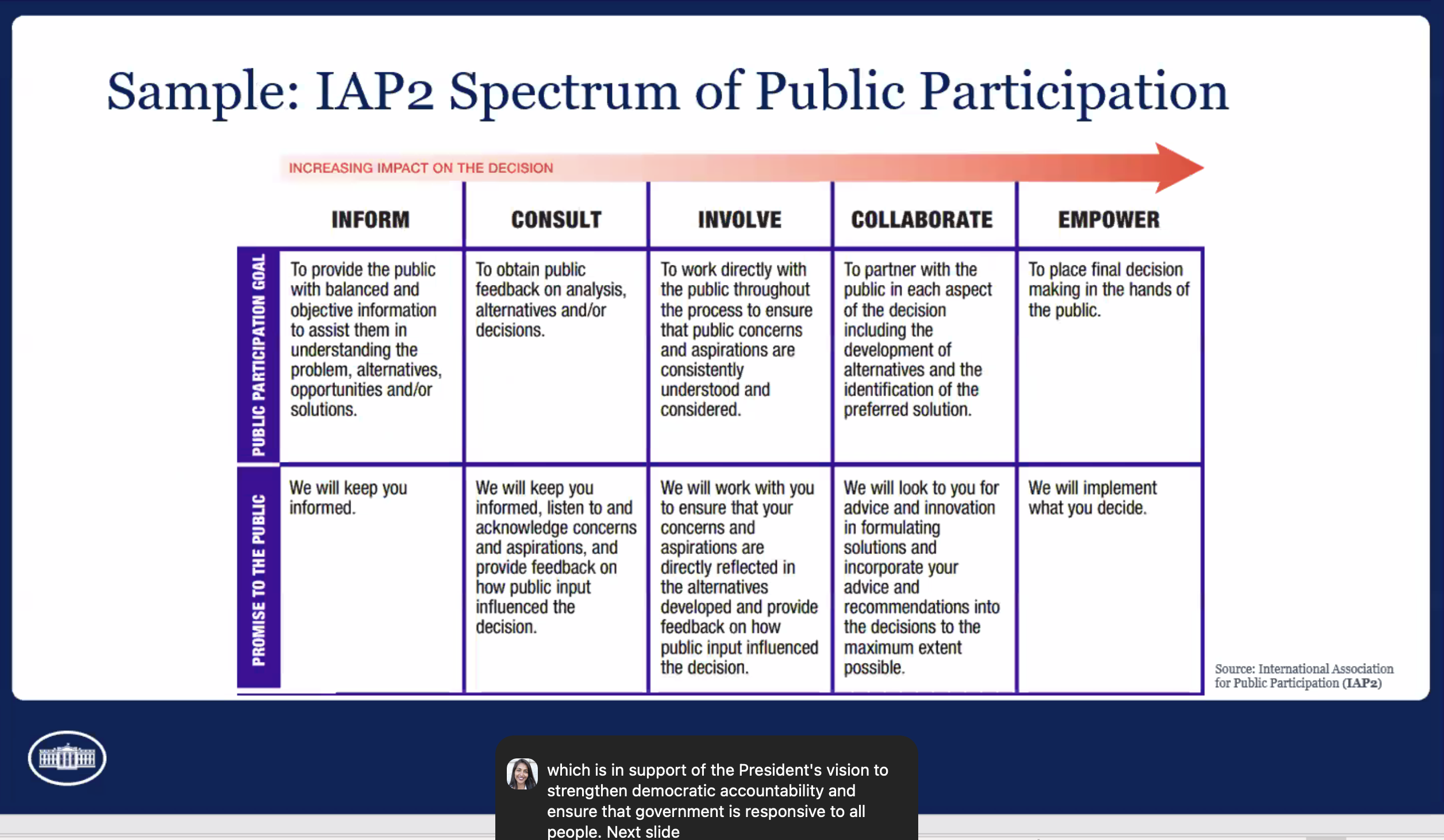
Officials at the White House Office of Management and Budget (OMB) and the Office of Information and Regulatory Affairs (OIRA) presented on their work on commitments to make the voices of the public heard.

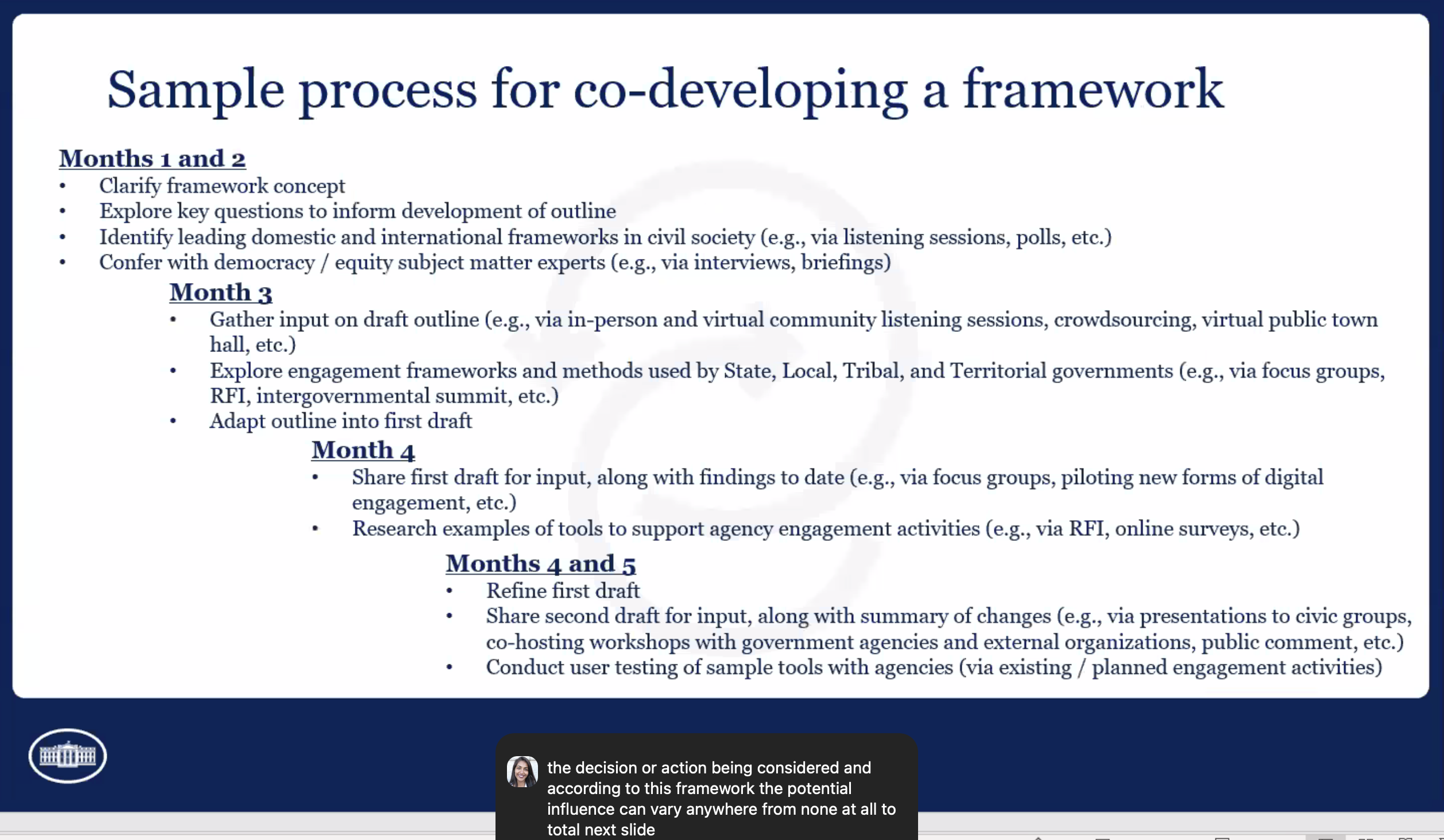
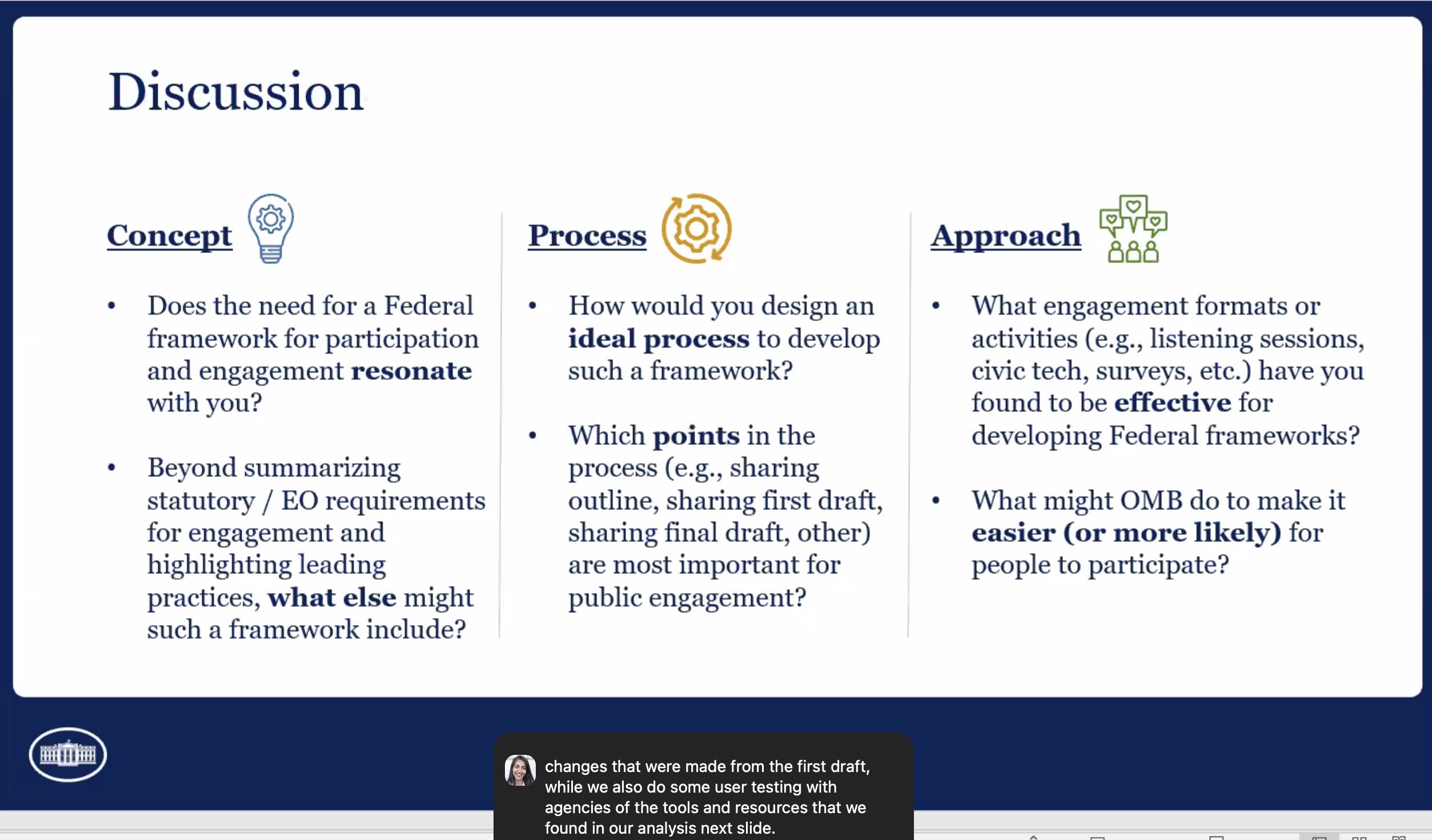
The first half of the forum discussed new guidance on broadening public engagement in the regulatory process issued on July 2019, followed by questions about developing a framework for engagement for use across the federal government. OMB requests feedback on the questions below to go to publicparticipation@omb.eop.gov.

  1. Should the Federal government adopt a common framework for participation and engagement? What might such a framework include?
  2. How would you design an ideal process to develop such a framework?
  3. What points in the process (e.g., outline, first draft, final draft) are most important for public engagement?
  4. What engagement formats or activities would be most effective for developing a Federal framework?
  5. What might the Federal government do to make it easier for people to participate?

Our view? OMB should go back to the future. Review the Public Participation Playbook the Obama White House developed with the public in 2015, as part of the US government’s efforts to open government. Then, working in collaboration with the Office of Public Engagement, host a series of open government roundtables with the nation’s leading authorities on civic engagement and public participation in 2023 and 2024 that inform guidance for the federal government.

Officials might review what approaches were effective in engaging Americans with public health information in the pandemic, voting information, and extreme weather — and which were not.

That work should be part of a new open government plans at OMB and OSTP that are hosted at whitehouse.gov/open, showing President Biden’s commitment to government transparency like whitehouse.gov/equity shows his administration’s commitment to equity.

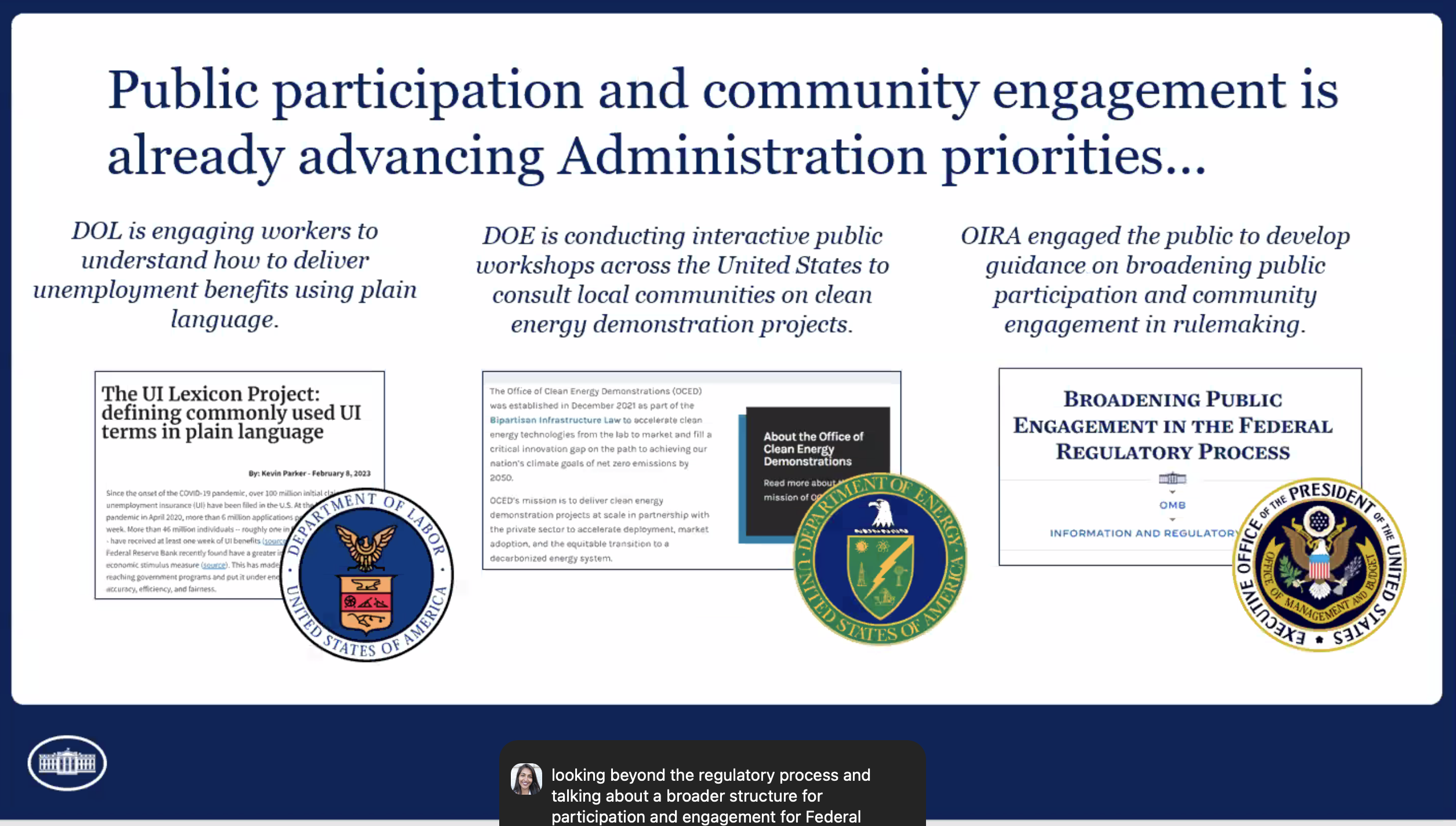
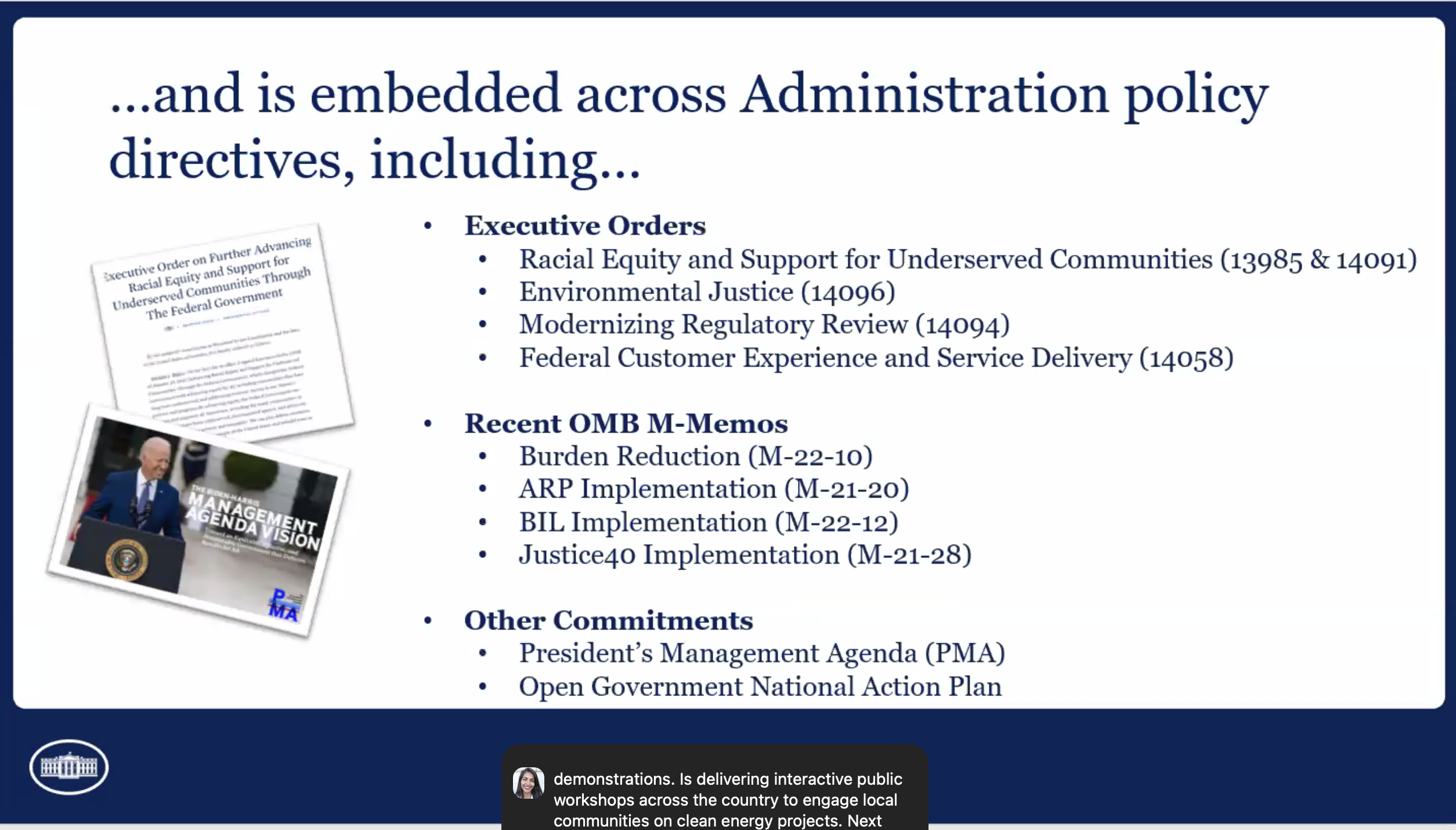
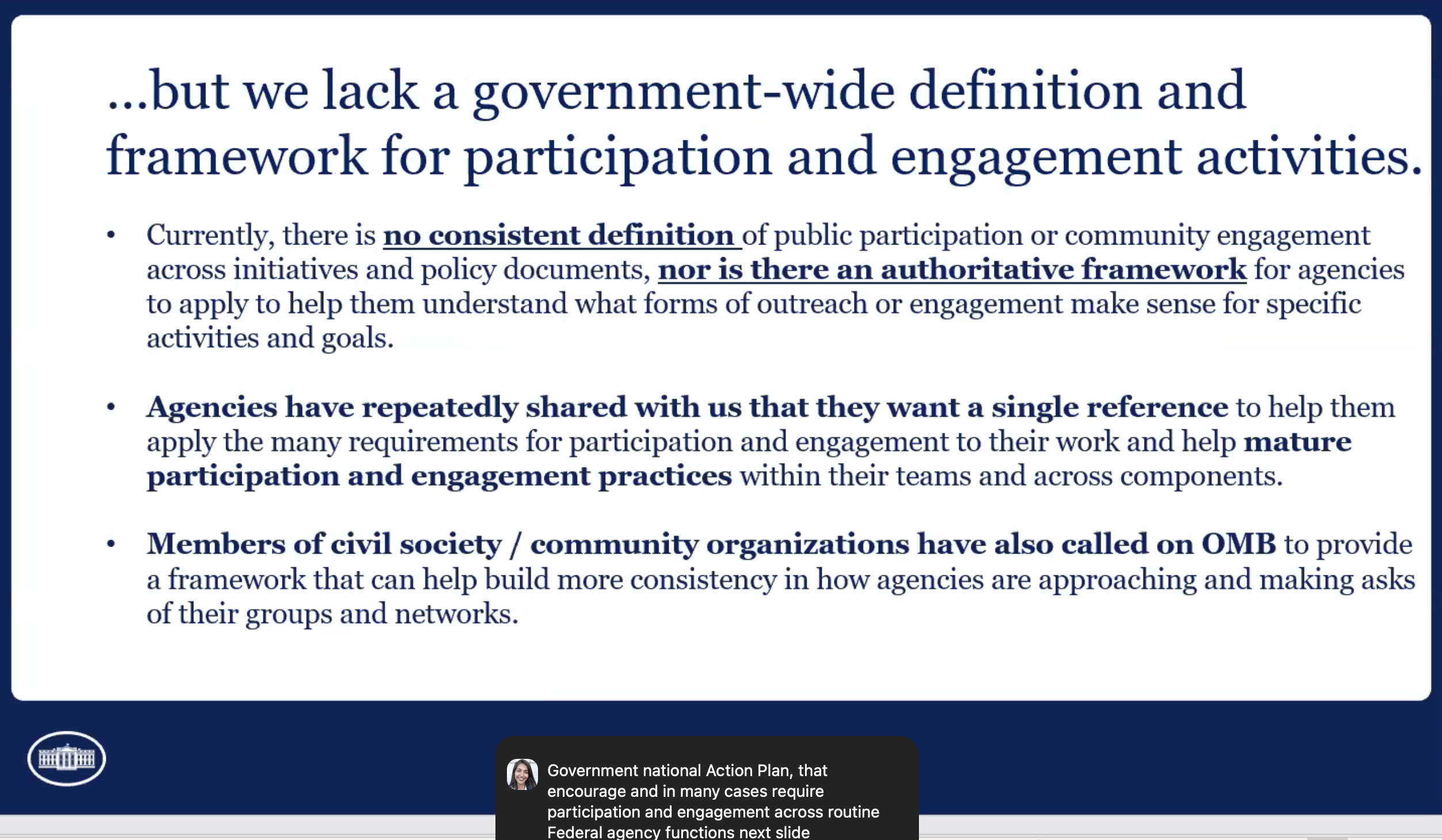
Screenshots of the presentation follow. (Our apologies: we missed slide 3 and 9.)

Should this White House publish slides or notes from this public session on its work implementing open government commitments, we will update this post.

(Officials said that the session was not recorded, so we are providing the above resources for the Americans who were unable to attend or who did not hear about this opportunity to engage with OMB and OIRA about broadening public engagement because this administration did not engage the public. As you’ll hear in the recording, the public participants in this listening session offered praise for the guidance and suggestions for improvement tempered with critiques of the opaque process, poor communications about the forum, and dissatisfaction at the lack of a cohesive way to track and understand this administration’s work on government transparency and accountability.)

Smarter disclosure of hospital data may be a sovereign remedy for price gouging

If knowledge is power, ignorance is impotence. Citizens, consumers, investors, and patients all need trustworthy information when we vote, making purchasing decisions, buy stocks or other assets, or choose a surgeon, medical device, nursing home, or dialysis center. That’s why … Continue reading

Why CovidTests.gov won’t be the next HealthCare.gov

The White House has launched COVIDTests.gov, which the Biden administration says will enable every home in the U.S. to order 4 free at-⁠home COVID-⁠19 tests through the mail, starting on January 19th — with no shipping costs or credit card required. Ideally, the administration will also allow Americans to request the high-quality masks President Biden said the US government would distribute through COVIDTests.gov as well.

As with Vaccines.gov, there’s a tremendous amount riding on the Biden administration delivering on this news service. Hundreds of millions of Americans REALLY need this administration to deliver on sending free tests and masks to the people through the mail who ask for them right now. This will be a simple but profound interaction.

If the White House can pull it off, it could rebuild public trust during a profoundly uneasy time, delivering the tests and masks that — with vaccines — would enable us all to navigate out of the pandemic together.

If COVIDTests.gov were to be overwhelmed by demand, flooding attacks, automated fraud, or test distribution is botched by the U.S. Postal Service, public trust could erode further.

Last week, Politico reporter Ben Leonard reached out and asked a series of questions about whether the Biden administration would be able to deliver on a website to request rapid tests, raising concerns about whether this be a repeat of the Healthcare.gov debacle of almost a decade ago. The answers below lay out the case for why this White House is likely to succeed.

What were the key failures of healthcare.gov

The public and major media focused a lot on the technology angle because healthcare.gov is a website, and it’s true that technical and design decisions caused major problems at the relaunch, when the Department of Health and Human Services moved it from being a glossy brochure to being a marketplace for health insurance. Lack of beta testing. Hosting at that couldn’t scale to meet demand. Incomplete integration between federal agency systems. Artificial bottlenecks in the marketplace flow.

That all led to a crisis when Americans began trying to use the site, in no small part because Healthcare.gov wasn’t iteratively built or tested “in the open” using modern software development practices, with the people it was meant to serve. 

Much like the endemic IT failures that have bedeviled big state and federal projects for years, however, the fundamental problems stemmed from:

  1. Poor project management and oversight
  2. A government procurement system that builds and buys software like buildings and cars
  3. Outsourcing huge contracts to systems integrators and contractors 
  4. Challenges recruiting and retaining technologists who must be sitting at the table from the beginning of a complex project 

The team that rescued the site in the winter of 2013 was able to address many of these failures and then founded the U.S. Digital Service based upon these insights and the inspiration of Gov.uk in the United Kingdom. 

  1. How can the Biden administration avoid them this time around?

The White House can give the U.S. Digital Service and 18F (the software development organization inside of the General Services Administration which could be involved) – resources and cover to do their best work. (Ideally, they will “show their work” as they go, too.) That means strong product management, iterative development,regular check-ins, designers and technologists in government, and working with best-in-class technology partners who understand how to build and scale modern responsive websites. 

It’s also worth noting that building a website to request a COVID-19 test is not the same technical challenge as one that had to tie into the IRS to check eligibility for subsidies and complete a secure transaction. Failure would still be consequential, but the bar is much lower, as are the risks surrounding errors.

  1. What were the key issues with Trump’s promised national COVID-19 screening website? What lessons can be taken from it? 

Former President Trump was unfit to lead a coordinated national response to a pandemic and uninterested in building out the national testing infrastructure that showed his lies about the prevalence of a deadly airborne virus to be false.

This promised website was vaporware, not a serious project that can or should be compared to past or present .gov efforts. The Trump White House never built or delivered anything after the President engaged in misleading hyperbole in the Rose Garden.

Instead of convening technologists, designers, and project managers from relevant agencies and private sector in a Manhattan Project for testing or grand national challenge, however, Trump misled the public by claiming that Google was already working on it. There’s no “there there” to compare.

  1. Vaccines.gov seemed to roll out more smoothly. Why do you think that happened and what lessons can be drawn? 

I’d rack that up to:

  1. Competent leadership at the U.S. Digital Service involved from the outset in coordinating and managing the project, top-down cover from the Oval Office
  2. Subject matter expertise from the medical professionals who built VaccineFinder.org
  3. Deep technical expertise and capacity to deliver at scale from private sector companies involved
  4. All-out, mission-driven effort from many patriots inside and outside of government committed to connecting Americans with vaccines. A thread: https://twitter.com/digiphile/status/1388495731422543877 

We all would know a lot more about what worked and why if the Biden administration had narrated its work in the open, held a press conference about Vaccines.gov, and taken questions instead of giving the news to Bloomberg on background

  1. How big of a technical task do you think putting together this website will be? 

If the functionality of COVIDTests.gov is limited to someone requesting a test be delivered to a given address, I don’t think that’s a big task for US government in 2022, even under heavy demand. If the COVIDTests.gov needs to authenticate someone and create accounts to prevent fraud or abuse, that will be a bit harder.

My hope is that we’ll see a lightweight website that uses Login.gov and a shortcode — say, text your zipcode to GETTST – that will enable people to quickly and easily request tests from a smartphone – along with a package of better, medical grade masks for themselves and their children that President Biden announced today would be made available for free to all Americans.

In 2021, We the People need a Public Chair to ask the White House public questions and pose petitions

Today, the White House Press Secretary Jen Psaki said that the White House is open to bringing back the “Skype seat” again and to taking questions from it. Psaki noted she took Q’s on Twitter — she then replied to … Continue reading

In a dual crisis of of pandemic and protest, DC extends “vote-by-email” to people who requested an absentee ballot

Digital democracy reforms tends to advance or retreat in fits and starts, but when exigent circumstances require more from us and our governments, change can happen unexpectedly. On May 26, I requested an absentee ballot, intending to cast my vote … Continue reading

What cities can learn from Gainesville’s experiment with radical transparency

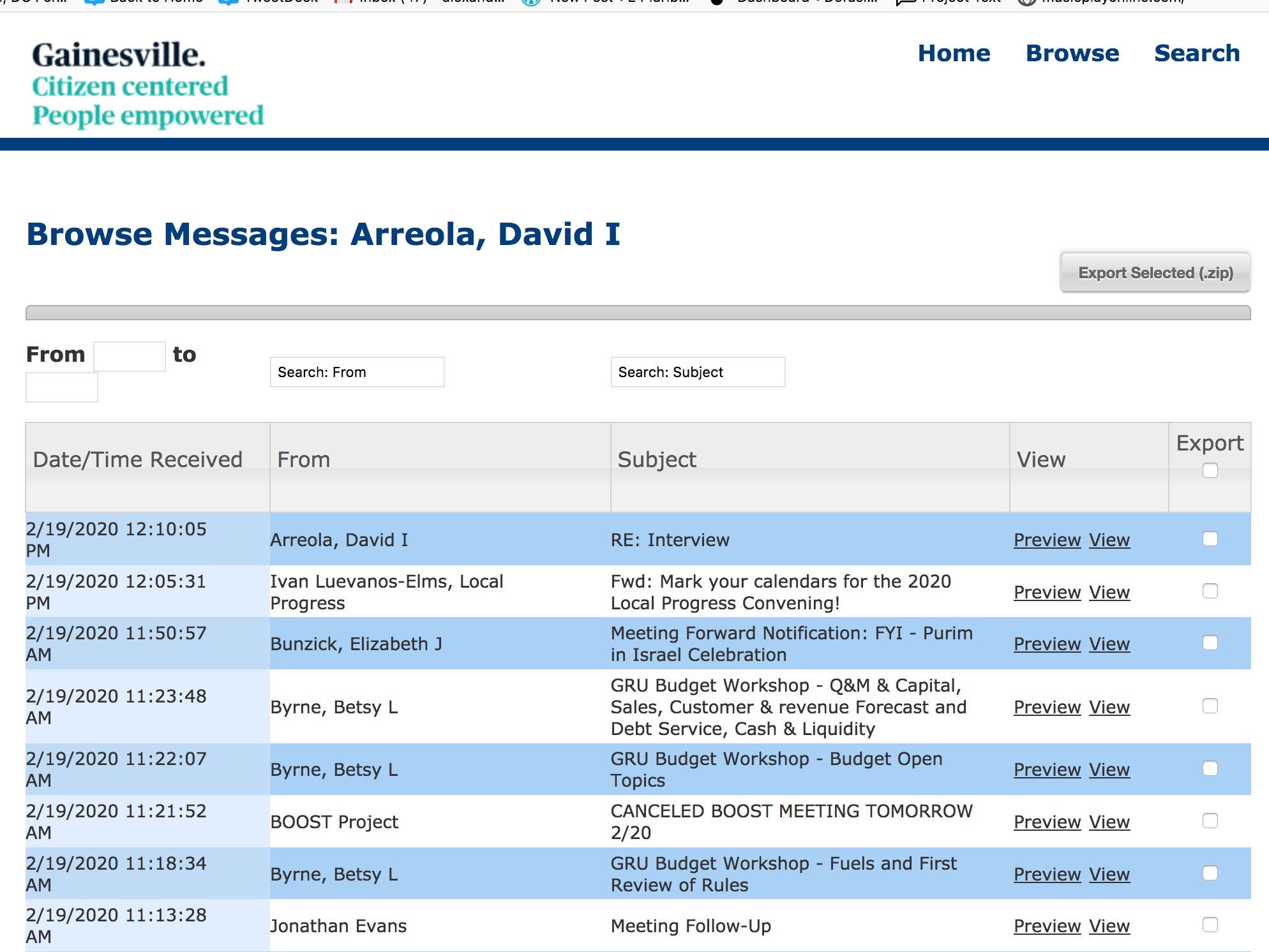
City_of_Gainesville_Commissioner_Mail_Archive_-_Message_Archive

There’s much to be learned from the experience of the city Gainesville, Florida, where a commissioners voted in 2014 to publish the public’s email correspondence with them and the mayor online.

More than five years on, the city government and its residents have are ground zero for an tumultuous experiment in hyper-transparent government in the 21st century, as Brad Harper reports for the Montgomery Advertiser.

It’s hard not to read this story and immediately see a core flaw in the design of this digital governance system: the city government is violating the public’s expectation of privacy by publishing email online.

“Smart cities” will look foolish if they adopt hyper-transparent government without first ensuring the public they serve understands whether their interactions with city government will be records and published online.

Unexpected sunshine will also dissolve public trust if there’s a big gap between the public’s expectations of privacy and the radical transparency that comes from publishing the emails residents send to agencies online.

Residents should be offered multiple digital options for interacting with governments. In addition to exercising their rights to freedom of expression, assembly and petition on the phone, in written communications with a given government, or in person at hearing or town halls, city (and state) governments should break down three broad categories of inquiries into different channels:

Emergency Requests: Emergency calls go to 911 from all other channels. Calls to 911 are recorded but private by default. Calls should not be disclosed online without human review.

Service Requests: Non-emergency requests should go 311, through a city call center or through 311 system. Open data with 311 requests is public by default and are disclosed online in real-time.

Information Requests: People looking for information should be able to find a city website through a Web search or social media. A city.gov should use a /open page that includes open data, news, contact information for agencies and public information officers, and a virtual agent or “chat bot” to guide their search.

If proactive disclosures aren’t sufficient, then there should be way to make Freedom of Information Act requests under the law if the information people seek is not online. But public correspondence with agencies should be private by default.


Remote biosurveillance poses novel existential threats to civil liberties

FierceElectronics reports that Draganfly is claiming that their technologies can, when attached to a drone, detect fever, coughs, respiration, heart rate, & blood pressure for a given human at a distance. Put another way, this drone company is saying that … Continue reading

US FOIA Advisory Committee recommends agencies harmonize FOIA and open data programs

Yesterday, the United States Freedom of Information Act Advisory Committee met at the National Archives in Washington and approved a series of recommendations that would, if implemented, dramatically improve public access to public information. And in May, it will consider … Continue reading