Department of Veterans Affairs releases progressive, structured social media policy

In 2011, it might feel a little late for federal agencies to be issuing social media policies. How governments use social media has shifted from a niche concern, debated by new media and policy wonks, to an issue that makes international headlines when global leaders alternately decry or celebrate the impact of connection technologies upon their countries.

Think again.

As anyone who has worked in a federal bureaucracy will tell you, squaring usage policies with rules, regulations and laws is a fundamental need if there’s going to be any progress towards 21st century governance.

“One of the biggest, long-standing complaints about VA is how it’s an opaque, monolithic bureaucracy that doesn’t respond to the needs of vets,” writes Brandon Friedman (@BrandonF), director of online communications for the U.S. Department of Veterans Affairs, in an email today. “We’re finally putting a human face on it. Everything we post on our blog or our main Facebook page or Twitter feed has a name attached to it. This shows even the largest, slow-moving federal agencies can make progress in becoming more agile and responsive.”

There’s also a matter of default for usage of these tools: open, versus closed. Consider that the emphasis below is the VA’s:

The use of Web-based collaboration tools such as social media tools is highly encouraged. Web-based collaboration is intended for information sharing within and outside of VA. To increase accountability, promote informed participation by the public, and create economic opportunity, the presumption shall be in favor of openness (to the extent permitted by law and subject to the exclusions noted in this Directive or other policy)

The entire policy, which has to be considered progressive for an organization with military DNA, is embedded below or available as a PDF. Given the stance that other federal agencies have taken recently on social media usage, this policy is not a watershed but is extremely important to over 300,000 VA employees and the millions veterans they serve. If access to Internet-based capabilities is critical at the Department of Defense, similar access for veterans is important.

Today’s announcement also serves as a reminder that the VA has come a long way in a short time, particularly in the context of an enormous government institution. “Less than two years ago, VA’s primary method of engagement with the public consisted of telephone calls and the USPS,” wrote Friedman. “Today, hundreds of thousands of veterans can get help navigating the bureaucracy via social media. We can also make a direct difference in peoples’ lives. One example I use concerns suicidal ideation on Facebook and Twitter. We’ve actually intervened in at least half a dozen instances where veterans have talked about killing themselves. We’ve been able to jump in and link them up with assistance. As we always say here, it’s about leveraging new technology to get the right information to the right veteran at the right time. For so long, many veterans have lost out on the benefits to which they’re entitled because they weren’t even aware of them—or they didn’t want to deal with a complex bureaucracy. Social media allows us to get them the information and to help ease the transition from the military into the VA system.”

It’s an important shift. Next up? Work to leverage technology better to reduce the backlog in veterans’ benefit applications and help vets who have returned from service abroad get back to work in a down economy.

Getting social with security and privacy

Embedded in this policy is are security and privacy provisions that instruct to the deputy assistant secretary for information security to issue an information protection policy, do a risk assessment, provide patching, training and a “Trusted Internet Connection” for the desktop images of VA users.

There is also instruction for the director of the VA privacy service to address policy concerns and to public affairs, granting “the authority to disapprove any outward-facing content on official VA blogs and social media sites which do not meet accepted standards of quality,” along with audits to ensure same.

For a deeper dive into what social media means to the military, read this talk on connection technologies and global organizations. It’s by U.S. Navy Chief of Naval Operations Roughead, a title which effectively makes him the “CEO” of that global enterprise. He talked about “burning the boats” as the Navy enters this operational space — an extremely powerful metaphor, given his occupation — but perhaps a fitting one, given that achieving and maintaining situational awareness in a changing information environment has become a strategic capability.

As the VA looks to support the considerable needs of the men and women who have served their country, it looks like social media will be a part of the plumbing that connects them together.

Department of Veterans Affairs Social Media Policy//

Carmi Levy: open government is about leveraging technology and citizens to do more with less

It looks like the dog days of August 2011 may be the month when the meme of a citizen-centric government gets some traction in the business world. Over on the finance section of Yahoo Canada, Carmi Levy writes that the future of government is citizen-focused.

Levy cites open government in British Columbia and initiatives in New Zealand, Toronto, and Lousiana as case studies for his thinking and then connects the dots with the big idea: that technology enables officials to empower citizens to work with government in new ways, driven by macrotrends towards open data, mobile connectivity, social media and austerity measures.

…governments are increasingly giving citizens free rein to do as they wish with previously inaccessible data. Costs are significantly reduced as big, conventional IT projects are replaced by more on-the-fly approaches to resource management. Timelines are also cut down to size thanks to the use of agile development methods and more collaborative models. Crowdsourcing also maximizes the use of newer technologies, thanks to home-based developers looking to market their prowess to a broader audience. This all translates into more bang for the public buck.

Proponents of open data initiatives claim they increase government efficiency and effectiveness by encouraging greater levels of citizen participation in the creation and delivery of public services. But in light of the just-completed U.S. deal to restructure its debt ceiling and begin trimming the federal budget, it’s difficult to ignore the cost side of the equation, as well.

As governments on both sides of the border find themselves increasingly pressured to deliver the same — or more — services for less, open data and so-called Government 2.0-based initiatives could hold the key to taxpayers having their cake and eating it, too. As government shrinks, citizens willingly take up the slack using rapidly evolving development and social media tools.

Open government isn’t just a philosophical concept designed to drive democracy.

It’s really about leveraging technology — and technologically enabled citizens — to do more with less. By throwing data out there and seeing what develops, governments can reduce spend and enable business in ways they simply wouldn’t be able to do if they functioned conventionally. They can leverage the motivations and skills of interested members of the public to create value that conventionally hired departmental resources have never been able to achieve; at least not at this level of efficiency.

Carmi Levy (@CarmiLevy)

It’s a bold vision, although perhaps a familiar one to those who have been following the narrative that runs through these open government stories. The notable connection is connecting this approach to the need that governments have now.

If open government is going to work better, however, citizens will have to become more civically engaged — and their governments will need to both listen to them and work with them.

Kundra: Closing the IT gap is the key to making government work better for the American people

Today, the first chief information officer of the United States, Vivek Kundra, shared his reflections on public service.

Kundra, whose last day of work at the White House Office of Management and Budget was last Friday, is now at the Harvard Kennedy School and Berkman Center.

I arrived at a White House that was, as the Washington Post put it, “stuck” in the “Dark Ages of technology.” In their words, “If the Obama campaign represented a sleek, new iPhone kind of future, the first day of the Obama administration looked more like the rotary-dial past.”

As my team congratulated me on the new job, they handed me a stack of documents with $27 billion worth of technology projects that were years behind schedule and millions of dollars over budget. At the time, those documents were what passed for real-time updates on the performance of IT projects. My neighbor’s ten year old could look up the latest stats of his favorite baseball player on his phone on the school bus, but I couldn’t get an update on how we were spending billions of taxpayer dollars while at my desk in the White House. And at the same time, the President of the United States had to fight tooth and nail to simply get a blackberry.

These were symptoms of a much larger problem.

The information technology gap between the public and private sectors makes the Federal Government less productive and less effective at providing basic services to its citizens. Closing this gap is the key to making government work better for the American people – the ultimate goal.

His complete thoughts are embedded below. If you’re interested in frank insight into why changing government through information technology isn’t easy, read on.

Vivek Kundra’s Reflections on Public Service 2011(function() { var scribd = document.createElement(“script”); scribd.type = “text/javascript”; scribd.async = true; scribd.src = “http://www.scribd.com/javascripts/embed_code/inject.js”; var s = document.getElementsByTagName(“script”)[0]; s.parentNode.insertBefore(scribd, s); })();

Notes from the third White House Open Government Partnership consultation

In July 2011, the State Department hosted an historic gathering in Washington to announce an Open Government Partnership with Brazil and six other nations. For background on the initiative, read this digest on Open Government Partnership analysis for context.

This new new open government partnership could drive U.S. commitments, according to OMB Watch.

What those commitments will be is still unclear. Given that they’re due by September’s Open Government Summit at the United Nations in New York City, the timeline for drafting them is quite limited.

Last week, when the White House asked for ideas on the National Plan for open government, the community learned a bit more about what’s on the table: improving public services and increasing public integrity.

Clay Johnson has since offered the White House a deep set of recommendations for open government in response to the three questions it posed, including better ways to use open data, social media, improving regulations, public comment, and the developer community better. If you’re interested in open government, it’s a must-read.

Those are not the limit of potential commitments on the table, at least as evidenced by what we know about the series of three consultations with open government stakeholders in Washington that the White House Office of Information and Regulatory Affairs held this July, on the 22nd, 25th and 29th. These consultations were not livestreamed or otherwise recorded, however, nor have OIRA’s notes been released to the public yet. That said, we have at least two accounts of what happened in July, from:

I attended the July 29th consultation and, while I did not record video or audio, can share the following written notes.

Attendees

As with the previous meetings, OIRA administrator Cass Sunstein led the discussion. White House OSTP deputy CTO for public sector innovation Chris Vein was also there, along with half a dozen OIRA staff and a representative of the National Security Archive.

Seated around the table were representatives from America Speaks, OMB Watch, the Center for Technology in Government at the University of Albany, Sunshine in Government. University of Pennsylvania professor Cary Coglionese and a board member from the International Association for Public Participation, Leanne Nurse, dialed into a conference speaker phone line.
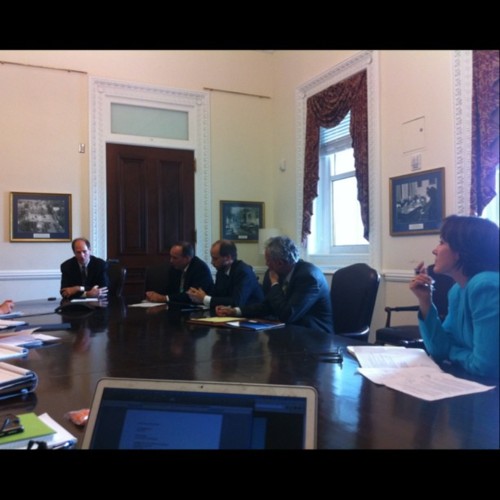
Past meetings included representatives from the Revenue Watch Institute, Code for America, Harvard’s Kennedy School of Government, Open Plans, Civic Commons, the Sunlight Foundation, Citizens for Responsibility and Ethics in Washington and the Project for Government Oversight, in addition to Open the Government and NCDD.

Open Government Consultation

Sunstein started the meeting by offering high level context for the OGP and thanks to the organizations around the table.

When the OGP was devised, he said, it was done with background experience from the Open Government Directive that came President Barack Obama and the White House Office of Management and Budget.

Many of your organizations were “indispensable” during that process, Sunstein said, and even though what happened with the open government directive “wasn’t perfect,” there has been “tremendous progress.” He thought from the beginning, with regard to the OMB open government project, that it would be a work in progress, with plans scrutinized and improved over time.

Sunstein laid out the reason for the consultation: the White House has national action plan due in September, with an event at the UN as the president promised. The White House wants the national action plan to be as good as possible, “improving on what we’ve got so far as we can.” Reflecting his comments at the previous two consultations, Sunstein said that one way to think of the meeting is generating ideas through three stages, given the temporal and feasibility constraints posed by the short deadline for UN recommendations. He observed that where would be opportunities moving forward in the medium term, over a 3-5 month time period to do more.

Katherine McFate, the executive director of OMB Watch, asked a question about the parameters for the consultation, noting that if you go back and look at the open government partnership, there are five different challenges for countries. If you only have to pick one or two, she suggested, improving public services is one, and may be improving public integrity is another. Increasing accountability, likely to be three. (Given the recent White House blog post, OIRA may have taken that suggestion.)

In response, Sunstein replied that there are surely things that have budgetary repercussions, which you then have to answer for, although in open government, sometimes it’s possible to improve public services without stretching the budget.

Theresa Pardo, director of the CTG at Albany, after thanking OIRA for the opportunity to speak and to listen, focused on the some of the issues that have arisen during implementation of the open government directive, including the role of citizen engagement. One tension is how to think about citizen participation, versus accountability imperatives.

One of the things that we hear quite regularly when we talk to practitioners at federal, local, and state level, along with academics, is a lot of confusion about concepts underlying open government directive. There’s pressure towards clarity, and still a lot of ambiguity. One of the ways to push through in creating that clarity, she suggested, would be to focus a bit more on the conversation, on figuring out what the problems that citizens are seeking open government to solve. Pardo said that in their experience, in various jurisdictions in US and outside of the US, it’s a challenge to connect what’s happening in government agencies with what citizens are talking about in public. Over the long term, the opportunity for open government, she explained, is to move towards deeper engagement with citizens themselves about what problems are they experiencing.

Professor Coglianese, speaking over the phone, agreed with Pardo and McFate. He also suggested that the White House clearly take stock of where open government is currently. We’re seeing great things, in taking stock of regulations, he said. It would make sense to something similar with taking stock of public participation now, defining a better baseline of where to assess what kinds of reform are making changes.

The point, about defining a baseline for public participation, was taken up and emphasized by many of those invited to the July 29 consultation. One of our major tools is the public participation spectrum, said Douglas Sarno of IAP2 USA. No systematic approach to what we’re trying to do or what’s been achieved has been defined by the White House, he said, and no way of qualifying bonafide public participation versus hackneyed participation defined. There are good challenges in finding metrics.

Sunstein agreed that the regulatory process requires significant public participation. This week, the Regulations.gov team acknowledged the need to do more in that regard.

In response, Pardo cited a number of studies in which communications scholars and computer scientists are using machine language processing to analyze online rulemaking to see if it results in changing in deliberation or positive social interaction. Such studies can be expensive but useful. Part of the issue in integrated such work, however, is getting real movement in processes in partnership with academics, she said.

Pardo focused further upon the role of citizen engagement, both around rulemaking and the large context of open government. Nowhere, until just recently, she said, do we teach our public managers about how to look, engage, and use citizen participation tools. “There’s a capability gap at all levels of government. How do public managers in local governments and cities, think about their jobs in different ways?”

The National Association of State CIOs and others are looking at building capability to understand how to use data and engagement tools better, said Pardo, but across the board there’s lack of ability in these core competencies. Maybe building ability as with cybersecurity skills would make sense, she suggested, including professional standards for citizen participation.

Coglianese similary focused more on baseline assessments for public participation. There are some political scientists who have tried to assess the actual impact of public comment and proposed rulemaking, he said. In terms of what to look to as baseline, what is it you want to accomplish with this national action plan? Is the goal to increase public participation? What is the level right now? We don’t have a way of saying what the volume of interaction is across the federal government, he asserted.

We do know, however, that rulemaking tends to be more something that organizations participated in more than individual citizens, Coglionese said, citing a recent article on public participation that he’d authored law journal. “We need a baseline of who’s participating and at what level,” he said. “Is the goal of participation to increase the quality of public decision making? That’s hard to assess. To enhance public virtue? That’s much harder to assess. Until it’s clear exactly what it is you would want to do, you can’t answer these questions.”

David Stern, director on online engagement at America Speaks, validated Coglionese’s words, observing that his organization had recently looked at all open government plans by agencies and came to the same conclusion. There’s a lack of consistency in metrics used to evaluate projects, said Stern, and no standards about what defines good participation. Number of people, diversity, number of instances policy influenced? Standards and best practices, in this area, would be helpful coming from White House and OMB. Every open government project contains response to the most popular proposals, he said, which means that every public engagement initiative has a public engagement component.

Rick Blum of Sunshine in Government raised another issue: FOIA exemptions, including agencies proposing them independently. The Department of Defense is overclassifying, said Blum, and it’s very hard to track what’s happening. The Department of Justice has put up a FOIA dashboard but it’s “plagued with tech glitches and bad data,” he said. This has become a public debate about secrecy or disclosure, with some half a billion dollars being spent annually fulfilling FOIA requests, said Blum. There’s also concern about the impact of the recent Supreme Court decision in Milner vs the Navy.

On my part, I offered feedback that I’d collected from the broader open government community ahead of time and over the previous year.

First, the White House has not explicitly separated open government innovation, in terms of open data about the business of government, from “good government” initiatives that transparency advocates expect and demand, in terms of accountability to the people. Misset expectations around the goals the White House has set out have created widespread dissatisfaction and harsh criticisms of an administration that promised to be “most transparent ever.” The open government initiative in the province of British Columbia offers a potential model for the White House to consider, in terms of this separation.

Second, as the federal government moves forward with its ongoing review of .gov websites, there are opportunities to work with civil society and civic developers to co-create better e-services.

Third, opportunities exist for the White House to partner with entrepreneurs, media or nonprofits that are making government data open, useful and searchable. For instance, BrightScope has made financial advisor data from the SEC and FINRA available to the public. The work of Code for America and others on farmers market open data is another example.

Finally, there continue to be serious issues raised by developers about the quality of open government data on Data.gov. In general, public servants continue to release PDFs, as opposed to machine-readable structured data, and cite the language in the Open Government Directive for support. If government wishes developers and businesses to use its data for accountability, civic utility or economic value, then releasing data in the open formats that these communities find most useful makes logical sense.

Pardo took up the issues raised with good government versus open innovation, noting that the two aren’t necessarily against each other. The idea of high value data wasn’t well defined, she said. For instance, the calendars of public officials are nothing more than a dataset.

Sunstein asked after the data issues and the one of his deputies specifically asked about the language in the OGD. He brought up the work that the federal government has done on regulations.gov – which was a persistent focus from the OIRA administrator – and asked whether it was good enough, and over what time limit? And for whom?

The general answer there was clear enough: “we the people.”

Coglianese offered more feedback on regulations.gov: it’s not enough. There are data fields are not filled in, missing information, and things remain incomprehensible, he said. “Imagine how it is for many others coming for first time?” Coglianese endorsed the recommendations of ADA blue ribbon commission for a dedicated overseer of data quality, although such a role would require congressional authorization.

There are some really important opportunities to leverage data in regulations.gov, he emphasized. Leverage that data to extract it automatically, display the data on websites. For instance, many members of congress have a button on their websites forlegislation they’re sponsoring, which then takes visitors to data automatically etxtracted from Thomas.gov. Imagine a similar system for agencies and regulators, he suggested, or consider the EPA, which is trying to display every rule that the agency is working on., which is being developed in addition to regulations.gov.

Agencies right now are building websites around current uses, said Coglionese. That makes a lot of senses, and it’s what one would hope, but doesn’t go to the “separate question of who do they want their users to be.” He criticized the design of the new FCC.gov, although I pointed out that the process that preceded the FCC relaunch was focused on the most common purposes of the site’ visitors.

What was left unsaid in these open government partnership consultations? A great deal, due to the length of time allowed. The voices that were heard around this table were also those of advocates, policy, experts, academics, and technologists: not citizens, and by and large not those of the media, whose function in representative democracies been to hold government accountable on behalf of the public.

As the White House considers its commitments in advance of the September meeting at the United Nations, the people will have a window of opportunity to tell their elected officials what open government means to them and how they woud like their federal government to be more transparent, participatory or collaborative.

If you have feedback on any of those accounts, send it to opengov@omb.gov.
Health 2.0: Todd Park talks about open data and healthcare at NYC Hacks and Hackers [VIDEO]

If you’re a regular reader of Govfresh or the O’Reilly Radar, you know how the chief technology officer of the U.S. Department of Health and Human Services, Todd Park ,is focused on unleashing the power of open data to improve health. If you aren’t familiar with this story, go read Simon Owen’s excellent feature article that explores his work on revolutionizing the healthcare industry. Part of unlocking innovation through open health data has been a relentless promotion and evangelization of the data that HHS has to venture capitalists, the healthcare industry and developers. It was in that context that Park visited New York’s Hacks and Hackers meetup today. The video of the meeting is embedded below, including a lengthy question and answer period at the end.

health20nyc on livestream.com. Broadcast Live Free

NYC Hacks and Hackers co-organizer Chrys Wu was kind enough to ask my questions, posed over Twitter. Here were the answers I pulled out from the video above:

How much data has been released? Park: “A ton.” He pointed to HealthData.gov as a scorecard and said that HHS isn’t just releasing brand new data. They’re “also making existing data truly accessible or usable,” he said. They’re taking “stuff that’s in a book or website and turning it into machine readable data or an API.”

What formats? Park: Lots and lots of different formats. “Some people put spreadsheets online, other people actually create open APIs and open services,” he said. “We’re trying to migrate people as much towards open API as possible.”

Impact to date? “The best quantification that I can articulate is the Health data-palooza,” he said. “50 companies and nonprofits updated and deployed new versions of their platforms and services. The data already helping millions of Americans in all kinds of ways.”

Park emphasized that it’s still quite early for the project, at only 18 months into this. He also emphasized that the work isn’t just about data: it’s about how and where it’s used. “Data by itself isn’t useful. You don’t go and download data and slather data on yourself and get healed,” he said. “Data is useful when it’s integrated with other stuff that does useful jobs for doctors, patients and consumers.”

Al Gore, Vint Cerf and Tim Berners-Lee on Internet freedom and democracy [VIDEO]

Last month, Cory Doctorow talked with Al Gore, Vint Cerf and Tim Berners-Lee in Mexico City about privacy, freedom, neutrality and democracy in the context of the Internet and the Web. Shaky handheld video is embedded below — the audio is worth tuning in, however, even if the video is a bit jumpy.

Hat tip to Cory Doctorow at BoingBoing, who writes:

We had a wide-ranging discussion, but kept circling back to the threats and promises for the net — copyright wars, privacy wars, government and grassroots. It was a lot of fun, and quite an honor, and I’m happy to see they’ve got the video online.

ExpertLabs: The future of open government is citizen-focused

On Monday, the White House asked for ideas on the National Plan for open government in the Open Government Partnership. (For background on the initiative, read this digest on Open Government Partnership analysis for context.) Specifically, the White House asked for feedback on ideas related to two of the key challenges from the OGP: improving public services and increasing public integrity.

  • How can regulations.gov, one of the primary mechanisms for government transparency and public participation, be made more useful to the public rulemaking process?
  • OMB is beginning the process of reviewing and potentially updating its Federal Web Policy. What policy updates should be included in this revision to make Federal websites more user-friendly and pertinent to the needs of the public?
  • How can we build on the success of Data.Gov and encourage the use of democratized data to build new consumer-oriented products and services?

Today, Clay Johnson offered the White House a deep set of recommendations for open government in response to the three questions it posed, including better ways to use open data, social media, improving regulations, public comment, and the developer community better. If you’re interested in open government, it’s a must-read.

We believe the future of open government is citizen focused — to be open to engagement on the terms that citizens are used to in the venues they’re accustomed to.

The growth of social media since the delivery of the initial open government directive, and its adoption by agencies’ communications departments requires the next step: for social media to also be used in giving citizens a voice in regulatory decisions. We believe the future of open government is about discoverability. Moving data or regulations from print publications to the online world results in a net loss if there are less people viewing them. Government should work hard to make sure that all publicly available information is discoverable by search engines, and via social media.

We believe that the future of open government is through the engagement of open source communities, and that agencies should begin to open up to their participation. Government treats lawyers as experts in the field of law, why not treat developers as experts in the field of processing data? Take the next step and participate with them directly, rather than through independent vessels.

– Clay Johnson (@cjoh), Recommendations for Open Government

For more on the decision to use email in the consultation, read Tiago Peixoto’s post on Google Plus.

Pew: Search and email are nearly universal among adult Internet users

The results of a new survey from the Pew Internet and Life Project will come as no surprise to most: Internet users: search and email top the list of the things people do online. These two activities have been the most popular since Pew first started tracking online behavior over the last decade. The advent of broadband, mobile devices and social media has not changed that dynamic, though it’s a safe bet that adults under 30 are sending quite a lot of Facemail, IMs and tweets these days too.

That said, Pew did identify a difference. “The most significant change over that time is that both activities have become more habitual,” writes Kristen Purcell. “Today, roughly six in ten online adults engage in each of these activities on a typical day; in 2002, 49% of online adults used email each day, while just 29% used a search engine daily.”

Search and email demographics

According to Pew’s numbers, search is most popular among adult internet users aged age 18-29, 96% of whom use search engines to find information online.

There’s also some evidence of a continuing digital divide based upon education and race. According to Pew, online adults, college-educated, and those in the highest income categories are more likely than others to use email.

“These demographic differences are considerably more pronounced when one looks at email use on a typical day,” writes Purcell. “Moreover, while overall email use is comparable across white, African-American and Hispanic online adults, internet use on any given day is not. White online adults are significantly more likely than both African-American and Hispanic online adults to be email users on a typical day (63% v. 48% v. 53%, respectively).”

This new survey and its findings should be read in the context of last year’s report that citizens are turning to Internet for government data, policy and services and considering in the context of the ongoing federal .gov website review.

If open government is to be citizen-centric, it will clearly need to be search-centric. That means ensuring that government websites are available in search and evaluating how search-centric redesigns at Utah.gov perform over time.

These results also suggest that as exciting as the integration of social media into government may be, officials tasked with public engagement and consultation shouldn’t neglect using email to communicate with citizens, along with Facebook, Flickr, Twitter, YouTube and the other apps available to them. The difference in demographics usage of social media and email, however, does highlight that social media offers an important complementary channel to reach mobile citizens that access the Internet primarily through their mobile phones.

Jennifer Pahlka: Do more than leave or speak up. Make open government work better.

In the face of existential challenges that test the national character of the United States of America, including long wars abroad and high unemployment at home, citizens may be tempted to tune out or voice their displeasure. With the growth of the open government movement, people now have another option: take the future of government into their own hands and try to make it work better. Today, Jennifer Pahlka, the founder of Code for America, highlighted why she believes the time for that choice has come. (If you’re following the open government movement, you’ve likely come across the work of Code for America, whose fellows have been trying to help cities work better across the country.)

…in the past twenty years, a solid chunk of American society has subscribed to the notion that the Internet was the new frontier, and a limitless one at that, and so the disgruntled could simply draw their own map, create their own circles, and be done with it. And it’s the Millennials who have brought us back down to earth and reminded us that the lesson of the Internet is that shared endeavor has value, that pooling resources is a good idea, and that government is the way we do things together that we can’t do individually. Which is why Millennials are the most pro-government generation in decades, however disgusted they would be by the debt ceiling brinksmanship, if they looked up from their laptops and smart phones long enough to notice. They are tapping into another innately American tradition, one of fundamental optimism, invention, and practicality. They’ve never met a system they couldn’t participate in, hack, mash-up, add value to or improve. And government is already meeting their expectations, providing data, enabling the creation of apps, and slowly adopting the tools of the Internet to make it easier for us to do the important work of governing ourselves together. – Jennifer Pahlka, founder of Code for America, “Exit or Voice? How About Neither?

For more on this front, watch Pahlka’s talk from the Future of Web Apps Conference, where she makes the case that civic startups are the next disruption.

Jennifer Pahlka – The Next Disruption: Government from Code for America on Vimeo.

Apps for the Environment: Can developers and government talk? [WEBINAR]

Over the past two years, entrepreneurs, developers and government agencies have collaboratively explored the power of open data to improve health or transit data as open government fuel for economic growth. Now, the Environmental Protection Agency (EPA) is looking to do the same with an Apps for the Environment challenge.

This Thursday at 4 PM EST, the EPA is hosting a webinar for developers to hear more from the community about what the government can do to make data more usable by developers. (Heads up, government folks: Socrata’s open data study found progress but a long road ahead, with clear need for improvement: only 30 percent of developers surveyed said that government data was available, and of that, 50 percent was unusable.)

I look forward to moderating the EPA webinar (register here) on Thursday. Listeners can expect to hear more about collaborative innovation in open government, crowdsourcing and challenges, and the sustainability of apps contests before we open up the discussion with Jeremy Carbaugh of Sunlight Labs and Michaela Hackner of ForumOne, the developers of DataMasher, the winner of Apps for America2.

If you’re interested in a different kind of public service through code, please tune in.