United States federal government use of crowdsourcing grows six-fold since 2011

578430main_20110809-xclass_full

Citizensourcing and open innovation can work in the public sector, just as crowdsourcing can in the private sector. Around the world, the use of prizes to spur innovation has been booming for years. The United States of America has been significantly scaling up its use of prizes and challenges to solving grand national challenges since January 2011, when, President Obama signed an updated version of the America COMPETES Act into law.

According to the third congressionally mandated report released by the Obama administration today (PDF/Text), the number of prizes and challenges conducted under the America COMPETES Act has increased by 50% since 2012, 85% since 2012, and nearly six-fold overall since 2011. 25 different federal agencies offered prizes under COMPETES in fiscal year 2013, with 87 prize competitions in total. The size of the prize purses has also grown as well, with 11 challenges over $100,000 in 2013. Nearly half of the prizes conducted in FY 2013 were focused on software, including applications, data visualization tools, and predictive algorithms. Challenge.gov, the award-winning online platform for crowdsourcing national challenges, now has tens of thousands of users who have participated in more than 300 public-sector prize competitions. Beyond the growth in prize numbers and amounts, Obama administration highlighted 4 trends in public-sector prize competitions:

  • New models for public engagement and community building during competitions
  • Growth software and information technology challenges, with nearly 50% of the total prizes in this category
  • More emphasis on sustainability and “creating a post-competition path to success”
  • Increased focus on identifying novel approaches to solving problems

The growth of open innovation in and by the public sector was directly enabled by Congress and the White House, working together for the common good. Congress reauthorized COMPETES in 2010 with an amendment to Section 105 of the act that added a Section 24 on “Prize Competitions,” providing all agencies with the authority to conduct prizes and challenges that only NASA and DARPA has previously enjoyed, and the White House Office of Science and Technology Policy (OSTP), which has been guiding its implementation and providing guidance on the use of challenges and prizes to promote open government.

“This progress is due to important steps that the Obama Administration has taken to make prizes a standard tool in every agency’s toolbox,” wrote Cristin Dorgelo, assistant director for grand challenges in OSTP, in a WhiteHouse.gov blog post on engaging citizen solvers with prizes:

In his September 2009 Strategy for American Innovation, President Obama called on all Federal agencies to increase their use of prizes to address some of our Nation’s most pressing challenges. Those efforts have expanded since the signing of the America COMPETES Reauthorization Act of 2010, which provided all agencies with expanded authority to pursue ambitious prizes with robust incentives.

To support these ongoing efforts, OSTP and the General Services Administration have trained over 1,200 agency staff through workshops, online resources, and an active community of practice. And NASA’s Center of Excellence for Collaborative Innovation (COECI) provides a full suite of prize implementation services, allowing agencies to experiment with these new methods before standing up their own capabilities.

Sun Microsystems co-founder Bill Joy famously once said that “No matter who you are, most of the smartest people work for someone else.” This rings true, in and outside of government. The idea of governments using prizes like this to inspire technological innovation, however, is not reliant on Web services and social media, born from the fertile mind of a Silicon Valley entrepreneur. As the introduction to the third White House prize report  notes:

“One of the most famous scientific achievements in nautical history was spurred by a grand challenge issued in the 18th Century. The issue of safe, long distance sea travel in the Age of Sail was of such great importance that the British government offered a cash award of £20,000 pounds to anyone who could invent a way of precisely determining a ship’s longitude. The Longitude Prize, enacted by the British Parliament in 1714, would be worth some £30 million pounds today, but even by that measure the value of the marine chronometer invented by British clockmaker John Harrison might be a deal.”

X-prize-graph-300x297Centuries later, the Internet, World Wide Web, mobile devices and social media offer the best platforms in history for this kind of approach to solving grand challenges and catalyzing civic innovation, helping public officials and businesses find new ways to solve old problem. When a new idea, technology or methodology that challenges and improves upon existing processes and systems, it can improve the lives of citizens or the function of the society that they live within.

“Open innovation or crowdsourcing or whatever you want to call it is real, and is (slowly) making inroads into mainstream (i.e. non high-tech) corporate America,” said MIT principal research professor Andrew McAfee, in an interview in 2012.” P&G is real. Innocentive is real. Kickstarter is real. Idea solicitations like the ones from Starbucks are real, and lead-user innovation is really real.”

Prizes and competitions all rely upon the same simple idea behind the efforts like the X-Prize: tapping into the distributed intelligence of humans using a structured methodology. This might include distributing work, in terms of completing a given task or project, or soliciting information about how to design a process, product or policy.

Over the past decade, experiments with this kind of civic innovation around the world have been driven by tight budgets and increased demands for services, and enabled by the increased availability of inexpensive, lightweight tools for collaborating with connected populations. The report claimed that crowdsourcing can save federal agencies significant taxpayer dollars, citing an example of a challenge where the outcome cost a sixth of the estimated total of a traditional approach.

One example of a cost-effective prize program is the Medicaid Provider Screening Challenge that was offered by the Centers for Medicare & Medicaid Services (CMS) as part of a pilot designed in partnership with states and other stakeholders. This prize program was a series of software development challenges designed to improve capabilities for streamlining operations and screening Medicaid providers to reduce fraud and abuse. With a total prize purse of $500,000, the challenge series is leading to the development of an open source multi-state, multi-program provider screening shared-service software program capable of risk scoring, credential validation, identity authentication, and sanction checks, while lowering the burden on providers and reducing administrative and infrastructure expenses for states and Federal programs. CMS partnered with the NASA Center of Excellence for Collaborative Innovation (COECI), NASA’s contractor Harvard Business School, Harvard’s subcontractor TopCoder, and the State of Minnesota. The State of Minnesota is working on full deployment of the software, and CMS is initiating a campaign to encourage other states to leverage the software. COECI estimates that the cost of designing and building the portal through crowdsourcing was one-sixth of what the effort would have cost using traditional software development methods. Through the success of this and subsequent
challenges, CMS is attempting to establish a new paradigm for crowdsourcing state and Federal information technology (IT) systems in a low-cost, agile manner by opening challenges to new players, small companies, and talented individual developers to build solutions which can “plug and play” with existing legacy systems or can operate in a shared, cloud-based environment.

As is always the nature of experiments, many early attempts failed. A few have worked and subsequently grown into sustainable applications, services, data sources, startups, processes and knowledge that can be massively scaled. Years ago, Micah Sifry predicted that the “gains from enabling a culture of open challenges, outsider innovation and public participation” in government were going to be huge. He was right.

Linked below are the administration’s official letters to the House and Senate, reporting the results of last year’s prizes.

COMPETES FY2013PrizesReport HOUSE Letter (PDF)/COMPETES FY2013PrizesReport HOUSE Letter (Text)

COMPETES FY2013 PrizesReport SENATE Letter (PDF)/COMPETES FY2013 PrizesReport SENATE Letter (Text)

[Image Credit: NASA SDO. Context: Solar flare predictive algorithm challenge]

PCAST report on big data and privacy emphasizes value of encryption, need for policy

pcast-4-4-2014 (1)
April 4, 2014 meeting of PCAST at National Academy of Sciences

This week, the President’s Council of Advisors on Science and Technology (PCAST) met to discuss and vote to approve a new report on big data and privacy.

UPDATE: The White House published the findings of its review on big data today, including the PCAST review of technologies underpinning big data (PDF), discussed below.

As White House special advisor John Podesta noted in January, the PCAST has been conducting a study “to explore in-depth the technological dimensions of the intersection of big data and privacy.” Earlier this week, the Associated Press interviewed Podesta about the results of the review, reporting that the White House had learned of the potential for discrimination through the use of data aggregation and analysis. These are precisely the privacy concerns that stem from data collection that I wrote about earlier this spring. Here’s the PCAST’s list of “things happening today or very soon” that provide examples of technologies that can have benefits but pose privacy risks:

 Pioneered more than a decade ago, devices mounted on utility poles are able to sense the radio stations
being listened to by passing drivers, with the results sold to advertisers.26
 In 2011, automatic license‐plate readers were in use by three quarters of local police departments
surveyed.  Within 5 years, 25% of departments expect to have them installed on all patrol cars, alerting
police when a vehicle associated with an outstanding warrant is in view.27  Meanwhile, civilian uses of
license‐plate readers are emerging, leveraging cloud platforms and promising multiple ways of using the
information collected.28
 Experts at the Massachusetts Institute of Technology and the Cambridge Police Department have used a
machine‐learning algorithm to identify which burglaries likely were committed by the same offender,
thus aiding police investigators.29
 Differential pricing (offering different prices to different customers for essentially the same goods) has
become familiar in domains such as airline tickets and college costs.  Big data may increase the power
and prevalence of this practice and may also decrease even further its transparency.30
 reSpace offers machine‐learning algorithms to the gaming industry that may detect
early signs of gambling addiction or other aberrant behavior among online players.31
 Retailers like CVS and AutoZone analyze their customers’ shopping patterns to improve the layout of
their stores and stock the products their customers want in a particular location.32  By tracking cell
phones, RetailNext offers bricks‐and‐mortar retailers the chance to recognize returning customers, just
as cookies allow them to be recognized by on‐line merchants.33  Similar WiFi tracking technology could
detect how many people are in a closed room (and in some cases their identities).
 The retailer Target inferred that a teenage customer was pregnant and, by mailing her coupons
intended to be useful, unintentionally disclosed this fact to her father.34
 The author of an anonymous book, magazine article, or web posting is frequently “outed” by informal
crowd sourcing, fueled by the natural curiosity of many unrelated individuals.35
 Social media and public sources of records make it easy for anyone to infer the network of friends and
associates of most people who are active on the web, and many who are not.36
 Marist College in Poughkeepsie, New York, uses predictive modeling to identify college students who are
at risk of dropping out, allowing it to target additional support to those in need.37
 The Durkheim Project, funded by the U.S. Department of Defense, analyzes social‐media behavior to
detect early signs of suicidal thoughts among veterans.38
 LendUp, a California‐based startup, sought to use nontraditional data sources such as social media to
provide credit to underserved individuals.  Because of the challenges in ensuring accuracy and fairness,
however, they have been unable to proceed.

The PCAST meeting was open to the public through a teleconference line. I called in and took rough notes on the discussion of the forthcoming report as it progressed. My notes on the comments of professors Susan Graham and Bill Press offer sufficient insight and into the forthcoming report, however, that I thought the public value of publishing them was warranted today, given the ongoing national debate regarding data collection, analysis, privacy and surveillance. The following should not be considered verbatim or an official transcript. The emphases below are mine, as are the words of [brackets]. For that, look for the PCAST to make a recording and transcript available online in the future, at its archive of past meetings.


graham-sSusan Graham: Our charge was to look at confluence of big data and privacy, to summarize current tech and the way technology is moving in foreseeable future, including its influence the way we think about privacy.

The first thing that’s very very obvious is that personal data in electronic form is pervasive. Traditional data that was in health and financial [paper] records is now electronic and online. Users provide info about themselves in exchange for various services. They use Web browsers and share their interests. They provide information via social media, Facebook, LinkedIn, Twitter. There is [also] data collected that is invisible, from public cameras, microphones, and sensors.

What is unusual about this environment and big data is the ability to do analysis in huge corpuses of that data. We can learn things from the data that allow us to provide a lot of societal benefits. There is an enormous amount of patient data, data about about disease, and data about genetics. By putting it together, we can learn about treatment. With enough data, we can look at rare diseases, and learn what has been effective. We could not have done this otherwise.

We can analyze more online information about education and learning, not only MOOCs but lots of learning environments. [Analysis] can tell teachers how to present material effectively, to do comparisons about whether one presentation of information works better than another, or analyze how well assessments work with learning styles.
Certain visual information is comprehensible, certain verbal information is hard to understand. Understanding different learning styles [can enable] develop customized teaching.

The reason this all works is the profound nature of analysis. This is the idea of data fusion, where you take multiple sources of information, combine them, which provides much richer picture of some phenomenon. If you look at patterns of human movements on public transport, or pollution measures, or weather, maybe we can predict dynamics caused by human context.

We can use statistics to do statistics-based pattern recognition on large amounts of data. One of the things that we understand about this statistics-based approach is that it might not be 100% accurate if map down to the individual providing data in these patterns. We have to very careful not to make mistakes about individuals because we make [an inference] about a population.

How do we think about privacy? We looked at it from the point of view of harms. There are a variety of ways in which results of big data can create harm, including inappropriate disclosures [of personal information], potential discrimination against groups, classes, or individuals, and embarrassment to individuals or groups.

We turned to what tech has to offer in helping to reduce harms. We looked at a number of technologies in use now. We looked at a bunch coming down the pike. We looked at several tech in use, some of which become less effective because of pervasivesness [of data] and depth of analytics.

We traditionally have controlled [data] collection. We have seen some data collection from cameras and sensors that people don’t know about. If you don’t know, it’s hard to control.

Tech creates many concerns. We have looked at methods coming down the pike. Some are more robust and responsive. We have a number of draft recommendations that we are still working out.

Part of privacy is protecting the data using security methods. That needs to continue. It needs to be used routinely. Security is not the same as privacy, though security helps to protect privacy. There are a number of approaches that are now used by hand that with sufficient research could be automated could be used more reliably, so they scale.

There needs to be more research and education about education about privacy. Professionals need to understand how to treat privacy concerns anytime they deal with personal data. We need to create a large group of professionals who understand privacy, and privacy concerns, in tech.

Technology alone cannot reduce privacy risks. There has to be a policy as well. It was not our role to say what that policy should be. We need to lead by example by using good privacy protecting practices in what the government does and increasingly what the private sector does.

pressBill Press: We tried throughout to think of scenarios and examples. There’s a whole chapter [in the report] devoted explicitly to that.

They range from things being done today, present technology, even though they are not all known to people, to our extrapolations to the outer limits, of what might well happen in next ten years. We tried to balance examples by showing both benefits, they’re great, and they raise challenges, they raise the possibility of new privacy issues.

In another aspect, in Chapter 3, we tried to survey technologies from both sides, with both tech going to bring benefits, those that will protect [people], and also those that will raise concerns.

In our technology survey, we were very much helped by the team at the National Science Foundation. They provided a very clear, detailed outline of where they thought that technology was going.

This was part of our outreach to a large number of experts and members of the public. That doesn’t mean that they agree with our conclusions.

Eric Lander: Can you take everybody through analysis of encryption? Are people using much more? What are the limits?

Graham: The idea behind classical encryption is that when data is stored, when it’s sitting around in a database, let’s say, encryption entangles the representation of the data so that it can’t be read without using a mathematical algorithm and a key to convert a seemingly set of meaningless set of bits into something reasonable.

The same technology, where you convert and change meaningless bits, is used when you send data from one place to another. So, if someone is scanning traffic on internet, you can’t read it. Over the years, we’ve developed pretty robust ways of doing encryption.

The weak link is that to use data, you have to read it, and it becomes unencrypted. Security technologists worry about it being read in the short time.

Encryption technology is vulnerable. The key that unlocks the data is itself vulnerable to theft or getting the wrong user to decrypt.

Both problems of encryption are active topics of research on how to use data without being able to read it. There research on increasingly robustness of encryption, so if a key is disclosed, you haven’t lost everything and you can protect some of data or future encryption of new data. This reduces risk a great deal and is important to use. Encryption alone doesn’t protect.

Unknown Speaker: People read of breaches derived from security. I see a different set of issues of privacy from big data vs those in security. Can you distinguish them?

Bill Press: Privacy and security are different issues. Security is necessary to have good privacy in the technological sense if communications are insecure, they clearly can’t be private. This goes beyond, to where parties that are authorized, in a security sense, to see the information. Privacy is much closer to values. security is much closer to protocols.

Interesting thing is that this is less about purely tech elements — everyone can agree on right protocol, eventually. These things that go beyond and have to do with values.

At 18F in GSA, U.S. seeks to tap the success of the U.K.’s Government Digital Services

bridge-21st-centuryThe question of how the United States can avoid another Healthcare.gov debacle has been on the mind of many officials, from Congress to the man in the Oval Office.

Last November, I speculated about the potential of a” kernel of a United States Digital Services team built around the DNA of the CFPB: digital by default, open by nature,” incorporating the skills of Presidential Innovation Fellows.

As I wrote last week, after a successful big fix to Healthcare.gov by a trauma team got the trouble marketplace for health insurance working, the Obama administration has been moving forward on information technology reforms, including a new development unit within the U.S. General Services Administration.

This week, that new unit became a real entity online, at “18F.

As with the United Kingdom’s Government Digital Services Team, 18F is focused on delivery, an area that the UK’s executive director of digital, Mike Bracken, has been relentless in pushing. Here’s how 18F introduced itself:

18F builds effective, user-centric digital services focused on the interaction between government and the people and businesses it serves. We help agencies deliver on their mission through the development of digital and web services. Our newly formed organization, within the General Services Administration, encompasses the Presidential Innovation Fellows program and an in-house digital delivery team.

18F is a startup within GSA — the agency responsible for government procurement — giving us the power to make small changes with big effect. We’re doers, recruited from industry and the most innovative corners of public service, who are passionate about “hacking” bureaucracy to drive efficiency, transparency, and savings for government agencies and the American people. We make easy things easy, and hard things possible.

The 18F team, amongst other things, has some intriguing, geeky, and even funny titles for government workers, all focused around “agents.” API Agent. Counter Agent. Free Agent. Service Agent. Change Agent. User Agent. Agent Schmagent. Reagent. Agent onGover(). It’s fair to say that their branding, at minimum, sets this “startup in government” apart.

So does their initial foray into social media, now basic building block of digital engagement for government: 18F is on Twitter, Tumblr and Github at launch.

Looks like their office suite is pretty sweet, too.

18F-floorplan

This effort won’t be a panacea for federal IT ills, nor will a U.S. Government Digital Office nor the role of a U.S. chief technology officer be institutionalized until Congress acts. That said, 18F looks like a bonafide effort to take the approaches to buying, building and maintaining digital and Web services that worked in the Presidential Innovation Fellows program and the Consumer Financial Protection Bureau and trying to scale them around the federal government. The team explained more at their Tumblr blog about how they’ll approach their sizable remit:

  • Partner with agencies to deliver high quality in-house digital services using agile methodologies pioneered by top technology startups.
  • Rapidly deploy working prototypes using Lean Startup principles to get a desired product into a customer’s hands faster.
  • Offer digital tools and services that result in governmentwide reuse and savings, allowing agencies to reinvest in their core missions.
  • We’re transparent about our work, develop in the open, and commit to continuous improvement.

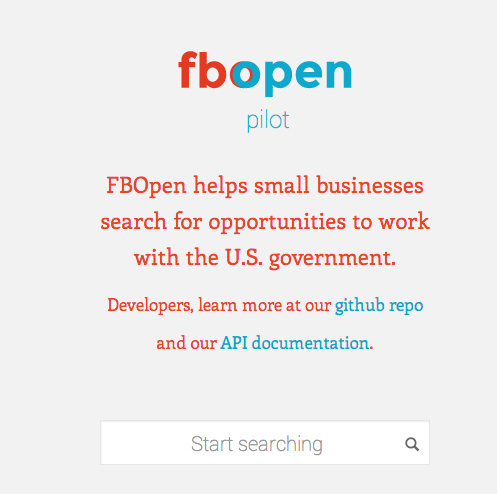
More than five years ago, Anil Dash wrote that the most interesting startup of 2009 was the United States government. Maybe, just maybe, that’s become true again, given the potential impact that the intelligent application of modern development practices could have on the digital government services that hundreds of millions of Americans increasingly expect and depend upon. What I’ve seen so far is promising, from the website itself to an initial pilot project, FBopen, that provides a simple, clean, mobile-friendly interface for small businesses to “search for opportunities to work with the U.S. government.”

fbopen

Clay Johnson, a member of the inaugural class of Presidential Innovation Fellows and founder of a startup focused on improving government IT procurement, offered measured praise for the launch of 18F:

Is it a complete solution to government’s IT woes? No. But, like RFP-IT and FITARA, it’s a component to a larger solution. Much of these problems stem from a faulty way of mitigating risk. The assumption is that by erecting barriers to entry – making it so that the only bets to be made are safe ones – then you can never fail. But evidence shows us something different: by increasing the barriers to competition, you not only increase risk, you also get mediocre results.

The best way for government to mitigate risk is to increase competition, and ensure that companies doing work for the citizen are transparently evaluated based on the merits of their work. Hopefully, 18F can position itself not only as a group of talented people who can deliver, but also an organization that connects agencies to great talent outside of its own walls. To change the mindset of the IT implementation, and convince people inside of government that not only can small teams like 18F do the job, but there are dozens of other small teams that are here to help.

Given the current nation-wide malaise about the U.S. government’s ability to execute on technology project, the only approach that will win 18F accolades after the launch of these modern websites will be the unit’s ability to deliver more of them, along with services to support others. Good luck, team.

Federal government agencies receive .91 GPA in FOIA compliance from Center for Effective Government

Today, the Center for Effective Government released a scorecard for access to information from the 15 United States federal government agencies that received the most Freedom of Information Act (FOIA) requests, focusing upon an analysis of their performance in 2013.

The results of the report (PDF) for the agencies weren’t pretty: if you computed a grade point average from this open government report card (and I did) the federal government would receive a D for its performance. 7 agencies outright failed, with the State Department receiving the worst grade (37%).

The grades were based upon:

  1. How well agencies processed FOIA requests, including the rate of disclosure, fullness of information provided, and timeliness of the response
  2. How well the agencies established rules of information access, including the effectiveness of agency polices on withholding information and communications with requestors
  3. Creating user-friendly websites, including features that facilitate the flow of information to citizens, associated online services, and up-to-date reading rooms

The report is released at an interesting historic moment for the United States, with Sunshine Week just around the corner. The United States House of Representatives just unanimously passed a FOIA Reform Act that is substantially modeled upon the Obama administration’s proposals for FOIA reforms, advanced as part of the second National Open Government Action Plan. If the Senate takes up that bill and passes it, it would be one of the most important, substantive achievements in institutionalizing open government beyond this administration.

The Citizens for Responsibility and Ethics in Washington have disputed the accuracy of this scorecard, based upon the high rating for the Department of Justice. CREW counsel Anne Weismann:

It is appropriate and fair to recognize agencies that are fulfilling their obligations under the FOIA. But CEG’s latest report does a huge disservice to all requesters by falsely inflating DOJ’s performance, and ignoring the myriad ways in which that agency — a supposed leader on the FOIA front — ignores, if not flouts, its obligations under the statute.

Last Friday, I spoke with Sean Moulton, the director of open government policy at the Center for Effective Government, about the contents of the report and the state of FOIA in the federal government, from the status quo to what needs to be done. Our interview, lightly edited for content and clarity, follows.

What was the methodology behind the report?

Moulton: Our goal was to keep this very quantifiable, very exact, and to try and lay out some specifics. We thought about what the components were necessary for a successful FOIA program. The processing numbers that come out each year are a very rich area for data. They’re extremely important: if you’re not processing quickly and releasing information, you can’t be successful, regardless of other components.

We did think that there are two other areas that are important. First, online services. Let’s face it, the majority of us live online in a big way. It’s a requirement now for agencies to be living there as well. Then, the rules. They’re explained to the agencies and the public, in how they’re going to do things when they get a request. A lot of the agencies have outdated rules. Their current practices may be different, and they may be doing things that the rules don’t say they have to, but without them, they may stop. Consistent rules are essential for consistent long term performance.

A few months back, we released a report that laid out what we felt were best practices for FOIA regulations. We went through a review of dozens of agencies, in terms of their FOIA regulations, and identified key issues, such as communicating with the requester, how you manage confidential business information, how you handle appeals, and how you handle timelines. Then we found inside existing regulations the best ways this was being handled. It really helped us here, when we got to the rules. We used that as our roadmap. We knew agencies were already doing these things, and making that commitment. The main thing we measured under the rules were the items from that best practices report that were common already. If things were universal, we didn’t want to call a best practice, but a normal practice.

Is FOIA compliance better under the Obama administration, more than 4 years after the Open Government Directive?

Moulton: In general, I think FOIA is improving in this administration. Certainly, the administration itself is investing a great deal of energy and resources in trying to make greater improvements in FOIA, but it’s challenging. None of this has penetrated into national security issues.

I think it’s more of a challenge than the administration thought it would be. It’s different from other things, like open data or better websites. The FOIA process has become entrenched. The biggest open government wins were in areas where they were breaking new ground. There wasn’t a culture or way of doing this or problems that were inherited. They were building from the beginning. With FOIA, there was a long history. Some agencies may see FOIA as some sort of burden, and not part of their mission. They may think of it as a distraction from their mission, in fact. When the Department of Transportation puts out information, it usually gets used in the service of their mission. Many agencies haven’t internalized that.

There’s also the issue of backlogs, bureaucracy, lack of technology or technology that doesn’t work that well — but they’re locked into it.

What about redaction issues? Can you be FOIA compliant without actually honoring the intent of the request?

Moulton: We’re very aware of this as well. The data is just not there to evaluate that. We wish it was. The most you get right now is “fully granted” or “partly granted.” That’s incredibly vague. You can redact 99% or 1% and claim it’s partially redacted, either way. We have no indicator and no data on how much is being released. It’s frustrating, because something like that would help us get a better sense on whether agencies would benefit would new policies

We do know that the percentage of full grants has dropped every year, for 12 years, from the Clinton administration all the way through the Bush administration to today. It’s such a gray area. It’s hard to say whether it’s a terrible thing or a modest change.

Has the Obama administration’s focus on open government made any difference?

Moulton: I think it has. There were a couple of agencies that got together on FOIA reform. The EPA led the team, with the U.S. National Archives and the Commerce Department, to build a new FOIA tool. The outward-facing part of the tool enables a user to go to a single spot, request and track it. Other people could come and search FOIA’ed documents. Behind the scenes, federal workers could use the tool to forward requests back and forth. This fits into what the administration has been trying to do, using technology better in government

Another example, again at the EPA, is where they’ve put together a proactive disclosure website. They got a lot of requests, like if there are inquiries about properties, environmental history, like leaks and spills, and set up a site where you could look up real estate. They did this because they went to FOIA requests and see what people wanted. That has cut down their requests to a certain percentage.

Has there been increasing FOIA demand in recent years, affecting compliance?

Moulton: I do think FOIA requests have been increasing. We’ll see what this next year of data shows. We have seen a pretty significant increase, after a significant decrease in the Bush administration. That may be because this administration keeps speaking about open government, which leads to more hopeful requestors. We fully expect that in 2013, there will be more requests than the prior year.

DHS gets the biggest number of all, but that’s not surprising when we look at the size of it. It’s second biggest agency, after Defense, and the biggest domestic facing agency. when you start talking about things like immigration and FEMA, which go deep into communities and people’s lives, in ways that have a lot impact, that makes sense.

What about the Department of Justice’s record?

Moulton: Well, DoJ got the second highest rating, but we know they have a mixed record. There are things you can’t measure and quantify, in terms of culture and attitude. I do know there were concerns about the online portal, in terms of the turf war between agencies. There were concerns about whether the tech was flexible, in terms of meeting all agency needs. If you want to build a government-wide tool, it needs to have real flexibility. The portal changed the dialogue entirely

Is FOIA performance a sufficient metric to analyze any administration’s performance on open government?

Moulton: We should step back further and look at the broader picture, if we’re going to talk about open government. This administration has done things, outside of FOIA, to try to open up records and data. They’ve built better online tools for people to get information. You have to consider all of those things.

Does that include efforts like the Intelligence Community Tumblr?

Moulton: That’s a good example. One thing this administration did early on is to identify social media outlets. We should be going there. We can’t make citizens come to us. We should go to where people are. The administration pushed early on that agencies should be able to use Tumblr and Twitter and Facebook and Flickr and so on.

Is this social media use “propaganda,” as some members of the media have suggested?

Moulton: That’s really hard to decide. I think it can result in that. It has the potential to be misused to sidestep the media, and not have good interaction with the media, which is another important outlet. People get a lot of their information from the media. Government needs to have good relationship.

I don’t think that’s the intention, though, just as under Clinton, when they started setting up websites for the first time. That’s what the Internet is for: sharing information. That’s what social media can be used for, so let’s use what’s there.

Presidential Innovation Fellows show (some) government technology can work, after all

The last six months haven’t been kind to the public’s perception of the Obama administration’s ability to apply technology to government. The administration’s first term that featured fitful but genuine progress in modernizing the federal government’s use of technology, from embracing online video and social media to adopting cloud computing, virtualization, mobile devices and open source software. The Consumer Financial Protection Bureau earned praise from The Washington Post, Bloomberg View, and The New York Times for getting government technology right.

Last fall, however, the White House fell into a sinkhole of its own creation when the troubled launch of Healthcare.gov led to the novel scene of a President of the United States standing in the Rose Garden, apologizing for the performance of a website. After the big fix to Healthcare.gov by a quickly assembled trauma team got the site working, the administration has quietly moved towards information technology reforms, with the hopes of avoiding the next Healthcare.gov, considering potential shifts in hiring rules and forming a new development unit within the U.S. General Services agency.

Without improved results, however, those reforms won’t be sufficient to shift the opinion of millions of angry Americans. The White House and agencies will have to deliver on better digital government, from services to public engagement.

pif-logo-300pxThis week, the administration showed evidence that it has done so: The projects from the second round of the White House’s Presidential Innovation Fellows program are online, and they’re impressive. US CTO Todd Park and US GSA Administrator Dan Tangherlini proudly described their accomplishments today:

Since the initiative launched two years ago, Presidential Innovation Fellows, along with their government teammates, have been delivering impressive results—at start-up velocity. Fellows have unleashed the power of open government data to spur the creation of new products and jobs; improved the ability of the Federal government to respond effectively to natural disasters; designed pilot projects that make it easier for new economy companies to do business with the Federal Government; and much more. Their impact is enormous.

These projects show that a relatively small number of talented fellows can work with and within huge institutions to rapidly design and launch platforms, Web applications and open data initiatives. The ambition and, in some cases, successful deployment of projects like RFPEZ, Blue Button Connect, OpenFDA, a GI Bill toolGreen Button, and a transcription tool at the Smithsonian Institute are a testament to the ability of public servants in the federal government to accomplish their missions using modern Web technologies and standards. (It’s also an answer to some of the harsh partisan criticism that the program faced at launch.)

In a blog post and YouTube video from deputy U.S. chief technology officer Jennifer Pahlka, the White House announced today they had started taking applications for a third round of fellows that would focus on 14 projects within three broad areas: veterans, open data and crowdsourcing:

  • “Making Digital the Default: Building a 21st Century Veterans Experience: The U.S. Department of Veterans Affairs is embarking on a bold new initiative to create a “digital by default” experience for our Nation’s veterans that provides better, faster access to services and complements the Department’s work to eliminate the disability claims backlog.
  • Data Innovation: Unleashing the Power of Data Resources to Improve Americans’ Lives: This initiative aim to accelerate and expand the Federal Government’s efforts to liberate government data by making these information resources more accessible to the public and useable in computer readable forms, and to spur the use of those data by companies, entrepreneurs, citizens, and others to fuel the creation of new products, services, and jobs.
  • By the People, for the People: Crowdsourcing to Improve Government: Crowdsourcing is a powerful way to organize people, mobilize resources, and gather information. This initiative will leverage technology and innovation to engage the American public as a strategic partner in solving difficult challenges and improving the way government works—from helping NASA find asteroid threats to human populations to improving the quality of U.S. patents to unlocking information contained in government records.”

Up until today, the fruits of the second class of fellows have been a bit harder to ascertain from the outside, as compared to the first round of five projects, like RFPEZ, where more iterative development was happening out in the open on Github. Now, the public can go see for themselves what has been developed on their behalf and judge for themselves whether it works or not, much as they have with Healthcare.gov.

I’m particularly fond of the new Web application at the Smithsonian Institute, which enables the public to transcribe handwritten historic documents and records. It’s live at Transcription.si.edu, if you’d like to pitch in, you can join more than three thousand volunteers who have already transcribed and reviewed more than 13,000 historic and scientific records. It’s a complement to the citizen archivist platform that the U.S. National Archives announced in 2011 and subsequently launched. Both make exceptional use of the Internet’s ability to distribute and scale a huge project around the country, enabling public participation in the creation of a digital commons in a way that was not possible before.

With major pharmacies on board, is the Blue Button about to scale nation-wide?

blue_button_for_homepage1The Obama administration announced significant adoption for the Blue Button in the private sector today. In a post at the White House Office of Science and Technology blog, Nick Sinai, U.S. deputy chief technology officer and Adam Dole, a Presidential Innovation Fellow at the U.S. Department of Health and Human Services, listed major pharmacies and retailers joining the Blue Button initiative, which enables people to download a personal health record in an open, machine-readable electronic format:

“These commitments from some of the Nation’s largest retail pharmacy chains and associations promise to provide a growing number of patients with easy and secure access to their own personal pharmacy prescription history and allow them to check their medication history for accuracy, access prescription lists from multiple doctors, and securely share this information with their healthcare providers,” they wrote.

“As companies move towards standard formats and the ability to securely transmit this information electronically, Americans will be able to use their pharmacy records with new innovative software applications and services that can improve medication adherence, reduce dosing errors, prevent adverse drug interactions, and save lives. ”

While I referred to the Blue Button obliquely at ReadWrite almost two years ago and in many other stories, I can’t help but wish that I’d finished my feature for Radar a year ago and written up a full analytical report. Extending access to a downloadable personal health record to millions of Americans has been an important, steadily shift that has largely gone unappreciated, despite reporting like Ina Fried’s regarding veterans getting downloadable health information.  According to the Office of the National Coordinator for Health IT, “more than 5.4 million veterans have now downloaded their Blue Button data and more than 500 companies and organizations in the private-sector have pledged to support it.

As I’ve said before, data standards are the railway gauges of the 21st century. When they’re agreed upon and built out, remarkable things can happen. This is one of those public-private initiatives that has taken years to take fruit that stands to substantially improve the lives of so many people. This one started with something simple, when the administration gave military veterans the ability to download their own health records using from on MyMedicare.gov and MyHealthyVet and scaled progressively to Medicare recipients and then Aetna and other players from there.

There have been bumps and bruises along with the way, from issues with the standard to concerns about lost devices, but this news of adoption by places like CVS suggests the Blue Button is about to go mainstream in a big way. According to the White House, “more than 150 million Americans today are able to use Blue Button-enabled tools to access their own health information from a variety of sources including healthcare providers, health insurance companies, medical labs, and state health information networks.”

Notably, HHS has ruled that doctors and clinics that implement the new “BlueButton+” specification will be meeting the requirements of “View, Download, and Transmit (V/D/T)” in Meaningful Use Stage 2 for electronic health records under the HITECH Act, meaning they can apply for reimbursement. According to ONC, that MU program currently includes half of eligible physicians and more than 80 percent of hospitals in the United States. With that carrot, many more Americans should expect to see a Blue Button in the doctor’s office soon.

In the video below, U.S. chief technology officer Todd Park speaks with me about the Blue Button and the work of Dole and other presidential innovation fellows on the project.

U.S. CIO Steven VanRoekel on the risks and potential of open data and digital government

Last year, I conducted an in-depth interview with United States chief information officer Steven VanRoekel in his office in the Eisenhower Executive Office Building, overlooking the White House. I was there to talk about the historic open data executive order that President Obama had signed in May 2013. vanroekel On this visit, I couldn’t help but notice that VanRoekel has a Star Wars clock in his office.  The Force is strong here. The US CIO also had a lot of other consumer technology around his workspace: a MacBook and Windows laptop and dock, dual monitors, iPad, a teleconferencing system integrated with a desktop PC, and an iPhone, which recently became securely permissible on in the White House IT system in a “bring your own device” pilot. The interview that follows is slightly dated, in certain respects, but still offers significant insight into how the nation’s top IT executive is thinking about digital government, open data and more. It has also been lightly edited, primarily removing the long-winded questions of the interviewer.

We’re at the one year mark of the Digital Government Strategy. Where do we stand with hitting the metrics in the strategy? Why did it take until now to get this out?

VanRoekel: The strategy calls for the launch of the policy itself. Throughout the year, the policy was a framework for a 12 month set of deliverables of different aspects, from the work we’re doing in mobile, from ‘bring your own device,’ to security baselines and mobile device management platforms. Not only streamlining procurement, streamlining app development in government. Managing those devices securely to thinking about the way we do customer service and the way we think about the power of data and how it plays into all of this. It’s been part of that process for about the year we’ve been working on it. Of course, we thought through these principles and have been working on data-related aspects for longer. The digital strategy policy was the framework for us to catalyze and accelerate that, and over the course of the year, the stuff that’s been going on behind the scenes has largely been working with agencies on building some of this capability around open data. You’re going to see some things happening very soon on the release of some of this capability. Second, standing up the Presidential Innovation Fellows program and then putting specific ‘PIFs’ into certain targeted agencies to fast track their opening of data — that’s going to extend into Wave Two. You’re going to see that continuing to happen, where we just take these principles and just kind of ‘rinse and repeat’ in government. Third, we’re working with a small set of the community to build tools to make it easy for agencies to implement these guidelines. So if there’s an agency that doesn’t know how to create a JSON file, that tool is on Github. You can see that on Project Open Data .

How involved has the president been in this executive order? It’s his name, his words are in there — how much have you and U.S. chief technology officer Todd Park talked with the president about this?

VanRoekel: Ever since about last summer, we’ve been talking to the president about open data, specifically. I think there’s lots of examples where we’ve had conversations on the periphery, and he’s met with a lot of tech leaders and others around the country that in many, many cases have either built their business or are relying upon some government service or data stream. We’re seeing that culminating into the mindset of what we do as a factor of economic growth. His thoughts are ‘how do we unlock this national resource?’ We’re sitting on this treasure trove – how do we unleash it into the developer community, so that these app developers can build these different solutions?’ He’s definitely inspired – he wrote that cover memo to the digital strategy last May – and then we’ve had all of these different meetings, across the course of the year, and now it culminates into this executive order, where we’re working to catalyze these agencies and get them to pay attention and follow up.

We’ve been down this road before, in some respects, with the Open Government Directive in 2009, with former US CIO Vivek Kundra putting forward claims of positive outcomes from releasing data. Yet, what have we learned over the past four years? What makes this different? Where’s the “how,” in terms of implementing this?

VanRoekel: The original launch of data.gov was, I think, a way of really shocking the system, and getting people to pay attention to and notice that there was an important resource we’re sitting on called data. Prior to data.gov, and prior to the work of this administration, the daily approach to data was very ad hoc. It wasn’t taken as data, it was just an output or a piece of a broader mix. That’s why you get so much disparity in the approach to the way we manage data. You get the paper-driven processes that are still very prevalent, where someone will send a paper document, and someone will sign it, and scan it, feed it into a system, and then eventually print it and mail it. It’s crazy what you end up seeing and experiencing inside of government in terms of how these things work. Data.gov was an important first step. The difference now is really around taking this approach to everything that we do. The work that we did with the Open Government Directive back in 2009 was really about taking some high value data sets and putting them up on Data.gov. What you ended up seeing was kind of a ‘bulk upload, bulk download,’ kind of access to the data. Machine-readability and programmability wasn’t taken into account, or the searchability and findability.

Did entrepreneurs or advocates validate these data sets as “high value?” Entrepreneurs have kept buying data from government over the past four years or making Freedom of Information Act requests for data from government or scraping data. They’re not getting that from Data.gov.

VanRoekel: I have no official way of measuring the ‘value’ of the data, other than anecdotal conversations. I do think that the motion of getting people to wake up and think about how they are treating data internally within in an organization – well, there was a convenience factor to that, which basically was that ‘I got to pick what data I release,’ which probably dates from ‘what data I have that’s releasable?’ The different tiers to this executive order and this policy are a huge part of why it’s different. It sets the new default. It basically says, if you are modernizing a system or creating a new system, you can do that in a way that adopts these principles. If you [undertake] the collection, use and dissemination of data, you’ll make those machine-readable and interoperable by default. That doesn’t always mean public, because there are applications that privacy and national security mean we should make public, but those principles still hold, in terms of the way I believe we the ways we build things should evolve on this foundation. For the community that’s getting value outside of the government, this really sets a predictable, consistent course for the government to open up data. Any business decisions are risk-based decisions. You have to assume some level of risk with anything you do.

If there’s too much risk, entrepreneurs won’t do it.

VanRoekel: True. To that end, the work we’ve done in this policy that’s different than before is the way we’re collecting information about the data is being standardized. We’re creating a meta data infrastructure. Data itself doesn’t have to be all described in the same way. We’re not coming up with “one schema to rule them all” across government. The complexity of that would be insurmountable. I don’t think that’s a 21st century approach. That’s probably a last century thinking around to say that if we get one schema, we’re going to get it all done. The meta data approach is to say let’s collect a standard template way of describing – but flexible for future extension – the data that is contained in government. In that description, and in that meta data, tags like “who owns this data” and “how often is the data updated,” information about how to get a hold of people to find out more about descriptions within the data. They will be a part of that description in a way that gives you some level of assurance on how the data is managed. Much of the data we have out there, there’s existing laws on the books to collect the data. Most of it, there’s existing laws, not just a business process. One of the great conversations we’re having with the agencies is that they find greater efficiency in the way they collect data and build solutions based upon these open data principles.

I received a question from David Robinson, regarding open licensing in this policy. Isn’t U.S. government data exempt from copyright?

VanRoekel: Not all government data is exempt from copyright, but those are generally edge cases. The Smithsonian takes pictures of things that are still under copyright, for instance. That’s government data. I sent a note about this announcement to the Secretary of the Smithsonian this morning. I’ve been talking to him about opening up data for some time. The nuance there, about open licenses, is really around the types of systems that create the data, and putting a preference for a non-proprietary format. You can imagine a world in which I give you an XML file, and I give you a Microsoft Excel file. Those are both piece of data. To some extent, the Excel format is machine-readable. You can open it up and look at it internally just the way it is, but do you have to go buy a special piece of software to read the file or not? That kind of denotes the open[ness] and accessibility of the data. In the case of policy, we declare a strong preference towards these non-proprietary formats, so that not only do you get machine-readability but you get the broadest access to the data. It’s less about the content in there – is that’s copyrighted or not — I think most data in government, outside of the realm of confidential or private data, is not copyrighted, so to speak from the standpoint of the license. It’s more about the format, and if there’s a proprietary standard wrapped in the stuff. We have an obligation as a government to pick formats, pick solutions, et cetera that not only have the broadest applicability and accessibility for the public but also create the most opportunity in the broadest sense.

Open data doesn’t come without costs. Is this open data policy an unfunded mandate on all of the agencies, instructing them to put all of the data online they can, to digitize content?

VanRoekel: In the broadest sense, the phrase ‘the new default’ is an important one. It basically says, for enhancements to existing systems or new systems, follow this guideline. If people are making changes, this is in the list of requirements. From a costing perspective, it’s pre-baked into the cost of any enhancement or release. That’s the broad statement. The narrow statement is that there are many agencies out there, increasing every day, that are embracing these retroactive open data approaches, saying that there is value to the outside world, there is lower cost, greater interoperability, there are solutions that can be derived from taking these open data approaches inside of my own organization. That’s what we saw in PIF [Presidential Innovation Fellows] round one, where these agencies adopted the innovations fellows to unlock their data. That’s increasing and expanding in round two, and continuing in the agencies which we thought were high administration priorities, along with others. I think we’re going to continue to see this as a catalyzing element of that phenomenon, where people are going to back and spend the resources on doing this. Just invite any of these leaders to the last twenty minutes of a hackathon, where folks are standing up and showing their solutions that they developed in one day, based on the principles of open data and APIs. They just are overwhelmed about the potential within their own organizations, and they run back and want to do this as fast as they can.

Are you using anything that has ever been developed at a hackathon, personally or professionally?

VanRoekel: We are incorporating code from the “We The People” hackathon, the most recent one. I know Macon Phillips and team are looking at incorporating feature sets they got out of that. An important part of the hackathon, like most conferences you go to, is the time between the sessions. They’re the most important – the relationship building aspect, figuring out how we shape the next set of capabilities or APIs or other things you want to build.

How does this relate to the way that the federal government uses open data internally?

VanRoekel: There are so many examples of government agencies, when faced with a technical problem, will go hire a single monolithic vendor to do a single, monolithic solution – and spend most of the budget on the planning cycle – and you end up with these multi-million dollar, 3-ring binders that ultimately fail because technology has moved on or people have left or laws have moved on five or ten years later, after they started these projects. One of the key components of this is laying foundational stones down to say how are we going to build upon that, to create the apps and solutions of the future. You know, I can swoop in and say “here’s how to do modular contracting in the context of government acquisition” – but unless you say, you’ve got to adopt open data and these principles of API-first, of doing things a different way — smaller, reusable, interoperable pieces – you can really build the phenomenon. These are all elements of that – and the cost savings aspect of it are extraordinary. The risk profile is going to be a lot smaller. Inside government I’m as excited about as outside.

Do you think the federal government will ever be able to move from big data centers and complicated enterprise software to a lightweight, distributed model for mobile services built on APIs?

VanRoekel: I think there is massive potential for things like that across the whole of government. I mean, we’re a big organization. We’re the largest buyer of technology in the world. We have unending opportunities to do things in a more efficient way. I’ve been running this process that I launched last year called Portfolio Stat. It’s all about taking a left to right look, sitting down with agencies. What I’ve always been missing from those is some of these groundbreaking policies that start to paint the picture for what the ideal is, and how to get your job done in a way that’s different than the way you’ve don’t it before, like the notion of continuous improvement. We’ve needed things like the EO to give us those conversation starters to say, here’s the way to do it, see what they are doing over at HHS. “How are you going to bring that kind of discipline into your organization?” I’m sitting down with every deputy secretary and all the C-level executives to have those tough conversations. Fruitful, but good conversations about how we are going to change the way we deliver solutions inside of government. The ideal state that they’ll all hear about is the service-oriented model with centralized, commodity computing that’s mostly cloud-based. Then, how do you provide services out to the periphery of your organization.

You told me in our last interview that you had statutory authority to make things happen. What happens if a federal CIO drags his or her feet and, a year from now, you’re still here and they’re not moving on these policies, from cloud to open data?

VanRoekel: The answer I gave to you last time still holds: it’s about inspire and push. Inspire comes in many factors. One is me coming in and showing them the art of the possible, saying there’s a better way of doing this, getting their customers to show up at the door to say that we want better capabilities and get them inspired to do things, getting their leadership to show up and say we want better things. Push is about budget – how do you manage their budget. There’s aspects of both inspire and push in the way we’ve managed the budget this year. I have the authority to do that.

What’s your best case for adopting an open data strategy and enterprise data inventory, if you’re trying to inspire?

VanRoekel: The bottom line is meet your mission faster and at a much lower cost. Our job is not about technology as an end state – it’s about our mission. We’ve got to get the mission of government done. You’re fostering immigration, you’re protecting public safety, you’re providing better energy guidance, you’re shaping an industry for the country. Open data is a fundamental building block of providing flexibility and reusability into the workplace. It’s what you do to get you to the end state of your mission. I hearken back a lot to the examples we used at the FCC, which was moving from like fourteen websites to one and how we managed that. How do we take workload of a place so that the effort pays for itself in six months and start yielding benefits beyond that? The benefits are long-term. When you build that next enhancement, or that new thing on top of it, you can realize the benefits at lower cost. It’s amazing. I do these TechStat processes, where I sit down with the agencies. They have some project that’s going off the rails. They need help, focus, and some executive oversight. I sit down, usually in a big room of people, and it’s almost gotten to the point where you don’t need to look at the briefing documents ahead of time. You sit down and say, I bet you’re doing it this way – and it’s monolithic, proprietary, probably taking a lot of packaged software and writing a lot of glue code to hold it all together – and you then propose to them the principles of open data and open approaches to doing the solution, and tell them I want to see in the next sixty days some customer-facing, benefit value that’s built on this model. They go off and do that, and they get right back on the tracks and they succeed. Time after time when we do TechStat, that’s the formula and it’s yielded these incredible results. That culture is starting to permeate into how we get stuff done, because they see how it might accomplish their mission if they just turn 45 degrees and try a different approach. If that makes them successful, they will go there every time.

Critiques of open data raise concerns about “discretionary disclosure,” where a government entity releases what it wants, claim credit for embracing open government, and obfuscates the rest of the data. Does this policy change any of the decisions that are being made to delay, redact or not release requested data?

VanRoekel: I think today marks an inflection point that will set a course for the future. It’s not that tomorrow or next month or next year that all government data will just be transformed into open, machine-readable form. It will happen over time. The key here is that we’ve created mechanisms to protect privacy and security of data but built in culture where that which is intended to be public should be made public. Part of what is described in the executive order is the formation of this cross-agency executive group that will define a cross-agency priority goal, that we need to get inventories in from agencies regarding that which they hold that could be made public. We want to know stuff that’s not public today, what could be out there. We’re going to take that in and look at how we can set goals for this year, the next year and the year after that to continue to open up data at a faster pace than we’ve been doing in the past. The modernization act and some of the work around setting goals in government is much more compatible and looks a lot like the private sector. We’re embracing these notions that I’ve really grown to love and respect over the course of my private sector career in government around methodologies. Stay tuned on the capital and what that looks like.

Are you all going to work with the House and Senate on the DATA Act or are statutory issues on oversight still a stumbling block?

VanRoekel: The spirit of the DATA Act, of transparency and openness, are the things we’re doing, and I think are embraced. Some of the tactical aspects of the act were a little off the mark, in terms of getting to the end state that we want to get to. If you look at the FY-14 budget and the work we’ve done on transferring USASpending.gov to Treasury to get it closer to the source of the data, plus a view into how those systems get modernized, how we bring these principles into that mix, that will all be a part of the end state, which is how we track the spending.

Do you ever anticipate the data going into FOIA.gov also going into Data.gov?

VanRoekel: I don’t know. I can’t speculate on that. I’m not close enough to it.

Well, FOIA requests show demand. Do you have any sense of what people are paying for now, in terms of government data?

VanRoekel: I don’t.

Has anybody ever asked, to try to figure that out?

VanRoekel: I think that would be a great thing for you to do.

I appreciate that, but this strikes me as an interesting assessment that you could be doing, in terms of measuring outflows for business intelligence. If someone buys data, it shows that there is value in it. What would it mean if releases reflected that signal?

VanRoekel: You mean preference data that is being purchased?

Right.

VanRoekel: Well, part of this will be building and looking at Data.gov. Some of the stuff coming there is really building community around the data. The number one question Todd Park and I had coming out of the PIF program, at the end of May [2013] was, what if I think there’s data, but I don’t know, who do I contact? An important part of the delivery of this wave and the product coming out as part of this policy is going to be this enhanced Data.gov, that’s our intention to build a much richer community around government data. We want to hear from people. If there are data sources that do hold promise and value, let’s hear about those and see if there are things we can do to get a PIF on structuring it, and get agencies to modernize systems to get it released and open. I know some of the costs are like administrative feeds for printing or finding the data, something that’s related to third parties collecting it and then reselling it. We want to make sure that we’re thoughtful in how we approach that.

How has the experience that you’ve seen everyone have with the first iteration of Data.gov informed the nation’s open data strategy today? What specifically had not been done before that you will be doing now?

VanRoekel: The first Data.gov set us on a cultural path.What it didn’t do was connect you to data the source. What is this data? How often is it updated? Findability and searchability of broad government data wasn’t there. Programmability of the data wasn’t necessarily there. Data.gov, in the future, instead of being a repository for data, a place to upload the data, my intention is that it will become a meta data catalog. It will be the place you go, the one-stop-shop, to find government data, across multiple aspects. The way we’re doing this is through the policy itself, which says that agencies have to go and set up this new page, similar to what is now standard in open government, /open, /developer. In that page, the most important part of that page is a JSON file. That’s what data.gov can go out and crawl, or any developer outside can go out and crawl, to find out when data has been updated, what data is available, in what format. All of the standard meta data that I’ve described earlier will be represented through that JSON file. Data.gov will then become a meta data catalog of all the open data out in government at its source. As a developer, you’d come in, and it you wanted to do a map, for instance, to see what broadband capabilities exist near low-income Americans and then overlay locations of educational institutions, if you wanted to look for a correlation between income and broadband deployment and education, you’d hypothetically be looking for 3 different data sources, from 3 different agencies. You’d be able to find the open data streams, the APIs, to go get that data in one place, and then you’d have a connection back to the mothership to be able to grab it, find out who owns it. We want to still have a center of gravity for data, but make the data itself follow these principles, in terms of discoverability and use. The thing that probably got me most pointed in this direction is the President’s Council of Advisors on Science and Technology (PCAST), which did a report on health IT. Buried on page 60 or something, it had this description of meta data as the linchpin of discoverability of diverse data sources. That’s the approach we’ve taken, much like Google.

5 years from now, what will have changed because of this effort?

VanRoekel: The way we build solutions inside of government is going to change, and the amount of apps and solutions outside of government are going to fundamentally change. You and I now, sitting in our cars, take for granted the GPS signal going to the device on the dash. I think about government. Government is right there with me, every single day, as I’m driving my car, or when I do a Foursquare check-in on my phone. We’ll be bringing government data to citizens where they are, versus making people come to government. It’s been a long time since the mid-80s, when we opened up GPS, but look at where we are today. I think we’ll look back in 10 or 15 years and think about all of the potential we unlocked today.

What data could be like GPS, in terms of their impact on our lives?

VanRoekel: I think health and energy are probably two big ones.

POSTSCRIPT

Since we talked, the Obama administration has followed through on some of the commitments the U.S. CIO described, including relaunching Data.gov and releasing more data. Other goals, like every agency releasing an enterprise data inventory or publishing a /data and /developer page online, have seen mixed compliance, as an audit by the Sunlight Foundation showed in December. The federal government shutdown last fall also scuttled open data access, where certain data types were deemed essential to maintain and others were not. The shutdown also suggested that an “API-first” strategy for open data might be problematic. OMB, where VanRoekel works, has also quietly called for major changes in the DATA Act, which passed the House of Representatives with overwhelming support at the end of last year. A marked up version of the DATA Act obtained by Federal News Radio removes funding for the legislation and language that would require standardized data elements for reporting federal government spending. The news was not received well on Capitol Hill. Sen. Mark Warner, D-Va., the lead sponsor of the DATA Act in the Senate, reaffirmed his commitment to the current version of the bill in statement: “The Obama administration talks a lot about transparency, but these comments reflect a clear attempt to gut the DATA Act. DATA reflects years of bipartisan, bicameral work, and to propose substantial, unproductive changes this late in the game is unacceptable. We look forward to passing the DATA Act, which had near universal support in its House passage and passed unanimously out of its Senate committee. I will not back down from a bill that holds the government accountable and provides taxpayers the transparency they deserve.” The leaked markup has led to observers wondering whether the White House wants to scuttle the DATA Act and others to potentially withdraw support. “OMB’s version of the DATA Act is not a bill that the Sunlight Foundation can support,” wrote Matt Rumsey, a policy analyst at the Sunlight Foundation. “If OMB’s suggestions are ultimately added to the legislation, we will join our friends at the Data Transparency Coalition and withdraw our support of the DATA Act.” In response to repeated questions about the leaked draft, the OMB press office has sent the same statement to multiple media outlets: “The Administration believes data transparency is a critical element to good government, and we share the goal of advancing transparency and accountability of Federal spending. We will continue to work with Congress and other stakeholders to identify the most effective & efficient use of taxpayer dollars to accomplish this goal.” I have asked the Office of Management and Budget (OMB) about all of these issues and will publish any reply I receive separately, with a link from this post.


Privacy and Civil Liberties Report Finds NSA bulk phone records program illegal and ineffective

Earlier this afternoon, I emailed info@pclob.gov in search of the report that the New York Times  and Washington Post had obtained and reported upon this morning. 2 hours later, I received a response: www.pclob.gov. There, visitors can now find, download and read a “Report on the Telephone Records Program Conducted under Section 215 of the USA PATRIOT Act and on the Operations of the Foreign Intelligence Surveillance Court” and separate statements by Elisebeth Collins Cook  Rachel Brand. As Charlie Savage and Ellen Nakashima reported, Cook and Brand dissented from the report’s recommendation to end the collection of phone records under the 215 programs of the USA Patriot Act.

The privacy and civil liberties board’s report is strongly critical of the impact that mass surveillance has upon the privacy and civil liberties of American citizens, along with billions of other people around the world.

“The Section 215 bulk telephone records program lacks a viable legal foundation under Section 215, implicates constitutional concerns under the First and Fourth Amendments, raises serious threats to privacy and civil liberties as a policy matter, and has shown only limited value. As a result, the Board recommends that the government end the program.”

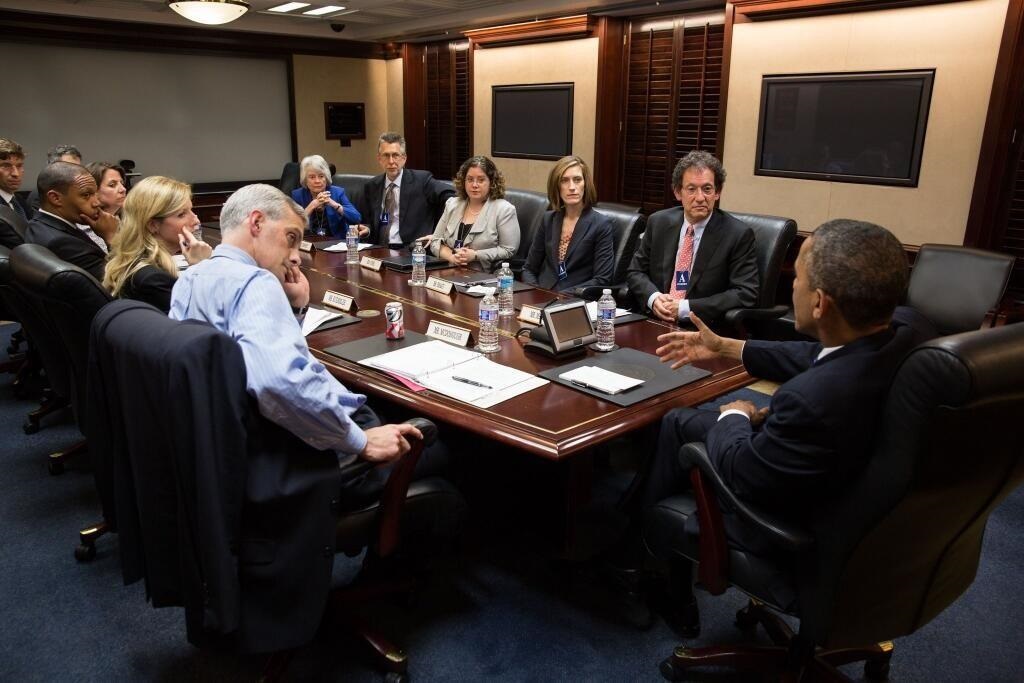
PCLOB Board Members meet with President Obama on June 21, 2013​. Photo by Pete Souza.

PCLOB Board Members meet with President Obama on June 21, 2013​. Photo by Pete Souza.

While President Obama met with the board and heard their recommendations prior to his speech last week, his administration is disputing its legal analysis.

“We disagree with the board’s analysis on the legality,” said Caitlin Hayden, spokeswoman for the White House National Security Council, in an e-mail to Bloomberg News. “The administration believes that the program is lawful.”

House Intelligence Committee Chairman Mike Rogers (R-MI) was also critical of the report’s findings. “I am disappointed that three members of the Board decided to step well beyond their policy and oversight role and conducted a legal review of a program that has been thoroughly reviewed,” he said in a statement.

The Electronic Frontier Foundation hailed the report as a vindication of its position on the consitutionality of the programs.

“The board’s other recommendations—increasing transparency and changing the FISA court in important ways—similarly reflect a nearly universal consensus that significant reform is needed,” wrote Mark Rumold, a staff attorney. “In the coming weeks, PCLOB is set to release a second report addressing the NSA’s collection under Section 702 of the FISA Amendments Act. We hope that the board will apply similar principles and recognize the threat of mass surveillance to the privacy rights of all people, not just American citizens.”

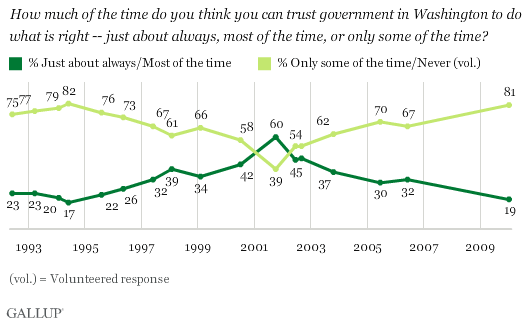
Historic lows in trust in government creates icy headwinds for U.S. open government policies

Open government advocates in the United States can expect to find public support for more accountability on a host of federal programs and policies among an electorate deeply distrustful of the White House’s commitment to more transparency regarding them.

Anyone interested in engaging the public regarding rules, regulations and proposed laws, however, should take note of the tenor of the comments on the coverage of the second United States National Action Plan on Open Government. They are a bellwether for the degree of damage to public trust in government that now persists in the United States.

If you feel like reading through the comments on “White House promises more transparency in second Open Government plan” at The Verge or “White House announces second open government plan” at Politico or “New White House plan reaffirms commitment to open data” at The Washington Post, you’ll find anger, disbelief and mockery.

gallup-polls-trust-government

I couldn’t find a single positive or even neutral comment on any of the stories. Considered in the context of the current political climate in the United States, that’s not surprising.

Gallup polling data from September 2013 indicated then that the trust of Americans in government had now fallen to historic lows.

After the government shutdown this fall and the messy rollout of the Affordable Care Act over the past two months, including a high stakes Internet failure at Healthcare.gov, I suspect that a Gallup poll taken today would find that even fewer people trust that the executive or legislative branch of the federal government of the United States.

If my own article on the White House’s second open government national action plan gains more attention, I expect to find similar sentiments from people who choose to comment.