This afternoon, Code for America announced that civic engagement platform Change by Us is launching in Philadelphia and into the Civic Commons, where it has been open sourced. Philadelphia residents (and all other interested parties) can check it out now at Philly.ChangeBy.us. As someone who spent the bulk of childhood in Philadelphia, this is great to see.
Abhi Nemani, at Code for America, highlighted the significance of the move over at the nonprofit’s blog, where he wrote that this is an important step forward for the reuse of civic software in the country:
the civic engagement platform initially deployed in New York is now available for any city to use under a free open source license. Change By Us’s reuse shows the opportunity for shared civic software.
He’s spot on. A short video about Change By Us is embedded below. Source code and instructions for installation of Change By Us are available for download on Github.
Update: In the context of fauxpen data, beware “openwashing:” Simply opening up data is not a replacement for a Constitution that enforces a rule of law, free and fair elections, an effective judiciary, decent schools, basic regulatory bodies or civil society — particularly if the data does not relate to meaningful aspects of society. Adopting open data and digital government reforms is not quite the same thing as good government, although they certainly can be and are related, in some cases.
If a country launches an open data platform but deprecates freedom of the press or assembly, questions freedom of information laws or restricts the ability of government scientists to speak to the public, is it adopting “open government” — or doing something else?
This Web app takes 311 reports about vacant and abandoned buildings from the Chicago and visualizes them onto a searchable map. “It’s specifically set up to pull data from Chicago’s data portal,” said Eder, linking to the 311 service requests of vacant and abandoned buildings dataset.
Eder shared more about how mapping Chicago’s vacant buildings in a blog post earlier this week. The results are unsurprising: there are many more vacant buildings in areas with high poverty rates.
Eder said that the app could be used by other cities, depending on how they store or format their data. The code for Chicago Buildings is on Github. On that front, he says that Chicago “isn’t using Open 311 yet, so this site isn’t either. That being said, it wouldn’t be too hard to hook up the same interface to a different data source.” Code for America will help Chicago to implement Open311 in 2012. Eder shared that he wrote a script that converts Socrata to Google Fusion Tables that could be modified for this purpose.
In the video below, Elizabeth Park, the creator of IFindit Chicago, talks about how she was inspired to build the team that created an Android app to help homeless and lower income citizens find resources like as shelters, medical clinics,and food pantries.
Voting for the winners ends this Friday, October 14th, so check out the community round entries and weigh in.
As a reminder: If you have open government news to share, you can always find me at @digiphile on Twitter, where I share my email address, alex@oreilly.com.
Congress may be one of the most unpopular institutions in the land but some of its staffers are continuing to work towards bringing its communications infrastructure into the 21st century.
The United States House of Representatives has begun beta testing streaming video from the House floor directly to mobile devices via HouseLive.gov — and they’re doing it using an open format that will work on iPads, iPhones Android devices or whatever else a citizen is using.
“Streaming the House floor to mobile devices through HouseLive.gov is just one more way the House is innovating and keeping its pledge to make Congress more open and accessible to the American people,” wrote Don Seymour in a blog post on Speaker.gov.
“The Office of the Clerk began beta testing this new H.264 live streaming feed for mobile devices last week,” wrote Seymour.
At present, supported video resolution is 480×360 and the bit rate is 650 kbps, so you’ll need to have a fast mobile connection to tune in. The bottom line, however, is that the video stream should work across ALL platforms now, desktop or mobile.
Seymour explained a bit more via email “The site now works like this: 1) when someone visits HouseLive.gov, the site first defaults to Silverlight. If Silverlight is not installed, then, 2) it defaults to Flash. If Flash is not installed/available, then, 3) it defaults to HTML5.”
He also used a key term that’s familiar to the Web world: “beta,” referring to a feature that’s still not finalized. Given that open government is in beta, and looks set to remain in that phase for a long time to come, it feels apt. Seymour asks in his blog post that citizens send feedback to the Clerk’s office: “…since this feature is still in beta, please leave a comment below if you experience any difficulties. Be sure to note your device (iPhone? Blackberry?), operating system (iOS? Android?), and connection speed (Wi-fi? 3G?); we’ll pass your note along to the Clerk’s office.”
Radhika Marya covered the news about mobile video over at Mashable, adding a few bytes of context for the addition.
The House Republicans have their share of tech-savvy staffers who have brought their side of the Hill out of the Stone Age when it comes to things like what a member’s website can do, for instance, encouraging lawmakers to adopt Drupal, a popular open-source content management system. They’ve also come up with new ways to interact with voters, such as YouCut and a project to solicit tales of regulatory woe from business owners. That said, in August, after Congress squeaked a debt-ceiling deal through both houses, Politifact reported that House Republicans have had trouble making good on another 21st-century promise: to post all legislation online 72 hours in advance of a vote.
Live video from the House floor on a mobile device isn’t likely to stimulate movement on the issues that matter to many citizens, including jobs, education, energy costs or healthcare, to name the hot buttons that will be discussed at tonight’s Republican primary debate. It will, however, give citizens a direct window to watch debates from wherever they are, however, and that’s a step forward. Speaking as someone who has suffered through abysmal streamed video of committee meetings many times — or not seen them online at all — here’s hoping that the next step for Congressional staff is to bring those proceedings into the 21st century soon too.
Update: Commenting on my post about this news on Google Plus, software architect David Bucci questions just how “open” the format in question is: “This gets an “interesting use of the word ‘open'” alert – first it tries SilverLight, then falls back to Flash, and then HTML5 using the patent-encumbered H.264. Umm … I’m looking for the “open” in there … ubiquitous != open. Instead of “open format”, it must mean “open access” (which I applaud).”
Android….in….space! This morning, Will Marshall of NASA showed the Android Open Conference plans for a sub-$10,000 Nexus One “phonesat.” Given that the cost of satellites usually measure in the tens or hundreds of millions or so, that’s a rather spectacular cost savings.
Marshall says that this will be the fastest processor to govern a satellite. For reference, Mars Explorer used a 33MHz processor. It sends signals back via amateur radio packet system, rather than ground tracking. The launch video is embedded below:
Great anecdote: when a launch failed, the entire payload fell without parachute into desert. The data was left intact.
William launching 3 Android phonesats in December, in space for 3 weeks. As O’Reilly Media’s Gina Blaber pointed out, they’re “iterating Silicon Valley-style.”
For more, check out the short documentary below about the PhoneSat suborbital test launch in the Black Rock desert:
You can follow @NASA_Phonesat on Twitter — there’s no official website yet – and, according to Marshall, eventually check out code on Github, where NASA is open sourcing some software behind it. (And yes, that’s a big deal.)
Two weeks ago at the Strata Conference in NYC, I donned a headset, grabbed a tablet worth of questions and headed to the podium to talk with the chairman of the U.S. House Committee on Oversight and Government Reform about data and open government.
Congressman Darrell Issa (R-CA) joined me via remote webcast from chambers in Washington, D.C. Our crack video team is working on an improved version of this video in which you’ll see my side of the broadcast, along with a boost in audio. Until then, the video that the House Oversight digital team uploaded to YouTube will suffice — and I don’t want to wait to share this story any longer in the meantime, particularly as interest builds behind the principle subject of our conversation, a proposed bill to standardize financial reporting data standards in the federal government and create single database for financial spending.
Daniel Schuman listened in and summarized our conversation on open government data over at the Sunlight Foundation’s blog:
The Chairman focused his remarks on the DATA Act, the bipartisan legislation he introduced that would transform how government tracks federal spending and identifies waste, fraud, and abuse.
He emphasized the importance of making government data available online in real time so that innovative minds can immediately make use the information to build their own businesses. Business, in turn, would help the government identify program mismanagement and data quality problems. The Chairman specifically singled out Vice President Biden as a supporter of efforts to find a common solution to make data available in a systematic way.
…Chairman Issa explained that the private sector must step up as advocates for greater openness because they will benefit from building and using the tools made possible by greater transparency. He added when government drives down the cost of obtaining information, private individuals will derive value from the analysis of data, not its ownership.
“In a cost estimate dated Sept. 16, the CBO attributes $325 million of the estimated total to requirements in the bill regarding the collecting and reporting of financial information. The DATA Act would require federal agencies, and most government contractors and grant award winners to adopt XBRL as a financial data reporting mechanism.”
Left unsaid in the CBO estimate is what the impact of this kind of transparency on the federal government’s finances might be, in terms of savings. House Oversight staff have estimated annual savings from standards and centralized spending database that would more than offset that outlay, including:
$41 million in funds recovered from questionable recipients
$63 million in funds withheld from questionable recipients
$5 billion in savings recommended by inspectors general
unknown savings resulting from better internal spending control and better oversight by Congressional appropriators.
The DATA Act, which would expand the role of the Recovery Accountability and Transparency Board to track all federal spending and make all of the information available to the public, has bipartisan support in the Senate from Senator Mark Warner (D-VA), who has introduced a companion bill there.
Given the White House’s embrace of the mantle of open government on President’s first day in office, the executive branch has gathered a lot of the press, attention, praise, scrutiny and criticism in this area.
That looks to be changing, and for the better. As Clay Johnson pointed out at the beginning of 2011, any competition between the White House and Congress on open government is likely to be a win for the American people.
Jim Harper, director of information policy studies at the Cato Foundation and webmaster of WashingtonWatch.com, wrote then that the GOP can eclipse Obama on transparency. “House Republicans can quickly outshine Obama and the Democratic Senate,” he opined. “It all depends on how they implement the watch phrase of their amendment package: “publicly available in electronic form.”
The GOP House leadership must make sure that this translates into real-time posting of bills, amendments and steps in the legislative process, in formats the Internet can work with. It’s not about documents anymore. It’s about data. Today’s Internet needs the data in these documents.
There are no technical impediments to a fully transparent Congress. Computers can handle this. The challenges, however, are institutional and practical.”
Johnson identified the moment in history as an important inflection point, and one that, if the White House rose to the challenge, could legitimately be seen as an open government win for the American people and a smarter, more accountable government.
The White House may hold the considerable advantages of the bully pulpit and the largest followings of any federal entity or politician on Twitter, for now, but that has to be balanced against the considerable new media prowess that the GOP has built up over their Democratic counterparts in Congress, where Republicans hold an edge on social media.
While some projects or choices continue to cast questions on commitment in the rank and file to open government principles, with the GOP bending new House rules, there’s progress to report. The leadership of the House of Representatives has supported the creation of open, online video archives, like House.Resource.org. The House revamped its floor feed recently, adding live XML. And House leadership has recently venerated the role of technology in making Congress more transparent, engaged and accountable.
Rep. Issa, in particularly, appears to have taken on open government as a cause and, for the moment, its rhetoric. He even tweets using the #opengov hashtag. When it comes to the legislature, “the American people have a right to all the data from Congress. They have a right,” he said at a recent forum on Congressional transparency, as reported by Diana Lopez.
Government secrecy and transparency are, in theory, non-partisan issues. In practice, they are often used a political bludgeons against an opposing party, particularly by a partisan minority, and then discarded once power is gained. For government transparency to outlast a given White House or Congress, laws and regulatory changes have to happen.
Open government has to be “baked in” to culture, practices, regulations, technology, business practices and public expectations. Needless to say, that’s going to take a while, but it looks like both the administration and some members of Congress are willing to keep trying.
As these efforts go forward, it will be up to the media, businesses, nonprofits, watchdogs and, of course, citizens to hold them accountable for actions taken, not just rhetoric.
What’s the future of the DATA Act?
I’m writing a feature article about the bill, this conversation, context for government performance data and whether open government and transparency will have any legs in the upcoming presidential campaign.
If you have any questions that are unanswered after watching the conversation, comments about the use of XBRL or perspective on the proposed law’s future in Congress, please ring in in the comments or find me at alex[at]oreilly.com.
It’s a tale of two parties, two social networks, live events and high stakes: creating jobs in an American economy still struggling to come out of recession. Would the American Jobs Act, introduced by President Obama earlier this month, make a difference? Can the White House or Congress do anything to create jobs, aside from directly hiring more government workers for infrastructure projects or similar initiatives? The American people will have the opportunity to hear from both sides of the aisle today and judge themselves, starting at 2 PM EST when the president will participate in a town hall hosted at LinkedIn in California.
Notably, there will still be a live chat on Facebook at a LinkedIn townhall, along with a public “backchannel” at the #meetopportunity hashtag on Twitter.
This is the second time that the White House experiments with LinkedIn for questions, following a forum earlier this year with tech CEOs and federal CTO Aneesh Chopra. The questions are pulled from a “putting America back to work forum on LinkedIn.com. As I’ve observed before, the platform isn’t ideal for ideation and moderation of questions but LinkedIn is unquestionably targeted towards employment.
Personally, I’d like to see CEO Jeff Weiner crunch the big data the social network has collected about job openings and the skills and degrees that high school and college grads currently have. Programs and policies oriented towards matching the two would be an interesting direction.
House GOP Leaders discuss technology, transparency and jobs
At 6 PM EST, the leaders of the Republican caucus in the U.S. House of Representatives will also host an online townhall, though they’ll be doing it on Facebook Live. The event will feature House Majority Leader Eric Cantor of Virginia, Majority Whip Kevin McCarthy of California and Budget Committee Chairman Paul Ryan of Wisconsin. Facebook COO Sheryl Sandberg will moderate.
Prior to today’s event, the House GOP leaders participated in a discussion about the role social media and technology now plays in government with Politico’s senior White House correspondent, Mike Allen. Video is below:
In the interview, the House GOP’s “Young Guns” spoke at length about the role that new social and mobile technology plays in the work of Congress and government, touching upon many subjects that will be of interest to the open government community.
Such interest is hardly new — the new GOP majority came into the House with promises to embrace innovation and transparency— but given the importance of open government, it’s a useful reminder that open government is a bipartisan issue.
If you have thoughts or comments on either of the town halls or the discussion above, please share them in the comments.
UPDATE: The archived video of this congressional “Facehall” is embedded below:
UPDATE: A Storify of my own tweets during the event is embedded below:
On September 22, the Republican candidates for president will be in Orlando, Florida for the next debate. Unlike the last debate, where moderators from NBC and Politico chose the questions, Google-Fox News debate will use Google Moderator and YouTube to bubble up questions from the Internet. Questions can be submitted as text or video through the Fox News YouTube channel. The deadline is September 21st. The video embedded below introduces the concept:
Fox News anchor Brett Baer explains the process below and encourages people to submit questions “creatively” — which means that former Massachusetts governor Mitt Romney could potentially be confronted by a YouTube snowman of the sort he didn’t care much for in 2007.
For good or ill, that kind of question in that kind of costume is likely to be part of the warp and weft of presidential politics in the 21st century. President Obama’s Twitter townhall” featured several questions from people with quirky account names or avatars. Bringing YouTube into the discussion will allow even more self expression and, while Fox News has the ability not to broadcast a video, millions of connected Americans can go watch the videos themselves if they choose. At the moment, the top-rated questions are substantive ones:
How do you intend to shift some of the power and influence of large corporations in Washington DC back to the average American and small business owner?
Would you support term limits for Congress?
As president, would you support the elimination of government agencies or departments as a means to reduce our government’s size and spending? If so, which agencies or departments would you eliminate or substantially downsize?
We’ll see if the question about marijuana legalization that has so frequently bubbled up to the top of Moderator instances for the president ends up in this one.
Designing digital democracy is hard. The structures and conventions that have evolved for deliberative democracy, as messy as it can be offline, don’t transfer perfectly into machine code. Many different companies, civic entrepreneurs, nonprofits and public servants are working to create better online forums for discussion that make better use of technology. Last week, ASU journalism professor and author Dan Gillmor commented in the Guardian that is was past time for “presidential primary debate 2.0, where the Internet would a much bigger role in the structure, format and substance of these events. As Gillmor observes, “truly using the web would mean creating a much more ambitious project.”
Imagine, for example, a debate that unfolds online over the course of days, or even weeks and months. While they’d include audio, video and other media, these debates would necessarily exist, for the most part, in the more traditional form of text, which is still by far the best for exploring serious issues in serious ways. Questions would be posed by candidates to each other, as well as by journalists and the public. But an answer would not be the end of that round; in fact, it would only be the beginning.
We’re not there yet. In less than two weeks, however, we’ll see if the hybrid Fox News-Google Moderator approach comes any closer to bringing the Internet into the debate in any sort of meaningful way than it has in the past.
The details of the launch of the Open Government Partnership on September 20th are now public. Under Secretary of State Maria Otero, Brazilian Minister of State Jorge Hage and President Benigno S. Aquino III will be making keynote speeches, followed by senior government officials, business leaders and technologists, including eBay founder Pierre Omidyar, World Wide Web creator Tim Berners-Lee and Celtel founder Mo Ibrahim.
The “Power of Open” event will be hosted by Google NYC. Given limited capacity for live attendance, a live stream of the event at the Open Gov Partnership YouTube channel will substantially increase the forum’s reach. The “Power of Open” agenda is embedded below.
With We the People,” the White House has added a new page to WhiteHouse.gov and has announced a potentially disruptive feature for an American public that increasingly turning online for government information and political action: online petitions.
“When I ran for this office, I pledged to make government more open and accountable to its citizens,” reads a statement by President Barack Obama at WhiteHouse.gov. “That’s what the new We the People feature on WhiteHouse.gov is all about – giving Americans a direct line to the White House on the issues and concerns that matter most to them.”
There’s a big idea embedded in this launch, going back to the original compact between the American people and its government. The First Amendment of United States Constitution gives citizens the right to petition their government. In the 21st century, the Internet provides a new means for such petitions to be made.
“With We the People, we’re offering a new way to submit an online petition on a range of issues — and get an official response,” writes Macon Phillips, White House director of digital in a WhiteHouse.gov blog post announcing We the People.
He explains more in the video embedded below and invites people to sign up for email updates when We The People goes live.
Citizens can create or sign e-petitions on a “range of issues” — it’s not clear yet whether citizens can define their own issues or will have to choose from a list.
If an e-petition gathers more than 5,000 signatures in 30 days, White House officials will review and answer it.
Initially, an e-petition will have a unique URL that only its creator knows. “It’s up to that person to share it in their network to gather an initial amount of signatures — initially 150 — before it is searchable on WhiteHouse.gov. ” It’s not clear what a “network” means but it likely refers to Twitter or Facebook, like the way act.ly works.
There are still many questions that remain in terms of how this is going to work or how it’s going to fit into a 21st century e-democracy. As Phillips recognized, the United States isn’t the first to try this: the United Kingdom offers e-petitions, and according to Phillips, “this work was very helpful as we developed our own.”
The sticky e-widget there is that the UK dropped e-petitions late last year as the new prime minister came into office, due to negative publicity and other issues. Reasonably, we can expect there to be similar challenges with the White House version. The UK has since relaunched its e-petitions site, as Phillips points out, and sharedplans to release the e-petitions code on Github.While it’s not clear yet who built the White House version, it’s possible that they used this code, given the support for open source that Philips has demonstrated over the past three years. The White House built the system in house, according to Phillips.
The initial response online ranges from celebration, including a “high five from PopVox,” to extreme skepticism.
Open government godfather Carl Malamud the long view: “Nice job on We The People,” he tweeted. “Treading in the footsteps of the Founders, petitions have a long and honorable history in our republic!”
“What difference do they make?” tweeted FutureGov Dominic Campbell. “None. Just a distraction technique to pacify the masses. Need new politics not gimmicks. Backbenchers are generally as influential over govt policy as my gran. And she’s dead. Petition / precise tech tool is irrelevant, it’s all about political culture. Petitions are lame. All power is in the hands of govt. Not game changing. More make u feel better/doing *something*.” While the UK petitions have come back, “You’d be hard pushed to find anyone in UK speak +vely of them. Waste of space… think they just reinforce status quo and reward loudest/best organised. Not democracy. ”
Former Sunlight Foundationer Jake Brewer dug into some of the structural issues that exist with this approach. The “only reason “We the People” would [be] useful vs other tools is if @WhiteHouse can convince all they are listening & meaningfully responding,” he tweeted.
“It strikes me though that “giving people a voice” is not at all the problem in gov. Many ways to talk AT gov. Few ways to do so usefully.We simply don’t need more ways to send petitions or gather ideas. We need better ways to listen & operationalize good ideas. What will be an agency’s incentive to take any action based on a petition? Will Whitehouse pressure? Petitions to Congress (theoretically) work because Reps want to be responsive/re-elected. Exec not the same, so how to handle? Guess I’m having a hard time seeing “We the People” as anything more than gov 2.0 theater, and I’d like to be wrong. We simply don’t need more ways to send petitions or gather ideas. We need better ways to listen and operationalize good ideas.”
Questions for We the People
The White House is taking questions on We the People using the feedback form at White House.gov and on Twitter, using the hashtag #WHWeb, where Phillips is listening as @macon44.
Why do petitions at all?“Online petitions are commonly understood, and petitions have been part of our democracy since the beginning,” he tweeted.
When asked by Nancy Scola whether the thinking with We the People is to “have @whitehouse act as [a] clearinghouse for petitions directed towards agencies,” Phillips replied: “People shouldn’t have to decipher how the executive branch is organized in order to speak out about an issue. Processing incoming petitions handled by WH, but relevant petitions will be coordinated w/others as needed, including Agencies.”
In response to a question by @abc4all, Phillips tweeted that “participation in We the People is open to the general public (13yrs+) & requires a valid email address.”
When Alex Rose asked if “WH have a profile of citizens based on petitions we support on We the People? Who can access aggregated data?,” Phillips replied that “only a small group of wh staff will have access to administrative data We the People will be subject to a public privacy policy.”
Here are the questions I’ve tweeted out and their answers:
Who built the e-petitions function? Is it the the same code as the UK tool?
Answer: “System design and development of We the People was developed in house,” tweeted Phillips.
How will identity be handled? How will the White House authenticate citizens to e-petitions government?
Answer: “Lightweight – participation will require an email verification step,” tweeted Phillips. “For now we are using first party WH accounts that verify an email address. Plan to incorporate NSTIC rec’s in future http://1.usa.gov/p7n8HR ”
Do you have to be a citizen?
Answer: “Right now the system only requires valid email and does not verify citizenship,” tweeted Phillips.
How will social media be integrated?
Answer: “when you create a petition you get a unique link. How you share that is up to you. Will have @facebook & @twitter share [buttons],” tweeted Phillips. yes, just like other content on wh.gov
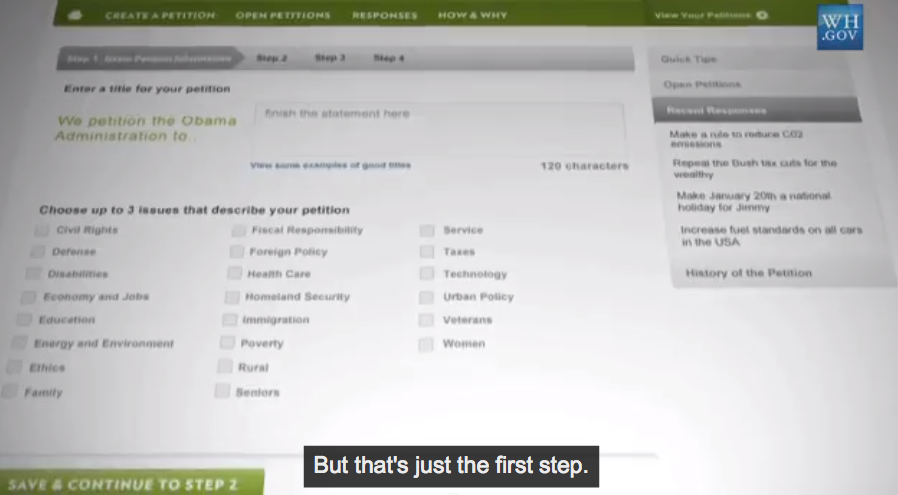
Can citizens ask questions using We The People on whatever topic they wish or will these be predefined? The screenshot below implies the latter categorization: taxonomy, not folksonomy.
Answer: “there will be a defined set of topic people can choose from but its a wide range, and there will also be ad hoc tags,” tweeted Phillips.
Will there be an API so that civic developers can visualize and analyze them to see if there are duplicates or emerging themes?
Answer: “Not now; API’s for analysis & extending petition functionality on a long list of features we we are considering for future. With [federal CIO] Steve upstairs now, thinking through how that can best work is both a priority & more informed.”
Why build this when services like PopVox, Votizen and Change exist to create social e-petitions?
Answer: “Developing We the People ourselves […] offers the flexibility to adapt to the public response to improve engagement,” tweeted Phillips. “It’s a false choice to say _either_ We the People _or_ others – there’s lots of collaboration ahead, this space is still young.”
There’s another key detail: these e-petitions would go to the executive branch, whereas Votizen and PopVox are targeted at Congress and constituent communications.
The creator of act.ly, Jim Gilliam, offered some of his own perspective and questions. “I built a petition/priority tool White House 2 back in 2008. I learned a lot, happy to share,” he tweeted to Phillips, linking to his post on White House 2.0. On this count, the White House was listening: Phillips asked Gilliam to “dm him his email address.” Here’s a look back at “imagining White House 2.0” from the 2009 Personal Democracy Forum:
“I figured out all the problems, except for one. getting the white house to pay attention. (or maybe it just took 3yrs),” tweeted Gilliam.
He highlighted two issues, one for advocates and one for White House technologists: “”How will the white house use all the email addresses it collects with new petition tool? Advocacy groups will have to decide whether to send their people to whitehouse.gov at the expense of their own list building,” he tweeted. “White house will need some serious anti-spam jujitsu to knock back the tools that scrape congressional forms.”
Perhaps most important, how will citizens know that they’re being heard by the White House, that these e-petitions matter, and that this will not be a public relations exercise that ends with a thank you letter from staff?
This goes to the issue of connecting e-petition action to results. “OpenGov has the equivalent of a “last mile” problem: a culture+digital-infrastructure gap at the workgroup level,” tweeted Dan Latorre, leader of Digital Placemaking and creator ofFixCity.org.
For instance, if enough people sign e-petitions on withdrawing from Afghanistan, supporting gay marriage, legalizing marijuana or opposing ICE takedowns of websites without judicial review, will the White House change its policy?
Stay tuned for answers [See above] and upon launch, outcomes.


 Congress may be one of the most unpopular institutions in the land but some of its staffers are continuing to work towards bringing its communications infrastructure into the 21st century.
 E Pluribus Unum