If you’re a regular reader of Govfresh or the O’Reilly Radar, you know how the chief technology officer of the U.S. Department of Health and Human Services, Todd Park ,is focused on unleashing the power of open data to improve health. If you aren’t familiar with this story, go read Simon Owen’s excellent feature article that explores his work on revolutionizing the healthcare industry. Part of unlocking innovation through open health data has been a relentless promotion and evangelization of the data that HHS has to venture capitalists, the healthcare industry and developers. It was in that context that Park visited New York’s Hacks and Hackers meetup today. The video of the meeting is embedded below, including a lengthy question and answer period at the end.
NYC Hacks and Hackers co-organizer Chrys Wu was kind enough to ask my questions, posed over Twitter. Here were the answers I pulled out from the video above:
How much data has been released? Park: “A ton.” He pointed to HealthData.gov as a scorecard and said that HHS isn’t just releasing brand new data. They’re “also making existing data truly accessible or usable,” he said. They’re taking “stuff that’s in a book or website and turning it into machine readable data or an API.”
What formats? Park: Lots and lots of different formats. “Some people put spreadsheets online, other people actually create open APIs and open services,” he said. “We’re trying to migrate people as much towards open API as possible.”
Impact to date? “The best quantification that I can articulate is the Health data-palooza,” he said. “50 companies and nonprofits updated and deployed new versions of their platforms and services. The data already helping millions of Americans in all kinds of ways.”
Park emphasized that it’s still quite early for the project, at only 18 months into this. He also emphasized that the work isn’t just about data: it’s about how and where it’s used. “Data by itself isn’t useful. You don’t go and download data and slather data on yourself and get healed,” he said. “Data is useful when it’s integrated with other stuff that does useful jobs for doctors, patients and consumers.”
How can regulations.gov, one of the primary mechanisms for government transparency and public participation, be made more useful to the public rulemaking process?
OMB is beginning the process of reviewing and potentially updating its Federal Web Policy. What policy updates should be included in this revision to make Federal websites more user-friendly and pertinent to the needs of the public?
How can we build on the success of Data.Gov and encourage the use of democratized data to build new consumer-oriented products and services?
Today, Clay Johnson offered the White House a deep set of recommendations for open government in response to the three questions it posed, including better ways to use open data, social media, improving regulations, public comment, and the developer community better. If you’re interested in open government, it’s a must-read.
We believe the future of open government is citizen focused — to be open to engagement on the terms that citizens are used to in the venues they’re accustomed to.
The growth of social media since the delivery of the initial open government directive, and its adoption by agencies’ communications departments requires the next step: for social media to also be used in giving citizens a voice in regulatory decisions. We believe the future of open government is about discoverability. Moving data or regulations from print publications to the online world results in a net loss if there are less people viewing them. Government should work hard to make sure that all publicly available information is discoverable by search engines, and via social media.
We believe that the future of open government is through the engagement of open source communities, and that agencies should begin to open up to their participation. Government treats lawyers as experts in the field of law, why not treat developers as experts in the field of processing data? Take the next step and participate with them directly, rather than through independent vessels.
The results of a new survey from the Pew Internet and Life Project will come as no surprise to most: Internet users: search and email top the list of the things people do online. These two activities have been the most popular since Pew first started tracking online behavior over the last decade. The advent of broadband, mobile devices and social media has not changed that dynamic, though it’s a safe bet that adults under 30 are sending quite a lot of Facemail, IMs and tweets these days too.
That said, Pew did identify a difference. “The most significant change over that time is that both activities have become more habitual,” writes Kristen Purcell. “Today, roughly six in ten online adults engage in each of these activities on a typical day; in 2002, 49% of online adults used email each day, while just 29% used a search engine daily.”
Search and email demographics
According to Pew’s numbers, search is most popular among adult internet users aged age 18-29, 96% of whom use search engines to find information online.
There’s also some evidence of a continuing digital divide based upon education and race. According to Pew, online adults, college-educated, and those in the highest income categories are more likely than others to use email.
“These demographic differences are considerably more pronounced when one looks at email use on a typical day,” writes Purcell. “Moreover, while overall email use is comparable across white, African-American and Hispanic online adults, internet use on any given day is not. White online adults are significantly more likely than both African-American and Hispanic online adults to be email users on a typical day (63% v. 48% v. 53%, respectively).”
These results also suggest that as exciting as the integration of social media into government may be, officials tasked with public engagement and consultation shouldn’t neglect using email to communicate with citizens, along with Facebook, Flickr, Twitter, YouTube and the other apps available to them. The difference in demographics usage of social media and email, however, does highlight that social media offers an important complementary channel to reach mobile citizens that access the Internet primarily through their mobile phones.
This Thursday at 4 PM EST, the EPA is hosting a webinar for developers to hear more from the community about what the government can do to make data more usable by developers. (Heads up, government folks: Socrata’s open data study found progress but a long road ahead, with clear need for improvement: only 30 percent of developers surveyed said that government data was available, and of that, 50 percent was unusable.)
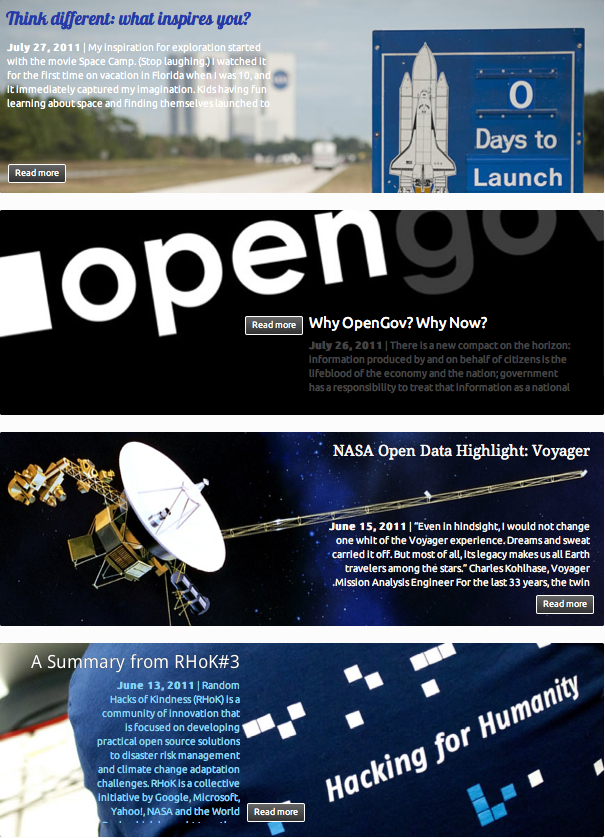
In one of the first posts on NASA’s newly relaunched open government blog, open government analyst Ali Llewellyn writes more about why adopting open government is important now, with a nod to Tim O’Reilly’s essay on “government as a platform.”
…OpenGov is not just data transparency or technology use. “Open government is an innovative strategy for changing how government works,” Beth Noveck, the original director of the White House Open Government Initiative, explains. “By using network technology to connect the public to government and to one another informed by open data, an open government asks for help with solving problems. The end result is more effective institutions and more robust democracy.”
From the beginning, democracy was supposed to be participatory. Thomas Jefferson noted in a letter how he envisioned a government where “every man…feels that he is a participator in the government of affairs, not merely at an election one day in the year, but every day.”
In the service of that vision, the National Aeronautics and Space Administration continues to extend its journey into the open government stratosphere with the launch of a redesigned open.nasa.gov. The new site complements nasa.gov/open – but doesn’t replace it. (The /open sites that exist on federal .gov websites are a direct result of the Open Goverment Directive issued by the White House Office of Management and Budget in 2009.)
The new NASA open government is a beautiful departure from standard NASA websites. In fact, it’s a lovely move away from the Web design citizens encounter at most of the thousands of federal .gov sites. In part, that’s because the new NASA open government site is built upon General Service Agency-approved technologies and the same open source platforms ( like WordPress) that you’ll find at top-notch blogs like BoingBoing. (Or Govfresh). All due credit to Nick Skytland, Chris Gerty and Sean Herron for their hard work coding and designing the site as well. Skytland, who now heads up open government at NASA, wrote in to share his vision for the site and make a request:
After months of development and many discussions, we are very excited to announce the official public launch of open.nasa.gov. The site is a collaborative platform for the open government community at NASA to share success stories and projects related OpenGov from around the agency. The content on this site is written by NASA employees and contractors (just the core OpenGov team right now). We will be highlighting the ways that transparency, participation, and collaboration are being embraced by NASA policy, technology, and culture, and the future that becomes possible because of that commitment. We would love your feedback on the site. Please let us know if you have any issues with the site so we can fix them. The site works on most browsers, but we are still working out issues with Internet Explorer.”
Aside from WordPress, the technology behind open.nasa.gov includes:
Techs used:
A WordPress theme by Landau Reece called Protean 1.0
MySQL
Apache
The Disqus commenting system
The UserVoice feedback collection tool
As I reported yesterday, NASA’s open government story now includes supplying the innovation behind OpenStack and Nebula. That said, while the technology behind the new NASA open government site and other initiatives is important to recognize, it has to be valued in terms of its ability to both host conversations and feature the people behind it. As NASA’s open government story evolves, cultural changes will be important to track, along with any technical milestones driven by open source or efficiencies driven by tightening budgets.
A note on FOIA
One of the interesting decisions that British Columbia’s government made in its adoption of open government was its decision to separate good government data, associated with transparency and accountability, from open government data, associated with innovation and co-creation.
NASA’s open government site makes no such distinction, with the link to Freedom of Information Act requests buried down at the bottom of the open data page. NASA’s open government plan includes aspirational goals of further reducing its FOIA backlog and creating a “single, Web-based system for handling all FOIA requests across the 13 NASA locations.” If the agency can do as well with that system as it has with the design, communication and coding embodied this new site, its open government team will be able to celebrate more good government achievement alongside its explorations into citizen science, random hacks of kindness, education and open data.
If you love space, science, open source and data, you’ve probably come across Ariel Waldman online. If you’re lucky, you’ve met her or heard her speak. She’ll be talking about how people are hacking space exploration at OSCON in Portland tomorrow morning. She spoke with my colleague, Edd Dumbill, about how open science is helping us all learn more about the stars.
Ariel Waldman is an open science strategist, interaction designer and the founder of Spacehack.org, a directory of ways to participate in space exploration. She currently works at Institute For The Future, a non-profit founded by early internet pioneers and ARPANET researchers. Recently, she founded Science Hack Day SF, an event that brings together scientists, technologists, designers and people with good ideas to see what they can create in a weekend.
To those in media, government or commentariot who think that cloud computing or open data might be going away in federal government after the departure of federal CIO Vivek Kundra next month, Dave McClure offered a simple message today: these trends are “inevitable.”
Cloud computing, for instance, will “survive if we change federal CIOs,” he said. “It’s here, and it’s not going away. McClure describes cloud computing as a worldwide global development in both business and government, where the economics and efficiencies created are “compelling.” The move to the cloud, for instance, is behind US plans to close or consolidate some 800 data centers,, including hundreds by the end of 2011.
Cloud computing was just one of five macro trends that McClure “listed at this year’s FOSE Conference in Washington, D.C. FOSE is one of the biggest annual government IT conferences.
inevitable. Here’s the breakdown:
1) Cloud computing
The GSA is the “engine behind the administration’s ‘cloud-first’ strategy,” said McClure, lining up the procurement details for government to adopt it. He said that he’s seen “maturity” in this area in the past 18-24 months. Two years ago, National Institute of Standards and Technology (NIST) was spending time at conferences and panels defining it. Now we have cloud deployments that are robust and scalable, said McClure, including infrastructure as a service and email-as-a-service.
Government cloud deployments now includes public facing websites, storage, disaster recovery andare beginning to move into financial apps.
2) Collaboration and engagement
The cloud is teaching us that once we free data, make it accessible, and make it usable, it’s
creating opportunities for effective collaboration with citizens, said McClure, noting that this trend is in its “early stages.”
3) Open data and big data
Data.gov has “treasure troves” of data that entrepreneurs and citizens are turning into hundreds of applications and innovations, said McClure. Inside of government, he said that access to data is creating a “thirst” for data mining and business intelligence that help public servants work more efficient.
4) Mobile
Mobile computing will be the next wave of innovation, said McClure, delivering value to ourselves and delivering value to citizens. Government is “entrenched in thinking about creation of data on websites or desktop PCs,” he said. That perspective is, in this context, dated. Most of the audience here has a smartphone, he pointed out, with most interactions occurring on the hip device. “That’s going to be the new platform,” a transition that’s “absolutely inevitable,” he said, “despite arguments about digital divide and broadband access.”
5) Security
As McClure noted, you have to include security at a government IT conference. The need for improved security on the Web, for critical infrastructure, on email and where ever else government has exposed attack surface is clear to all observers.
The federal government is hosting a hackathon focused on unlocking the value from the newly opened click data from its URL shortener. Organizers hope the developer community can create apps that provide meaningful information from the online audience’s activity. Later this month, USA.gov has organized a nationwide hack day, inviting software developers, entrepreneurs, and citizens to engage with the data produced by 1.USA.gov, its URL shortener.
The USA.gov hackathon fits into a larger open government zeitgeist. Simply put, if you enjoy building applications that improve the lives of others, there may never have been a better time to be alive. Whether it’s rethinking transportation or convening for a datacamp, every month, there are new hackathons, challenges, apps contests and code-a-thons to participate in, contributing time and effort to the benefit of others. This July is no exception. Last Saturday, Google Chicago hosted a hackathon to encourage people to work on Apps for Metro Chicago. On the Saturday after OSCON, an API Hackday in Portland, Oregon for “an all-day coding fest focused on building apps and mashups.” If you’re free and interested in participating in a new kind of public service, on July 29th, hack days will be hosted by USA.gov in Washington, D.C., Measured Voice in San Diego, bitly* in New York City, and SimpleGeo in San Francisco. If New Yorkers still have some fire in your belly to collaborate with their local government, the city of New York is hosting its first-ever hackathon to re-imagine NYC.gov on July 30-31.
How URL shorteners and 1.USA.gov work
To understand why this particular set of open data from USA.gov is interesting, however, you have to know a bit more about USA.gov and how social media has changed information sharing online. A URL is the Web address, like, say, oreilly.com, that a citizen types into a Web browser to go to a site. Many URLs are long, which makes sharing them on Twitter or other mobile platforms awkward. As a result, many people share shortened versions. (O’Reilly Media links are shortened to oreil.ly, for instance.) One of the challenges that face users is that, unless a citizen uses one of several tools to view what the actual hyperlink is below the link, he or she might be led astray or exposed to malicious code that was included in the original link. In other words, this is about being able to trust a link.
Last year, the United States General Services Administration (GSA) launched a Go.USA.gov URL shortener at the Gov 2.0 Expo in Washington, D.C. Whenever a government employee used Bit.ly (or any service that uses Bit.ly to shorten URLs, like Tweetdeck) to shorten a .gov or .mil URL, the link will be converted to a short go.USA.gov. That meant that whenever a citizen saw a go.usa.gov short URL on a social network, she knows the content came from an official government source.
For more on how Go.USA.gov URLs work, watch Michele Chronister’s presentation from the last year’s Gov 2.0 Expo, below. Chronister is a presidential management fellow and Web content manager for USA.gov in the Office of Citizen Services and Innovative Technologies at the GSA.
This March, the GSA added a 1.USA.gov URL shortener for civilian use. “The whole idea is to improve people’s experience when dealing with government information online,” explained Jed Sundwall, a contractor for USA.gov and GobiernoUSA.gov, via email. “We keep USA.gov in the domain for usability reasons. It’s crystal clear, worldwide, that 1.USA.gov URLs point to trustworthy government information.”
According to Sundwall, ABC senior White House correspondent Jake Tapper was the first to use it when he tweeted out a link to a PDF containing new unemployment information at the Bureau of Labor and Statistics: “For those asking follow-ups on unemployment, here’s the BLS link http://1.usa.gov/XUtpL“
Months later, Tapper has been followed by thousands of other people that have used the 1.USA.gov URL shortener simply by using the tools there already knew.”The beauty is that Jake used it without knowing he was using it,” writes Sundwall.”We’re trying making it easy for anyone to identify .gov information as it’s being shared online.”
That easy identification is quite helpful given the increasing pace of news and information sharing on the Web. “Trust is a valuable thing online, and being able to know that the information you’re receiving is reliable and accurate is difficult yet essential — especially so for government websites, where people go for critical information, like health services and public safety,” wrote Abhi Nemani, director of strategy and communications for Code for America.
Code for America is “excited to be partnering them to help bring together passionate developers, designers, and really anyone interested to see what we can hack together with the data,” wrote Nemani. The 1.USA.gov hackathon will tap into “a huge and growing resource for new and really interesting apps,” he wrote at the Code for America blog. “See, this data gives a lens into how people are interacting with government, online; an increasingly important lens as citizen/government interaction moves from the front desk or the phone line to the web browser.”
To learn a bit(ly) more about the hackathon and its goals, I conducted an email interview with Michele Chronister and Sundwall.
What does the GSA hope to achieve with this hackathon? How can open data help the agency achieve the missions taxpayers expect their dollars to be applied towards?
Chronister: We hope to encourage software developers, entrepreneurs, and curious citizens to engage with the data produced by 1.USA.gov. 1.USA.gov data provides real-time insights into the government content people are sharing online and we know hack day participants will surprise us with creative new uses for the data. We anticipate that what’s produced will benefit the government and the public. Making this data public expands GSA’s commitment to open, participatory and transparent government.
What hacks can come of this that aren’t simply visualizing the most popular content being shared using 1.USA.gov?
Sundwall: First of all, the issue of popular content is an important one. Before this data set, no one has had such a broad view of how government information is being viewed online. Getting a view of what’s popular across government in real time is a big deal, but a big list of popular URL’s isn’t killer per se.
The data from 1.USA.gov includes a lot of data beyond just clicks, including clickers’ browser version (firefox v ie, mobile v desktop, etc) and IP-derived geo data. It’s also real time. This allows people to look at the data across a number of different dimensions to get actionable meaning out of it. A few ideas:
1. Geo data. The geo data included in the 1.USA.gov feed is derived from IP addresses, which makes it intentionally imprecise for privacy reasons (we don’t show the IP address of each click), but precise enough to spot location-based trends.
One of the reasons we brought SimpleGeo on as a collaborator for the hack day is because they’re really good at making location data easy to work with. Their Context product makes it easy to filter clicks through a number of geographic boundaries including legislative districts. They also make it easy to mash the data up with Census demographic data.
We want to let journalists, analysts, campaign strategists, and other researchers know that 1.USA.gov data is a powerful tool to spot trends in the areas where they work. I gave a demo of 1.USA.gov to Richard Boly at the State Dept soon after we launched 1.USA.gov and thought it could be a tool for country desk officers to spot trends in their countries. Hint: if you’re coming to the hack day, think about building something like this.
We hacked together a quick video showing click data mapped out across the US for most of June: red dots are non-mobile clicks and green are mobile. It’s a blunt visualization, but it’s fascinating to watch the clicks pulse across the country, from the east to west in the morning, and then from red to green when people leave their desks and get on their phones.
We could enhance visualizations like this to see if there are trends in how particular kinds of information are shared throughout cities and across the country. I wouldn’t be surprised if clicks on certain links from certain agencies turn out to be leading indicators—perhaps municipal leaders should pay attention to spikes in clicks on hud.gov links.
2. Browser data. We log, on average, about 56,000 clicks on 1.USA.gov links per day. It’s not a ton of data like Google, but the 1.USA.gov dataset provides a really nice sample of user behavior—particularly social media users because the short URLs are most frequently shared and clicked via Twitter and FB.
I’m hoping 1.USA.gov data can be useful to people tracking trends in browser adoption and trends in mobile usage. The data science team at bitly is already doing this kind of analysis with their much larger set of click data, but we’re really excited to give a slice of that data out to researchers for free.
3. Contextual data. Each link points to a file that is likely to include some amount of machine readable content such as an HTML page title, meta description, body content, etc. Many links, if not most, are shared via Twitter. Both the content of the link’s file and the content of the tweet that included the link when it was shared provide insight into not just what links people are sharing, but what topics people are talking about.
What are some of the early successes — and failures — that inform how the GSA is approaching its open data initiatives? And how will it all relate to citizen engagement?
Chonister: Data.gov has successfully built a community of people interested in government data and we hope to expand on that by making USA.gov’s data more available. One part of this is releasing the 1.USA.gov click data to the public. We also provide XML for all of our frequently asked questions on answers.usa.gov and a product recall API. These resources can be found at www.usa.gov/About/developer_resources/developers.shtml
We know that raw government data is not interesting or useful to everyone which is why we are trying to engage specific communities with the hack day. Hopefully any tools created in the hack day will help engage a larger audience and show what’s possible when government opens their data and makes it available.
What are some useful examples of “infohacks” where someone can easily find useful information already?
Sundwall: USA.gov actually used a method to finding useful government information from 1.USA.gov (and Go.USA.gov) by instructing people to search for USA.gov + tsunami on Twitter after the Japan earthquake in early March — this was the best way for people to find the best government information about the tsunami at the time. It allowed us to crowdsource the best government resources about the tsunami by relying on what everyone on Twitter was already finding and sharing. You won’t see this now, but at the time, the search results featured a few “top tweets” pointing to useful government information. 1.USA.gov let us know it was authoritative even though it was being shared from non-govt Twitter accounts like @BreakingNews.
This Twitter search trick is one of my favorite hacks. I subscribe to RSS feeds of USA.gov + awesome and USA.gov + cool and find great crowdsourced govt information every day. Just last week, this tweet inspired this blog post, which ended up being the most popular post on the USA.gov blog ever.
How else could this bit.ly data be made more useful to citizens – or government?
Sundwall: Researchers could use this Twitter search method to be notified of new information by subscribing to searches like USA.gov + cancer, USA.gov + human rights, USA.gov + Afghanistan, etc. I sometimes get a kick out of searching “USA.gov + wtf.” I’m a nerd.
What’s the incentive for developers to donate their time and skill to hacking on this data?
Sundwall: This is the best question. I hope some of the ideas I’ve presented above give an idea of how powerful this dataset is. This is the kind of information that organizations usually regard as proprietary because it gives them intelligence that they don’t want their competitors to have. I’m really really proud to work with the folks at USA.gov because opening up this dataset reveals a deep understanding of how open data can work.
USA.gov wants to help people by helping them find the government information they need. This data will allow other people to join them in this endeavor. As Tim says, “Create more value than you capture.” I hope that people will recognize the value in this data and create tools, apps, more efficient research methods, and perhaps even businesses based on it. I’m certain this data will prove to be valuable to many people who will discover applications of it that we haven’t imagined yet.
*Editor’s Note: bit.ly is funded by O’Reilly AlphaTech Ventures.
As social media becomes more integrated into the world’s political, educational and economic fabric, more and more organizations have moved from asking “what it is” to “how to do we use it?”
Today in Big Sky, Montana, the Western Association of Fish and Wildlife Agencies hosted a summer meeting with a plenary session on Gov 2.0 that included:
a talk on about rethinking a more mobile government from Peter Corbett, “Apps for Fish & Wildlife”
a discussion of social media and the FBI
a talk on “Citizen 2.0” from Microsoft’s Mark Drapeau
Kim Hart and Michelle Quinn published a new trends piece in Politico this morning, covering the exit of technology innovators from the White House. They tap into something important here that her sources, including Ellen Miller of the Sunlight Foundation and Micah Sifry of techPresident, validate: some of the primary drivers of the technology initiatives that marked the Obama administration’s first two years in office have departed. Vivek Kundra, the nation’s first CIO, Andrew McLaughlin, Beth Noveck, Jim Kohlenberger, Scott Deutchman and Phil Weiser have all decided to move on. If you follow Govfresh and the O’Reilly Radar, you know we’ve been tracking many of those stories and people.
One is the normal transition between presidential terms. It’s unusual for senior staff White House to remain for all four years, due to the exhausting, round-the-clock schedule. Another is certainly the culture of the startup meeting the realities of government, as many publications and participants recognize. “I think tech entrepreneurs in government service is a bit of an oxymoron,” Miller said to Politico’s MorningTech. “Someone who is an entrepreneur is able to execute and test and fail. … I can imagine there’s a mismatch in DNA in terms of being able to control and execute as quickly as they can in the private sector.”
If you followed the path of Katie Stanton from Google to the White House to the State Department to Twitter, you’d find a case study in that reality. When Stanton reflected on Washington, explaining to Nancy Scola that “being used to a fast-paced environment that isn’t afraid to fail, where risk-takers are rewarded, government is just a very different environment.” If you pick up Steven Levy’s excellent book on Google, In the Plex, you’ll read a longer discussion of what happened when Googlers go to Washington and come up against the different culture inside the Beltway.
As MIT research professor Andrew McAfee aptly observed, this is Gov 2.0 vs the Beast of Bureaucracy, and it’s not a conflict that is going to be solved in a few years or in any single administration. The bloom is off the rose, in terms of the hopes in 2009 that the adoption of Web 2.0 technologies, cloud computing and strategies from the private sector would radically change the federal government. The issues that plague government IT or Washington in general are a tough nut to crack, even for the brain trust in Silicon Valley. It’s even harder to attract and retain those minds to serve in government, as this Politico article narrates. If the country is going to solve the immense challenges that confront it in the 21st century, attracting and retaining geeks in government should be a national priority. The gap between Washington, VCs, entrepreneurs and Silicon Valley culture will have to narrow, whether through smarter immigration policies or innovation centers far outside of the Beltway.
When Quinn and Hart wrote that tech experts exit the White House, however, they for some reason failed to report that others have stepped up to take their place. I leave it to others to speculate about why that might be. For the moment, let the record show that there will be other techies serving in the White House.
And one of the biggest guessing games in government technology right now is who will fill Kundra’s shoes as the nation’s second CIO – a story which Politico itself has covered.
For many open government advocates, the shoes left unfilled that may cause the great consternation are those of Norm Eisen, the White House “ethics czar” that President Obama appointed to be ambassador of the Republic of Czech.)
There will be more tech talent that steps up to help the White House, but it’s safe to say they’ll be realistic about what can be accomplished in an election season where any decision will have political consequences.
Wither open government?
The departure of Kundra has caused a great deal of consternation in the open government community, particularly after a sensationalist op-ed on a Washington Post
by Vivek Wadhwa proclaimed the “coming death” of the movement. While Luke Fretwell forcefully rebutted Wadhwa here at Govfresh, essentially calling him wrong about open government, the lingering impression remains in the community that open government is in trouble. That feeling is part of longer continuum of criticism that reaches back into 2010, when it was already clear that open government was in beta and would continue to be, regardless of new open government platforms coming online or open data success at HHS. Advances and setbacks in open government will continue in Washington.
There will be new tech advisors that come into and leave the Obama administration (Harper Reed, for instance, has joined the campaign side as a CTO) but the future of open government won’t be borne solely upon their ability to innovate inside of government. Ultimately, in a new era of technology-fueled transparency, innovation and open government dawns around the world, it won’t depend on any single CIO or federal program. It will be driven by a distributed community of media, nonprofits, academics and civic advocates focused on better outcomes, more informed communities and the new news, whatever form it is delivered in. Advocates, watchdogs and government officials will have new tools for data journalism and, over time, open government. Globally, transparency movement is growing. Look to the launch of an Kenya’s open government data platform today and the lifted hopes of Kenya’s people for example, or new transparency initiatives in Britain for inspiration.
The growth of citizen science and open data hint at our collective future. Open government is about all of us, whether the White House steps up to the plate to reinvigorate its open government directive or not.





 E Pluribus Unum