United States releases second Open Government National Action Plan

This morning, the White House released its second action plan (PDF) for improving the state of open government in the United States. The action plan is required for U.S. participation in the Open Government Partnership, an international, multilateral initiative that seeks to push nations to make and keep commitments to open government.

“This second National Action Plan is another opportunity to set concrete and measurable goals for achieving a more transparent, participatory, and collaborative government,” wrote Nick Sinai, United States deputy chief technology officer and Gayle Smith, special assistant to the president and senior director for development and democracy, at the White House blog. “We look forward to working alongside civil society to carry out these commitments and continue identifying new ways to open our government in the future.”
open gov nap 2.0

As I previously reported, the action plan commits to modernizing the Freedom of Information Act, open more government data, improve the management of natural resources and engage citizens in innovation. Additionally, the final plan (a draft was released earlier this fall) includes commitments to join the Global Initiative on Fiscal Transparency  (GIFT), promote participatory budgeting, increase the transparency of spending and foreign assistance, improve the participation of the public in rulemaking and a number of other measures that expand existing commitments.

Initial reactions from open government advocates — many of whom, it must be said, worked to shape the contents of the plan — are strongly positive.

“The United States helped found the Open Government Partnership to challenge other countries to make concrete commitments to make themselves more transparent and accountable to the people,” said Patrice McDermott, executive director of OpenTheGovernment.org, in a statement.

“This plan shows that the US is also serious about challenging itself. While we have been critical of some of this Administration’s decisions, particularly its continued insistence on walling off all information related to national security, this plan begins to break down that wall and advance open government.”

Sean Moulton, director of open government policy at the Center for Effective Government, was similarly positive about the plan:

We are impressed by the scope and detail of the plan, as well as the administration’s commitment to continue to engage and refine those commitments for which detailed goals are not yet available. This broad and ambitious plan tackles important open government issues that we have long been advocating, including: 1) strengthening the Freedom of Information Act (FOIA), 2) improving information about government spending, and 3) continuing to open government data to the public. Properly implemented, these commitments can make government openness work for the public and change how government operates. The Center for Effective Government looks forward to working with the administration to ensure the outlined goals are executed over the next two years.

Sunlight Foundation policy director John Wonderlich balanced good with the bad in the plan:

There are some new and meaningful commitments. The proposed FOIA advisory board and committee could be transformative, and commitments to greater transparency in the extractives industry extend the significant new commitments that began in the US’s last plan.

More disappointing are the commitments around spending transparency, which would build on existing efforts to improve federal spending transparency in Congress and the federal government, but but offer only vague commitments. The National Action Plan also outlines a process to ensure federal agencies treat their data as an asset that should be open to the public, (long a Sunlight priority), but without adding much new detail to a process that is already well along its path.

And money in politics, like in the first National Action Plan, is missing entirely.

The measures that are likely to draw the most attention are those that relate to electronic surveillance and national security, and to whistleblower protections.

On that count, the second U.S. national action plan for open government includes measures to increase the transparency of foreign intelligence surveillance activities (largely mirroring the measures President Obama has already introduced this fall and repackaging the commitments made by the intelligence community) and to “strengthen and expand whistleblower protections for government personnel.” I include both below:

6. Increase Transparency of Foreign Intelligence Surveillance Activities
In June 2013, the President directed the U.S. Intelligence Community to declassify and make public as much information as possible about certain sensitive intelligence collection programs undertaken under the authority of the Foreign Intelligence Surveillance Act (FISA), while being mindful of the need to protect national security. Nearly two thousand pages of documents have since been released, including materials that were provided to Congress in conjunction with its oversight and reauthorization of these authorities. As information is declassified, the U.S. Intelligence Community is posting online materials and other information relevant to FISA, the FISA Court, and oversight and compliance efforts. The Administration has further committed to:

• Share Data on the Use of National Security Legal Authorities. The Administration will release annual public reports on the U.S. Government’s use of certain national security authorities. These reports will include the total number of orders issued during the prior twelve-month period and the number of targets affected by them.

• Review and Declassify Information Regarding Foreign Intelligence Surveillance Programs. The Director of National Intelligence will continue to review and, where appropriate, declassify information related to foreign intelligence surveillance programs.

• Consult with Stakeholders. The Administration will continue to engage with a broad group of stakeholders and seek input from the Privacy and Civil Liberties Oversight Board to ensure the Government appropriately protects privacy and civil liberties while simultaneously safeguarding
national security.

9. Strengthen and Expand Whistleblower Protections for Government Personnel
Employees with the courage to report wrongdoing through appropriate, legally authorized channels are a government’s best defense against waste, fraud, and abuse. Federal law prohibits retaliation against most government employees and contractors who act as whistleblowers, and those protections were strengthened by recent legislation and Executive action. However, some who work for the Government still have diminished statutory protections. The Government must also ensure that Federal employees know their rights. Therefore, the Administration will:

• Mandate Participation in the Office of Special Counsel Whistleblower Certification Program. To ensure that Federal employees understand their whistleblower rights and how to make protected disclosures, the Administration will require covered agencies to complete the U.S. Office of Special Counsel’s program to certify compliance with the Whistleblower Protection Act’s notification requirements.

• Implement the Presidential Directive on Protecting Whistleblowers. The U.S. Government will continue to work to implement the President’s October 2012 Policy Directive on Protecting Whistleblowers with Access to Classified Information (PPD-19), including by ensuring strong, independent due process procedures; awareness of protections; and agency understanding of the protections available to government contractors under the directive.

• Advocate for Legislation to Expand Whistleblower Protections. With the Administration’s support, Congress recently enacted legislation to strengthen whistleblower protections for most Federal Government employees and contractors, but there are still gaps in statutory protections available to certain government employees and contractors. The Administration will continue to work with Congress to enact appropriate legislation to protect these individuals.

• Explore Executive Authority to Expand Whistleblower Protections if Congress Does Not Act. While statutory protections are preferable, the Administration will explore additional options for utilizing Executive authority to further strengthen and expand whistleblower protections if Congress fails to act further.

“This is big news in my mind,” writes Nathaniel Heller, executive director of Global Integrity. “Yes, the commitments to greater disclosure around surveillance activities are largely retread and don’t go nearly far enough. But for these issues to have made their way into a US National Action Plan is an important first step towards broadening the open government agenda to include “new frontiers” or “thorny” issues. That’s a big deal and a win.”

As with so many aspects of government announcements regarding measures to hold themselves more accountable or become more transparent, the most important part of this plan will be not be the words themselves but in how they are interpreted and implemented by this administration and those to follow. To date, after bold rhetoric in 2009, the Obama administration’s record on open government is mixed, with ongoing challenges regarding transparency on Healthcare.gov’s performance. There’s also precious little acknowledgment of concerns about press freedoms in the plan. Heller would also have liked to have seen something on corporate ownership:

The administration remains silent on public registries of beneficial owners of companies,” he writes. “Sigh. David Cameron and the UK government made a pioneering commitment to public registries of who really owns UK companies at the OGP summit in London. The US is now in the awkward position of having to defend keeping this valuable data private to only government regulators and investigators. That’s an increasingly thin reed. There’s certainly opposition to public registries in Congress, but the White House could have at least committed to publicly pushing for public registries. Instead, mum’s the word.

Steven Aftergood expressed some concerns about the administration’s new goals on open government, focusing on his wheelhouse, overclassification and pervasive secrecy. As he noted, the plan also includes a measure to improve declassication:

…a new interagency Classification Review Committee is being established with White House leadership to evaluate proposals for classification reform, and to coordinate their implementation throughout the executive branch.  The creation of such a body was the primary recommendation of the Public Interest Declassification Board last year, and it was strongly endorsed by public interest groups.

Both because of its interagency character and especially due to its White House leadership, the new Committee has the potential to overcome the autonomous classification practices of individual agencies that have contributed to the explosive growth in secrecy.

Positive results are naturally not guaranteed.  The Administration has not embraced an explicit theory of how overclassification occurs, or even how overclassification is to be defined, and therefore it is not yet well-equipped to address the problem.

The new Plan notes that in June of this year President Obama directed the Intelligence Community to declassify and make public “as much information as possible” about intelligence surveillance programs. But in an optimally functioning classification system, the President’s directive would have been redundant and unnecessary; the system would already be declassifying as much information as possible.

Of course, the existing classification system is not functioning optimally. That is the problem.  So either the President needs to issue individualized directives to all agencies on every conceivable classified topic to “declassify as much as possible,” or else the new White House interagency Committee needs to find alternate means to effectively communicate the same imperative.

Wonderlich also expressed a deeper concern about the plan: its lack of ambition, focus upon political power and personal investment or commitment of political capital from President Obama.

Unfortunately, if we imagine what a National Action Plan could be with a committed, engaged President, and senior political staff at the White House who discuss and engage with integrity issues, rather than treating them as political liabilities, we imagine a wholly different world. Incremental working groups and vaguely redundant reporting procedures would be replaced by bold proposals that affect political and state power, and we’d see a White House that talks more about the transparency we’re building than the transparency they use as a shield against critics. That’s clearly not the National Action Plan the White House released today.

All that being said, the fact that these measures are in the plan shows that the Obama administration has heard the criticism of civil society regarding secret surveillance laws, overclassification, and prosecuting whistleblowers and included elements addressing them.

That’s better. Let’s see what they do next.

This post has been updated with reactions from  open government advocates over time.

Report by Committee to Protect Journalists hammers Obama administration record on transparency

Leading the day in the world of open government is a mammoth report from the Committee to Protect Journalists on the Obama administration and the press, by Leonard Downie Jr., with reporting by Sara Rafsky.

Much of this won’t be new to those who have been tracking secrecy, over-classification, prosecution of whistleblowers and selective disclosure of favorable information using new media and leaks — all core open government issues — but this pulls together those issues into a coherent whole. Abstract:

“U.S. President Barack Obama came into office pledging open government, but he has fallen short of his promise. Journalists and transparency advocates say the White House curbs routine disclosure of information and deploys its own media to evade scrutiny by the press. Aggressive prosecution of leakers of classified information and broad electronic surveillance programs deter government sources from speaking to journalists.”

While I find prosecution of whistleblowers, insider threats and the aggressive surveillance of journalists investigating national security and the surveillance state (meta!) to be particularly problematic, there are also significant issues around FOIA compliance and access to officials.

“The administration’s war on leaks and other efforts to control information are the most aggressive I’ve seen since the Nixon administration,” writes Downie

As press freedom goes, so to does open government and democracy. I’ll be making this point strongly in London in a few weeks.

White House asks for feedback on second National Action Plan for Open Government

As the annual Open Government Partnership conference draws near, the White House would like the people to weigh in on building a more open government. The request for feedback parallels the one made two years ago, when the White House engaged civil society organizations regarding its open government efforts, and follows up on a July 3 post on open government on the White House blog.

WhiteHouse-EOB

Here are the questions that they’d like help answering:

  1. How can we better encourage and enable the public to participate in government and increase public integrity? For example, in the first National Action Plan, we required Federal enforcement agencies to make publicly available compliance information easily accessible, downloadable and searchable online – helping the public to hold the government and regulated entities accountable.
  • What other kinds of government information should be made more available to help inform decisions in your communities or in your lives?
  • How would you like to be able to interact with Federal agencies making decisions which impact where you live?
  • How can the Federal government better ensure broad feedback and public participation when considering a new policy?
  1. The American people must be able to trust that their Government is doing everything in its power to stop wasteful practices and earn a high return on every tax dollar that is spent.  How can the government better manage public resources? 
  • What suggestions do you have to help the government achieve savings while also improving the way that government operates?
  • What suggestions do you have to improve transparency in government spending?
  1. The American people deserve a Government that is responsive to their needs, makes information readily accessible, and leverages Federal resources to help foster innovation both in the public and private sector.   How can the government more effectively work in collaboration with the public to improve services?
  • What are your suggestions for ways the government can better serve you when you are seeking information or help in trying to receive benefits?
  • In the past few years, the government has promoted the use of “grand challenges,” ambitious yet achievable goals to solve problems of national priority, and incentive prizes, where the government identifies challenging problems and provides prizes and awards to the best solutions submitted by the public.  Are there areas of public services that you think could be especially benefited by a grand challenge or incentive prize?
  • What information or data could the government make more accessible to help you start or improve your business?

The White House is asking that feedback be sent to opengov@ostp.gov by September 23 and states that it will post a summary of submissions online in the future.

If you’re in the mood to weigh in, there just might be a few other pressing issues that deserve to be addressed in the plan, from compliance with the Freedom of Information Act to press freedom to surveillance and national security.

A note on email, public engagement and transparency

In a post regarding the White House’s call for input, Nextgov reporter Joseph Marks is skeptical about using email to solicit feedback, suggesting instead that the administration return to the approach of 2009, when the transition team asked the public at large to weigh in on open government.

“When seeking advice on open government, it seems natural to make that advice itself open and transparent,” writes Marks. “This could be done using a plain old comments section. Even better, the White House could have engaged the public with a crowdsourcing platform such as IdeaScale, which allows users to vote ideas up and down. That way the public could participate not just in offering ideas but in choosing which ones merit further consideration.”

People who have been following the thread around the drafting of the U.S. “national action plans” for open government know, however, that a similar call for feedback went out two years ago, when the White House asked for comments on the first version of the plan. At the time, I was similarly skeptical of using email as a mechanism for feedback.

Writing on Google+, however, open government researcher Tiago Peixto, however, posited some reasons to look at email in a different light:

My first reaction was similar to that of some other observers: e-mail consultations, in most cases, are not transparent (at least immediately) and do not foster any kind of collaboration/deliberation.

But this comes rather as a surprise. Even though Sunstein might have some reserves towards deliberative models he is a major scholar in the field of decision-making and – to put it in fashionable terms – solutions to tap the crowd’s expertise. In fact, judging from this, one might even expect that Sunstein would take the opportunity offered by the OGP to create some sort of “prediction market”, one of his favorite mechanisms to leverage the knowledge dispersed across the public. In this case, why would they solicit online feedback via e-mail?

Thinking of email as a practical, last-minute choice is a possible explanation. But in the spirit of open interpretation (nowadays everything needs to be preceded by the word “open”), I am thinking of an alternative scenario that may have led to the choice of e-mail as the channel to gather input from the public online:

A possible hypothesis is that Sunstein might have been confronted by something that is no news to federal government employees: they have a very limited number of tools that they are actually allowed to use in order to engage with the public online. Having a limited number of options is not a bad thing per se, provided the options available are good enough. In this sense, the problem is that most of the tools available (e.g. ranking, ideation) do not meet reasonable standards of good “choice architecture”, to use Sunstein’s terms. One might imagine that as Sunstein went through the different options available, he foresaw all the effects that could be generated by the tools and their design: reputational cascades, polarization, herding… In the end, the only remaining alternative, although unexciting, was e-mail. In this case at least, preferences are independently aggregated, and the risks of informational and social influence are mitigated.

Maybe the option of using e-mail to solicit inputs from the public was just a practical solution. But thinking twice, given the options out there, I guess I would have opted for e-mail myself.

From where I sit today, the White House might be better off trying a both/and strategy: solicit feedback via email, but also post the draft action plan to Github, just like the open data policy, and invite the public to comment on proposals and add new ones.

The lack of public engagement around the plan on the primary White House Twitter, Facebook and Google+ accounts, however, along with the rest of the administration’s social media channels, suggests that feedback on this plan may not a top priority at the moment. To date, federal agencies are not using social media to ask for feedback either, including the Justice Department, which plays an important role in Freedom of Information Act policy and requests.

At least they’re using the @OpenGov and @WhiteHouseOSTP accounts:


White House names “champions of change” for local open government and civic hacking

On June 27, the White House asked for nominations for civic hackers that have built tools that helped to meet the needs of the public. This morning, the Obama administration honored 15 different Americans for their work on open government and “civic hacking.”

The event was part of the ongoing “Champions of Change” program, where the work of Americans in their communities is at the White House. The stories serve as a reminder that in order for local governments work to deliver smarter government, people must step up to lead, organize, collaborate, create and code those better outcomes. Technology itself is not enough. For more examples, look to last year’s champions of change for local government innovation.

One notable detail that emerged from today: Intel announced that it will be funding some open government projects.

Politico’s Morning Tech reported that Intel will fund some of the projects created at the National  Day of Civic Hacking to the tune of some $20,000 – a piece. “It’s unclear how many they’ll support, but the chipmaker will pick projects that envision a more data-oriented society and use datasets from a diverse array of industries,” wrote Alex Byers. “They’ll announce the recipients over the next few weeks.” (If any readers hear of such grants, please let me know.)

Following is a small sample of tweets from or about the event, followed by a list of the men and women who were honored today, biographies provided by the White House press office, and links to their organizations and/or work. I’ll post video when it’s available.

Steve Spiker, Director of Research & Technology at the Urban Strategies Council Moraga, CA

Steve Spiker (Spike) is the Director of Research & Technology at the Urban Strategies Council, a social change nonprofit supporting innovation and collaboration based in Oakland for almost 25 years. He leads the Council’s research, spatial analysis, civic innovation, open data, and technology efforts. Spike has research experience in community development, housing, criminology, spatial epidemiology and reentry issues. He loves data, visualization, GIS and strategic technology implementation, especially open source tech. Spike is the co-founder of OpenOakland, a Code for America Brigade and is helping guide government technology decisions and civic engagement in the East Bay. In 2012 Spike was chosen as one of the Next American City Vanguard class. He is an outspoken supporter of open data and open government and speaks across the USA about data driven decision making. He also campaigns to end human trafficking and runs Stealing Beauty Photography.

Travis Laurendine, Founder and CEO of LA Labs New Orleans, LA

Travis Laurendine doesn’t fit in the typical bio box any more than his hair fits into the typical hat. As a serial entrepreneur he has been on the cutting edge of both the web startup and entertainment industry for nearly 10 years. He launched his first web startup while an Economics major at Vanderbilt University, where he was also selected as the first Vanderbilt student with a film to make it in the Nashville Film Festival. When Hurricane Katrina struck his hometown of New Orleans, he stayed back in the city and found himself wearing the hats of startup CEO, concert promoter, restaurant general manager, standup comic, film/video producer and director, MTV News journalist, band manager/agent, investor, hackathon organizer, Entrepreneur-In- Residence, and cultural ambassador. Recently, he founded Louisiana’s first hackathon organization, CODEMKRS, which is currently being transformed into Louisiana’s only modern code school. This summer he has organized hackathons for giant music festivals JazzFest and Bonnaroo and is currently planning San Francisco’s Outside Lands’ first hackathon. His official job is being the founder and CEO of LA Labs, a startup laboratory focused on the marriage of entertainment and technology that uses New Orleans as the ultimate creative incubator. He is thankful for his loving family and friends and the daily inspiration he gets from the great city of New Orleans.

Scott Phillips, Co-Founder and CEO of Isocentric Networks Tulsa, OK

Scott Phillips is the co-founder and CEO of Isocentric Networks, an advanced data center services company based in Tulsa, OK. He was previously the founder and CEO of a sensor technology company whose work included a project for NASA for use on a manned mission to Mars. Scott is also a founding board member of Fab Lab Tulsa, a 21st Century non-profit community center for innovation, entrepreneurship, and STEM education through a partnership with the Massachusetts Institute of Technology. Scott’s current passion lives at the nexus of entrepreneurship, the maker movement, and civic hacking, three transformative movements that he believes are democratizing how we live, work and play. According to Scott, it is easy to understand the impact of civic hacking on government when you view it in three steps; give citizens transparency, give citizens a voice, then give citizens ownership.

George Luc, Co-Founder and CEO of GivePulse Austin, TX

George Luc is Co-Founder and CEO of GivePulse, a social network that matches people to causes and enables nonprofits, companies and affinities to manage volunteers, list events and track service hours in one central community. GivePulse launched earlier this year in 2013 and has since tracked over 100K service hours and mobilized over 5K volunteers in Austin alone. George has a BS and MS in Computer Science from Virginia Tech with an emphasis in Human Computer Interaction. He spent much of his early career developing technology for people with disabilities and has worked with companies like Daylert, IBM, ESO and HomeAway. He serves as a board member of City of Austin Volunteer & Service, Austin Convention Center and Visitor’s Bureau, KLRU, Open Door Preschool, and was a City Commissioner for Austin Mayor’s Committee for People with Disabilities.

Craig Michael Lie Njie, CEO, Kismet World Wide Consulting Mountain View, CA

Mr. Lie Njie is CEO of Kismet World Wide Consulting, which he founded in 2002. Lie has over 20 years of professional experience and currently consults world-wide on a variety of topics including privacy, security, technology design and development, education, entrepreneurship, management, sales and marketing, and mobile application development. Lie was given his name as an honorarium for his three years of service (2005-2008) as a Peace Corps Volunteer in The Gambia, West Africa, where he designed, deployed, and taught the first two years of The Gambia’s first Bachelor’s in Computer Science program at the University of The Gambia (UTG). Today his program is still successful and sustainable. After returning from the Peace Corps, Lie recruited and managed a volunteer team to build and release the free WasteNot iOS app to help people world-wide share their good ideas for reducing environmental impact. He furthermore helped the United Nations as a technology consultant and researched and documented the privacy risks of health and fitness mobile apps.

Christopher Whitaker, Project Management Consultant at the Smart Chicago Collaborative, Chicago, IL

Christopher Whitaker is a project management consultant at the Smart Chicago Collaborative, utilizing his experience in government and community organizing to advance civic innovation in Chicago. Whitaker also serves as the Chicago Brigade Captain for Code for America, supporting civic hacking events and teaching a weekly Civic Hacking 101 class. He is a graduate of DePaul University (MPA) and Sam Houston State University (BA, Political Science). Previously, Whitaker served with the US Army in Iraq as a mechanized infantryman.

Jessica Klein, Co-Founder of Rockaway Help, Brooklyn, NY

Together with a group of journalists and residents, civic hacker and designer Jessica Klein co-founded “Rockaway Help” in the wake of Hurricane Sandy. Rockaway Help is committed to empowering the community to find solutions for emergency response, preparedness and rebuilding through hyperlocal open news and the development of innovative community-designed technologies. As part of the National Day of Civic Hacking, Jessica lead workshops and hackathons for designers, engineers and Rockaway Beach, New York residents to identify problems and prototype design or technology solutions in the devastated coastal community. Jessica is currently the Creative Lead of the Mozilla Open Badges project where she promotes openness and creativity in formal and informal learning environments and develops ways for learners to design their own unique narrative around their credentials. Jessica created the Hackasaurus project, the Web X-Ray Goggles and Thimble tools to help teens learn how to code through hacking. Over the last decade, she has worked at a variety of institutions dedicated to learning including the Museum of Arts & Design, The Rubin Museum of Art, The Institute of Play, Startl, The Hive and Sesame Workshop. She also founded OceanLab NYC, a project which asked parents, teachers and kids in the NYC community to investigate their urban coastal environment through casual interaction and play.

Caitria O’Neill, Co-Founder of Recovers San Francisco, CA

Caitria O’Neill is a co-founder of Recovers, a disaster preparedness and recovery technology company in San Francisco. After a tornado struck her hometown, Monson, MA in 2011, Caitria and her sister Morgan worked within their community to connect survivors with local skills and donations. This kind of seat-of-the-pants organizing happens in every neighborhood, after every storm. The Recovers team has turned the best practices of many efforts into a user-friendly tech toolkit for risk mitigation and community response. In less than two years they have helped hundreds of thousands of people find information, aid, and ways to pitch in. Caitria holds a BA in Government from Harvard University, FEMA NIMS/ICS certifications, and was named an Up-and- Coming CEO by Forbes Magazine. Her work has been featured by CNN Opinion, TED.com, and Bloomberg Businessweek.

Steven Clift, Founder of E-Democracy Minneapolis, Minnesota

Steven Clift is @democracy on Twitter. He launched E-Democracy.org in 1994 and it is the world’s first election information website. His “government by day, citizen by night” insights were built as leader of the State of Minnesota’s first e-government initiative. He spoke across 30 countries for over a decade from Estonia to Libya to Mongolia on open government and civic participation to support non-partisan, volunteer-powered efforts for inclusive online local democracy. An Ashoka Fellow, today he is E-Democracy’s Executive Director. He leads a dedicated team with the BeNeighbors.org effort to connect all neighbors online (and off) in public life across race and ethnicity, generations, immigrant and native-born, and more. He lives with his lovely wife and two children in Minneapolis, Minnesota.

Gerrie Schipske, Councilwoman on the Long Beach City Council Long Beach City, CA

Councilwoman Gerrie Schipske is currently serving her second term on the Long Beach City Council. She has championed open, transparent and accountable local government since she took office in 2006 by being the first elected official in Long Beach to disclose their calendar and to communicate daily via blog, email, Facebook and Twitter. In January 2012, she took public education and transparency efforts one step further with her “Open Up Long Beach” initiative and website which provide residents increased access to the city’s every day affairs and documents, and includes opportunities for residents to “ go behind the scenes” of city operations. These efforts were lauded in California Forward’s report: The State of Transparency in California: 2013. Gerrie also brought transparency to the Medical Board of California on which she serves by initiating the requirement that members disclose each meeting any contacts they have had with interested parties. Gerrie earned her JD from Pacific Coast University School of Law, her MA from George Washington University, her BA from University of California, Irvine and her RNP from Harbor UCLA Women’s Health Care Nurse Practitioner Program. She is the author of three books on the history of Long Beach, California.

Brad Lander, New York City Council Member Brooklyn, NY

Brad Lander is a New York City Council Member representing Brooklyn’s 39th District, and a leader on issues of affordable housing, livable communities, the environment, and public education. Named one of “Today’s Social Justice Heroes” by The Nation magazine, Lander is co-chair of the Council’s Progressive Caucus and was one of the first councilmembers to bring “participatory budgeting” to his district, giving residents the power to decide which projects to support with their tax dollars. Prior to serving in the City Council, Brad directed the Pratt Center for Community Development and the Fifth Avenue Committee, a nationally-recognized community development organization.

Robert Davis, Co-Founder of RadSocial Cooper City, FL

Robert Davis is a recent marketing graduate from Nova Southeastern University in Davie, FL. His day job consists of managing a social media consultancy for small to medium sized businesses, and at night one can find him at the local maker and hacker spaces around Fort Lauderdale and Miami. Robert is a Code for America intern alumni (’12) and an avid supporter of creating civic tools with open data for the public good. Along with fellow Floridian Cristina Solana, the two created the Florida Bill Tracker, forked from the MinnPost and redeployed to easily track controversial Florida legislation. Robert is also an avid traveler and surfer, and hopes to inspire others to change their world regardless of age or expertise.

Alderman Joe Moore, City of Chicago, 49th Ward Chicago, IL

Known as a pioneer for political reform, governmental transparency and democratic governance, Joe Moore represents Chicago’s 49th Ward, one of the nation’s most economically and racially diverse communities. Moore became the first elected official to bring “participatory budgeting” to the United States. Each year, Moore turns over $1 million of his discretionary capital budget to a process of democratic deliberation and decision-making in which his constituents decide through direct vote how to allocate his budget. Moore’s participatory budgeting model has since been adopted by four of his Chicago City Council colleagues, as well as city council members in New York City, San Francisco, and Vallejo, California.

Anita Brown-Graham, Director of the Institute for Emerging Issues at NC State University, Raleigh, NC

Anita Brown-Graham is Director of the Institute for Emerging Issues (IEI) at NC State University, a think-and-do tank focused on tackling big issues that affect North Carolina’s future growth and prosperity. From energy, to fiscal modernization, to improving our systems of higher education, IEI takes the lead in convening state leaders in business, higher education and government to address these issues in a comprehensive, long-term way to prepare the state for future challenges and opportunities. In her role at IEI, Anita led the development of the Emerging Issues Commons, a first of its kind civic engagement tool – both a physical space and an online hub that stands to transform how citizens across the state connect with each other, access information, and take action in the decades to come. Prior to her leadership at IEI, Anita worked as faculty of the School of Government at UNC Chapel Hill for 13 years, training communities in strategic planning to revitalize their distressed rural communities. Her work inspired both rural and urban communities to work together for a better future for the state. Anita is a William C. Friday Fellow, American Marshall Fellow, and Eisenhower Fellow.

Deborah Parker, Tulalip Tribes Vice Chair Tulalip, WA

Deborah Parker Tsi-Cy-Altsa (Tulalip/Yaqui) was elected to the Tulalip Tribes Board of Directors in 2012. As Vice-Chairwoman, Deborah brings to Tulalip leadership nearly two decades of experience as a policy analyst, program developer, communications specialist, and committed cultural advocate and volunteer in the tribal and surrounding communities. Serving as a Legislative Policy Analyst in the Office of Governmental Affairs for the Tulalip Tribes from 2005-2012, Deborah engaged in the legislative process on behalf of the Tulalip Tribes by providing quality analysis of issues most pertinent to the exercise of sovereignty and tribal governance, with particular emphasis in the areas of education, finance, taxation, and healthcare. Before joining legislative affairs Deborah developed two unique outreach and education programs for the Tulalip Tribes. Young Mothers was a culturally relevant program for teen mothers, and the Tribal Tobacco Program sought to inspire responsible tobacco use among tribal members, while acknowledging tobacco’s sacred place in Indigenous cultures. Prior to her work for the Tulalip Tribes Deborah served as Director of the Residential Healing School of the Tseil-Waututh Nation in Canada, and in the Treaty Taskforce Office of the Lummi Nation, where she was mentored by American Indian leaders such as Joe Delacruz, Billy Frank, Henry Cagey and Jewell James. As a passionate advocate for improved education for tribal members, and a belief in the inherent right of all Native Americans to expect and receive a quality education, one that is free from racial or cultural bias, Deborah is focused on educational reform, which includes developing curriculum that is a true reflection of an Indigenous ethics and knowledge system. Deborah remains committed to education by volunteering her time in the local schools where her children are enrolled. Deborah graduated from the University of Washington with a Bachelor of Arts degree in American Ethnic Studies and Sociology where she distinguished herself as a scholar and a young Indigenous leader. Deborah lives in Tulalip with her husband Myron Dewey (Paiute/Shoshone) and their five children.

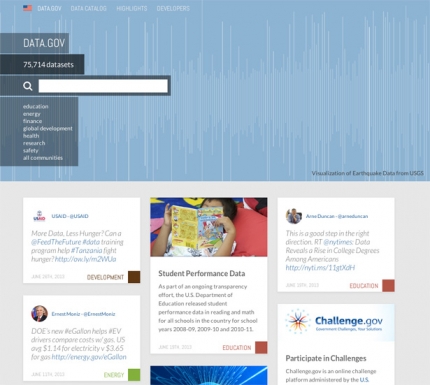
Open data in beta: From Data.gov to alpha.data.gov to next.data.gov

Writing at the White House blog, deputy US CTO Nick Sinai and Presidential Innovation Fellow Ryan Panchadsaram explain what’s new behind the next iteration of the federal open government data platform.

next-data-gov

The first incarnation of Data.gov and subsequent iterations haven’t excited the imagination of the nation. The next version, which employs open source technology like WordPress and CKAN, uses adaptive Web design and features improved search.

It also, critically, highlights how open data is fueling a new economy. If you read Slate, you already knew about how the future is shaping up, but this will provide more people with a reference. Great “next” step.

If you have opinions, questions or suggestions regarding the newest iteration, the Data.gov team is looking for feedback and Project Open Data is encouraging people to collaborate in the design process by creating pull requests on Github or commenting on Quora or Twitter.

White House moves to bash patent trolls, though Congress still must enact trollbane

This morning, President Obama moved to curb suits from “patent trolls,” entities that many observers of the technology industry have been warning have increasingly been harming innovation across the United States. As it turned out, those concerned parties have been right to decry the trend: a report (PDF) contained a startling statistic: the number of lawsuits brought by patent trolls has nearly tripled in the past 2 years, now accounting for 62% of all patent lawsuits in America. As Edward Wyatt pointed out in the New York Times, this surge in patent lawsuits is directly related to the passage of a 2011 law that was designed to address the trouble.

The White House announced several executive actions today to take on patent trolls, including a series of workshops, scholarship opportunities, a consumer-facing website and a review of exclusion orders. The administration will also begin a rulemaking process at the U.S. Patent Office to that would “require patent applicants and owners to regularly update ownership information when they are involved in proceedings before the PTO, specifically designating the ‘ultimate parent entity’ in control of the patent or application.”

One interesting additional outcome of the day’s news is that White House Google+ Hangouts matter. Entrepreneur Limor Fried’s unexpected question to President Obama on patent trolls during a White House Hangout in February 2013 led to a frank answer and contributed to the White House’s action today, a connected directly made by the @WhiteHouse Twitter account. Here’s what the president said, back in February:

A couple of years ago we began the process of patent reform. We actually passed some legislation that made progress on some of these issues, but it hasn’t captured all the problems. And the folks that you’re talking about are a classic example. They don’t actually produce anything themselves, they’re just trying to essentially leverage and hijack somebody else’s idea and see if they can extort some money out of them. And, you know, sometimes these things are challenging, because we also want to make sure that the patents are long enough that, you know, people’s intellectual property is protected. We’ve got to balance that with making sure that they’re not so long that innovation is reduced. And, but I do think that our efforts at patent reform only went about halfway to where we need to go. And what we need to do is pull together, you know, additional stakeholders, and see if we can build some additional consensus on some smarter patent laws. This is true, by the way, across the board when it comes to high tech issues. The technology’s changing so fast. We want to protect privacy, we want to protect people’s civil liberties, we want to make sure the Internet stays open. And I’m an ardent believer that what’s powerful about the Internet is its openness and the capacity for people to get out there and just introduce a new idea with low barriers to entry.

I hope President Obama does more Google+ Hangouts and is asked more tough questions regarding drones, patents and other issues on the minds of the People, far outside of the DC media bubble.

Hangouts aside, as Greg Ferenstein pointed out at TechCrunch, the administration is going to need Congress to effectively curb these abuses: the president can’t simply declare an end to this mess: Congress must be involved.

Five relevant bills have been introduced recently, as Michelle Quinn noted out at Politico and Joe Mullen emphasized at Ars Technica, and while the legislative reforms suggested by the White House could make a real difference in curbing the worst of patent troll abuses, it’s not at all clear what this Congress is capable of passing through both chambers at this point.

Timothy Lee, newly ensconced at Wonkblog at the Washington Post, isn’t convinced that such legislation, even if passed, will effectively smash patent trolls. Lee would like to see the federal government fix a broken patent system. Unfortunately for that aspiration, Washington recently passed an America Invents Act and is now moving forward on implementation. It’s not at all clear how soon substantial reform will end up on a president’s desk again soon.

[Animated GIF credit: White House Tumblr. Oh yes, there will be GIFs. ]

Beth Noveck: think about how to open up the API of government

Former White House deputy CTO for open government Beth Noveck recently gave a TED Talk on a “more open source government. For more perspective in the vein of “open,” read CNN’s TED summary, “What if you could make anything you … Continue reading

White House announces 200m in funding for big data research and development, hosts forum at AAAS

In 2012, making sense of big data through narrative and context, particularly unstructured data, is now a strategic imperative for leaders around the world, whether they serve in Washington, run media companies or trading floors in New York City or guide tech titans in Silicon Valley.

While big data carries the baggage of huge hype, the institutions of federal government are getting serious about its genuine promise. On Thursday morning, the Obama Administration announced a “Big Data Research and Development Initiative,” with more than $200 million in new commitments. (See fact sheet provided by the White House Office of Science and technology policy at the bottom of this post.)

“In the same way that past Federal investments in information-technology R&D led to dramatic advances in supercomputing and the creation of the Internet, the initiative we are launching today promises to transform our ability to use Big Data for scientific discovery, environmental and biomedical research, education, and national security,” said Dr. John P. Holdren, Assistant to the President and Director of the White House Office of Science and Technology Policy, in a prepared statement.

The research and development effort will focus on advancing “state-of-the-art core technologies” need for big data, harnessing said technologies “to accelerate the pace of discovery in science and engineering, strengthen our national security, and transform teaching and learning,” and “expand the workforce needed to develop and use Big Data technologies.”

In other words, the nation’s major research institutions will focus on improving available technology to collect and use big data, apply them to science and national security, and look for ways to train more data scientists.

“IBM views Big Data as organizations’ most valuable natural resource, and the ability to use technology to understand it holds enormous promise for society at large,” said David McQueeney, vice president of software, IBM Research, in a statement. “The Administration’s work to advance research and funding of big data projects, in partnership with the private sector, will help federal agencies accelerate innovations in science, engineering, education, business and government.”

While $200 million dollars is a relatively small amount of funding, particularly in the context of the federal budget or as compared to investments that are (probably) being made by Google or other major tech players, specific support for training and subsequent application of big data within federal government is important and sorely needed. The job market for data scientists in the private sector is so hot that government may well need to build up its own internal expertise, much in the same way Living Social is training coders at the Hungry Academy.

Big data is a big deal,” blogged Tom Kalil, deputy director for policy at White House OSTP, at the White House blog this morning.

We also want to challenge industry, research universities, and non-profits to join with the Administration to make the most of the opportunities created by Big Data. Clearly, the government can’t do this on its own. We need what the President calls an “all hands on deck” effort.

Some companies are already sponsoring Big Data-related competitions, and providing funding for university research. Universities are beginning to create new courses—and entire courses of study—to prepare the next generation of “data scientists.” Organizations like Data Without Borders are helping non-profits by providing pro bono data collection, analysis, and visualization. OSTP would be very interested in supporting the creation of a forum to highlight new public-private partnerships related to Big Data.

The White House is hosting a forum today in Washington to explore the challenges and opportunities of big data and discuss the investment. The event will be streamed online in live webcast from the headquarters of the AAAS in Washington, DC. I’ll be in attendance and sharing what I learn.

“Researchers in a growing number of fields are generating extremely large and complicated data sets, commonly referred to as ‘big data,'” reads the invitation to the event from the White House Office of Science and Technology Policy. “A wealth of information may be found within these sets, with enormous potential to shed light on some of the toughest and most pressing challenges facing the nation. To capitalize on this unprecedented opportunity — to extract insights, discover new patterns and make new connections across disciplines — we need better tools to access, store, search, visualize, and analyze these data.”

Speakers:

  • John Holdren, Assistant to the President and Director, White House Office of Science and Technology Policy
  • Subra Suresh, Director, National Science Foundation
  • Francis Collins, Director, National Institutes of Health
  • William Brinkman, Director, Department of Energy Office of Science

Panel discussion:

  • Moderator: Steve Lohr, New York Times, author of “Big Data’s Impact in the World
  • Alex Szalay, Johns Hopkins University
  • Lucila Ohno-Machado, UC San Diego
  • Daphne Koller, Stanford
  • James Manyika, McKinsey

What is big data?

Anyone planning for big data to use data for public good — or profit — through applied data science must know first understand what big data is.

On that count, turn to my colleague Edd Dumbill, who posted a useful definition last year on the O’Reilly Radar in his introduction to the big data landscape:

Big data is data that exceeds the processing capacity of conventional database systems. The data is too big, moves too fast, or doesn’t fit the strictures of your database architectures. To gain value from this data, you must choose an alternative way to process it.

The hot IT buzzword of 2012, big data has become viable as cost-effective approaches have emerged to tame the volume, velocity and variability of massive data. Within this data lie valuable patterns and information, previously hidden because of the amount of work required to extract them. To leading corporations, such as Walmart or Google, this power has been in reach for some time, but at fantastic cost. Today’s commodity hardware, cloud architectures and open source software bring big data processing into the reach of the less well-resourced. Big data processing is eminently feasible for even the small garage startups, who can cheaply rent server time in the cloud.

Teams of data scientists are increasingly leveraging a powerful, growing set of common tools, whether they’re employed by government technologists opening cities, developers driving a revolution in healthcare or hacks and hackers defining the practice of data journalism.

To learn more about the growing ecosystem of big data tools, watch my interview with Cloudera architect Doug Cutting, embedded below. @Cutting created Lucerne and led the Hadoop project at Yahoo before he joined Cloudera. Apache Hadoop is an open source framework that allows distributed applications based upon the MapReduce paradigm to run on immense clusters of commodity hardware, which in turn enables the processing of massive amounts of big data.

Details on the administration’s big data investments

A fact sheet released by the White House OSTP follows, verbatim:

National Science Foundation and the National Institutes of Health – Core Techniques and Technologies for Advancing Big Data Science & Engineering

“Big Data” is a new joint solicitation supported by the National Science Foundation (NSF) and the National Institutes of Health (NIH) that will advance the core scientific and technological means of managing, analyzing, visualizing, and extracting useful information from large and diverse data sets. This will accelerate scientific discovery and lead to new fields of inquiry that would otherwise not be possible. NIH is particularly interested in imaging, molecular, cellular, electrophysiological, chemical, behavioral, epidemiological, clinical, and other data sets related to health and disease.

National Science Foundation: In addition to funding the Big Data solicitation, and keeping with its focus on basic research, NSF is implementing a comprehensive, long-term strategy that includes new methods to derive knowledge from data; infrastructure to manage, curate, and serve data to communities; and new approaches to education and workforce development. Specifically, NSF is:

· Encouraging research universities to develop interdisciplinary graduate programs to prepare the next generation of data scientists and engineers;
· Funding a $10 million Expeditions in Computing project based at the University of California, Berkeley, that will integrate three powerful approaches for turning data into information – machine learning, cloud computing, and crowd sourcing;
· Providing the first round of grants to support “EarthCube” – a system that will allow geoscientists to access, analyze and share information about our planet;
Issuing a $2 million award for a research training group to support training for undergraduates to use graphical and visualization techniques for complex data.
Providing $1.4 million in support for a focused research group of statisticians and biologists to determine protein structures and biological pathways.
· Convening researchers across disciplines to determine how Big Data can transform teaching and learning.

Department of Defense – Data to Decisions: The Department of Defense (DoD) is “placing a big bet on big data” investing approximately $250 million annually (with $60 million available for new research projects) across the Military Departments in a series of programs that will:

*Harness and utilize massive data in new ways and bring together sensing, perception and decision support to make truly autonomous systems that can maneuver and make decisions on their own.
*Improve situational awareness to help warfighters and analysts and provide increased support to operations. The Department is seeking a 100-fold increase in the ability of analysts to extract information from texts in any language, and a similar increase in the number of objects, activities, and events that an analyst can observe.

To accelerate innovation in Big Data that meets these and other requirements, DoD will announce a series of open prize competitions over the next several months.

In addition, the Defense Advanced Research Projects Agency (DARPA) is beginning the XDATA program, which intends to invest approximately $25 million annually for four years to develop computational techniques and software tools for analyzing large volumes of data, both semi-structured (e.g., tabular, relational, categorical, meta-data) and unstructured (e.g., text documents, message traffic). Central challenges to be addressed include:

· Developing scalable algorithms for processing imperfect data in distributed data stores; and
· Creating effective human-computer interaction tools for facilitating rapidly customizable visual reasoning for diverse missions.

The XDATA program will support open source software toolkits to enable flexible software development for users to process large volumes of data in timelines commensurate with mission workflows of targeted defense applications.

National Institutes of Health – 1000 Genomes Project Data Available on Cloud: The National Institutes of Health is announcing that the world’s largest set of data on human genetic variation – produced by the international 1000 Genomes Project – is now freely available on the Amazon Web Services (AWS) cloud. At 200 terabytes – the equivalent of 16 million file cabinets filled with text, or more than 30,000 standard DVDs – the current 1000 Genomes Project data set is a prime example of big data, where data sets become so massive that few researchers have the computing power to make best use of them. AWS is storing the 1000 Genomes Project as a publically available data set for free and researchers only will pay for the computing services that they use.

Department of Energy – Scientific Discovery Through Advanced Computing: The Department of Energy will provide $25 million in funding to establish the Scalable Data Management, Analysis and Visualization (SDAV) Institute. Led by the Energy Department’s Lawrence Berkeley National Laboratory, the SDAV Institute will bring together the expertise of six national laboratories and seven universities to develop new tools to help scientists manage and visualize data on the Department’s supercomputers, which will further streamline the processes that lead to discoveries made by scientists using the Department’s research facilities. The need for these new tools has grown as the simulations running on the Department’s supercomputers have increased in size and complexity.

US Geological Survey – Big Data for Earth System Science: USGS is announcing the latest awardees for grants it issues through its John Wesley Powell Center for Analysis and Synthesis. The Center catalyzes innovative thinking in Earth system science by providing scientists a place and time for in-depth analysis, state-of-the-art computing capabilities, and collaborative tools invaluable for making sense of huge data sets. These Big Data projects will improve our understanding of issues such as species response to climate change, earthquake recurrence rates, and the next generation of ecological indicators.”

Further details about each department’s or agency’s commitments can be found at the following websites by 2 pm today:

NSF: http://www.nsf.gov/news/news_summ.jsp?cntn_id=123607
HHS/NIH: http://www.nih.gov/news/health/mar2012/nhgri-29.htm
DOE: http://science.energy.gov/news/
DOD: www.DefenseInnovationMarketplace.mil
DARPA: http://www.darpa.mil/NewsEvents/Releases/2012/03/29.aspx
USGS: http://powellcenter.usgs.gov

IBM infographic on big data

Big Data: The New Natural Resource

This post and headline have been updated as more information on the big data R&D initiative became available.

White House releases Consumer Privacy Bill of Rights

After years of wrangling about online privacy in Washington, the White House has unveiled a Consumer Privacy Bill of Rights. A coalition of Internet giants, including Google, Yahoo, Microsoft, and AOL, have committed to adopt “Do Not Track technology” in most Web browsers by the end of 2012.

These companies, which deliver almost 90 percent of online behavioral advertisements, have agreed not to track consumers if these choose to opt out of online tracking using the Do Not Track mechanism, which will likely manifest as a button or browser plug-in. All companies that have made this commitment will be subject to FTC enforcement.

“American consumers can’t wait any longer for clear rules of the road that ensure their personal information is safe online,” said President Obama in a prepared statement. “As the Internet evolves, consumer trust is essential for the continued growth of the digital economy. That’s why an online privacy Bill of Rights is so important. For businesses to succeed online, consumers must feel secure. By following this blueprint, companies, consumer advocates and policymakers can help protect consumers and ensure the Internet remains a platform for innovation and economic growth.”

The announcement coincided with the release of a long awaited white paper: Consumer Data Privacy in a Networked World: A Framework for Protecting Privacy and Promoting Innovation in the Global Digital Economy. (Embedded below.)

The Center for Democracy & Technology (CDT) welcomed the Administration’s unveiling of this “Consumer Privacy Bill of Rights,” calling the industry announcement by industry to respect “Do Not Track” settings in Web browsers is “a positive step for consumer privacy.”

“The Administration’s call for a comprehensive privacy bill of rights comes at a pivotal time when there is a tremendous concern among consumers about their personal information,” said CDT President Leslie Harris in a prepared statement. “While we believe legislation will likely be necessary to achieve these protections, we support the White Paper’s call for the development of consensus rules on emerging privacy issues to be worked out by industry, civil society, and regulators.”

“For five years CDT has pushed for the development of a reliable ‘Do Not Track’ mechanism; today’s Digital Advertising Alliance announcement is an important step toward making ‘Do Not Track’ a reality for consumers,” said CDT’s Director of Consumer Privacy Justin Brookman in a prepared statement. “The industry deserves credit for this commitment, though the details of exactly what ‘Do Not Track’ means still need to be worked out,” Brookman said. “CDT will continue to work through the W3C standards setting process to develop strong and workable ‘Do Not Track’ guidelines.”

As Edward Wyatt reported at the New York Times, however, implementation of these online privacy guidelines won’t be just a matter of adding some lines of code:

Much remains to be done before consumers can click on a button in their Web browser to set their privacy standards. Congress will probably have to write legislation governing the collection and use of personal data, officials said, something that is unlikely to occur this year. And the companies that make browsers — Google, Microsoft, Apple and others — will have to agree to the new standards.

There will be a press conference tomorrow, streamed live from the White House. (Much more to come on this story tomorrow, though given that I’ll be traveling, you’ll be reading it elsewhere.)

A Consumer Privacy Bill of Rights

· Individual Control: Consumers have a right to exercise control over what personal data organizations collect from them and how they use it.

· Transparency: Consumers have a right to easily understandable information about privacy and security practices.

· Respect for Context: Consumers have a right to expect that organizations will collect, use, and disclose personal data in ways that are consistent with the context in which consumers provide the data.

· Security: Consumers have a right to secure and responsible handling of personal data.

· Access and Accuracy: Consumers have a right to access and correct personal data in usable formats, in a manner that is appropriate to the sensitivity of the data and the risk of adverse consequences to consumers if the data are inaccurate.

· Focused Collection: Consumers have a right to reasonable limits on the personal data that companies collect and retain.

· Accountability: Consumers have a right to have personal data handled by companies with appropriate measures in place to assure they adhere to the Consumer Privacy Bill of Rights.

White House Privacy White Paper(function() { var scribd = document.createElement(“script”); scribd.type = “text/javascript”; scribd.async = true; scribd.src = “http://www.scribd.com/javascripts/embed_code/inject.js”; var s = document.getElementsByTagName(“script”)[0]; s.parentNode.insertBefore(scribd, s); })();

This story has been updated as more statements and news stories came online.