President Obama toasts technology with Silicon Valley tech leaders

President Barack Obama joins a toast with Technology Business Leaders at a dinner in Woodside, California, Feb. 17, 2011. (Official White House Photo by Pete Souza)

President Barack Obama joins a toast with Technology Business Leaders at a dinner in Woodside, California, Feb. 17, 2011. (Official White House Photo by Pete Souza)

White House press secretary Jay Carney issued the following statement after President Obama met with Silicon Valley leaders, including Apple Chief Executive Steve Jobs, Google CEO Eric Schmidt, Facebook founder Mark Zuckerberg, Twitter CEO Dick Costolo and others in Woodside, California:

“This evening, the President joined twelve leaders from technology companies to discuss ways to work together to invest in American innovation and promote private sector job growth. In the President’s State of the Union Address, he called on us to win the future by out-innovating and out-educating the rest of the world and increasing American competitiveness. The President believes that American companies like these have been leading by investing in the creativity and ingenuity of the American people, creating cutting-edge new technologies and promoting new ways to communicate. The President specifically discussed his proposals to invest in research and development and expand incentives for companies to grow and hire, along with his goal of doubling exports over five years to support millions of American jobs. The group also discussed the importance of new investments in education and the new White House initiative Startup America, a partnership with the private sector aimed at supporting new startups and small businesses. The President expressed his desire to continue a dialogue with the group to share new ideas so we can work as partners to promote growth and create good jobs in the United States.”

What else did President Obama ask tech leaders? There’s not a lot out there on the Web, given that the dinner was closed to press and none of the tech leaders has blogged or spoken about it to date. The Silicon Jose Mercury News has one of the best accounts of Obama’s meeting with Silicon Valley tech elite but, given the paucity of details about the conversation, the paper had little choice but to go a series of analysts and consultants to comment upon the event. SFGate.com went a step further on the transparency angle and used MapLight.org to analyze the lobbying and campaign donations of the tech stars of Silicon Valley.

Until more details emerge from the meeting, here’s some idle fun from the online audience about what might have come up over dinner. Engadget posted its own caption contest earlier today. If you have a quip about the president’s social network, tweet away using the hashtag #ObamaTechDin.

http://storify.com/digiphile/twitter-caption-contest-for-obama-tech-dinner.js

President of Free World meets President of Facebook World

President Barack Obama talks with Facebook founder and CEO Mark Zuckerberg before a dinner with Technology Business Leaders in Woodside, California, Feb. 17, 2011. Also pictured, left to right, are Carol Bartz, Yahoo! President and CEO; Art Levinson, Genentech Chairman and former CEO; Steve Westly, Founder and Managing Partner, The Westly Group; and Eric Schmidt, Executive Chairman and CEO of Google. (Official White House Photo by Pete Souza)

President Barack Obama talks with Facebook founder and CEO Mark Zuckerberg before a dinner with Technology Business Leaders in Woodside, California, Feb. 17, 2011. Also pictured, left to right, are Carol Bartz, Yahoo! President and CEO; Art Levinson, Genentech Chairman and former CEO; Steve Westly, Founder and Managing Partner, The Westly Group; and Eric Schmidt, Executive Chairman and CEO of Google. (Official White House Photo by Pete Souza)

Amazingly, the White House Flickr feed hasn’t turned into a caption contest for this picture. In the absence of press coverage, Marshall Kirkpatrick had some fun speculating about the topic of conversation at Obama’s meeting with other Silicon Valley leaders over at ReadWriteWeb.

No word on whether the president talked with Zuckerberg about what it was like to act as POTUS on Facebook using the upgraded Pages feature. (As of this morning, President Barack Obama’s Facebook page has 18,368,666 likes. The WhiteHouse has 903,252. )

Enhancing serendipity in civic life

Government data sets bring citizens and friends more closely together, says Max Ogden. In the video below, Ogden, a Code for America fellow, talks about how open government data can be used to enhance serendipity in civic life.

http://www.kaltura.org/apis/stagingHtml5lib/mwEmbedLoader.js
mw.setConfig(‘EmbedPlayer.AttributionButton’,false);
mw.setConfig(‘EmbedPlayer.EnableOptionsMenu’,false);

http://www.kaltura.com/index.php/kwidget/wid/_203822/uiconf_id/1898102/entry_id/1_8w8j67o8/

Ogden spoke at “Cities, Code, and Civics,” a civic media session at the MIT Center for Future Civic Media.

[Hat tip to @Participatory]

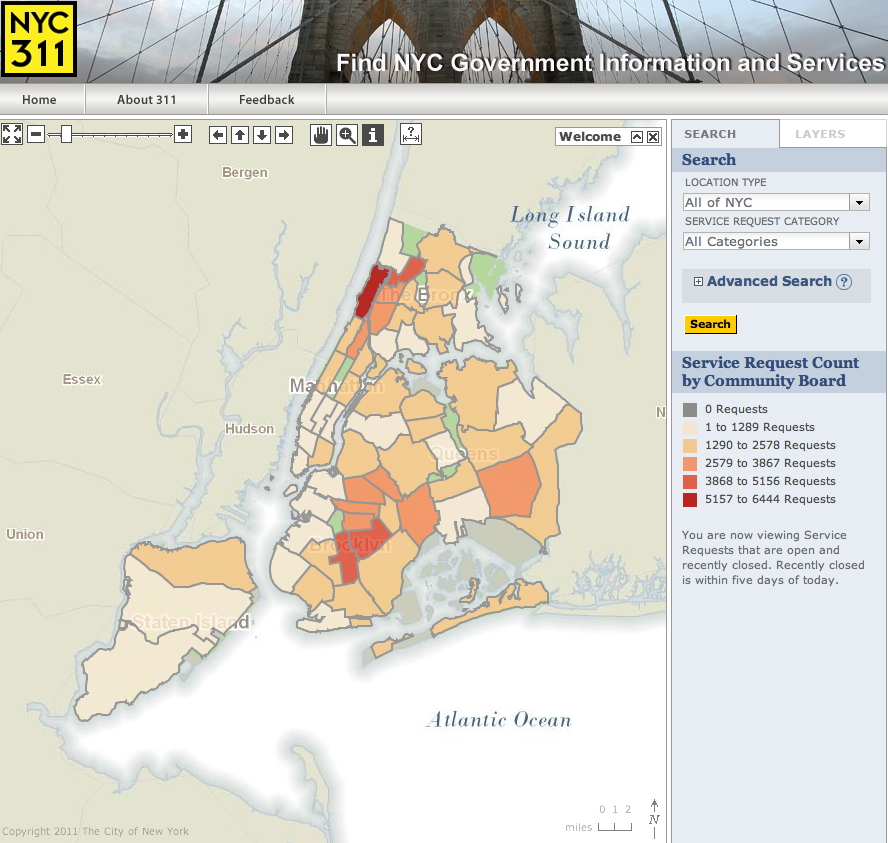
New York City launches 311 online service request map

If you read Steven B. Johnson, you know that 100 million 311 calls reveal a lot about New York. Now citizens can surf over to look at those 311 requests every day. Today, New York City launched a 311 online service request map.

“The launch of the 311 Service Request Map is another milestone in the City’s efforts to improve the way we report 311 data to the public,” said Deputy Mayor Stephen Goldsmith in a prepared statement. “The release of this information will better enable the public and elected officials to hold the City accountable for the services we provide. Putting better information into the hands of community leaders across the five boroughs increases transparency and allows us to collaboratively address the problems that neighborhoods face.”

It appears that Inwood and Washington Heights are making the most 311 service requests, according to the latest version of the map.

This 311 online service request map is a good start, with layers, custom searches and a clean design. Querying for those layers is a bit slow but returns relevant results for bike parking or continuing education, although many of the other layers appear to be grayed out and “coming soon.” Querying for specific request types was even slower, so for the moment I can’t find out where complaints about poison ivy, illegal animals or noisy church services are concentrated.

Early reviews have generally been positive but guarded, with room to grow. It’s a “huge step forward, long way to go,” tweeted Philip Ashlock. They “could get something better for free (eg mobile) by doing #Open311 API instead,” referring to the idea of government as a platform.

I “would much rather have the data raw via an API in an open [format] than the map UI (which isn’t all bad) in the way,” tweeted Mark Headd.

The “NYC 311 map is impressive technically, but lacks context (time period?), a legend (Maps 101), & metadata. I wonder if they talked to users before implementing it,” tweeted Steven Romalewski. “Also, the city obviously has the address-level 311 data. It’d be nice if they published the raw data so others could analyze it (residents & NYC Council reps have been asking for this for years). That would indicate a real commitment to transparency.”

UPDATE: Nick Judd published an excellent post on the New York City 311 map at techPresident, where he reports that “raw complaint data from 311 on the city’s data repository, the NYC DataMine, later this year, according to a city spokesman.” Judd also fills in a couple of key details, like:

  • The application was built using the city’s public city-wide geospatial information system, CityMap
  • Requests for literature are not included in the NYC 311 map
  • Deputy Mayor Stephen P. Goldsmith acknowledged in a press conference today, reported on by the New York Times, “this addition to the city’s open data efforts was a nod to transparency advocates.”

“Some of this will not be entirely exciting for those of us whose job it is to make sure that the holes in the street are filled and the trash is picked up because it’ll provide visibility to what we are or not doing,” Mr. Goldsmith said. “And some of you will enjoy that visibility.”

As Judd links out, in the New York Times Cityroom blog has good coverage of the step towards getting a visual on New Yorkers’ 311 calls.

Solving your neighbor’s possum problem in the dark? There’s an app for that.

One of the most common aphorisms heard around the Gov 2.0 world is that “potholes are the gateway drugs to civic engagement.”

After a recent report in Boston, maybe Hub pundits can add a new phrase to the lexicon: “possums are the gateway animal to citizens connecting.

As the indefatigable Adam Gaffin reported at Universal Hub, the wonderful hyperlocal blog in Beantown, the Citizens Connect app has now been deployed as Boston’s high tech possum saver.

According to Gaffin’s post, Susan Landibar of South Boston saw a possum report:

“Possum in my trash can. Can’t tell if it’s dead. Barrel in back of 168 west 9th. How do I get this removed?”

And acted upon it:

Labandibar reports:
11:15PM Walked over to West Ninth Street. It’s about three blocks from my house. Locate trash can behind house. Possum? Check. Living? Yep.

Turned the trash can on its side. Walked home. Good night, sweet possum.

When the city of Boston released the Citizens Connect application, which works on Android phones and iPhones, officials no doubt expected it to help constituents report potholes, graffiti, unplowed snow and trash removal.

And indeed, if you look through the list of reported issues, that’s the bulk of it.

After today, however, the city can add “possum problems” to the list of resolved issues. Crucially, however, it wasn’t the city that fixed it: it was a fellow citizen who saw an issue using the app and then went and took care of it herself.

For good or ill, this example of “do it ourselves” government is a data point that may be increasingly relevant. Plummeting city budgets mean smarter cities will need citizen sensors to detect issues and take civic pride into their own hands. As Gov 2.0 goes local, applications that connect citizens to one another in crises may become as important as technologies that connect citizens to government, like Citizens Connect.

As the role of the Internet as a platform for collective action grows, Clay Shirky may be proven prescient: “We have historically overestimated the value of access to information and underestimated the value of access to one another.”

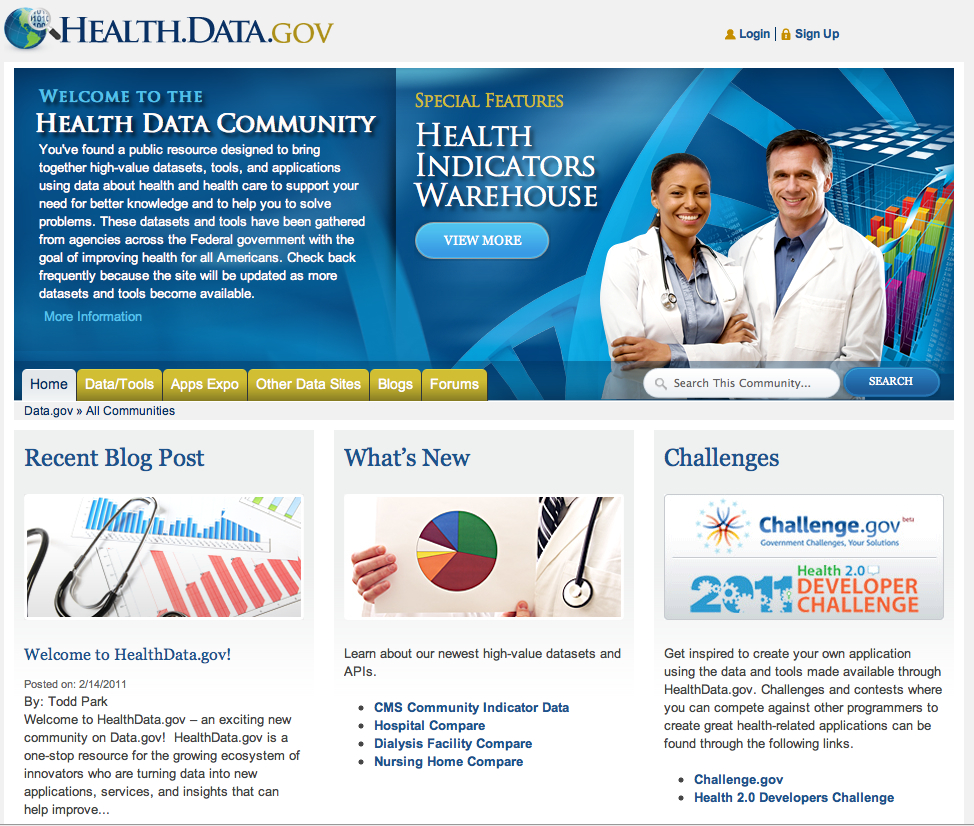
HHS launches Health.Data.gov

Last October, Todd Park, the chief technology officer at the Department of Health and Human Services (HSS) announced HealthData.gov at the HealthCamp in San Francisco. Today, Health.Data.gov went live. When the domain name propagates properly through the Internet, HealthData.gov will send online users directly to the new community at Data.gov.

Park blogged about HealthData.gov and the open health data initiative on Data.gov this morning.

“HealthData.gov is a one-stop resource for the growing ecosystem of innovators who are turning data into new applications, services, and insights that can help improve health,” he wrote.

The new open health data site includes community features and links to more than a thousand indicators at HealthIndicators.gov and a health apps showcase.

New apps like iTriage have the potential to turn open health data to better decisions and build new businesses. Speaking at the State Department’s open source conference last week, Park said that tens of thousands of citizens have now used the health data in iTriage to find community health centers.

Park has been working to make community health information as useful as weather data through the release of open health data from HSS. Today, the nation now can see more about what the tech community has come up since this spring, when the question of whether “there’s a healthcare app for that” was answered the first time. “Social value and economic value can go hand in hand,” he told a health IT summit in San Francisco.

Below, Park speaks more about what open health data could mean at last weekend’s health 2.0 code-a-thon in Washington, DC.

http://c.brightcove.com/services/viewer/federated_f9?isVid=1&isUI=1

Here come the healthcare apps.

Clinton: There is no silver bullet in the struggle against Internet repression. There’s no “app” for that

Today in Washington, Secretary of State Clinton reiterated the State Department’s commitment to an Internet freedom policy in a speech at George Washington University. Rebecca MacKinnon, journalist, free speech activist, and expert on Chinese Internet censorship, provided some on the spot analysis immediately following Clinton’s words. MacKinnon made an interesting, and timely, point: there are limits to directly funding certain groups. “I think one of the reasons that the Egyptian and Tunisian revolutions were successful was that they were really home grown, grass roots. At the end of the day, the people in the countries concerned need to really want change and drive that change.”

MacKinnon parsed the considerable complexity of advocating for Internet freedom in the context of Wikileaks and electronic surveillance in other areas of the federal government. For those interested, she elaborated on the issues inherent in this nexus of government and technology in her Senate testimony last year. At some point this winter, there will be a hearing on “CALEA 2″ in the United States Congress that’s going to be worth paying close attention to for anyone tracking Internet freedom closer to home, so to speak.

Should the U.S. support Internet freedom through technology, whether it’s an “app” or other means? To date, so far the State Department has allocated only $20 million of the total funding it has received from Congress, according to a report on Internet censorship from the Senate Foreign Relations Committee obtained by the AFP. (Hat tip to Nick Kristof on that one).

Clinton defended the slow rollout of funding today in her speech (emphasis is added):

“The United States continues to help people in oppressive Internet environments get around filters, stay one step ahead of the censors, the hackers, and the thugs who beat them up or imprison them for what they say online. While the rights we seek to protect are clear, the various ways that these rights are violated are increasingly complex. Some have criticized us for not pouring funding into a single technology—but there is no silver bullet in the struggle against Internet repression. There’s no “app” for that. And accordingly, we are taking a comprehensive and innovative approach—one that matches our diplomacy with technology, secure distribution networks for tools, and direct support for those on the front lines.”

The caution in spending may well also be driven by the issues that the State Department encountered with Haystack, a much celebrated technology for Internet freedom tool that turned out to be closer to a fraud than a phenomenon.

There may be no silver bullet to deliver Internet freedom to the disconnected or filtered masses, per se, but there are more options beyond the Tor Project that people in repressive regimes can leverage. Today, MIT’s Technology Review reported on an app for dissidents that encrypts phone and text communications:

Two new applications for Android devices, called RedPhone and TextSecure, were released last week by Whisper Systems, a startup created by security researchers Moxie Marlinspike and Stuart Anderson. The apps are offered free of charge to users in Egypt, where protesters opposing ex-president Hosni Mubarak have clashed with police for weeks. The apps use end-to-end encryption and a private proxy server to obfuscate who is communicating with whom, and to secure the contents of messages or phone conversations. “We literally have been working night and day for the last two weeks to get an international server infrastructure set up,” says Anderson.

No word on whether they’ve received funding from State yet. For more on today’s speech, read the full report on the State department’s Internet freedom policy at the Huffington Post, Ethan Zuckerman or the ever sharp Nancy Scola on #NetFreedom, which does, in fact, now look like a “big deal.”

Secretary of State Clinton speaks about Internet freedom and technology

Today in Washington, Secretary of State Hillary Rodham Clinton is speaking about Internet freedom and technology.

http://c.brightcove.com/services/viewer/federated_f9?isVid=1

The PBS Newshour is also streaming the speech:

http://www.ustream.tv/pbsnewshour

2011 Trend: Deloitte predicts eGovernment will reach an inflection point

http://c.brightcove.com/services/viewer/federated_f9?isVid=1

2011 predictions from Deloitte Consulting:

In 2011 Deloitte predicts eGovernemt (eGov) usage will reach an inflection point. Across developed countries, the proportion of businesses that use eGov services for at least one process is expected to average over 90 percent, up from 75 percent in 2010. Similarly, the proportion of citizens that use eGov in industrialized countries should rise by at least 10 percentage points. In some countries, the importance of eGov as a way to boost public sector productivity and efficiency may even prompt the appointment of a national Chief Information Officer (CIO) where one did not exist previously.”

For those watching, the United States has had both a CIO and a chief technology officer (CTO) since the beginning of the Obama administration. Both Vivek Kundra and Aneesh Chopra, respectively CIO and CTO, have worked with their staff to go beyond traditional e-government in the context of the open government initiative, evolving from a “vending machine” model, where government simply provides e-services, to where government acts as a platform, releasing data and convening citizens, industry and policy makers to address huge challenges.

Whether Deloitte’s prediction comes true in 2011 for the world remains to be seen. It’s certainly interesting and worth taking note.

“If there was no social networks, this would never have been sparked”-Wael Ghonim

Wordle of a interview of Ghonim by Steve Garfield

In an interview about the Egyptian revolution on 60 Minutes tonight, Wael Ghonim told Harry Smith that “if there was no social networks, it would have never been sparked. Because the whole thing before the revolution was the most critical thing. Without Facebook, without Twitter, without Google, without YouTube, this would have never happened.”

Block the whole Internet, you’re gonna really frustrate people. One of the strategic mistakes of this regime was blocking Facebook. One of the reasons why they are no longer in power now is that they blocked Facebook. Why? Because they have told four million people that they are scared like hell from the revolution by blocking Facebook. They forced everyone who’s just, you know, waiting to read the news on Facebook, they forced them to go to the street to be part of this.

Ghonim, who has called the galvanic events that swept Egyptian president Hosni Mubarak out of power “Revolution 2.0,” spoke eloquently about the role of social networking in Egypt. “If there was no social networks, this would never have been sparked. Without Facebook, without Twitter, without YouTube, this would never have happened.”

Shortly after the 60 Minutes interview aired on the East Coast of the United States, Ghonim posted another tweet:

.bbpBox36944183608475650 {background:url(http://a1.twimg.com/profile_background_images/170023094/wae_clearl.jpg) #32cef9;padding:20px;} p.bbpTweet{background:#fff;padding:10px 12px 10px 12px;margin:0;min-height:48px;color:#000;font-size:18px !important;line-height:22px;-moz-border-radius:5px;-webkit-border-radius:5px} p.bbpTweet span.metadata{display:block;width:100%;clear:both;margin-top:8px;padding-top:12px;height:40px;border-top:1px solid #fff;border-top:1px solid #e6e6e6} p.bbpTweet span.metadata span.author{line-height:19px} p.bbpTweet span.metadata span.author img{float:left;margin:0 7px 0 0px;width:38px;height:38px} p.bbpTweet a:hover{text-decoration:underline}p.bbpTweet span.timestamp{font-size:12px;display:block}

My message to the dictators of the world: You should at least freak out. Block Facebook and cancel Fridays. #Jan25 #SidiBouzid #WhatsNextless than a minute ago via web

What happens next in Egypt is not clear. As Anthony Shadid wrote this week, it’s uncharted ground. What is clear is that history has been made, and in Wael Ghonim’s eyes, “this was an Internet Revolution.”