Congress faces challenges in identifying constituents using social media

Citizens are becoming more influential through social networks and influencing their peers. Research from the The Pew Research Center’s Internet & American Life Project suggests that government 2.0 an important trend, with respect to our understanding of what it means to be a citizen and how our actions influence those of our fellow citizens. The role of the Internet as a platform for collective action is growing but the authorities that control the levers of power offline still matters immensely.

Today, Politico reported that social media isn’t so hot on the Hill. Or, as FierceGovernmentIT.com reported, “Congress is using social media to talk, not listen.” Both media outlets were reporting on survey results conducted by the Congressional Management Foundation on perceptions of citizen advocacy by Congressional staffers.

A better headline, however, might have been “Twitter isn’t so hot on the hill with lawmakers,” given myriad challenges around identifying constituents online, automated campaigns and what Representative Culberson (R-TX) described as a “lot of trolls on Twitter.” (It’s even worse on YouTube, Congressman.) The question posed at the end of the Politico article — “Are lawmakers putting too much time — or staff resources — into social media?” is followed with Pew stats on *Twitter* use and penetration, not Facebook.

The complaints from numerous anonymous Congressional staffers about the time it takes to maintain social media are likely honest and parallel the experiences of higher-paid contemporaries in private industry, academia, media, fashion and the nonprofit worlds. Managing multiple social media presences can, indeed, be a pain in the a–. And it takes resources, in terms of time, that may be scarcer than ever. That said, social media is now part of the lexicon of Congressional staff trusted with constituent communications. If a Representative or Senator is speaking anywhere in DC, there’s an increasingly good chance that snippets of it may tweeted, unusual pictures will be tagged on Facebook and that any gaffes will be up on YouTube later.

Doing more than trying to fit the 20th century model of broadcasting to these platform requires time, expertise and commitment, along with a thick skin. Opening up these new online channels for Congressional communications created challenges, to be sure, but then so did adding the telegraph, radio, television, fax machines, cellphones and email. It’s not hard to find past news reports of Senators resisting the addition of dial phones to the Hill.

Every new communications technology has had an impact on Congress. In 2011, Twitter, Facebook and YouTube do each come with new wrinkles. YouTube and Twitter can work in concert to share video and share it instantly with the world. At the same time, on the Hill, automated campaigns using social media have followed the path of email and faxes deluges. Carefully edited videos can trim key context from statements, or audio from broadcasts. The risks and rewards for the use of Web 2.0 that pertain to federal and state agencies also pertain to Congress.

Take, for instance, Facebook, which is generally tied to the real identities of citizens. Engaging with citizens carries with it identity and privacy issues for constituents. That’s the rub, and it won’t come out easily. Look at how San Francisco integrated city services with 311 and Facebook for an example of how government can mitigate and address some of those issues. The National Strategy for Trusted Identities in Cyberspace might address some of the challenges as well.

In the meantime, Congresional staffers and citizens alike can hope that new, improved architectures for participatory democracy online come along soon to upgrade the status quo in Washington.

Podcast: IT Security, Internet Freedom and Open Government at Threatpost

This morning, I was privileged to join Dennis Fisher on the Digital Underground podcast to talk about IT security, open government, Internet freedom and open data movements, including how they’re affecting IT security.

ListenIT Security, Internet Freedom and Open Government [MP3]

Fisher is a founding editor of the Threatpost blog and is one of the best information security journalists in the industry and a former colleague from TechTarget.

Over the course of the podcast, we discussed the different ways in which Internet freedom and privacy play into the current climate online. (We also talked a bit about Twitter and journalism.) As 2011 matures, legitimate concerns about national security will continue to be balanced with the spirit of open government expressed by the Obama administration.

The issues created between Wikileaks and open government policies are substantial. Open data may be used for accountability, citizen utility and economic opportunity. But as federal CIO Vivek Kundra said to Harvard Business School students studying Data.gov last year, the transparency facet in the Obama administration’s open government initiative has multiple layers of complexity.

Fisher and I explore these issues, along with a number of the complexities involved with improving information sharing between the public and private sector when it comes to vulnerabilities and threats. Currently, over 80% of the nation’s critical infrastructure is in the private sector.

Related stories:

40,000+ gather to watch the launch of NASA’s space shuttle Discovery online

At just after 4:50 PM EST today, space shuttle Discovery launched in Florida. Commander Steve Lindsey and the 5 other members of the STS-133 crew will deliver the Permanent Multipurpose Module and Robonaut 2, a humanoid robot, to the International Space Station. NASA’s uStream channel is below. At launch time, there were more than 40,000 people tuned in to uStream, along with many more watching NASA TV online.

Video chat rooms at Ustream

The NASA tweetup is certain to provide live, likely very enthusiastic, coverage. If you want slighter slower updates from NASA’s live blogger, follow the STS-133 launch blog. You can see all of NASA’s social media activity at Buzzroom.NASA.gov.

new TWTR.Widget({
version: 2,
type: ‘search’,
search: ‘#nasatweetup’,
interval: 6000,
title: ‘What\’s happening at the ‘,
subject: ‘NASA Tweetup’,
width: ‘auto’,
height: 300,
theme: {
shell: {
background: ‘#00408f’,
color: ‘#ffffff’
},
tweets: {
background: ‘#ffffff’,
color: ‘#444444’,
links: ‘#1985b5’
}
},
features: {
scrollbar: false,
loop: true,
live: true,
hashtags: true,
timestamp: true,
avatars: true,
toptweets: true,
behavior: ‘default’
}
}).render().start();

NASA uStream chat:

Gov 2.0 and open government: Perspectives from Belgium and Australia

On any given week, there’s usually someone delivering a presentation that explores the intersection of citizens, technology and government. Here are just a few of the better ones I’ve come across in 2011 so far. If you’ve found other gems out there on the Internet, please share the links in the comments. Below, you’ll find ideas from citizens of three different countries, along with a report on government from the Pew Internet Society that was delivered as a presentation.

Vincent Van Quickenborn

Vincent Van Quickenborne

Vincent Van Quickenbore. Credit: Wikipedia

“My conclusion today:‘Open Data is becoming a reality. The public sector must lead by example. It must rethink administrative processes that appear to be dinosaurs in the era of social media and cloud computing.’” –Vincent Van Quickenborn, Belgian Minister for “Ondernemen en Vereenvoudigen.” (Loosely translated, that’s “enterprise and simplification.”)

David J. Eade on the Characteristics of Government 2.0

Perspectives from Australia, including lessons after the recent “Big Wet,” from David J. Eade, co-founder of the Government 2.0 in Queensland community.

http://b.scorecardresearch.com/beacon.js?c1=7&c2=7400849&c3=1&c4=&c5=&c6=http://b.scorecardresearch.com/beacon.js?c1=7&c2=7400849&c3=1&c4=&c5=&c6=http://b.scorecardresearch.com/beacon.js?c1=7&c2=7400849&c3=1&c4=&c5=&c6= http://b.scorecardresearch.com/beacon.js?c1=7&c2=7400849&c3=1&c4=&c5=&c6=http://b.scorecardresearch.com/beacon.js?c1=7&c2=7400849&c3=1&c4=&c5=&c6=http://b.scorecardresearch.com/beacon.js?c1=7&c2=7400849&c3=1&c4=&c5=&c6=

Steve Lunceford

This Prezi on open government and Gov 2.0 by Steve Lunceford is an engaging overview, and a welcome change from static, slide-driven presentations.

Government Online – Findings from Pew Internet

http://b.scorecardresearch.com/beacon.js?c1=7&c2=7400849&c3=1&c4=&c5=&c6=http://b.scorecardresearch.com/beacon.js?c1=7&c2=7400849&c3=1&c4=&c5=&c6=

Knight Commission to release recommendations on open government and online hubs

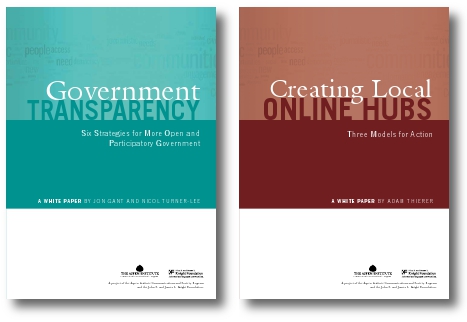
Tomorrow, the Aspen Institute Communications and Society Program and the John S. and James L. Knight Foundation will release two new white papers that focus on implementing the recommendations of the Knight Commission on the Information Needs of Communities in a Democracy.

The two new white papers—“Government Transparency: Six Strategies for More Open and Participatory Government” by Jon Gant and Nicol Turner-Lee, and “Creating Local Online Hubs: Three Models for Action” by Adam Thierer, recommend steps that government and community leaders should take to increase government transparency and put more information hubs online.

To Aspen Institute will convene a roundtable of public officials, advocates, and watchdogs from national, state and local levels of government (along with this correspondent) tomorrow morning from 9:00 a.m. to 12:00 p.m. EST. See the list of attendees below for specific details.

There will be a live webcast of the event. The Knight Commission is encouraging people to participate online at <a href="http://www.knightcomm.org and on Twitter using #knightcomm hashtag. According to the event organizers, a livestream will begin at 9:00 a.m. (EST) and will be archived. These white papers will be available to read and download Friday morning. Look for links here when they become available.

http://widgets.twimg.com/j/2/widget.js

new TWTR.Widget({
version: 2,
type: ‘search’,
search: ‘knightcomm’,
interval: 6000,
title: ‘New in Knight Commission papers on’,
subject: ‘Government Transparency and Online Hubs’,
width: ‘auto’,
height: 300,
theme: {
shell: {
background: ‘#00278a’,
color: ‘#ffffff’
},
tweets: {
background: ‘#ffffff’,
color: ‘#444444’,
links: ‘#1985b5’
}
},
features: {
scrollbar: false,
loop: true,
live: true,
hashtags: true,
timestamp: true,
avatars: true,
toptweets: true,
behavior: ‘default’
}
}).render().start();

Featured Roundtable Speakers

Dr. Jon Gant, Fellow, Joint Center for Political and Economic Studies, and Associate Professor, Graduate School of Library and Information Science, University of Illinois at Urbana-Champaign. He is a leading scholar in the field of information systems and public administration.

Dr. Nicol Turner-Lee, Vice President and Director of the Media and Technology Institute for the Joint Center for Political and Economic Studies. She has produced path breaking research on broadband adoption among minority and disadvantaged populations and engages city, state and federal legislators on issues in telecommunications, open government and the emerging technology innovation sectors.

Adam Thierer, Senior Research Fellow, Technology Policy Program, Mercatus Center at George Mason University, having previously served as President of the Progress & Freedom Foundation. His work spans technology, media, and Internet and free speech with a focus in online child safety and digital privacy policy issues.

Roundtable participants include:

Gary Bass, Executive Director, OMB Watch
Ben Berkowitz, Founder, SeeClickFix
John Bracken, Directory of Digital Media, John S. and James L. Knight Foundation
Jerry Brito, Senior Research Fellow, George Mason University
Kevin Curry, Co-Founder, CityCamp.com
Lucy Dalglish, Executive Director, Reporters Committee for Freedom of the Press
Charlie Firestone, Executive Director, Communications and Society Program, Aspen Institute
Feather Houstoun, President, William Penn Foundation
Alexander Howarder, Government 2.0 Washington Correspondent, O’Reilly Media
William Kellibrew, IV, Deputy Director, National Coalition on Black Civic Participation
Alex Kreilein, Legislative Assistant, Office of Congresswoman Jane Harman
Ngoan Le, Vice President of Programs, The Chicago Community Trust
Blair Levin, Communications and Society Fellow, Aspen Institute
Philip Neustrom, Founder, Davis Wiki
Steve Pearson, Publisher and Chief Technologist, Project Virginia
Lee Rainie, Director, PEW Internet and American Life Project
Rachel Sterne, Chief Digital Officer, Mayor’s Office of Media & Entertainment, New York City
Daniel Schuman, Policy Counsel, Sunlight Foundation
Nancy Tate, Executive Director, League of Women Voters
Tracy Viselli, Community Manager, ACTion Alexandria
Marijke Visser, Assistant Director, OITP, American Library Association
Eric Wenger, Policy Counsel, US-Legal-Government Affairs, Microsoft Corporation
Harry Wingo, Senior Policy Counsel, Google, Inc.

Civic developers gather to code for America at data camps

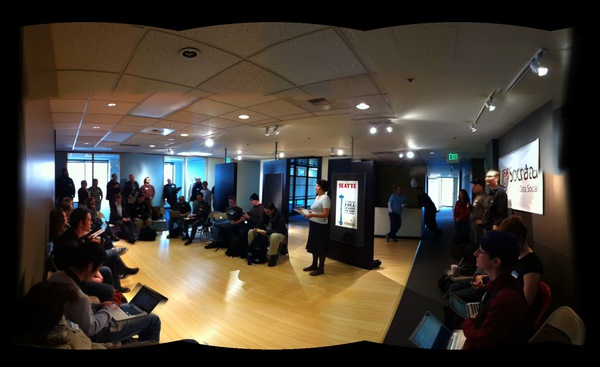
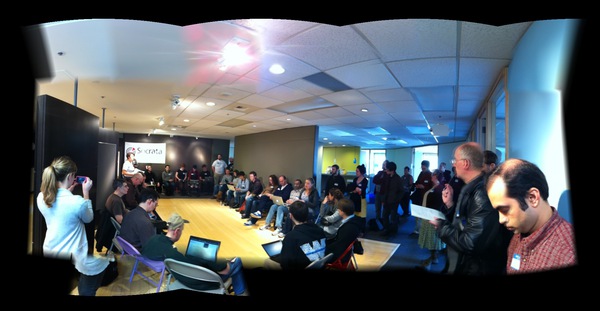
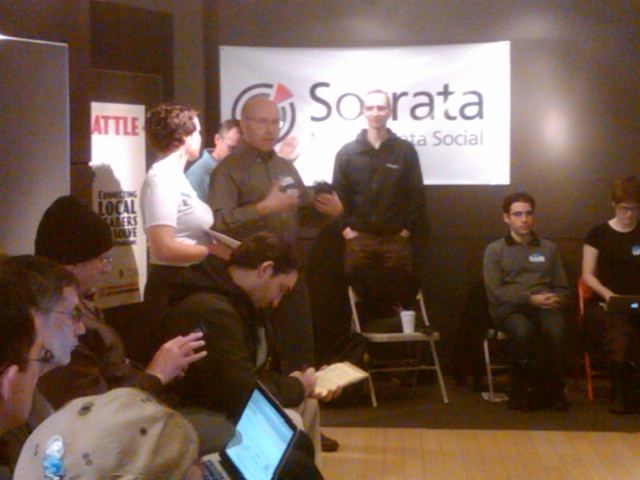
Today in Seattle, over 50 civic developers have gathered at Socrata to work on coding applications from the city’s open data repository at data.seattle.gov. Today’s Seattle datacamp, organized by Code for America, is just one of several data camps that the new civic service is convening in host cities around the United States. Chacha Sikes, a 2011 Code for America fellow, explains what’s behind these data camps:

City governments have a lot of information which is useful to all of us. This ranges from maps of local parks to building footprints to real-time 911 calls. We all have an interest in our budget information, legislative documents and other resources that we use in collective decision-making and deliberation. Not all of this information is currently available for all cities, even though much of it is public record. The “Open Data” movement is a way to work on getting information into machine-readable formats, allowing for easy publishing, sharing, and reuse.

We’re hosting DataCamps in CfA’s cities this year to build communities around making city data more open and accessible to allow citizens to help cities work better.

DataCamp is a event focusing on skill-building and collaborative work on city data. It is an opportunity for interested parties in a city to work together, and build a network of people with shared interested in improving civic communications and information management.

Sanjay B. Hyatt, a writer at the Seattle Times, is at the data camp in the Pacific Northeast. He reported back that CTO Bill Schrier said that Seattle has 100 data sets. “Turn that data into information.”

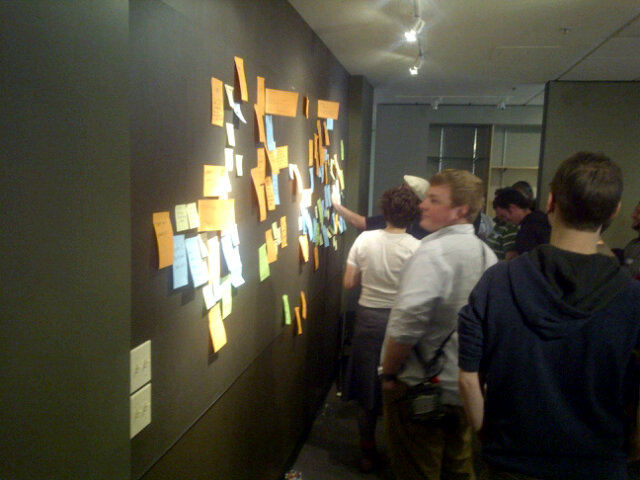
DataCamp Seattle is using a Drupal site and a DataCamp Seattle Google group to coordinate and share notes. In the tradition of unconferences and barcamps, they’re also using a more analog method to sort out ideas and projects: sticky notes. Virtual observers can see the various projects going up, including calendars, an impact survey, an apps workshop and a “pimp my blog” to help stimulate the creation of hyperlocal blogs.

More data camps are coming soon to Seattle and Washington, D.C.

UPDATE: A day after the datacamp, a new app is available to Seattle residents. Hear Near pushes alerts about Seattle events nearby to mobile phone users using text messages.

Hear Near is available from iTunes and Android.

Hear Near was created by a team that included Amber Case (whose geolocation startup, Geoloqi, powers it), Aaron Parecki, Joe McCarthy, Jesse Kocher, Gene Homicki, Naoya Makino, Steve Ripley, Rebecca Gutterman and Jenny Frank.

Frank, a self-identified “non-techie” who attended the camp, came away with the feeling that “nothing is impossible.”

Panoramic image credits to Chris Metcalf.

Clinton: There is no silver bullet in the struggle against Internet repression. There’s no “app” for that

Today in Washington, Secretary of State Clinton reiterated the State Department’s commitment to an Internet freedom policy in a speech at George Washington University. Rebecca MacKinnon, journalist, free speech activist, and expert on Chinese Internet censorship, provided some on the spot analysis immediately following Clinton’s words. MacKinnon made an interesting, and timely, point: there are limits to directly funding certain groups. “I think one of the reasons that the Egyptian and Tunisian revolutions were successful was that they were really home grown, grass roots. At the end of the day, the people in the countries concerned need to really want change and drive that change.”

MacKinnon parsed the considerable complexity of advocating for Internet freedom in the context of Wikileaks and electronic surveillance in other areas of the federal government. For those interested, she elaborated on the issues inherent in this nexus of government and technology in her Senate testimony last year. At some point this winter, there will be a hearing on “CALEA 2″ in the United States Congress that’s going to be worth paying close attention to for anyone tracking Internet freedom closer to home, so to speak.

Should the U.S. support Internet freedom through technology, whether it’s an “app” or other means? To date, so far the State Department has allocated only $20 million of the total funding it has received from Congress, according to a report on Internet censorship from the Senate Foreign Relations Committee obtained by the AFP. (Hat tip to Nick Kristof on that one).

Clinton defended the slow rollout of funding today in her speech (emphasis is added):

“The United States continues to help people in oppressive Internet environments get around filters, stay one step ahead of the censors, the hackers, and the thugs who beat them up or imprison them for what they say online. While the rights we seek to protect are clear, the various ways that these rights are violated are increasingly complex. Some have criticized us for not pouring funding into a single technology—but there is no silver bullet in the struggle against Internet repression. There’s no “app” for that. And accordingly, we are taking a comprehensive and innovative approach—one that matches our diplomacy with technology, secure distribution networks for tools, and direct support for those on the front lines.”

The caution in spending may well also be driven by the issues that the State Department encountered with Haystack, a much celebrated technology for Internet freedom tool that turned out to be closer to a fraud than a phenomenon.

There may be no silver bullet to deliver Internet freedom to the disconnected or filtered masses, per se, but there are more options beyond the Tor Project that people in repressive regimes can leverage. Today, MIT’s Technology Review reported on an app for dissidents that encrypts phone and text communications:

Two new applications for Android devices, called RedPhone and TextSecure, were released last week by Whisper Systems, a startup created by security researchers Moxie Marlinspike and Stuart Anderson. The apps are offered free of charge to users in Egypt, where protesters opposing ex-president Hosni Mubarak have clashed with police for weeks. The apps use end-to-end encryption and a private proxy server to obfuscate who is communicating with whom, and to secure the contents of messages or phone conversations. “We literally have been working night and day for the last two weeks to get an international server infrastructure set up,” says Anderson.

No word on whether they’ve received funding from State yet. For more on today’s speech, read the full report on the State department’s Internet freedom policy at the Huffington Post, Ethan Zuckerman or the ever sharp Nancy Scola on #NetFreedom, which does, in fact, now look like a “big deal.”

Live townhall from Twitter HQ with US UN @AmbassadorRice [#AskAmbRice]

Today at 1 PM EST, Susan Rice, United States Ambassador to the United Nations, participated in a live town hall on foreign policy. Archived video from the livestream is embedded below:

Here’s how Ambassador Rice described the digital town hall at the White House blog:

When I left the West Coast after college in 1986, only one in 500 Americans owned a cell phone – and these were essentially bricks about 10 inches long. IBM had just announced its first laptop, which weighed 12 pounds. The founders of Facebook, I can only imagine, were then figuring out how to master nap time and tee ball.

As I go back again this week to take part in a Twitter Town Hall in San Francisco, an event that will be carried live on Twitter and Ustream at 10:00 a.m. Pacific Time, the Bay Area looks quite a bit different. Education and innovation – “the currency of the 21st century,” in the words of President Obama – have changed the face of Silicon Valley and much of the world. But our interconnected age has also brought us new challenges. Today, transnational threats can sweep across borders as freely as a mass migration, an environmental calamity, or a deadly disease.

The Obama Administration is working every day to meet these challenges through our work at the United Nations, which plays an essential role as a keeper of peace, a provider of emergency aid, and a mediator between nations. You may agree – or disagree – with an approach to foreign policy that makes the best use of this complicated but indispensable institution. Whatever your views, I encourage you to send me your questions tomorrow at 10 a.m. Pacific Time on Twitter, using the hashtag, #AskAmbRice.

A snapshot of the conversation is featured using the Twitter search widget below.

new TWTR.Widget({
version: 2,
type: ‘search’,
search: ‘#AskAmbRice’,
interval: 6000,
title: ‘Ask’,
subject: ‘Ambassador Rice’,
width: ‘auto’,
height: 300,
theme: {
shell: {
background: ‘#0a1585’,
color: ‘#ffffff’
},
tweets: {
background: ‘#ffffff’,
color: ‘#444444’,
links: ‘#1985b5’
}
},
features: {
scrollbar: false,
loop: true,
live: true,
hashtags: true,
timestamp: true,
avatars: true,
toptweets: true,
behavior: ‘default’
}
}).render().start();

Here’s the uStream social stream:

White House CTO takes questions on innovation strategy on Twitter

US chief technology officer Aneesh Chopra took questions about the White House’s new innovation strategy on Twitter. Following is a report of the conversation between Chopra and the online audience. http://storify.com/digiphile/white-house-cto-aneesh-chopra-takes-questions-on-i.js

Why does government social media use matter to citizens?

An important role of technology journalists in the 21st century is to explain how broader trends that are changing technology, government and civic society relate to average citizens. Some have called this broader trend towards smarter, more agile government that leverage technology “Gov 2.0.” (Readers of this blog are no doubt familiar with the term.) When you dig into the topic, you can get stuck in a lot of buzzwords and jargon quickly. Most people don’t care about how a satellite gets into orbit, the release of community health data or the standards of an API for product recalls. They care quite a bit, however, about whether their GPS receiver enables them to get to a job interview, if a search engine can show them ER waiting room times and quality statistics, or if a cradle for their baby is safe. Those wonky policies can lead to better outcomes for citizens.

If you follow Mashable, you might have read about the ways that social media promotes good health or how government works better with social media.

The following stories have little to do with technology buzzwords and everything to do with impact. Following are five stories about government 2.0 that matter to citizens, with issues that literally come home to everyone.

1) The Consumer Product Safety Commission has launched a public complaints database at SaferProducts.gov. You could think of it as a Yelp for government, or simply as a place where consumers could go to see what was safe. Add that to the mobile recalls application that people can already use to see whether a product has been recalled.

2) The new Consumer Financial Protection Bureau will use technology to listen to citizens online to detect fraud. If you haven’t heard, DC has a new startup agency. That hasn’t happened in a long time. Your could think of it as Mint.gov mashed up with HealthCare.gov. The CFPB plans to use technology in a number of unprecedented ways for fraud detection, including crowdsourcing consumer complaints and trends analysis. Given how much financial fraud has affected citizens in recent years,and how much of the anger that the public holds for the bailouts of banks remains, whether this agency leveraging technology well will matter to many citizens.

3) Social data and geospatial mapping join the crisis response toolset. Historic floods in Australia caused serious damage and deaths. Government workers used next-generation technology that pulled in social media in Australia and mapped the instances using geospatial tools so that first responders could help citizens faster, more efficiently and more effectively. It’s an excellent example of how an enterprise software provider (ESRI) partnered with an open source platform (Ushahidi) to help government workers use social media to help people.

4) New geolocation app connects first responders to heart attack victims.The average citizen will never need to know what Web 2.0 or Gov 2.0 means. Tens of thousands, however, will have heart attacks every year. With a new geolocation mobile application that connects citizen first responders to heart attack victims, connected citizens trained in CPR now have a new tool to help them save lives.

Better access to information about food safety, product recalls and financial fraud will help citizens around the country. Improvements to the ability of government workers to direct help in a disastrous flood or for citizens to receive immediate help from a trained first responder in an emergency are important developments. As 2011 takes shape, the need for government to use social media well has become more important than ever. That’s why the perspective of government officials like FEMA administrator Craig Fugate matter.

“We work for the people, so why can’t they be part of the solution? “
said Fugate, speaking to delegates from the distributed chapters of Crisis Commons assembled at FEMA headquarters. “The public is a resource, not a 
liability.”

For example, Fugate said that FEMA used reporters’ tweets during Hurricane Ike for
 situational awareness. “We’ve seen mashups providing better info than
 the government.” Listening and acting upon those digital cries for help on social media during crisis could literally be a matter of life and death.

Whether government can adapt to a disrupted media landscape and the new realities of information consumption is of substantial interest to many observers, both inside and out of government. Whether government can be smarter, agile and more effective is a great interest to all.