Making open government data visualizations that matter

Every month, more open government data is available online. Local governments are becoming data suppliers. Open healthcare data is spurring better decisions. There’s a tremendous amount of activity in open data – but there’s a long road ahead for open government. At the SXSW Interactive Festival in Austin, Texas, Jeremiah Akin and Michael Castellon made a case for “why visualizing government data makes taxpayers happy.”

The expectation of transparency is creating demand for government agencies to develop new ways to communicate complex data and trends to the public in easy-to-access and easy-to-understand formats.

Some agencies are turning to Google Maps and KML data to visualize raw information online and on mobile devices. Delivering data in more easily understandable formats not only boosts trust and confidence between government agencies and their publics, but also streamlines workloads among Data, Web, Editorial, and Customer Service teams.

The two men talked about how the Texas Comptroller is using public-facing maps to communicate with the public, including to the rapidly increasing numbers of citizens accessing government websites from mobile devices.

The utility of open government data can be quite concrete, as when live tsunami data is used to help save lives. It can also help people to understand more about the virtual lines in their towns and cities. In Texas, ClaimItTexas.org shows unclaimed property in Lone Star State.

Mobile transparency

The Texas Transparency Map is also available for touchscreen mobile devices and for tablets. That’s no accident: Akin said that mobile traffic to the site up four-fold since lat year.

“We’re seeing a lot more mobile access,” he said. “If we want to make it available on multiple devices, we need to create in a way that can be displayed.” That insight is a crucial one, and reverberates far beyond the government sphere. By choosing to develop non-native Web applications written in HTML5, Javascript and JSON, this cohort of Texas government avoided “Shiny App Syndrome.” Next steps include support for street level detail, Google Fusion tables, and geolocation.

Putting open government data to work

“Open government data has been used for a long time,” said Akin, citing the use of census data in newspapers. A new class of new media journalism is putting data to use in innovative ways, pointed out Castellon. “The Texas Tribune is one of the leaders in data visualization,” he said, which helps citizens to make sense of government data.

The key here, emphasized Akin, is that is not just enough to simply dump data. You need ways to visualize it and make it meaningful as information. “There’s a lot of resistance – people have been there, and that’s not how they’ve done things,” he said. “If you make a visualization that makes someone’s job easier pretty soon they start coming back to you.

With better data visualizations and more information, Castellon posited that more problem solving can take place. “When you release data, especiallly with science, education or research, there are stories embedded in that data,” he said.

In this narrative, it’s up to governments to release better, clean data in consumable formats and the evolving art of data journalism to make stories from it that give citizens, businesses and elected officials insight into the complexities of modern life.

Open government scrutinized before the House Oversight Committee

This morning, the Oversight Committee in the United States House of Representatives held a hearing on the Obama administration’s open government efforts. The “Transparency Through Technology: Evaluating Federal Open-Government Initiatives hearing was streamed live online at oversight.house.gov.

House Oversight Chairman Darrell Issa (R-CA) asked his Twitter followers before the hearing a simple question “Have you tried to get facts on how gov’t spends your $ on USASpending.gov?” He received no answers.

The oversight committee did, however, hear extensive testimony from government IT executives and open government watchdogs. As Representative Issa probes how agencies balance their books, such insight will be crucial, particularly with respect to improving accountability mechanism and data. Poor data has been a reoccurring theme in these assessments over the years. Whether the federal government can effectively and pervasively apply open data principles appears itself to be open question.

The first half of the hearing featured testimony from Dr. Danny Harris, chief information officer for the Department of Education, Chris Smith, chief information officer for the Department of Agriculture, Jerry Brito, senior research fellow at the Mercatus Center at George Mason University and Ellen Miller, co-founder and executive director of the Sunlight Foundation.

Alice Lipowicz of Federal Computer Week tweeted out a few data points from the hearing.

  • A Sunlight Foundation audit found that the USDA spent $12.7B on school lunches but only reported $250,000 on USASpending.gov
  • According to Brito, “half of 3000 datasets on Data.gov are on EPA toxic releases, with only 200 to 300 datasets are on fed gov activity.” Lipowicz also tweeted that Brito testified that federal agencies need outside auditors and “ought to report ‘earnings’ similar to private sector.”
  • USDA CIO Chris Smith said that the agency did not report school lunch payments below $25,000 to USASpending.gov; will report in FY2012

In her testimony before the House committee on clearspending, Miller reiterated the position of the Sunlight Foundation that the efforts of the administration to make government spending data open, accurate and available have been insufficient, particularly when the data is wrong.

The Sunlight Foundation has been excited about the new promises of data transparency, but sometimes the results are nowhere near the accuracy and completeness necessary for the data to be useful for the public.

Sunlight’s Clearspending analysis found that nearly $1.3 trillion of federal spending as reported on USASpending.gov was inaccurate. While there have been some improvements, little to no progress has been made to address the fundamental flaws in the data quality. Correcting the very complicated system of federal reporting for government spending is an enormous task. It has to be done because without it there is no hope for accountability.

Miller made several recommendations to the committee to improve the situation, including:

  • unique identifiers for government contracts and grants
  • publicly available hierarchical identifiers for recipients to follow interconnected entities
  • timely bulk access to all data.

Her remarks ultimately reflect the assessment that she made at last year’s Gov 2.0 Summit, where she made it clear that open government remains in beta. Our interview is below:

Tracking the progress of the Open Government Directive requires better data, more auditors and improved performance metrics. That said, this looks like the year when many of the projects at agencies will move forward towards implementation.

Last month, the U.S. moved forward into the pilot phase of an open source model for health data systems as the fruits of the Direct Project came to Minnesota and Rhode Island. The Direct Project allows for the secure transmission of health care data over a network. Some observers have dubbed it the Health Internet, and the technology has the potential to save government hundreds of millions of dollars, along with supporting the growth of new electronic health records systems .Open source and open government have also come together to create OpenStack, an open cloud computing platform that’s a collaboration between NASA, Rackspace, Cisco and a growing group of partners.

It’s too early to judge the overall effort open government as ultimately a success or failure. That said, the administration clearly needs to do more. In 2011, the open question is whether “We the people” will use these new participatory platforms to help government work better.

Video of the hearing will be posted here when available. Testimony from today’s hearing is linked to PDFs below.

Dr. Danny Harris

Chris Smith

Jerry Brito

Ellen Miller

The Honorable Danny Werfel

Note: Video of the hearing was provided through the efforts of citizen archivist Carl Malamud at house.resource.org, the open government video website that he set up in collaboration with Speaker Boehner and Congressman Issa. While the open government efforts of the federal government have a long way to go, in this particular regard, a public-private collaboration is making the proceedings of the House Oversight committee available to the world online.

White House dCTO Chris Vein on innovation and open government

Chris Vein is the newly minted deputy United States chief technology officer for government innovation in the White House Office of Science and Technology Policy. As reported by Fast Company last month, Vein headed to the White House from San Francisco, where he served as the city’s chief information technology officer. Vein takes on the portfolio from now departed deputy CTO for open government Beth Noveck, along with the @OpenGov Twitter account. Vein was a supporter of both open source and open data while at San Francisco; it’s reasonable to expect that will continue in his new role.

As Nick Judd reported at techPresident, Vein talked to open government advocates at the recent Transportation Camp in New York City. You can watch his talk below.

Transportation Camp East: Chris Vein from Streetfilms on Vimeo.

Enhanced by Zemanta

Talking about crisis data, social media and GIS on Federal News Radio

American Red Cross Conference On Use Of Intern...

Image by ShashiBellamkonda via Flickr

Earlier this week, the O’Reilly Radar published a new article about how the Red Cross and the Los Angeles Fire Department integrate social tools into crisis response. This afternoon, I talked with Federal News Radio‘s anchor Chris Dorobek about crisis data for the Dorobek Insider:

Have a crisis? Don’t worry, there’s an app for that.

With the emergence of social media tools, emergency responders have been forced to integrate social media into their crisis response.

During the Gulf Coast oil spill last year, the Coast Guard launched an app where you could actually track the oil. Now the Red Cross and the Los Angeles Fire Department are using Twitter and Facebook in their emergency response.

If you’re in the Washington, D.C. listening area, our interview was on at 4:05 and will be rebroadcast at 6:05 PM EST. For online listeners (that’s you, dear reader) you can listen to the show on crisis data here.

Enhanced by Zemanta

Transit data as open government fuel for economic growth

Transportation Camp Big Board

At the Big Board at Transportation Camp NYC. Credit: Transportation Camp

Today in New York City, the attendees of TransportationCamp will look for ways to build a better to and fro. Technologists, trains fans, government workers and East Coast civic hackers have gathered for a sold out two-day unconference at the New York Law School Institute for Information Law and Policy. TransportationCamp East.

They’ve come together to discuss how the modern transit system can be improved, focusing on the intersection between technology, citizens, public data and government. Around the United States, there has been a blossoming of innovation in the city transit sector, driven by the passion of citizens and fueled by the release of real-time transit data by their city governments. These efforts have a long way to go, given challenges of driving interoperability standards to address the break of gauge. As open government moves from theory to practice, what lies ahead for Gov 2.0 will include more innovation in opening transit data as a platform for civic innovation.

In many cities, the future of open transit data is already around us, but the promise has yet to be fully realized. The case for open data in transit is made in the video below:

A Case for Open Data in Transit from Streetfilms on Vimeo.

An “open data project that I’m fond of that started very early in the open government process is GTFS, the General Transit Feed Specification,” said Tim O’Reilly.

That’s the data standard that lets transit districts feed their bus and train arrival times to applications like Google Transit, or any of the many smartphone apps that help you plan your trip on public transit. This standard started as a collaboration between Google and the city of Portland, but is now available from many cities. It’s a great example of how governments can think like platform providers. They have to equip their buses and trains with GPS, and report out the data. They could report it just to their own bus stops and train stations, or they could make it available to third parties to deliver in a hundred ways. Which is better for citizens? It’s pretty obvious.”

For passionate civic advocates like Laurel Ruma, a colleague at O’Reilly Media, getting real-time transit data in Boston was better than winning the World Series. (That might have been a harder sell in 2003, but table that for now). The decision to release and support open transit data online has spawned a new ecosystem of mobile applications, many of which are featured at MBTA.com. The addition of real-time transit data could add more value to the apps offering help for MBTA riders that went online in 2009, like the Mass Transit app that has been making money for SparkFish Creative.

It’s that kind of economic value creation combined with civic utility and accountability that has many people in the open government community excited. “Transportation has been a breakout segment of the “Gov 2.0” space over the last several years — it’s an issue with direct impacts on every citizen, and an area where we are seeing tons of innovation right now,” said Nick Grossman, director of civic works at OpenPlans. “Agencies are re-thinking their tech and data strategies, entrepreneurs and “civic hackers” are building tools at a furious rate, and the public is benefiting in tangible ways. We are excited to bring together many of the players in the space for two weekends of discussing, debating, and building at TransportationCamp.”

The unconference organizers posted the http://transportationcamp.org/topics/”>discussion topics online before Transportation Camp kicked off, so virtual onlookers and on-site participants alike can get a flavor of interests that range from walking to to cycling to ride sharing. (No evidence of transit via horse, mule nor camel is to be found, no doubt because of the changing face of New York City versus their utility).

“We are honored to be partnering with former White House deputy CTO for open government Beth Noveck and the Do Tank & Democracy Design Workshop at New York Law School, said Grossman. “Beth’s and the Do Tank’s work has been an inspiration for all forms of collaborative work around civic issues, governance, and democracy.”

TransportationCamp West will be in San Francisco March 19-20. Both of the unconferences are sponsored by NYC-based nonprofit OpenPlans. ”

“TransportationCamp is all about building connections across a widespread sector, from public officials, to software developers, to academics, to urban advocates and interested citizens,” said Grossman. “We hope to not only address some immediate issues (such as working on technical data standards), but also plant the seed for longer-term partnerships.”

Luke Fretwell captured an extensive Q&A with Grossman, were he talks more about TransportationCamp’s objectives and transportation’s impact on the bigger issues around Gov 2.0 and open government.

Follow @transpocamp and the #transpo hashtag on Twitter today and over the coming weeks to watch the discussion data unfold in real-time.

http://widgets.twimg.com/j/2/widget.js

new TWTR.Widget({
version: 2,
type: ‘search’,
search: ‘transpo’,
interval: 6000,
title: ‘What\’s happening at’,
subject: ‘Transportation Camp’,
width: ‘auto’,
height: 300,
theme: {
shell: {
background: ‘#005e8a’,
color: ‘#ffffff’
},
tweets: {
background: ‘#ffffff’,
color: ‘#444444’,
links: ‘#730000’
}
},
features: {
scrollbar: false,
loop: true,
live: true,
hashtags: true,
timestamp: true,
avatars: true,
toptweets: true,
behavior: ‘default’
}
}).render().start();

Frank Hebert posted a recap of Saturday morning at Transportation Camp at the camp blog.

New recommendations for improving local open government and creating online hubs

Today, the Aspen Institute hosted a roundtable on government transparency and online hubs in Washington, DC. You can watch the archived webcast below.

http://www.newmediamanager2.net/sites/all/modules/newmediamill/flashclip/player.swf

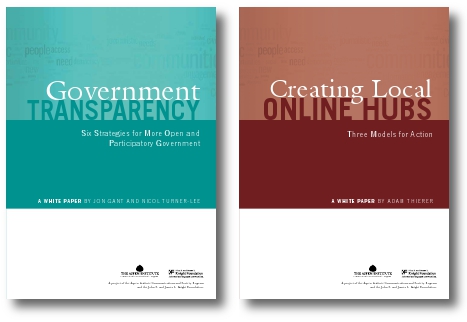
The roundtable focused on the release of two new white papers. The first, “Creating Local Online Hubs: Three Models for Action,” by Adam Thierer, discusses scenarios where community leaders, citizens, media, technologists and — critically, local government — can work together” to create local online hubs where citizens can access information about their governments and local communities.” Creating such high-quality online information hubs was one of the 15 key recommendations of Knight Commission on the Information Needs of Communities in a Democracy. “Just as communities depend on maps of physical space, they should create maps of information flow that enable members of the public to connect to the data and information they want,” said the Knight Commission. (Download PDF or Read Online)

“Governments need to get more information out and make it more accessible, said Thierer today. “This shouldn’t be controversial.” Thierer said that government can do well to catalyze and support this development simply by doing a better job of making such information easily available in easy to use formats. While open government data stores have grown, Thierer noted that this has not trickled down. He cited the example of Manor, Texas as one example of where one local champion (former CIO Dustin Haisler) got help from Stanford and other external resources to get the local open data repository online.

Broadly, Thierer described three models for online hubs:

  • Hubs focused on community government information. Example: Texas Tribune
  • Community connections: local forums and community email listservs. Example: e-democracy.org
  • Community news and commentary. Example: Universal Hub

Thierer focused on the important role that libraries and local or state universities can play in this new ecosystem, by connected offline and online worlds. These universities could create “code toolboxes” that local communities can use, as Stanford did for Manor. He hoped that that model could be replicated nationally.

Government transparency

Government Transparency: Six Strategies for More Open and Participatory Government, by Jon Gant and Nicol Turner-Lee, is call to action for state and local governments to adopt open government. The six sensible strategies “focus on enhancing government expertise and transparency, educating citizens regarding the availability and utility of government information and e-government tools, expanding efforts to support greater adoption of broadband Internet access services and devices, and forging public-private-citizen partnerships in order to enhance open government solutions.” (Download PDF or Read Online)

There are three basic issues here, according to Turner-Lee:

  • Do people get it?
  • Do they have the resources they need?
  • Can they do transparency with those resources?

“All of us who have been in this debate have seen a conflict between these three factors, said Turner-Lee. The question, she said Turner-Lee, is how we empower state and local government. The challenge is that in most open data effort, “We are still in a one-way world, where data is pushed down to the public, not in a reciprocal ecosystem.”

It’s one thing to say citizens who should be involved, said Turner-Lee, but more needs to be done. “As an organizer, I can speak to that. It’s hard to get people to a block meeting,” much less meeting online, she said. There’s also a persistent issue of the digital divide that has to be addressed in this context. “We cannot proclaim government transparency” where millions of people don’t have online access, said Turner-Lee.

There are many examples of where open data is being put to use on the behalf of citizens now. Turner cited apps driven by transit data in Chicago, heritage trees in Portland or the use of 311 by SeeClickFix in the District of Columbia.

Jon Grant focused on a major pain point for government at all levels for tapping into the innovation economy: procurement issues, which civic entrepreneurs run into in cities, statehouses and Washington. “It is time to look at these procurement rules more closely,” he said, and promote higher levels of innovation. “There are a lot of ideas are happening but a lot of rules restrict vendors from interacting in government,” said Grant. Turner-Lee observed that traditional procurement laws may also not be flexible enough to bring more mobile apps into government.

Fundamentally, empowering more government transparency through the Internet will require both creating a climate for the actions, said Turner-Lee, but also through structural changes, specifically, through the release of spectrum and Universal Service Fund (USF) reform.

It will also require that state and local government officials are part of the conversation, “It they aren’t at the table, we’re going to be pretty much talking to ourselves,” said Turner-Lee.

Former San Francisco CIO Chris Vein, now the new White House deputy CTO for government innovation, agreed. biggest challenge of all is that we like to think there are templates. to a certain extent, they can be. fundamentally, all politics is local. To make this work in government, a community “needs someone who takes risks, who goes out there and makes it happen regardlesss of the cost.”

All stakeholder at the panel acknowledged the crucial importance of community institutions, nonprofits and libraries in addressing issues of the digital divide and creating a bridge between online hubs and local citizens. Turner Lee noted that billions of people over the course of years have come into libraries for assistance, particularly the homeless and low-income citizens. “What better way to get people into the system by enabling libraries to be a conduit of information?” she asked.

“Public information belongs to the public, and the public’s business should be done in public,” said Turner. That said, local citizens also don’t want data for the sake of data. “Consumption of this data would be inconsistent if the data doesn’t provide quality of life,” she said.

Gov 2.0 and open government: Perspectives from Belgium and Australia

On any given week, there’s usually someone delivering a presentation that explores the intersection of citizens, technology and government. Here are just a few of the better ones I’ve come across in 2011 so far. If you’ve found other gems out there on the Internet, please share the links in the comments. Below, you’ll find ideas from citizens of three different countries, along with a report on government from the Pew Internet Society that was delivered as a presentation.

Vincent Van Quickenborn

Vincent Van Quickenborne

Vincent Van Quickenbore. Credit: Wikipedia

“My conclusion today:‘Open Data is becoming a reality. The public sector must lead by example. It must rethink administrative processes that appear to be dinosaurs in the era of social media and cloud computing.’” –Vincent Van Quickenborn, Belgian Minister for “Ondernemen en Vereenvoudigen.” (Loosely translated, that’s “enterprise and simplification.”)

David J. Eade on the Characteristics of Government 2.0

Perspectives from Australia, including lessons after the recent “Big Wet,” from David J. Eade, co-founder of the Government 2.0 in Queensland community.

http://b.scorecardresearch.com/beacon.js?c1=7&c2=7400849&c3=1&c4=&c5=&c6=http://b.scorecardresearch.com/beacon.js?c1=7&c2=7400849&c3=1&c4=&c5=&c6=http://b.scorecardresearch.com/beacon.js?c1=7&c2=7400849&c3=1&c4=&c5=&c6= http://b.scorecardresearch.com/beacon.js?c1=7&c2=7400849&c3=1&c4=&c5=&c6=http://b.scorecardresearch.com/beacon.js?c1=7&c2=7400849&c3=1&c4=&c5=&c6=http://b.scorecardresearch.com/beacon.js?c1=7&c2=7400849&c3=1&c4=&c5=&c6=

Steve Lunceford

This Prezi on open government and Gov 2.0 by Steve Lunceford is an engaging overview, and a welcome change from static, slide-driven presentations.

Government Online – Findings from Pew Internet

http://b.scorecardresearch.com/beacon.js?c1=7&c2=7400849&c3=1&c4=&c5=&c6=http://b.scorecardresearch.com/beacon.js?c1=7&c2=7400849&c3=1&c4=&c5=&c6=

Platforms for citizensourcing emerge in Egypt


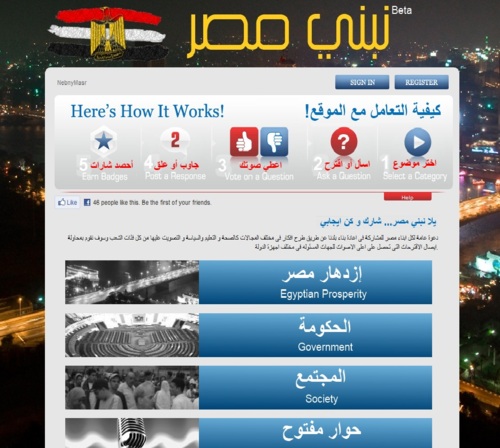
As people watching the impact of social media in the events in Egypt know, Facebook, Twitter and YouTube played a role. Today, Microsoft’s director of public sector engagement, Mark Drapeau, sent word that the Redmond-based software company’s open source ideation platform, Town Hall, has been deployed at nebnymasr.org to collect ideas.

The highest profile implementation of Town Hall to date was for crowdsourcing ideas in Congress for the incoming Republican majority in Congress at “America Speaking Out.

This Town Hall instance and others show how citizensourcing platforms can be tailored to channel feedback around specific topics, as opposed to less structured platforms. As governments and citizens try to catalyze civic engagement using the Internet, creating better architectures for citizen participation will be critical. Clay Shirky’s talk about the Internet, citizenship and lessons for government agencies at the Personal Democracy Forum offered some insight on that count. Using taxonomies to aggregate ideas instead of a single list was a key takeaway.

To date, the Egyptian citizensourcing site has logged a few dozen questions and votes. Whether usage of the site will grow more or not is up for debate. The network effect may working against it. As ReadWriteWeb reported last week, Egyptians are using Google Moderator to brainstorm Egypt’s future. Wael Ghonim, the Google executive who played a role in Egypt’s recent revolution, started a Google Moderator page for Egypt entitled, “Egypt 2.0, what does we need? What are our dreams?!.” To date, the Moderator instance has logged 1,361,694 votes for more than 50,000 of the ideas submitted by nearly 40,000 users.

Building open source platforms for open government

Agency.com/open

Open Public template

As reported in Radar yesterday, Phase2 Consulting acquired two more Drupal distributions.

With the acquisition of Open Atrium and Managing News, Phase2 now has the top four Drupal distributions in use in government and the media. It already hosted the OpenPublic and OpenPublish distributions, both of which are used by government and publishing clients. AfghanistanElectionData.org was using Managing News. So was HaitiAidMap.org.

The move could pave the way for increased interoperability between federal, state and local .gov websites that use Open Atrium and Open Public. Given the economic realities that face the media industry, improvements to collaboration and functionality on the Managing News and Open Publish distributions are also likely to be of interest to online publishers.

Given the budget pressures that face all levels of government in 2011, the ability to share code between government should not be underestimated as a cost saver. Increased interoperability was one driver behind the the websites for dozens of freshman Representatives on House.gov moved to Drupal. (It’s not clear yet how developments costs were affected in the House.)

That move followed the transition of the most high profile government websites in the world to Drupal: WhiteHouse.gov. The blog post on open source at WhiteHouse.gov supported the development of projects within the Open Atrium collaboration suite.

When open source and open government took the stage at the State Department earlier this month, the White House released more open source code back into the Drupal community.

If .gov is the new .com, Drupal is now positioned to play an even bigger role in providing the infrastructure for those data driven websites.

Ignite Philly: Code for America’s Pete Fecteau on being the “dumbest guy in the room

Last week, Code for America Fellow Pete Fecteau gave a great five minute talk at Ignite Philly 7. Fecteau about why he’s participating in the program and what he’s hoping to accomplish.

Code for America IgnitePhilly talk from @peterfecteau from Uploaded by: Tyler Stalder on Vimeo.

“Code for America is not about building some shiny piece of technology. It’s about spreading both collaborative and cognitive knowledge. As many questions as we hope to ask in Philly, we hope to answer that many questions,” he said. “”What we build in Philly we share with the rest of the nation’s struggling cities. We’re opening data, plugging it in, and releasing it as an open source platform.”

[Hat tip Code for America]