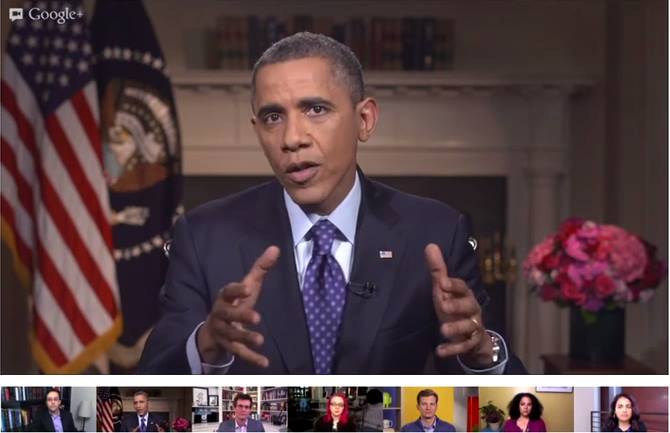
The Google home page currently has a link to ask President Obama a question in a Google+ Hangout. That’s some mighty popular online real estate devoted to citizen engagement.
The privacy and civil liberties board’s report is strongly critical of the impact that mass surveillance has upon the privacy and civil liberties of American citizens, along with billions of other people around the world.
“The Section 215 bulk telephone records program lacks a viable legal foundation under Section 215, implicates constitutional concerns under the First and Fourth Amendments, raises serious threats to privacy and civil liberties as a policy matter, and has shown only limited value. As a result, the Board recommends that the government end the program.”
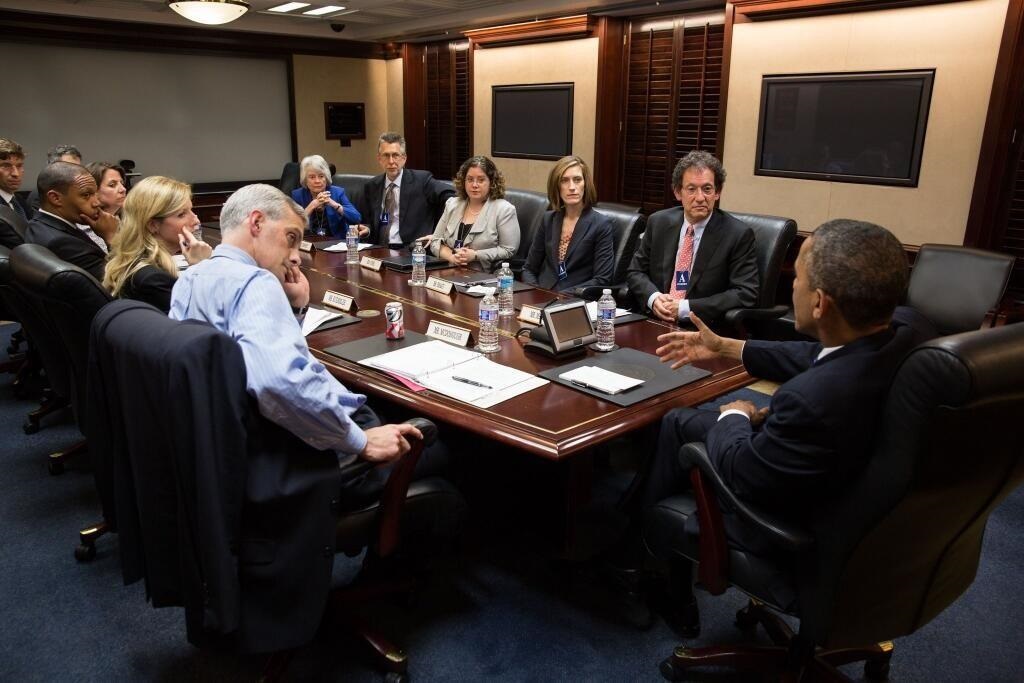
PCLOB Board Members meet with President Obama on June 21, 2013. Photo by Pete Souza.
While President Obama met with the board and heard their recommendations prior to his speech last week, his administration is disputing its legal analysis.
“We disagree with the board’s analysis on the legality,” said Caitlin Hayden, spokeswoman for the White House National Security Council, in an e-mail to Bloomberg News. “The administration believes that the program is lawful.”
House Intelligence Committee Chairman Mike Rogers (R-MI) was also critical of the report’s findings. “I am disappointed that three members of the Board decided to step well beyond their policy and oversight role and conducted a legal review of a program that has been thoroughly reviewed,” he said in a statement.
The Electronic Frontier Foundation hailed the report as a vindication of its position on the consitutionality of the programs.
“The board’s other recommendations—increasing transparency and changing the FISA court in important ways—similarly reflect a nearly universal consensus that significant reform is needed,” wrote Mark Rumold, a staff attorney. “In the coming weeks, PCLOB is set to release a second report addressing the NSA’s collection under Section 702 of the FISA Amendments Act. We hope that the board will apply similar principles and recognize the threat of mass surveillance to the privacy rights of all people, not just American citizens.”
As ever, laws and institutions lag the rapid pace of technological change. In 2014, for instance, mandating that the person designated to publish federal information must be a practical printer “versed in the art of bookbinding” is a statutory remnant of a bygone age.
Last week, Senator Amy Klobuchar [D-MN] introduced the Government Publishing Office Act of 2014, S.1947, which would rename the United States Government Printing Office the Government Publishing Office. (It would also strike the bookbinding requirement.)
The current Public Printer of the United States supported the proposal. “Publishing defines a broad range of services that includes print, digital, and future technological advancements,” said Public Printer Davita Vance-Cooks, in a statement. “The name Government Publishing Office better reflects the services that GPO currently provides and will provide in the future. I appreciate the efforts of Senators Klobuchar and Chambliss for introducing and supporting this bill. GPO will continue to meet the information needs of Congress, Federal agencies, and the public and
carry out our mission of Keeping America Informed.”
“The idea of renaming GPO was discussed in a December Committee on House Administration hearing entitled “Mission of the Government Printing Office in a post-print world”, which I wrote about here,” said Daniel Schuman, policy director at Citizens for Responsibility and Ethics in Washington (CREW), in a blog post on the GPO bill.
One of the most important open government data efforts in United States history came into being in 1993, when citizen archivist Carl Malamud used a small planning grant from the National Science Foundation to license data from the Securities and Exchange Commission, published the SEC data on the Internet and then operated it for two years. At the end of the grant, the SEC decided to make the EDGAR data available itself — albeit not without some significant prodding — and has continued to do so ever since. You can read the history behind putting periodic reports of public corporations online at Malamud’s website, public.resource.org.
Two decades later, Malamud is working to make the law public, reform copyright, and free up government data again, buying, processing and publishing millions of public tax filings from nonprofits to the Internal Revenue Service. He has made the bulk data from these efforts available to the public and anyone else who wants to use it.
“This is exactly analogous to the SEC and the EDGAR database,” Malamud told me, in an phone interview last year. The trouble is that data has been deliberately dumbed down, he said. “If you make the data available, you will get innovation.”
November Form 990s now ready. http://t.co/HDoMzPjpY0 We have 7,335,804 Form 990s available. *STILL* no word from the IRS.
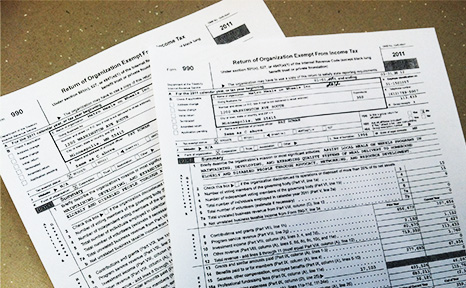
Making millions of Form 990 returns free online is not a minor public service. Despite many nonprofits file their Form 990s electronically, the IRS does not publish the data. Rather, the government agency releases images of millions of returns formatted as .TIFF files onto multiple DVDs to people and companies willing and able to pay thousands of dollars for them. Services like Guidestar, for instance, acquire the data, convert it to PDFs and use it to provide information about nonprofits. (Registered users view the returns on their website.)
As Sam Roudman reported at TechPresident, Luke Rosiak, a senior watchdog reporter for the Washington Examiner, took the files Malamud published and made them more useful. Specifically, he used credits for processing that Amazon donated to participants in the 2013 National Day of Civic Hacking to make the .TIFF files text-searchable. Rosiak then set up CItizenAudit.org a new website that makes nonprofit transparency easy.
“This is useful information to track lobbying,” Malamud told me. “A state attorney general could just search for all nonprofits that received funds from a donor.”
Malamud estimates nearly 9% of jobs in the U.S. are in this sector. “This is an issue of capital allocation and market efficiency,” he said. “Who are the most efficient players? This is more than a CEO making too much money — it’s about ensuring that investments in nonprofits get a return.
“I think inertia is behind the delay,” he told me, in our interview. “These are not the expense accounts of government employees. This is something much more fundamental about a $1.6 trillion dollar marketplace. It’s not about who gave money to a politician.”
If I order these IRS DVDs, my cost is $2910. Media and gov get them free, but none of them lifting a finger to help. http://t.co/B6m5VECV1O
When asked for comment, a spokesperson for the White House Office of Management and Budget said that the IRS “has been engaging on this topic with interested stakeholders” and that “the Administration’s Fiscal Year 2014 revenue proposals would let the IRS receive all Form 990 information electronically, allowing us to make all such data available in machine readable format.”
Today, Malamud sent a letter of complaint to Howard Shelanski, administrator of the Office of Information and Regulatory Affairs in the White House Office of Management and Budget, asking for a review of the pricing policies of the IRS after a significant increase year-over-year. Specifically, Malamud wrote that the IRS is violating the requirements of President Obama’s executive order on open data:
The current method of distribution is a clear violation of the President’s instructions to
move towards more open data formats, including the requirements of the May 9, 2013 Executive Order making “open and machine readable the new default for government
information.”
I believe the current pricing policies do not make any sense for a government
information dissemination service in this century, hence my request for your review.
There are also significant additional issues that the IRS refuses to address, including
substantial privacy problems with their database and a flat-our refusal to even
consider release of the Form 990 E-File data, a format that would greatly increase the
transparency and effectiveness of our non-profit marketplace and is required by law.
It’s not clear at all whether the continued pressure from Malamud, the obvious utility of CitizenAudit.org or the bipartisan budget deal that President Obama signed in December will push the IRS to freely release open government data about the nonprofit sector,
The furor last summer over the IRS investigating the status of conservative groups claimed tax-exempt status, however, could carry over into political pressure to reform. If political groups were tax-exempt and nonprofit e-file data were published about them, it would be possible for auditors, journalists and Congressional investigators to detect patterns. The IRS would need to be careful about scrubbing the data of personal information: last year, the IRS mistakenly exposed thousands of Social Security numbers when it posted 527 forms online — an issue that Malamud, as it turns out, discovered in an audit.
“This data is up there with EDGAR, in terms of its potential,” said Malamud. “There are lots of databases. Few are as vital to government at large. This is not just about jobs. It’s like not releasing patent data.”
If the IRS were to modernize its audit system, inspector generals could use automated predictive data analysis to find aberrations to flag for a human to examine, enabling government watchdogs and investigative journalists to potentially detect similar issues much earlier.
That level of data-driven transparency remains in the future. In the meantime, CitizenAudit.org is currently running on a server in Rosiak’s apartment.
Whether the IRS adopts it as the SEC did EDGAR remains to be seen.
Here’s the summary of the decision, published earlier today:
The panel affirmed in part and reversed in part the district
court’s judgment awarding compensatory damages to a
bankruptcy trustee on a defamation claim against an Internet
blogger.
The panel held that Gertz v. Robert Welch, Inc., 418 U.S. 323, 350 (1974) (holding that the First Amendment required only a “negligence standard for private defamation actions”), is not limited to cases with institutional media defendants.
The panel further held that the blog post at issue addressed a matter of public concern, and the district court should have instructed the jury that it could not find the blogger liable for defamation unless it found that she acted negligently. The panel held that the bankruptcy trustee did not become a “public official” simply by virtue of court appointment, or by receiving compensation from the court. The panel remanded for a new trial on the blog post at issue, and affirmed the district court’s summary judgment on the other blog posts
that were deemed constitutionally protected opinions.
The ruling provides support for the view that the First Amendment applies more broadly to protect speech by all American citizens and acts of journalism, as opposed to solely protecting publications by institutional, credentialed media.
“I will take a back seat to no one in my commitment to network neutrality, because once providers start to privilege some applications or websites over others, then the smaller voices get squeezed out and we all lose. The Internet is perhaps the most open network in history, and we have to keep it that way.” — Senator Barack Obama, November 14, 2007
As of yet, there has been no direct comment from the president who supported net neutrality as a candidate in California, just over six years ago.
Yesterday, The White House told The Hill that it is “‘still reviewing the court’s decision,” but won’t abandon the push to ensure that Internet providers treat all traffic the same,” including a statement from an unnamed government official:
“President Obama remains committed to an open internet, where consumers are free to choose the websites they want to visit and the online services they want to use, and where online innovators are allowed to compete on a level playing field based on the quality of their products.”
After yesterday’s ruling against the FCC, what happens next isn’t obvious, though there’s a growing chorus of commentary, predictions and advocacy.
Journalist John Hermann described a nightmare scenario and venture capitalist Fred Wilson mapped out a similarly dire future at his blog.
The man President Obama nominated to protect an Open Internet, Julius Genachowski, didn’t get the legal rulemaking around network neutrality right. Tim Wu and Jon Brodkin explain this effectively & succinctly. Nilay Patel is particularly unsparing in his analysis.
So, three things are clear:
1) If you’re reading this online — and by definition you are, given where I’m writing this — you should care about the issue. Here’s a quick FAQ from CNET on why.
2) The new FCC Chairman, Tom Wheeler, has a difficult decision ahead of him.
3) There’s going to be a ruckus about this issue in DC in 2014.
Critics of the telecommunications industry and public interest advocates like Susan Crawford and Marvin Ammori are up in arms, advocating for the FCC to reclassify the Internet. Brian Fung mapped out a way for network neutrality to survivee. Hint: it involves more rulemaking and lawsuits.
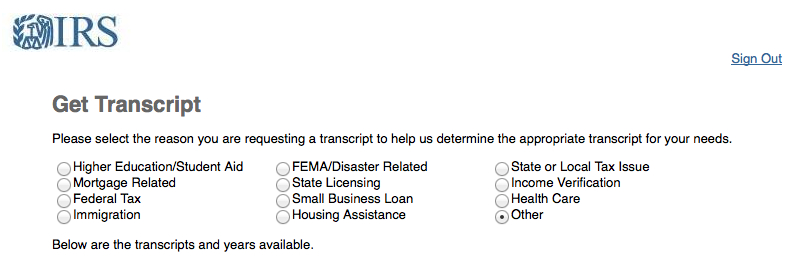
Earlier today, at the White House Education Datapalooza, an official from the United States Department of the Treasury informed a packed theater and livestream that students, parents and citizens would finally be able to do something simple and profoundly useful over the Internet: download a transcript of their tax return from the Internal Revenue Service.
“I am very excited to announce that the IRS has just launched, this week, a transcript application which will give taxpayers the ability to view, print, and download tax transcripts,” said Katherine Sydor, a policy advisor in the Office of Consumer Policy of the Treasury, “making it easier for student borrowers to access tax records he or she might need to submit loan applications or grant applications.” [VIDEO]
Previously, filers could request a copy of the transcript (not the full return) but would have to wait 5-10 business days to receive it in the mail. For people who needed more rapid access for applications, the delay could be critical. A White House fact sheet subsequently confirmed the news, under the rubric of “streamlining application paperwork,” and a quick follow up with an official secured the correct URL for the new IRS Web application to get a tax transcript.
I created an account, which involved jumping through the hoops familiar from establishing online access bank accounts — choosing pass phrase, pass image and security questions — and then answered a number of questions that made it pretty clear that the IRS knew exactly who I was and where I had lived. (It’s not clear whether they hold this information or used a credit bureau, from the consumer-side.)
When I tried to actually download the transcript, though, I ran into some issues: first, a browser error in Chrome — “This XML file does not appear to have any style information associated with it. The document tree is shown below.” Using Firefox, however, I was able to at least get the page where I could choose from various years of transcripts.
Unfortunately, clicking any of the links delivered a file that my Macbook was unable to parse. I was, however, able to log into IRS.gov and easily download last year’s tax return with one click to my iPhone. Success!
While the technical problems I ran into suggest that Apple computer users might run into some issues, I have a funny feeling that (the vast majority) of people who are running Internet Explorer on a Windows machine will fare better.
The fact that American citizens could not access their own tax returns online in 2014 might seem jarring but, until this week, that was the status quo. This advance represents the sort of somewhat mundane but important shift that the Obama administration’s approach to digital government have enabled over the past five years.
While the troubles behind the botched launch of Healthcare.gov have shaken the confidence of many citizens in the capacity of this administration to deliver effective digital services and months of headlines about digital surveillance by the National Security Agency have diminished trust in government overall, the ability of the “tech surge” to fix the site and the success of the technology team at the Consumer Financial Protection Bureau not only offers a guide for how to avoid similar issues but highlights a less salacious and boring reality that will generate no headlines nor heated rhetoric on cable news shows: most public officials and civil servants are quietly working to deliver better customer service for citizens.
Being able to download a tax transcript online is not, however, without risks. The Internal Revenue Service will need to continue to be vigilant about security. The new functionality will almost certainly inspire fraudsters to create mockups of the government website that look similar and then send phishing emails to consumers, urging them to “log in” to fake websites.
Perhaps most problematically, people will download tax transcripts to mobile devices and laptops and then not take steps to protect them with encryption. If you do download your transcripts or personal health information, make sure to also install full disk encryption on every machine you own. Leaving your files unprotected there is like leaving the door to your house unlocked with your tax returns and medical records on the kitchen table.
I have asked the IRS for comment on the new feature, browser and operating system and security guidance and will update this post if and when I receive any.
Update: comment from the IRS on follows.
How much time and technical resources did the IRS invest in deploying the feature? Has the IRS increased the capacity of the website for more demand?
From establishing the business case and receiving funding plus approval to start the work to implementation took approximately one year. Additional time was spent in ideation, innovation, and confirming requirements of the product prior to receiving approval.
I had trouble downloading my transcript on an Apple computer using Chrome and Firefox. (I was able to get it through my iPhone.) What browsers and operating systems does the new function officially support?
As a web application, Get Transcript is supported on most modern OS/browser combinations. While there may be intermittent issues due to certain end-user configurations, IRS has not implemented any restrictions against certain browsers or operating systems. We are continuing to work open issues as they are identified and validated.
A side note: For the best user experience, taxpayers may want to try up-to-date versions of internet explorer and a supported version of Microsoft windows; however, that is certainly not a requirement.)
Does the IRS have any guidance for ensuring that Americans connect securely to the website and then protect tax returns on their home computers once they have downloaded them?
The IRS has made good progress on oversight and enhanced security controls in the area of information technology. With state-of-the-art technology as the foundation for our portal (e.g. irs.gov), we continue to focus on protecting the PII of all taxpayers when communicating with the IRS.
However, security is a two-way street with both the IRS and users needing to take steps for a secure experience. On our end, our security is comparable to leaders in private industry.
Our IRS2GO app has successfully completed a security assessment and received approval to launch by our cybersecurity organization after being scanned for weaknesses and vulnerabilities.
Any personally identifiable information (PII) or sensitive information transmitted to the IRS through IRS2Go for refund status or tax record requests uses secure communication channels that meet or exceed federal requirements for encryption. No PII is passed back to the taxpayer through IRS2GO and no PII is stored on the smartphone by the application.
When using our popular Where’s My Refund? application, taxpayers may notice just a few of our security measures. The URL for Where’s My Refund? begins with https. Just like in private industry, the “s” is a key indicator that a web user should notice indicating you are in a “secure session.” Taxpayers may also notice our message that we recommend they close their browser when finished accessing your refund status.
As we become a more mobile society and able to link to the internet while we’re on the go, we remind taxpayers to take precautions to protect themselves from being victimized, including using secure networks, firewalls, virus protection and other safeguards.
We always recommend taxpayers check with the Federal Trade Commission for the latest on reporting incidents of identity theft. You can find more information on our website, including tips if you believe you have become the victim of identity theft.
Does the IRS have any plans to provide Americans with access or insight to estimated tax returns online in the future? Now that we have the ability to establish user accounts, would it ever be possible, for instance, for people with simple taxes (1040EZ, etc) to log in, review an estimated return, make any required edits, and then e-file it on IRS.gov?
IRS: The IRS is considering a number of new proposals that may become a part of the online services roadmap some time in the future. This may include a taxpayer account where up to date status could be securely reviewed by the account owner.
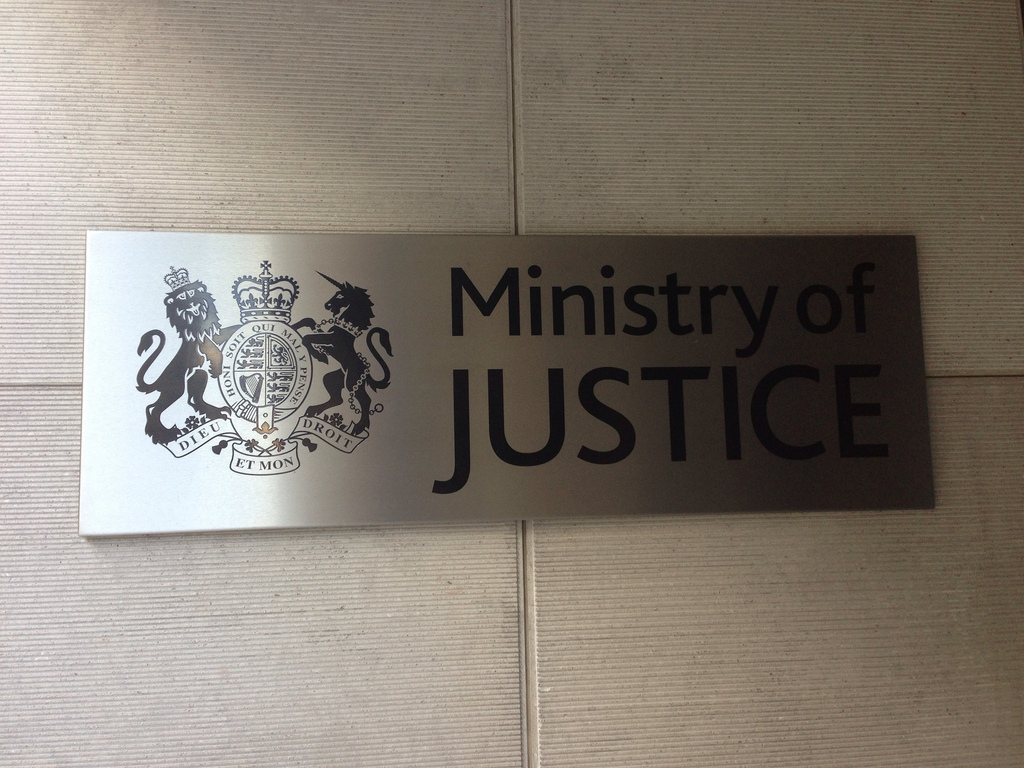
This September, I visited the United Kingdom’s Ministry of Justice and looked at the last remaining section of the Magna Carta that remains in effect. I was not, however, in a climate-controlled reading room, looking at a parchment or sheepskin.
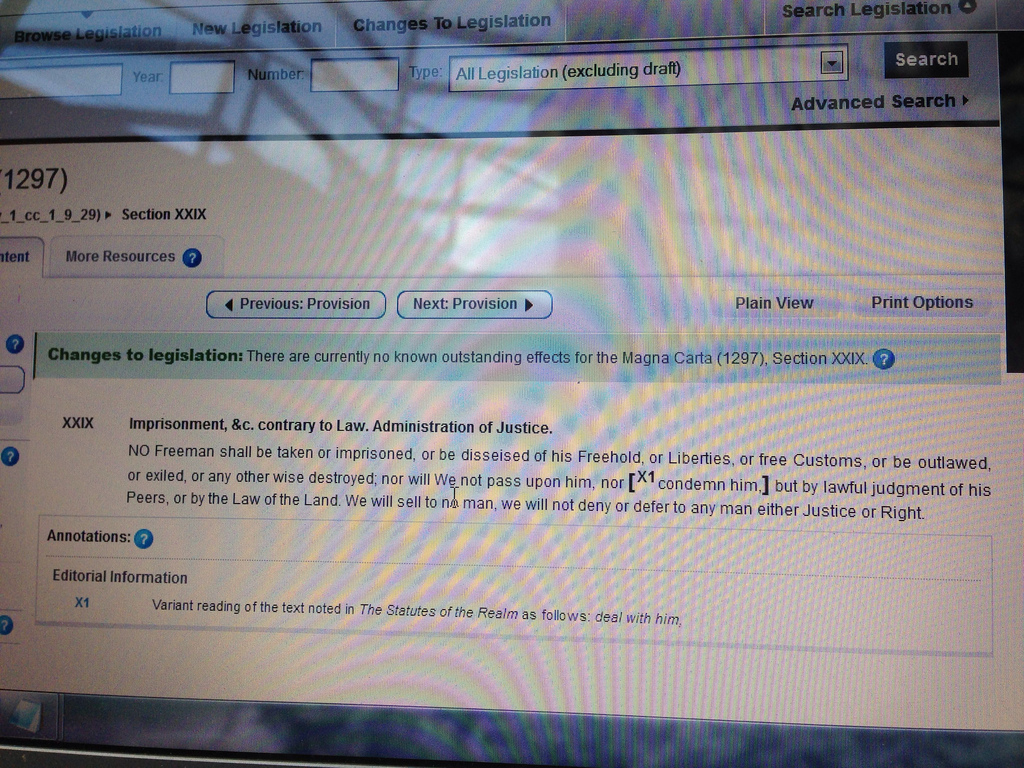
Rather, I was sitting in the Ministry’s sunny atrium, where John Sheridan was showing me the latest version of the seminal legal document, now living on online, on his laptop screen. The remaining section that is in force is rather important to Western civilization and the rule of law as many citizens in democracies now experience it:
NO Freeman shall be taken or imprisoned, or be disseised of his Freehold, or Liberties, or free Customs, or be outlawed, or exiled, or any other wise destroyed; nor will We not pass upon him, nor [X1condemn him,] but by lawful judgment of his Peers, or by the Law of the Land. We will sell to no man, we will not deny or defer to any man either Justice or Right.
From due process to eminent domain to a right to a jury trial, many of the rights that American or British citizens take as a given today have their basis in the English common law that stems from this document.
Over a cup of tea, Sheridan caught me up on the progress that his team has made in digitizing documents and improving the laws of the land. There are now 2 million monthly unique visitors to legislation.gov.uk every month, with 500+ million page views annually. People really are reading Parliament’s output, he observed, and increasingly doing so on tablets and mobile devices. The amount of content flowing into the site is considerable: according to Sheridan, the United Kingdom is passing laws at an estimated rate of 100,000 words every month, or twice as much as the complete works of Shakespeare.
Notable improvements over the years include the ability to compare the original text of legislation versus the latest version (as we did with the Magna Carta) and view a timeline of changes using a slider for navigation, exploring any given moment in time. Sheridan was particularly proud of the site’s rendering of legislation in HTML, include human-readable permanent uniform resource locators (URLS) and the capacity to produce on-demand PDFs of a given document. (This isn’t universally true: I found some orders appear still as PDFs).
More specifically, Sheridan highlighted a “good law” project, wherein the Office of the Parliamentary Counsel (OPC) of Britain is working to help develop plain language laws that are “necessary, clear, coherent, effective and accessible.” A notable component of this good law project is an effort to apply a tool used in online publishing, software development and advertising — A/B testing — to testing different versions of legislation for usability.
The video of a TedX talk embedded below by Richard Heaton, the permanent secretary of the United Kingdom’s Cabinet Office and first parliamentary counsel, explores the idea of “good law” at more length:
Sheridan went on to describe one of the more ambitious online collaborations between a government and its citizens I had heard of to date, a novel cross-Atlantic challenge co-sponsored by the UK and US governments, and a hairy legal technology challenge bearing down upon societies everywhere: what happens when software interprets the law?
For instance, he suggested, consider the increasing use of Oracle software around legislation. “As statutes are interpreted by software, what’s introduced by the code? What about quality testing?”
As this becomes a data problem, “you need information to contextualize it,” said Sheridan. “If you’re thinking about legislation as code, and as data, it raises huge questions for the rule of law.”
Sheridan has been one of the world’s foremost proponents of publishing legislative data through APIs, an approach that has come under criticism by open government data advocates after the government shutdown in the United States. (In 2014, forward-thinking governments publishing open data might consider provide basic visualization tools to site visitors, API access for third-party developers and internal users, and bulk data downloads.) One key difference between the approach of his team and other government entities might be that the National Archives are “dogfooding,” or consuming the same data through the same interface that they expect third-parties to use, as Sheridan wrote last March:
“We developed the API and then built the legislation.gov.uk website on top of it. The API isn’t a bolt-on or additional feature, it is the beating heart of the service. Thanks to this approach it is very easy to access legislation data – just add /data.xml or /data.rdf to any web page containing legislation, or /data.feed, to any list or search results. One benefit of this approach is that the website, in a way, also documents the API for developers, helping them understand this complex data.”
Perhaps because of that perspective, Sheridan, was as supportive of an APIs when we talked this September as he had been in 2012:
The legislation.gov.uk API has changed everything for us. It powers our website. It has enabled us to move to an open data business model, securing the editorial effort we need from the private sector for this important source of public data. It allows us to deliver information and services across channels and platforms through third party applications. We are developing other tools that use the API, using Linked Data – from recording the provenance of new legislation as it is converted from one format to another, to a suite of web based editorial tools for legislation, including a natural language processing capability that automatically identifies the legislative effects. Everything we do is underpinned by the API and Linked Data. With the foundations in place, the possibilities of what can be done with legislation data are now almost limitless.
Sheridan noted to me that the United Kingdom’s legislative open government data efforts are now acting as a platform for large commercial legal publishers and new entrants, like mobile legislative app, iLegal.
The iLegal app content is derived from the legislation.gov.uk API and offers handy features, like offline access to all items of legislation. iLegal currently costs £49.99/$74.99 annually or £149.99/$219.99 for a lifetime subscription, which might seem steep but is a fraction of the cost of of Halsbury’s Statutes, currently listed at £9,360.00 from Lexis-Nexis.
This approach to publishing the laws of the land online, in structured form under an open license, is an instantiation of the vision for Law.gov that citizen archivist Carl Malamud has been advocating for in the United States. 2013 saw some progress in that vein when the U.S. House of Representatives publishes U.S. Code as open government data.)
What’s notable about the United Kingdom’s example, however, is that less then a decade ago, none of this could have been possible. Why? As ScraperWiki founder Francis Irving explained, the UK’s database of laws was proprietary data until December 2006. Now, however, the law of the land is released back to the people as it is updated, a living code available in digital form to any member of the public that wishes to read or reuse it.
The United Kingdom, however, has moved beyond simply publishing legislation as open data: they’re actively soliciting civic participation in its maintenance and improvement. For the last year, the National Archives has been guiding the world’s leading commercial open data curation project.
“We are using open data as business model for fulfilling public services,” said Sheridan, in our interview. “We train people to do editorial work. They are paid to improve data. The outputs are public.”
In other words, the open government data always remains free to the people through legislation.gov.uk but any academic, nonprofit or commercial entity can act to add value to it and sell access to the resulting applications, analyses or interfaces.
Since the start of the UK project, they have doubled the number of people working on their open data, Sheridan told me. “The bottleneck is training,” he said. “We have almost unlimited editorial expertise available through our website. We define the process and rules, and then let anyone contribute. For example, we’re now working on revising legislation, identifying changes, researching it — when it comes in, what it affects — and then working with editor. Previous to this effort, government hasn’t been able to revise secondary legislation.”
Sheridan said that the next step is feedback for other editorial values.
“We’re looking for more experts,” he said. “They’re generally paid for by someone. It’s very close to open source software model. They must be able to demonstrate competence. There’s a 45-minute test, which we’re now given to thousands of people.”
If this continues to work, distributed online collaboration is a “brilliant way to help improve the quality of law,” said Sheridan.
“It’s a way to get the work done — and the work is really hard. You have to invest time and energy, and you must protect the reputation of the Archive. This is somewhat radical for the nation’s statute book. We have redesigned the process so people can work with us. It’s not a wiki, but participation is open. It’s peer production.”
A trans-Atlantic challenge to map legislative data
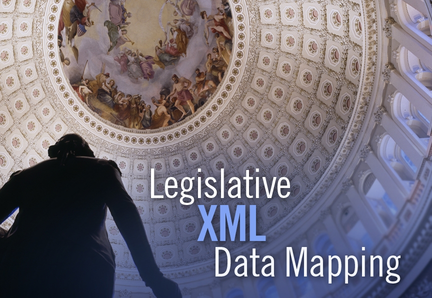
The U.K. National Archives and U.S. Library of Congress have asked for help mapping elements from bills to the most recent Akoma Ntoso schema. (Akoma Ntoso is an emerging global standard for machine-readable data describing parliamentary, legislative and judiciary documents.) The best algorithm that maps U.S. bill XML or UK bill XML to Akoma Ntoso XML, including necessary data files and supporting documentation, will win $10,000.
If you have both skills and interest, get cracking: the challenge closes on December 31, 2013.
The event featured comments from deputy United States chief technology officer Nick Sinai, the authors of the McKinsey report on the economic value of open data, and a panel of experts, moderated by yours truly.
P.J. Vogt, a producer for NPR’s “On The Media,” was surprised to find that a “We the People” epetition had played a role in the FCC moving to make a deal with wireless carriers that will allow consumers to unlock their cellphones.
He’s not alone. Historic lows in trust in the federal government mean that any progress toward a positive outcome — like legal unlocking of mobile devices — is viewed skeptically in public discourse.
Should carriers actually allow consumers to unlock those devices, it would be the the open government platform has now played a role in U.S. history.
As I’ve observed before, on the evening of December 20, 2012, however, President Barack Obama responded to 32 different e-petitions related to gun violence. It was the first direct response to an e-petition at The White House by a President of the United States. While this remains the only e-petition that the President has responded to personally, before or since, it was a milestone in digital government, marking the first time that the President spoke directly to the people through the Internet about an issue they had collectively asked to be addressed using the Internet.
By January 2013, it had 5 million users. Now, there are over 10 million. It’s the first open government platform to reach that scale of use, in no small part due to the epic response to the Death Star petition that drew both Internet-wide and mainstream media attention.
And here’s the thing: most of those users are satisfied with the responses. Not all of them have resulted in policy shifts — in fact, only a few have, like a rulemaking on online puppy mills — but the ones that did are significant: SOPA/PIPA, increasing public access to scientific research online, and supporting consumers unlocking their mobile devices.
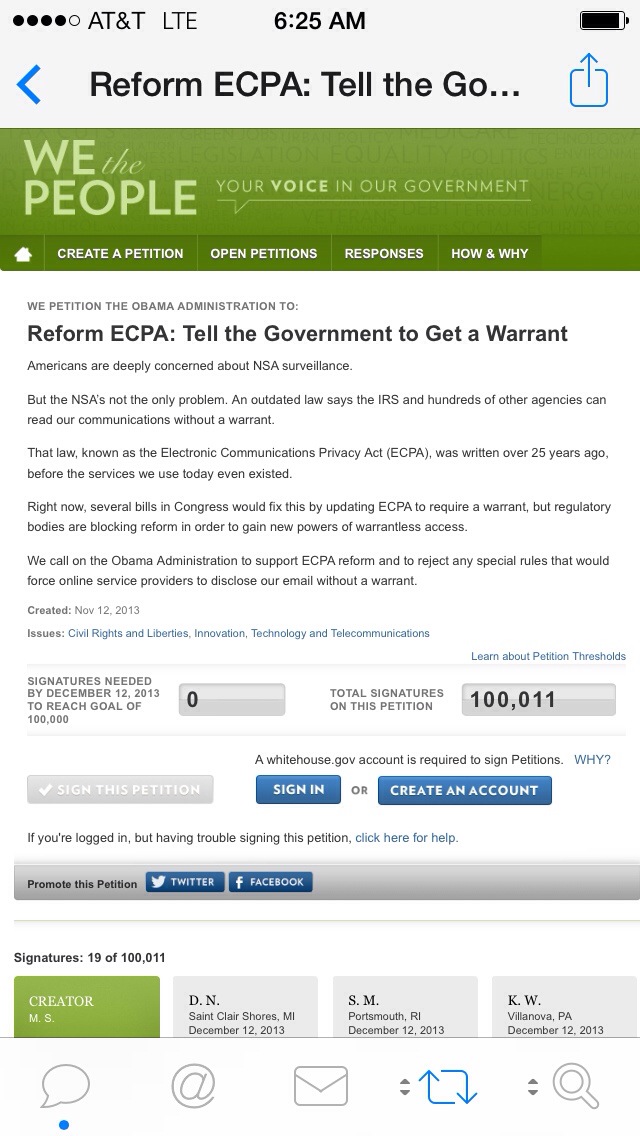
More challenging requests lie ahead. An epetition for the administration to reform the Electronic Communications Privacy Act just passed the 100,000 signature threshold this week, requiring a response.
The epetition will join a dozen or so popular online petitions that have passed the threshold, some of which have lingered unanswered for over a year.
This tardiness of response might lead critics of the administration to conclude that this White House putting off public responses to popular petitions it finds politically inconvenient, like the one to pardon Edward Snowden.
Even if that’s the case, if this trend continues, these epetitions from the American people look a bit less like a useless exercise in democracy theater at week’s end.
In 2014, the White House has announced a plan to launch a public version of the application programming interface (API) for “We The People,” enabling third parties to build applications on top of it.
Should mainstream adoption continue, American citizens may find a bonafide means to exercise their right to petition the United States government for the redress of grievances in the public desire of the twenty-first century.





 E Pluribus Unum