Do nudges and civic apps help or hinder public policy reform?

sbst_2015_annual_report_final_9_14_15_pdf

The New York Times published a thoughtful exploration of societal probems, behavioral economics and government policy today. The intended big takeaway is clear enough: systemic issues, from poverty to retirement savings, need bigger policy intercessions than “nudges” to address the underlying issues.

To the extent that nudging distracts or delays broader change, the thinking goes, they may even be negative. You can tell that’s the intention because Eduardo Porter, the author, and the editor gives the “kicker quote” — the last word — to this expert:

“The single biggest contribution of behavioral economics to public policy is taking this flawed approach to retirement savings and making it a little bit more viable,” Mr. Loewenstein told me. “The downside is that if we make it just sufficiently viable, people won’t recognize how bankrupt the concept is.”

To his credit, Porter did acknowledge *why* the Obama administration has embraced applying behavioral economics in public policy — “Washington’s political paralysis.” In the face of a Republican-controlled Congress, the White House has had little reason to expect to enact any large social reforms since 2010, which means taking other approaches to improving social outcomes became more attractive. This is relevant to the Democratic presidential campaign as well, but that’s a subject for a separate piece.

As it happens, this is an argument that I’ve run into before, albeit in another context.

In 2013, voluble tech critic Evgeny Morozov made a similar observation about food stamp apps that help people keep benefits:

When I asked him why alerting the poor via a mobile device that their food stamps are expiring (versus a densely worded mailed printed document) is not an achievement, he responded that it “perpetuates a neoliberal regime where paperwork equals precarity equals a barrier to decent life.”

When I responded that, barring a political revolution, this system is the one the poor must negotiate, Morozov suggested that I take my pragmatic attitude somewhere else: a food stamp app is “a perfect example of tech that makes already ugly regimes more efficient.”

In my view, then and now, is that if “paperwork equals precocity,” improving the capacity of poor to access & retain benefits looks like a social good.

Morozov responded that “social goods come in different kinds, and that “the one you advocate is woefully unambitious.”

“Keep pretending that making ugly programs more efficient is apolitical or is in fact a social good,” he suggested.

Morozov asked if I had ever heard of a basic income, arriving at the significant social reform he presumably supports, providing the poor with an automatic benefit instead of one that they must register for and maintain. (The answer, then and now, was yes.)

It is extraordinarily unlikely, however, that the 114th Congress of United States of America will enact such a reform this year or next.

In that context, I’m not sure that food stamps — subsidies for families to buy food — are “ugly.” Removing a social program families depend on and letting our fellow citizens and their children go hungry to try galvanize political reforms would be ugly.

I do think that the way that they are currently delivered and administrated is ugly and must be improved. The software people must use to register for food stamps should be just as user-friendly as ordering a car through Uber.

I also think that applying behavioral economics to existing government programs makes sense, along with better designed digital services, as long as policy makers are transparent about how they are using nudges and disclose evidence to justify the defaults that they establish.

If you share Morozov’s view or have other arguments, please link and share them in the comments.

P.S. I think there was something of a strawman embedded in the Times article: Have President Barack Obama, Richard Thaler, Cass Sunstein or any other public official or researcher ever claimed that “nudges” alone would be enough to lift people out of poverty or develop additional income needed to save enough for retirement? I couldn’t find such an assertion. (If you do, please let us know.)

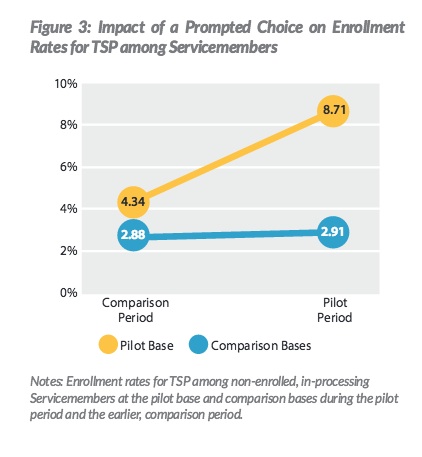
[FIGURE CREDIT: Re-enrollment rate changes for military service members after the introduction of a prompt, as detailed in the 2015 annual report of White House Social and Behavioral Sciences team]

REPORT: Limited White House Progress On Open Government Commitments

Civil_Society_Report_on_Implementation_of_the_Second_US_National_Action_Plan_-_NAP_2_Final_Evaluation_pdf
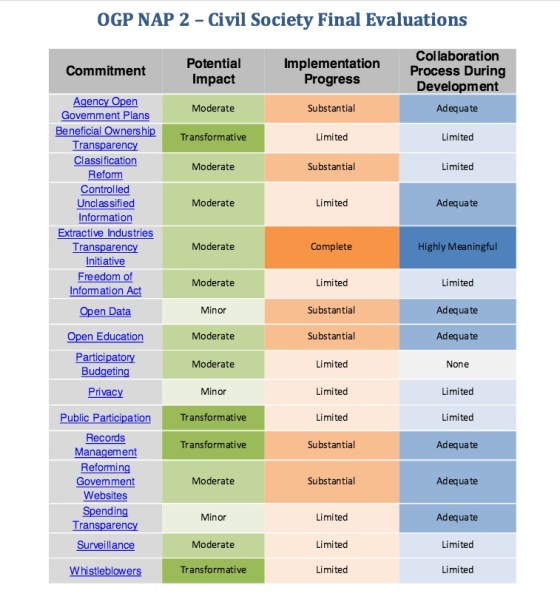
Today, OpenTheGovernment.org released a report of experts who evaluated how well the Obama administration has met its commitments to the Open Government Partnership in its second National Action Plan for Open Government. As you can see in the chart above, the researchers found only one commitment is fully met. Others, not so much.
What’s behind the hold up ? Here’s what the researchers suggested:
The possible explanations for why government agencies were unable to complete the initiatives varied across the evaluations. For example, the evaluation on the commitment to “Modernize the Freedom of  Information Act,” attributed the limited progress on this commitment to the lack of a strong mandate, absence of political will, and need for greater leadership. The evaluation of the commitment on transparency for legal entities noted “corporate opposition” as an apparent roadblock to that potentially transformative commitment. On the commitment to increase transparency of foreign intelligence surveillance activities, the lack of progress was discussed as possibly being a result of the complex challenges stemming from a deeply engrained culture of secrecy.
The lack of benchmarks and specific language is another commonly noted problem that emerges from this report. OGP guidance notes that governments should develop specific commitments and, where commitments have multiple sub-commitments, they should be broken into “clear, measurable milestones.” While the Civil Society Model Plan for the NAP 2 included detailed benchmarks and timelines for achieving measurable sub-commitments, these are generally not included in the U.S. NAPs.
Keep all of this in mind as The White House and federal agencies talk about new open government commitments.
I was asked to examine the administration’s progress meeting a commitment on the Freedom of Information Act — but failed to submit my own comments. As noted above, while the Obama administration made some progress on a new FOIA website, the Justice Department has so far failed to deliver better FOIA software — or, even better, an API for FOIA software vendors to build on. More problematically, the White House has been completely silent on Freedom of Information Act reform in Congress, despite language that mirrored the information policy that President Barack Obama and former U.S. Attorney General Eric Holder promulgated.
Those issues aside, the lack of progress on the potentially transformative commitments offers an opportunity for the Obama administration in its final year, as well as a set of idea that the presidential candidates could take up on the trail. Pushing even one of these through to completion by next January would be meaningful.
P.S. If you are a reporter covering the campaigns, please consider asking the candidates these  open government-related questions drafted by OpenTheGovernment.org and the American Society of News Editors (ASNE).


New Freedom of Information Act Reform Bill Introduced In Congress

IMG_1992

On Tuesday, the U.S. House of Representatives will once again weigh reforming the Freedom of Information Act to improve how the most important open government law of the United States is honored.

The FOIA Reform Act,  authored by Rep. Darrell Issa (R-CA) is once again on the Congressional Calendar, with an additional 22 page report, H.R. 391.

According to government transparency advocate Lisette Garcia, an expert on FOIA law, the new FOIA bill (H.R. 653) was “heavily negotiated between both parties throughout the drafting stages.” She expects it to be considered in suspension of ordinary debate rules and fast-tracked with little opportunity for public input.

Garcia, who alerted us to the new bill text via email, said that Congressman Jason Chaffetz (R-CO) gave her an advance copy of the bill last December in exchange for her feedback as an experienced FOIA requester.

“Now is the time to register any objection or endorsement you may want to offer regarding any specific provisions,” she wrote.”Feedback to your representative, or any member of the Oversight Committee, may be submitted by calling the U.S. House switchboard at (202) 224-3121.”
That feedback matters because of the way that FOIA reform died in 2014.

Alert readers may recall that Congress was poised to enact historic Freedom of Information Act reforms in late 2014, only to see FOIA reform die as the press looked the other way and lobbying by the financial industry scuttled it at the last minute.

That was a huge loss for the public interest and a giant missed opportunity for public engagement around public access to public information.

Despite FOIA reform passing both Houses of Congress unanimously, the government transparency bill expired when federal agencies, including the Justice Department and the Federal Trade Agency, reportedly lobbied against the bill when it came before the House one final time and Speaker of the House John Boehner failed to put it on the legislative calendar.

The fiasco led press freedom advocates to criticize the Obama administration for failing to support making the same FOIA policy the President introduced and endorsed publicly in 2009 the law of the land.

Over the past several years, the Obama administration has committed and recommitted to modernizing how the federal government complies with the Freedom of Information Act for years.

On the one hand, there has been progress on a new website for requests and pilot projects for ‘release to one, release to all’ policies. The administration has also released  vast amounts of public data online and used technology to inform and engage the public in governance and science in unprecedented ways, from crowdsourcing and challenges to social media.

On the other, there’s a gap between what the Obama administration says about open government and how it follows through when informed members of the public ask tough questions.

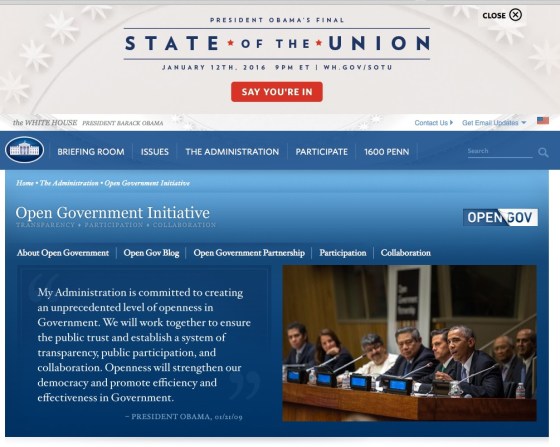
The “presumption of openness” presented with such hope on the first day of President Barack Obama’s presidency in 2009 hasn’t led to the change that the public wished to see in 2016.

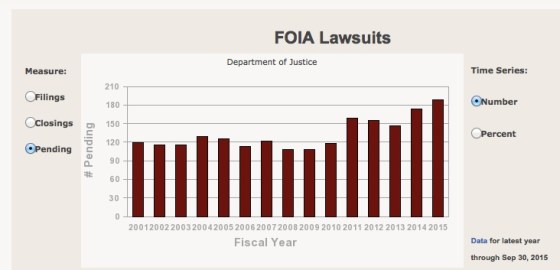
Researchers at the FOIA Project at Syracuse University found last week that there was a record number of pending FOIA lawsuits in 2015.

pending FOIA_Lawsuits

FOIA reform may face higher barriers to passing in the 114th Congress, but it’s more sorely needed than ever.

Here’s one way to give it some more attention. At the end of 2015, the Obama administration outlined 45 different ways it’s working to make the U.S. government more open and accountable to the people it serves.

If the White House intends to fulfill the open government promise it made in January 2009, President Barack Obama could start by adding a single sentence endorsing FOIA reform in Congress during his final State of the Union speech tomorrow night, making the “presumption of openness” law.

Open_Government_Initiative___The_White_House

If President Obama still believes that he has led the “most transparent administration in history,” maybe it’s time to ask the public and Congress to make his public policies permanent so that the next inhabitant of the People’s House cannot easily reverse them.

Updates: 

  1. Yes, FOIA is still broken, but for more reasons than you might think. 

    The Washington Times and The Blaze  reported on today’s House Oversight Committee’s report, which lambasted the Obama administration’s handling of FOIA requests as “hobbled” and “broken.”What both publications left out — along with Congressman Issa, who wrote an op-ed in the Daily Caller about the FOIA Oversight and Implementation Act he sponsored — is important. As the Wall Street Journal reported in 2013 and the New York Times reported today, the private sector is a huge user of this open government law. Consulting groups and hedge funds use FOIA requests for business intelligence.

    In fact, according to a 2015 study by Margaret B. Kwoka, an assistant professor at the University of Denver Sturm College of Law, cited by the Times, commercial resellers of data make the majority of FOIA requests at some federal agencies: 75%+ at the FDA, 9% at the Defense Logistics Agency.

    In theory, a “release to one, release to all” policy would address this issue, if FOIA officers and agencies worked to reconcile it with complementary efforts to proactive disclosure of open data online across the federal government — and the Department of Justice was willing to hold agencies and itself to a higher standard.

  2. This reform could weaken the current Freedom of Information Act.
    While they’re supportive of the core reforms that are preserved from the original FOIA Reform Act, open government advocates are decrying the addition of new language that would exempt the U.S. intelligence community from certain provisions of the Freedom of Information Act, including the consultation process that the bill would create.

    Yep: this FOIA reform bill could enable a vast portion of the federal government to be more secretive, not less.

    “The changes to the House FOIA bill, added as a result of a last-minute demand of HPSCI, is a pattern that is becoming all too familiar and objectionable” said Patrice McDermott, the executive director of OpenTheGovernment.org, in a statement.

    “The efforts to exempt the Intelligence Community are not acceptable. They are particularly offensive in this bill intended to promote openness across the federal government.”

  3. FOIA reform passed the House but the bill is not law yet.

     The Hill reported that the House is poised to approve the FOIA reform bill on Tuesday, Jan.12.

    In fact, the House moved to consider H.R. 653 “as amended” on Monday night, under suspension of the rules, and passed the bill under voice vote.

    Now that the House has passed FOIA reform (again), it’s on to the Senate.


U.S. Civil Society Groups release model National Open Government Action Plan

This is the week for seeking feedback on open government in the United States. 4 days ago, the White House published a collaborative online document that digitized the notes from an open government workshop held during Sunshine Week in March. Today, Abby Paulson from OpenTheGovernment.org uploaded a final draft of a Model National Action Plan to the Internet, as a .doc. I’ve uploaded it to Scribd and embedded it below for easy browsing.

Nelson shared the document over email with people who contributed to the online draft.

Thank you so much for contributing to the civil society model National Action Plan. The Plan has made its way from Google Site to Word doc (attached)! We will share these recommendations with the White House, and I encourage you to share your commitments with any government contacts you have. If you notice any errors made in the transition from web to document, please let me know. If there are any other organizations that should be named as contributors, we will certainly add them as well. The White House’s consultation for their plan will continue throughout the summer, so there are still opportunities to weigh in. Additional recommendations on surveillance transparency and beneficial ownership are in development. We will work to secure meetings with the relevant agencies and officials to discuss these recommendations and make a push for their inclusion in the official government plan. So, expect to hear from us in the coming weeks!

From Stickies to Wikis: White House seeks online feedback on open government

In a followup post, the White House shared a link to a collaborative online document where the notes from an open government workshop held during Sunlight Week were posted online for comment. In doing so, they moves from sticky notes to a wiki.

What will come of asking the broader public for feedback on the ideas that a workshop of advocates and policy wonks in DC suggested? Stay tuned.

Half empty or half full? Mixed reactions to Pew research on open data and open government

Yesterday, I wrote up 15 key insights from the Pew Internet and Life Project’s new research on the American public’s attitude towards open data and open government. If you missed it, what people think about government data and the potential impact of releasing it is heavily influenced by the prevailing low trust in government and their politics.

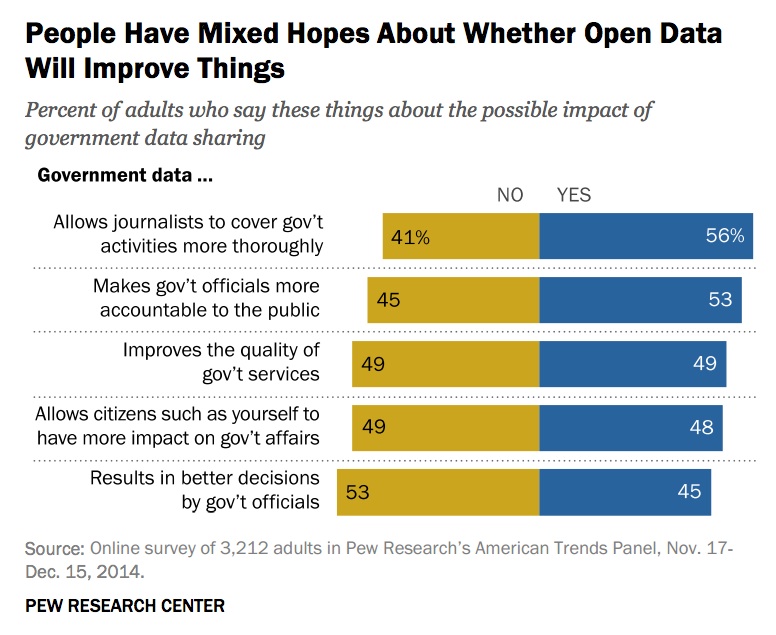
mixed-hopes-open-data-improve-pew

Media coverage of the survey reflected the skepticism of the reporters (“Most Americans don’t think government transparency matters a damn“) or of the public (“Who cares about open data” and “Americans not impressed by open government initiatives“). This photo by Pete Souza below might be an apt image for this feeling:

not-impressed-souza-obama

Other stories pulled out individual elements of the research (“Open data on criminals and teachers is a-okay, say most US citizens” or mixed results (“People Like U.S. Open Data Initiatives, But Think Government Could Do More” and “Sorry, open data: Americans just aren’t that into you“) or general doubts about an unfamiliar topic (“Many Americans Doubt Government Open Data Efforts“). At least one editor’s headline suggested that the results were an indictment of everything government does online: (“Americans view government’s online services and public data sharing as a resounding ‘meh’.) Meh, indeed.

As usual, keep a salt shaker handy as you browse the headlines and read the original source. The research itself is more nuanced than those headlines suggest, as my interview with the lead researcher on the survey, John Horrigan, hopefully made clear.

Over at TechPresident, editor-in-chief Micah Sifry saw a glass half full:

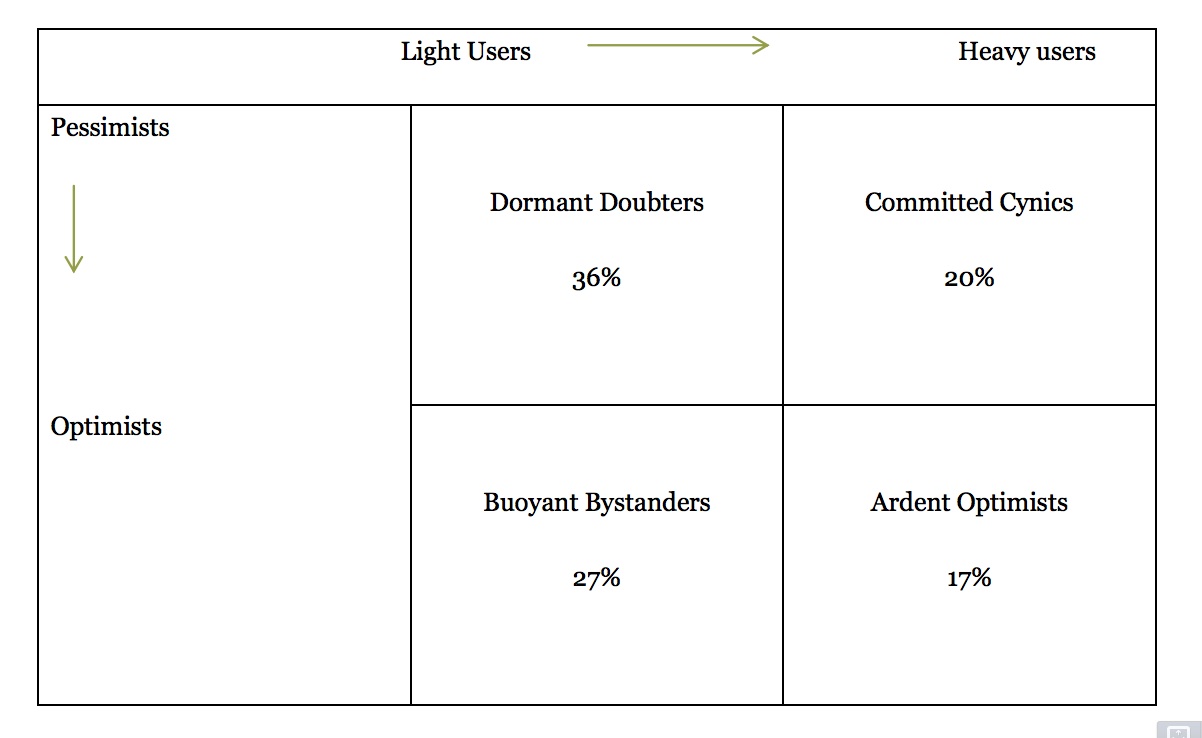
  • Digging deeper into the Pew report, it’s interesting to find that beyond the “ardent optimists” (17% of adults) who embrace the benefit of open government data and use it often, and the “committed cynics” (20%) who use online government resources but think they aren’t improving government performance much, there’s a big group of “buoyant bystanders” (27%) who like the idea that open data can improve government’s performance but themselves aren’t using the internet much to engage with government. (Heads up Kate Krontiris, who’s been studying the “interested bystander.”)
  • It’s not clear how much of the bystander problem is also an access problem. According to a different new analysis done by the Pew Research Center, about five million American households with school-age children–nearly one in five–do not have high-speed internet access at home. This “broadband gap” is worst among households with incomes under $50,000 a year.

Reaction from foundations that have advocated, funded or otherwise supported open government data efforts went deeper. Writing for the Sunlight Foundation, communications director Gabriela Schneider saw the results from the survey in a rosy (sun)light, seeing public optimism about open government and open data.

People are optimistic that open data initiatives can make government more accountable. But, many surveyed by Pew are less sure open data will improve government performance. Relatedly, Americans have not quite engaged very deeply with government data to monitor performance, so it remains to be seen if changes in engagement will affect public attitudes.

That’s something we at Sunlight hope to positively affect, particularly as we make new inroads in setting new standards for how the federal government discloses its work online. And as Americans shift their attention away from Congress and more toward their own backyards, we know our newly expanded work as part of the What Works Cities initiative will better engage the public, make government more effective and improve people’s lives.

Jonathan Sotsky, director of strategy and assessment for the Knight Foundation, saw a trust conundrum for government in the results:

Undoubtedly, a greater focus is needed on explaining to the public how increasing the accessibility and utility of government data can drive accountability, improve government service delivery and even provide the grist for new startup businesses. The short-term conundrum government data initiatives face is that while they ultimately seek to increase government trustworthiness, they may struggle to gain structure because the present lack of trust in government undermines their perceived impact.

Steven Clift, the founder of e-democracy.org, views this survey as a wakeup call for open data advocates.

One reason I love services like CityGram, GovDelivery, etc. is that they deliver government information (often in a timely way) to the public based on their preferences/subscriptions. As someone who worked in “e-government” for the State of Minnesota, I think most people just want the “information” that matters to them and the public has no particular attachment to the idea of “open data” allowing third parties to innovate or make this data available. I view this survey as a huge wake up call to #opengov advocates on the #opendata side that the field needs to provide far more useful stuff to the general public and care a lot more about outreach and marketing to reach people with the good stuff already available.

Mark Headd, former chief data officer for the City of Philadelphia and current developer evangelist for Accela software, saw the results as a huge opportunity to win hearts and minds:

The modern open data and civic hacking movements were largely born out of the experience of cities. Washington DC, New York City and Chicago were among the first governments to actively recruit outside software developers to build solutions on top of their open data. And the first governments to partner with Code for America – and the majority over the life of the organization’s history – have been cities.

How do school closings impact individual neighborhoods? How do construction permit approvals change the character of communities? How is green space distributed across neighborhoods in a city? Where are vacant properties in a neighborhood – who owns them and are there opportunities for reuse?

These are all the kinds of questions we need people living and working in neighborhoods to help us answer. And we need more open data from local governments to do this.

If you see other blog posts or media coverage that’s not linked above, please let me know. I storified some reactions on Twitter but I’m certain that I missed conversations or opinions.

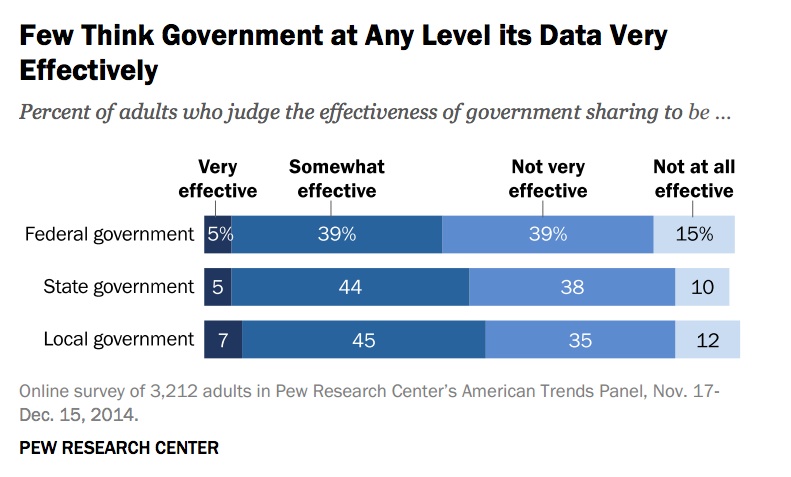
few-think-govt-data-sharing-effective-pew

There are two additional insights from Pew that I didn’t write about yesterday that are worth keeping in mind with respect to how how Americans are thinking about the release of public data back to the public. First, it’s unclear whether the public realizes they’re using apps and services built upon government data, despite sizable majorities doing so.

Second, John Horrigan told me that survey respondents universally are not simply asking for governments to make the data easier to understand so that they can figure out what I want to figure out: what people really want is intermediaries to help them make sense of the data.

“We saw a fair number of people pleading in comments for better apps to make the data make sense,” said Horrigan. “When they went online, they couldn’t get budget data to work. When the found traffic data, couldn’t make it work. There were comments on both sides of the ledger. Those that think government did an ok job wish they did this. Those that thin government is doing a horrible job also wish they did this.”

This is the opportunity that Headd referred to, and the reason that data journalism is the critical capacity that democratic governments which genuinely want to see returns on accountability and transparency must ensure can flourish in civil society.

If a Republican is elected as the next President of the United States, we’ll see if public views shift on other fronts.

15 key insights from the Pew Internet and Life Project on the American public, open data and open government

Today, a new survey released by the Pew Research Internet and Life Project provided one of the most comprehensive snapshots into the attitudes of the American public towards open data and open government to date. In general, more people surveyed are guardedly optimistic about the outcomes and release of open data, although that belief does vary with their political views, trust in government, and specific areas.  (Full disclosure: I was consulted by Pew researchers regarding useful survey questions to pose.)
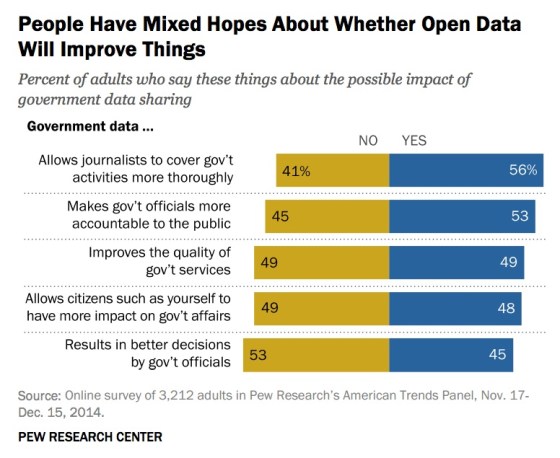
mixed-hopes-open-data-improve-pew

“Trust in government is the reference that people bring to their answers on open government and open data,” said John Horrigan, the principal researcher on the survey, in an interview. “That’s the frame of reference people bring. A lot of people still aren’t familiar with the notion, and because they don’t have a framework about open data, trust dominates, and you get the response that we got.”
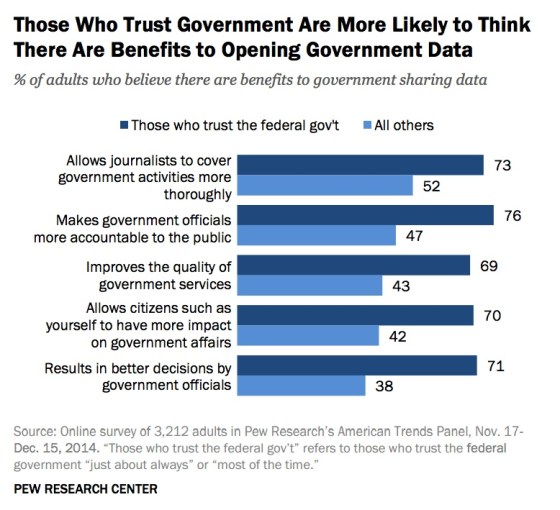
more-trust-gov-more-benefits-open-data

While majorities of the American public use applications and services that use government data, from GPS to weather to transit to health apps, relatively few are aware that data produced and released by government drives them.

“The challenge for activists or advocates in this space will be to try to make the link between government data and service delivery outcomes,” said Horrigan. “If the goals are to make government perform better and maybe reverse the historic tide of lowered trust, then the goal is to make improvements real in delivery. If this is framed just as argument over data quality, it would go into an irresolvable back and forth into the quality of government data collection. If you can cast it beyond whether unemployment statistics are correct or not but instead of how government services improve or saved money, you have a chance of speaking to wether government data makes things better.”

The public knowledge gap regarding this connection is one of the most important points that proponents, advocates, journalists and publishers who wish to see funding for open data initiatives be maintained or Freedom of Information Act reforms pass.

“I think a key implication of the findings is that – if advocates of government data initiatives hope that data will improve people’s views about government’s efficacy – efforts by intermediaries or governments to tie the open data/open government to the government’s collection of data may be worthwhile,” said Horrigan. “Such public awareness efforts might introduce a new “mental model” for the public about what these initiatives are all about. Right now, at least as the data for this report suggests, people do not have a clear sense of government data initiatives. And that means the context for how they think about them has a lot to do with their baseline level of trust in the government – particularly the federal government.”

Horrigan suggested thinking about this using a metaphor familiar to anyone who’s attended a middle school dance.

“Because people do engage with the government online, just through services, it’s like getting them on a big dance floor,” he suggested. “They’re on the floor, where you want them, but they’re on the other part of it. They don’t know that there’s another part of the dance that they’d like to see or be drawn to that they’d want to be in. There’s an opportunity to draw them. The good news that they’re on the dance floor, the bad news is they don’t know about all of it. Someone might want to go over and talk to them an explain that if you go over here you might have a better experience.”

Following are 13 more key insights about the public’s views regarding the Internet, open data and government. For more, make sure to read the full report on open government data, which is full of useful discussion of its findings.

One additional worth noting before you dive in: this survey is representative of American adults, not just the attitudes of people who are online. “The Americans Trends Panel was recruited to be nationally representative, and is weighted in such a way (as nearly all surveys are) to ensure responses reflect the general population,” said Horrigan. “The overall rate of internet use is a bit higher than we typically record, but within the margin of error. So we are comfortable that the sample is representative of the general population.”

Growing number of Americans adults are using the Internet to get information and data

While Pew cautions that the questions posed in this survey are different from another conducted in 2010, the trend is clear: the way citizens communicate with government now includes the Internet, and the way government communicates with citizens increasingly includes digital channels. That use now includes getting information or data about federal, state and local government.
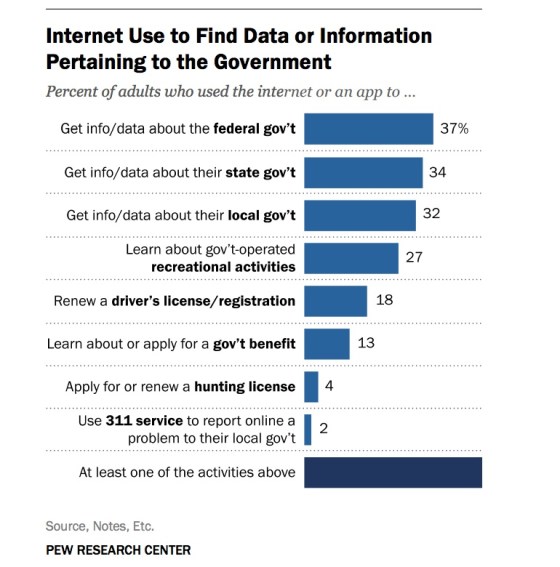
internet-use-info-government-pew

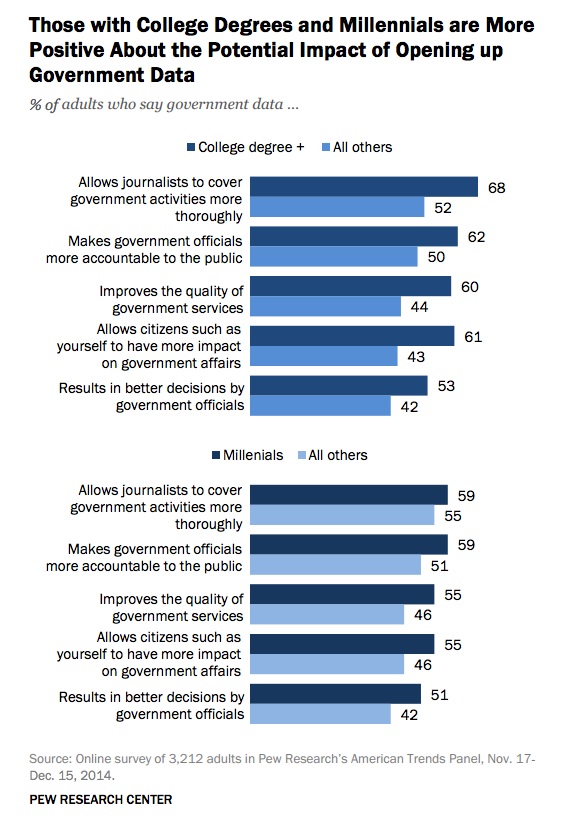
College-educated Americans and millennials are more hopeful about open data releases
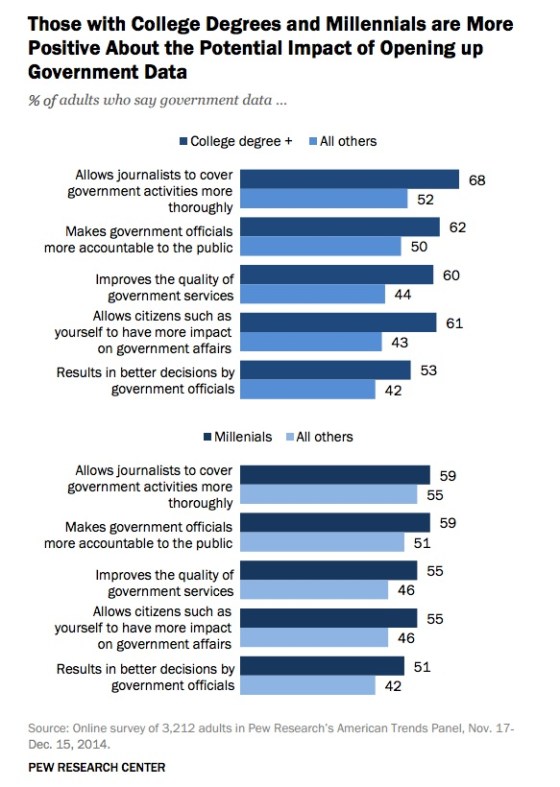
college-grad-millennials-more-hopeful-open-data-pew

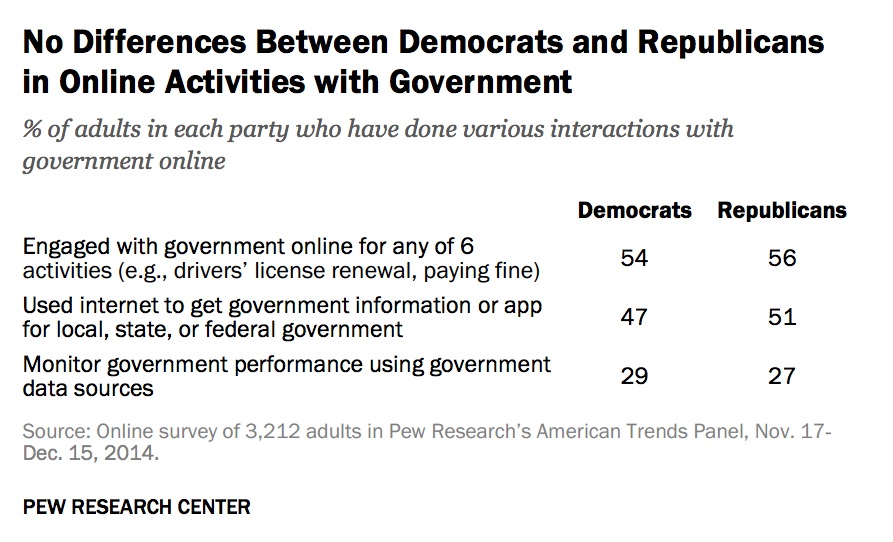
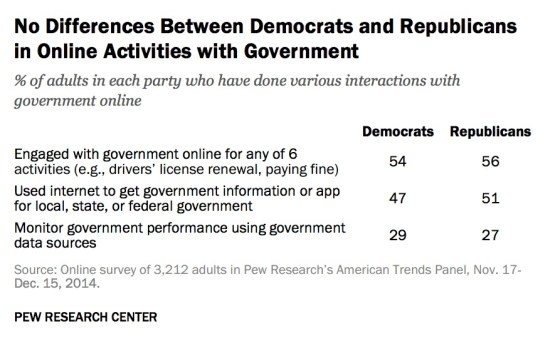
Despite disparities in trust and belief in outcomes, there is no difference in online activities between members of political parties
no-difference-trust-parties-in-online-activities

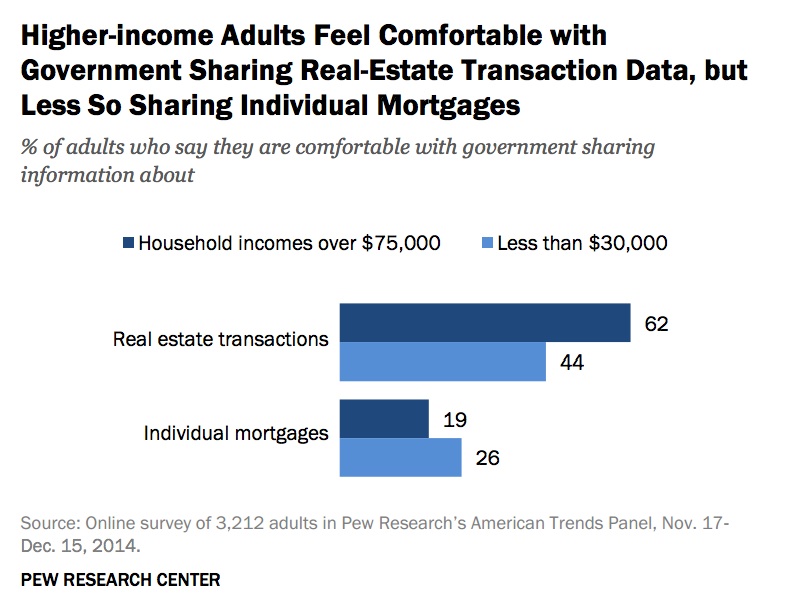
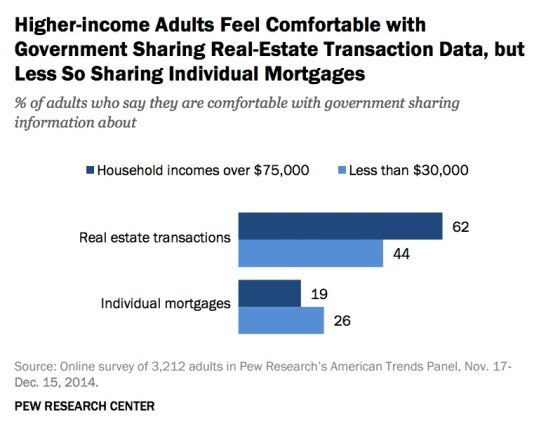
Wealthier Americans are comfortable with open data about real estate transactions but not individual mortgages
wealthy-comfortable-transaction-data-not-mortgages-pew

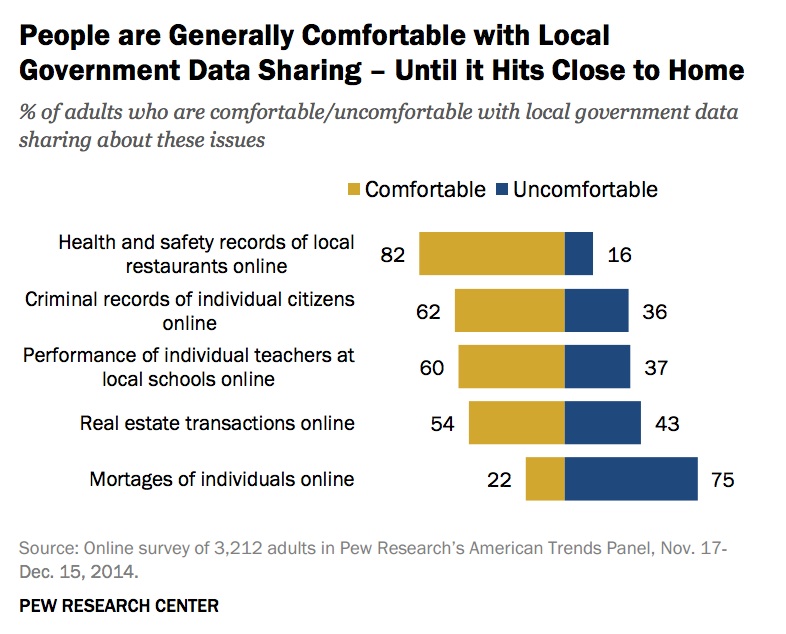
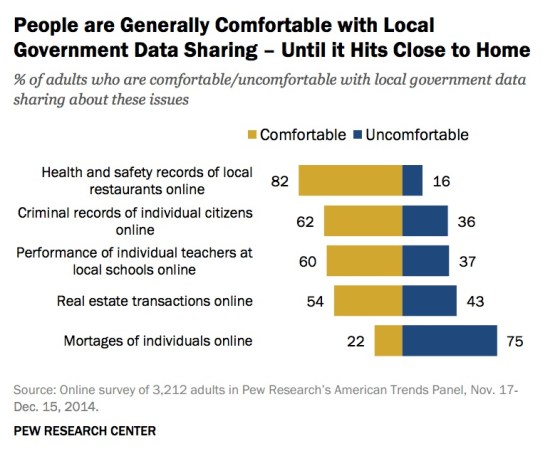
This attitude is generally true across all income levels.
people-comfortable-data-sharing-not-mortgage-pew

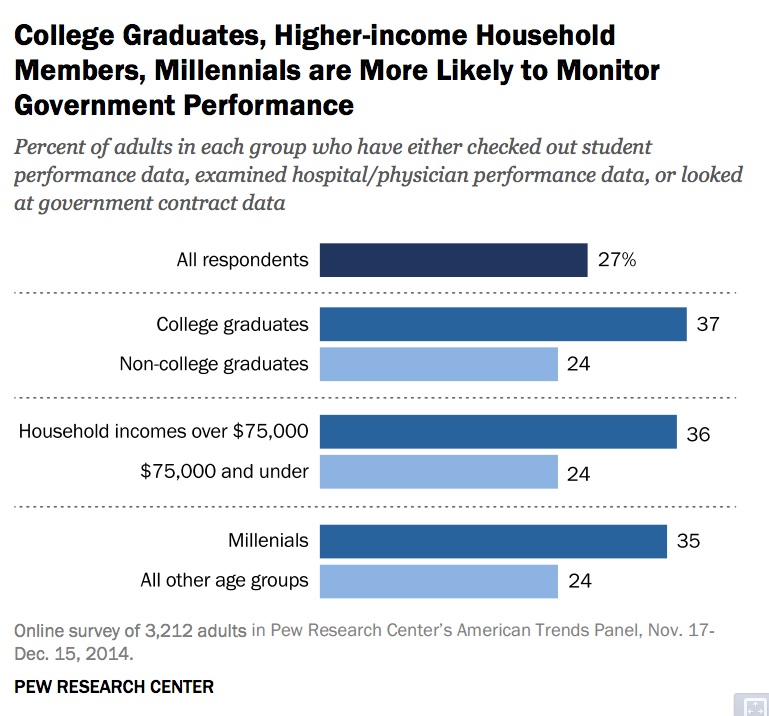
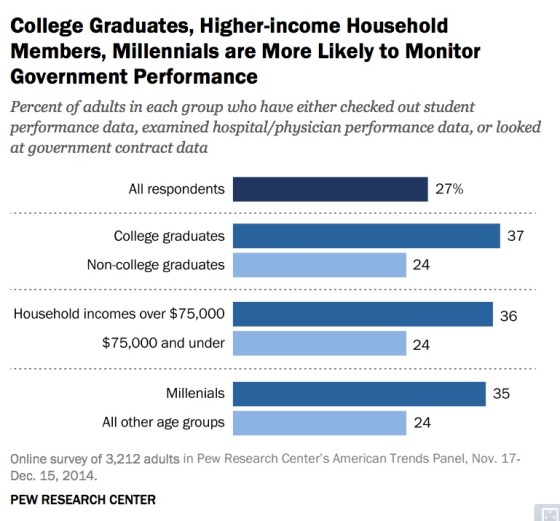
College graduates, millennials and higher-income adults are more likely to use data to monitor government performance

About a third of college grads, young people and wealthy Americans have checked out performance data or government contracting data, or about 50% more than other age groups, lower income or non-college grads.
college-grads-higher-income-monitor-performance-pew

The ways American adults interact with government services and data digitally are expanding
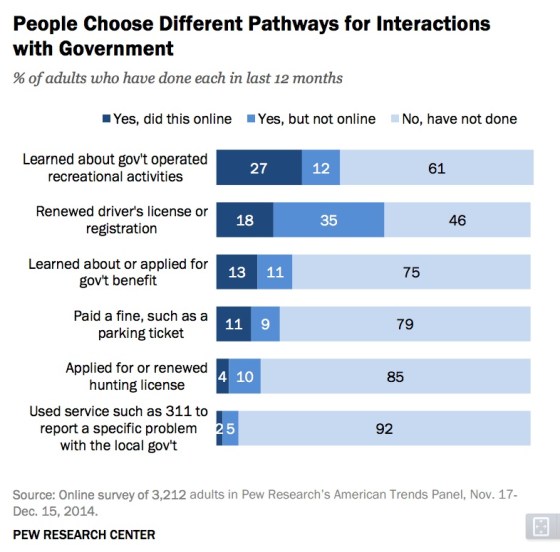
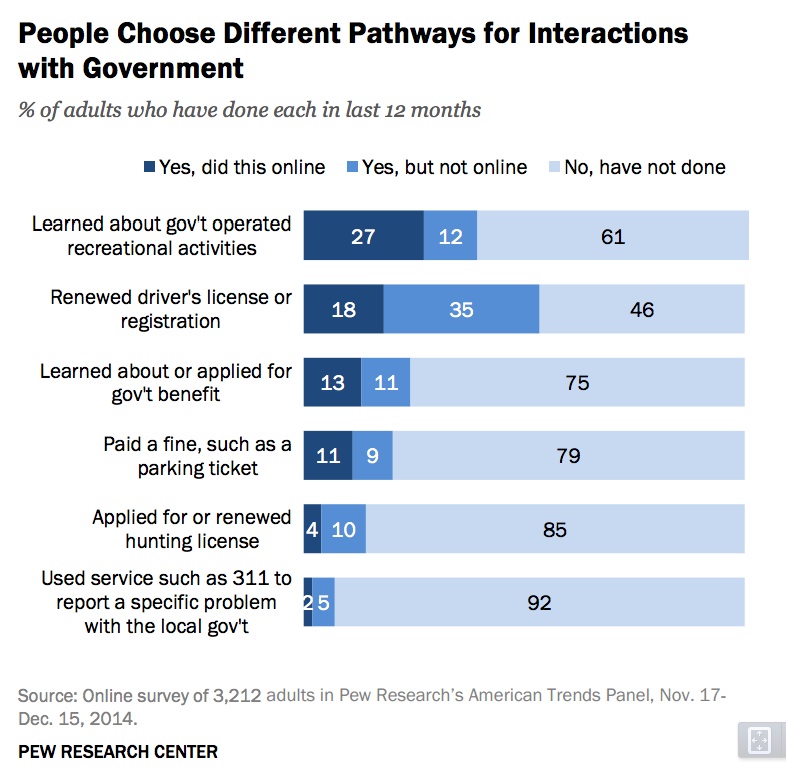
ways-people-interact-government-info-pew

But very few American adults think government data sharing is currently very effective:
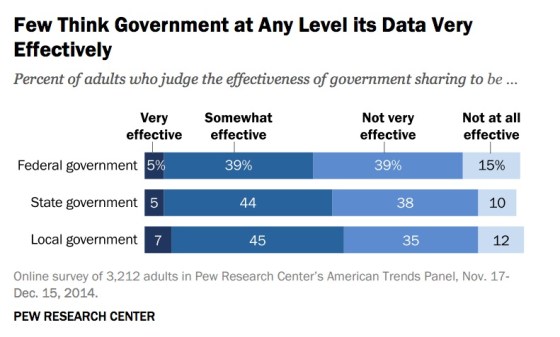
few-think-govt-data-sharing-effective-pew

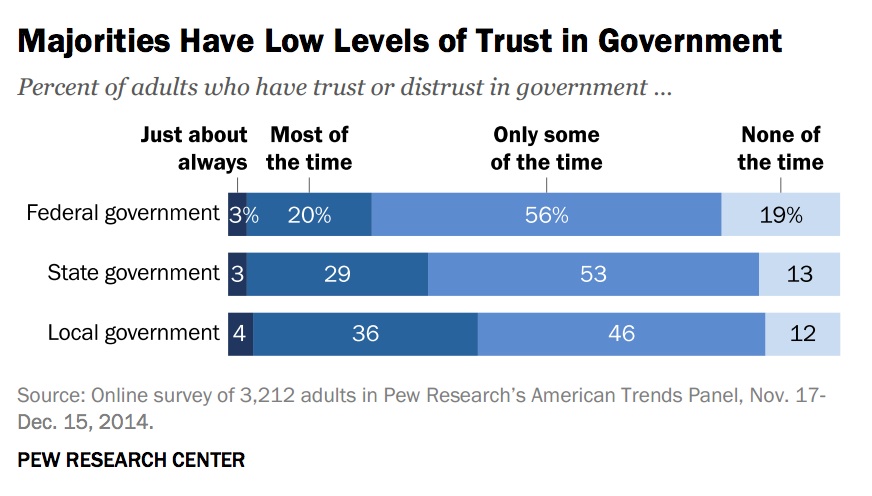
A small minority of Americans, however, have a great deal of trust in federal government at all:
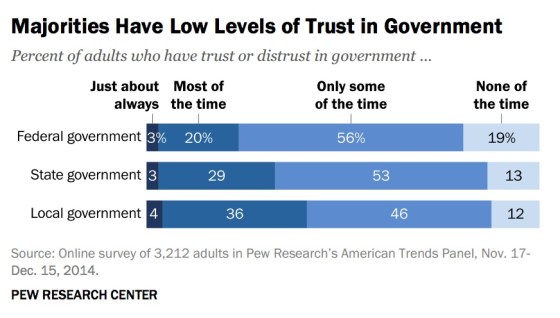
majorities-low-trust-government-pew

In fact, increasing individual use of data isn’t necessarily correlated with belief in positive outcomes:

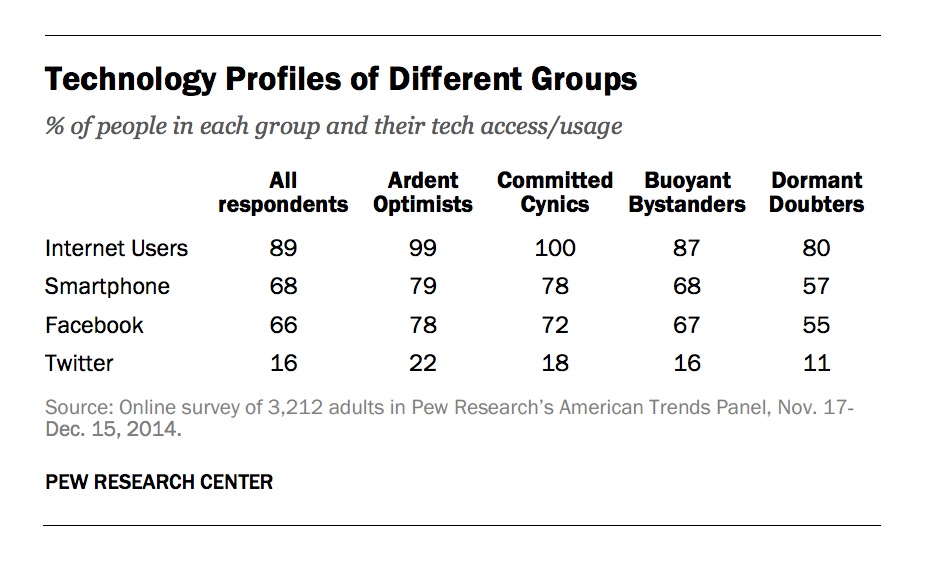
Pew grouped the 3,212 respondents into four quadrants, seen below, with a vertical axis ranging from optimism to skepticism and a horizontal axis that described use. Notably, more use of data doesn’t correlate to more belief in positive outcomes.

“In my mind, you have to get to the part of the story where you show government ran better as a result,” said Horrigan. “You have to get to a position where these stories are being told. Then, at least, while you’re opening up new possibilities for cynicism or skepticism, you’re at least focused on the data as opposed to trust in government.”
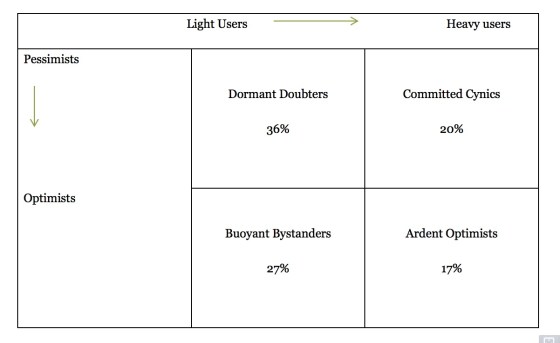
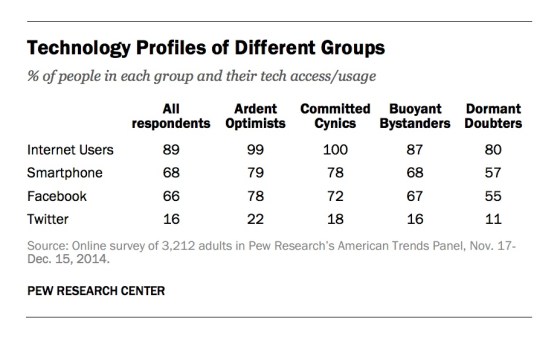
quadrants-belief-open-data

tech-profiles-quadrants-open-data-pew

Instead…

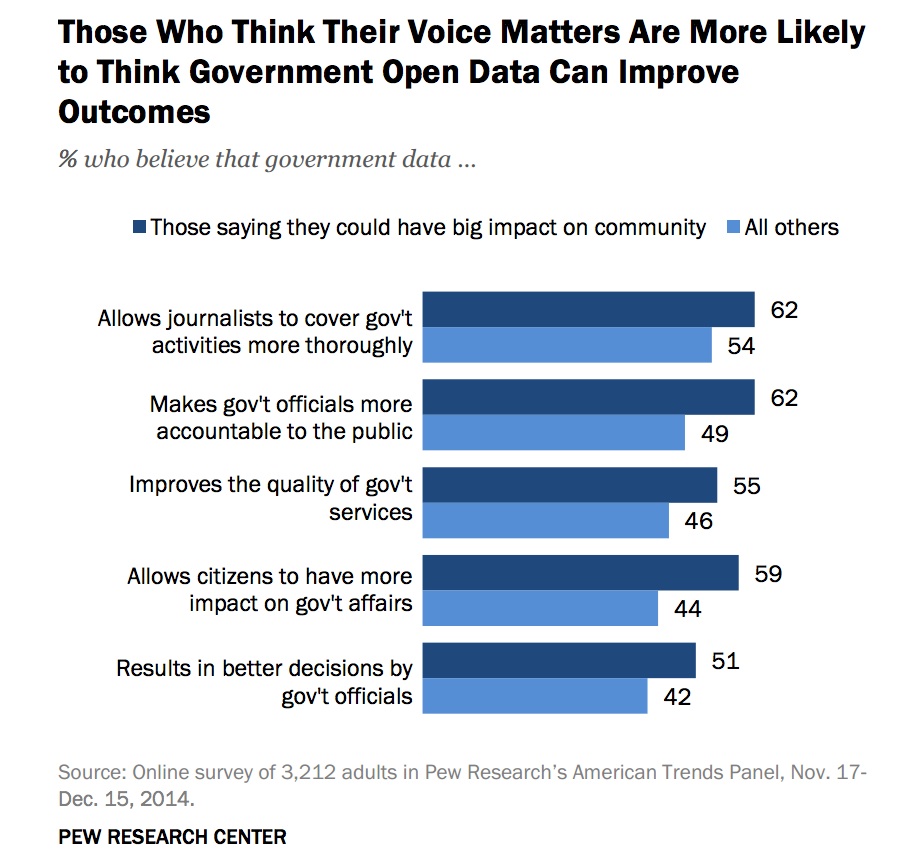
Belief in positive outcomes from the release of open data is correlated with a belief that your voice matters in this republic:
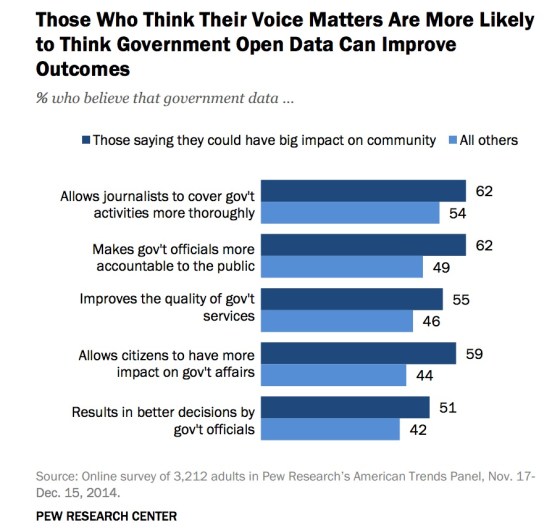
belief-voice-matters-believe-open-data-improves-pew

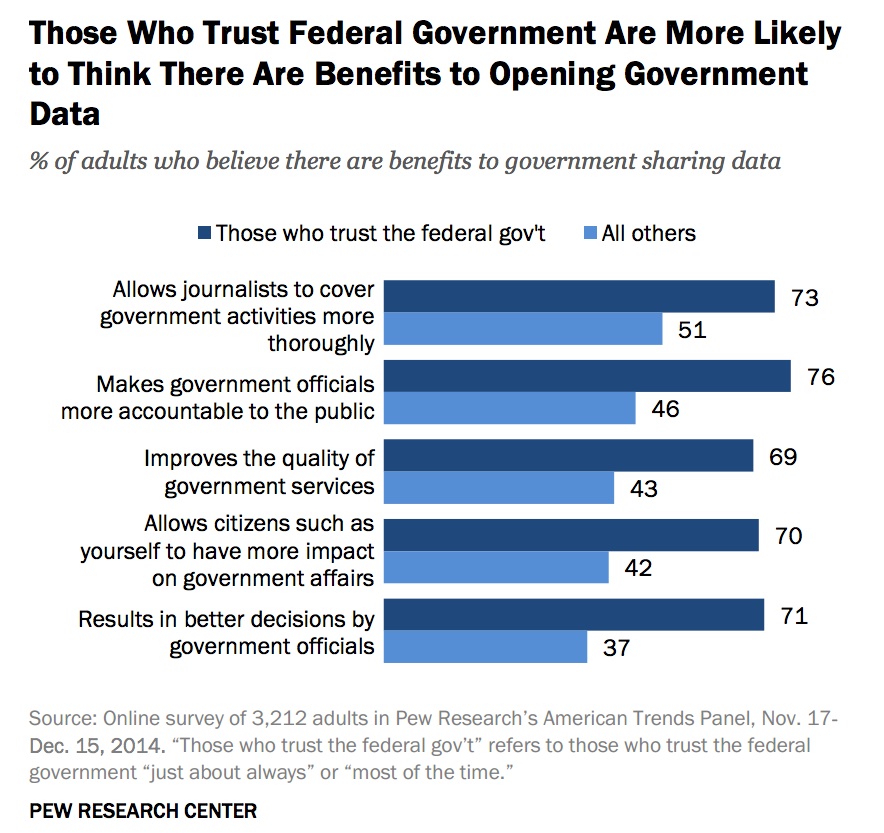
If you trust the federal government, you’re more likely to see the benefit in open data:
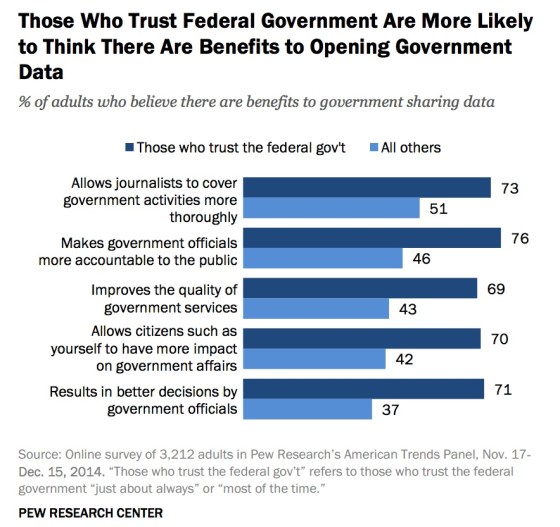
trust-fed-govt-more-likely-to-see-benefit

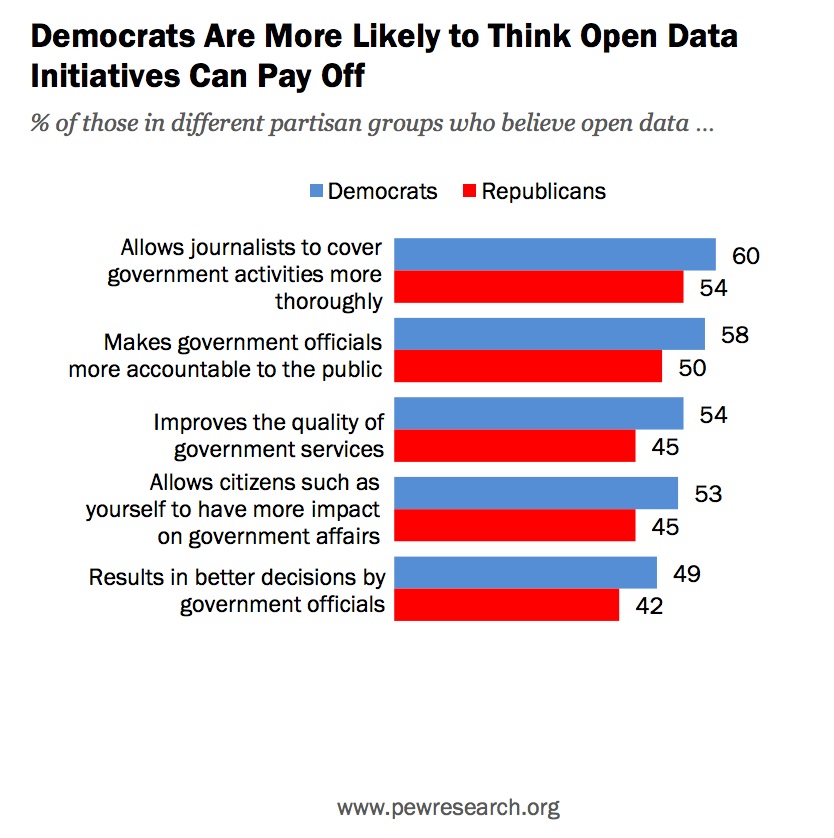
But belief in positive outcomes from the release of open data is related to political party affiliation:
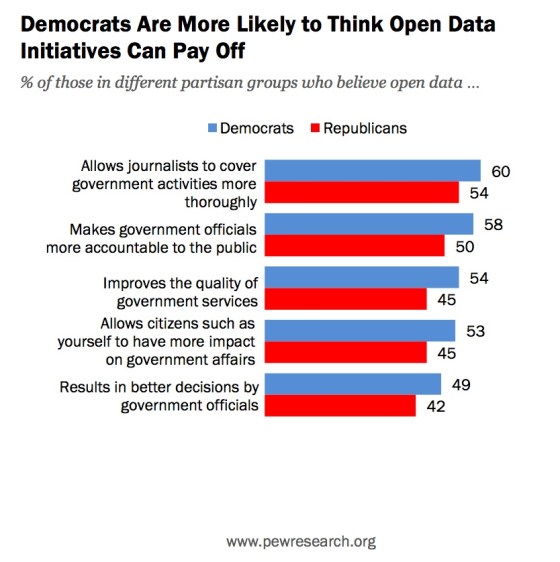
democrats-more-likely-to-believe-open-data-pay-off-pew

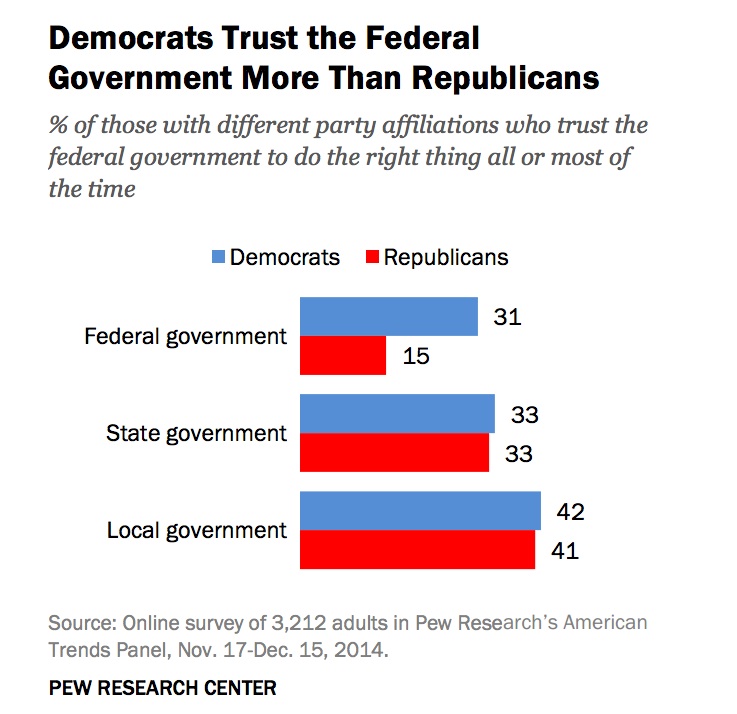
Put simply, Democrats trust the federal government more, and that relates to how people feel about open data released by that government.
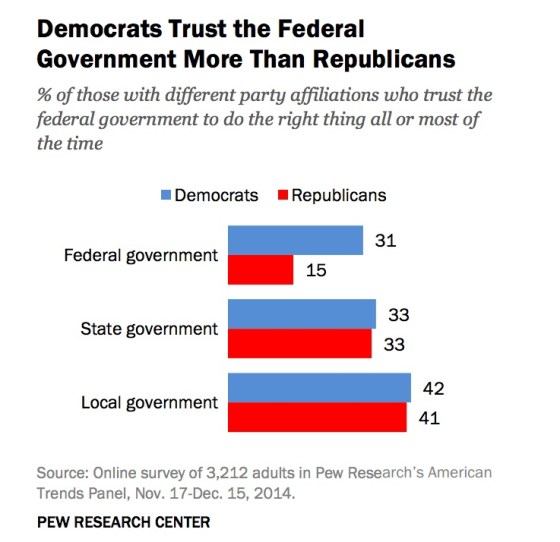
democrats-trust-fed-govt-more


Political party has an impact upon the view of open data in the federal government

One challenge is that if President Barack Obama says “open data” again, he may further associate the release of government data with Democratic policies, despite bipartisan support for open government data in Congress. If a Republican is elected President in November 2016, however, this particular attitude may well shift.

“That’s definitely the historic pattern, tracked over time, dating to 1958,” said Horrigan, citing a Pew study. “If if holds and a Republican wins the White House, you’d expect it to flip. Let’s say that we get a Republican president and he continues some of these initiatives to make government perform better, which I expect to be the case. The Bush administration invested in e-government, and used the tools available to them at the time. The Obama administration picked it up, used the new tools available, and got better. President [X] could say this stuff works.”
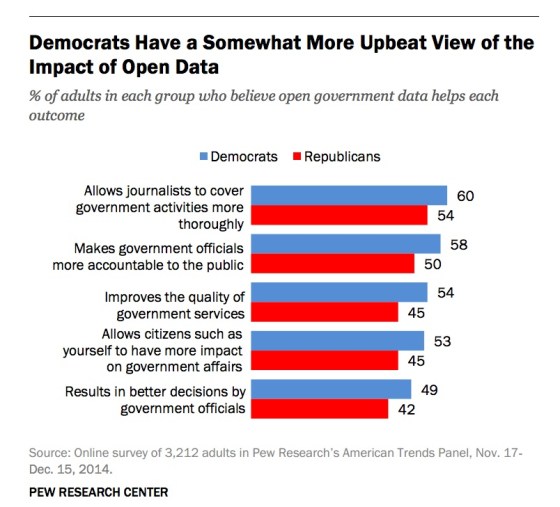
democrats-more-upbeat-view-open-data

The unresolved question that we won’t know the answer to until well into 2017, if then, is whether today’s era of hyper-partisanship will change this historic pattern.

There’s bipartisan agreement on the need to use government data better in government. Democratss want to improve efficiency and effectiveness, Republicans want to do the same, but often in the context of demonstrating that programs or policies are ineffective and thereby shrink government. If the country can rise about partisan politics to innovate government, awareness of the utility of releases will grow, along with support for open data will grow.

“Many Americans are not much attuned to government data initiatives, which is why they think about them (in the attitudinal questions) through the lens of whether they trust government,” said Horrigan. “Even the positive part of the attitudinal questions (i.e., the data initiatives can improve accountability) has a dollop of concern, in that even the positive findings can be seen as people saying: ‘These government data initiatives might be good because they will shine more light on government – which really needs it because government doesn’t perform well enough.’ That is an opportunity of course – especially for intermediaries that might, through use of data, help the public understand how/whether government is being accountable to citizens.”

That opportunity is cause for hope.

“Whether it is ‘traditional’ online access for doing transactions/info searches with respect to government, or using mobile apps that rely on government data, people engage with government online, “said Horrigan. “That creates the opportunity for advocates of government data initiatives to draw citizens further down the path of understanding (and perhaps better appreciating) the possible impacts of such initiatives.”
USASpending.gov addresses some data issues, adds Github issues tracker for feedback

usaspending

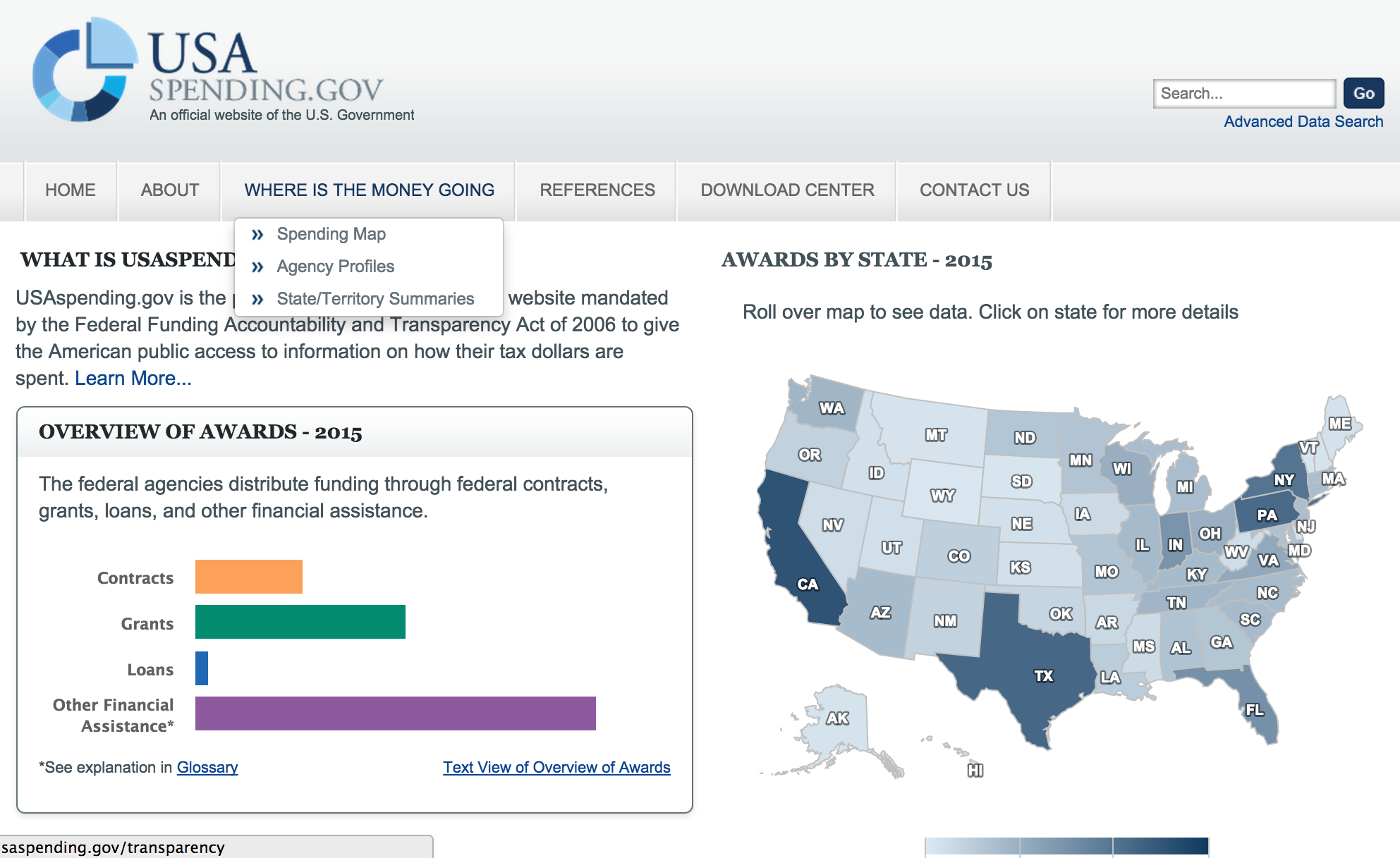
On April 1st, some reporters, open government advocates and people in industry may have hoped that a new redesign of USASpending.gov, the flagship financial transparency website of the United States government, was just a poorly conceived April Fool’s joke. Unfortunately, an official statement about the USASpending.gov redesign at the U.S. Treasury’s blog confirmed that the redesign was real. Analysts, media and businesses that rely on the contracting data on the site were loudly decried the decreased functionality of USASpending.gov.

A week later, there’s a still no evidence of deliberate intent on the part of Treasury not to publish accurate spending data or break the tool, despite headlines about rolling back transparency. Rather, it looks more likely that there were been a number of mistakes or even unavoidable errors made in the transitioning the site and data from a bankrupt federal contractor. There was certainly poor communication with the business community and advocates who use the site, a reality that Luke Fretwell helpfully suggested at Govfresh that other government agencies work to avoid next time.

Today, as Fretwell first reported, the federal government launched a new repository for tracking issues on USASpending.gov on Github, the social coding site that’s become an increasingly important platform for 18F, which committed to developing free and open source software by default last year.

In an email to the White House’s open government Google Group, Corinna Zarek, the senior advisor for open government in the Obama administration, followed up on earlier concerns about the redesign:

The USAspending team has been working to improve the usability of the site and has made some great strides to make it easier for average citizens to navigate information. But at the same time, we all understand that some of our expert users (like a lot of you) seek more technical information and the team is striving to meet your needs as well.

This is definitely a work in progress so please keep working with the team as it iterates on the best ways to improve function of the site while maintaining the content you seek. Your initial comments have been really helpful and the USAspending team is already working to address some of them.

Zarek also said that several of the problems with data that people have reported been addressed, including the capacity to download larger data sets and define specific dates in search, and asked for more feedback.

Specifically, this week the team addressed data export issues to allow the ability to specify date ranges to download data, added the bulk file format API, and modified the download capability so larger datasets can be downloaded. Additionally, data archives are being added continually. This week, they loaded the 2014 and 2015 delta files that show the new transactions in the last month. You can keep track of the ongoing improvements on the “What’s new” page.

Please keep sharing your feedback and continue working with the USAspending team as it makes improvements to the site. You can do this through the site’s contact page or on the new Github page where you can report issues and track them in the open.

If you find bugs, let the feds know about them on Github so that everyone can see the issues and how they’re addressed. As Mollie Walker reported for FierceGovernmentIT, there’s still missing functionality yet to be restored.

[Image Credit: Govfresh, via USASpending.gov]

Hillary Clinton hires Google product manager for civic innovation and social impact as campaign CTO

In hiring Stephanie Hannon to be her campaign’s chief technology officer, former Secretary of State Hillary Clinton is not just bringing on a former Cisco software engineer with product management experience at Google and Facebook and time in the trenches at tech startups: she’s added a woman who’s deeply immersed in the civic technology movement and knowledgeable about open data. Just watch her talk at the 2014 Code for America Summit:

So, here’s the bad news: Hannon was a product manager for Gmail and Google Wave, so steel yourself for a lot of bad jokes in the days and months ahead in the media, given her new boss’ questionable choices about email as Secretary of State and Google Wave’s demise. While a B.A. and an M.S. in electrical engineering from Stanford and an MBA from Harvard will insulate her from the some of the lamer slings and arrows, get ready for unsubtle, tortured metaphors and misogyny in the comment sections.

Here’s the mixed news: Hannon’s focus on open data on Google appears to have been on standards, services and civic impact, not accountability and transparency. Take a look at her presentation, embedded below:

Given the record of the Obama administration, it remains to be seen whether Clinton will proactively adopt an ambitious agenda on open government if elected, from implementing and resource FOIA reforms, whistleblower support or nominating inspector generals for all federal agencies.

And here’s the good news: while political observers will (and should!) no doubt focus upon her ability to duplicate the success of Harper Reed, the CTO for Barack Obama’s 2012 presidential campaign, Clinton just brought someone who’s tapped into what’s happening in the civic tech space into orbit. If that experience elevates those issues into the campaign and national conversation, it will stand to benefit everyone working towards improving civic life in America. If Clinton starts talking about “building better governance with the people, not for them” on the campaign trail, you’ll know something important has occurred.

FOIA reform faces higher odds in 114th Congress

Federal financial regulators and the industry that they regulate are fretting over Freedom of Informatiom Act reform in Congress, per The Hill.

At least the concerns about sensitive info are being aired in public this time, albeit not on the record: the regulators aren’t commenting, and neither is industry. (It was their lobbying that scuttled FOIA reform become law last December, despite bills passing both houses of Congress unanimously.) 

Behind this story is a deeper one about how power and influence are used. The odds against strong FOIA reform being passed in the 114th Congress look longer today.