Apps for Amsterdam catalyzes civic hacking in Netherlands

Application contests, data camps and hackathons are showing how civic coding can put open government data to work. In the Netherlands, Apps for Amsterdam has launched to try catalyze the development of software that puts the city’s open data to work. If you’re interested in open government in the Netherlands, here’s your chance to hack the government – for good.

The new competition is backed by the Waag Society, the city of Amsterdam and Public Hack. There’s an upcoming open data hackathon in Amsterdam on March 12th, for those interested. Below is an account of the launch curated by Rolf Kleef using Storify:

http://storify.com/rolfkleef/apps-for-amsterdam.js

Senator Kate Lundy emphasizes citizen-centric services and location in open government

If you follow the story of Gov 2.0 in Australia, you’ll have come across Senator Kate Lundy. Today, she published a new post making the case that citizen-centric services are a necessary principle for achieving open government:

Australia is facing some big challenges. We have citizens here and around the world now more connected than ever. Using social networks and open govenment strategies to help government to access the ideas and inputs of citizens, the “wisdom of the crowd” will helo governments make better informed decisions and deliver better targetted programs.

We will only achieve true citizen-centric services if collaboration between agencies and departments is the reality. I am firmly of the view that open data strategies are a necessary pre-requisite to achieving a seamless and simple online interaction for citizens with government.

The post is rich with hyperlinks to examples of the points she’s making and is well worth reviewing. This isn’t the first time that Senator Lundy has described “citizen-centric services, democratising data and participatory government” as the three pillars of open government. She spoke about them at the Gov 2.0 Expo in Washington:

http://blip.tv/play/AYHhzhwC

For more, below is an interview from last year on open government in Australia:

Pew: Open government is tied to higher levels of community satisfaction

The results from a new study from Pew Internet and Life Project found that when citizens believe their governments are sharing more information, they are more likely to feel satisfied with civic life. The study will offer some evidence for elected officials who run on open government platforms or who work for more transparency. Broadband users are more critical of their communities and local institutions.

The study, released by the Pew Research Center, Monitor Institute and Knight Foundation found that citizens who believe that their city hall is more transparency are more likely to have positive feelings about:

  • the overall quality of their community
  • the ability of their community, including media and neighbors, to provide them with information that matters;
  • the overall performance of their local government
  • the performance of civic and journalistic institutions, including public safety, libraries, and media outlets.

The Pew study also found that government transparency was associated with how empowered residents feel. Specifically, those who think government shares information well “are more likely to say that average citizens can have an impact on government.” That said, the authors of the report made sure to caution not to draw too broad a conclusion from these findings:

We did not establish causality here – for instance, that greater government transparency provides benefits to a host of civic organizations or that broadband-adoption initiatives will heighten citizens’ critical thinking about their community or that higher-quality journalism will encourage more people to turn out for town meetings. Yet these possibilities emerge in the answers citizens and their leaders gave.

The degree of open government in a given community isn’t just about how citizens feel about it, however, as transparency advocates have emphasized: it’s  about how well government is actually sharing information, versus how well citizens feel they are. One interesting finding from the survey was that with increased broadband use, citizens become more critical of their communities and institutions.

“This result suggests that those citizens with broadband expect – but don’t always find – information from their governments, schools and other local civic organizations there where they want it when they want it,” noted report author Tony Siesfeld, head of research for the Monitor Institute, in a prepared statement. “It may be that broadband is raising ‘the bar’ on information transparency.”

The Internet is playing a role in the new information ecosystem. According to the survey:

  • 32% of the residents of the towns surved now get local news from social networking sites like Facebook
  • 19% get local news from blogs
  • 12% get it on smartphones and mobile devices like smartphones
  • 7% get local news from Twitter.

“There have been vast changes in the local news and information landscape in recent years,” noted Lee Rainie, Director of the Pew Internet Project and an author of a report on the findings, in a prepared statement.  “One of the key insights here is that citizens have new ways to assess the performance of city hall. They are paying attention to how transparent their government is. If they feel public agencies are forthcoming, they also feel better about other parts of town. There might be a real civic payoff if governments shared more. ”

There’s much more to dig through in the survey (both the OhMyGov.com and techPresident analyses are worth reading) but one findings is worth highlighting for local government leaders making policy decisions this year:

Each of the 3 communities surveyed (San Jose, CA, Macon, GA, and Philadelphia, PA) have what the report calls an “online portal” for government and civic information. Even so, only a little more than a third of their residents were fully aware of the local government website.. From the report:

Moreover, in the opinion surveys, we found that many who tried to use the internet to get local civic information could not always find what they were seeking. Only a quarter of these residents said that when they did searches for local civic information they always found what they were seeking. Yet even when they found what they were seeking, only 37% said the information presented to them was very clear and easy to understand.

There’s clearly some room for local governments to improve here. The survey results suggested what could be done: “one strong yearning residents expressed was for a central location for civic information that is maintained by the government. More than three-quarters of the respondents in these three communities (78%) said it was ‘very important’ that a government website be set up for this and another 17% said it was ‘somewhat important.'”

Throughout United States and elsewere in the world, there are more examples of technology-fueled open government, where citizensourcing is part of the set of tools officials deploy. If local governments keep using technology to deliver smarter government, there’s reason to be hopeful that new online hubs fueled by open government data will play an important role in the information needs of citizens.

Crowdsourcing where to put QR codes in NYC

This February, New York City adopted QR codes in a significant way. “QR” stands for “quick response” codes. QR codes enable somebody with the appropriate software and hardware to quickly scan a code for information from any direction. As TechCrunch reported, NYC will put QR codes on all of its building permits.

The QR codes will link users to a mobile version of the Department of Buildings Information System, and will give them the option to click a link that will initiate a phone call to the city’s 311 phone service, where they can register a complaint about noise, safety or other concerns.

As permits at 975,000 building and construction sites that already have them are replaced, they will have QR codes added; all New York City permits are expected to have QR codes by roughly 2013.

QR Code on Love ArtPhoto illustration by Zachary M. Seward based on a photo by Chris Goldberg
QR codes can be scanned by smartphones equipped with relevant software in much the same way that a handheld scanner can scan the more familiar horizontal barcodes used globally in shipping and retail industries. Their use is hardly limited to building permits, however, as Zach Seward pointed out at the Wall Street Journal:

In 2011, you’re likely to see more QR codes on billboards, print publications, museum placards — anywhere with limited space and lots of information to convey. On city building permits, scanning the QR code will direct you to a website with more information about the construction project, if you’re into that.

But the New Yorkers who responded to Sterne are more excited about the prospect of applying QR codes to the city’s public-transit system. One  common suggestion: place them at bus stops, where schedules aren’t always displayed and are often out of date.

So where should New York City place QR codes? As Seward reported, New York City’s chief digital officer, Rachel Sterne, is looking for ideas. Seward captured her questions and the responses of citizens (including this correspondent) using Storify:

http://storify.com/zseward/qr-codes-in-new-york-city.js[View the story “QR codes in New York City” on Storify]

Congress faces challenges in identifying constituents using social media

Citizens are becoming more influential through social networks and influencing their peers. Research from the The Pew Research Center’s Internet & American Life Project suggests that government 2.0 an important trend, with respect to our understanding of what it means to be a citizen and how our actions influence those of our fellow citizens. The role of the Internet as a platform for collective action is growing but the authorities that control the levers of power offline still matters immensely.

Today, Politico reported that social media isn’t so hot on the Hill. Or, as FierceGovernmentIT.com reported, “Congress is using social media to talk, not listen.” Both media outlets were reporting on survey results conducted by the Congressional Management Foundation on perceptions of citizen advocacy by Congressional staffers.

A better headline, however, might have been “Twitter isn’t so hot on the hill with lawmakers,” given myriad challenges around identifying constituents online, automated campaigns and what Representative Culberson (R-TX) described as a “lot of trolls on Twitter.” (It’s even worse on YouTube, Congressman.) The question posed at the end of the Politico article — “Are lawmakers putting too much time — or staff resources — into social media?” is followed with Pew stats on *Twitter* use and penetration, not Facebook.

The complaints from numerous anonymous Congressional staffers about the time it takes to maintain social media are likely honest and parallel the experiences of higher-paid contemporaries in private industry, academia, media, fashion and the nonprofit worlds. Managing multiple social media presences can, indeed, be a pain in the a–. And it takes resources, in terms of time, that may be scarcer than ever. That said, social media is now part of the lexicon of Congressional staff trusted with constituent communications. If a Representative or Senator is speaking anywhere in DC, there’s an increasingly good chance that snippets of it may tweeted, unusual pictures will be tagged on Facebook and that any gaffes will be up on YouTube later.

Doing more than trying to fit the 20th century model of broadcasting to these platform requires time, expertise and commitment, along with a thick skin. Opening up these new online channels for Congressional communications created challenges, to be sure, but then so did adding the telegraph, radio, television, fax machines, cellphones and email. It’s not hard to find past news reports of Senators resisting the addition of dial phones to the Hill.

Every new communications technology has had an impact on Congress. In 2011, Twitter, Facebook and YouTube do each come with new wrinkles. YouTube and Twitter can work in concert to share video and share it instantly with the world. At the same time, on the Hill, automated campaigns using social media have followed the path of email and faxes deluges. Carefully edited videos can trim key context from statements, or audio from broadcasts. The risks and rewards for the use of Web 2.0 that pertain to federal and state agencies also pertain to Congress.

Take, for instance, Facebook, which is generally tied to the real identities of citizens. Engaging with citizens carries with it identity and privacy issues for constituents. That’s the rub, and it won’t come out easily. Look at how San Francisco integrated city services with 311 and Facebook for an example of how government can mitigate and address some of those issues. The National Strategy for Trusted Identities in Cyberspace might address some of the challenges as well.

In the meantime, Congresional staffers and citizens alike can hope that new, improved architectures for participatory democracy online come along soon to upgrade the status quo in Washington.

New recommendations for improving local open government and creating online hubs

Today, the Aspen Institute hosted a roundtable on government transparency and online hubs in Washington, DC. You can watch the archived webcast below.

http://www.newmediamanager2.net/sites/all/modules/newmediamill/flashclip/player.swf

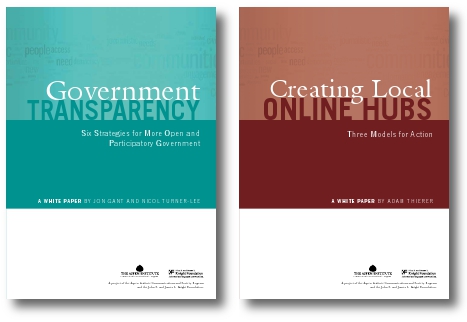
The roundtable focused on the release of two new white papers. The first, “Creating Local Online Hubs: Three Models for Action,” by Adam Thierer, discusses scenarios where community leaders, citizens, media, technologists and — critically, local government — can work together” to create local online hubs where citizens can access information about their governments and local communities.” Creating such high-quality online information hubs was one of the 15 key recommendations of Knight Commission on the Information Needs of Communities in a Democracy. “Just as communities depend on maps of physical space, they should create maps of information flow that enable members of the public to connect to the data and information they want,” said the Knight Commission. (Download PDF or Read Online)

“Governments need to get more information out and make it more accessible, said Thierer today. “This shouldn’t be controversial.” Thierer said that government can do well to catalyze and support this development simply by doing a better job of making such information easily available in easy to use formats. While open government data stores have grown, Thierer noted that this has not trickled down. He cited the example of Manor, Texas as one example of where one local champion (former CIO Dustin Haisler) got help from Stanford and other external resources to get the local open data repository online.

Broadly, Thierer described three models for online hubs:

  • Hubs focused on community government information. Example: Texas Tribune
  • Community connections: local forums and community email listservs. Example: e-democracy.org
  • Community news and commentary. Example: Universal Hub

Thierer focused on the important role that libraries and local or state universities can play in this new ecosystem, by connected offline and online worlds. These universities could create “code toolboxes” that local communities can use, as Stanford did for Manor. He hoped that that model could be replicated nationally.

Government transparency

Government Transparency: Six Strategies for More Open and Participatory Government, by Jon Gant and Nicol Turner-Lee, is call to action for state and local governments to adopt open government. The six sensible strategies “focus on enhancing government expertise and transparency, educating citizens regarding the availability and utility of government information and e-government tools, expanding efforts to support greater adoption of broadband Internet access services and devices, and forging public-private-citizen partnerships in order to enhance open government solutions.” (Download PDF or Read Online)

There are three basic issues here, according to Turner-Lee:

  • Do people get it?
  • Do they have the resources they need?
  • Can they do transparency with those resources?

“All of us who have been in this debate have seen a conflict between these three factors, said Turner-Lee. The question, she said Turner-Lee, is how we empower state and local government. The challenge is that in most open data effort, “We are still in a one-way world, where data is pushed down to the public, not in a reciprocal ecosystem.”

It’s one thing to say citizens who should be involved, said Turner-Lee, but more needs to be done. “As an organizer, I can speak to that. It’s hard to get people to a block meeting,” much less meeting online, she said. There’s also a persistent issue of the digital divide that has to be addressed in this context. “We cannot proclaim government transparency” where millions of people don’t have online access, said Turner-Lee.

There are many examples of where open data is being put to use on the behalf of citizens now. Turner cited apps driven by transit data in Chicago, heritage trees in Portland or the use of 311 by SeeClickFix in the District of Columbia.

Jon Grant focused on a major pain point for government at all levels for tapping into the innovation economy: procurement issues, which civic entrepreneurs run into in cities, statehouses and Washington. “It is time to look at these procurement rules more closely,” he said, and promote higher levels of innovation. “There are a lot of ideas are happening but a lot of rules restrict vendors from interacting in government,” said Grant. Turner-Lee observed that traditional procurement laws may also not be flexible enough to bring more mobile apps into government.

Fundamentally, empowering more government transparency through the Internet will require both creating a climate for the actions, said Turner-Lee, but also through structural changes, specifically, through the release of spectrum and Universal Service Fund (USF) reform.

It will also require that state and local government officials are part of the conversation, “It they aren’t at the table, we’re going to be pretty much talking to ourselves,” said Turner-Lee.

Former San Francisco CIO Chris Vein, now the new White House deputy CTO for government innovation, agreed. biggest challenge of all is that we like to think there are templates. to a certain extent, they can be. fundamentally, all politics is local. To make this work in government, a community “needs someone who takes risks, who goes out there and makes it happen regardlesss of the cost.”

All stakeholder at the panel acknowledged the crucial importance of community institutions, nonprofits and libraries in addressing issues of the digital divide and creating a bridge between online hubs and local citizens. Turner Lee noted that billions of people over the course of years have come into libraries for assistance, particularly the homeless and low-income citizens. “What better way to get people into the system by enabling libraries to be a conduit of information?” she asked.

“Public information belongs to the public, and the public’s business should be done in public,” said Turner. That said, local citizens also don’t want data for the sake of data. “Consumption of this data would be inconsistent if the data doesn’t provide quality of life,” she said.

Podcast: IT Security, Internet Freedom and Open Government at Threatpost

This morning, I was privileged to join Dennis Fisher on the Digital Underground podcast to talk about IT security, open government, Internet freedom and open data movements, including how they’re affecting IT security.

ListenIT Security, Internet Freedom and Open Government [MP3]

Fisher is a founding editor of the Threatpost blog and is one of the best information security journalists in the industry and a former colleague from TechTarget.

Over the course of the podcast, we discussed the different ways in which Internet freedom and privacy play into the current climate online. (We also talked a bit about Twitter and journalism.) As 2011 matures, legitimate concerns about national security will continue to be balanced with the spirit of open government expressed by the Obama administration.

The issues created between Wikileaks and open government policies are substantial. Open data may be used for accountability, citizen utility and economic opportunity. But as federal CIO Vivek Kundra said to Harvard Business School students studying Data.gov last year, the transparency facet in the Obama administration’s open government initiative has multiple layers of complexity.

Fisher and I explore these issues, along with a number of the complexities involved with improving information sharing between the public and private sector when it comes to vulnerabilities and threats. Currently, over 80% of the nation’s critical infrastructure is in the private sector.

Related stories:

Gov 2.0 and open government: Perspectives from Belgium and Australia

On any given week, there’s usually someone delivering a presentation that explores the intersection of citizens, technology and government. Here are just a few of the better ones I’ve come across in 2011 so far. If you’ve found other gems out there on the Internet, please share the links in the comments. Below, you’ll find ideas from citizens of three different countries, along with a report on government from the Pew Internet Society that was delivered as a presentation.

Vincent Van Quickenborn

Vincent Van Quickenborne

Vincent Van Quickenbore. Credit: Wikipedia

“My conclusion today:‘Open Data is becoming a reality. The public sector must lead by example. It must rethink administrative processes that appear to be dinosaurs in the era of social media and cloud computing.’” –Vincent Van Quickenborn, Belgian Minister for “Ondernemen en Vereenvoudigen.” (Loosely translated, that’s “enterprise and simplification.”)

David J. Eade on the Characteristics of Government 2.0

Perspectives from Australia, including lessons after the recent “Big Wet,” from David J. Eade, co-founder of the Government 2.0 in Queensland community.

http://b.scorecardresearch.com/beacon.js?c1=7&c2=7400849&c3=1&c4=&c5=&c6=http://b.scorecardresearch.com/beacon.js?c1=7&c2=7400849&c3=1&c4=&c5=&c6=http://b.scorecardresearch.com/beacon.js?c1=7&c2=7400849&c3=1&c4=&c5=&c6= http://b.scorecardresearch.com/beacon.js?c1=7&c2=7400849&c3=1&c4=&c5=&c6=http://b.scorecardresearch.com/beacon.js?c1=7&c2=7400849&c3=1&c4=&c5=&c6=http://b.scorecardresearch.com/beacon.js?c1=7&c2=7400849&c3=1&c4=&c5=&c6=

Steve Lunceford

This Prezi on open government and Gov 2.0 by Steve Lunceford is an engaging overview, and a welcome change from static, slide-driven presentations.

Government Online – Findings from Pew Internet

http://b.scorecardresearch.com/beacon.js?c1=7&c2=7400849&c3=1&c4=&c5=&c6=http://b.scorecardresearch.com/beacon.js?c1=7&c2=7400849&c3=1&c4=&c5=&c6=

Knight Commission to release recommendations on open government and online hubs

Tomorrow, the Aspen Institute Communications and Society Program and the John S. and James L. Knight Foundation will release two new white papers that focus on implementing the recommendations of the Knight Commission on the Information Needs of Communities in a Democracy.

The two new white papers—“Government Transparency: Six Strategies for More Open and Participatory Government” by Jon Gant and Nicol Turner-Lee, and “Creating Local Online Hubs: Three Models for Action” by Adam Thierer, recommend steps that government and community leaders should take to increase government transparency and put more information hubs online.

To Aspen Institute will convene a roundtable of public officials, advocates, and watchdogs from national, state and local levels of government (along with this correspondent) tomorrow morning from 9:00 a.m. to 12:00 p.m. EST. See the list of attendees below for specific details.

There will be a live webcast of the event. The Knight Commission is encouraging people to participate online at <a href="http://www.knightcomm.org and on Twitter using #knightcomm hashtag. According to the event organizers, a livestream will begin at 9:00 a.m. (EST) and will be archived. These white papers will be available to read and download Friday morning. Look for links here when they become available.

http://widgets.twimg.com/j/2/widget.js

new TWTR.Widget({
version: 2,
type: ‘search’,
search: ‘knightcomm’,
interval: 6000,
title: ‘New in Knight Commission papers on’,
subject: ‘Government Transparency and Online Hubs’,
width: ‘auto’,
height: 300,
theme: {
shell: {
background: ‘#00278a’,
color: ‘#ffffff’
},
tweets: {
background: ‘#ffffff’,
color: ‘#444444’,
links: ‘#1985b5’
}
},
features: {
scrollbar: false,
loop: true,
live: true,
hashtags: true,
timestamp: true,
avatars: true,
toptweets: true,
behavior: ‘default’
}
}).render().start();

Featured Roundtable Speakers

Dr. Jon Gant, Fellow, Joint Center for Political and Economic Studies, and Associate Professor, Graduate School of Library and Information Science, University of Illinois at Urbana-Champaign. He is a leading scholar in the field of information systems and public administration.

Dr. Nicol Turner-Lee, Vice President and Director of the Media and Technology Institute for the Joint Center for Political and Economic Studies. She has produced path breaking research on broadband adoption among minority and disadvantaged populations and engages city, state and federal legislators on issues in telecommunications, open government and the emerging technology innovation sectors.

Adam Thierer, Senior Research Fellow, Technology Policy Program, Mercatus Center at George Mason University, having previously served as President of the Progress & Freedom Foundation. His work spans technology, media, and Internet and free speech with a focus in online child safety and digital privacy policy issues.

Roundtable participants include:

Gary Bass, Executive Director, OMB Watch
Ben Berkowitz, Founder, SeeClickFix
John Bracken, Directory of Digital Media, John S. and James L. Knight Foundation
Jerry Brito, Senior Research Fellow, George Mason University
Kevin Curry, Co-Founder, CityCamp.com
Lucy Dalglish, Executive Director, Reporters Committee for Freedom of the Press
Charlie Firestone, Executive Director, Communications and Society Program, Aspen Institute
Feather Houstoun, President, William Penn Foundation
Alexander Howarder, Government 2.0 Washington Correspondent, O’Reilly Media
William Kellibrew, IV, Deputy Director, National Coalition on Black Civic Participation
Alex Kreilein, Legislative Assistant, Office of Congresswoman Jane Harman
Ngoan Le, Vice President of Programs, The Chicago Community Trust
Blair Levin, Communications and Society Fellow, Aspen Institute
Philip Neustrom, Founder, Davis Wiki
Steve Pearson, Publisher and Chief Technologist, Project Virginia
Lee Rainie, Director, PEW Internet and American Life Project
Rachel Sterne, Chief Digital Officer, Mayor’s Office of Media & Entertainment, New York City
Daniel Schuman, Policy Counsel, Sunlight Foundation
Nancy Tate, Executive Director, League of Women Voters
Tracy Viselli, Community Manager, ACTion Alexandria
Marijke Visser, Assistant Director, OITP, American Library Association
Eric Wenger, Policy Counsel, US-Legal-Government Affairs, Microsoft Corporation
Harry Wingo, Senior Policy Counsel, Google, Inc.

Platforms for citizensourcing emerge in Egypt


As people watching the impact of social media in the events in Egypt know, Facebook, Twitter and YouTube played a role. Today, Microsoft’s director of public sector engagement, Mark Drapeau, sent word that the Redmond-based software company’s open source ideation platform, Town Hall, has been deployed at nebnymasr.org to collect ideas.

The highest profile implementation of Town Hall to date was for crowdsourcing ideas in Congress for the incoming Republican majority in Congress at “America Speaking Out.

This Town Hall instance and others show how citizensourcing platforms can be tailored to channel feedback around specific topics, as opposed to less structured platforms. As governments and citizens try to catalyze civic engagement using the Internet, creating better architectures for citizen participation will be critical. Clay Shirky’s talk about the Internet, citizenship and lessons for government agencies at the Personal Democracy Forum offered some insight on that count. Using taxonomies to aggregate ideas instead of a single list was a key takeaway.

To date, the Egyptian citizensourcing site has logged a few dozen questions and votes. Whether usage of the site will grow more or not is up for debate. The network effect may working against it. As ReadWriteWeb reported last week, Egyptians are using Google Moderator to brainstorm Egypt’s future. Wael Ghonim, the Google executive who played a role in Egypt’s recent revolution, started a Google Moderator page for Egypt entitled, “Egypt 2.0, what does we need? What are our dreams?!.” To date, the Moderator instance has logged 1,361,694 votes for more than 50,000 of the ideas submitted by nearly 40,000 users.