Senator Kate Lundy emphasizes citizen-centric services and location in open government

If you follow the story of Gov 2.0 in Australia, you’ll have come across Senator Kate Lundy. Today, she published a new post making the case that citizen-centric services are a necessary principle for achieving open government:

Australia is facing some big challenges. We have citizens here and around the world now more connected than ever. Using social networks and open govenment strategies to help government to access the ideas and inputs of citizens, the “wisdom of the crowd” will helo governments make better informed decisions and deliver better targetted programs.

We will only achieve true citizen-centric services if collaboration between agencies and departments is the reality. I am firmly of the view that open data strategies are a necessary pre-requisite to achieving a seamless and simple online interaction for citizens with government.

The post is rich with hyperlinks to examples of the points she’s making and is well worth reviewing. This isn’t the first time that Senator Lundy has described “citizen-centric services, democratising data and participatory government” as the three pillars of open government. She spoke about them at the Gov 2.0 Expo in Washington:

http://blip.tv/play/AYHhzhwC

For more, below is an interview from last year on open government in Australia:

Pew: Open government is tied to higher levels of community satisfaction

The results from a new study from Pew Internet and Life Project found that when citizens believe their governments are sharing more information, they are more likely to feel satisfied with civic life. The study will offer some evidence for elected officials who run on open government platforms or who work for more transparency. Broadband users are more critical of their communities and local institutions.

The study, released by the Pew Research Center, Monitor Institute and Knight Foundation found that citizens who believe that their city hall is more transparency are more likely to have positive feelings about:

  • the overall quality of their community
  • the ability of their community, including media and neighbors, to provide them with information that matters;
  • the overall performance of their local government
  • the performance of civic and journalistic institutions, including public safety, libraries, and media outlets.

The Pew study also found that government transparency was associated with how empowered residents feel. Specifically, those who think government shares information well “are more likely to say that average citizens can have an impact on government.” That said, the authors of the report made sure to caution not to draw too broad a conclusion from these findings:

We did not establish causality here – for instance, that greater government transparency provides benefits to a host of civic organizations or that broadband-adoption initiatives will heighten citizens’ critical thinking about their community or that higher-quality journalism will encourage more people to turn out for town meetings. Yet these possibilities emerge in the answers citizens and their leaders gave.

The degree of open government in a given community isn’t just about how citizens feel about it, however, as transparency advocates have emphasized: it’s  about how well government is actually sharing information, versus how well citizens feel they are. One interesting finding from the survey was that with increased broadband use, citizens become more critical of their communities and institutions.

“This result suggests that those citizens with broadband expect – but don’t always find – information from their governments, schools and other local civic organizations there where they want it when they want it,” noted report author Tony Siesfeld, head of research for the Monitor Institute, in a prepared statement. “It may be that broadband is raising ‘the bar’ on information transparency.”

The Internet is playing a role in the new information ecosystem. According to the survey:

  • 32% of the residents of the towns surved now get local news from social networking sites like Facebook
  • 19% get local news from blogs
  • 12% get it on smartphones and mobile devices like smartphones
  • 7% get local news from Twitter.

“There have been vast changes in the local news and information landscape in recent years,” noted Lee Rainie, Director of the Pew Internet Project and an author of a report on the findings, in a prepared statement.  “One of the key insights here is that citizens have new ways to assess the performance of city hall. They are paying attention to how transparent their government is. If they feel public agencies are forthcoming, they also feel better about other parts of town. There might be a real civic payoff if governments shared more. ”

There’s much more to dig through in the survey (both the OhMyGov.com and techPresident analyses are worth reading) but one findings is worth highlighting for local government leaders making policy decisions this year:

Each of the 3 communities surveyed (San Jose, CA, Macon, GA, and Philadelphia, PA) have what the report calls an “online portal” for government and civic information. Even so, only a little more than a third of their residents were fully aware of the local government website.. From the report:

Moreover, in the opinion surveys, we found that many who tried to use the internet to get local civic information could not always find what they were seeking. Only a quarter of these residents said that when they did searches for local civic information they always found what they were seeking. Yet even when they found what they were seeking, only 37% said the information presented to them was very clear and easy to understand.

There’s clearly some room for local governments to improve here. The survey results suggested what could be done: “one strong yearning residents expressed was for a central location for civic information that is maintained by the government. More than three-quarters of the respondents in these three communities (78%) said it was ‘very important’ that a government website be set up for this and another 17% said it was ‘somewhat important.'”

Throughout United States and elsewere in the world, there are more examples of technology-fueled open government, where citizensourcing is part of the set of tools officials deploy. If local governments keep using technology to deliver smarter government, there’s reason to be hopeful that new online hubs fueled by open government data will play an important role in the information needs of citizens.

Congress faces challenges in identifying constituents using social media

Citizens are becoming more influential through social networks and influencing their peers. Research from the The Pew Research Center’s Internet & American Life Project suggests that government 2.0 an important trend, with respect to our understanding of what it means to be a citizen and how our actions influence those of our fellow citizens. The role of the Internet as a platform for collective action is growing but the authorities that control the levers of power offline still matters immensely.

Today, Politico reported that social media isn’t so hot on the Hill. Or, as FierceGovernmentIT.com reported, “Congress is using social media to talk, not listen.” Both media outlets were reporting on survey results conducted by the Congressional Management Foundation on perceptions of citizen advocacy by Congressional staffers.

A better headline, however, might have been “Twitter isn’t so hot on the hill with lawmakers,” given myriad challenges around identifying constituents online, automated campaigns and what Representative Culberson (R-TX) described as a “lot of trolls on Twitter.” (It’s even worse on YouTube, Congressman.) The question posed at the end of the Politico article — “Are lawmakers putting too much time — or staff resources — into social media?” is followed with Pew stats on *Twitter* use and penetration, not Facebook.

The complaints from numerous anonymous Congressional staffers about the time it takes to maintain social media are likely honest and parallel the experiences of higher-paid contemporaries in private industry, academia, media, fashion and the nonprofit worlds. Managing multiple social media presences can, indeed, be a pain in the a–. And it takes resources, in terms of time, that may be scarcer than ever. That said, social media is now part of the lexicon of Congressional staff trusted with constituent communications. If a Representative or Senator is speaking anywhere in DC, there’s an increasingly good chance that snippets of it may tweeted, unusual pictures will be tagged on Facebook and that any gaffes will be up on YouTube later.

Doing more than trying to fit the 20th century model of broadcasting to these platform requires time, expertise and commitment, along with a thick skin. Opening up these new online channels for Congressional communications created challenges, to be sure, but then so did adding the telegraph, radio, television, fax machines, cellphones and email. It’s not hard to find past news reports of Senators resisting the addition of dial phones to the Hill.

Every new communications technology has had an impact on Congress. In 2011, Twitter, Facebook and YouTube do each come with new wrinkles. YouTube and Twitter can work in concert to share video and share it instantly with the world. At the same time, on the Hill, automated campaigns using social media have followed the path of email and faxes deluges. Carefully edited videos can trim key context from statements, or audio from broadcasts. The risks and rewards for the use of Web 2.0 that pertain to federal and state agencies also pertain to Congress.

Take, for instance, Facebook, which is generally tied to the real identities of citizens. Engaging with citizens carries with it identity and privacy issues for constituents. That’s the rub, and it won’t come out easily. Look at how San Francisco integrated city services with 311 and Facebook for an example of how government can mitigate and address some of those issues. The National Strategy for Trusted Identities in Cyberspace might address some of the challenges as well.

In the meantime, Congresional staffers and citizens alike can hope that new, improved architectures for participatory democracy online come along soon to upgrade the status quo in Washington.

New recommendations for improving local open government and creating online hubs

Today, the Aspen Institute hosted a roundtable on government transparency and online hubs in Washington, DC. You can watch the archived webcast below.

http://www.newmediamanager2.net/sites/all/modules/newmediamill/flashclip/player.swf

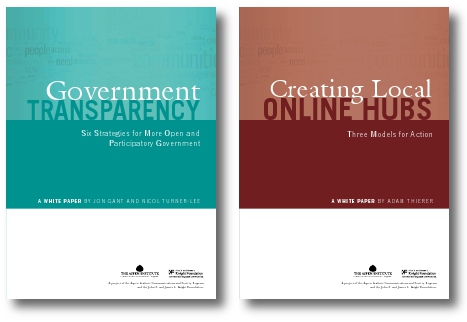
The roundtable focused on the release of two new white papers. The first, “Creating Local Online Hubs: Three Models for Action,” by Adam Thierer, discusses scenarios where community leaders, citizens, media, technologists and — critically, local government — can work together” to create local online hubs where citizens can access information about their governments and local communities.” Creating such high-quality online information hubs was one of the 15 key recommendations of Knight Commission on the Information Needs of Communities in a Democracy. “Just as communities depend on maps of physical space, they should create maps of information flow that enable members of the public to connect to the data and information they want,” said the Knight Commission. (Download PDF or Read Online)

“Governments need to get more information out and make it more accessible, said Thierer today. “This shouldn’t be controversial.” Thierer said that government can do well to catalyze and support this development simply by doing a better job of making such information easily available in easy to use formats. While open government data stores have grown, Thierer noted that this has not trickled down. He cited the example of Manor, Texas as one example of where one local champion (former CIO Dustin Haisler) got help from Stanford and other external resources to get the local open data repository online.

Broadly, Thierer described three models for online hubs:

  • Hubs focused on community government information. Example: Texas Tribune
  • Community connections: local forums and community email listservs. Example: e-democracy.org
  • Community news and commentary. Example: Universal Hub

Thierer focused on the important role that libraries and local or state universities can play in this new ecosystem, by connected offline and online worlds. These universities could create “code toolboxes” that local communities can use, as Stanford did for Manor. He hoped that that model could be replicated nationally.

Government transparency

Government Transparency: Six Strategies for More Open and Participatory Government, by Jon Gant and Nicol Turner-Lee, is call to action for state and local governments to adopt open government. The six sensible strategies “focus on enhancing government expertise and transparency, educating citizens regarding the availability and utility of government information and e-government tools, expanding efforts to support greater adoption of broadband Internet access services and devices, and forging public-private-citizen partnerships in order to enhance open government solutions.” (Download PDF or Read Online)

There are three basic issues here, according to Turner-Lee:

  • Do people get it?
  • Do they have the resources they need?
  • Can they do transparency with those resources?

“All of us who have been in this debate have seen a conflict between these three factors, said Turner-Lee. The question, she said Turner-Lee, is how we empower state and local government. The challenge is that in most open data effort, “We are still in a one-way world, where data is pushed down to the public, not in a reciprocal ecosystem.”

It’s one thing to say citizens who should be involved, said Turner-Lee, but more needs to be done. “As an organizer, I can speak to that. It’s hard to get people to a block meeting,” much less meeting online, she said. There’s also a persistent issue of the digital divide that has to be addressed in this context. “We cannot proclaim government transparency” where millions of people don’t have online access, said Turner-Lee.

There are many examples of where open data is being put to use on the behalf of citizens now. Turner cited apps driven by transit data in Chicago, heritage trees in Portland or the use of 311 by SeeClickFix in the District of Columbia.

Jon Grant focused on a major pain point for government at all levels for tapping into the innovation economy: procurement issues, which civic entrepreneurs run into in cities, statehouses and Washington. “It is time to look at these procurement rules more closely,” he said, and promote higher levels of innovation. “There are a lot of ideas are happening but a lot of rules restrict vendors from interacting in government,” said Grant. Turner-Lee observed that traditional procurement laws may also not be flexible enough to bring more mobile apps into government.

Fundamentally, empowering more government transparency through the Internet will require both creating a climate for the actions, said Turner-Lee, but also through structural changes, specifically, through the release of spectrum and Universal Service Fund (USF) reform.

It will also require that state and local government officials are part of the conversation, “It they aren’t at the table, we’re going to be pretty much talking to ourselves,” said Turner-Lee.

Former San Francisco CIO Chris Vein, now the new White House deputy CTO for government innovation, agreed. biggest challenge of all is that we like to think there are templates. to a certain extent, they can be. fundamentally, all politics is local. To make this work in government, a community “needs someone who takes risks, who goes out there and makes it happen regardlesss of the cost.”

All stakeholder at the panel acknowledged the crucial importance of community institutions, nonprofits and libraries in addressing issues of the digital divide and creating a bridge between online hubs and local citizens. Turner Lee noted that billions of people over the course of years have come into libraries for assistance, particularly the homeless and low-income citizens. “What better way to get people into the system by enabling libraries to be a conduit of information?” she asked.

“Public information belongs to the public, and the public’s business should be done in public,” said Turner. That said, local citizens also don’t want data for the sake of data. “Consumption of this data would be inconsistent if the data doesn’t provide quality of life,” she said.

Building open source platforms for open government

Agency.com/open

Open Public template

As reported in Radar yesterday, Phase2 Consulting acquired two more Drupal distributions.

With the acquisition of Open Atrium and Managing News, Phase2 now has the top four Drupal distributions in use in government and the media. It already hosted the OpenPublic and OpenPublish distributions, both of which are used by government and publishing clients. AfghanistanElectionData.org was using Managing News. So was HaitiAidMap.org.

The move could pave the way for increased interoperability between federal, state and local .gov websites that use Open Atrium and Open Public. Given the economic realities that face the media industry, improvements to collaboration and functionality on the Managing News and Open Publish distributions are also likely to be of interest to online publishers.

Given the budget pressures that face all levels of government in 2011, the ability to share code between government should not be underestimated as a cost saver. Increased interoperability was one driver behind the the websites for dozens of freshman Representatives on House.gov moved to Drupal. (It’s not clear yet how developments costs were affected in the House.)

That move followed the transition of the most high profile government websites in the world to Drupal: WhiteHouse.gov. The blog post on open source at WhiteHouse.gov supported the development of projects within the Open Atrium collaboration suite.

When open source and open government took the stage at the State Department earlier this month, the White House released more open source code back into the Drupal community.

If .gov is the new .com, Drupal is now positioned to play an even bigger role in providing the infrastructure for those data driven websites.

AP covers Gov 2.0 and open government in US cities as citizensourcing grows

QR Codes on NYC building permits

Mayor Bloomberg, Deputy Mayor for Operations Goldsmith and Buildings Commissioner LiMandri announced the use of Quick Response (QR) codes on all Department of Buildings permits, providing New Yorkers with instant access to information related to buildings and construction sites throughout New York City.

As people who follow this blog know well, there’s a new movement afoot to make government work better through technology. This week, Samantha Gross covered the trend for the Associated Press, publishing a widely syndicated piece on how cities are using tech to cull ideas from citizens. In the private sector, leveraging collective intelligence is often called crowdsourcing. In open government, it’s citizensourcing — and in cities around the country, the approach is gaining traction:

Government officials tout such projects as money-savers that increase efficiency and improve transparency. Citizen advocates for the programs argue they offer something deeper — an opportunity to reignite civic responsibility and community participation.

In some ways, the new approach is simply a high-tech version of an old concept, says Ben Berkowitz, the CEO of SeeClickFix, which helps citizens post pothole-type complaints and track whether they’ve been addressed.

“It’s participatory democracy,” he says. “Open government … is something that was laid out by Thomas Jefferson pretty early on. This is just a way to realize that vision.”

Efforts towards open government in the United States remain in beta. It’s early days yet for all of these trends. On this day, however, it’s good news for the community that the AP reported a “Gov 2.0” approach took off in Manor, Texas because of financial concerns.

As Gross reported, city officials in Manor “decided they wanted to engage residents and beef up services beyond the means of their modest budget.” The approaches they chose to tap into the local civic surplus, including ideation platforms, QR codes and open source publishing, have been widely documented. Over the past month, QR codes and citizensourcing have been adopted in New York City.

Below, one of the officials – former Manor CIO Dustin Haisler – talks about what Manor did to implement Gov 2.0, speaking from a business perspective:

There’s a long road ahead for citizens, government and technology. This story in the Associated Press, however, will means that a few more citizens will be aware that change is afoot.

Ignite Philly: Code for America’s Pete Fecteau on being the “dumbest guy in the room

Last week, Code for America Fellow Pete Fecteau gave a great five minute talk at Ignite Philly 7. Fecteau about why he’s participating in the program and what he’s hoping to accomplish.

Code for America IgnitePhilly talk from @peterfecteau from Uploaded by: Tyler Stalder on Vimeo.

“Code for America is not about building some shiny piece of technology. It’s about spreading both collaborative and cognitive knowledge. As many questions as we hope to ask in Philly, we hope to answer that many questions,” he said. “”What we build in Philly we share with the rest of the nation’s struggling cities. We’re opening data, plugging it in, and releasing it as an open source platform.”

[Hat tip Code for America]

Civic coders for America gather in DC for a Presidents’ Day datacamp

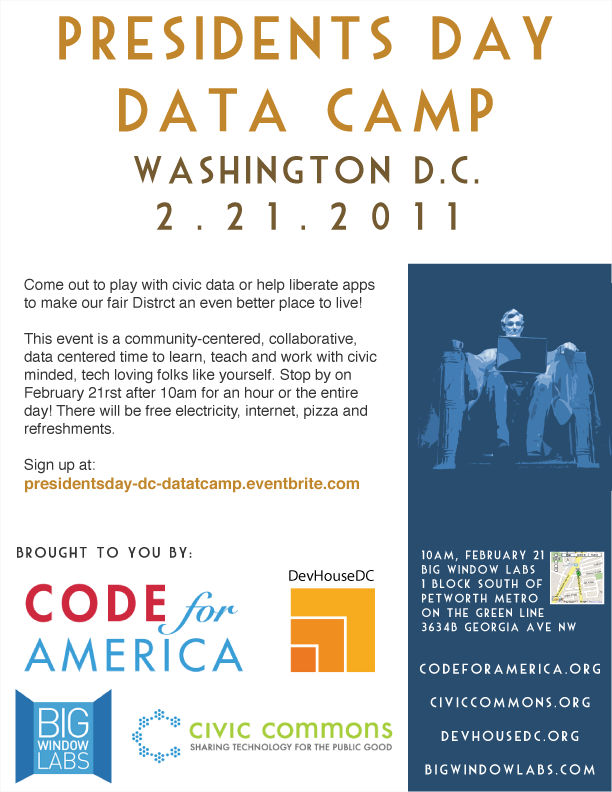
This past weekend, civic developers gathered at a Seattle data camp to code for America. This Presidents’ Day, the day before George Washington’s Birthday, dozens of government technologists, data nerds, civic hackers and citizens from around the District of Columbia, Virginia and Maryland will join Code for America fellows for a datacamp at Big Window Labs.

The attendees of the Washington datacamp can look to the Seattle Data Camp for inspiration. The civic hacktivism on display there led to engaged discussions about Seattle’s South Park neighborhoodmobile damage assessment appstransit apps, mobile / geolocation appsdata mininginformation visualization.

Perhaps even more impressive, one of those discussions lead to the creation of a new smartphone application. Hear Near pushes alerts about Seattle events nearby to iPhone or Android device users using text messages. Hear Near is now available from iTunes and Android.
Joe McCarthy published a terrific post about Data Camp Seattle that offers a great deal of insight into why the event worked well. McCarthy helped the HearNear team by identifying and defining mappings between the GeoLoqi API and the iCal feed.

McCarthy describes how a creative discussion amongst talented, civic-minded people enabled them to donate their skills to putting the open data from Seattle’s data repository to work for its citizens. He also explored what inspires him about Code for America:

I wasn’t sure what to expect going into the event, but was greatly impressed with the interactions, overall experience and outcomes at Data Camp Seattle. I’ve admired the Code for America project since first learning about it, and have been a proponent of open data and platform thinking (and doing) on my blog. It was inspiring and empowering to have an opportunity to do more than simply blog about these topics … though I recognize the potential irony of writing that statement in a new blog post about these topics.

I suspect that one of the most durable outcomes of the Code for America project will be this kind of projection or radiation of civic empowerment through – and beyond – the efforts of the CfA fellows and their collaboration partners. In The Wealth of Networks, Yochai Benkler writes about how “[t]he practice of producing culture makes us all more sophisticated readers, viewers, and listeners, as well as more engaged makers”. In Program or Be Programmed, Doug Rushkoff warns against “relinquishing our nascent collective agency” to computers and the people who program them by engaging in “a renaissance of human capacity” by becoming programmers ourselves.

While many – or even most – of the specific applications we designed and developed during the Data Camp Seattle civic hackathon may not gain widespread traction and use, if the experience helps more of us shift our thinking – and doing – toward becoming co-creators of civic applications – and civic engagement – then the Code for America project will have succeeded in achieving some grand goals indeed.

This example of directed action at an unconference has fast become the next step in the evolution of camps, where a diverse set of volunteers come together to donate more than money or blood: they exchange information and then apply their skills to creating solutions to the needs defined by a given set of societal challenges.

This model of directed civic involvement has became a global phenomenon in wake of the crisiscamps that sprung up after the earthquake in Haiti last year. The cultural DNA of these camps has evolved into CrisisCommons, which has acted as platform for volunteers to donate their skills to help in natural disasters and other crises.

As the role of the Internet as a platform for collective action grows, those volunteers are gaining more ability to make a difference using powerful lightweight collaboration tecnology and open source data tools.

From the towns of the United States to cities in Denmark, Brazil, Kenya, Illinois and India, people interested in local Gov 2.0 have been gathering to to create applications that use open public data. In December, Around the world, the International Open Data Hackathon convened participants in over 56 cities in 26 countries on 5 continents.

As Seattle CIO Bill Schrier put it this past weekend, they’re turning data into information. Federal CTO Aneesh Chopra has praised these kinds of efforts “hacking for humanity.” An event like Random Hacks of Kindness “brings together the sustainable development, disaster risk management, and software developer communities to solve real-world problems with technology.”

On President’s Day, another datacamp will try to put that vision into action.

http://widgets.twimg.com/j/2/widget.js //

Civic developers gather to code for America at data camps

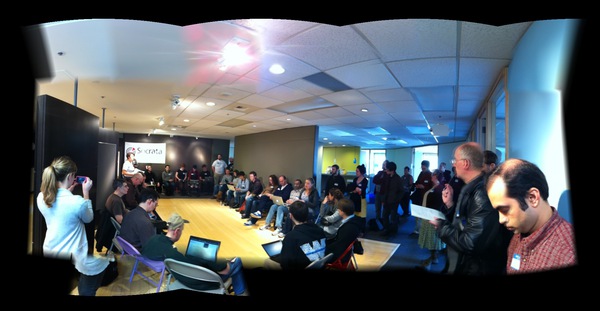
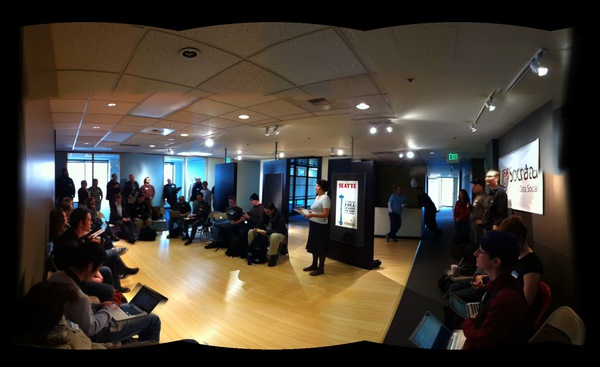
Today in Seattle, over 50 civic developers have gathered at Socrata to work on coding applications from the city’s open data repository at data.seattle.gov. Today’s Seattle datacamp, organized by Code for America, is just one of several data camps that the new civic service is convening in host cities around the United States. Chacha Sikes, a 2011 Code for America fellow, explains what’s behind these data camps:

City governments have a lot of information which is useful to all of us. This ranges from maps of local parks to building footprints to real-time 911 calls. We all have an interest in our budget information, legislative documents and other resources that we use in collective decision-making and deliberation. Not all of this information is currently available for all cities, even though much of it is public record. The “Open Data” movement is a way to work on getting information into machine-readable formats, allowing for easy publishing, sharing, and reuse.

We’re hosting DataCamps in CfA’s cities this year to build communities around making city data more open and accessible to allow citizens to help cities work better.

DataCamp is a event focusing on skill-building and collaborative work on city data. It is an opportunity for interested parties in a city to work together, and build a network of people with shared interested in improving civic communications and information management.

Sanjay B. Hyatt, a writer at the Seattle Times, is at the data camp in the Pacific Northeast. He reported back that CTO Bill Schrier said that Seattle has 100 data sets. “Turn that data into information.”

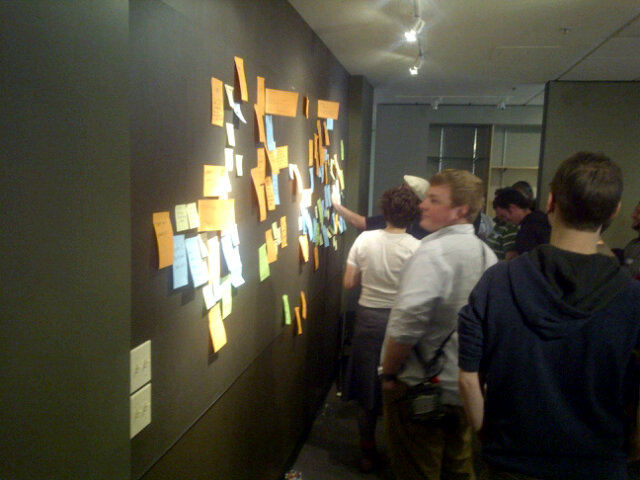
DataCamp Seattle is using a Drupal site and a DataCamp Seattle Google group to coordinate and share notes. In the tradition of unconferences and barcamps, they’re also using a more analog method to sort out ideas and projects: sticky notes. Virtual observers can see the various projects going up, including calendars, an impact survey, an apps workshop and a “pimp my blog” to help stimulate the creation of hyperlocal blogs.

More data camps are coming soon to Seattle and Washington, D.C.

UPDATE: A day after the datacamp, a new app is available to Seattle residents. Hear Near pushes alerts about Seattle events nearby to mobile phone users using text messages.

Hear Near is available from iTunes and Android.

Hear Near was created by a team that included Amber Case (whose geolocation startup, Geoloqi, powers it), Aaron Parecki, Joe McCarthy, Jesse Kocher, Gene Homicki, Naoya Makino, Steve Ripley, Rebecca Gutterman and Jenny Frank.

Frank, a self-identified “non-techie” who attended the camp, came away with the feeling that “nothing is impossible.”

Panoramic image credits to Chris Metcalf.

Solving your neighbor’s possum problem in the dark? There’s an app for that.

One of the most common aphorisms heard around the Gov 2.0 world is that “potholes are the gateway drugs to civic engagement.”

After a recent report in Boston, maybe Hub pundits can add a new phrase to the lexicon: “possums are the gateway animal to citizens connecting.

As the indefatigable Adam Gaffin reported at Universal Hub, the wonderful hyperlocal blog in Beantown, the Citizens Connect app has now been deployed as Boston’s high tech possum saver.

According to Gaffin’s post, Susan Landibar of South Boston saw a possum report:

“Possum in my trash can. Can’t tell if it’s dead. Barrel in back of 168 west 9th. How do I get this removed?”

And acted upon it:

Labandibar reports:
11:15PM Walked over to West Ninth Street. It’s about three blocks from my house. Locate trash can behind house. Possum? Check. Living? Yep.

Turned the trash can on its side. Walked home. Good night, sweet possum.

When the city of Boston released the Citizens Connect application, which works on Android phones and iPhones, officials no doubt expected it to help constituents report potholes, graffiti, unplowed snow and trash removal.

And indeed, if you look through the list of reported issues, that’s the bulk of it.

After today, however, the city can add “possum problems” to the list of resolved issues. Crucially, however, it wasn’t the city that fixed it: it was a fellow citizen who saw an issue using the app and then went and took care of it herself.

For good or ill, this example of “do it ourselves” government is a data point that may be increasingly relevant. Plummeting city budgets mean smarter cities will need citizen sensors to detect issues and take civic pride into their own hands. As Gov 2.0 goes local, applications that connect citizens to one another in crises may become as important as technologies that connect citizens to government, like Citizens Connect.

As the role of the Internet as a platform for collective action grows, Clay Shirky may be proven prescient: “We have historically overestimated the value of access to information and underestimated the value of access to one another.”