The Smithsonian goes virtual at SXSWi

In the face of adversity, Gov 2.0 will find a way. This morning, the Smithsonian’s director of Web and new media strategy, Michael Peter Edson, was unable to attend the Innovating and Developing with Libraries, Museums, and Archives panel at SXSW Interactive, 2011. Instead of leaving a hole in the program, he created a video about his work, below, and tweeted out links to the Smithsonian Commons, the Smithsonian Web and New Media Strategy and a presentation on prototyping. Enjoy.

Michael Edson: Prototyping the Smithsonian Commons

:

Are the Internet and Social Media ‘Tools of Freedom’ or ‘Tools of Oppression?’

The role of the Internet and social media in what has been described as the “Arab Spring” in Egypt, Tunisia, Libya and the rest of the Middle East is one of the hottest topics in technology and foreign policy. Ever since the #IranElection hashtag first gave the world a look at social media as forum for information exchange about civil unrest outside of state-controlled media, there has been a huge explosion oof forums and op-eds exploring the question of whether YouTube, Facebook, Twitter, cellphones, crisis mapping and other technology platforms were creating the conditions for revolution — or acting as an accelerant to the embers of revolution. The State Department’s “Internet freedom” policy has come into conflict with both autocrats whose iron rule has carried over from the 21st century using Facebook and mobile technology to track down dissidents and Western democracies seeking increased electronic surveillance powers over the network of networks that now spans the globe.

As with so many other communications tools, it’s becoming increasingly clear that the connection technologies whose use has rapidly brought more of us together can be used in both positive and negative ways, much in the same way the printing press, radio or television changed the distribution of ideas and news in past centuries. Cellphones equipped with cameras and connected to the rest of the world have become the eyes and ears of young people in the Middle East. They can also be used to track them.

In a year when the leader of Libya mentioned Facebook by name and Egypt shuts down the Internet, it would be easy to simply celebrate the role of people power accelerated by social media. Not so fast. These social media platforms of 2011 can and will be used to people, governments and covert organizations to greenwash, astroturf or distribute propaganda or misinformation. This reality has been articulated by Evgeny Morozov in The Net Delusion and emphasized again in a commentary today on the role of social networking in the Arab Spring. While Wael Ghonim said that without social networking, this wouldn’t have happened, Morozov emphasizes that it took the bravery of millions of young people to show up in real life in Tahir Square in Egypt or in the streets of Tunisia for this to become a reality.

Smarter social networking” in the service of the ends of dictators and autocrats can and will happen, along with so many other spheres of public life. As Ben Scott, innovation advisor of the State Department acknowledged at an AMP Summit in D.C. on social networking and Egypt last month, it is happening, with more use of tools for negative purpose to come. “The question is no longer does technology matter,” he said. “It’s how, and in what ways.”


http://www.ustream.tv/flash/viewer.swf

“Network effects are politically agnostic,” said Scott. These connection technologies are not causing revolution. “They’re accelerating them.”

The question of whether these connection technologies are by their nature aligned with greater freedoms has also, literally, been up for debate. When it comes to a bigger question — whether connection technologies are more useful for democrats or dictators — Scott said that on the whole, he thought the proliferation of connection technologies is good for democracy. The online audience in a recent debate at Economist.com between Stanford’s Evgeny Morozov and Harvard’s John Palfrey decided by a narrow margin that the Internet is “inherently” a force for democracy. The full dialogue between the two men is well worth reading in its entirety.

Whether that view or this architecture of the Internet itself persists has other members of the academy concerned as well. As Harvard computer science professor Jonathan Zittrain observes in the Scientific American, keeping the Internet open, distributed and free is not a certain outcome.

Attacks on Internet sites and infrastructure, and the compromise of secure information, pose a particularly tricky problem because it is usually impossible to trace an attack back to its instigator. This “attribution problem” is so troublesome that some law-enforcement experts have called for a wholesale reworking of Internet architecture and protocols, such that every packet of data is engraved with the identity of its source. The idea is to make punishment, and therefore deterrence, possible. Unfortunately, such a reworking would also threaten what makes the Internet special, both technologically and socially.

The Internet works thanks to loose but trusted connections among its many constituent parts, with easy entry and exit for new Internet service providers or new forms of expanding access. That is not the case with, say, mobile phones, in which the telecom operator can tell which phone placed what call and to whom the phone is registered. Establishing this level of identity on the Internet is no small task, as we have seen with authoritarian regimes that have sought to limit anonymity. It would involve eliminating free and open Wi-Fi access points and other ways of sharing connections. Terminals in libraries and cybercafes would have to have verified sign-in rosters. Or worse, Internet access would have to be predicated on providing a special ID akin to a government-issued driver’s license—perhaps in the form of a USB key. No key, no bits. To be sure, this step would not stop criminals and states wanting to act covertly but would force them to invest much more to achieve the anonymity that comes so naturally today.

The history of the introduction of new communication tools is a reminder that most disruptive technologies have dual uses. In 1924, Calvin Coolidge was the first President of the United States to make a radio broadcast from the White House. A decade later, Hitler and Stalin were using the same tool to spread a different kind of message.

Nearly a century later, the current occupant of the White House is using YouTube, Facebook, Twitter, apps and live video on WhiteHouse.gov to communicate with citizens, both of the United States or in other countries. While the White House can claim some open source cred for running WhiteHouse.gov on Drupal, much of the rest world has long since becoming aware of the disruptive nature of a more wired society that is connected to the Internet.

The debate about the role of connection technologies in Internet freedom spans many audiences. Last month, the discussion came to the Cato Institute, where a debate on social media and revolutions was moderated by Jim Harper, Director of Information Policy Studies at Cato. The discussion featured Christopher Preble, Director of Foreign Policy Studies at Cato Institute, Tim Karr, Campaign Director, Free Press, and this correspondent.

http://www.cato.org/jwmediaplayer44/player.swf

The same platforms that can and are being used to transmit breathtaking moments of wonder,
hear digital cries for help or lift up the voices of the citizens in oppressed societies to the rest of the world will also be used against them. Palfrey has further explored Middle East conflict and an Internet tipping point for the Internet at MIT’s Tech Review. His conclusion is worth sharing again:

Today, we are entering a period that we should call “access contested.” Activists around the world are pushing back on the denial of access and controls put in place by states that wish to restrict the free flow of information. This round of the contest, at least in the Middle East and North Africa, is being won by those who are using the network to organize against autocratic regimes. Online communities such as Herdict.org and peer-to-peer technologies like mesh networking provide specific ways for people to get involved directly in shaping how these technologies develop around the world.

But it would be a big mistake to presume that this state of affairs will last for long, or that it is an inevitable outcome. History shows us that there are cycles to the way that technologies, and how we use them, change over time, as Timothy Wu argues in his new book, The Master Switch. The leaders of many states, like China, Vietnam, and Uzbekistan, have proven able to use the Internet to restrict online discussion and to put people into jail for what they do using the network. We should resist the urge to cheer the triumph of pro-Western democracy fueled by widespread Internet access and usage. The contest for control of the Internet is only just beginning.

As the rest of the world watches the changes sweeping the Middle East through snippets of cellphone video uploaded to YouTube and curated by digital journalists like Andy Carvin, connected citizens have unprecedented capacity to drink from the firehose of revolutionary media. The role of the Internet as a platform for collective action is growing. The challenge is what people do with it.

Enhanced by Zemanta

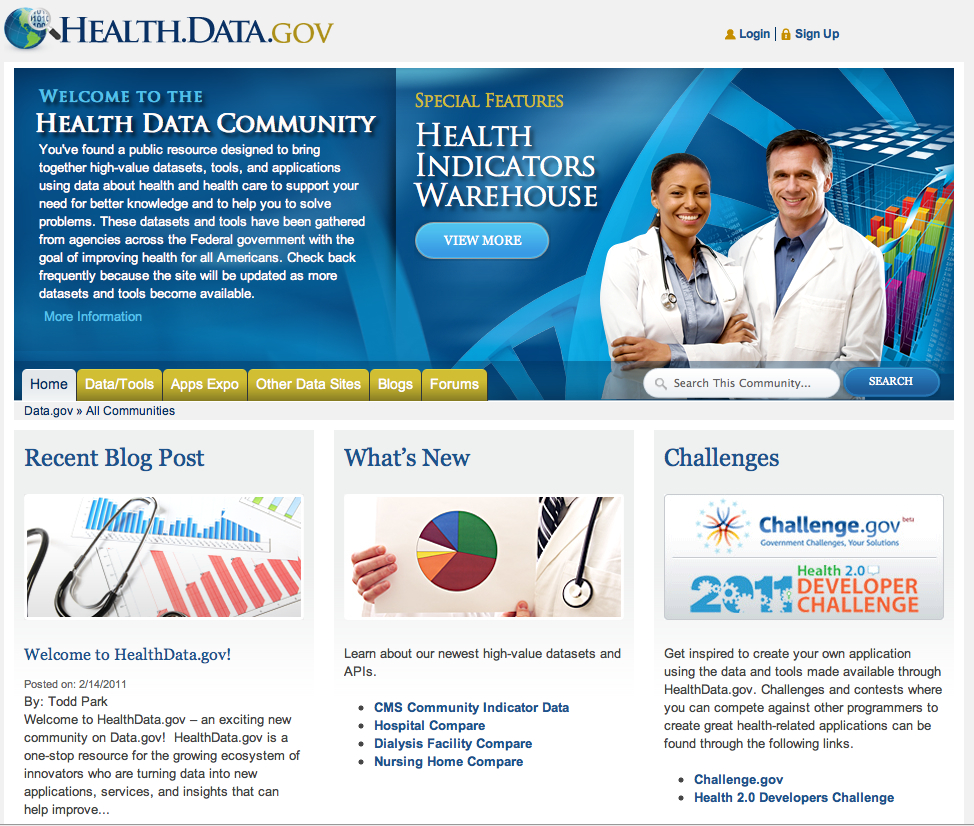
HHS launches Health.Data.gov

Last October, Todd Park, the chief technology officer at the Department of Health and Human Services (HSS) announced HealthData.gov at the HealthCamp in San Francisco. Today, Health.Data.gov went live. When the domain name propagates properly through the Internet, HealthData.gov will send online users directly to the new community at Data.gov.

Park blogged about HealthData.gov and the open health data initiative on Data.gov this morning.

“HealthData.gov is a one-stop resource for the growing ecosystem of innovators who are turning data into new applications, services, and insights that can help improve health,” he wrote.

The new open health data site includes community features and links to more than a thousand indicators at HealthIndicators.gov and a health apps showcase.

New apps like iTriage have the potential to turn open health data to better decisions and build new businesses. Speaking at the State Department’s open source conference last week, Park said that tens of thousands of citizens have now used the health data in iTriage to find community health centers.

Park has been working to make community health information as useful as weather data through the release of open health data from HSS. Today, the nation now can see more about what the tech community has come up since this spring, when the question of whether “there’s a healthcare app for that” was answered the first time. “Social value and economic value can go hand in hand,” he told a health IT summit in San Francisco.

Below, Park speaks more about what open health data could mean at last weekend’s health 2.0 code-a-thon in Washington, DC.

http://c.brightcove.com/services/viewer/federated_f9?isVid=1&isUI=1

Here come the healthcare apps.

Clinton: There is no silver bullet in the struggle against Internet repression. There’s no “app” for that

Today in Washington, Secretary of State Clinton reiterated the State Department’s commitment to an Internet freedom policy in a speech at George Washington University. Rebecca MacKinnon, journalist, free speech activist, and expert on Chinese Internet censorship, provided some on the spot analysis immediately following Clinton’s words. MacKinnon made an interesting, and timely, point: there are limits to directly funding certain groups. “I think one of the reasons that the Egyptian and Tunisian revolutions were successful was that they were really home grown, grass roots. At the end of the day, the people in the countries concerned need to really want change and drive that change.”

MacKinnon parsed the considerable complexity of advocating for Internet freedom in the context of Wikileaks and electronic surveillance in other areas of the federal government. For those interested, she elaborated on the issues inherent in this nexus of government and technology in her Senate testimony last year. At some point this winter, there will be a hearing on “CALEA 2″ in the United States Congress that’s going to be worth paying close attention to for anyone tracking Internet freedom closer to home, so to speak.

Should the U.S. support Internet freedom through technology, whether it’s an “app” or other means? To date, so far the State Department has allocated only $20 million of the total funding it has received from Congress, according to a report on Internet censorship from the Senate Foreign Relations Committee obtained by the AFP. (Hat tip to Nick Kristof on that one).

Clinton defended the slow rollout of funding today in her speech (emphasis is added):

“The United States continues to help people in oppressive Internet environments get around filters, stay one step ahead of the censors, the hackers, and the thugs who beat them up or imprison them for what they say online. While the rights we seek to protect are clear, the various ways that these rights are violated are increasingly complex. Some have criticized us for not pouring funding into a single technology—but there is no silver bullet in the struggle against Internet repression. There’s no “app” for that. And accordingly, we are taking a comprehensive and innovative approach—one that matches our diplomacy with technology, secure distribution networks for tools, and direct support for those on the front lines.”

The caution in spending may well also be driven by the issues that the State Department encountered with Haystack, a much celebrated technology for Internet freedom tool that turned out to be closer to a fraud than a phenomenon.

There may be no silver bullet to deliver Internet freedom to the disconnected or filtered masses, per se, but there are more options beyond the Tor Project that people in repressive regimes can leverage. Today, MIT’s Technology Review reported on an app for dissidents that encrypts phone and text communications:

Two new applications for Android devices, called RedPhone and TextSecure, were released last week by Whisper Systems, a startup created by security researchers Moxie Marlinspike and Stuart Anderson. The apps are offered free of charge to users in Egypt, where protesters opposing ex-president Hosni Mubarak have clashed with police for weeks. The apps use end-to-end encryption and a private proxy server to obfuscate who is communicating with whom, and to secure the contents of messages or phone conversations. “We literally have been working night and day for the last two weeks to get an international server infrastructure set up,” says Anderson.

No word on whether they’ve received funding from State yet. For more on today’s speech, read the full report on the State department’s Internet freedom policy at the Huffington Post, Ethan Zuckerman or the ever sharp Nancy Scola on #NetFreedom, which does, in fact, now look like a “big deal.”

2011 Trend: Deloitte predicts eGovernment will reach an inflection point

http://c.brightcove.com/services/viewer/federated_f9?isVid=1

2011 predictions from Deloitte Consulting:

In 2011 Deloitte predicts eGovernemt (eGov) usage will reach an inflection point. Across developed countries, the proportion of businesses that use eGov services for at least one process is expected to average over 90 percent, up from 75 percent in 2010. Similarly, the proportion of citizens that use eGov in industrialized countries should rise by at least 10 percentage points. In some countries, the importance of eGov as a way to boost public sector productivity and efficiency may even prompt the appointment of a national Chief Information Officer (CIO) where one did not exist previously.”

For those watching, the United States has had both a CIO and a chief technology officer (CTO) since the beginning of the Obama administration. Both Vivek Kundra and Aneesh Chopra, respectively CIO and CTO, have worked with their staff to go beyond traditional e-government in the context of the open government initiative, evolving from a “vending machine” model, where government simply provides e-services, to where government acts as a platform, releasing data and convening citizens, industry and policy makers to address huge challenges.

Whether Deloitte’s prediction comes true in 2011 for the world remains to be seen. It’s certainly interesting and worth taking note.

Deb Bryant on open source at the Tech@State unconference

Deb Bryant, public sector communities manager at the Oregon State University Open Source Lab, kicked off the Tech@State unconference on open source at the National Democratic Institute today.

The short video below, capturing some of her thoughts on the evolution of open source in government, are worth considering, particularly with respect its use internationally. As Bryant pointed out, for instance, Brazil has been doing open source for a decade. “They’re really the Simon Bolivar of software down there.”

The schedule for the Tech@State unconference is evolving at Open4m.org/NDI. It bids to be an interesting day.

Live from the Newseum: Jobs and the Economy of the Future

In February of 2011, the effects of the The Atlantic has released a special report on jobs and the economy. This morning, the report and the prospects for growth will be discussed at a digital town hall on at the Newseum, “Jobs and the Economy of the Future.

Guests include:

  • Timothy Geithner, Secretary of the Treasury
  • Julius Genachowski, Chairman, FCC
  • Sen. Orrin Hatch
  • Jon Huntsman, US Ambassador to China
  • Gov. Bob McDonnell, Virginia
  • Brian Deese, Deputy Director, NEC

    The event’s digital component includes a livestream and a new instance of Microsoft’s Town Hall platform for collecting feedback from the online audience. There is also an active backchannel on Twitter aggregated at the #USFutureEconomy hashtag:

    http://widgets.twimg.com/j/2/widget.js

    new TWTR.Widget({
    version: 2,
    type: ‘search’,
    search: ‘USFutureEconomy’,
    interval: 6000,
    title: ‘What is the discussion about the’,
    subject: ‘Jobs of the Future?’,
    width: ‘auto’,
    height: 300,
    theme: {
    shell: {
    background: ‘#004869’,
    color: ‘#ffffff’
    },
    tweets: {
    background: ‘#ffffff’,
    color: ‘#444444’,
    links: ‘#1985b5’
    }
    },
    features: {
    scrollbar: false,
    loop: true,
    live: true,
    hashtags: true,
    timestamp: true,
    avatars: true,
    toptweets: true,
    behavior: ‘default’
    }
    }).render().start();

    The Atlantic will be liveblogging the event as well.

  • Nicholas Gruen on Gov 2.0 in Australia and cultural change

    “I began the Gov 2.0 taskforce thinking that open government was a kind of civil rights agenda, even if it has economic costs,” said Nicholas Gruen last week in Santa Clara at the Strata Conference. Gruen headed Australia’s Gov 2.0 taskforce. “At the end of it, I realized that open government was actually a really powerful economic driver.”

    Why? Gruen pointed to the efficiencies presented inside of government by improved communication and the opportunities to ask citizens for ideas and solutions to problems. “Even if our team said we couldn’t do it technically, I just said we’ll tell everyone that we need help and approach it that way.” Asking questions was, he said, an effective means of accomplishing many tasks much faster than they would have been otherwise.

    In a video interview, embedded below, Gruen talked more about the state of Gov 2.0 in Australia and some of his thoughts of the economics involved His comments on cultural change will be of particular interest those focused on technology as a panacea to inefficiency or engagement.

    The recent historic flooding in Australia created an urgent use case for improved communications between the public and government. “When you look at the Queensland floods, the Facebook of the police department use blew people away,” said Gruen. “Their links got many comments and compliments.”

    For more about how social media combine with geospatial mapping in crisis response, read about a new online application from geospatial mapping giant ESRI that applies trend analysis to help responders to Australia’s recent floods create relevance and context from citizen-generated reports.

    Achieving better outcomes through technology isn’t just about setting up a Facebook page or Twitter account, emphasized Gruen. Public servants have to be willing to share information that matters to citizens and in turn listen to feedback from the public to create better feedback loops.

    “This is a cultural transformation,” said Gruen. “You can’t impose that. You can’t dictate it.”

    Further reading:Gov 2.0 Down Under: Australia and Open Government

    How GIS technology and social media helped crisis response in Australia

    As a new article at the O’Reilly Radar showed today, social data and geospatial mapping have joined the crisis response toolset. A new online application from geospatial mapping giant ESRI applies trend analysis to help responders to Australia’s recent floods create relevance and context from social media reporting. The Australian flood trends map shows how crowdsourced social intelligence provided by Ushahidi enables emergency social data to be integrated into crisis response in a meaningful way.

    The combination of Ushahidi and ESRI in Australia shows that “formal and innovative approaches to information collection and analysis during disasters is possible,” said Patrick Meier, “and that there is an interface that can be crafted between official and non-official responses.” Meier is a research fellow at the Harvard Humanitarian Initiative and director of crisis mapping at Ushahidi and was reached via email.

    Russ Johnson, ESRI’s global director for emergency response, recently spoke with the correspondent at the ESRI federal user conference in Washington, D.C. Johnson spent 32 years as a federal employee in southern California, predominantly working in the U.S. Forest Service. He was one of the pioneers who built up the FEMA incident response system, and he commanded one of the 18 teams around the nation that deploy assets in the wake of floods, fires and other disasters. At ESRI, Johnson helps the company understand the workflow and relevance of GIS for first-response operations. Our full interview is embedded below in the following video.

    The world of crisis response has changed dramatically in the past several years, said Johnson. The beauty of the present historic moment is that “everybody can be a sensor,” said Johnson. “Everybody is potentially part of the network. The struggle that operators have is taking all of that free form data and trying to put into some sort of framework that makes it accurate.”

    Emergency and crisis responders are faced with significant cultural barriers that have nothing to do with logging on to a website or configuring a new account, explained Johnson. “Public safety organizations are really, really resistant to change,” he said. “Technology has frightened a lot of people before social media was a new data source. It’s a new challenge that’s threatening to a lot of people. The question I pose is simple. Let’s use the first responder scenario, where you have 4-6 minutes from the time you get the call. the expectation is you’ll be on scene. Think about the possibility that before you arrive, thousands of people will have video on YouTube. They may have more situation awareness. When you arrive, you’ll be videoed, watched, and critiqued. Shouldn’t you consider that data if it can help you deploy more safely or effectively?”

    Johnson said that he really likes FEMA director Fugate’s philosophy and operational mentality in that context. Fugate has emphasized that he believes the public can be a resource in crises, instead of a hindrance. The current FEMA chief is tapping social media’s potential for aiding disaster response. “There are times when agencies can’t get good intelligence,” said Johnson. “I cannot tell you how many times where we had televisions and the best information we were getting was from CNN or helicopters. There are times when it may be wrong but I’d rather have it be part of our mashup of data to help validate and inform responders.”

    The technology itself has also evolved recently, said Johnson. “We used to have to have a specific person to support mission, which meant we had to drag a person trained in GIS everywhere. As the technology has evolved, and data has evolved, the tools have reached the operator and first responder level. We can now match persona, mission and task to GIS tech so that it fits them. You can get complex answers that can be generated by an operator, not a GIS geek.”

    How did Haiti change the conversation?

    “Everyone thought Haiti would be completely dark,” said Johnson, with all information provided by boots on the ground. In fact, social media played an important role, he said, highlighted by the efforts of Crisis Congress and others who heard those digital cries for help. Social media “brought the light on,” said Johnson, providing not just something to act on but perhaps the only thing to act on, at least initially. In subsequent crises, responders have found that crisis data, particularly when added to maps for context, can provide valuable insight long before official reports emerge.

    This trend is a key issue for communities as more citizen engagement platforms emerge. “When you have a large emergency, who are the first responders? Who can get to you the most quickly? Your neighbors,” says Johnson. “if you can have a universal way to communicate to the people who can help you, that may have the only help you have. Conventionally, you think of the guys in uniforms and helmets.”

    In 2011, citizens have the opportunity to shoulder more of that shared responsibility than ever.

    For #AskObama on YouTube, a RT is a vote on Google Moderator

    Designing digital democracy is hard. The structures and conventions that have evolved for deliberative democracy, as messy as it can be offline, don’t transfer perfectly into machine code. Many different companies, civic entrepreneurs, nonprofits and public servants are working to create better online forums for discussion that make better use of technology. This morning, New York City’s new chief digital officer, Rachel Sterne, asked how NYC could use technology to serve citizens. In 2011, the White House is using an unprecedented mix of Web 2.0 platforms at its new State of the Union page for tonight’s speech, integrating graphs and other elements to the WhiteHouse.gov livestream.

    Tonight, a new alpha feature in Google Moderator is adding some social signals to help identify the questions that citizens want President Obama to answer in his YouTube interview on Thursday night. Every tweet with an #askObama hashtag will be added to the Google Moderator instance at YouTube.com/AskObama. And every retweet of an #AskObama tweet will count as vote in the Moderator instance. (For the uninitiated, a retweet on Twitter is when a user reshares another user’s tweet. To count as a vote on Moderator, the retweet has to be a “native RT,” not the older manual version where text is copied.)

    It’s a simple tweak but it’s one that could make the tool more useful for people who wish to crowdsource questions. “There’s a lot of experimentation going on with Gov 2.0,” said Ginny Hunt, product manager for Google Moderator. “There’s a lot of people on all sides trying to figure out how to involve people in a more useful, participatory, exciting way.”

    Hunt looks at Moderator as a way to aggregate and rank answers from many different places across the Web. “We don’t see Moderator as a Q&A platform in quite the same way that you might look at Yahoo Answers or Quora,” she said. “We see it as a way to have an ongoing conversation with constituents in a way that’s efficiently organized. That’s why it fits so naturally with YouTube, because there’s a very clear connection with engaging content.”

    Hunt emphasized that what people will see on Moderator tonight “is really alpha” and isn’t available on the standard module on YouTube. “It’s a small step in the evolution of social engagement,” she said. “The more we can simplify the process for government and partners, the better. What you’ll see with Twitter tonight is just the first step. Tweets will get integrated into Moderator with your Twitter identity. It’s just a tiptoe into how we can aggregate ideas in a smarter way and is highly experimental, which is why it’s in Google Labs.”

    Part of that process is in making the Google Moderator API available to developers. For instance, Google Moderator powers 10 Questions, which the Personal Democracy Forum relaunched in an effort to reboot citizen to candidate engagement.

    “We’ve now used the API to kick of something called YouTube World View, which will be a monthly interview with a world leader,” said Hunt. “You can use the API to plug into anything you want to socialize to allow ranking. We made it open because we expect people to be more innovative than we can anticipate in terms of easily crowdsourcing within a community.”

    The content from a Moderator series can also be exported as comma-separated values (CSV) files, which allows developers and designers to take the information and do analysis with the raw data.

    There are many challenges in creating platforms for civic discourse, including building in incentives for participation, mitigating identity or privacy issues, addressing vocal minorities overwhelming the system, or ensuring systems scale under heavy traffic. (On that last count, Google’s servers have had little trouble keeping up the load: the Google Moderator instance for last year’s YouTube interview on the CitizenTube channel received over 11,600 questions and over 660,000 votes.)

    Even as the role of the Internet as a platform for collective action is growing, however, the technical challenges of getting this right include numerous design, community and cultural challenges. The ways that connection technologies can be turned to governance, versus campaigning, will become increasingly critical as more people go online. Many of the social platforms that are in current use give their users substantial ability to personalize what information or conversations they receive.

    Clay Shirky, speaking at this year’s State of the Internet Conference, said that government and technologists have systematically undersigned social spaces where hard choices are addressed. “We have, thanks to James Madison, lots of well designed systems to do that [offline]” he said. “We don’t have as many online. The tendency to rant or opt out prevents the kind of bargaining or horsetrading that’s important.”

    The Google Moderator team has made an effort to address some of those issues. “We’ve tried to address that by giving everyone a way to let their voices be heard and to weigh in on the process. Ideally, a small, loud, organized group wouldn’t block the virtual room for others,” said Hunt. “The online systems haven’t caught up to the checks and balances that exist in an in-person town hall. Sometimes, they can be more disruptive. We’re still figuring that out. We do care that people have fair space to have their voice heard.”

    Hunt posits that when you ask community about not just what they want to say but what they care about, you’ll get more useful results. “We’re not just inviting people here to post something. We’re asking them to contribute and then vote on something they care about. Freedom of speech in a representative democracy can be messy but that’s part of the process that makes it what it is. The challenge is getting closer to giving people who are busy, with a lot on their minds, a way to get involved.”

    The real time Web needs to become the right time Web for most of those citizens to find it relevant in their everyday lives, as it did today when a new geolocation app launched that connected trained citizens with heart attack victims. People need actionable intelligence. Geeks hacking smarter government to make asking questions and gathering feedback simpler can and will make a difference. “If we can make it simpler for folks to plug in, that’s a good thing for everyone,” said Hunt. For those that want to #askObama a question about his plans for 2011, that Moderator instance closes at midnight on Wednesday.