Improving open government oversight through FOIA reform

The Freedom of Information Act is one of the primary levers by which journalists, government watchdogs and other organizations can hold the United States government accountable. Today in Washington, the U.S. House of Representatives Committee on Oversight and Government Reform held a hearing on “The Freedom of Information Act: Crowd-Sourcing Government Oversight.
Full House Oversight and Reform Committee

The testimony of the witnesses made it clear that major issues persist with the cost, mechanism and compliance with FOIA requests made to government agencies.

Public information should be online in real time, said Representative Darrell Issa (R-CA) (@DarrellIssa), chairman of the committee.

His prepared statement provided context for the focus of the hearing:

The Freedom of Information Act (“FOIA”) is one of the most important tools for government transparency and accountability. It permits the private-sector, the media, watchdog groups, and the general public to scrutinize the activities of federal agencies – from the telephone logs and email correspondence of federal employees to internal memoranda, transcripts, and meeting minutes.

Minus a few specific exemptions designed to protect narrowly-defined privacy concerns, national security and law enforcement matters, claims of executive privilege and trade secrets, information about the government’s work is required by law to be publicly accessible. Indeed, every federal agency, commission, department and corporation – as well as the White House itself – falls under FOIA’s expansive authority.

Representative Elijah Cummings (D-MD) defended the record of the Obama administration on open government and quoted President James Madison in his opening statement:

A popular government without popular information or the means of acquiring it, is but a prologue to a farce, or a tragedy, or perhaps both. Knowledge will forever govern ignorance, , and a people who mean to be their own governors, must arm themselve with the power knowledge gives.”

Rep. Cummings introduced a new bill today, entitled the “Transparency and Openness in Government Act.” (As of the time this post went live, it was not in Thomas.gov yet.) According to Rep. Cummings, the bill would make federal commissions more transparent, increase access to records, ensure government email records were preserved and improve GAO access to govt records. The legislation includes five bills that passed the House during the 111th Congress:

  • The Federal Advisory Committee Act requires agencies to disclose more information about advisory committees and closes existing loopholes;
  • The Presidential Records Act increases public access to White House records by establishing statutory procedures prior to FOIA releases;
  • The Presidential Libraries Donation Reform Act mandates greater public disclosure of library donor information;
  • The Electronic Message Preservation Act modernizesthe Federal Records Act and the Presidential Records Act to ensure that White House and agency e-mail records are preserved;
  • The GAO Improvement Act strengthens the authority of the Government Accountability Office to access agency records.

Transparency shouldn’t be a partisan issue, emphasized Cummings.

Miriam Nisbit of OGIS

The committee heard from a distinguished panel of witnesses, including Miriam Nesbit, the director of the Office of Government Information Services (OGIS) at the National Archives and Records Administration. OGIS opened in September 2009 and acts as an ombudsman for FOIA request. “OGIS encourages a more collaborative, accessible FOIA for everyone,” said Nisbet.

While both witnesses and congressmen recognized that the Department of Justice launched FOIA.gov at the outset of Sunshine Week, “there is the awkward fact the Justice Department’s own FOIA backlog has not been reduced in the past year,” observed Daniel Metcalfe, executive director of Collaboration on Government Secrecy.

The costs of FOIA are part of that story. “In 2010, agencies reported nearly $400 million to process FOIA requests,” testified Rick Blum of SunshineInGovernment.org.

There’s also the issue of agencies and officials claimed exemptions to requests. Blum noted that for Sunshine Week, ProPublica created a searchable database of FOIA exemptions.

These claimed exemptions extend to the White House. Tom Fitton of Judicial Watch challenged the Secret Services’ contention that visitor logs are not subject to FOIA.

While the Project of Government Oversight’s Angela Canterbury gave the administration credit for proactive information release at USASpending.gov, Data.gov, Recovery.gov and FOIA.gov, she acknowledged that “if FOIA is the yardstick for openness, then we haven’t gotten very far yet.”

The issue lies is in the default towards secrecy versus openness. “Too often, overt secrecy has not only impaired the promise of FOIA but also has put the American people at risk,” said Canterbury.

That said, Daniel Metcalfe did offer recognition of President Obama’s elevation of open government in his administration, including a speech at the United Nations where openness was highlighted in an “unprecedented” way.

The written testimony of the witnesses is linked below. Video of the hearing will be available through the tireless efforts of citizen archivist Carl Malamud at House.Resource.org later in the week.

At the @NASATweetup, @Astro_Wheels shares the view from space

http://storify.com/digiphile/nasa-tweetup-with-astrowheels-shares-the-view-from.js

The Smithsonian goes virtual at SXSWi

In the face of adversity, Gov 2.0 will find a way. This morning, the Smithsonian’s director of Web and new media strategy, Michael Peter Edson, was unable to attend the Innovating and Developing with Libraries, Museums, and Archives panel at SXSW Interactive, 2011. Instead of leaving a hole in the program, he created a video about his work, below, and tweeted out links to the Smithsonian Commons, the Smithsonian Web and New Media Strategy and a presentation on prototyping. Enjoy.

Michael Edson: Prototyping the Smithsonian Commons

:

Visualizing the future of programmable cities

Technology is fueling new visions for the future of cities. Today at the South by Southwest Interactive festival, a panel considered “Web Mashup Platforms and Future Programmable Cities. NYC chief digital officer Rachel Sterne (@RachelSterne) joined Christine Outram (@cityinnovation), Vlad Trifa (@vladounet) and Dominique Guinard (@domguinard) in exploring how open data, mobile platforms and citizen engagement will shape what comes next in urban life.

Below, visual notes by OgilvyNotes and ImageThink capture the conversation.

n Web Mashup Platforms and Future Programmable Cities

For more on how cities are embracing new platforms and technologies, learn about citizensourcing smarter government in New York City.

[Hat Tip: Rachel Sterne]

Open government scrutinized before the House Oversight Committee

This morning, the Oversight Committee in the United States House of Representatives held a hearing on the Obama administration’s open government efforts. The “Transparency Through Technology: Evaluating Federal Open-Government Initiatives hearing was streamed live online at oversight.house.gov.

House Oversight Chairman Darrell Issa (R-CA) asked his Twitter followers before the hearing a simple question “Have you tried to get facts on how gov’t spends your $ on USASpending.gov?” He received no answers.

The oversight committee did, however, hear extensive testimony from government IT executives and open government watchdogs. As Representative Issa probes how agencies balance their books, such insight will be crucial, particularly with respect to improving accountability mechanism and data. Poor data has been a reoccurring theme in these assessments over the years. Whether the federal government can effectively and pervasively apply open data principles appears itself to be open question.

The first half of the hearing featured testimony from Dr. Danny Harris, chief information officer for the Department of Education, Chris Smith, chief information officer for the Department of Agriculture, Jerry Brito, senior research fellow at the Mercatus Center at George Mason University and Ellen Miller, co-founder and executive director of the Sunlight Foundation.

Alice Lipowicz of Federal Computer Week tweeted out a few data points from the hearing.

  • A Sunlight Foundation audit found that the USDA spent $12.7B on school lunches but only reported $250,000 on USASpending.gov
  • According to Brito, “half of 3000 datasets on Data.gov are on EPA toxic releases, with only 200 to 300 datasets are on fed gov activity.” Lipowicz also tweeted that Brito testified that federal agencies need outside auditors and “ought to report ‘earnings’ similar to private sector.”
  • USDA CIO Chris Smith said that the agency did not report school lunch payments below $25,000 to USASpending.gov; will report in FY2012

In her testimony before the House committee on clearspending, Miller reiterated the position of the Sunlight Foundation that the efforts of the administration to make government spending data open, accurate and available have been insufficient, particularly when the data is wrong.

The Sunlight Foundation has been excited about the new promises of data transparency, but sometimes the results are nowhere near the accuracy and completeness necessary for the data to be useful for the public.

Sunlight’s Clearspending analysis found that nearly $1.3 trillion of federal spending as reported on USASpending.gov was inaccurate. While there have been some improvements, little to no progress has been made to address the fundamental flaws in the data quality. Correcting the very complicated system of federal reporting for government spending is an enormous task. It has to be done because without it there is no hope for accountability.

Miller made several recommendations to the committee to improve the situation, including:

  • unique identifiers for government contracts and grants
  • publicly available hierarchical identifiers for recipients to follow interconnected entities
  • timely bulk access to all data.

Her remarks ultimately reflect the assessment that she made at last year’s Gov 2.0 Summit, where she made it clear that open government remains in beta. Our interview is below:

Tracking the progress of the Open Government Directive requires better data, more auditors and improved performance metrics. That said, this looks like the year when many of the projects at agencies will move forward towards implementation.

Last month, the U.S. moved forward into the pilot phase of an open source model for health data systems as the fruits of the Direct Project came to Minnesota and Rhode Island. The Direct Project allows for the secure transmission of health care data over a network. Some observers have dubbed it the Health Internet, and the technology has the potential to save government hundreds of millions of dollars, along with supporting the growth of new electronic health records systems .Open source and open government have also come together to create OpenStack, an open cloud computing platform that’s a collaboration between NASA, Rackspace, Cisco and a growing group of partners.

It’s too early to judge the overall effort open government as ultimately a success or failure. That said, the administration clearly needs to do more. In 2011, the open question is whether “We the people” will use these new participatory platforms to help government work better.

Video of the hearing will be posted here when available. Testimony from today’s hearing is linked to PDFs below.

Dr. Danny Harris

Chris Smith

Jerry Brito

Ellen Miller

The Honorable Danny Werfel

Note: Video of the hearing was provided through the efforts of citizen archivist Carl Malamud at house.resource.org, the open government video website that he set up in collaboration with Speaker Boehner and Congressman Issa. While the open government efforts of the federal government have a long way to go, in this particular regard, a public-private collaboration is making the proceedings of the House Oversight committee available to the world online.

Are the Internet and Social Media ‘Tools of Freedom’ or ‘Tools of Oppression?’

The role of the Internet and social media in what has been described as the “Arab Spring” in Egypt, Tunisia, Libya and the rest of the Middle East is one of the hottest topics in technology and foreign policy. Ever since the #IranElection hashtag first gave the world a look at social media as forum for information exchange about civil unrest outside of state-controlled media, there has been a huge explosion oof forums and op-eds exploring the question of whether YouTube, Facebook, Twitter, cellphones, crisis mapping and other technology platforms were creating the conditions for revolution — or acting as an accelerant to the embers of revolution. The State Department’s “Internet freedom” policy has come into conflict with both autocrats whose iron rule has carried over from the 21st century using Facebook and mobile technology to track down dissidents and Western democracies seeking increased electronic surveillance powers over the network of networks that now spans the globe.

As with so many other communications tools, it’s becoming increasingly clear that the connection technologies whose use has rapidly brought more of us together can be used in both positive and negative ways, much in the same way the printing press, radio or television changed the distribution of ideas and news in past centuries. Cellphones equipped with cameras and connected to the rest of the world have become the eyes and ears of young people in the Middle East. They can also be used to track them.

In a year when the leader of Libya mentioned Facebook by name and Egypt shuts down the Internet, it would be easy to simply celebrate the role of people power accelerated by social media. Not so fast. These social media platforms of 2011 can and will be used to people, governments and covert organizations to greenwash, astroturf or distribute propaganda or misinformation. This reality has been articulated by Evgeny Morozov in The Net Delusion and emphasized again in a commentary today on the role of social networking in the Arab Spring. While Wael Ghonim said that without social networking, this wouldn’t have happened, Morozov emphasizes that it took the bravery of millions of young people to show up in real life in Tahir Square in Egypt or in the streets of Tunisia for this to become a reality.

Smarter social networking” in the service of the ends of dictators and autocrats can and will happen, along with so many other spheres of public life. As Ben Scott, innovation advisor of the State Department acknowledged at an AMP Summit in D.C. on social networking and Egypt last month, it is happening, with more use of tools for negative purpose to come. “The question is no longer does technology matter,” he said. “It’s how, and in what ways.”


http://www.ustream.tv/flash/viewer.swf

“Network effects are politically agnostic,” said Scott. These connection technologies are not causing revolution. “They’re accelerating them.”

The question of whether these connection technologies are by their nature aligned with greater freedoms has also, literally, been up for debate. When it comes to a bigger question — whether connection technologies are more useful for democrats or dictators — Scott said that on the whole, he thought the proliferation of connection technologies is good for democracy. The online audience in a recent debate at Economist.com between Stanford’s Evgeny Morozov and Harvard’s John Palfrey decided by a narrow margin that the Internet is “inherently” a force for democracy. The full dialogue between the two men is well worth reading in its entirety.

Whether that view or this architecture of the Internet itself persists has other members of the academy concerned as well. As Harvard computer science professor Jonathan Zittrain observes in the Scientific American, keeping the Internet open, distributed and free is not a certain outcome.

Attacks on Internet sites and infrastructure, and the compromise of secure information, pose a particularly tricky problem because it is usually impossible to trace an attack back to its instigator. This “attribution problem” is so troublesome that some law-enforcement experts have called for a wholesale reworking of Internet architecture and protocols, such that every packet of data is engraved with the identity of its source. The idea is to make punishment, and therefore deterrence, possible. Unfortunately, such a reworking would also threaten what makes the Internet special, both technologically and socially.

The Internet works thanks to loose but trusted connections among its many constituent parts, with easy entry and exit for new Internet service providers or new forms of expanding access. That is not the case with, say, mobile phones, in which the telecom operator can tell which phone placed what call and to whom the phone is registered. Establishing this level of identity on the Internet is no small task, as we have seen with authoritarian regimes that have sought to limit anonymity. It would involve eliminating free and open Wi-Fi access points and other ways of sharing connections. Terminals in libraries and cybercafes would have to have verified sign-in rosters. Or worse, Internet access would have to be predicated on providing a special ID akin to a government-issued driver’s license—perhaps in the form of a USB key. No key, no bits. To be sure, this step would not stop criminals and states wanting to act covertly but would force them to invest much more to achieve the anonymity that comes so naturally today.

The history of the introduction of new communication tools is a reminder that most disruptive technologies have dual uses. In 1924, Calvin Coolidge was the first President of the United States to make a radio broadcast from the White House. A decade later, Hitler and Stalin were using the same tool to spread a different kind of message.

Nearly a century later, the current occupant of the White House is using YouTube, Facebook, Twitter, apps and live video on WhiteHouse.gov to communicate with citizens, both of the United States or in other countries. While the White House can claim some open source cred for running WhiteHouse.gov on Drupal, much of the rest world has long since becoming aware of the disruptive nature of a more wired society that is connected to the Internet.

The debate about the role of connection technologies in Internet freedom spans many audiences. Last month, the discussion came to the Cato Institute, where a debate on social media and revolutions was moderated by Jim Harper, Director of Information Policy Studies at Cato. The discussion featured Christopher Preble, Director of Foreign Policy Studies at Cato Institute, Tim Karr, Campaign Director, Free Press, and this correspondent.

http://www.cato.org/jwmediaplayer44/player.swf

The same platforms that can and are being used to transmit breathtaking moments of wonder,
hear digital cries for help or lift up the voices of the citizens in oppressed societies to the rest of the world will also be used against them. Palfrey has further explored Middle East conflict and an Internet tipping point for the Internet at MIT’s Tech Review. His conclusion is worth sharing again:

Today, we are entering a period that we should call “access contested.” Activists around the world are pushing back on the denial of access and controls put in place by states that wish to restrict the free flow of information. This round of the contest, at least in the Middle East and North Africa, is being won by those who are using the network to organize against autocratic regimes. Online communities such as Herdict.org and peer-to-peer technologies like mesh networking provide specific ways for people to get involved directly in shaping how these technologies develop around the world.

But it would be a big mistake to presume that this state of affairs will last for long, or that it is an inevitable outcome. History shows us that there are cycles to the way that technologies, and how we use them, change over time, as Timothy Wu argues in his new book, The Master Switch. The leaders of many states, like China, Vietnam, and Uzbekistan, have proven able to use the Internet to restrict online discussion and to put people into jail for what they do using the network. We should resist the urge to cheer the triumph of pro-Western democracy fueled by widespread Internet access and usage. The contest for control of the Internet is only just beginning.

As the rest of the world watches the changes sweeping the Middle East through snippets of cellphone video uploaded to YouTube and curated by digital journalists like Andy Carvin, connected citizens have unprecedented capacity to drink from the firehose of revolutionary media. The role of the Internet as a platform for collective action is growing. The challenge is what people do with it.

Enhanced by Zemanta

Transit data as open government fuel for economic growth

Transportation Camp Big Board

At the Big Board at Transportation Camp NYC. Credit: Transportation Camp

Today in New York City, the attendees of TransportationCamp will look for ways to build a better to and fro. Technologists, trains fans, government workers and East Coast civic hackers have gathered for a sold out two-day unconference at the New York Law School Institute for Information Law and Policy. TransportationCamp East.

They’ve come together to discuss how the modern transit system can be improved, focusing on the intersection between technology, citizens, public data and government. Around the United States, there has been a blossoming of innovation in the city transit sector, driven by the passion of citizens and fueled by the release of real-time transit data by their city governments. These efforts have a long way to go, given challenges of driving interoperability standards to address the break of gauge. As open government moves from theory to practice, what lies ahead for Gov 2.0 will include more innovation in opening transit data as a platform for civic innovation.

In many cities, the future of open transit data is already around us, but the promise has yet to be fully realized. The case for open data in transit is made in the video below:

A Case for Open Data in Transit from Streetfilms on Vimeo.

An “open data project that I’m fond of that started very early in the open government process is GTFS, the General Transit Feed Specification,” said Tim O’Reilly.

That’s the data standard that lets transit districts feed their bus and train arrival times to applications like Google Transit, or any of the many smartphone apps that help you plan your trip on public transit. This standard started as a collaboration between Google and the city of Portland, but is now available from many cities. It’s a great example of how governments can think like platform providers. They have to equip their buses and trains with GPS, and report out the data. They could report it just to their own bus stops and train stations, or they could make it available to third parties to deliver in a hundred ways. Which is better for citizens? It’s pretty obvious.”

For passionate civic advocates like Laurel Ruma, a colleague at O’Reilly Media, getting real-time transit data in Boston was better than winning the World Series. (That might have been a harder sell in 2003, but table that for now). The decision to release and support open transit data online has spawned a new ecosystem of mobile applications, many of which are featured at MBTA.com. The addition of real-time transit data could add more value to the apps offering help for MBTA riders that went online in 2009, like the Mass Transit app that has been making money for SparkFish Creative.

It’s that kind of economic value creation combined with civic utility and accountability that has many people in the open government community excited. “Transportation has been a breakout segment of the “Gov 2.0” space over the last several years — it’s an issue with direct impacts on every citizen, and an area where we are seeing tons of innovation right now,” said Nick Grossman, director of civic works at OpenPlans. “Agencies are re-thinking their tech and data strategies, entrepreneurs and “civic hackers” are building tools at a furious rate, and the public is benefiting in tangible ways. We are excited to bring together many of the players in the space for two weekends of discussing, debating, and building at TransportationCamp.”

The unconference organizers posted the http://transportationcamp.org/topics/”>discussion topics online before Transportation Camp kicked off, so virtual onlookers and on-site participants alike can get a flavor of interests that range from walking to to cycling to ride sharing. (No evidence of transit via horse, mule nor camel is to be found, no doubt because of the changing face of New York City versus their utility).

“We are honored to be partnering with former White House deputy CTO for open government Beth Noveck and the Do Tank & Democracy Design Workshop at New York Law School, said Grossman. “Beth’s and the Do Tank’s work has been an inspiration for all forms of collaborative work around civic issues, governance, and democracy.”

TransportationCamp West will be in San Francisco March 19-20. Both of the unconferences are sponsored by NYC-based nonprofit OpenPlans. ”

“TransportationCamp is all about building connections across a widespread sector, from public officials, to software developers, to academics, to urban advocates and interested citizens,” said Grossman. “We hope to not only address some immediate issues (such as working on technical data standards), but also plant the seed for longer-term partnerships.”

Luke Fretwell captured an extensive Q&A with Grossman, were he talks more about TransportationCamp’s objectives and transportation’s impact on the bigger issues around Gov 2.0 and open government.

Follow @transpocamp and the #transpo hashtag on Twitter today and over the coming weeks to watch the discussion data unfold in real-time.

http://widgets.twimg.com/j/2/widget.js

new TWTR.Widget({
version: 2,
type: ‘search’,
search: ‘transpo’,
interval: 6000,
title: ‘What\’s happening at’,
subject: ‘Transportation Camp’,
width: ‘auto’,
height: 300,
theme: {
shell: {
background: ‘#005e8a’,
color: ‘#ffffff’
},
tweets: {
background: ‘#ffffff’,
color: ‘#444444’,
links: ‘#730000’
}
},
features: {
scrollbar: false,
loop: true,
live: true,
hashtags: true,
timestamp: true,
avatars: true,
toptweets: true,
behavior: ‘default’
}
}).render().start();

Frank Hebert posted a recap of Saturday morning at Transportation Camp at the camp blog.

Apps for Amsterdam catalyzes civic hacking in Netherlands

Application contests, data camps and hackathons are showing how civic coding can put open government data to work. In the Netherlands, Apps for Amsterdam has launched to try catalyze the development of software that puts the city’s open data to work. If you’re interested in open government in the Netherlands, here’s your chance to hack the government – for good.

The new competition is backed by the Waag Society, the city of Amsterdam and Public Hack. There’s an upcoming open data hackathon in Amsterdam on March 12th, for those interested. Below is an account of the launch curated by Rolf Kleef using Storify:

http://storify.com/rolfkleef/apps-for-amsterdam.js

New recommendations for improving local open government and creating online hubs

Today, the Aspen Institute hosted a roundtable on government transparency and online hubs in Washington, DC. You can watch the archived webcast below.

http://www.newmediamanager2.net/sites/all/modules/newmediamill/flashclip/player.swf

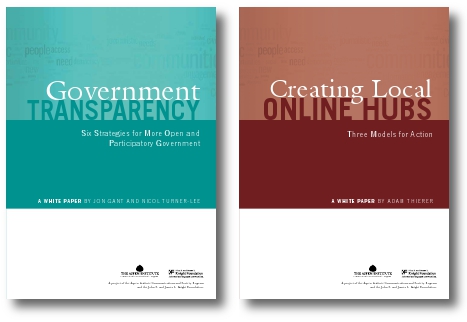
The roundtable focused on the release of two new white papers. The first, “Creating Local Online Hubs: Three Models for Action,” by Adam Thierer, discusses scenarios where community leaders, citizens, media, technologists and — critically, local government — can work together” to create local online hubs where citizens can access information about their governments and local communities.” Creating such high-quality online information hubs was one of the 15 key recommendations of Knight Commission on the Information Needs of Communities in a Democracy. “Just as communities depend on maps of physical space, they should create maps of information flow that enable members of the public to connect to the data and information they want,” said the Knight Commission. (Download PDF or Read Online)

“Governments need to get more information out and make it more accessible, said Thierer today. “This shouldn’t be controversial.” Thierer said that government can do well to catalyze and support this development simply by doing a better job of making such information easily available in easy to use formats. While open government data stores have grown, Thierer noted that this has not trickled down. He cited the example of Manor, Texas as one example of where one local champion (former CIO Dustin Haisler) got help from Stanford and other external resources to get the local open data repository online.

Broadly, Thierer described three models for online hubs:

  • Hubs focused on community government information. Example: Texas Tribune
  • Community connections: local forums and community email listservs. Example: e-democracy.org
  • Community news and commentary. Example: Universal Hub

Thierer focused on the important role that libraries and local or state universities can play in this new ecosystem, by connected offline and online worlds. These universities could create “code toolboxes” that local communities can use, as Stanford did for Manor. He hoped that that model could be replicated nationally.

Government transparency

Government Transparency: Six Strategies for More Open and Participatory Government, by Jon Gant and Nicol Turner-Lee, is call to action for state and local governments to adopt open government. The six sensible strategies “focus on enhancing government expertise and transparency, educating citizens regarding the availability and utility of government information and e-government tools, expanding efforts to support greater adoption of broadband Internet access services and devices, and forging public-private-citizen partnerships in order to enhance open government solutions.” (Download PDF or Read Online)

There are three basic issues here, according to Turner-Lee:

  • Do people get it?
  • Do they have the resources they need?
  • Can they do transparency with those resources?

“All of us who have been in this debate have seen a conflict between these three factors, said Turner-Lee. The question, she said Turner-Lee, is how we empower state and local government. The challenge is that in most open data effort, “We are still in a one-way world, where data is pushed down to the public, not in a reciprocal ecosystem.”

It’s one thing to say citizens who should be involved, said Turner-Lee, but more needs to be done. “As an organizer, I can speak to that. It’s hard to get people to a block meeting,” much less meeting online, she said. There’s also a persistent issue of the digital divide that has to be addressed in this context. “We cannot proclaim government transparency” where millions of people don’t have online access, said Turner-Lee.

There are many examples of where open data is being put to use on the behalf of citizens now. Turner cited apps driven by transit data in Chicago, heritage trees in Portland or the use of 311 by SeeClickFix in the District of Columbia.

Jon Grant focused on a major pain point for government at all levels for tapping into the innovation economy: procurement issues, which civic entrepreneurs run into in cities, statehouses and Washington. “It is time to look at these procurement rules more closely,” he said, and promote higher levels of innovation. “There are a lot of ideas are happening but a lot of rules restrict vendors from interacting in government,” said Grant. Turner-Lee observed that traditional procurement laws may also not be flexible enough to bring more mobile apps into government.

Fundamentally, empowering more government transparency through the Internet will require both creating a climate for the actions, said Turner-Lee, but also through structural changes, specifically, through the release of spectrum and Universal Service Fund (USF) reform.

It will also require that state and local government officials are part of the conversation, “It they aren’t at the table, we’re going to be pretty much talking to ourselves,” said Turner-Lee.

Former San Francisco CIO Chris Vein, now the new White House deputy CTO for government innovation, agreed. biggest challenge of all is that we like to think there are templates. to a certain extent, they can be. fundamentally, all politics is local. To make this work in government, a community “needs someone who takes risks, who goes out there and makes it happen regardlesss of the cost.”

All stakeholder at the panel acknowledged the crucial importance of community institutions, nonprofits and libraries in addressing issues of the digital divide and creating a bridge between online hubs and local citizens. Turner Lee noted that billions of people over the course of years have come into libraries for assistance, particularly the homeless and low-income citizens. “What better way to get people into the system by enabling libraries to be a conduit of information?” she asked.

“Public information belongs to the public, and the public’s business should be done in public,” said Turner. That said, local citizens also don’t want data for the sake of data. “Consumption of this data would be inconsistent if the data doesn’t provide quality of life,” she said.

Knight Commission to release recommendations on open government and online hubs

Tomorrow, the Aspen Institute Communications and Society Program and the John S. and James L. Knight Foundation will release two new white papers that focus on implementing the recommendations of the Knight Commission on the Information Needs of Communities in a Democracy.

The two new white papers—“Government Transparency: Six Strategies for More Open and Participatory Government” by Jon Gant and Nicol Turner-Lee, and “Creating Local Online Hubs: Three Models for Action” by Adam Thierer, recommend steps that government and community leaders should take to increase government transparency and put more information hubs online.

To Aspen Institute will convene a roundtable of public officials, advocates, and watchdogs from national, state and local levels of government (along with this correspondent) tomorrow morning from 9:00 a.m. to 12:00 p.m. EST. See the list of attendees below for specific details.

There will be a live webcast of the event. The Knight Commission is encouraging people to participate online at <a href="http://www.knightcomm.org and on Twitter using #knightcomm hashtag. According to the event organizers, a livestream will begin at 9:00 a.m. (EST) and will be archived. These white papers will be available to read and download Friday morning. Look for links here when they become available.

http://widgets.twimg.com/j/2/widget.js

new TWTR.Widget({
version: 2,
type: ‘search’,
search: ‘knightcomm’,
interval: 6000,
title: ‘New in Knight Commission papers on’,
subject: ‘Government Transparency and Online Hubs’,
width: ‘auto’,
height: 300,
theme: {
shell: {
background: ‘#00278a’,
color: ‘#ffffff’
},
tweets: {
background: ‘#ffffff’,
color: ‘#444444’,
links: ‘#1985b5’
}
},
features: {
scrollbar: false,
loop: true,
live: true,
hashtags: true,
timestamp: true,
avatars: true,
toptweets: true,
behavior: ‘default’
}
}).render().start();

Featured Roundtable Speakers

Dr. Jon Gant, Fellow, Joint Center for Political and Economic Studies, and Associate Professor, Graduate School of Library and Information Science, University of Illinois at Urbana-Champaign. He is a leading scholar in the field of information systems and public administration.

Dr. Nicol Turner-Lee, Vice President and Director of the Media and Technology Institute for the Joint Center for Political and Economic Studies. She has produced path breaking research on broadband adoption among minority and disadvantaged populations and engages city, state and federal legislators on issues in telecommunications, open government and the emerging technology innovation sectors.

Adam Thierer, Senior Research Fellow, Technology Policy Program, Mercatus Center at George Mason University, having previously served as President of the Progress & Freedom Foundation. His work spans technology, media, and Internet and free speech with a focus in online child safety and digital privacy policy issues.

Roundtable participants include:

Gary Bass, Executive Director, OMB Watch
Ben Berkowitz, Founder, SeeClickFix
John Bracken, Directory of Digital Media, John S. and James L. Knight Foundation
Jerry Brito, Senior Research Fellow, George Mason University
Kevin Curry, Co-Founder, CityCamp.com
Lucy Dalglish, Executive Director, Reporters Committee for Freedom of the Press
Charlie Firestone, Executive Director, Communications and Society Program, Aspen Institute
Feather Houstoun, President, William Penn Foundation
Alexander Howarder, Government 2.0 Washington Correspondent, O’Reilly Media
William Kellibrew, IV, Deputy Director, National Coalition on Black Civic Participation
Alex Kreilein, Legislative Assistant, Office of Congresswoman Jane Harman
Ngoan Le, Vice President of Programs, The Chicago Community Trust
Blair Levin, Communications and Society Fellow, Aspen Institute
Philip Neustrom, Founder, Davis Wiki
Steve Pearson, Publisher and Chief Technologist, Project Virginia
Lee Rainie, Director, PEW Internet and American Life Project
Rachel Sterne, Chief Digital Officer, Mayor’s Office of Media & Entertainment, New York City
Daniel Schuman, Policy Counsel, Sunlight Foundation
Nancy Tate, Executive Director, League of Women Voters
Tracy Viselli, Community Manager, ACTion Alexandria
Marijke Visser, Assistant Director, OITP, American Library Association
Eric Wenger, Policy Counsel, US-Legal-Government Affairs, Microsoft Corporation
Harry Wingo, Senior Policy Counsel, Google, Inc.