Today in Washington, President Obama hosted the second annual White House Science Fair. Video of his comments is embedded below, along with a storify of exhibits and students from the day.
“The young people I met today, the young people behind me — you guys inspire me. It’s young people like you that make me so confident that America’s best days are still to come. When you work and study and excel at what you’re doing in math and science, when you compete in something like this, you’re not just trying to win a prize today. You’re getting America in shape to win the future. You’re making sure we have the best, smartest, most skilled workers in the world, so that the jobs and industries of tomorrow take root right here. You’re making sure we’ll always be home to the most creative entrepreneurs, the most advanced science labs and universities. You’re making sure America will win the race to the future.
So as an American, I’m proud of you. As your President, I think we need to make sure your success stories are happening all across our country.
And that’s why when I took office, I called for an all-hands-on-deck approach to science, math, technology and engineering. Let’s train more teachers. Let’s get more kids studying these subjects. Let’s make sure these fields get the respect and attention that they deserve.
…
Now, in a lot of ways, today is a celebration of the new. But the belief that we belong on the cutting edge of innovation — that’s an idea as old as America itself. I mean, we’re a nation of tinkerers and dreamers and believers in a better tomorrow. You think about our Founding Fathers — they were all out there doing experiments — and folks like Benjamin Franklin and Thomas Jefferson, they were constantly curious about the world around them and trying to figure out how can we help shape that environment so that people’s lives are better.
It’s in our DNA. We know that innovation has helped each generation pass down that basic American promise, which is no matter who you are, no matter where you come from, you can make it if you try. So there’s nothing more important than keeping that promise alive for the next generation. There’s no priority I have that’s higher than President — as President than this.
And I can’t think of a better way to spend a morning than with the young people who are here doing their part and creating some unbelievable stuff in the process. So I’m proud of you. I want you to keep up your good work.-President Barack Obama
There are lots of views into engagement on Twitter, but we have the data to give a unique view into what it looks like from the @whitehouse perspective.
We’ve tracked their activity for the last couple years using ThinkUp to analyze and publicly release large datasets. We decided it might be nice show how the White House engaged their audience last year — without resorting to cheap gimmicks like linkbait infographics.
As Baio points out, if you want to work some mojo on this data set, you can download the .CSV file and have some fun. Kudos to the Expert Labs team for making both the open data and visualization available to all.
On Thursday, I joined Edmonton-based social media consultant and digital strategist Walter Schwabe on “Gov 2.0 TV” to talk about what’s new in open government since our last interview.
Over the course of the show, we talked about the following stories:
2011 Gov 2.0 year in review: What Gov 2.0 issue mattered most in 2011? Disruption caused by an increasingly mobile and networked society certainly ranked high. Other key developments included a new Open Government Partnership, emerging civic media, open source adoption, new civic startups, the growth of open data, and fights over intellectual property and Internet freedom.
Yesterday, David Copeland reported at ReadWriteWeb that the GOP tried to replicate the success of the White House’s #40dollars social media campaign on Twitter with their own #1000days effort. As the Chicago Tribune reported, the GOP campaign sought to highlight an inauspicious milestone for the U.S. Senate. 1,000 since it passed a budget. Democrats, who control the Senate, last approved a budget in 2009.
The President addresses America tonight about the State of our Union. Will he ask @SenateDems to pass a budget for first time in #1000days ?
Writes Copeland, “It’s clear that the digitial [sic] media campaigns had different goals, and #1000days was primarily aimed at emphasizing a point that was notably absent in President Obama’s State of the Union address last night. But if social media as it pertains to politics is truly about connecting with voters and constituents, score one for the Democrats.”
In this particular case, I mostly agree. The GOP’s efforts at gop.gov/sotu this year constituted an unprecedented use of the Web and social media by an opposition party to respond to a State of the Union, with smart integration of Twitter and YouTube. Citizens asked questions on the #GOPSOTU hashtag and Members of Congress responded using YouTube. As the Daily Dot reported, the #1000days hashtag has failed to spread beyond the Beltway. From what I’ve seen, the four reasons why #1000days hasn’t resonated in the same way break down into structural, tactical, and strategic issues:
1) Structural issue: Reach. Based upon the statistics I’ve seen, the @WhiteHouse has much more reach than than any single other “governance” account on Twitter. The GOP caucus in Congress, former Massachusetts governor@MittRomney and the @Heritage Foundation do have, in aggregate, an even or greater number of engaged followers. That said, the @BarackObama campaign account, which amplified the #40dollars conversation, has far greater reach, if lower engagement. Both metrics matter, in terms of the ability to involving and focusing more citizens in a given conversation around a #hashtag at a given time.
2) Tactical issue: Timing. The #1000days campaign was launched during the #SOTU, when the attention of politically engaged Americans was fractured between paying attention to the President’s speech itself, watching online (3m+ visits to wh.gov/sotu), reading the media organizations competing to report or fact check on the speech online, watching the TV networks and, of course, talking to one another.
3) Strategic issue: Adaptability. Agreeing upon and passing a budget is a fundamental, basic issue for the operations of any business, organization or government entity. Congress and the Obama administration have cobbled together a series of continuing resolutions and omnibus bills to fund itself over the past 3 years. While many Americans have to make and live by budgets in their personal lives and businesses, however, the #1000days campaign may be both too abstract and too constrained to a single message. The question about #40dollars, by contrast, asked citizens what it means to them, which is concrete, personal and invites creative answers.
4) Tactical issue: Engagement and Amplification. As Copeland reports, “Ahead of last night’s State of the Union address, Sen. John McCain, R-Ariz., GOP presidential candidate Mitt Romney and other Republicans started tweeting using the hashtag #1000days to accent the amount of time since Senate Democrats passed a federal budget.”
On Tuesday night, the top tweets for a search of the #1000days hashtag come from @MittRomney and Republican politicians. Neither Romney nor @SenJohnMcCain had retweeted any followers who have used the hashtag. @SpeakerBoehner has primarily retweeted the @GOPconference or other members of his caucus. The Heritage Foundation has only retweeted its own staff. That pattern is replicated throughout other participating accounts.
The @WhiteHouse, in contrast, continued its practice of resharing tweets from Twitter users who joined the conversation, sharing the voices of citizens with one another, not just other politicians. There’s a good lesson in this successful use to of Twitter that should extend well beyond citizen engagement and open government circles. One campaign amplified the messages of the representatives, the other channeled the voices of constituents responding to their elected issues on on a given issue back through the accounts coordinating the effort.
As I pointed out last year in an article on social media, politics and influence, it’s of note that the operators of the @WhiteHouse Twitter account now routinely natively retweet other accounts participating in #WHchats. While some of these Tweets will leave followers without context for the Tweet, the White House appears to have shifted its online strategy to one of engagement versus the lower risk style broadcasting that most politicians adopt online. To date, many of the president’s political opponents have not followed suit.
The challenges of these four issues look validated by the results to date: some 6,000 tweets per hour for #40dollars at the height of the campaign, as Ed O’Keefe wrote at the Washington Post. Keefe, on a talk on Monday, given by Kori Schulman, White House deputy director for digital strategy, “by 5 p.m., #40dollars was trending worldwide, Schulman said, and the hashtag was generating about 6,000 tweets per hour. At the height of the push, WhiteHouse.gov received about 5,000 responses per hour to the question.” In total, Schulman said the #40dollars campaign “generated 70,000 tweets, 46,000 submissions via the White House Web site, 10,000 related Facebook posts and contributions from 126,000 users.”
This is the kind of innovation that gets me excited. The Green Button is like OAuth for energy data. It is a simple standard that the utilities can implement on one side and web/mobile deveopers can implement on the other side. And the result is a ton of information sharing about energy consumption and in all liklihood energy savings that result from more informed consumers.
The Green Button follows on the success of the Blue Button, a similar initiative that allows veterans to get at their medical data.
I’m a big fan of simplicity and open standards to unleash a lot of innovation. APIs and open data aren’t always simple concepts for end users. Green Buttons and Blue Buttons are pretty simple concepts that most consumers will understand. I’m hoping we soon see Yellow Buttons, Red Buttons, Purple Buttons, and Orange Buttons too.
Let’s get behind these open data initiatives. Let’s build them into our apps. And let’s pressure our hospitals, utilities, and other institutions to support them. I’m going to reach out to ConEd, the utility in NYC, and find out when they are going to add Green Button support to their consumers data. I hope it is soon.
This strikes me as an important data point, endorsement and call to action. Let’s see what happens. After a huge year of changes and progress for Gov 2.0 in 2011, open data looks poised to take off in 2012.
For more about the Green Button initiative, watch the video interview with the nation’s first CTO, below. (Hat tip PG & E.)
The Friday night news dump lives on: at 12:30 AM last night, I received an email from the U.S. House Committee on Oversight and Government Reform: according to the release, Rep. Lamar Smith said he will remove the domain name provision from the Stop Online Piracy Act. Rep. Darrell Issa says he’ll suspend next week’s hearing with Reddit co-founder Alexis Ohanian & other Internet experts. As you may have heard, the United States Congress is considering anti-piracy bills that could cripple Internet industries that are engine of the dynamic economic growth all around the world: the Stop Online Piracy Act (SOPA) in the U.S. House of Representatives and the PROTECT IP Act in the U.S. Senate.
Here’s the release:
House Oversight and Government Reform Committee Chairman Darrell Issa today announced that a hearing scheduled for Wednesday, which was to examine the impact of Domain Name Service (DNS) and search engine blocking on the Internet, has been postponed following assurances that anti-piracy legislation will not move to the House floor this Congress without a consensus.
“While I remain concerned about Senate action on the Protect IP Act, I am confident that flawed legislation will not be taken up by this House. Majority Leader Cantor has assured me that we will continue to work to address outstanding concerns and work to build consensus prior to any anti-piracy legislation coming before the House for a vote,” said Chairman Issa. “The voice of the Internet community has been heard. Much more education for Members of Congress about the workings of the Internet is essential if anti-piracy legislation is to be workable and achieve broad appeal.”
“Earlier tonight, Chairman Smith announced that he will remove the DNS blocking provision from his legislation. Although SOPA, despite the removal of this provision, is still a fundamentally flawed bill, I have decided that postponing the scheduled hearing on DNS blocking with technical experts is the best course of action at this time. Right now, the focus of protecting the Internet needs to be on the Senate where Majority Leader Reid has announced his intention to try to move similar legislation in less than two weeks.” http://www.keepthewebopen.com
This isn’t the end of the news, however: on the same night, this morning, the White House responded to the “We The People” epetition asking the President to veto the Stop Online Piracy Act & PROTECT IP Act. Cybersecurity coordinator Howard Schmidt, US CTO Aneesh Chopra and OMB intellectual property enforcement coordinator Victoria Espinel wrote it. While they don’t address the veto requested in the epetition, the White House did come out strongly against the DNS provisions in the bills.
Any effort to combat online piracy must guard against the risk of online censorship of lawful activity and must not inhibit innovation by our dynamic businesses large and small. Across the globe, the openness of the Internet is increasingly central to innovation in business, government, and society and it must be protected. To minimize this risk, new legislation must be narrowly targeted only at sites beyond the reach of current U.S. law, cover activity clearly prohibited under existing U.S. laws, and be effectively tailored, with strong due process and focused on criminal activity. Any provision covering Internet intermediaries such as online advertising networks, payment processors, or search engines must be transparent and designed to prevent overly broad private rights of action that could encourage unjustified litigation that could discourage startup businesses and innovative firms from growing.
We must avoid creating new cybersecurity risks or disrupting the underlying architecture of the Internet. Proposed laws must not tamper with the technical architecture of the Internet through manipulation of the Domain Name System (DNS), a foundation of Internet security. Our analysis of the DNS filtering provisions in some proposed legislation suggests that they pose a real risk to cybersecurity and yet leave contraband goods and services accessible online. We must avoid legislation that drives users to dangerous, unreliable DNS servers and puts next-generation security policies, such as the deployment of DNSSEC, at risk.
Taken in context with Senator Leahy’s statement on reconsidering DNS (albeit not removing it from the bill) and Rep. Lamar Smith saying he’ll remove a DNS provision from SOPA, one of the major concerns that the tech community appears to have been heard and validated. Read my past coverage of SOPA and PIPA at Radar for these concerns, including links to the bills and a white paper from Internet engineers.
The White House, however, did write that “existing tools are not strong enough” and that they want legislation to move forward. That could well be the OPEN Act supported by Senator Ron Wyden and Rep. Darrell Issa.
The MPAA has also weighed in on the Congressional moves. (PDF. Michael O’Leary, senior executive VP for global policy and external affairs for the MPAA:
“We fully support Chairman Smith in his efforts to protect U.S. workers, businesses and consumers
against online theft. We believe his announcement today regarding the Stop Online Piracy Act and
Senator Leahy’s earlier announcement regarding the PROTECT IP Act will help forge an even
broader consensus for legislative action, and we look forward to working with them and other
interested parties in passing strong legislation utilizing the remaining tools at our disposal to protect
American jobs and creativity. We continue to believe that DNS filtering is an important tool, already
used in numerous countries internationally to protect consumers and the intellectual property of
businesses with targeted filters for rogue sites. We are confident that any close examination of DNS
screening will demonstrate that contrary to the claims of some critics, it will not break the Internet.”
Gary Price, who forwarded the MPAA response, also notes that “on Thursday, the Library of Congress named a new Director of Communications. She starts at the end of this month. She was key in the founding of the Pro-SOPA Copyright Alliance and
also worked for the MPAA.
We’ll be seeing reactions to this all weekend. I’ll link to the best of them tomorrow from this story. For now, a couple of things seems clear:
1) The technical concerns of the Internet community appear to have been heard. It’s also likely that the federal government’s own cybersecurity experts, including Sandia Labs and Schmidt himself, influenced Congressional actions here. Senator Leahy, however, has not committed to remove DNS provisions entirely from PIPA, only to research them upon passage. That’s likely to be unsatisfactory to many concerned with the bills. “Trust us” to study it after passage is a tough sell.
2) The White House is supporting the arguments that online piracy is a a “real problem that harms the American economy, and threatens jobs for significant numbers of middle class workers.” That statement should have been supported with more evidence from the government’s research institutions.
3) The response from the White House has to be considered an open government win, with respect to an epetition resulting in a statement from the top IT officials in the country. That said, posting it on a Friday night Saturday morning, as opposed to a response from the President during his Friday news conference, buried* diminished the impact of the news and muted its political impact.
4) Most American citizens oppose government involvement in blocking access to content online, particularly when the word “censor” is accurately applied. When asked if ISPs, social media sites and search engines should block access — as they would under SOPA — only a third of Americans agree.
The White House stated that “we will not support legislation that reduces freedom of expression, increases cybersecurity risk, or undermines the dynamic, innovative global Internet.”
It will be up to the American people to hold them accountable for the commitment.
This pretty clearly pits the Obama Administration against SOPA/PIPA. It also calls for more open and honest discussion about these bills and the problems they seek to address. Since there has been almost no discussion or debate until very recently on the legislation in question, this is a very welcome development.
I admit that while I’m pretty glad to see the administration come out with this sort of in-depth statement on the matter, I have a hard time trusting the president on these issues. His veto pen notably did not come out to quash the NDAA – a bill he vowed at one point to not let past his desk.
Then again, internet regulations may have wide, bipartisan support but still nowhere near the support that a defense funding bill has. Obama may have seen a political fight he couldn’t win, read the writing on the wall, and backed off of the NDAA rather than suffer a blow right before an election. The same does not apply to SOPA/PIPA.
So an executive veto on these bills seems much more likely, though at this point – with various congressmen starting to speak out, lots of companies threatening blackouts of their websites – including Wikipedia and Reddit – we may see the momentum behind these bills grind to a halt. The White House statement on the matter will only help push the conversation in congress. That’s a good thing.
It increasingly looks like the SOPA/Protect IP fights are turning into an example of how the political system sometimes does work correctly after all. The con forces on these bills initially looked numerically overwhelmed in congress and hugely outspent. But opponents really mobilized vocally, got people and institutions who don’t normally focus on politics to write about this, and perhaps most important of all demonstrated that more people genuinely cared about this issue than most members of congress initially realized. Now the momentum has slowed incredibly and the White House technology policy team has come out against these bills.
To look a gift horse in the mouth for a second, however, I note that the White House statement does contain a “reasonable” to-be-sure line stating that “online piracy is a real problem that harms the American economy, and threatens jobs for significant numbers of middle class workers and hurts some of our nation’s most creative and innovative companies and entrepreneurs.”
Without the DNS provision, SOPA now looks a great deal more like the OPEN Act, a bill introduced by Rep. Darrell Issa (R-Calif.) and Sen. Ron Wyden (D-Ore.), which was designed to be an alternative to SOPA. A watered-down SOPA means Smith improves his chances of getting the bill through Congress but at this point, nothing is assured.
Late today came word that six Republican senators have asked Majority Leader Harry Reid to postpone a vote on Pro IP, also known as PIPA. The senators wrote: “Prior to committee action, some members expressed substantive concerns about the bill, and there was a commitment to resolve them prior to floor consideration.”
Leahy issued a statement which appears to be a reply to the request by those senators. He argued that the PIPA vote should go ahead as planned.
“Saying no to debating the [Pro IP Act] hurts the economy,” Leahy wrote. “It says no to the American workers whose livelihoods depend on intellectual property-reliant businesses. And it says yes to the criminals hiding overseas stealing American intellectual property…all Senators should agree that this is a debate we must have…and should support cloture on the motion to proceed on January 24.”
It sounds as if Leahy is trying to keep some of the bill’s supporters from bolting. There’s little question now that some SOPA and PIPA backers in Congress are in retreat and seeking some kind of compromise in the face of significant opposition.
After repeatedly insisting that establishing a national censoring firewall with DNS-blocking was critical to the Stop Online Piracy Act, the bill’s sponsor (and chair of the House Judicial Committee) Rep Lamar Smith has blinked. He’s agreed to cut DNS-blocking from the bill, in the face of a threat from rival Rep Darrell Issa, whose House Oversight and Government Reform Committee was preparing to hear expert testimony on the harm that this provision would do to national security and the Internet’s robustness against fraud and worse.
Even without its DNS provisions, SOPA remains terminally flawed, creating a regime that would be terminally hostile to any site that contains links and any site that allows the public to post comments on it. But attention has shifted to PIPA, the Senate version of the bill, which is nearly as bad, and which is rocketing towards an imminent vote.
Combine all those concerns, and the statement is a fairly sweeping condemnation of SOPA and PIPA in their current form. Espinel and her colleagues appear to have left enough wiggle room in the statement to allow the president to sign a future version of the bill that addresses some, but not all, of the critics’ concerns. But the bill’s sponsors are now going to have to work hard to satisfy critics and build a consensus in favor of passage.
I found myself profoundly disturbed by something that seems to me to go to the root of the problem in Washington: the failure to correctly diagnose the problem we are trying to solve, but instead to accept, seemingly uncritically, the claims of various interest groups. The offending paragraph is as follows:
“Let us be clear—online piracy is a real problem that harms the American economy, and threatens jobs for significant numbers of middle class workers and hurts some of our nation’s most creative and innovative companies and entrepreneurs. It harms everyone from struggling artists to production crews, and from startup social media companies to large movie studios. While we are strongly committed to the vigorous enforcement of intellectual property rights, existing tools are not strong enough to root out the worst online pirates beyond our borders.”
In the entire discussion, I’ve seen no discussion of credible evidence of this economic harm. There’s no question in my mind that piracy exists, that people around the world are enjoying creative content without paying for it, and even that some criminals are profiting by redistributing it. But is there actual economic harm?
In my experience at O’Reilly, the losses due to piracy are far outweighed by the benefits of the free flow of information, which makes the world richer, and develops new markets for legitimate content. Most of the people who are downloading unauthorized copies of O’Reilly books would never have paid us for them anyway; meanwhile, hundreds of thousands of others are buying content from us, many of them in countries that we were never able to do business with when our products were not available in digital form.
History shows us, again and again, that frontiers are lawless places, but that as they get richer and more settled, they join in the rule of law. American publishing, now the largest publishing industry in the world, began with piracy. (I have a post coming on that subject on Monday.)
Congress (and the White House) need to spend time thinking hard about how best to grow our economy – and that means being careful not to close off the frontier, or to harm those trying to settle it, in order to protect those who want to remain safe at home. British publishers could have come to America in the 19th century; they chose not to, and as a result, we grew our own indigenous publishing industry, which relied at first, in no small part, on pirating British and European works.
If the goal is really to support jobs and the American economy, internet “protectionism” is not the way to do it.
*The White House emailed me later in the morning to point out that the epetition response was posted on Saturday morning.
While neither of those stories are good data points for the state of open government at the federal level, they are both part of a much larger narrative where some 40 countries (including the founding 8 members) have reportedly now submitted letters of intent to join this unprecedented international open government partnership.
Next Tuesday, I’ll be in New York on the same day that President Obama introduces the U.S. National Plan for open government as part of its commitment to the Open Government Partnership As John Wonderlich observed at the Sunlight Foundation on Friday, preparing for the U.S. National Plan and then delivering upon whatever is contains will be a “complex, ongoing effort that takes dedicated effort and attention,” adding to the progress towards a more transparent, participatory, collaborative or innovative government made to date.
The report, which I’ve embedded below, was released through a blog post at Whitehouse.gov by Steven Croley, special assistant and senior counsel to the President:
President Obama has made open government a high priority. Greater openness renders our government more efficient and effective. It strengthens our democracy. It improves our citizens’ lives.
To these ends, the Administration has taken many substantial steps to promote increased participation and collaboration in government, and to make government more transparent. For example, federal agencies have increased transparency through redoubled efforts to disclose more information under the Freedom of Information Act. They have implemented ambitious Open Government Plans, and made voluminous data newly available to the public. The Administration has also made spending information more transparent, and taken steps to disclose previously sensitive government information.
Of course, creating a more open government requires sustained effort. How best to harness new technologies in the service of open government, to strike the proper balance between transparency and the protection of national security and personal privacy, to change agency culture so that openness becomes the new normal–such issues require long-term commitment.
But it is useful to take stock of the Administration’s accomplishments along the way. Accordingly, today the White House is releasing The Obama Administration’s Commitment to Open Government: A Status Report (pdf). This status report highlights the breadth of the Administration’s commitment to open government, documents the substantial progress made on many of the Administration’s open government initiatives, and anticipates continued progress. Although not an exhaustive compilation of our open government efforts, thi provides a compelling picture of how far the Administration has already come towards forging a more open government.
The 34-page report is a highlight reel of everything the administration has accomplished on open government, claiming victories in increased agency responsiveness to Freedom of Information Act requests, the release of government data online, and better communication using web tools. It comes as the Obama administration prepares to make good on a challenge the president himself issued at last year’s convening of the U.N. General Assembly to return there this month with concrete steps to make governments more open, participatory and collaborative.
“We are pleased to see the Administration undertaking this kind of review because it gives us an all opportunity to reflect on what goals have been met and what challenges we agree remain,” wrote Patrice McDermott, director of Open the Government, in a post at OpenTheGovernment.org. “We hope our advocacy and the Administration’s actions will result in an even more impressive report in the future.”
With We the People,” the White House has added a new page to WhiteHouse.gov and has announced a potentially disruptive feature for an American public that increasingly turning online for government information and political action: online petitions.
“When I ran for this office, I pledged to make government more open and accountable to its citizens,” reads a statement by President Barack Obama at WhiteHouse.gov. “That’s what the new We the People feature on WhiteHouse.gov is all about – giving Americans a direct line to the White House on the issues and concerns that matter most to them.”
There’s a big idea embedded in this launch, going back to the original compact between the American people and its government. The First Amendment of United States Constitution gives citizens the right to petition their government. In the 21st century, the Internet provides a new means for such petitions to be made.
“With We the People, we’re offering a new way to submit an online petition on a range of issues — and get an official response,” writes Macon Phillips, White House director of digital in a WhiteHouse.gov blog post announcing We the People.
He explains more in the video embedded below and invites people to sign up for email updates when We The People goes live.
Citizens can create or sign e-petitions on a “range of issues” — it’s not clear yet whether citizens can define their own issues or will have to choose from a list.
If an e-petition gathers more than 5,000 signatures in 30 days, White House officials will review and answer it.
Initially, an e-petition will have a unique URL that only its creator knows. “It’s up to that person to share it in their network to gather an initial amount of signatures — initially 150 — before it is searchable on WhiteHouse.gov. ” It’s not clear what a “network” means but it likely refers to Twitter or Facebook, like the way act.ly works.
There are still many questions that remain in terms of how this is going to work or how it’s going to fit into a 21st century e-democracy. As Phillips recognized, the United States isn’t the first to try this: the United Kingdom offers e-petitions, and according to Phillips, “this work was very helpful as we developed our own.”
The sticky e-widget there is that the UK dropped e-petitions late last year as the new prime minister came into office, due to negative publicity and other issues. Reasonably, we can expect there to be similar challenges with the White House version. The UK has since relaunched its e-petitions site, as Phillips points out, and sharedplans to release the e-petitions code on Github.While it’s not clear yet who built the White House version, it’s possible that they used this code, given the support for open source that Philips has demonstrated over the past three years. The White House built the system in house, according to Phillips.
The initial response online ranges from celebration, including a “high five from PopVox,” to extreme skepticism.
Open government godfather Carl Malamud the long view: “Nice job on We The People,” he tweeted. “Treading in the footsteps of the Founders, petitions have a long and honorable history in our republic!”
“What difference do they make?” tweeted FutureGov Dominic Campbell. “None. Just a distraction technique to pacify the masses. Need new politics not gimmicks. Backbenchers are generally as influential over govt policy as my gran. And she’s dead. Petition / precise tech tool is irrelevant, it’s all about political culture. Petitions are lame. All power is in the hands of govt. Not game changing. More make u feel better/doing *something*.” While the UK petitions have come back, “You’d be hard pushed to find anyone in UK speak +vely of them. Waste of space… think they just reinforce status quo and reward loudest/best organised. Not democracy. ”
Former Sunlight Foundationer Jake Brewer dug into some of the structural issues that exist with this approach. The “only reason “We the People” would [be] useful vs other tools is if @WhiteHouse can convince all they are listening & meaningfully responding,” he tweeted.
“It strikes me though that “giving people a voice” is not at all the problem in gov. Many ways to talk AT gov. Few ways to do so usefully.We simply don’t need more ways to send petitions or gather ideas. We need better ways to listen & operationalize good ideas. What will be an agency’s incentive to take any action based on a petition? Will Whitehouse pressure? Petitions to Congress (theoretically) work because Reps want to be responsive/re-elected. Exec not the same, so how to handle? Guess I’m having a hard time seeing “We the People” as anything more than gov 2.0 theater, and I’d like to be wrong. We simply don’t need more ways to send petitions or gather ideas. We need better ways to listen and operationalize good ideas.”
Questions for We the People
The White House is taking questions on We the People using the feedback form at White House.gov and on Twitter, using the hashtag #WHWeb, where Phillips is listening as @macon44.
Why do petitions at all?“Online petitions are commonly understood, and petitions have been part of our democracy since the beginning,” he tweeted.
When asked by Nancy Scola whether the thinking with We the People is to “have @whitehouse act as [a] clearinghouse for petitions directed towards agencies,” Phillips replied: “People shouldn’t have to decipher how the executive branch is organized in order to speak out about an issue. Processing incoming petitions handled by WH, but relevant petitions will be coordinated w/others as needed, including Agencies.”
In response to a question by @abc4all, Phillips tweeted that “participation in We the People is open to the general public (13yrs+) & requires a valid email address.”
When Alex Rose asked if “WH have a profile of citizens based on petitions we support on We the People? Who can access aggregated data?,” Phillips replied that “only a small group of wh staff will have access to administrative data We the People will be subject to a public privacy policy.”
Here are the questions I’ve tweeted out and their answers:
Who built the e-petitions function? Is it the the same code as the UK tool?
Answer: “System design and development of We the People was developed in house,” tweeted Phillips.
How will identity be handled? How will the White House authenticate citizens to e-petitions government?
Answer: “Lightweight – participation will require an email verification step,” tweeted Phillips. “For now we are using first party WH accounts that verify an email address. Plan to incorporate NSTIC rec’s in future http://1.usa.gov/p7n8HR ”
Do you have to be a citizen?
Answer: “Right now the system only requires valid email and does not verify citizenship,” tweeted Phillips.
How will social media be integrated?
Answer: “when you create a petition you get a unique link. How you share that is up to you. Will have @facebook & @twitter share [buttons],” tweeted Phillips. yes, just like other content on wh.gov
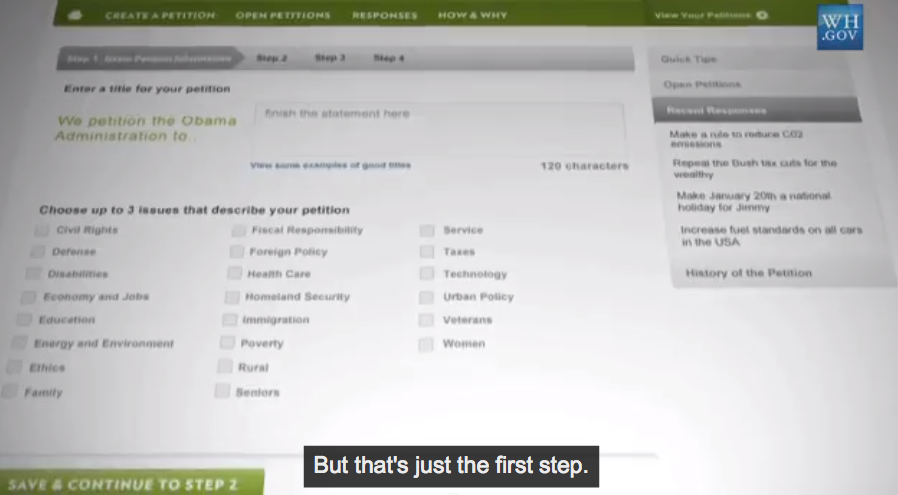
Can citizens ask questions using We The People on whatever topic they wish or will these be predefined? The screenshot below implies the latter categorization: taxonomy, not folksonomy.
Answer: “there will be a defined set of topic people can choose from but its a wide range, and there will also be ad hoc tags,” tweeted Phillips.
Will there be an API so that civic developers can visualize and analyze them to see if there are duplicates or emerging themes?
Answer: “Not now; API’s for analysis & extending petition functionality on a long list of features we we are considering for future. With [federal CIO] Steve upstairs now, thinking through how that can best work is both a priority & more informed.”
Why build this when services like PopVox, Votizen and Change exist to create social e-petitions?
Answer: “Developing We the People ourselves […] offers the flexibility to adapt to the public response to improve engagement,” tweeted Phillips. “It’s a false choice to say _either_ We the People _or_ others – there’s lots of collaboration ahead, this space is still young.”
There’s another key detail: these e-petitions would go to the executive branch, whereas Votizen and PopVox are targeted at Congress and constituent communications.
The creator of act.ly, Jim Gilliam, offered some of his own perspective and questions. “I built a petition/priority tool White House 2 back in 2008. I learned a lot, happy to share,” he tweeted to Phillips, linking to his post on White House 2.0. On this count, the White House was listening: Phillips asked Gilliam to “dm him his email address.” Here’s a look back at “imagining White House 2.0” from the 2009 Personal Democracy Forum:
“I figured out all the problems, except for one. getting the white house to pay attention. (or maybe it just took 3yrs),” tweeted Gilliam.
He highlighted two issues, one for advocates and one for White House technologists: “”How will the white house use all the email addresses it collects with new petition tool? Advocacy groups will have to decide whether to send their people to whitehouse.gov at the expense of their own list building,” he tweeted. “White house will need some serious anti-spam jujitsu to knock back the tools that scrape congressional forms.”
Perhaps most important, how will citizens know that they’re being heard by the White House, that these e-petitions matter, and that this will not be a public relations exercise that ends with a thank you letter from staff?
This goes to the issue of connecting e-petition action to results. “OpenGov has the equivalent of a “last mile” problem: a culture+digital-infrastructure gap at the workgroup level,” tweeted Dan Latorre, leader of Digital Placemaking and creator ofFixCity.org.
For instance, if enough people sign e-petitions on withdrawing from Afghanistan, supporting gay marriage, legalizing marijuana or opposing ICE takedowns of websites without judicial review, will the White House change its policy?
Stay tuned for answers [See above] and upon launch, outcomes.
A 3D map of the earthquake from DC-based DevelopmentSeed, embedded below, visualizes the intensity of the tremblor.
Thankfully, today’s earthquake does not appear to have caused any deaths nor collapsed buildings or bridges, although the National Cathedral sustained what officials call “substantial earthquake damage.” Longer term earthquake damage in DC will take time to assess. Eric Wemple has a comprehensive assessment of earthquake coverage that includes links to more logistical details and assessments, if you’re interested.
He also highlighted a critical resource for an increasingly mobile citizenry, m.fema.gov/earthquake, and hurricanes.gov, which will be an important source of information as Hurricane Irene moves up the coast.
While both DC residents and people across the United States took the opportunity to joke about the quake using Twitter, a more sobering reality emerged as residents found themselves unable to make phone calls over overloaded cellphone networks: social networks offered an important alternate channel to connect with friends, family and coworkers. In the context of overloaded networks, the Department of Homeland Security offered earthquake advice: don’t call. In fact, DHS urged urged citizens to use social media to contact one another. The White House amplified that message:
Citizens didn’t need much urging to turn to social networks after the quake. According to
Facebook hosts conversation with Red Cross on social media in emergencies
The day after the earthquake, in what turns out to be an unusually good scheduling choice, Facebook DC is hosting a conversation with the Red Cross on the use of social media in emergencies. As a new infographic from the Red Cross, embedded below, makes clear, the importance of emergency social data has grown over the past year.



 Favorite
 Retweet
 Reply
Reply
 E Pluribus Unum