Can open government be embedded?

This morning, the White House posted President Obama’s long form birth certificate to the public. Now that the White House has released the president’s long form birth certificate to the media (and directly over Twitter to everyone) I hope that the country can move on to the much greater issues that confront the country and humanity as a whole.

Honestly, it was much cooler to watch Mr. Obama speak live using the White House iPhone application than to see the President of the United States take time to debunk the issue that has been settled for years. His remarks are embedded below:

It’s also worth noting the evolution of the White House’s new media strategy, where a government document was not only released directly to the American people as a PDF over social networks but was uploaded to Slideshare where it can be embedded on other webpages to be spread even further, as I have done below.

The White House is not alone in using SlideShare to create embeddable documents. The Congressional Budget OfficeDepartment of EnergyU.S. Environmental Protection Agency and U.S. National Library of Medicine are sharing information there as well. The military has created channels there too, including the Department of Defense and the U.S. Navy.

To be clear, releasing documents online in of itself is not nor will ever be a full measure of government transparency. Open government is a mindset, not just a matter of adopting new tools. For open government to endure in an era of budget austerity, it will need to be baked in to how government operates, with a clear connection to how it helps deliver on the mission of agencies and officials.

That said, creating online channels with embeddable content is taking more than a few steps forward from paper memos dropped into file cabinets or proclamation read over the radio.

Here’s to moving forward to work on the stuff that matters.

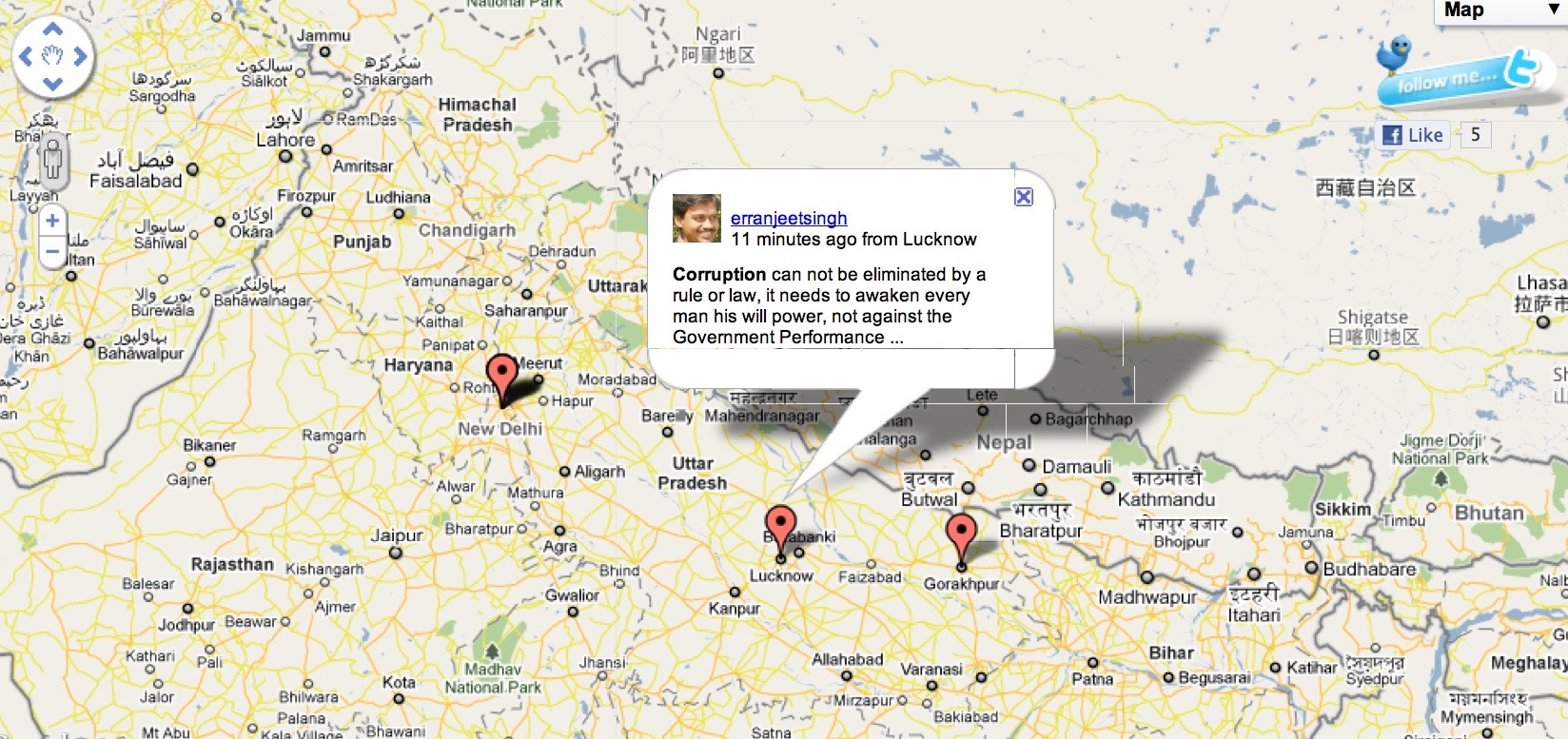
Mapping corruption tweets in real-time in India [MASHUP]

Transparency has gone global. Today, there’s a mashup of corruption-related tweets in India and Google Maps to explore.

Add an expanding number of data points in how Gov 2.0 and open government are taking root in India.

Hat tip to Andrew McLaughlin.

FCC.gov 2.0 Preview: FCC launches FCC.us URL shortener

FCC Data Center

FCC Data Center

Later this week, a new version of FCC.gov will go live. It’s a complete redesign of the Federal Communications Online presence. You could even call it a reboot, in keeping with the FCC launch of reboot.gov last January.

There’s much more to report on when the new FCC.gov goes online. For now, here’s a preview of something nifty that’s already live: the new FCC custom URL shortener, FCC.us.

The new custom URL shortener, is based upon bit.ly, like the 1.usa.gov URL shortener for civilian use. It automatically shortens any FCC.gov that’s shortened using bit.ly or the shorter j.mp. For instance, FCC.gov/developer becomes http://fcc.us/bkJYlG. In a new media world that is often shortened to 140 characters, that’s rather handy.

More to come soon.

At the @NASATweetup, @Astro_Wheels shares the view from space

http://storify.com/digiphile/nasa-tweetup-with-astrowheels-shares-the-view-from.js

Talking about crisis data, social media and GIS on Federal News Radio

American Red Cross Conference On Use Of Intern...

Image by ShashiBellamkonda via Flickr

Earlier this week, the O’Reilly Radar published a new article about how the Red Cross and the Los Angeles Fire Department integrate social tools into crisis response. This afternoon, I talked with Federal News Radio‘s anchor Chris Dorobek about crisis data for the Dorobek Insider:

Have a crisis? Don’t worry, there’s an app for that.

With the emergence of social media tools, emergency responders have been forced to integrate social media into their crisis response.

During the Gulf Coast oil spill last year, the Coast Guard launched an app where you could actually track the oil. Now the Red Cross and the Los Angeles Fire Department are using Twitter and Facebook in their emergency response.

If you’re in the Washington, D.C. listening area, our interview was on at 4:05 and will be rebroadcast at 6:05 PM EST. For online listeners (that’s you, dear reader) you can listen to the show on crisis data here.

Enhanced by Zemanta

USA.gov adds 1.USA.gov URL shortener for civilian use

Last year, the United States General Services Administration (GSA) launched the Go.USA.gov URL shortener at the Gov 2.0 Expo in Washington, D.C. Today, USA.gov soft-launched a way for citizens to create shortened USA.gov URLs as well. Whenever someone uses Bit.ly (or any service that uses Bit.ly, like Tweetdeck or the Twitter app for iPhone) to shorten a .gov or .mil URL, the link will be converted to a short 1.USA.gov.

For those feeling a bit dizzied by acronyms, URL stands for “uniform resource locator.” A URL is the Web address, like, say, govfresh.com, that a citizen types into a Web browser to go to a site. Many URLs are long, which makes sharing them on Twitter or other mobile platforms awkward. As a result, many people share shortened versions. One of the challenges that face users is that, unless a citizen uses one of several tools to view what the actual hyperlink is below the link, he or she might be led astray or exposed to malicious code that was included in the original link.

This new service will make it easier for people to know when a short URL will direct them to a trustworthy official U.S. government site. “The whole idea is to improve people’s experience when dealing with government information online,” said Jed Sundwall, a contractor for USA.gov and GobiernoUSA.gov. “We keep USA.gov in the domain for usability reasons. It’s crystal clear, worldwide, that 1.USA.gov URLs point to trustworthy governmentt information.” Adriel Hampton talked with Jed Sundwall about Go.USA.gov on Gov 2.0 Radio last year. For more on how Go.USA.gov URLs work, watch Michele Chronister’s presentation from the last year’s Gov 2.0 Expo, below:

The new shortener began appearing online this Friday. According to Sundwall, ABC senior White House correspondent Jake Tapper was the first to use it when he linked to a PDF containing new unemployment information at the Bureau of Labor and Statistics: “For those asking follow-ups on unemployment, here’s the BLS link http://1.usa.gov/XUtpL

Tapper is not alone, as many others have used the 1.USA.gov URL shortener simply by using the tools there already knew. “The beauty is that Jake used it without knowing he was using it,” said Sundwall. “We’re trying making it easy for anyone to identify .gov information as it’s being shared online,” said Sundwall.

<

1.USA.gov FAQ

Following are the GSA’s answers to frequently asked questions about 1.USA.gov.

Why did we use 1.USA.gov when go.gov or 1.us.gov would be shorter?
Including USA.gov in the shortened URLs makes them more intuitive and meaningful to users worldwide. Many Internet users may not realize that .gov is the exclusive top-level domain of the U.S. government, and USA.gov adds valuable context to the short URLs.

What if I don’t want a 1.USA.gov URL?

You can replace 1.USA.gov with bit.ly or j.mp. For example 1.USA.gov/12345 will go to the same place as j.mp/12345 or bit.ly/12345.

Is Bit.ly owned by the Libyan government?

No. Bit.ly (@bitly is an American-owned company based in New York City. While .ly is the top level Internet domain assigned to Libya, this does not mean that Libya has any stake at all in Bit.ly, the ability to access Bit.ly’s data, or the ability to control Bit.ly’s servers. On the Quora website, Bit.ly’s CEO has addressed what would happen to Bit.ly if Libya were to shut off Internet access in Libya. Regardless, we use .gov URLs, and none of the servers that power this service (or any of Bit.ly’s servers) are located in Libya.

Who uses a similar service with Bit.ly?

C-SPAN: http://cs.pn
NY Times: http://nyti.ms
NPR: http://n.pr
Facebook: http://fb.me
Pepsi: http://pep.si
Economist: http://econ.st

What does this mean for Go.USA.gov?

We will still maintain Go.USA.gov as an option for government employees to use as a URL shortener, and Go.USA.gov URLs will continue to work.

Correction: an earlier version of this story referred to the new shortener as 1.GO.USA.gov, as opposed to the shorter version. We regret the error.

Question Time 2.0: GOP Leader on Quora, Rep. John Garamendi on Reddit

Last month, Matt Lira, a member of House GOP Leader Eric Cantor’s staff, asked how the United States Congress should use social media to enhance the legislative process on Quora, the hot question and answer website of the moment. To date, he’s received 19 answers, many quite substantive.

Today, Representative John Garamendi (D-CA) asked the Reddit community for “as many questions as he could get through” when he returned to the page at 8 PM tonight.

My name is John Garamendi, and I am a Member of Congress representing the 10th Congressional District in Northern California. Ask Me Anything. I will be back at 8 PM EST/5 PM PST today (Wednesday, March 2) to answer as many questions as I can get through.

I previously served as California Lieutenant Governor, California Insurance Commissioner, Deputy Secretary of the U.S. Interior Department under President Clinton, a state legislator, and a Returned Peace Corps Volunteer.

Garameni offered his House.gov website, YouTube channel and @RepGaramendi Twitter handle and Facebook page for Redditors to find him. When a member of the community expressed skepticism that it was “really him,” he tweeted that “Today I will join @reddit at 8PM EST for an #AMA Ask Me Anything. Thread will appear here: http://www.reddit.com/r/IAmA.”

As of 6:40 PM EST, there were more than 1400 comments on the thread, with many substantive questions voted to the top. The online public will see how frank he’s willing to be in that context.

Whether this is a success or not, it’s good to see representatives exploring new platforms for participatory democracy. They may be far from perfect but the moderation mechanisms on Reddit and Quora, along with their associated communities, hint at the ways that the next generation of e-democracy platforms will evolve. Tune in at 8 PM EST to see if Representative Garamendi takes the top questions on the forum.

UPDATE: The Congressman did, in fact, log in to Reddit and answered questions for nearly an hour. Here’s the the top-voted question, by “anexanhume”:

John,
I am curious as to whether or not you believe that it is possible to be a politician that reaches any major political office (say for instance, state legislator or large city mayor as the least important office) without owing either a person, political organization or corporation some sort of favor for reaching your office. Moreover, is it ever actually possible to vote on your principles consistently without the fear of losing reelection or angering someone who helped you get where you are?

Representative Garamendi answered:

Thank you for the question. It’s a good one. I believe I vote consistently with my principles. Obviously there are some political interests who align with me more than others, and that will be somewhat reflected in whom they choose to support. And like everyone, there are personal opinions about individuals that I sometimes keep to myself for the sake of congeniality and relationships.

So the answer to your question is I honestly don’t think I “owe” any group my allegiance. I’ve been in public policy enough that I doubt there’s a single group left in America that has given me a 100% report card every year I’ve been in office.
Ultimately, public policy is about choices and compromise. When I’m on the House floor, after all the debate is done, after all the deals have been struck, I’m left with a choice: Yes or No. This means I’ve voted for bills that had elements I didn’t like (I was disappointed the public option wasn’t in the Patient’s Bill of Rights for example) and voted against bills that had some good policy (I voted against tax cuts for millionaires and billionaires even though the bill contained an important extension of assistance for people looking for work). It’s clichéd at this point, but we shouldn’t let the perfect be the enemy of the good.

He answered two anonymous questions as well: Do you think a representative is elected to execute his own moral compass? Do you think a representative is elected to reflect the opinion of the constituency?

Good questions without an easy answer, but I’ll try. I fight tirelessly for the people of the 10th Congressional District, and luckily, priorities like transportation investments, job creation, Delta protection, health care access, fighting for veterans, ending the war in Afghanistan, and equal rights are both popular in the district and at the core of my policy goals.

My constituents have chosen me to be their voice in Washington, and that literally means making hundreds of decisions every week. I don’t expect anyone to agree with every decision, and there are times when I have access to more information than the public. Have I taken positions that a majority of my constituents disagree with at one point or another? Probably, but that’s the beauty of democracy. Every two years, the people have a chance to reevaluate who they’ve chosen to represent them.

There’s more on the Reddit thread, including answers on the budget, unions, entitlement reform, the financial crisis and more.

Apps for Amsterdam catalyzes civic hacking in Netherlands

Application contests, data camps and hackathons are showing how civic coding can put open government data to work. In the Netherlands, Apps for Amsterdam has launched to try catalyze the development of software that puts the city’s open data to work. If you’re interested in open government in the Netherlands, here’s your chance to hack the government – for good.

The new competition is backed by the Waag Society, the city of Amsterdam and Public Hack. There’s an upcoming open data hackathon in Amsterdam on March 12th, for those interested. Below is an account of the launch curated by Rolf Kleef using Storify:

http://storify.com/rolfkleef/apps-for-amsterdam.js

Crowdsourcing where to put QR codes in NYC

This February, New York City adopted QR codes in a significant way. “QR” stands for “quick response” codes. QR codes enable somebody with the appropriate software and hardware to quickly scan a code for information from any direction. As TechCrunch reported, NYC will put QR codes on all of its building permits.

The QR codes will link users to a mobile version of the Department of Buildings Information System, and will give them the option to click a link that will initiate a phone call to the city’s 311 phone service, where they can register a complaint about noise, safety or other concerns.

As permits at 975,000 building and construction sites that already have them are replaced, they will have QR codes added; all New York City permits are expected to have QR codes by roughly 2013.

QR Code on Love ArtPhoto illustration by Zachary M. Seward based on a photo by Chris Goldberg

QR codes can be scanned by smartphones equipped with relevant software in much the same way that a handheld scanner can scan the more familiar horizontal barcodes used globally in shipping and retail industries. Their use is hardly limited to building permits, however, as Zach Seward pointed out at the Wall Street Journal:

In 2011, you’re likely to see more QR codes on billboards, print publications, museum placards — anywhere with limited space and lots of information to convey. On city building permits, scanning the QR code will direct you to a website with more information about the construction project, if you’re into that.

But the New Yorkers who responded to Sterne are more excited about the prospect of applying QR codes to the city’s public-transit system. One  common suggestion: place them at bus stops, where schedules aren’t always displayed and are often out of date.

So where should New York City place QR codes? As Seward reported, New York City’s chief digital officer, Rachel Sterne, is looking for ideas. Seward captured her questions and the responses of citizens (including this correspondent) using Storify:

http://storify.com/zseward/qr-codes-in-new-york-city.js[View the story “QR codes in New York City” on Storify]

Congress faces challenges in identifying constituents using social media

Citizens are becoming more influential through social networks and influencing their peers. Research from the The Pew Research Center’s Internet & American Life Project suggests that government 2.0 an important trend, with respect to our understanding of what it means to be a citizen and how our actions influence those of our fellow citizens. The role of the Internet as a platform for collective action is growing but the authorities that control the levers of power offline still matters immensely.

Today, Politico reported that social media isn’t so hot on the Hill. Or, as FierceGovernmentIT.com reported, “Congress is using social media to talk, not listen.” Both media outlets were reporting on survey results conducted by the Congressional Management Foundation on perceptions of citizen advocacy by Congressional staffers.

A better headline, however, might have been “Twitter isn’t so hot on the hill with lawmakers,” given myriad challenges around identifying constituents online, automated campaigns and what Representative Culberson (R-TX) described as a “lot of trolls on Twitter.” (It’s even worse on YouTube, Congressman.) The question posed at the end of the Politico article — “Are lawmakers putting too much time — or staff resources — into social media?” is followed with Pew stats on *Twitter* use and penetration, not Facebook.

The complaints from numerous anonymous Congressional staffers about the time it takes to maintain social media are likely honest and parallel the experiences of higher-paid contemporaries in private industry, academia, media, fashion and the nonprofit worlds. Managing multiple social media presences can, indeed, be a pain in the a–. And it takes resources, in terms of time, that may be scarcer than ever. That said, social media is now part of the lexicon of Congressional staff trusted with constituent communications. If a Representative or Senator is speaking anywhere in DC, there’s an increasingly good chance that snippets of it may tweeted, unusual pictures will be tagged on Facebook and that any gaffes will be up on YouTube later.

Doing more than trying to fit the 20th century model of broadcasting to these platform requires time, expertise and commitment, along with a thick skin. Opening up these new online channels for Congressional communications created challenges, to be sure, but then so did adding the telegraph, radio, television, fax machines, cellphones and email. It’s not hard to find past news reports of Senators resisting the addition of dial phones to the Hill.

Every new communications technology has had an impact on Congress. In 2011, Twitter, Facebook and YouTube do each come with new wrinkles. YouTube and Twitter can work in concert to share video and share it instantly with the world. At the same time, on the Hill, automated campaigns using social media have followed the path of email and faxes deluges. Carefully edited videos can trim key context from statements, or audio from broadcasts. The risks and rewards for the use of Web 2.0 that pertain to federal and state agencies also pertain to Congress.

Take, for instance, Facebook, which is generally tied to the real identities of citizens. Engaging with citizens carries with it identity and privacy issues for constituents. That’s the rub, and it won’t come out easily. Look at how San Francisco integrated city services with 311 and Facebook for an example of how government can mitigate and address some of those issues. The National Strategy for Trusted Identities in Cyberspace might address some of the challenges as well.

In the meantime, Congresional staffers and citizens alike can hope that new, improved architectures for participatory democracy online come along soon to upgrade the status quo in Washington.