
DC city government issues executive order on open data, FOIA portal and chief data officer

Today, the District of Columbia launched a new online service for Freedom of Information Act requests and Mayor Vincent Gray issued a transparency, open government and open data directive. DC city government has come under harsh criticism from the ACLU for its record on FOIA and transparency and has a spate of recent corruption scandals, albeit not one that appears to be worse than other major American cities.

“This new online FOIA system is a key part of our strategy to improve government transparency and accountability,” said Mayor Gray, in a statement. “In addition, the executive order I am issuing today sends an important message to District government agencies and the public: Everyone wins when we make it easier for the public to understand the workings of the District government. I also look forward to seeing the exciting applications I hope the District’s technology community will develop with the government data we will be putting online.”

Here’s what Mayor Gray has instructed DC government to do:

1) Within 30 days from today, the DC chief technology officer (currently Rob Mancini) must create “a common Web portal” that “will serve as the source for District-wide and agency activities related to this Transparency and Open Data Directive.” Translation: OCTO must create a new website that aggregates information related to this directive.

2) OCTO will publish technical standards for open data by November 1, 2014. DC government could refer to the Sunlight Foundation’s Open Data Guidelines as a useful reference, or the canonical 8 principles of Open Government Data.

3) Within 120 days from today, the DC City Administrator and each deputy mayor must identify at least 3 new high-value datasets to publish to the DC Data Catalog that are either not currently available or not available in an exportable format.

4) Starting on October 1, 2014, and continuing annually, each DC agency will develop and publish an “Open Government Report” that will “describe how the agency has or will enhance and develop transparency, public participation, and collaboration. Each agency shall include in its open government report a description of the information (including data) that will be made available to the public, formats in which information and data will be made.”

Translation: city agencies will report on how they’re doing complying with this mandate. Hopefully, the DC Office of Open Government will be an effective ombudsman on that progress, along with directly engaging on Freedom of Information Act disputes and processes, and will do more public engagement around open government or open data than @OCTONEWS has to date.

Unfortunately, and not a little bit ironically, the directive was published online as a scanned-in PDF that is neither searchable nor accessible to the blind, itself embodying the way not to release text online in the 21st century. Below, I have summarized the main deliverables mandated in the directive and converted the images to plain text. Following the order is criticism from open government advocate, civic hacker, and DC resident Josh Tauberer.


GOVERNMENT OF THE DISTRICT OF COLUMBIA

ADMINISTRATIVE ISSUANCE SYSTEM

Mayor’s Order 2014-170
July 21, 2014

SUBJECT: Transparency, Open Government and Open Data Directive

ORIGINATING AGENCY: Office of the Mayor

By virtue of the authority vested in me as Mayor of the District of Columbia by section 422(2) and (11) of the District of Columbia Home Rule Act, approved December 24, 1973, 87 Stat. 790, Pub. L. No. 93-198, D.C. Official Code § 1-204.22(2) and (11) (2012 Repl.), and section 206 of the District of Columbia Freedom of Information Act, effective March 25, 1977, D.C. Law 1-96, D.C. Official Code § 2-536 (2012 Repl.), it is hereby ORDERED that:

SECTION 1: Introduction.

a. Background. The District of Columbia government (“District”) is committed to creating an unprecedented level of openness in government. Agency heads will work together and with the public to ensure public trust, and an open and effective government by establishing a system of transparency, public participation, collaboration, and accountability that increases the public’s confidence in their government. The goal of this directive is to provide a tool for prescribing and institutionalizing change within all departments and agencies.

The District has been a leader in government transparency and open data policy in the United States. In 2001, the Freedom of Information Act was amended to require that certain public records be published online. Since 2006, the District has been making data publicly available on the Internet. In January 2011, Mayor’s Memorandum 2011-1, entitled Transparency and Open Government Policy, was issued, recognizing that the District government needed to continue to proactively provide information to citizens, and thereby reduce the need for information requests. This directive implements Mayor’s Memorandum 2011-1, to require District government departments and agencies to take the following
steps to achieve the goal of creating a more transparent and open government:

b. Definitions.

  1. “Chief Data Officer” (“CDO”) means the Chief Technology Officer or a Chief Data Officer designated by the Chief Technology Officer.
  2.  “Data” means statistical, or factual, quantitative, or qualitative information that are regularly maintained or created by or on behalf of a District agency, and controlled by such agency in structured formats, including statistical or factual information about image files and geographic information system data.
  3. “Dataset” means a named collection of related records, with the collection containing data organized or formatted in a specific or prescribed way, often in tabular form.
  4. “Open Government Coordinator” means agency personnel designated by an agency head, in coordination with the Office of the Chief Technology Officer (“OCTO”) or the CDO as appropriate, to ensure that the information and data required to be published online is published and updated as required by this Order.
  5. “Protected data” means (i) any dataset or portion thereof to which an agency may deny access pursuant to the District of Columbia Freedom of Information Act, effective March 25, 1977 (D.C. Law 1-96; D.C. Official Code § 2-531 et seq.)(“FOIA”), or any other law or rule or regulation; (ii) any dataset that contains a significant amount of data to which an agency may deny access pursuant to FOIA or any other law or rule or regulation promulgated thereunder, if the removal of such protected data from the dataset would impose an undue financial or administrative burden on the agency; or (iii) any data which, if disclosed on the District of Columbia Data Catalog, could raise privacy, confidentiality or security concerns or jeopardize or have the potential to jeopardize public health, safety or welfare.

C. Scope.

a. The requirements of this Order shall be applied to any District of Columbia department, office, administrative unit, commission, board, advisory committee or other division of the District government (“agency”), including the records of third party agency contractors that create or acquire information, records, or data on behalf of a District agency.

b. Any agency that is not subject to the jurisdiction of the Mayor under the Freedom of Information Act or any other law is strongly encouraged to comply with the requirements of this Order.

SECTION 2: Transparency and Open Government Policy.

a. Publish Government Information Online. To increase accountability and transparency, promote informed public participation, and create economic development opportunities, each District agency shall expand access to information by making it proactively available online, and when practicable, in an open format that can be retrieved, downloaded, indexed, sorted, searched, and reused by commonly used Web search applications and commonly used software to facilitate access to and reuse of information. Examples of open format include HTML, XML, CSV, JSON, RDF or XHTML. The Freedom of Information Act creates a presumption in favor of openness and publication (to the extent permitted by law and subject to valid privacy, confidentiality, security, or other restrictions).

b. Open Government Web Portal: Within 30 days from the date of this Order, the Chief Technology Officer shall establish a common web portal that will serve as the source for District-wide and agency activities related to this Transparency and Open Data Directive. The Chief Technology Officer, in his or her discretion, may build upon an existing web portal, or may establish a new portal. Each agency shall be responsible for ensuring that the information required to be published online is accessible from the agency’s designated Open Government and FOIA webpage. The required information shall include, but is not limited to, where applicable:

  1. Means for the public to submit and track Freedom of Information Act requests online;
  2. The information required to be made public under this Directive and D.C. Official Code § 2-536, including links to:
    A. Employee salary information;
    B. Administrative staff manuals and instructions that affect the public;
    C. Final opinions and orders made in the adjudication of cases;
    D. Statements of policy, interpretations of policy, and rules adopted by the agency;
    E. Correspondence and other materials relating to agency regulatory, supervisory or enforcement responsibilities in which the rights of the public are determined;
    F. Information dealing with the receipt or expenditure of public or other funds;
    G. Budget information;
    H. Minutes of public meetings;
    I. Absentee real property owners and their agent’s names and mailing addresses;
    J. Pending and authorized building permits;
    K. Frequently requested public records; and
    L. An index to the records referred to in this section;
  3. Freedom of Information Act reports;
  4. An organizational chart or statement of the agency’s major components;
  5. Links to high-value datasets (as defined in section 3(a)(4);
  6. Public Meeting Notices and minutes required to be published under the Open Meetings Act and Freedom of Information Act; and
  7. A mechanism for the public to submit feedback on the agency’s Open Government Report or other agency actions.

c. Open Government Report. To institutionalize a culture of transparent and open government, accountability, and to expand opportunities for resident participation and collaboration, beginning October 1, 2014, and each year thereafter, each agency shall develop and publish an Open Government Report that will describe how the agency has or will enhance and develop transparency, public participation, and collaboration. Each agency shall include in its open government report a description of the information (including data) that will be made available to the public, formats in which information and data will be made available, a schedule for making the information available, the dates for which information and datasets will be updated, and contact information for agency Open Government Coordinators. The Open Government Report shall address the following topics, and be transmitted to the Mayor and Director of the Office of Open Government:

  1. Transparency: The Open Government Report shall reference statutes, regulations, policies, legislative records, budget information, geographic data, crime statistics, public health statistics, and other public records and data, and describe steps each agency has taken or will take to:A. Meet its legal information dissemination obligations under Freedom of Information Act and Open Meetings Act;
    B. Create more access to information and opportunities for public participation; and
    C. Conduct its work more openly and publish its information online, including a plan for how each board and commission subject to the Open Meetings Act will ensure that all of its meetings are, where practicable, webcast live on the Internet.
  2. Participation: To create more informed and effective policies, each agency shall enhance and expand opportunities for the public to participate throughout agency decision-making processes. The Open Government Report will include descriptions of or plans to provide:A. Online access to proposed rules and regulations;
    B. Online access to information and resources to keep the public properly informed (such as frequently asked questions, contact information of city officials’ and departments, and other supportive content);
    C. Opportunities for the public to comment through the Web on any proposed rule, ordinance, or other regulation;
    D. Methods of identifying stakeholders and other affected parties and inviting their participation;
    E. Proposed changes to internal management and administrative policies to improve participation;
    F. Links to appropriate websites where the public can engage in the District government’s existing participatory processes;
    G. Proposals for new feedback mechanisms, including innovative tools and practices that create new and more accessible methods for public participation; and
    H. A plan that provides a timetable for ensuring that all meetings of boardsand commissions that are subject to the Open Meetings Act are webcast live and archived on the Internet.
  3. Collaboration: The Open Government Report will describe steps the agency will take or has taken to enhance and expand its practices to further cooperation among departments, other governmental agencies, the public, and non-profit and private entities in fulfilling its obligations. The Report will include specific details about:A. Proposed changes to internal management and administrative policies to improve collaboration;
    B. Proposals to use technology platforms to improve collaboration among District employees and the public;
    C. Descriptions of and links to appropriate websites where the public can learn about existing collaboration efforts; and
    D. Innovative methods, such as prizes and competitions, to obtain ideas from and to increase collaboration with those in the private sector, non-profit, and academic communities.

SECTION 3: Open Data Policy.

a. Agency Requirements.

  1. Each agency shall, in collaboration with the Chief Data Officer and OCTO, make available through the online District of Columbia Data Catalog all appropriate datasets, associated extensible metadata, and associated documented agency business processes under the agency’s control. Each agency, in collaboration with OCTO, shall determine the frequency for updates to a dataset, and the mechanism to be utilized. To the extent possible, datasets shall be updated through an automated process to limit the additional burden on agency resources. The publication of an agency’s datasets shall exclude protected data.
  2. Datasets under paragraph (4) shall be made available in accordance with technical standards published by OCTO not later than November 1, 2014 that ensure that data is published in a format that is machine readable, and fully accessible to the broadest range of users, for varying purposes. Datasets shall be made available to the public on an open license basis. An open license on a dataset signifies there are no restrictions on copying, publishing, further distributing, modifying or using the data for a non-commercial or commercial purpose.
  3. For the purposes of identifying datasets for inclusion on the District of Columbia Data Catalog, each agency shall consider whether the information embodied in the dataset is (i) reliable and accurate; (ii) frequently the subject of a written request for public records of the type that a public body is required to make available for inspection or copying under FOIA; (iii) increases agency accountability, efficiency, responsiveness or delivery of services; (iv) improves public knowledge of the agency and its operations; (v) furthers the mission of the agency; or (vi) creates economic opportunity.
  4. Within 120 days of the date of this Order, the City Administrator and each Deputy Mayor shall, collaborating with their cluster agencies, and OCTO, identify at least 3 new high-value datasets to publish to the Data Catalog, in accordance with OCTO’s open data standards. The identified high-value datasets will not be currently available, or not available in an exportable format. For the purposes of this section, “high-value dataset” includes agency outcome data, agency caseload data, data reported to the federal government outcome data, agency caseload data, data reported to the federal government by the agency, agency data reported as part of the performance measurement process, and any data that is tracked by the agency that is not protected data.

b. Chief Data Officer.

  1. The Chief Technology Officer shall designate a Chief Data Officer (“CDO”) for the District of Columbia to coordinate implementation, compliance and expansion of the District’s Open Data Program, to facilitate the sharing of information between departments and agencies, and to coordinate initiatives to improve decision making and management through data analysis. The Chief improve decision making and management through data analysis. The Chief Data Officer shall report to the Chief Technology Officer.
  2. The Chief Data Officer shall:
    A. Identify points of contact, which may include agency open government coordinators within departments, on data related issues who will be responsible for leading intra-departmental open data initiatives;
    B. Emphasize the culture behind open data and the benefits to ensure that opportunities to increase efficiency through open data practices can be obtained from those with the most direct expertise;
    C. Work together with District agencies to develop a methodology and framework that supports the collection, or creation of data in a way that assists in downstream data processing and open data distribution activities;
    D. Identify and overcome challenges with agency proprietary business systems; create and/or leverage opportunities through procurement or other means to upgrade legacy systems to one of an open data architecture; and
    E. Function as a data ombudsman for the public, fielding public feedback and ensuring the policy is included into a long-term data strategy.

c. District of Columbia Open Data Catalog.

  1. A single web portal, or integrated set of websites, shall be established and maintained by or on behalf of the District of Columbia. The Chief Data maintained by or on behalf of the District of Columbia. The Chief Data Officer, in collaboration with OCTO, may build upon previous open data initiatives, or may establish a new portal for managing and delivering open data benefits to constituents.
  2. Any dataset made accessible on the District of Columbia Data Catalog shall use an open format that permits automated processing of such data in a form that can be retrieved via an open application programming interface (API), downloaded, indexed, searched and reused by commonly used web search applications and software; (ii) use appropriate technology to notify the public of updates to the data; and (iii) be accessible to external search capabilities.
  3. OCTO shall (i) post on the portal a list of all datasets available on such portal; and (ii) establish and maintain on the portal an online forum to solicit feedback from the public and to encourage public discussion on open data policies and dataset availability.

d. Open Data Legal Policy.

  1. The District of Columbia Data Catalog and all public data contained on such portal shall be subject to Terms of Use developed by OCTO. Such Terms of Use shall be posted by OCTO in a conspicuous place on the District ofColumbia Data Catalog.
  2. Public data made available on the District of Columbia Data Catalog shall be provided as a public service, on an “as is” basis. Although the District will strive to ensure that such public data are accurate, the District shall make no warranty, representation or guaranty of any type as to the content, accuracy, timeliness, completeness or fitness for any particular purpose or use of any public data provided on such portal; nor shall any such warranty be implied, including, without limitation, the implied warranties of merchantability and fitness for a particular purpose. The District shall assume no liability for any other act identified in any disclaimer of liability or indemnification provision or any other provision set forth in the Terms of Use required under subsection (d)(1) of this section.
  3. The District shall reserve the right to discontinue availability of content on the District of Columbia Data Catalog at any time and for any reason. If a dataset is made accessible by an agency on the District of Columbia Data Catalog and such agency is notified or otherwise learns that any dataset or portion thereof posted on the Data Catalog is factually inaccurate or misleading or is protected data, the agency shall, as appropriate, promptly correct or remove, or cause to be corrected or removed, such data from the Data Catalog and shall so inform the Chief Data Officer.
  4. Nothing in this Order shall be deemed to prohibit OCTO or any agency or any third party that establishes or maintains the District of Columbia Data Catalog on behalf of the District from adopting or implementing measures necessary or appropriate to (1) ensure access to public datasets housed on the Data Catalog; (ii) protect the Data Catalog from unlawful use or from attempts to impair or damage the use of the portal; (iii) analyze the types of public data on the Data Catalog being used by the public in order to improve service delivery or for any other lawful purpose; (iv) terminate any and all display, distribution or other use of any or all of the public data provided on the Data Catalog for violation of any of the Terms of Use posted on the Data Catalog pursuant to subsection (d)(1) of this section; or (v) require a third party providing the District’s public data (or applications based on public data) to the public to explicitly identify the source and version of the public dataset, and describe any modifications made to the public dataset.
  5. Nothing in this Order shall be construed to create a private right of action to enforce any provision of this Order. Failure to comply with any provision of this Order shall not result in any liability to the District, including, but not limited to, OCTO or any agency or third party that establishes or maintains on behalf of the District the Open Data Services Portal required under this Order.

Section 4. Open Government Advisory Group.

a. The Mayor shall convene an Open Government Advisory Group to be chaired and convened by the Mayor’s designee, CDO, and the Director of the Office of Open Government within the Board of Ethics and Government Accountability.

b. The Open Government Advisory Group shall:

  1. Evaluate the District’s progress towards meeting the requirements of this Order and make specific recommendations for improvement; and
  2. Assist the Mayor and CDO in creating policy establishing specific criteria for agency identification of protected data in accordance with FOIA, maintenance of existing data, and the creation of data in open formats.

c. The CDO shall publish the evaluation and recommendations on the Open Government Web Portal or create an Open Government Dashboard that will provide the public with both graphic and narrative evaluation information.

Section 5: EFFECTIVE DATE:

This Order shall be effective immediately.

VINCENT C. GRAY
MAYOR

ATTEST:
CYNTHIA BR CIS-SMITH
SECRETARY OF THE DISTRICT OF COLUMBIA


After the order was published online, GovTrack.us founder Josh Tauberer issued a series of critical tweets and extended his thoughts into a blog post, holding that DC city government adopted the mistakes made by the White House:

There is a strong American tradition — or at least a core American value — that the government does not get in the way of the dissemination of ideas. We don’t always live up to that ideal, but we strive for it. Access to information about the government that comes with restrictions on what we can say when we use it (e.g. attribution & explanation), a waiver of rights or a commitment to indemnify, etc. are all an anathema to accountability and transparency and respect for the public.

CFPB proposes new policy to allow consumers to share stories of woes with financial companies

cfpb complaints

As the nation’s first startup agency in more than a generation, the Consumer Financial Protection Bureau has broken new ground in how it uses technology to create better Web products, publishes complaint data, shares software code, catalyzes innovation, uses the Internet to redesign forms, and, of course, regulates providers of consumer financial services. Now, it has floated a new proposal to create a consumer complaint database that would, for the first time, make the stories that consumers tell the regulatory agency public.

“The consumer experience shared in the narrative is the heart and soul of the complaint,” said CFPB Director Richard Cordray, in a statement. “By publicly voicing their complaint, consumers can stand up for themselves and others who have experienced the same problem. There is power in their stories, and that power can be put in service to strengthen the foundation for consumers, responsible providers, and our economy as a whole.”

The CFPB was given authority and responsibility for handling consumer complaints regarding financial services by the Dodd-Frank Wall Street Reform and Consumer Protection Act, more than three years ago. Today, the CFPB released an overview of the complaints that the agency has handled since July 21, 2011,

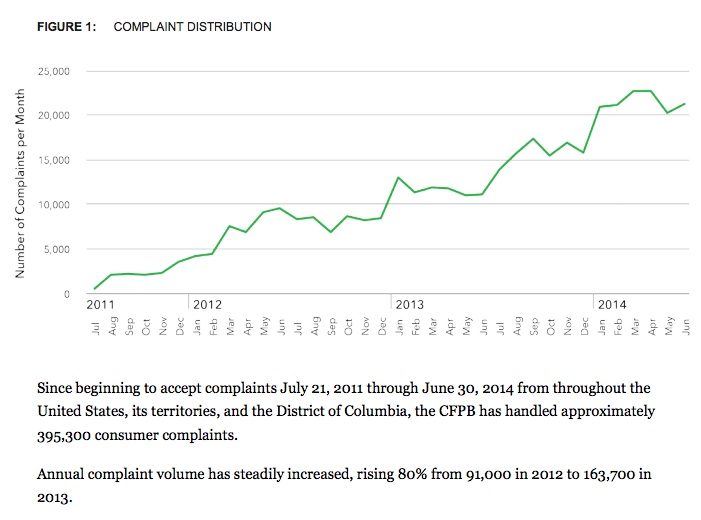
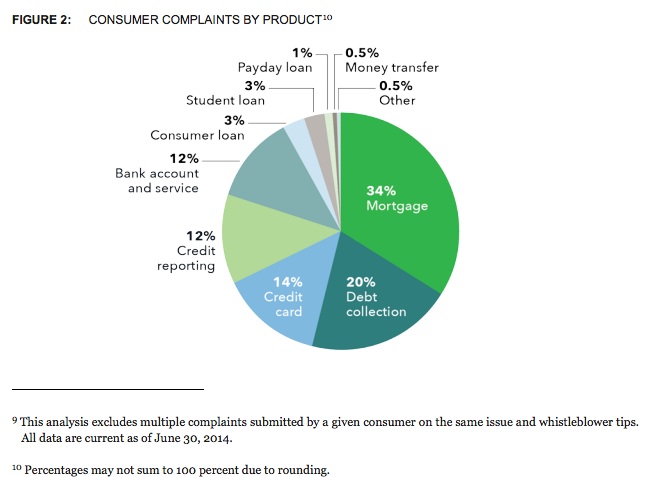
Today, the CFPB released an overview of complaints handled since the Bureau opened on July 21, 2011. (The graphics atop this post and below are sourced from this analysis.) According to the data inside, up until June 30, 2014, the CFPB has handled approximately 395,300 consumer complaints.

complaints by product

According to the overview, the World Wide Web has been a key channel for people to file complaints to the CFPB: 56% of all consumer complaints were submitted through the CFPB’s website. 10% were submitted via telephone calls, with the balance coming in through mail, email, and fax. The rest of the report contains tables and data that breaks down complaints by type, actions taken, company responses, and consumers’ feedback about company responses.

By releasing these narratives, not just the number of complaints, the agency holds that the following benefits will accrue: more context to the complaint, specific trends in complaints, enabling consumers to make more informed decisions, and spurring competition based on consumer satisfaction. In the release announcing the proposed policy, the CFPB emphasized that consumers must opt-in to share these stories: “The CFPB would not publish the complaint narrative unless the consumer provides informed consent. This means that when consumers submit a complaint through consumerfinance.gov, they would have to affirmatively check a consent box to give the Bureau permission to publish their narrative. At least initially, only narratives submitted online would be available for the opt-in.”

Consumers could subsequently decide to withdraw their consent, resulting in the regulator removing the complaint from their website. Companies will be given the opportunity to publish a written response to the complaints that would appear next to a given consumer’s story.

The agency’s proposal states that “no personal information will be shared, stating that “complaints would be scrubbed of information such as names, telephone numbers, account numbers, Social Security numbers, and other direct identifiers.”

Getting that right is important — watch for powerful financial companies, their lobbyists and sympathetic politicians to raise privacy concerns about the proposal in DC in the weeks to follow.

While it may not be apparent at first glance, however, the collection and publication of these complaints would have an important, tacit effect upon the market for financial services. By collecting, structuring and releasing consumer complaints as data, the CFPB could add crucial business intelligence into the marketplace for these services. This isn’t a novel model: the Consumer Product Safety Commission already discloses a public complaint database at SaferProducts.gov, enabling merchants and services like Consumer Products to give people crucial information about their purchases. The SEC and FINRA would be well-advised to release financial advisor data in a similar fashion. Someday, complaints submitted from mobile e-patients may have similarly powerful corrective effect in the market for health care goods and services.

[REPORT] On data journalism, democracy, open government and press freedom

On May 30, I gave a keynote talk on my research on the art and science of data journalism at the first Tow Center research conference at Columbia Journalism School in New York City. I’ve embedded the video below:

My presentation is embedded below, if you want to follow along or visit the sites and services I described.

Here’s an observation drawn from an extensive section on open government that should be of interest to readers of this blog:

“Proactive, selective open data initiatives by government focused on services that are not balanced by support for press freedoms and improved access can fairly be criticized as “openwashing” or “fauxpen government.”

Data journalists who are frequently faced with heavily redacted document releases or reams of blurry PDFs are particularly well placed to make those critiques.”

My contribution was only one part of the proceedings for “Quantifying Journalism: Metrics, Data and Computation,” which you can catch up through the Tow Center’s live blog or TechPresident’s coverage of measuring the impact of journalism.

Harvard Law study finds Supreme Court editing its decisions without notice

scotus-steps

This morning, Adam Liptak reported at the New York Times that the Supreme Court has been quietly editing its legal decisions without notice or indication. According to Richard J. Lazarus, a law professor at Harvard Liptak interviewed about a new study examining the issue, these revisions include “truly substantive changes in factual statements and legal reasoning.”

The court does warn readers that early versions of its decisions, available at the courthouse and on the court’s website, are works in progress. A small-print notice says that “this opinion is subject to formal revision before publication,” and it asks readers to notify the court of “any typographical or other formal errors.”

But aside from announcing the abstract proposition that revisions are possible, the court almost never notes when a change has been made, much less specifies what it was. And many changes do not seem merely typographical or formal.

Four legal publishers are granted access to “change pages” that show all revisions. Those documents are not made public, and the court refused to provide copies to The New York Times.

The Supreme Court secretly editing the legal record seems like a big deal to me. (Lawyers, professors, court reporters, tell me I’m wrong!)
To me, this story highlights the need for and, eventually the use of data and software to track the changes in a public, online record of Supreme Court decisions.

Static PDFs that are edited without notice, data or indication of changes doesn’t seem good enough for the legal branch of a constitutional republic in the 21st century.

Just as the U.S. Code, state and local codes, are being constantly being updated and consulted by lawyers, courts and the people, the Supreme Court’s decisions could be published and maintained online as a body of living legislation at SupremeCourt.gov so that they may be read and consulted by all.

Embedded and integrated into those decisions and codes would be a record of the changes to them, the “meta data” of the actions of the legislative organ of the republic.

What you’ll find now at SupremeCourt.gov is a significant improvement over past years. Future versions, however, might be even better.

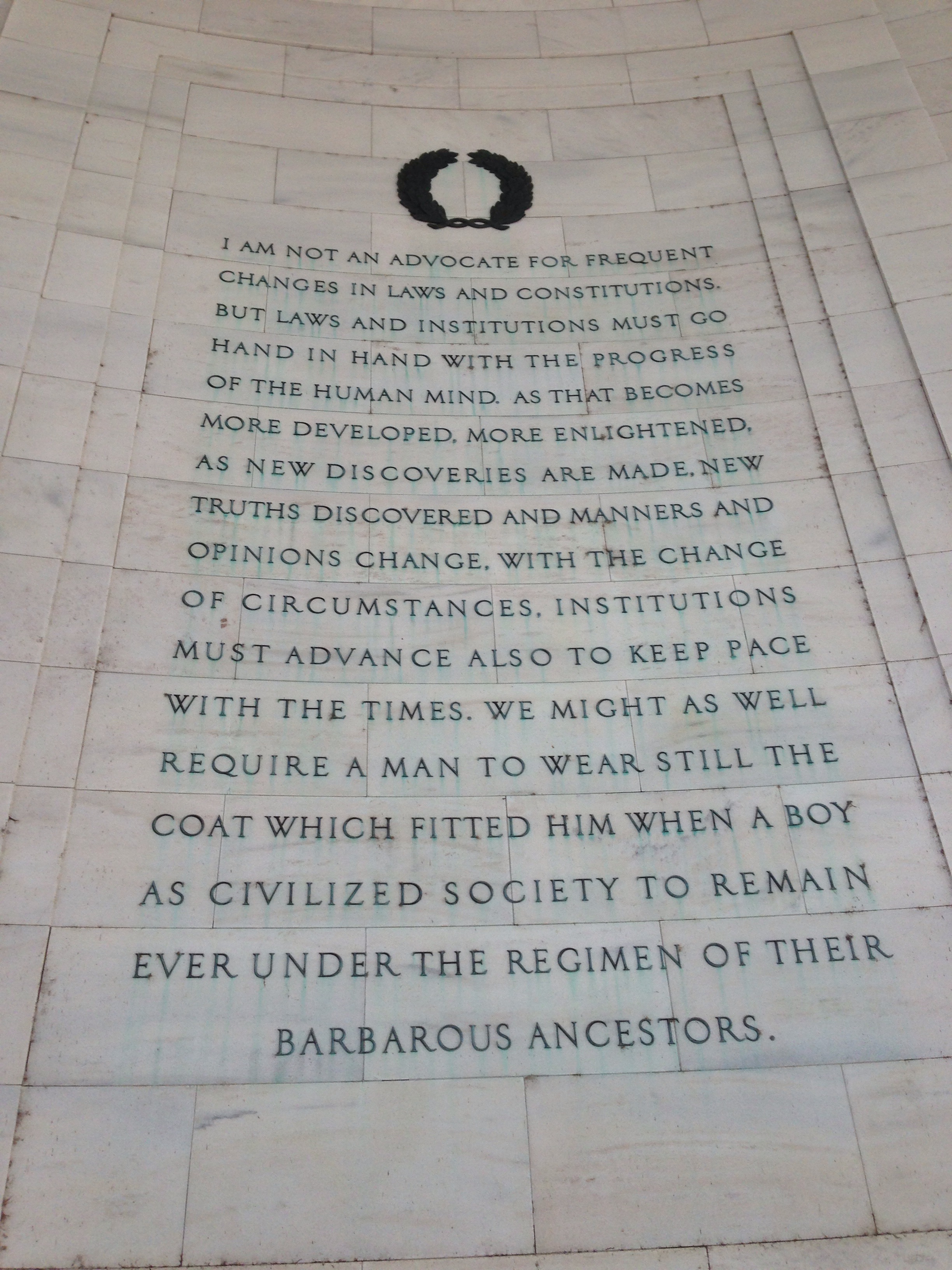
jefferson-quote

District of Columbia to experiment with collaborative lawmaking online

Residents of the District of Columbia now have a new way to comment on proposed legislation before the City Council, MadisonDC. Today, David Grosso, a DC Councilman-at-Large, introduced the new initiative to collaboratively draft laws online in a release and video on YouTube.

“As we encourage more public engagement in the legislative process, I hope D.C. residents will take a moment to log onto the Madison project,” said Councilmember Grosso. “I look forward to seeing the public input on my proposed bills.”

MadisonDC has its roots in the first Congressional hackathon, back in 2011. The event spawned a beta version of the Madison Project, an online platform to where lawmakers could crowdsource legislative markup. It was deployed first by the office of Representative Darrell Issa, crowdsourcing comments on several bills. The code was subsequently open sourced and now has been deployed by the OpenGov Foundation as a way to publish municipal codes online, along with other uses.

“We are excited to support Councilmember Grosso’s unprecedented efforts to welcome residents – and their ideas – directly into the local lawmaking process,” said Seamus Kraft, co-founder & executive director of The OpenGov Foundation, on the nonprofit organization’s blog. “But what really matters is that we’re going to produce better City Council bills, with fewer frustrations and unintended consequences. These three bills are only a start. The ultimate goal of MadisonDC is transforming D.C.’s entire policymaking machine for the Internet Age, creating an end-to-end, on-demand collaboration ecosystem for both citizens and city officials. The possibilities are limitless.”

The first three bills on MadisonDC are the D.C. Urban Farming and Food Security Act of 2014, the Marijuana Legalization and Regulation Act of 2013, and the Open Primary Elections Amendment Act of 2014.

The DC Open Government Office at the city’s Board of Ethics and Government Accountability, commended the effort with a tweet:

Councilman Grosso further engaged the public on Twitter this afternoon, inviting public comment on his proposed legislation.

This post has been updated to include more statements and social media updates.

[FAQ] How do I download a tax transcript from IRS.gov?

UPDATE: This service was taken offline after IRS security was compromised.

irs-transcriptIn January 2014, the IRS quietly introduced a new feature at IRS.gov that enabled Americans to download their tax transcript over the Internet. Previously, filers could request a copy of the transcript (not the full return) but had to wait 5-10 business days to receive it in the mail. For people who needed more rapid access for applications, the delay could be critical.

What’s a tax transcript?

It’s a list of the line items that you entered onto your federal tax return (Form 1040), as it was originally filed to the IRS.

Wait, we couldn’t already download a transcript like this in 2014?

Nope. Previously, filers could request a copy of the transcript (not the full return) but they would have to wait 5-10 business days to receive it in the mail.

Why did this happen now?

The introduction of the IRS feature coincided with a major Department of Education event focused on opening up such data. A U.S. Treasury official said that the administration was doing that to make it “easier for student borrowers to access tax records he or she might need to submit loan applications or grant applications.”

Why would someone want their tax transcript?

As the IRS itself says, “IRS transcripts are often used to validate income and tax filing status for mortgage applications, student and small business loan applications, and during tax preparation.” It’s pretty useful.

OK, so what do I do to download my transcript?

Visit “get transcript” and register online. You’ll find that the process is very similar to setting up online access for a bank accounts. You’ll need to choose a pass phrase, pass image and security questions, and then answer a series of questions about your life, like where you’ve lived. If you write them down, store them somewhere safe and secure offline, perhaps with your birth certificate and other sensitive documents.

Wait, what? That sounds like a lot of of private information.

True, but remember: the IRS already has a lot of private data about you. These questions are designed to prevent someone else from setting up a fake account on your behalf and stealing it from them. If you’re uncomfortable with answering these questions, you can request a print version of your transcript. To do so, you’ll need to enter your Social Security number, data of birth and street address online. If you’re still uncomfortable doing so, you can visit or contact the IRS in person.

So is this safe?

It’s probably about as safe as doing online banking. Virtually nothing you do online is without risk. Make sure you 1) go to the right website 2) connect securely and 3) protect the transcript, just as you would paper tax records. Here’s what the IRS told me about their online security:

“The IRS has made good progress on oversight and enhanced security controls in the area of information technology. With state-of-the-art technology as the foundation for our portal (e.g. irs.gov), we continue to focus on protecting the PII of all taxpayers when communicating with the IRS.

However, security is a two-way street with both the IRS and users needing to take steps for a secure experience. On our end, our security is comparable to leaders in private industry.

Our IRS2GO app has successfully completed a security assessment and received approval to launch by our cybersecurity organization after being scanned for weaknesses and vulnerabilities.

Any personally identifiable information (PII) or sensitive information transmitted to the IRS through IRS2Go for refund status or tax record requests uses secure communication channels that meet or exceed federal requirements for encryption. No PII is passed back to the taxpayer through IRS2GO and no PII is stored on the smartphone by the application.

When using our popular “Where’s My Refund?” application, taxpayers may notice just a few of our security measures. The URL for Where’s My Refund? begins with https. Just like in private industry, the “s” is a key indicator that a web user should notice indicating you are in a “secure session.” Taxpayers may also notice our message that we recommend they close their browser when finished accessing your refund status.

As we become a more mobile society and able to link to the internet while we’re on the go, we remind taxpayers to take precautions to protect themselves from being victimized, including using secure networks, firewalls, virus protection and other safeguards.

We always recommend taxpayers check with the Federal Trade Commission for the latest on reporting incidents of identity theft. You can find more information on our website, including tips if you believe you have become the victim of identity theft.”

What do I do with the transcript?

If you download tax transcripts or personal health information to a mobile device, laptop, tablet or desktop, install passcodes and full disk encryption, where available, on every machine its on. Leaving your files unprotected on computers connected to the Internet is like leaving the door to your house unlocked with your tax returns and medical records on the kitchen table.

I got an email from the IRS that asks me to email them personal information to access my transcript. Is this OK?

Nope! Don’t do it: it’s not them. The new functionality will likely inspire criminals to create mockups of the government website that look similar and then send phishing emails to consumers, urging them to “log in” to fake websites. You should know that IRS “does not send out unsolicited e-mails asking for personal information.” If you receive such an email, consider reporting the phishing to the IRS. Start at www.irs.gov/Individuals/Get-Transcript every time.

I tried to download my transcript but it didn’t work. What the heck?

You’re not alone. I had trouble using an Apple computer. Others have had technical issues as well.

Here’s what the IRS told me: “As a web application Get Transcript is supported on most modern OS/browser combinations. While there may be intermittent issues due to certain end-user configurations, IRS has not implemented any restrictions against certain browsers or operating systems. We are continuing to work open issues as they are identified and validated.”

A side note: For the best user experience, taxpayers may want to try up-to-date versions of Internet Explorer and a supported version of Microsoft Windows; however, that is certainly not a requirement.)”

What does that mean, in practice? That not all modern OS/browser combinations are supported, potentially including OS X and Android, that the IRS digital staff knows it — although they aren’t informing IRS.gov users regarding what versions of IE, Windows or other browsers/operating systems are presently supported and what is not — and are working to improve.

Unfortunately, ongoing security issues with Internet Explorer means that in 2014, we have the uncomfortable situation where the Department of Homeland Security is recommending that people avoid using Internet Explorer while the IRS recommends that its customers choose it for the “best experience.”

Given the comments from frustrated users, the IRS could and should do better on all counts.

Will I be able to file my tax return directly to the government through IRS.gov now?

You can already file your federal tax return online. According to the IRS, almost 120 million people used IRS e-file last year.

Well, OK, but shouldn’t having a user account and years of returns make it easier to file without a return at all?

It could. As you may know, other countries already have “return-free filing,” where a taxpayer can go online, login and access a pre-populated tax return, see what the government estimates her or she owes, make any necessary adjustments, and file.

Wait, that sounds pretty good. Why doesn’t the USA have return-free filing yet?

Yes, it does. As ProPublica reported last year, “the concept has been around for decades and has been endorsed by both President Ronald Reagan and a campaigning PresidentObama.”

As ProPublica reported last year, both H&R Block and Intuit, the maker of TurboTax, have lobbied against free and simple tax filing in Washington, given that it’s in their economic self-interest to do so:

In its latest annual report filed with the Securities and Exchange Commission, however, Intuit also says that free government tax preparation presents a risk to its business. Roughly 25 million Americans used TurboTax last year, and a recent GAO analysis said the software accounted for more than half of individual returns filed electronically. TurboTax products and services made up 35 percent of Intuit’s $4.2 billion in total revenues last year. Versions of TurboTax for individuals and small businesses range inprice from free to $150.

What are the chances return-free filing could be on IRS.gov soon?

Hard to say, but the IRS told me that something that sounds like a precursor to return-free filing is on the table.  According to the agency, “the IRS is considering a number of new proposals that may become a part of the online services roadmap some time in the future. This may include a taxpayer account where up to date status could be securely reviewed by the account owner.”

Creating the ability for people to establish secure access to IRS.gov to review and download tax transcripts is a big step in that direction. Whether the IRS takes any more steps  soon is more of a political and policy question than a technical one, although the details of the latter matter.  

Is the federal government offering other services like this for other agencies or personal data?

The Obama administration has been steadily modernizing government technology, although progress has been uneven across agencies. While the woes of Healthcare.gov attracted a lot of attention, many federal agencies have improved how they deliver services over the Internet. One of the themes of the administration’s digital government approach is “smart disclosure,” a form of targeted transparency in which people are offered the opportunity to download their own data, or data about them, from government or commercial services. The Blue Button is an example of this approach that has the potential to scale nationally.

U.S. publishes new “Open Data Action Plan,” announces new data releases

On the one year anniversary of President Barack Obama’s historic executive order to open up more government data, U.S. chief information officer Steven VanRoekel and U.S. chief technology officer Todd Park described “continued progress and plans for open government data” at the WhiteHouse.gov blog:

Freely available data from the U.S. government is an important national resource, serving as fuel for entrepreneurship, innovation, scientific discovery, and economic growth. Making information about government operations more readily available and useful is also core to the promise of a more efficient and transparent government. This initiative is a key component of the President’s Management Agenda and our efforts to ensure the government is acting as an engine to expand economic growth and opportunity for all Americans. The Administration is committed to driving further progress in this area, including by designating Open Data as one of our key Cross-Agency Priority Goals.

Over the past few years, the Administration has launched a number of Open Data Initiatives aimed at scaling up open data efforts across the Health, Energy, Climate, Education, Finance, Public Safety, and Global Development sectors. The White House has also launched Project Open Data, designed to share best practices, examples, and software code to assist federal agencies with opening data. These efforts have helped unlock troves of valuable data—that taxpayers have already paid for—and are making these resources more open and accessible to innovators and the public.

Other countries are also opening up their data. In June 2013, President Obama and other G7 leaders endorsed the Open Data Charter, in which the United States committed to publish a roadmap for our nation’s approach to releasing and improving government data for the public. Building upon the Administration’s Open Data progress, and in fulfillment of the Open Data Charter, today we are excited to release the U.S. Open Data Action Plan.

The new Open Data Action Plan (which was, ironically, released as a glossy PDF*, as opposed to a more machine-readable format) details a number of significant steps, including:

  • Many releases of new data and improved access to existing databases. These include more climate data, adding an API to Smithsonian artwork and the Small Business Administration’s database of suppliers and making data available for re-use. *Late in the day, with a “thanks to the open data community for their vigilance,” The White House posted the list of “high value data sets” in the plan as a .CSV.
  • A roadmap with deadlines for the release of these datasets over the course of 2014-2015. Some data releases are already online, like Medicare physician payment data. I’ve created an online spreadsheet that should act as a dashboard for U.S. National Open Data Action Plan Deadlines.
  • A policy that “new data sets will be prioritized for release based on public feedback.
  • New open data projects at federal agencies, each of which will be led by a Presidential Innovation Fellow. According to the plan, the agencies will include NOAA, the Census Bureau, NASA, IRS, Interior, Labor, Energy and HHS.

Compliance with the executive order on open data has been mixed, as the Sunlight Foundation detailed last December. While all executive branch agencies were required to develop a machine-readable catalog of their open data at [department].gov/data.json  and stand up /developer pages, it took until February 2014 for all Cabinet agencies to publish their open data inventories. (The government shutdown was a factor in the delay.)

The federal government’s progress on this open data action plan is likely to be similar, much as it has been for the past five years under the Obama administration: variable across agencies, with delays in publishing, issues in quality and carve outs for national security, particularly with respect to defense and intelligence agencies. That said, progress is progress: many of the open data releases detailed in the plan have already occurred.

If the American people, press, Congress and public worldwide wish to see whether the administration is following through on some of its transparency promises, they can do so by visiting agency websites and the federal open data repository, Data.gov, which will celebrate its fifth anniversary next week.

Former New York City mayor Mike Bloomberg is fond of quoting William Edwards Deming: “In God we trust. All others bring data.” Given historic lows in trust in government, the only way the Obama administration will make progress on that front is if they actually release more of it.

[Image Credit: Eric Fischer/Flickr]

From broadband maps to Data.gov, WordPress looks to power more open source government

I had a blast interviewing Matt Mullenweg, the co-creator of WordPress and CEO of Automattic, last night at the inaugural WordPress and government meetup in DC. UPDATE: Video of our interview and the Q&A that followed is embedded below:

WordPress code powers some 60 million websites, including 22% of the top 10 million sites on the planet and .gov platforms like Broadbandmap.gov. Mullenweg was, by turns, thoughtful, geeky and honest about open source and giving hundreds of millions of people free tools to express themselves, along with quietly principled,  with respect to the corporate values for an organization spread between 35 countries, government censorship and the ethics of transparency.

After Mullenweg finished taking questions from the meetup, Data.gov architect Philip Ashlock gave a presentation on how the staff working on the federal government’s open data platform are using open source software to design, build, publish and collaborate, from WordPress to CKAN to Github issue tracking.

United States federal government use of crowdsourcing grows six-fold since 2011

578430main_20110809-xclass_full

Citizensourcing and open innovation can work in the public sector, just as crowdsourcing can in the private sector. Around the world, the use of prizes to spur innovation has been booming for years. The United States of America has been significantly scaling up its use of prizes and challenges to solving grand national challenges since January 2011, when, President Obama signed an updated version of the America COMPETES Act into law.

According to the third congressionally mandated report released by the Obama administration today (PDF/Text), the number of prizes and challenges conducted under the America COMPETES Act has increased by 50% since 2012, 85% since 2012, and nearly six-fold overall since 2011. 25 different federal agencies offered prizes under COMPETES in fiscal year 2013, with 87 prize competitions in total. The size of the prize purses has also grown as well, with 11 challenges over $100,000 in 2013. Nearly half of the prizes conducted in FY 2013 were focused on software, including applications, data visualization tools, and predictive algorithms. Challenge.gov, the award-winning online platform for crowdsourcing national challenges, now has tens of thousands of users who have participated in more than 300 public-sector prize competitions. Beyond the growth in prize numbers and amounts, Obama administration highlighted 4 trends in public-sector prize competitions:

  • New models for public engagement and community building during competitions
  • Growth software and information technology challenges, with nearly 50% of the total prizes in this category
  • More emphasis on sustainability and “creating a post-competition path to success”
  • Increased focus on identifying novel approaches to solving problems

The growth of open innovation in and by the public sector was directly enabled by Congress and the White House, working together for the common good. Congress reauthorized COMPETES in 2010 with an amendment to Section 105 of the act that added a Section 24 on “Prize Competitions,” providing all agencies with the authority to conduct prizes and challenges that only NASA and DARPA has previously enjoyed, and the White House Office of Science and Technology Policy (OSTP), which has been guiding its implementation and providing guidance on the use of challenges and prizes to promote open government.

“This progress is due to important steps that the Obama Administration has taken to make prizes a standard tool in every agency’s toolbox,” wrote Cristin Dorgelo, assistant director for grand challenges in OSTP, in a WhiteHouse.gov blog post on engaging citizen solvers with prizes:

In his September 2009 Strategy for American Innovation, President Obama called on all Federal agencies to increase their use of prizes to address some of our Nation’s most pressing challenges. Those efforts have expanded since the signing of the America COMPETES Reauthorization Act of 2010, which provided all agencies with expanded authority to pursue ambitious prizes with robust incentives.

To support these ongoing efforts, OSTP and the General Services Administration have trained over 1,200 agency staff through workshops, online resources, and an active community of practice. And NASA’s Center of Excellence for Collaborative Innovation (COECI) provides a full suite of prize implementation services, allowing agencies to experiment with these new methods before standing up their own capabilities.

Sun Microsystems co-founder Bill Joy famously once said that “No matter who you are, most of the smartest people work for someone else.” This rings true, in and outside of government. The idea of governments using prizes like this to inspire technological innovation, however, is not reliant on Web services and social media, born from the fertile mind of a Silicon Valley entrepreneur. As the introduction to the third White House prize report  notes:

“One of the most famous scientific achievements in nautical history was spurred by a grand challenge issued in the 18th Century. The issue of safe, long distance sea travel in the Age of Sail was of such great importance that the British government offered a cash award of £20,000 pounds to anyone who could invent a way of precisely determining a ship’s longitude. The Longitude Prize, enacted by the British Parliament in 1714, would be worth some £30 million pounds today, but even by that measure the value of the marine chronometer invented by British clockmaker John Harrison might be a deal.”

X-prize-graph-300x297Centuries later, the Internet, World Wide Web, mobile devices and social media offer the best platforms in history for this kind of approach to solving grand challenges and catalyzing civic innovation, helping public officials and businesses find new ways to solve old problem. When a new idea, technology or methodology that challenges and improves upon existing processes and systems, it can improve the lives of citizens or the function of the society that they live within.

“Open innovation or crowdsourcing or whatever you want to call it is real, and is (slowly) making inroads into mainstream (i.e. non high-tech) corporate America,” said MIT principal research professor Andrew McAfee, in an interview in 2012.” P&G is real. Innocentive is real. Kickstarter is real. Idea solicitations like the ones from Starbucks are real, and lead-user innovation is really real.”

Prizes and competitions all rely upon the same simple idea behind the efforts like the X-Prize: tapping into the distributed intelligence of humans using a structured methodology. This might include distributing work, in terms of completing a given task or project, or soliciting information about how to design a process, product or policy.

Over the past decade, experiments with this kind of civic innovation around the world have been driven by tight budgets and increased demands for services, and enabled by the increased availability of inexpensive, lightweight tools for collaborating with connected populations. The report claimed that crowdsourcing can save federal agencies significant taxpayer dollars, citing an example of a challenge where the outcome cost a sixth of the estimated total of a traditional approach.

One example of a cost-effective prize program is the Medicaid Provider Screening Challenge that was offered by the Centers for Medicare & Medicaid Services (CMS) as part of a pilot designed in partnership with states and other stakeholders. This prize program was a series of software development challenges designed to improve capabilities for streamlining operations and screening Medicaid providers to reduce fraud and abuse. With a total prize purse of $500,000, the challenge series is leading to the development of an open source multi-state, multi-program provider screening shared-service software program capable of risk scoring, credential validation, identity authentication, and sanction checks, while lowering the burden on providers and reducing administrative and infrastructure expenses for states and Federal programs. CMS partnered with the NASA Center of Excellence for Collaborative Innovation (COECI), NASA’s contractor Harvard Business School, Harvard’s subcontractor TopCoder, and the State of Minnesota. The State of Minnesota is working on full deployment of the software, and CMS is initiating a campaign to encourage other states to leverage the software. COECI estimates that the cost of designing and building the portal through crowdsourcing was one-sixth of what the effort would have cost using traditional software development methods. Through the success of this and subsequent
challenges, CMS is attempting to establish a new paradigm for crowdsourcing state and Federal information technology (IT) systems in a low-cost, agile manner by opening challenges to new players, small companies, and talented individual developers to build solutions which can “plug and play” with existing legacy systems or can operate in a shared, cloud-based environment.

As is always the nature of experiments, many early attempts failed. A few have worked and subsequently grown into sustainable applications, services, data sources, startups, processes and knowledge that can be massively scaled. Years ago, Micah Sifry predicted that the “gains from enabling a culture of open challenges, outsider innovation and public participation” in government were going to be huge. He was right.

Linked below are the administration’s official letters to the House and Senate, reporting the results of last year’s prizes.

COMPETES FY2013PrizesReport HOUSE Letter (PDF)/COMPETES FY2013PrizesReport HOUSE Letter (Text)

COMPETES FY2013 PrizesReport SENATE Letter (PDF)/COMPETES FY2013 PrizesReport SENATE Letter (Text)

[Image Credit: NASA SDO. Context: Solar flare predictive algorithm challenge]