
I spoke with New York City deputy Mayor Steven Goldsmith (@s_goldsmith) about citizensourcing smarter government in New York City earlier this year. The following interview with CSPAN is worth watching for those interested in further insight into his perspective on urban governance in the 21st century.
Tag Archives: open government
Week in Review: Top Gov 2.0 and Open Government Stories

Open government made an appearance in popular culture, albeit not in an admiring sense. At the start of the week, Jon Stewart and the Daily Show mocked the Obama administration and the president for a perceived lack of transparency.
Stewart and many other commentators have understandably wondered why the president’s meeting with open government advocates to receive a transparency award wasn’t on the official schedule or covered by the media. A first hand account of the meeting from open government advocate Danielle Brian offered useful perspective on the issues that arose that go beyond a soundbite or one liner:
Gary, OMB Watch’s executive director, focused on the places where we have seen real change, including the Open Government Directive, the Executive Orders on Classified National Security and Controlled Unclassified Information, emphasis on affirmative disclosures of government information; and the President’s support of reporters’ privilege and shield law, as well as whistleblower protections.
Lucy, executive director for Reporters Committee for Freedom of the Press, pointed out that this was the first president in her 30 years of working in this field who had invited open government advocates into the Oval Office. She specifically thanked him for his strong support of a reporters’ shield law, which he affirmed he continues to support. Tom, executive director for the National Security Archive, emphasized that when it comes to FOIA reform and implementation we know it isn’t just a ship of state, but an entire flotilla including rowboats. And that while there has been notable improvement according to the National Security Archive’s survey of agencies, there continues to need be a need for leadership from the top to change cultures across the vast swath of government agencies. He also noted that we all believe the information we want to see is not simply that which is useful for consumers, but also that which holds the government accountable.
I knew my topic was likely to be sensitive. I began by thanking the President for his strong support of whistleblower protections, and noted that it was not for lack of effort on the part of the White House that the legislation didn’t pass at the end of the last Congress.
I noted, however, that the current aggressive prosecution of national security whistleblowers is undermining this legacy. That we need to create safe channels for disclosure of wrongdoing in national security agencies. That we need to work harder to shrink the amount of over-classified materials that unnecessarily prompt leak prosecutions.
The President shifted in his seat and leaned forward. He said he wanted to engage on this topic because this may be where we have some differences. He said he doesn’t want to protect the people who leak to the media war plans that could impact the troops. He differentiated these leaks from those whistleblowers exposing a contractor getting paid for work they are not performing. I was careful not to interrupt the President, but waited until he was done. I pointed out that few, if any, in our community would disagree with his distinction—but that in reality the current prosecutions are not of those high-level officials who regularly leak to the press to advance their policy agendas. Instead, the Department of Justice (DOJ) is prosecuting exactly the kind of whistleblower he described, for example one from the National Security Agency.
The President then did something that I think was remarkable. He said this is an incredibly difficult area and he wants to work through how to do a better job in handling it. He also agreed that too much information is classified, and asked us to work with his office on this. He wasn’t defensive nor was he dismissive. It was perhaps the dream moment for an advocate—hearing the most senior policymaker agree with you and offer to work together to tackle the problem.
Brian’s account is the most comprehensive account of the meeting on open government online. The irony that it was not recorded and released to the American people is, however, inescapable. For anyone tracking the progress of the Open Government Directive, the last six months have been an up and down experience. It was clear back in September that in the United States, open government remains in beta.
According to doctoral research by University of Texas academic, there are 358 open government projects in federal government. Former White House deputy chief technology officer Beth Noveck wrote about the semantics and the meaning of good government and open government mean in this context. One takeaway: don’t mistake open innovation policies for transparency guarantees.
The current White House deputy CTO for innovation, Chris Vein, wrote on the White House blog this week that the one year anniversary of open government plans were “a testament to hard work” at the agencies. As Vein acknowledged, “while there is always more to be done, we are proud of the important work that agencies have done and are doing to change the culture of government to one that encourages transparency and facilitates innovation. We are committed to maintaining and building upon this momentum to make our Nation stronger and to make the lives of Americans better.”
Naturally, some projects are always going to be judged more as more or less effective in delivering on the mission of government than others. An open government approach to creating a Health Internet may be the most disruptive of them. For those that expected to see rapid, dynamic changes in Washington fueled by technology, however, the bloom has long since come off of the proverbial rose. Open government is looking a lot more like an ultramarathon than a 400 yard dash accomplished over a few years.
That said, something different is going on during what Micah Sifry has aptly called the age of transparency. We’re in new territory here, with respect to the disruption that new connection technologies represent to citizens, society and government. It’s worth taking stock of what’s happened recently. It’s been a while since I first posted a Gov 2.0 Week in Review at Radar, and three months since the 2010 Gov 2.0 year in review.
There’s a lot happening in this space. Following is a quick digest that might provide some perspective to those who might think that open government is a better punchline than policy.
1. The government stayed open. The budget crisis on Capitol Hill overshadowed every other issue this past week. It’s harder for a government to be open if it’s closed. The secrecy of the shutdown negotiations left folks over at the Sunlight Foundation wondering about how open government principles matched up to reality.
2. Proposed deep cuts to funding for open government data platforms like Data.gov or the IT Dashboard appear to be least partially restored in the new budget. That will likely salve (some of) the concerns of advocates like Harlan Yu, who wrote about what we would lose if we lost Data.gov. John Wonderlich’s questions on the budget deal, however, include one on exactly how much funding was restored.
3. FCC.gov relaunched as an open government platform. In any other week, this story would have led the list open government news. Having sat out the Aughts, FCC.gov stepped into the modern age FCC managing director Steve Van Roekel and his team worked hard to bring Web 2.0 principles into the FCC’s online operations. Those principles include elements of open data, platform thinking, collective intelligence, and lightweight social software. What remains to be seen in the years ahead is how much incorporating Web 2.0 into operations will change how the FCC operates as a regulator. The redesign was driven through an open government process that solicited broad comment from the various constituencies that visit FCC.gov. The beta.FCC.gov isn’t just a site anymore, however: it’s a Web service that taps into open source, the cloud, and collective intelligence. In the world of Gov 2.0, that’s a substantial reframing of what government can do online.
4. What happens to e-government in a shutdown? This near miss forced hundreds of thousands of people to consider how to make wired government go dark. That discussion should not end with this latest resolution.
5. The first NASA Open Source Summit explored why open source is a valuable tool for the space agency. Open source is a pillar of NASA’s open government plan.
6. The Russian blogosphere came under attack, quashing an online parliament initiative. Needless to say, it will be interesting to see if a Russian Gov 2.0 conference next week addresses the issue of press freedoms or open government transparency.
7. Simpl launched as platform to bridge the connection between social innovators and government.
8. National Builder launched as a new online activism platform.
9. Senator Jon Tester (D-MT) and Representative Steve Israel (D-NY) reintroduced the Public Online Information Act. With this transparency bill, the federal government would acknowledge the Internet, opined Mother Jones.
10. SeeClickFix launches its Facebook app.. “It looks like the entire SeeClickFix experience has been ported over to the Facebook environment,” writes Dan Kennedy. “Users can report problems and pinpoint them on a Google map, thus alerting government officials and the news media. I am far from being the world’s biggest Facebook fan, but it’s a smart move, given how much time people spend there.”
Editor’s Note This is by no means a definitive, comprehensive list. For instance, there’s plenty of open government news happening in countries around the world, from corruption mashups in India to the transparency challenges in various states. For a daily dose of transparency, make sure to read the Sunlight Foundation’s blog IBM’s Business of Government blog has also posted a weekly round up. If you have more stories that came across your desktop, inbox or television this week, please share them in the comments.
As its Star Trek videos launch, Social Security tries to connect with younger citizens
Patty Duke and Mr. Sulu (aka, George Takei) want you to boldly go where you may never have gone before: SocialSecurity.gov. (At least if you’re under 65.)The short, commercial length spots make no bones about Takai’s time on Star Trek, so to speak, and are laced with references to the iconic television series.
In another, Takei and Duke encourage viewers to “Go Direct” to get direct deposits of monthly social security checks. (No way to beam those over, Scotty?) While the new slate of videos, Social Security is making an effort to connect with older Americans through the aging icons of 20th Century pop culture. As my colleague Luke Fretwell put it, Social Security has gone Star Trek.
If the spots help an increasingly digital cohort of senior citizens to learn about SocialSecurity.gov and relevant benefits, the cornball humor might have been worth the investment.
On the same day that the Star Trek videos launched however, the Social Security Administration also posted the full version of a webinar for young people wondering. The webinar, below, is the first official communications from the agency the contains information about the future of the program for young workers.
To say that there’s a contrast in styles between the two communication efforts is an understatement. The care with which the agency has had to take in communicating about an uncertain future, as opposed to trying to raise awareness of an improved website, is notable. This more recent example of how Social Security operates in the Gov 2.0 era drives how just how difficult operating in the new media environment will be for many agencies.
Will Social Security get social media? Hard to say. They’re trying. The @SocialSecurity Twitter wasn’t able to attract the attention of Takei or produce much engagement. Facebook produced slightly better results, but no obvious spike in awareness or viewership of the webinar.
If you have any thoughts on their success, failure or what they could or should be doing better, the comments are open.
Mapping corruption tweets in real-time in India [MASHUP]
Transparency has gone global. Today, there’s a mashup of corruption-related tweets in India and Google Maps to explore.
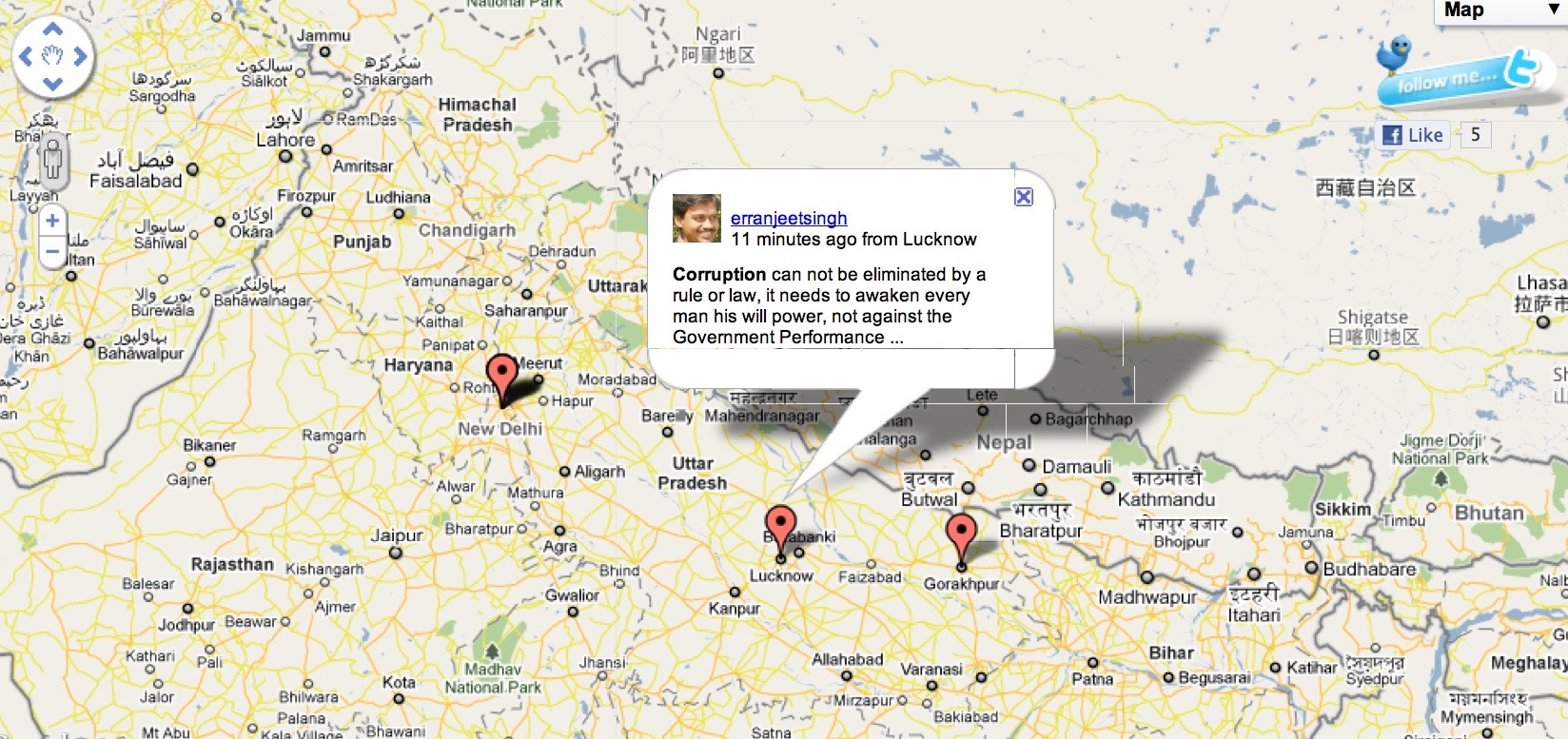
Add an expanding number of data points in how Gov 2.0 and open government are taking root in India.
Hat tip to Andrew McLaughlin.
How many federal open government projects are there? [INFOGRAPHIC]
April 7th, 2010 was Open Government Day in the United States. Many of the key requirements of the Open Government Directive issued by the Obama administration came due. A year later, the people charged with carrying out the plans, policies and projects that came out of that directive are starting to deliver upon some of the digital initiatives. NASA just held its first open source summit. FCC.gov relaunched as an open government platform.
There’s much more going on in the open government movement than new federal websites or revamped software policy, however, than most citizens or even other government workers and officials may realize.
According to the list of federal open government projects compiled by Angie Newell during her doctoral dissertation, there are currently 358 federal open government projects. Y
As Andy Kryzmarzik explained this morning in a post on Govloop, this terrific infographic is the results of a collaboration between Newell, NYC professor Beth Noveck and GOOD. Nancy Scola has aptly called a map of the US open government world. You can explore the graphic below or access a larger version open government infographic as a PDF. If you click on the numbers, you’ll be taken to a subset of projects in the database hosted on Govloop.
Open Government Projects [Infograph]
View more presentations from GovLoop
Here’s the backstory from Krzmarzick on how the infographic was created:
As serendipity would have it, I met both Beth and Angie Newell at Manor.Govfresh in September, where I learned that Angie was working on a doctoral dissertation and had already completed much of the data collection already…but she couldn’t quite share it yet as she was completing a bit more analysis and adding some additional information. In the meantime, she’s provided some analysis of the project here and here.
Fast forward to a month ago. By now, Beth had departed the White House…and Angie finalized the dataset with all 350+ open government projects. So Beth connected us with the GOOD guys (and I mean that literally – special shout out to Casey Caplowe and Oliver Munday). Our goal was to create a useful visualization that made it easy to find the data and they’re kinda known for their great infographics.
You can browse all of the open government projects in the database below.
This infographic and and database is useful for learning what’s out there in federal open government plans. That said, there’s no clear assessment of the quality of outcomes in that graphic. Understanding what exists, however, is a valuable first step, and I look forward to the analysis of the Govloop community and the larger open government ecosystem as more of these projects are implemented. Not every open government project will result in the creation of a health internet but they’re all important to someone.
Simpl tries to make connecting innovation to local government easier
There’s a new platform to bridge the connection between social innovators and government. Simpl, a joint project between FutureGov and Rock Creek Strategic Marketing, is short for “Social Innovation Marketplace.” As of last Friday, are Simpl is open for ideas in both the United Kingdom and United States.
For now, this open government startup is bootstrapping and focused on local government. “We’ll be exploring a bunch of avenues over the coming months, but for certain we see cities as important and the local as being the right level for being able to support this kind of action,” said co-founder Dominic Campbell. “That’s why we’re launching it with Code for America.” Craiglist founder Craig Newmark described the “social innovation speed dating” that’s set to take place in San Francisco tonight in more detail, for those interested in learning more or attending.
“We are committed to helping government embrace social innovation, handing over power to citizens,” said Campbell. “We see Simpl as a key tool to support the work we do with city governments to open up, connect and innovate.” His presentation from last year’s Open Cities Conference in the UK, embedded below, offers some more insight on that vision.
Simpl at #OpenCities Conference
View more presentations from Dominic Campbell
Campbell offered more insight into what Simpl is all about in a brief interview.
What is Simpl all about?
DC: It’s not about competition, it’s not (really) about money. It’s about peer to peer support and collaboration putting social innovator in touch with government. Not top down, not predetermined parameters by government – but instead gives people the opportunity to say, “Hey, this is a great idea I’m working on to fix a problem that you probably didn’t even know existed. How about you help me make it happen?” It’s mostly aimed at government but much wider. It’s more about meeting a social need as defined by the people who have that need and know what they need to make it happen. That’s often access to people in power more than money, or some borrowed skills, etc. It builds on the challenge model and says, “Hey, perhaps government doesn’t know the problems, so how can it set challenges to meet them? Who better than to define the problem/challenge/wish the person on the receiving end?”
What makes Simpl different from other platforms?
The competitive differentiator is that it is entirely agnostic. It’s about bringing people together, whoever they are, whether in government or out of government, to identify and solve challenges, meeting their own goals with or without the help of government. Frankly, Scott, me, Carrie, and most people we know have more ideas than time to make them happen so this is a vehicle to made that happen.
Why does Simpl matter to citizens?
The key is that this is all about the average citizen. They are the captive audience. They are the people on the site shaping the site from the start. Government is a key partner. That’s something we’ll be working very hard to do to connect our good government (and more than government) network into the ideas to help elevate them and help them meet their goals.
What’s else is ahead?
There’s tech development, in response to a number of requests we’ve already had for people wanting to use our matching software. We’re considering the possibility of adding some paid-for features over time. But all the functionality you see today will remain free.
Open government in beta: FCC.gov 2.0 is live
The beta version of the beautifully redesigned FCC.gov is now online at beta.FCC.gov. (Yes, it’s a United States federal government website in beta. This is 2011, after all.)

The rebooted FCC.gov integrates core principles of Web 2.0 into its design and function, serving as one of the most important examples of government as a platform to date. My full, in-depth review at the new FCC.gov is Gov 2.0 channel of the O’Reilly Radar:
FCC.gov reboots as an open government platform. The new FCC.gov isn’t just a site any more: it’s a Web service that taps into open source, the cloud, and collective intelligence. In the world of Gov 2.0, that’s a substantial reframing of what government can do online.
FCC.gov 2.0 Preview: FCC launches FCC.us URL shortener

FCC Data Center
There’s much more to report on when the new FCC.gov goes online. For now, here’s a preview of something nifty that’s already live: the new FCC custom URL shortener, FCC.us.
The new custom URL shortener, is based upon bit.ly, like the 1.usa.gov URL shortener for civilian use. It automatically shortens any FCC.gov that’s shortened using bit.ly or the shorter j.mp. For instance, FCC.gov/developer becomes http://fcc.us/bkJYlG. In a new media world that is often shortened to 140 characters, that’s rather handy.
More to come soon.
Multiple federal open data initiatives at risk under budget cuts
Earlier today, Virginia Carlson, president of the Metro Chicago Information Center (MCIC), commented extensively upon proposed deep Congressional cuts to funding for open government data platforms. Carlson provided more context for other federal open data initiatives that may also be cut. Her thoughts are shared below as a guest post. -Editor
Recent news that data transparency initiatives at the federal level are set to be shut down are coupled with an attack on long-standing federal data initiatives that produce critical economic and demographic data.
In March 2011, H.R. 931 was introduced to make participation in the American Community Survey voluntary by removing the legal penalty for not responding to the survey. Without compulsory participation, the ACS likely would not capture the broad swath of the American populace it needs to, –such citizens in towns and rural counties– and would become inaccurate and thus irrelevant. Congress relies on ACS data to guide the distribution of $485 billion annually in federal grants to states and localities. Already cash-strapped state and local governments would be hindered in their ability to efficiently target tax dollars in public investments such as roads, schools and health clinics. Private sector investments that rely on economic and demographic profiles of people in places (real estate and media industries for example) would also suffer.
At the same time, the Census Bureau budget for Fiscal Year 2012 submitted to Congress proposes to terminate six programs for a total of $10.3 million, about 1 percent of the Census Bureau budget. Among those items on the chopping block are online and print versions of the U.S. Statistical Abstract, State and Metropolitan Area Data Book, Population Change in Central and Outlying Counties of Metropolitan Statistical Areas, and the Consolidated Federal Funds Report.
What does this apparent diminishing commitment to federal data leadership mean for our future ability to make good policy, prioritize public investments, and compete globally? One scenario is that we turn to other, perhaps less democratic and more expensive, sources: internet-generated data (social apps, web scrapes), business-gathered data (market research firms) or harnessing administrative data (from driver’s license files, Medicare records, etc.). Who then will be counted? How do we ensure privacy?
Congress weighs deep cuts to funding for federal open government data platforms
Several core pillars of federal open government initiatives brought online by the Obama administration may be shuttered by proposed Congressional budget cuts. Data.gov, IT.USASpending.gov, and other five other websites that offer platforms for open government transparency are facing imminent closure. A comprehensive report filed by Jason Miller, executive editor of Federal News Radio, confirmed that the United States of Office of Management and Budget is planning to take open government websites offline over the next four months because of a 94% reduction in federal government funding in the Congressional budget. Daniel Schuman of the Sunlight Foundation first reported the cuts in the budget for data transparency. Schuman talked to Federal News Radio about the potential end of these transparency platforms this week.
Cutting these funds would also shut down the Fedspace federal social network and, notably, the FedRAMP cloud computing cybersecurity programs. Unsurprisingly, open government advocates in the Sunlight Foundation and the larger community have strongly opposed these cuts.
As Nancy Scola reported for techPresident, Donny Shaw put the proposal to defund open government datain perspective at OpenCongress: “The value of data openness in government cannot be overestimated, and for the cost of just one-third of one day of missile attacks in Libya, we can keep these initiatives alive and developing for another year.”
Daniel Schuman was clear about the value of data transparency funding at the Sunlight Foundation blog:
The returns from these e-government initiatives in terms of transparency are priceless. They will help the government operate more effectively and efficiently, thereby saving taxpayer money and aiding oversight. Although we have significant issues with some of these program’s data quality, and we are concerned that the government may be paying too much for the technology, there should be no doubt that we need the transparency they enable. For example, fully realized transparency would allow us to track every expense and truly understand how money — like that in the electronic government fund — flows to federal programs. Government spending and performance data must be available online, in real time, and in machine readable formats.
There is no question that Obama administration has come under heavy criticism for the quality of its transparency efforts from watchdogs, political opponents and media. OMB Watch found progress on open government in a recent report by cautioned that there’s a long road ahead. It is clear that we are in open government’s beta period. The transparency that Obama promised has not been delivered, as Charles Ornstein, a senior reporter at ProPublica, and Hagit Limor, president of the Society of Professional Journalists, wrote today in the Washington Post. There are real data quality and cultural issues that need to be addressed to match the rhetoric of the past three years. “Government transparency is not the same as data that can be called via an API,” said Virginia Carlson, president of the Metro Chicago Information Center. “I think the New Tech world forgets that — open data is a political process first and foremost, and a technology problem second.”
Carlson highlighted how some approaches taken in establishing Data.gov have detracted from success of that platform:
First, no distinction was made between making transparent operational data about how the government works (e.g, EPA clean up sites; medicaid records) and making statistical data more useful (data re: economy and population developed by the major Federal Statistical Agencies). So no clear priorities were set regarding whether it was an initiative meant to foster innovation (which would emphasize operational data) or whether it was an initiative meant to open data dissemination lines for agencies that had already been in the business of dissemination (Census, BLS, etc.), which would have suggested an emphasis on developing API platforms on top of current dissemination tools like American Fact Finder or DataFerrett.
Instead, a mandate came from above that each agency or program was responsible for putting X numbers of data sets on data.gov, with no distinction made as to source or usefulness. Thus you have weird things like cutting up geo files into many sub-files so that the total number of files on data.gov is higher.
The federal statistical agencies have been disseminating data for tens of decades. They felt that the data.gov initiative rolled right over them, for the most part, and there was a definite feeling that the data.gov people didn’t “get it” from the FSA perspective – who are these upstarts coming in to tell us how to release data, when they don’t understand how the FSAs function, how to deal with messy statistical data that have a provenance, etc. An open data session at the last APDU conference saw the beginnings of a conversation between data.gov folks and the APDU folks (who tend to be attached to the major statistical agencies), but there is a long way to go.
Second, individuals in bureaucracies are risk-averse. The political winds might be blowing toward openess now, but executives come and go while those in the trenches stay, (or would like to). Thus the tendency was to find data that was relatively low-risk. Agencies literally culled their catalogs to find the least controversial data that could be released.
Neither technical nor cultural changes will happen with the celerity that many would like, despite the realities imposed by the pace of institutional change. “Lots of folks in the open government space are losing their patience for this kind of thing, having grown accustomed to startups that move at internet speed,” said Tom Lee, director of Sunlight Labs. “But USAspending.gov really can be a vehicle for making smarter decisions about federal spending.”
“Obviously the data quality isn’t there yet. But you know what? OMB is taking steps to improve it, because the public was able to identify the problems. We’re never going to realize the incredible potential of these sites if we shutter them now. A house staffer, or journalist, or citizen ought to be able to figure out the shape of spending around an issue by going to these sites. This is an achievable goal! Right now they still turn to ad-hoc analyses by GAO or CRS — which, incidentally, pull from the same flawed data. But we really can automate that process and put the power of those analyses into everyone’s hands.”
Potential rollbacks to government transparency, if seen in that context, are detrimental to all American citizens, not just for those who support one party or the other. Or, for that matter, none at all. As Rebecca Sweger writes at the National Priorities Project, “although $32 million may sound like a vast sum of money, it is actually .0009% of the proposed Federal FY11 budget. A percentage that small does not represent a true cost-saving initiative–it represents an effort to use the budget and the economic crisis to promote policy change.”
Lee also pointed to the importance of TechStat to open government. TechStat was part of the White House making the IT Dashboard open source yesterday. “TechStat is one of the most concrete arguments for why cutting the e-government fund would be a huge mistake,” he said. “The TechStat process is credited with billions of dollars of savings. Clearly, Vivek [Kundra, the federal CIO] considers the IT Dashboard to be a key part of that process. For that reason alone cutting the e-gov fund seems to me to be incredibly foolish. You might also consider the fact pointed out by NPP: that the entire e-gov budget is a mere 7.7% of the government’s FOIA costs.”
In other words, it costs far more to release the information by the current means. This is the heart of the case for data.gov and data transparency in general: to get useful information into the hands of more people, at a lower cost than the alternatives,” said Lee. Writing on the Sunlight Labs blog, Lee emphasized today that “cutting the e-gov funding would be a disaster.”
The E-Government Act of 2002 that supports modern open government platforms was originally passed with strong bipartisan support, long before before the current president was elected. Across the Atlantic, the British parallel to Data.gov, Data.gov.uk continues under a conservative prime minister. Open government data can be used not just to create greater accountability, but also economic value. That point was made emphatically last week, when former White House deputy chief technology officer Beth Noveck made her position clear on the matter: cutting e-government funding threatens American jobs:
These are the tools that make openness real in practice. Without them, transparency becomes merely a toothless slogan. There is a reason why fourteen other countries whose governments are left- and right-wing are copying data.gov. Beyond the democratic benefits of facilitating public scrutiny and improving lives, open data of the kind enabled by USASpending and Data.gov save money, create jobs and promote effective and efficient government.
Noveck also referred to the Economist‘s support for open government data: “Public access to government figures is certain to release economic value and encourage entrepreneurship. That has already happened with weather data and with America’s GPS satellite-navigation system that was opened for full commercial use a decade ago. And many firms make a good living out of searching for or repackaging patent filings.”
The open data story in healthcare continues to be particularly compelling, from new mobile apps that spur better health decisions to data spurring changes in care at the Veterans Administration. Proposed cuts to weather data collection could, however, subtract from that success.
As Clive Thompson reported at Wired this week, public sector data can help fuel jobs, “shoving more public data into the commons could kick-start billions in economic activity.” Thompson focuses on the story of Brightscope, where government data drives the innovation economy. “That’s because all that information becomes incredibly valuable in the hands of clever entrepreneurs,” wrote Thompson. “Pick any area of public life and you can imagine dozens of startups fueled by public data. I bet millions of parents would shell out a few bucks for an app that cleverly parsed school ratings, teacher news, test results, and the like.”
Lee doesn’t entirely embrace this view but makes a strong case for the real value that does persist in open data. “Profits are driven toward zero in a perfectly competitive market,” he said.
Government data is available to all, which makes it a poor foundation for building competitive advantage. It’s not a natural breeding ground for lucrative businesses (though it can certainly offer a cheap way for businesses to improve the value of their services). Besides, the most valuable datasets were sniffed out by business years before data.gov had ever been imagined. But that doesn’t mean that there isn’t huge value that can be realized in terms of consumer surplus (cheaper maps! free weather forecasts! information about which drug in a class is the most effective for the money!) or through the enactment of better policy as previously difficult-to-access data becomes a natural part of policymakers’ and researchers’ lives.
To be clear, open data and the open government movement will not go away for lack of funding. Government data sets online will persist if Data.gov goes offline. As Samantha Power wrote at the White House last month, transparency has gone global. Open government may improve through FOIA reform. The technology that will make government work better will persist in other budgets, even if the e-government budget is cut to the bone.
There are a growing number of strong advocates who are coming forward to support the release of open government data through funding e-government. My publisher, Tim O’Reilly, offered additional perspective today as well. “Killing open data sites rather than fixing them is like Microsoft killing Windows 1.0 and giving up on GUIs rather than keeping at it,” said O’Reilly. “Open data is the future. The private sector is all about building APIs. Government will be left behind if they don’t understand that this is how computer systems work now.”
As Schuman highlighted at SunlightFoundation.com, the creator of the World Wide Web, Sir Tim Berners-Lee, has been encouraging his followers on Twitter to sign the Sunlight Foundation’s open letter to Congress asking elected officials to save the data.
What happens next is in the hands of Congress. A congressional source who spoke on condition of anonymity said that they are aware of the issues raised with cuts to e-government finding and are working on preserving core elements of these programs. Concerned citizens can contact the office of the House Majority Leader, Representative Eric Cantor (R-VI) (@GOPLeader), at 202.225.4000.
UPDATE: The Sunlight Foundation’s Daniel Schuman, who is continuing to track this closely, wrote yesterday that, under the latest continuing resolution under consideration, funding for the E-Government Fund would be back up in the tens of millions range. Hat tip to Nancy Scola.
UPDATE II: Final funding under FY 2011 budget will be $8M. Next step: figuring out the way forward for open government data.
 E Pluribus Unum