The new competition is backed by the Waag Society, the city of Amsterdam and Public Hack. There’s an upcoming open data hackathon in Amsterdam on March 12th, for those interested. Below is an account of the launch curated by Rolf Kleef using Storify:
Australia is facing some big challenges. We have citizens here and around the world now more connected than ever. Using social networks and open govenment strategies to help government to access the ideas and inputs of citizens, the “wisdom of the crowd” will helo governments make better informed decisions and deliver better targetted programs.
We will only achieve true citizen-centric services if collaboration between agencies and departments is the reality. I am firmly of the view that open data strategies are a necessary pre-requisite to achieving a seamless and simple online interaction for citizens with government.
The post is rich with hyperlinks to examples of the points she’s making and is well worth reviewing. This isn’t the first time that Senator Lundy has described “citizen-centric services, democratising data and participatory government” as the three pillars of open government. She spoke about them at the Gov 2.0 Expo in Washington:
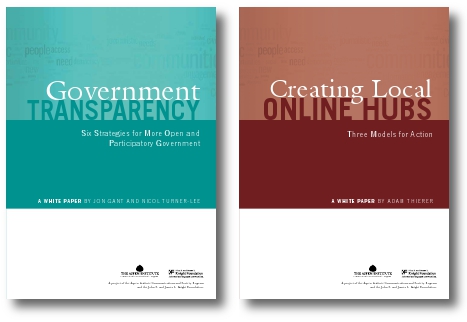
The roundtable focused on the release of two new white papers. The first, “Creating Local Online Hubs: Three Models for Action,” by Adam Thierer, discusses scenarios where community leaders, citizens, media, technologists and — critically, local government — can work together” to create local online hubs where citizens can access information about their governments and local communities.” Creating such high-quality online information hubs was one of the 15 key recommendations of Knight Commission on the Information Needs of Communities in a Democracy. “Just as communities depend on maps of physical space, they should create maps of information flow that enable members of the public to connect to the data and information they want,” said the Knight Commission. (Download PDF or Read Online)
“Governments need to get more information out and make it more accessible, said Thierer today. “This shouldn’t be controversial.” Thierer said that government can do well to catalyze and support this development simply by doing a better job of making such information easily available in easy to use formats. While open government data stores have grown, Thierer noted that this has not trickled down. He cited the example of Manor, Texas as one example of where one local champion (former CIO Dustin Haisler) got help from Stanford and other external resources to get the local open data repository online.
Broadly, Thierer described three models for online hubs:
Hubs focused on community government information. Example: Texas Tribune
Community connections: local forums and community email listservs. Example: e-democracy.org
Community news and commentary. Example: Universal Hub
Thierer focused on the important role that libraries and local or state universities can play in this new ecosystem, by connected offline and online worlds. These universities could create “code toolboxes” that local communities can use, as Stanford did for Manor. He hoped that that model could be replicated nationally.
Government transparency
Government Transparency: Six Strategies for More Open and Participatory Government, by Jon Gant and Nicol Turner-Lee, is call to action for state and local governments to adopt open government. The six sensible strategies “focus on enhancing government expertise and transparency, educating citizens regarding the availability and utility of government information and e-government tools, expanding efforts to support greater adoption of broadband Internet access services and devices, and forging public-private-citizen partnerships in order to enhance open government solutions.” (Download PDF or Read Online)
There are three basic issues here, according to Turner-Lee:
Do people get it?
Do they have the resources they need?
Can they do transparency with those resources?
“All of us who have been in this debate have seen a conflict between these three factors, said Turner-Lee. The question, she said Turner-Lee, is how we empower state and local government. The challenge is that in most open data effort, “We are still in a one-way world, where data is pushed down to the public, not in a reciprocal ecosystem.”
It’s one thing to say citizens who should be involved, said Turner-Lee, but more needs to be done. “As an organizer, I can speak to that. It’s hard to get people to a block meeting,” much less meeting online, she said. There’s also a persistent issue of the digital divide that has to be addressed in this context. “We cannot proclaim government transparency” where millions of people don’t have online access, said Turner-Lee.
There are many examples of where open data is being put to use on the behalf of citizens now. Turner cited apps driven by transit data in Chicago, heritage trees in Portland or the use of 311 by SeeClickFix in the District of Columbia.
Jon Grant focused on a major pain point for government at all levels for tapping into the innovation economy: procurement issues, which civic entrepreneurs run into in cities, statehouses and Washington. “It is time to look at these procurement rules more closely,” he said, and promote higher levels of innovation. “There are a lot of ideas are happening but a lot of rules restrict vendors from interacting in government,” said Grant. Turner-Lee observed that traditional procurement laws may also not be flexible enough to bring more mobile apps into government.
Fundamentally, empowering more government transparency through the Internet will require both creating a climate for the actions, said Turner-Lee, but also through structural changes, specifically, through the release of spectrum and Universal Service Fund (USF) reform.
It will also require that state and local government officials are part of the conversation, “It they aren’t at the table, we’re going to be pretty much talking to ourselves,” said Turner-Lee.
Former San Francisco CIO Chris Vein, now the new White House deputy CTO for government innovation, agreed. biggest challenge of all is that we like to think there are templates. to a certain extent, they can be. fundamentally, all politics is local. To make this work in government, a community “needs someone who takes risks, who goes out there and makes it happen regardlesss of the cost.”
All stakeholder at the panel acknowledged the crucial importance of community institutions, nonprofits and libraries in addressing issues of the digital divide and creating a bridge between online hubs and local citizens. Turner Lee noted that billions of people over the course of years have come into libraries for assistance, particularly the homeless and low-income citizens. “What better way to get people into the system by enabling libraries to be a conduit of information?” she asked.
“Public information belongs to the public, and the public’s business should be done in public,” said Turner. That said, local citizens also don’t want data for the sake of data. “Consumption of this data would be inconsistent if the data doesn’t provide quality of life,” she said.
On any given week, there’s usually someone delivering a presentation that explores the intersection of citizens, technology and government. Here are just a few of the better ones I’ve come across in 2011 so far. If you’ve found other gems out there on the Internet, please share the links in the comments. Below, you’ll find ideas from citizens of three different countries, along with a report on government from the Pew Internet Society that was delivered as a presentation.
Vincent Van Quickenborn
Vincent Van Quickenbore. Credit: Wikipedia
“My conclusion today:‘Open Data is becoming a reality. The public sector must lead by example. It must rethink administrative processes that appear to be dinosaurs in the era of social media and cloud computing.’” –Vincent Van Quickenborn, Belgian Minister for “Ondernemen en Vereenvoudigen.” (Loosely translated, that’s “enterprise and simplification.”)
Last week, Code for America Fellow Pete Fecteau gave a great five minute talk at Ignite Philly 7. Fecteau about why he’s participating in the program and what he’s hoping to accomplish.
“Code for America is not about building some shiny piece of technology. It’s about spreading both collaborative and cognitive knowledge. As many questions as we hope to ask in Philly, we hope to answer that many questions,” he said. “”What we build in Philly we share with the rest of the nation’s struggling cities. We’re opening data, plugging it in, and releasing it as an open source platform.”
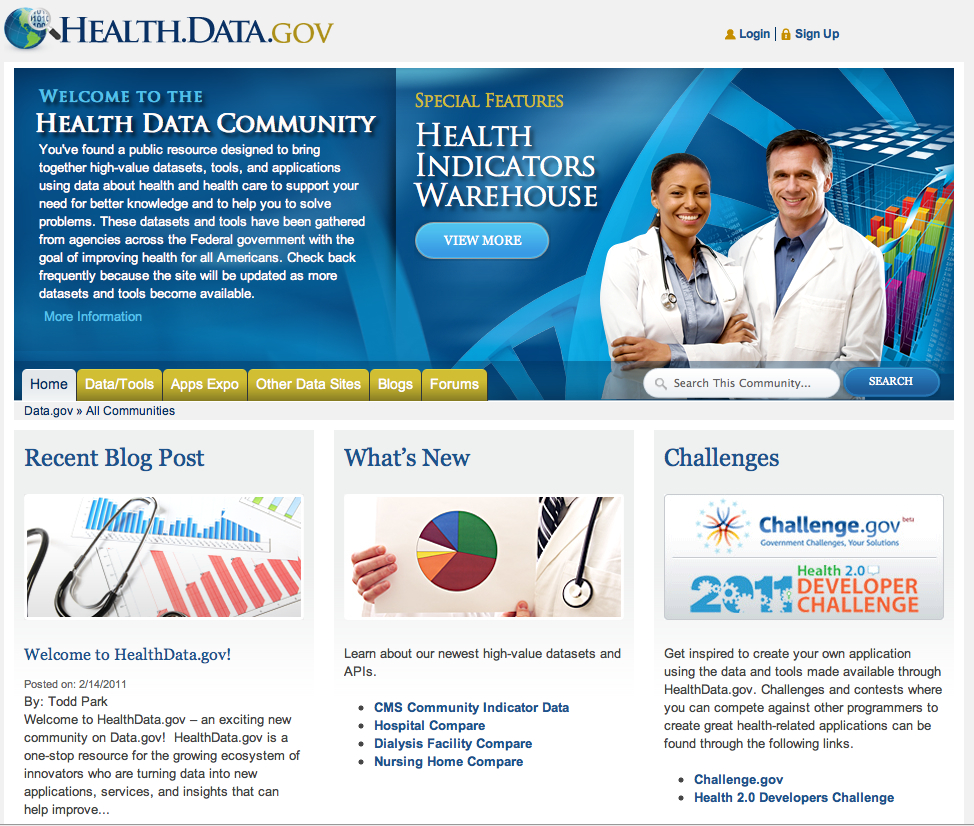
Last October, Todd Park, the chief technology officer at the Department of Health and Human Services (HSS) announced HealthData.gov at the HealthCamp in San Francisco. Today, Health.Data.gov went live. When the domain name propagates properly through the Internet, HealthData.gov will send online users directly to the new community at Data.gov.
“HealthData.gov is a one-stop resource for the growing ecosystem of innovators who are turning data into new applications, services, and insights that can help improve health,” he wrote.
Park has been working to make community health information as useful as weather data through the release of open health data from HSS. Today, the nation now can see more about what the tech community has come up since this spring, when the question of whether “there’s a healthcare app for that” was answered the first time. “Social value and economic value can go hand in hand,” he told a health IT summit in San Francisco.
Below, Park speaks more about what open health data could mean at last weekend’s health 2.0 code-a-thon in Washington, DC.
We are deluged in big data. We have become more adept, however, at collecting it than in making sense of it. The companies, individuals and governments that become the most adept at data analysis are doing more than find the signal in the noise: they are creating a strategic capability. Why?
“After Eisenhower, you couldn’t win an election without radio.
After JFK, you couldn’t win an election without television.
After Obama, you couldn’t win an election without social networking.
I predict that in 2012, you won’t be able to win an election without big data.”
In November 2012, we’ll know if his prediction came true.
All this week, I’ll be reporting from Santa Clara at the so-called “data Woodstock” that is the Strata Conference. Croll is its co-chair. You can tune in to the O’Reilly Media livestream for the conference keynotes.
For some perspective on big data and analytics in government, watch IBM’s Dave McQueeney at last year’s Gov 2.0 Summit:
Or watch how Hans Rosling makes big data dance in this TED Talk:
An important role of technology journalists in the 21st century is to explain how broader trends that are changing technology, government and civic society relate to average citizens. Some have called this broader trend towards smarter, more agile government that leverage technology “Gov 2.0.” (Readers of this blog are no doubt familiar with the term.) When you dig into the topic, you can get stuck in a lot of buzzwords and jargon quickly. Most people don’t care about how a satellite gets into orbit, the release of community health data or the standards of an API for product recalls. They care quite a bit, however, about whether their GPS receiver enables them to get to a job interview, if a search engine can show them ER waiting room times and quality statistics, or if a cradle for their baby is safe. Those wonky policies can lead to better outcomes for citizens.
The following stories have little to do with technology buzzwords and everything to do with impact. Following are five stories about government 2.0 that matter to citizens, with issues that literally come home to everyone.
2) The new Consumer Financial Protection Bureau will use technology to listen to citizens online to detect fraud. If you haven’t heard, DC has a new startup agency. That hasn’t happened in a long time. Your could think of it as Mint.gov mashed up with HealthCare.gov. The CFPB plans to use technology in a number of unprecedented ways for fraud detection, including crowdsourcing consumer complaints and trends analysis. Given how much financial fraud has affected citizens in recent years,and how much of the anger that the public holds for the bailouts of banks remains, whether this agency leveraging technology well will matter to many citizens.
3)Social data and geospatial mapping join the crisis response toolset. Historic floods in Australia caused serious damage and deaths. Government workers used next-generation technology that pulled in social media in Australia and mapped the instances using geospatial tools so that first responders could help citizens faster, more efficiently and more effectively. It’s an excellent example of how an enterprise software provider (ESRI) partnered with an open source platform (Ushahidi) to help government workers use social media to help people.
4) New geolocation app connects first responders to heart attack victims.The average citizen will never need to know what Web 2.0 or Gov 2.0 means. Tens of thousands, however, will have heart attacks every year. With a new geolocation mobile application that connects citizen first responders to heart attack victims, connected citizens trained in CPR now have a new tool to help them save lives.
Better access to information about food safety, product recalls and financial fraud will help citizens around the country. Improvements to the ability of government workers to direct help in a disastrous flood or for citizens to receive immediate help from a trained first responder in an emergency are important developments. As 2011 takes shape, the need for government to use social media well has become more important than ever. That’s why the perspective of government officials like FEMA administrator Craig Fugate matter.
“We work for the people, so why can’t they be part of the solution? “ said Fugate, speaking to delegates from the distributed chapters of Crisis Commons assembled at FEMA headquarters. “The public is a resource, not a liability.”
For example, Fugate said that FEMA used reporters’ tweets during Hurricane Ike for situational awareness. “We’ve seen mashups providing better info than the government.” Listening and acting upon those digital cries for help on social media during crisis could literally be a matter of life and death.
Whether government can adapt to a disrupted media landscape and the new realities of information consumption is of substantial interest to many observers, both inside and out of government. Whether government can be smarter, agile and more effective is a great interest to all.
An image of (insert name here), taken at about 2:30 this afternoon. (Photo by Abby Brack/Library of Congress)
Open government advocate Carl Malamud made a succinct recommendation for improving the United States House of Representatives on January 24th: “Open it up. Bulk access, developer day, an API, long-term open source model. People’s house.” Malamud linked to a letter at House.Resource.org to Representative Eric Cantor (R-VI), House Majority Leader in which he made the case for making bulk data access to bills and corollary data available to the public online through Thomas.gov:
Access to bulk data, both for the core Thomas system and for corollary databases, would have a huge and immediate effect. Hosting a developer day and making sure stakeholders are part of the long-term development will help keep the next- generation system in tune with the needs of the Congress and of the public.
As Malamud pointed out, long term plans to improve public access to the law are evolving, including the announcement that the Cornell Law Library would redesign Thomas.gov legislative/meta data models:
It’s finally official: The Library of Congress has selected us to work on a redesign of their legislative-metadata models. This sounds like really geeky stuff (and it is), but the effects for government and for citizens should be pretty big. What’s really being talked about here is (we hope) a great improvement not only in what can be retrieved from systems like THOMAS and LIS (the less-well-known internal system used by Congress itself), but also in what can be linked to and referenced. We’ll begin with a careful compilation of use cases, build functional requirements for what the data models should do, and go from there to think about prototype systems and datasets. The idea is to bring Semantic Web technology to bills, public laws, the US Code, Presidential documents, and a variety of other collections. Longtime LII friends and collaborators Diane Hillmann, John Joergensen and Rob Richards& will be working with our regular team to create the new models and systems.
Will the new GOP leadership take Malamud up on his proposal for an open developer day and bulk data? Stay tuned. As Nancy Scola wrote in techPresident that “Republicans in the House are making technology-enabled openness, transparency, and participation central to the public presentation of their core political values in a way that their Democratic counterparts never fully did.” Malamud has a track record that lends considerable credibility to his prospects: he helped to get the SEC online in 1993. More recently, “Washington’s IT guy” was able to work with the House leadership to start publishing hundreds of high-resolution videos from the House Oversight Committee hearings at House.Resource.org earlier this month.
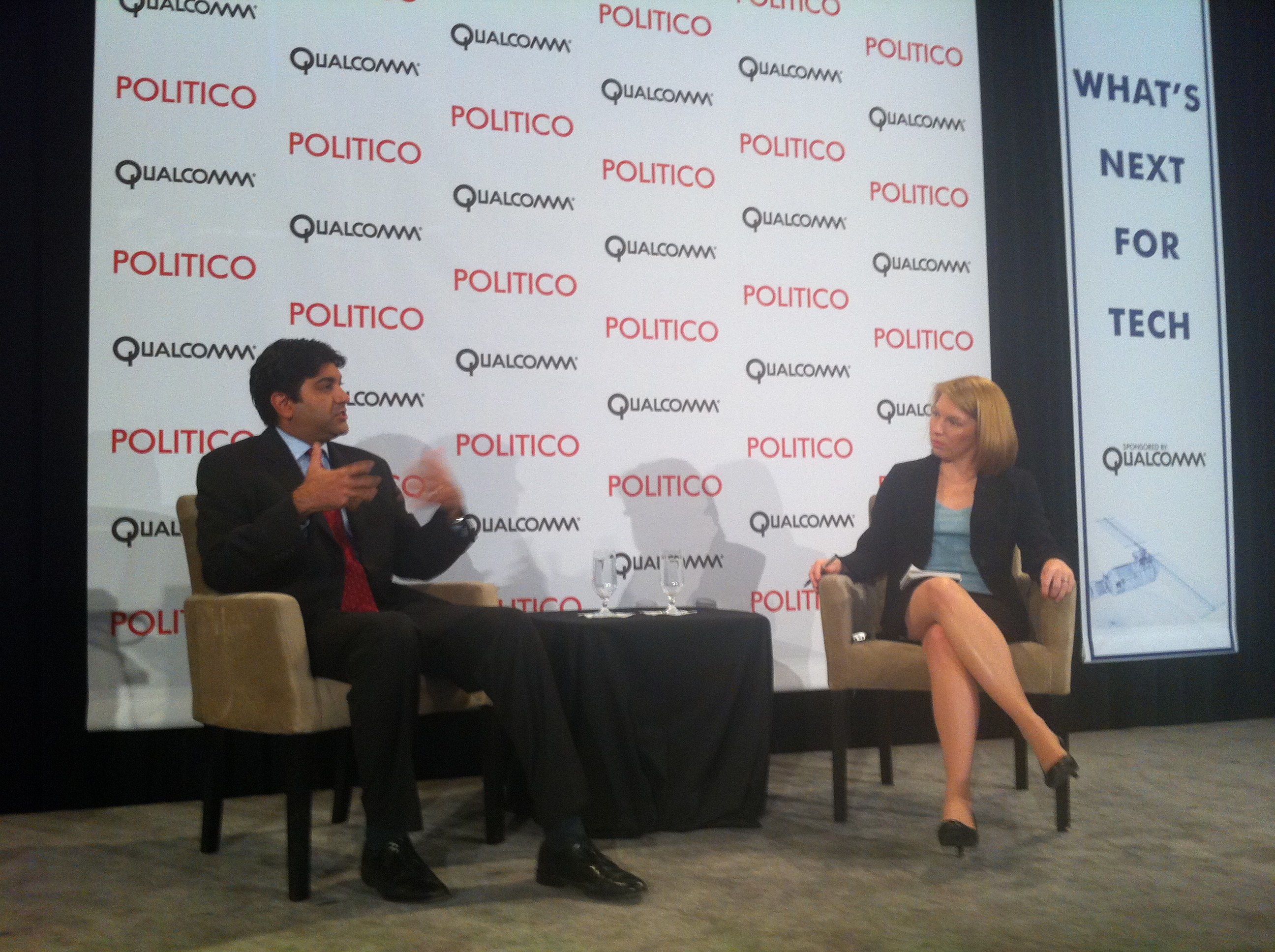
“The single best thing we could do in open government is to get the American people engaged in the question of what high value data is,” said Aneesh Chopra, the first United States chief technology officer, speaking at this morning’s Politico “What’s Next in Tech” forum in Union Station. Video is below:
In an interview with Politico’s technology editor, Kim Hart, Chopra looked back at the lessons learned from his first two years on the job and ahead, appropriately, to what to expect in tech policy from the Obama administration. They covered a lot of ground, from open government successes to what’s next in Congress (hint: watch the push to open up spectrum for first responders) to supporting entrepreneurial growth.
Lessons learned
What were Chopra’s lessons learned? He offered up three examples.
First, with support from the President, Chopra said that they’ve been able to open up discussion and build trusted relationships across the federal government, which has been “critical” to improving the way technology could be used and the long term policy posture.
Second, with that support, he’s been surprised on seeing the pace of response become fast. There’s a “lesson on balance of getting long term balance, versus getting results in 90 days,” he said, referring to the turnaround on projects like HealthCare.gov.
Third, Chopra emphasized the role of “government as a convener,” where the administration can use its influence to bring people together to accomplish goals with technology without new regulations or legislation.
Working tech policy levers
What are the levers that the first US CTO has worked to try to galvanize action on the administration’s priorities?
First, a commitment to openness. From Manor, Texas, to inner cities, “people have found ways to tap into info in ways that helps them do something different,” said Chopra, speaking to the phenomenon of Gov 2.0 going local. “85 to 90% of that activity is happening in places we wouldn’t have imagined,” not gathering in Washington.
Second, Chopra cited the White House’s work towards “voluntary, consensus-driven standards,” noting that he was ” very proud of the work on NHIN Direct.”
Finally, Chopra noted that there’s some $150 billion spent on research and development every year, which offers a number of ways to push forward with innovation in priorities like healthcare IT, energy, smart grid or communications.
Making meaningful use modular
Given the new Congress coming in to Washington, Chopra’s description on the bipartisan agreement on tech policy from his time in Virginia under Republican leadership has to be more than a little strategic. He talked about “getting to the right answer,” referring back to an former manager, David Bradley, and his management strategy of “True North.”
That approach will be rested in the next Congress, on rulemaking. and in moving forward with the tech policy decisions. Outside of the healthcare bill that President Obama signed into law, which continues to meet with significant opposition in Congress, Chopra noted that “healthcare is signature part of President’s agenda,” specifically advanced by more than 20 billion dollars in Recovery Act spending on healthcare IT.
Chopra looked back at two decisions related to approaching technology policy a bit differently. “Rather than walking into Best Buy and buying software, we created more flexible standards for meaningful use,” he said. As a result, “entrepreneurs that never thought of themselves as EMR companies are entering the market.”
The decision to make meaningful use more modular was also significant, asserted Chopra. “We opened up the regulatory regime so you could certify each and every regulatory module.”
In aggregate, Chopra associated that R&D investment, work to convene conversations, open up data and create more flexible regulatory regimes with a better outcomes: venture capital investment in HIT going up by 39%, citing a statistic from the National Venture Capital Association.
How did Chopra respond? He asked for more criticism, responding that you “must listen to people who are frustrated” and consider that much of the tech platform is in the space “where the plane is yet to land.” If you go through campaign promises, and look at executive ability to move the needle on different areas, Chopra asserted that the
biggest part of that – open government – has gone ahead. “It’s not ‘mom and apple pie perfect’,” he said, but they’re proud of delivering on 90 day deliverables like standards, or websites.
Part of the challenge of delivering on campaign promises is that budgetary or legislative action requires different stakeholders, observed Chopra, a reality that will become even more sharply defined in the next Congress. “The Recovery Act is a unique moment in time,” which, as he argued is “overwhelmingly the vehicle for campaign promises” in health IT and clean tech.
What’s next in United States technology policy?
First, it’s clear that Chopra and the Obama administration is thinking about online privacy, with the recently announced Internet privacy committee. There are open questions about how much portfolio, budget, subpoena power or other authority any new position would hold, but it’s an area to watch. Chopra said that he had met with Representative Bob Goodlatte (R-VA) and had found him supportive of privacy policy.
Chopra also met with Representative Darrell Issa (R-CA), who is very supportive of increased government transparency through technology. Issa, a successful technology entrepreneur, is one of the most knowledgeable members of Congress when it comes to technology. Whatever comes out of his his legislative staff, or the new House Oversight committee, which he will chair, could represent a step forward for open government after the 2010 election.
Chopra also emphasized “modest but significant actions” that could improve the conditions for tech entrepreneurs in the United Stats, from open government data to regulatory action to smart grid or support for new learning technologies. On that count, Chopra offered up a “scoop” to Kim Hart, observing that the next area where he will focus on driving innovation will be into learning technologies, with more news coming at a Brookings Institute event in December.
The top opportunities that Chopra sees for entrepreneurs are in healthcare and energy, the former of which is already becoming hot with more healthcare apps provisioned with open healthcare data
“One policy lever is the role of public-private partnerships,” observed Chopra, highlighting the growth in STEM education, with over half a billion dollars in investment. “It’s not the money, it’s the platforms,” he said.
Chopra fielded a question Congressman Wu (D-OR), the current chairman of the House technology and innovation committee. After a discursion into what went wrong for the Democratic Party in the midterm, Wu asked what the next priority will be for Congress and Chopra to work together upon. His answer was simple: spectrum policy, emphasizing voluntary processes for formulating solution. The priority, he said, was to get a broadband network for public safety that’s interoperable for first responders.
Finally, Chopra talked about the story of the Alfred brothers, who founded Brightscope in California in 2008. The story of Brightscope is important: data driving the innovation economy. They knew about key data on 401(k) plan fees at the Department of Labor, worked hard to liberate it and now have a successful, growing startup as a result.




 E Pluribus Unum