New Orleans launches open government data site

Tonight, Denice W. Ross, director of applications for the city of New Orleans, tweeted the news that “NOLA” had soft launched an open data site. There’s not a lot of data there yet but it’s a great start. Data.NOLA.gov is beautifully designed and based upon the Socrata platform, which will give the embryonic site room to grow.

As Ross shared, New Orleans’ new open data site starts its life online with data on parcels, streets, building permits, council districts and census data. The site also has data on post-Hurricane damage assessment that some plucky civic developer or data journalist will likely mash up to good effect.

For those unfamiliar, open government data broadly refers to public sector records that have been made available to citizens. Putting up an open government data platform online is not in of itself a guarantor of more open government, responsive government or good government — but it can be a enabler for all those things, in partnership with public officials, nonprofits, developers, media and citizens.

For a canonical resource on what makes such releases truly “open,” consult the 8 principles of open government data.

I first encountered Ross last year, at the Gov 2.0 Expo in Washington. Ross, who was then affiliated with the Greater New Orleans Community Data Center, gave a terrific talk about “An App We Can Trust: Lessons Learned in Post-Katrina New Orleans.” I’ve embedded it below.

UPDATE: As Leando Oliva shared, today was also the release of the sixth New Orleans Index. According to the Brooking Institute, the Greater New Orleans Community Data Center took on the publication of this index as a solo effort:

Download the Full Report » (PDF)
Download the Executive Summary » (PDF)
Download the Data Tables » (XLS)

American University to host EPA Apps for the Environment hackathon

If you’d like to get your civic hacker on, American University is hosting a hackathon for the Apps for Environment on Saturday, September 3rd. Register to make green apps here.

The pitch for the hackathon includes a “green from the beginning” detail that may catch the eye of sustainable energy advocates:

The hack-a-thon will be located in the spacious new Graduate Research Center adjoining the School of International Service building, which is itself a certified LEED Gold marvel of green technology innovation. With a sustainable design and “cradle-to cradle” philosophy for recycling and reusing building materials, participants will even power their devices with solar and wind offset power so their Apps for the Environment will be green from the first idea until the last line of code.

Come one, come all

The hackathon’s organizers emphasize that this event isn’t just about the District’s local civic coders: “Whether you’re a student at any school in computer science, journalism, a professional in the field, or just have an idea to share (which you can post here http://blog.epa.gov/data/ideasforappscomments/) please join us at the hack-a-thonT”

American University journalism professor David Johnson left a comment on the event page that expands that idea:

…even if you can’t code, you can have ideas. even if you don’t have ideas, you can help spread the word. even if you can’t come to DC or AU, you can join us on twitter, ustream, IRC, GitHub, and other online hangouts… we’ll be all over it. everyone can be a part of this. spread the word to campuses and dev shops. come hack with us.

Open data webinar

Last week, I moderated an EPA webinar on open data and the Apps for the Environment challenge from the D.C. headquarters of the U.S. Environmental Protection Agency.

If you’d like to learn more about Apps for the Environment (and hear a robust conversation about open data and apps contests!) watch the webinar and presentation embedded below.

Apps for the Environment Developer Webinar(function() { var scribd = document.createElement(“script”); scribd.type = “text/javascript”; scribd.async = true; scribd.src = “http://www.scribd.com/javascripts/embed_code/inject.js”; var s = document.getElementsByTagName(“script”)[0]; s.parentNode.insertBefore(scribd, s); })();

Hackathon coordinates

If you would like to participate in the AU hackathon, you can put your civic surplus to work from 9 AM to 6 PM at the location below:

Head on over to the event page on Facebook for more details and register to make green apps at Eventbrite.

Carmi Levy: open government is about leveraging technology and citizens to do more with less

It looks like the dog days of August 2011 may be the month when the meme of a citizen-centric government gets some traction in the business world. Over on the finance section of Yahoo Canada, Carmi Levy writes that the future of government is citizen-focused.

Levy cites open government in British Columbia and initiatives in New Zealand, Toronto, and Lousiana as case studies for his thinking and then connects the dots with the big idea: that technology enables officials to empower citizens to work with government in new ways, driven by macrotrends towards open data, mobile connectivity, social media and austerity measures.

…governments are increasingly giving citizens free rein to do as they wish with previously inaccessible data. Costs are significantly reduced as big, conventional IT projects are replaced by more on-the-fly approaches to resource management. Timelines are also cut down to size thanks to the use of agile development methods and more collaborative models. Crowdsourcing also maximizes the use of newer technologies, thanks to home-based developers looking to market their prowess to a broader audience. This all translates into more bang for the public buck.

Proponents of open data initiatives claim they increase government efficiency and effectiveness by encouraging greater levels of citizen participation in the creation and delivery of public services. But in light of the just-completed U.S. deal to restructure its debt ceiling and begin trimming the federal budget, it’s difficult to ignore the cost side of the equation, as well.

As governments on both sides of the border find themselves increasingly pressured to deliver the same — or more — services for less, open data and so-called Government 2.0-based initiatives could hold the key to taxpayers having their cake and eating it, too. As government shrinks, citizens willingly take up the slack using rapidly evolving development and social media tools.

Open government isn’t just a philosophical concept designed to drive democracy.

It’s really about leveraging technology — and technologically enabled citizens — to do more with less. By throwing data out there and seeing what develops, governments can reduce spend and enable business in ways they simply wouldn’t be able to do if they functioned conventionally. They can leverage the motivations and skills of interested members of the public to create value that conventionally hired departmental resources have never been able to achieve; at least not at this level of efficiency.

Carmi Levy (@CarmiLevy)

It’s a bold vision, although perhaps a familiar one to those who have been following the narrative that runs through these open government stories. The notable connection is connecting this approach to the need that governments have now.

If open government is going to work better, however, citizens will have to become more civically engaged — and their governments will need to both listen to them and work with them.

Notes from the third White House Open Government Partnership consultation

In July 2011, the State Department hosted an historic gathering in Washington to announce an Open Government Partnership with Brazil and six other nations. For background on the initiative, read this digest on Open Government Partnership analysis for context.

This new new open government partnership could drive U.S. commitments, according to OMB Watch.

What those commitments will be is still unclear. Given that they’re due by September’s Open Government Summit at the United Nations in New York City, the timeline for drafting them is quite limited.

Last week, when the White House asked for ideas on the National Plan for open government, the community learned a bit more about what’s on the table: improving public services and increasing public integrity.

Clay Johnson has since offered the White House a deep set of recommendations for open government in response to the three questions it posed, including better ways to use open data, social media, improving regulations, public comment, and the developer community better. If you’re interested in open government, it’s a must-read.

Those are not the limit of potential commitments on the table, at least as evidenced by what we know about the series of three consultations with open government stakeholders in Washington that the White House Office of Information and Regulatory Affairs held this July, on the 22nd, 25th and 29th. These consultations were not livestreamed or otherwise recorded, however, nor have OIRA’s notes been released to the public yet. That said, we have at least two accounts of what happened in July, from:

I attended the July 29th consultation and, while I did not record video or audio, can share the following written notes.

Attendees

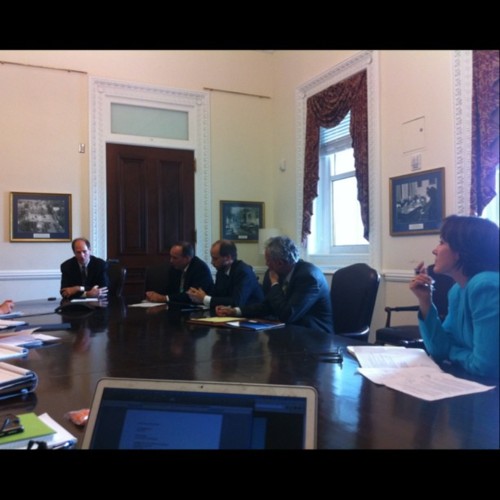
As with the previous meetings, OIRA administrator Cass Sunstein led the discussion. White House OSTP deputy CTO for public sector innovation Chris Vein was also there, along with half a dozen OIRA staff and a representative of the National Security Archive.

Seated around the table were representatives from America Speaks, OMB Watch, the Center for Technology in Government at the University of Albany, Sunshine in Government. University of Pennsylvania professor Cary Coglionese and a board member from the International Association for Public Participation, Leanne Nurse, dialed into a conference speaker phone line.
Past meetings included representatives from the Revenue Watch Institute, Code for America, Harvard’s Kennedy School of Government, Open Plans, Civic Commons, the Sunlight Foundation, Citizens for Responsibility and Ethics in Washington and the Project for Government Oversight, in addition to Open the Government and NCDD.

Open Government Consultation

Sunstein started the meeting by offering high level context for the OGP and thanks to the organizations around the table.

When the OGP was devised, he said, it was done with background experience from the Open Government Directive that came President Barack Obama and the White House Office of Management and Budget.

Many of your organizations were “indispensable” during that process, Sunstein said, and even though what happened with the open government directive “wasn’t perfect,” there has been “tremendous progress.” He thought from the beginning, with regard to the OMB open government project, that it would be a work in progress, with plans scrutinized and improved over time.

Sunstein laid out the reason for the consultation: the White House has national action plan due in September, with an event at the UN as the president promised. The White House wants the national action plan to be as good as possible, “improving on what we’ve got so far as we can.” Reflecting his comments at the previous two consultations, Sunstein said that one way to think of the meeting is generating ideas through three stages, given the temporal and feasibility constraints posed by the short deadline for UN recommendations. He observed that where would be opportunities moving forward in the medium term, over a 3-5 month time period to do more.

Katherine McFate, the executive director of OMB Watch, asked a question about the parameters for the consultation, noting that if you go back and look at the open government partnership, there are five different challenges for countries. If you only have to pick one or two, she suggested, improving public services is one, and may be improving public integrity is another. Increasing accountability, likely to be three. (Given the recent White House blog post, OIRA may have taken that suggestion.)

In response, Sunstein replied that there are surely things that have budgetary repercussions, which you then have to answer for, although in open government, sometimes it’s possible to improve public services without stretching the budget.

Theresa Pardo, director of the CTG at Albany, after thanking OIRA for the opportunity to speak and to listen, focused on the some of the issues that have arisen during implementation of the open government directive, including the role of citizen engagement. One tension is how to think about citizen participation, versus accountability imperatives.

One of the things that we hear quite regularly when we talk to practitioners at federal, local, and state level, along with academics, is a lot of confusion about concepts underlying open government directive. There’s pressure towards clarity, and still a lot of ambiguity. One of the ways to push through in creating that clarity, she suggested, would be to focus a bit more on the conversation, on figuring out what the problems that citizens are seeking open government to solve. Pardo said that in their experience, in various jurisdictions in US and outside of the US, it’s a challenge to connect what’s happening in government agencies with what citizens are talking about in public. Over the long term, the opportunity for open government, she explained, is to move towards deeper engagement with citizens themselves about what problems are they experiencing.

Professor Coglianese, speaking over the phone, agreed with Pardo and McFate. He also suggested that the White House clearly take stock of where open government is currently. We’re seeing great things, in taking stock of regulations, he said. It would make sense to something similar with taking stock of public participation now, defining a better baseline of where to assess what kinds of reform are making changes.

The point, about defining a baseline for public participation, was taken up and emphasized by many of those invited to the July 29 consultation. One of our major tools is the public participation spectrum, said Douglas Sarno of IAP2 USA. No systematic approach to what we’re trying to do or what’s been achieved has been defined by the White House, he said, and no way of qualifying bonafide public participation versus hackneyed participation defined. There are good challenges in finding metrics.

Sunstein agreed that the regulatory process requires significant public participation. This week, the Regulations.gov team acknowledged the need to do more in that regard.

In response, Pardo cited a number of studies in which communications scholars and computer scientists are using machine language processing to analyze online rulemaking to see if it results in changing in deliberation or positive social interaction. Such studies can be expensive but useful. Part of the issue in integrated such work, however, is getting real movement in processes in partnership with academics, she said.

Pardo focused further upon the role of citizen engagement, both around rulemaking and the large context of open government. Nowhere, until just recently, she said, do we teach our public managers about how to look, engage, and use citizen participation tools. “There’s a capability gap at all levels of government. How do public managers in local governments and cities, think about their jobs in different ways?”

The National Association of State CIOs and others are looking at building capability to understand how to use data and engagement tools better, said Pardo, but across the board there’s lack of ability in these core competencies. Maybe building ability as with cybersecurity skills would make sense, she suggested, including professional standards for citizen participation.

Coglianese similary focused more on baseline assessments for public participation. There are some political scientists who have tried to assess the actual impact of public comment and proposed rulemaking, he said. In terms of what to look to as baseline, what is it you want to accomplish with this national action plan? Is the goal to increase public participation? What is the level right now? We don’t have a way of saying what the volume of interaction is across the federal government, he asserted.

We do know, however, that rulemaking tends to be more something that organizations participated in more than individual citizens, Coglionese said, citing a recent article on public participation that he’d authored law journal. “We need a baseline of who’s participating and at what level,” he said. “Is the goal of participation to increase the quality of public decision making? That’s hard to assess. To enhance public virtue? That’s much harder to assess. Until it’s clear exactly what it is you would want to do, you can’t answer these questions.”

David Stern, director on online engagement at America Speaks, validated Coglionese’s words, observing that his organization had recently looked at all open government plans by agencies and came to the same conclusion. There’s a lack of consistency in metrics used to evaluate projects, said Stern, and no standards about what defines good participation. Number of people, diversity, number of instances policy influenced? Standards and best practices, in this area, would be helpful coming from White House and OMB. Every open government project contains response to the most popular proposals, he said, which means that every public engagement initiative has a public engagement component.

Rick Blum of Sunshine in Government raised another issue: FOIA exemptions, including agencies proposing them independently. The Department of Defense is overclassifying, said Blum, and it’s very hard to track what’s happening. The Department of Justice has put up a FOIA dashboard but it’s “plagued with tech glitches and bad data,” he said. This has become a public debate about secrecy or disclosure, with some half a billion dollars being spent annually fulfilling FOIA requests, said Blum. There’s also concern about the impact of the recent Supreme Court decision in Milner vs the Navy.

On my part, I offered feedback that I’d collected from the broader open government community ahead of time and over the previous year.

First, the White House has not explicitly separated open government innovation, in terms of open data about the business of government, from “good government” initiatives that transparency advocates expect and demand, in terms of accountability to the people. Misset expectations around the goals the White House has set out have created widespread dissatisfaction and harsh criticisms of an administration that promised to be “most transparent ever.” The open government initiative in the province of British Columbia offers a potential model for the White House to consider, in terms of this separation.

Second, as the federal government moves forward with its ongoing review of .gov websites, there are opportunities to work with civil society and civic developers to co-create better e-services.

Third, opportunities exist for the White House to partner with entrepreneurs, media or nonprofits that are making government data open, useful and searchable. For instance, BrightScope has made financial advisor data from the SEC and FINRA available to the public. The work of Code for America and others on farmers market open data is another example.

Finally, there continue to be serious issues raised by developers about the quality of open government data on Data.gov. In general, public servants continue to release PDFs, as opposed to machine-readable structured data, and cite the language in the Open Government Directive for support. If government wishes developers and businesses to use its data for accountability, civic utility or economic value, then releasing data in the open formats that these communities find most useful makes logical sense.

Pardo took up the issues raised with good government versus open innovation, noting that the two aren’t necessarily against each other. The idea of high value data wasn’t well defined, she said. For instance, the calendars of public officials are nothing more than a dataset.

Sunstein asked after the data issues and the one of his deputies specifically asked about the language in the OGD. He brought up the work that the federal government has done on regulations.gov – which was a persistent focus from the OIRA administrator – and asked whether it was good enough, and over what time limit? And for whom?

The general answer there was clear enough: “we the people.”

Coglianese offered more feedback on regulations.gov: it’s not enough. There are data fields are not filled in, missing information, and things remain incomprehensible, he said. “Imagine how it is for many others coming for first time?” Coglianese endorsed the recommendations of ADA blue ribbon commission for a dedicated overseer of data quality, although such a role would require congressional authorization.

There are some really important opportunities to leverage data in regulations.gov, he emphasized. Leverage that data to extract it automatically, display the data on websites. For instance, many members of congress have a button on their websites forlegislation they’re sponsoring, which then takes visitors to data automatically etxtracted from Thomas.gov. Imagine a similar system for agencies and regulators, he suggested, or consider the EPA, which is trying to display every rule that the agency is working on., which is being developed in addition to regulations.gov.

Agencies right now are building websites around current uses, said Coglionese. That makes a lot of senses, and it’s what one would hope, but doesn’t go to the “separate question of who do they want their users to be.” He criticized the design of the new FCC.gov, although I pointed out that the process that preceded the FCC relaunch was focused on the most common purposes of the site’ visitors.

What was left unsaid in these open government partnership consultations? A great deal, due to the length of time allowed. The voices that were heard around this table were also those of advocates, policy, experts, academics, and technologists: not citizens, and by and large not those of the media, whose function in representative democracies been to hold government accountable on behalf of the public.

As the White House considers its commitments in advance of the September meeting at the United Nations, the people will have a window of opportunity to tell their elected officials what open government means to them and how they woud like their federal government to be more transparent, participatory or collaborative.

If you have feedback on any of those accounts, send it to opengov@omb.gov.

Health 2.0: Todd Park talks about open data and healthcare at NYC Hacks and Hackers [VIDEO]

If you’re a regular reader of Govfresh or the O’Reilly Radar, you know how the chief technology officer of the U.S. Department of Health and Human Services, Todd Park ,is focused on unleashing the power of open data to improve health. If you aren’t familiar with this story, go read Simon Owen’s excellent feature article that explores his work on revolutionizing the healthcare industry. Part of unlocking innovation through open health data has been a relentless promotion and evangelization of the data that HHS has to venture capitalists, the healthcare industry and developers. It was in that context that Park visited New York’s Hacks and Hackers meetup today. The video of the meeting is embedded below, including a lengthy question and answer period at the end.

health20nyc on livestream.com. Broadcast Live Free

NYC Hacks and Hackers co-organizer Chrys Wu was kind enough to ask my questions, posed over Twitter. Here were the answers I pulled out from the video above:

How much data has been released? Park: “A ton.” He pointed to HealthData.gov as a scorecard and said that HHS isn’t just releasing brand new data. They’re “also making existing data truly accessible or usable,” he said. They’re taking “stuff that’s in a book or website and turning it into machine readable data or an API.”

What formats? Park: Lots and lots of different formats. “Some people put spreadsheets online, other people actually create open APIs and open services,” he said. “We’re trying to migrate people as much towards open API as possible.”

Impact to date? “The best quantification that I can articulate is the Health data-palooza,” he said. “50 companies and nonprofits updated and deployed new versions of their platforms and services. The data already helping millions of Americans in all kinds of ways.”

Park emphasized that it’s still quite early for the project, at only 18 months into this. He also emphasized that the work isn’t just about data: it’s about how and where it’s used. “Data by itself isn’t useful. You don’t go and download data and slather data on yourself and get healed,” he said. “Data is useful when it’s integrated with other stuff that does useful jobs for doctors, patients and consumers.”

ExpertLabs: The future of open government is citizen-focused

On Monday, the White House asked for ideas on the National Plan for open government in the Open Government Partnership. (For background on the initiative, read this digest on Open Government Partnership analysis for context.) Specifically, the White House asked for feedback on ideas related to two of the key challenges from the OGP: improving public services and increasing public integrity.

  • How can regulations.gov, one of the primary mechanisms for government transparency and public participation, be made more useful to the public rulemaking process?
  • OMB is beginning the process of reviewing and potentially updating its Federal Web Policy. What policy updates should be included in this revision to make Federal websites more user-friendly and pertinent to the needs of the public?
  • How can we build on the success of Data.Gov and encourage the use of democratized data to build new consumer-oriented products and services?

Today, Clay Johnson offered the White House a deep set of recommendations for open government in response to the three questions it posed, including better ways to use open data, social media, improving regulations, public comment, and the developer community better. If you’re interested in open government, it’s a must-read.

We believe the future of open government is citizen focused — to be open to engagement on the terms that citizens are used to in the venues they’re accustomed to.

The growth of social media since the delivery of the initial open government directive, and its adoption by agencies’ communications departments requires the next step: for social media to also be used in giving citizens a voice in regulatory decisions. We believe the future of open government is about discoverability. Moving data or regulations from print publications to the online world results in a net loss if there are less people viewing them. Government should work hard to make sure that all publicly available information is discoverable by search engines, and via social media.

We believe that the future of open government is through the engagement of open source communities, and that agencies should begin to open up to their participation. Government treats lawyers as experts in the field of law, why not treat developers as experts in the field of processing data? Take the next step and participate with them directly, rather than through independent vessels.

– Clay Johnson (@cjoh), Recommendations for Open Government

For more on the decision to use email in the consultation, read Tiago Peixoto’s post on Google Plus.

Apps for the Environment: Can developers and government talk? [WEBINAR]

Over the past two years, entrepreneurs, developers and government agencies have collaboratively explored the power of open data to improve health or transit data as open government fuel for economic growth. Now, the Environmental Protection Agency (EPA) is looking to do the same with an Apps for the Environment challenge.

This Thursday at 4 PM EST, the EPA is hosting a webinar for developers to hear more from the community about what the government can do to make data more usable by developers. (Heads up, government folks: Socrata’s open data study found progress but a long road ahead, with clear need for improvement: only 30 percent of developers surveyed said that government data was available, and of that, 50 percent was unusable.)

I look forward to moderating the EPA webinar (register here) on Thursday. Listeners can expect to hear more about collaborative innovation in open government, crowdsourcing and challenges, and the sustainability of apps contests before we open up the discussion with Jeremy Carbaugh of Sunlight Labs and Michaela Hackner of ForumOne, the developers of DataMasher, the winner of Apps for America2.

If you’re interested in a different kind of public service through code, please tune in.

Nigel Shadbolt on data.gov.uk: Open data is not a partisan issue

Catalyzing innovation and adding more transparency to government through the release of open data is an issue that should rise about partisan politics. At least, that was the message that Nigel Shadbolt, an advisor to the United Kingdom, delivered at a conference in Bilbao, Spain yesterday.

Opendata : les leçons à tirer de data.gov.uk, par Nigel Shadbolt from RSLNmag on Vimeo.

Shadbolt’s presentation on how they did data.gov.uk, the British open government data website will offer some fuel to the arguments of advocates in other countries or states working to justify standing up similar repositories – or defend one that are already online. In his presentation, below, Shadbolt offers up a range of arguments, including more accountability, citizen engagement, improvement to public services, government efficiency, benefits to economic and social value, and that “government as a platform” idea that continues to maintain traction around the globe.

Opendata – data.gov.uk : how did we do it?

It was only last month, after all, that the United States Congress weighed deep cuts to funding for federal open government data platforms, with the final budget slashing the White House Office of Management and Budget’s e-government fund by some 75%. As data.gov relaunches as a cloud-based platform, the arguments for open data that Shadbolt advances will need to be born out with favorable outcomes in at least a few areas over the coming year to shore up bipartisan its continued operations. The brightest hope for those outcomes is likely to come from health.data.gov, a subdomain of the main open government data repository, where the U.S. Department of Health and Services has been working to making health data as weather data.

For more on the United Kingdom’s open government initiative and the open data movement, watch Shadbolt’s talk from February 2011 of this year, embedded below:

[Hat tip to the Australia E-Government Research Center]

Data.gov relaunches as a cloud-based open data platform

There’s a new version of data.gov going online. For those keeping track, Data.gov is the open data website that the United States federal government launched two years ago. The most recent iteration integrates the services of Socrata, a Seattle-based startup that has quietly been helping cities and states around the country to get their data online. For more on the new version of Data.gov, check out explore.data.gov or watch Socrata’s introductory video about the changes.

One caveat: It was only a few weeks ago that Congress cut funding to open government data platforms by 75% – which includes data.gov. Federal CIO Vivek Kundra has not made any public statements about how the remaining $8 million dollars of the Office of Management and Budget’s e-government funds will be allocated, but given the ongoing revamp of data.gov, the smart money, so to speak, looks to be that the premier federal open government website will not only stay online but gain more functionality.

For a more personal look, here’s a video interview I recorded with Allen Vander Wallie, a program manager for Data.gov at the U.S. General Services Administration, where he talks about the potential for open data.

With a new road map, New York City aims to be the nation’s premier digital city

Today, New York City released its strategy to use technology to improve productivity, save money, attract startups and upgrade the services it provides to citizens. That’s a tall order, but then New Yorkers have rarely been know to think small or dream moderately.

“We want New York City to be the nation’s premier digital city – in how local government interacts with New Yorkers, in how New Yorkers have access to and capitalize on new technologies, and in how our tech and digital media sectors evolve, grow businesses and create jobs,” Mayor Michael Bloomberg said in a statement. His office released an official statement digital roadmap at MikeBloomberg.com. “NYC’s #digitalroadmap has 4 goals: access, open government, citizen engagement & expanding NYC’s digital job growth,” tweeted Bloomberg after the announcement.

Nick Judd secured an advance copy of NYC’s road map to the digital city over at techPresident, which I’ve embedded below, and has this analysis of some of the important bytes.

There are no explicit plans in the report for increasing the number of available datasets — such as more detailed city budget data — but do include an “apps wishlist” to streamline the process of requesting more data.

Implementing the recommendations in the report will in large part be the responsibility of city Department of Information Technology and Telecommunications Commissioner Carole Post, who is already in the process of pushing internally for updated city IT.

Archived video of today’s announcement by Mayor Bloomberg and NYC chief digital officer Rachel Sterne (which was, appropriately, livestreamed online) is embedded below.

Watch live streaming video from nycgov at livestream.com

While some media outlets will focus on NYC embracing Twitter, Facebook and Foursquare as digital partners, a notable aspect of today’s news that may fly under the radar may be that NYC.gov will be adding APIs for Open311, its open data mine and other Web efforts. Those are the open government pillars that will support New York City’s effort to architect a city as a platform. For more on how New York City is citizensourcing smarter government, head on over to Radar.

Social media will play a role in the months ahead. When Adam Sharp, Twitter’s government guy, tweeted out the Wall Street Journal above, he highlighted a feature that melds social media with old school mobile technology: the use of “Fast Follow,” a function that goes back to Twitter’s earliest days.

“New Yorkers who want to follow @nycgov by SMS can text “follow nycgov” to 40404. No @Twitter acct or computer needed,” tweeted Sharp.

That means that every resident with a phone call can receive updates from the city’s official account. It will be interesting to see if city government advertises that to its residents over the coming months, particularly in areas where Internet penetration rates are lower.

Anil Dash, native New Yorker, blogger and entrepreneur, highlighted something important in the plan that transcended any particular initiative, technology or policy: it captures New York City government thinking about the Web as a public space.

It’s an extraordinary document, and as someone who loves the web, civic engagement, public infrastructure and New York City, it feels like a momentous accomplishment, even though it marks the beginning of a years-long process, not just the end of a months-long one.

But the single biggest lesson I got from the 65-page, 11.8mb PDF is a simple one: The greatest city in the world can take shared public spaces online as seriously as it takes its public spaces in the physical world.

As you’d expect, there’s a press release about the Digital Road Map, but more reassuringly, the document demonstrates the idea of the web as public space throughout, making the idea explicit on page 43:

Maintaining digital ‘public spaces’ such as nyc.gov or 311 Online is equally important as maintaining physical public spaces like Prospect Park or the New York Public Library. Both digital and physical should be welcoming, accessible, cared for, and easy to navigate. Both must provide value to New Yorkers. And for both, regular stewardship and improvements are a necessity.

New York City’s road map for a digital city plan is embedded below. You also can download the digital city roadmap as a PDF.

NYC ODC 90day Report 5-15C(function() { var scribd = document.createElement(“script”); scribd.type = “text/javascript”; scribd.async = true; scribd.src = “http://www.scribd.com/javascripts/embed_code/inject.js”; var s = document.getElementsByTagName(“script”)[0]; s.parentNode.insertBefore(scribd, s); })();

UPDATE: There are some concerns about what happens next out there in the community. New York City resident and director of the CUNY Mapping Service at the Graduate Center of the City University of New York (CUNY) Steven Romalewski also listened in on the announcement and blogged his concerns about ‘open data fatigue“:

I always worry when I see the city touting its technology efforts without also including local Community Boards, neighborhood groups, business advocates, urban planners, other elected officials, etc. who rely on access to public data so they can hold government accountable and do their jobs better. In my view, these groups need the data moreso than app developers. That is why open data efforts and policies are so important.

But the city seems more focused on apps than on community. I understand the economic development appeal of fostering startups. But the open data movement long predated apps.  I highlighted this in my post last year (see the “Misplaced Priorities” section).

Apps are great (I use them constantly, and I’ve even developed one myself). And kudos to the city and its agencies for responding to app developers and making data more open so the developers can do great things with the data (things even the city might not do).

I just hope the latest announcements by the city will result in more real and lasting efforts to make data easier to access than the latest check-in craze. The Mayor already expressed some hesitation to making data accessible when a reporter asked him about CrashStat. CrashStat is a great example of my point — it wasn’t created to be an “app” per se; it’s an effort by a local nonprofit group to use public data to educate the public and hold government agencies more accountable about traffic injuries and fatalities. But the Mayor said he didn’t even know what CrashStat was, while making excuses about not making data available if it’s not in electronic format, or needs to be vetted, or is “sensitive”.  Blah blah blah – we’ve heard all that before and it undermines my confidence in the city’s pronouncements that more data will really be made open.