At Congressional Transparency Caucus event, experts warn of increased secrecy & corruption

On June 10, 2025, the U.S. House Transparency Caucus hosted a discussion about current issues, promising proposals, and ongoing successes in government transparency in the Rayburn building.

Our founder was present to record the event and pose questions. Video is embedded below.
https://m.youtube.com/watch?v=WjVGQyh7yco

Congressman Mike Quigley (D-IL-5), chair and founder of the Transparency Caucus, gave opening remarks about the importance of open government in American democracy, reflecting on his experiences in Chicago and Washington, DC.

The cost of corruption is dollars, but the real cost of corruption is the loss of public trust. That trust has been on steady decline for the last 20 years,” said Quigley. “If we can improve the openness in communication between the government and the people, we can build a government that works better for the people.”

Panel Participants:
-Courtney Bublé (Moderator), Congress Reporter with Law360
-Lauren Harper, Daniel Ellsberg Chair on Government Secrecy with the Freedom of the Press Foundation
-Demian Brady, Vice President of Research with the National Taxpayers Union Foundation
-Jason Powell, Policy Director with the Citizens for Responsibility and Ethics in Washington (CREW)

“Another thing we need to pay attention to is the destruction of records and agencies discontinuing the practice of maintaining certain records,” said Harper. “You can not get a FOIA response if an agency has destroyed those documents. Or if it has opted to stop creating those records.”

Members of Congress “don’t lose their pensions until they’re finally convicted. That means many can sit in jail, and appeal, and still collect their taxpayer-funded pension,” said Brady. “The last piece of transparency we need for that is from the Office of Personnel Management, but they haven’t answered my emails since 2020.”

“Sunlight in government is essential to a functioning democracy,” said Powell. “As part of DOGE’s efforts to reshape the government, on April 1st the CDC’s entire FOIA office was suspended without prior notice or without a plan for how the statutorily required work would continue. The CDC is now not able to respond to new [FOIA] requests, existing requests, or make statutorily-required proactive disclosures.”

More information on the House Transparency Caucus is available at Congressman Quigley’s website.

More information on the Advisory Committee for Transparency is available at transparencycaucus. info

U.S. National Archives reminds all officials that public records on Signal must be preserved under the law

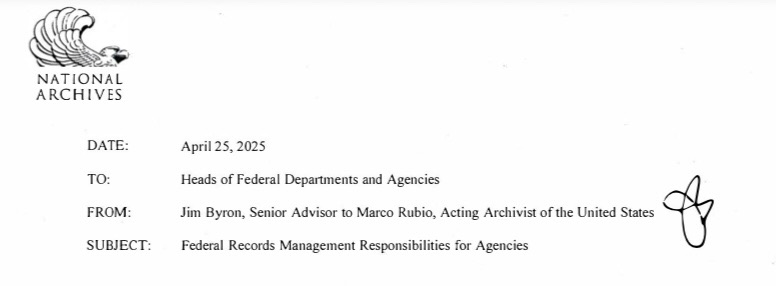
On April 25, 2025, the senior advisor to the acting Archivist of the United States (AOTUS) sent a memorandum to the heads of federal departments and agencies on the management responsibilities they have with respect to electronic messages that constitute public records.

In the memorandum (below), Jim Byron, Senior Advisor to Secretary Marco Rubio, Acting AOTUS, reminds agencies the obligation all officials have to memorialize official business conducted on a personal device or account by forwarding or copying an official account with the electronic correspondence.

Byron observes that “the use of the auto-delete function on digital messaging applications may prevent agency officials from meeting this critical obligation, possibly resulting in the permanent loss of federal records,” but this conflicts common sense.

The memorandum does not reference the March 25, 2025 guidance from the White House to staff at the U.S. DOGE Service, which is far clearer.

That policy emphasizes that “the basic rule is to preserve all work-related communications and records, regardless of format.” 

Messages that constitute public business that are sent on personal devices and on Signal must be archived, which means any auto-delete feature in the app should be disabled, not enabled by default — including those in the chat Acting Archivist Rubio was on with the National Security Advisor.


Screenshot of NARA memo header

Federal Records Management Responsibilities for Agencies

Congratulations to all of you on your recent appointments to federal service.

I write to make you aware of resources that are available to you and your employees regarding records management in your agencies.

All federal employees create and manage records as an integral part of their responsibilities in performing agency missions. Federal records protect the rights and interests of the public, allow officials to be held accountable for their actions, and document our nation’s history. Also, good records management helps your agency operate more effectively and efficiently.

It is crucial agency heads work with their Senior Agency Official for Records Management and Agency Records Officers to communicate the importance of their records management responsibilities to all staff, including political appointees.

Together, federal agencies and the National Archives work toward government transparency, public engagement, and accountability by promoting our obligations under the Federal Records Act (FRA). The FRA, at 44 U.S.C. § 3101, charges you, as the agency head, with creating and preserving federal records containing adequate and proper documentation of the agency’s activities so that the legal and financial rights of the Government and individuals affected by the agency’s activities are protected.

The emergence of —and increasing reliance upon — new forms of electronic communication can make records management more challenging, but no less important. The FRA imposes strict requirements on the use of personal accounts to conduct agency business. If any agency employee uses a personal account to engage in official business, they must copy an official account or forward their message to an official account within 20 days. 44 U.S.C. § 2911.

The use of the auto-delete function on digital messaging applications may prevent agency officials from meeting this critical obligation, possibly resulting in the permanent loss of federal records.

It is thus vital that you ensure staff are properly trained on their FRA obligations. Agency heads must ensure that their records management programs provide effective control over the creation and maintenance of records, 44 U.S.C. § 3102, and safeguard against the removal or loss of records, 44 U.S.C. § 3105.

We encourage you to take prompt action to ensure that your recordkeeping policies are up-to-date, and that they adequately educate agency staff how to create, maintain, and dispose of federal records, especially when using third-party apps. Additional details about the appropriate maintenance of electronic records, including metadata retention requirements, can be located at 36 CFR Part 1236.

Questions related to FRA compliance may also arise when agencies transfer their functions to other agencies. Agencies must ensure that:

Paper and electronic records are properly identified and segregated from non-records, as those terms are defined by federal law;

Temporary paper and electronic records are only disposed of in accordance with a NARA-approved agency-specific or General Records Schedule; and

Paper and electronic records are transferred to another federal entity, inactive storage, or NARA only in accordance with the procedures outlined in 36 CFR Parts 123 | to 1235.

NARA will be issuing additional guidance and resources to assist agencies with fulfilling their records management responsibilities when consolidating and reorganizing.

Thank you for your attention to these matters. If you have any questions about your agency’s records management responsibilities or would like to discuss anything further, I invite you to contact William Fischer, Acting Chief Records Officer at NARA, at william.fischer@nara.gov.

cc

Senior Agency Officials for Records Management Agency Records Officers

General Counsels

US FOIA Advisory Committee recommends agencies harmonize FOIA and open data programs

Yesterday, the United States Freedom of Information Act Advisory Committee met at the National Archives in Washington and approved a series of recommendations that would, if implemented, dramatically improve public access to public information. And in May, it will consider … Continue reading

VA rejects Freedom of Information Act request for missing open government plan

The VA is being neither open nor transparent about its missing open government plans or policies. On March 29, 2018, I made a Freedom of Information Act request to the United States Department of Veterans Affairs (VA) in which I … Continue reading

National Security Archive finds 40% E-FOIA compliance rate in federal government agencies

underConstruction

For Sunshine Week 2015, the National Security Archive​ conducted an audit of how well 165 federal government agencies in the United States of America comply with the E-FOIA Act of 1996. They found that only 67 of them had online libraries that were regularly updated with a significant number of documents released under the Freedom of Information Act. The criteria for the 165 agencies were that they had to have a chief Freedom of Information Officer and components that handled more than 500 FOIA requests annually.

Almost a decade after the E-FOIA Act, that’s about a 40% compliance rate. I wonder if the next U.S. Attorney General or the next presidential administration will make improving on this poor performance priority. It’s important for The United States Department of Justice​ to not only lead by example but push agencies into the 21st century when it comes to the Freedom of Information Act.

It would certainly help if Congress passed FOIA reform.

On that count, the Archive highlights a relevant issue in the current House and Senate FOIA reform bills in Congress: the FOIA statute states that documents that are “likely to become the subject of subsequent requests” should be published electronic reading rooms:

“The Department of Justice’s Office of Information Policy defines these records as “frequently requested records… or those which have been released three or more times to FOIA requesters.” Of course, it is time-consuming for agencies to develop a system that keeps track of how often a record has been released, which is in part why agencies rarely do so and are often in breach of the law. Troublingly, both the current House and Senate FOIA bills include language that codifies the instructions from the Department of Justice.

The National Security Archive believes the addition of this “three or more times” language actually harms the intent of the Freedom of Information Act as it will give agencies an easy excuse (“not requested three times yet!”) not to proactively post documents that agency FOIA offices have already spent time, money, and energy processing. We have formally suggested alternate language requiring that agencies generally post “all records, regardless of form or format that have been released in response to a FOIA request.”

This is a point that Members of Congress should think through carefully as they take another swing at reform. As I’ve highlighted elsewhere, FOIA requests that industry make are an important demand signal to show where data with economic value lies. (It’s also where the public interest tends to lie, with respect to FOIA requests from the media.)

While it’s true that it would take time and resources to build and maintain a system that tracks such requests by industry, there should already be a money trail from the fees paid to the agency. If FOIA reform leads to modernizing how it’s implemented, perhaps tying FOIA.gov to Data.gov might finally take place. The datasets are the subject of the most FOIA requests are the ones that should be prioritized for proactive disclosure online.

Adding a component that identifies which data sets are frequently requested, particularly periodically, should be a priority across the board for any administration that seeks to “manage information as an asset.” Adding the volume and periodicity of requests to the expanding national enterprise data inventory might naturally follow. It’s worth noting, too, that reform of the FOIA statute may not be necessary to achieve this end, if the 18F team working on modernizing FOIA software worked on it.

[STAT] State Department employees made .004% of email sent in 2013 into public records

Window_and_Hillary_Clinton_Not_Alone_in_Using_Private_Emails_to_Govern_-_Tech_-_GovExec_com

According to a new report from U.S. Department of State’s Office of the Inspector General, agency employees sent more than 1 billion emails, of which they made just 41,649 of them into public records.

That’s about 0.004% of them, by my rough calculation.

It’s a minuscule number, which probably why The Daily Beast ran a post reporting “only .00006% of State Department emails are preserved.”

While their calculation looks off by orders of magnitude, this tiny percentage still translates into members of the civil and foreign service entering almost none of their emails into archiving systems.

While the story hardly need it, this adds more interesting context to former Secretary of State Hillary Clinton’s decision to designate roughly 50% of her personal email as public records.

As Sunlight Foundation policy director John Wonderlich commented in Politico, this IG report undermines her argument that her emails with State Department workers were preserved on their end.

“Her justification around FOIA requests and around preservation became that most of the documents were cc’d or sent to .gov or state.gov addresses used by employees and therefore were preserved and accessible to requests, ” said Wonderlich “This [report] suggests that is not reliable at all.”

For more, read Josh Gerstein report exploring the broader ramifcations of the watchdog report on Clinton’s defense at greater length.

Could Hillary Clinton’s email account galvanize Congress to pass FOIA reform?

IMG_1992It’d be swell if the flap over former Secretary of State Hillary Clinton’s personal email account catalyzed the passage of Freedom of Information Act reform in Congress. Trevor Timm, executive director of the Freedom of the Press Foundation, laid out a strong case in the Guardian today for why both sides of the aisle should support reform:

Instead of both parties competing over who can be more secretive, like they did in the 2012 presidential campaign, this is also a great opportunity for 2016 presidential candidates to debate about who can deliver the most transparent White House. That doesn’t mean just voluntarily releasing emails you want the public to see – though that’s a start – but implementing lasting policy changes and laws that will change the trajectory of US secrecy law, which has grown out of control in the past decade.

The challenge is that the interests that didn’t want that reform to happen, both inside and outside of government, aren’t going to go away, from the financial industry to government agencies.

As readers no doubt recall, FOIA reform bills passed the U.S. Senate and House *unanimously* last year and yet failed to become law.

The pushback is already (quietly) happening in Congress, as reported last week in E&E publishing:

“I think a number of the agencies are probably concerned. This is the impression that I get: They think that you shouldn’t have this presumption that things should be revealed. In other words, there should be more of a screening process,” [Representative Elijah] Cummings said. “It’s hard for them to just come outright and say, ‘No, we don’t like that, we’re not going to do it.’ But I get that impression that they don’t feel that people need to have access to every record.”

Asked whether he or other lawmakers have heard from agencies regarding his bill, Cummings said their concerns about FOIA are more subtly made to Congress.

“In general, in general. But I don’t think it’s a big push, but that’s just the impression I get,” said the ranking member on the House Oversight and Government Reform Committee.

That doesn’t mean that reform won’t happen, or that it couldn’t be a political winner for members of both parties, particularly Republican Senators who aspire to higher office. This year, editorial boards are more outspoken on the issue and transparency could, once again, be a campaign issue. Here’s hoping that’s enough to lead to Congress enacting FOIA reform the country needs, not a watered down bill.

In a step towards sunlight, United States begins to publish a national data inventory

20130929-142228.jpg
Last year, a successful Freedom of Information request for the United States enterprise data inventory by the Sunlight Foundation was a big win for open government, nudging Uncle Sam towards a better information policy through some creative legal arguments. Today, the federal government started releasing its enterprise indices at data.gov. You can browse the data for individual agencies, like the feed for the Office for Personnel Management, using a JSON viewer like this one.

“Access to this data will empower journalists, government officials, civic technologists, innovators and the public to better hold government accountable,” said Sunlight Foundation president Chris Gates, in a statement. “Previously, it was next to impossible to know what and how much data the government has, and this is an unprecedented window into its internal workings. Transparency is a bedrock principle for democracy, and the federal government’s response to Sunlight’s Freedom of Information request shows a strong commitment to open data. We expect to see each of these agencies continue to proactively release their data inventories.”

Understanding what data an organization holds is a critical first step in deciding how it should be stored, analyzed or published, shifting towards thinking about data as an asset. That’s why President Barack Obama’s executive order requiring federal agencies to catalog the data they have was a big deal. When that organization is a democratic government and the data in question was created using taxpayer funds, releasing the inventory of the data sets that it holds is a basic expression of open and accountable government.

In the wake of scandal, the State of Oregon seeks to restore trust through publishing public records

or-state-sealIn a fascinating turn of events, rainy Oregon is embracing sunlight online after a scandal that led to the resignation of its governor. After governor Kate Brown was sworn in as the 38th governor of the state of Oregon, replacing fellow Democrat John Kitzhaber, her administration chose to try to restore public trust by not only posting public records requests online but including the authors, status and a downloadable link to the records themselves, once fulfilled. The records only go back to January 15th, 2015, with a note that requests made prior to that date are “still being processed.”

The City of Oakland’s public records system, built by Code for America, does the same thing but this appears to set a new bar for state government that’s unmatched in the United States of America. As has been reported elsewhere, exemptions to Oregon’s public records laws mean that this website will be no panacea, but it looks like progress from 3000 miles away in snowy Cambridge.

As Kirk Johnson reported for the New York Times, Brown’s record includes open government work while she was a state legislator, where, as Senate Majority Leader, she worked to reform Oregon’s ethics law and helped to enact legislation that created an online campaign finance database.

“…throughout my 24 years in public service, I have also sought to promote transparency and trust in government, working to build confidence that our public dollars are spent wisely,” she said, in her inaugural speech.

Later in her remarks, Governor Brown said that “we must seize this moment to work across party lines to restore the public’s trust. That means passing meaningful legislation that strengthens the capacity and independence of the Government Ethics Commission. We also must strengthen laws to ensure timely release of public documents.”

On that count, it’s notable that two of the records requests that have been posted for download involve Cynthia Hayes, the fiancee of former Governor Kitzhaber who was at the center of the scandals that led to his resignation. One comes from Margaret Olney, who is quite likely the same Margaret Olney who served in Oregon’s Department of Justice. The other requester was Alejandra Lazo, who co-authored a Wall Street Journal article on former Governor Kitzhaber’s resignation. In an interesting sidenote, the records for both responses were uploaded to Dropbox.

If you know of another state that meet or exceeds this standard for digital transparency, or have experience or feedback regarding the quality or importance of the public records posted by Oregon, please let us know in a comment.

Emily Shaw, the national policy manager at the Sunlight Foundation, said on Twitter that she has not seen any other state’s public records system exceed this standard of transparency.

https://twitter.com/emilydshaw/status/568469416406618112

With hours of sunshine left, passage of FOIA reform in the U.S. House hangs in the balance

IMG_1992

Update: The House Majority Leader didn’t put S.2520 on Thursday’s legislative calendar (PDF). Per Congress.gov, it was “held at the desk.” We can’t pronounce it dead until 3:30 PM, as the Speaker of the House could bring the bill up by unanimous consent, but FOIA reform in this Congress likely just expired at midnight.

Imagine if an important reform to public access to government information hung in the balance in the United States Congress and the editorial boards of the country’s major newspapers ignored it. Unfortunately, that’s exactly what has happened. Only a few weeks ago, it looked this ‘do nothing Congress’ was actually set to do something: pass much-needed reforms to the Freedom of Information Act. Over the weekend, an unexpected hold in the Senate by Senator Jay Rockefeller put months of bipartisan collaboration in jeopardy. If the U.S. House of Representatives doesn’t schedule a vote tomorrow on the Freedom of Information Improvement Act that passed the Senate on Monday, however, FOIA reform will quietly expire.

Senator Patrick Leahy (D-VT), the chairman of the Senate Judiciary Committee, is urging the House to pass the bill before the 113th Congress ends.

“This legislation is all about government transparency. If House Republicans want this administration to be more accountable, then they must put it on the suspension calendar without delay. Let’s get it done,” Leahy said. “With the sun about to set on this congressional session, the House should not leave this sunshine bill undone, on the table.  Time is quickly running out, and the House must act without further delay.

Representative Darrell Issa (R-CA), the chairman of the House Oversight and Government Reform Committee, and Ranking Member Representative Elijah Cummings (D-MD) have also called on the House to pass the Freedom of Information Act (FOIA) Improvement Act and send it to President Barack Obama after its unanimous passage in the Senate.

“The FOIA Improvement Act will strengthen FOIA, the cornerstone open government law,” Issa and Cummings said, in a joint statement.  “The House unanimously passed companion legislation, H.R. 1211, earlier this year.  The FOIA Improvement Act is a bipartisan bill that, after last night’s passage by the Senate, deserves to be taken up by the House and sent to the President.”

Given that FOIA reform passed the U.S. House unanimously 410-0 in February, why aren’t Speaker of the House John Boehner and Minority Leader Representative Nancy Pelosi bringing S.2520 to a vote? One source tells me that banks have sent lobbyists to the offices of House Financial Services members to oppose the FOIA reform and have told staff there that proprietary regulatory information could be released under the bill. FreedomInfo.org is also reporting that banking lobbyists are opposing the FOIA reform bill. This rumored pressure is in addition to the pressure of the same federal agencies that lobbied against the bill in the Senate.

A similar argument was made in the Senate, and it’s by all accounts a bogus one: Exemption 8 of the FOIA provides protection against such disclosure and the “foreseeable harm” standard embraced by this reform would not result in the release of such regulatory records,  given that there would be a clear foreseeable harm in their release. As FreedomOfInfo.org notes, “the Senate committee report includes lengthy language underscoring the importance of protecting financial information”:

 The paragraph secured support for the bill by the chairman of the Senate Banking Committee, Sen. Tom Johnson (D-SD), sources said. The relevant section of the report begins with a caution: “Extreme care should be taken with respect to disclosure under Exemption 8 which protects matters that are “contained in or related to examination, operating, or condition reports prepared by, on behalf of, or for the use of an agency responsible for the regulation or supervision of financial institutions.” The quote is from the FOIA.

The report language (minus footnotes) continues:

Currently, financial regulators rely on Exemption 8, and other relevant exemptions in Section 552(b), to protect sensitive information received from regulated entities, or prepared in connection with the regulation of such entities, in fulfilling their goals of ensuring safety and soundness of the financial system, compliance with federal consumer financial law, and promoting fair, orderly, and efficient financial markets. Exemption 8 was intended by Congress, and has been interpreted by the courts, to be very broadly construed to ensure the security of financial institutions and to safeguard the relationship between the banks and their supervising agencies. The D.C. Circuit has gone so far as to state that in Exemption 8 Congress has provided “absolute protection regardless of the circumstances underlying the regulatory agency’s receipt or preparation of examination, operating or condition reports.” Nothing in this legislation shall be interpreted to compromise the stability of any financial institution or the financial system, disrupt the operation of financial markets or undermine consumer protection efforts due to the release of confidential information about individuals or information that a financial institution may have, or encourage the release of confidential information about individuals. This legislation is not intended to lessen the protection under Exemption 8 created by Congress and traditionally afforded by the courts.

There’s a lot at stake here, and almost no time on the legislative clock. It is, as Sean Vitka wrote for the Sunlight Foundation wrote today, literally do-or-die time for FOIA reform. It’s crunch time. It’s now or (almost) never: if Speaker of the House John Boehner doesn’t bring the bill up for a vote by unanimous consent today, the process begins again in the next Congress, but without key sponsors of the FOIA reforms in the House and Senate occupying the chairs of committees.

“For all of his talk about the desire of House Republicans to hold the Obama Administration accountable, we are shocked and angered that Speaker Boehner would decide to allow a bill that strengthens and reforms the Freedom of Information Act (FOIA) die without a vote,” said Danielle Brian, chair of OpenTheGovernment.org and executive director of the Project On Government Oversight, in a statement. “S.2520 is a critical bill that strengthens the FOIA watchdog, the Office of Government Information Services, and would force agencies to finally deliver the levels of transparency that the Administration promised on their first day in office in 2009. We call on Speaker Boehner to do the right thing for the American public and call for a vote on S.2520 before the House leaves for the year.”

Update: On Thursday morning, when he was asked about FOIA reform at a press conference, Speaker Boehner said that “I have no knowledge of what the plan is for that bill.”

“We are particularly concerned that Speaker Boehner has now said that he has ‘no knowledge of the plan’ to pass the bipartisan, bicameral FOIA reform bill,” said Brian, in response. “If accountability and making the federal government answer to the public is really a priority for the Republican Caucus, passing this bill should be a priority. The House passed the House companion bill 410 – 0. The Senate passed the bill by unanimous consent after the open government community waged an all-out war against a last second attempt by the Federal Trade Commission (FTC) and other independent agencies that are supposed to be on the public’s side to stop the bill. It’s up to Speaker Boehner to put this bill to a vote and create the levels of open government the public needs.”

If the people’s right to know what their government does in their name matters to you, please let your Member of Congress know that FOIA reform matters to you, and let the Speaker of the House know. You can email the Speaker directly through OpenCongress, call him up at (202) 225-6205 and tweet him @SpeakerBoehner. Even if the press won’t represent itself and the people by asking Congress to support the free flow of government information, you can.

Update: FOIA reform failed to pass in the 113th Congress. As Newsweek reported, in an opaque move, Speaker Boehner tabled the government transparency bill. It was never brought up for a vote in the House. Unless the Speaker reconvenes the House, the FOIA bill is likely dead.

“…the fact that the bill was very close and was tabled because of the influence of lobbyists that found a problem in the legislation that didn’t even exist is frustrating not only for those who wanted the bill to pass but for those who want the American democratic process to be a shining light for the world – not an embarrassment,” wrote Scott A. Hodes, at the FOIA Blog.

“For all of his talk about his desire to hold the Obama Administration accountable, we find it unfathomable that that Speaker John Boehner would allow a bill that strengthens and reforms the Freedom of Information Act (FOIA) to die without a vote,” said Danielle Brian.

In reaction, Senator Leahy made the following statement:

“I am deeply disappointed that last night the House failed to pass the FOIA Improvement Act. This bipartisan bill was reported unanimously by the Senate Judiciary Committee last month, and it was the product of months of hard work by Senator Cornyn and me. Our bill is supported by more than 70 public interest groups that advocate for government transparency and it passed out of the Senate unanimously. I would think that members of the House Republican leadership, who have spent so much time on oversight of the Obama administration, would support the goal of making government more accountable and transparent. But instead of supporting this bill, they have chosen secrecy over sunlight.

“The FOIA Improvement Act would codify what the President laid out in his historic executive order in 2009 by requiring Federal agencies to adopt a ‘Presumption of Openness’ when considering the release of government information under FOIA. This bill would require agencies to find a foreseeable harm if they want to withhold information from the public. Prioritizing the people’s interest in what their government is doing, our bill will reduce the overuse of exemptions to withhold information. Federal agencies have been required to apply this standard since 2009. They also used this same standard during President Clinton’s terms in office. It was only during President George W. Bush’s term of secrecy that this standard was rolled back. It appears the House leadership wants to return to that era. It should not matter who is in the White House, information about what their government is doing belongs to the people.

“In a political climate as divided as this, I had hoped that we could come together in favor of something as fundamental to our democracy as the public’s right to know. That government transparency and openness would not just be the standard applied to the Obama Administration but what is applied to every future administration. The FOIA Improvement Act would have done just that.”

Postscript: Writing for the Sunlight Foundation, Matt Rumsey published a sunny post about the death of FOIA reform.

Sunlight has been strongly supportive of the FOIA Improvement Act because it addresses real world problems faced by requesters every day, specifically targeting overly broad exemptions and limiting unnecessary fees. Just like Sen. Patrick Leahy, D-Vt., one of its strongest champions, we aredisappointed that it did not become law.

And yet, we are hopeful for the future.

Most laws never make it out of committee even after repeated attempts spread over multiple years. The FOIA Improvement Act came tantalizingly close to becoming law its first time around.

Rest assured that the FOIA Improvement Act will be reintroduced in the 114th Congress and that the Sunlight Foundation and its allies will be fighting harder than ever for its passage. We want to say a hearty thank you to Leahy, Sen. John Cornyn, R-Texas, and everyone else that worked so hard during the 113th Congress to make these needed reforms possible. We’ll see you next year!

The Washington Post, to its credit, did a post-mortem on how this popular government transparency bill died in Congress. The reason the FOIA reform stalled in the House may not simply have been lobbying by the financial industry, however, as had been previously reported.

According to House aides, some lawmakers balked at the legislation because several agencies, including the Justice Department, warned that those making information requests would use the “forseeable harm” requirement as the basis for frequent lawsuits.

This detail led Trevor Timm, executive director of the Freedom of the Press Foundation, to argue that it was the Justice Department that secretly tried to stop FOIA reform, despite the text of the legislation being almost word-for-word the poilcy that the agency itself embraced in 2009.

The “foreseeable harm” section referred to by the Post would force federal agencies to justify withholding information if they wished to do so. Essentially, they would have to show the information would cause “foreseeable harm” if released. Not exactly a tall order. But what makes the Justice Department’s objection so shocking is that this “foreseeable harm” provision would not deviate at all from the Justice Department’s own policy. In fact, it was based on it.

In a March 19, 2009 memo to all federal agencies, Attorney General Eric Holder himself wrote that the Justice Department would carry out Obama’s aforementioned transparency order by rescinding the Bush DOJ’s more restrictive FOIA rules and designating new ones. From that moment on, Holder declared:

[T]he Department of Justice will defend a denial of a FOIA request only if (1) the agency reasonably foresees that disclosure would harm an interest protected by one of the statutory exemptions, or (2) disclosure is prohibited by law.

Now read the full text of the provision in the just-killed FOIA reform bill that the Justice Department allegedly objected to:

An agency shall withhold information under this section only if a) the agency reasonably foresees that disclosure would harm an interest protected by an exemption described in subsection or other provision of law; or b) disclosure is prohibited by law.

As you can see, the two passages are virtually identical. How does the Justice Department think this provision will lead to more lawsuits it would have to defend if they’re not supposed to be defending those lawsuits in the first place?

The Justice Department is objecting to making its own supposed policy the law, and confirms what many have long believed: the agency does not want to—or have to—comply with its own FOIA rules.

The DOJ has repeatedly been criticized for failing to enforce, and downright ignoring its own FOIA guidance for years, and their stance on transparency in general has been incredibly hypocritical. For example, Holder has claimed hewanted the torture report to be public as soon as possible, meanwhile fighting in court to prevent the release of any documents on its own torture investigation. Likewise, he’s claimed the Justice Department supports a federal shield law so reporters can protect their sources, while at the same time destroying the already-existing reporter’s privilege in the Fourth Circuit.

Writing for the National Security Archive, Nate Jones looked for lessons from the death of the unanimously supported FOIA bill and decried “Janus-faced support for open government.”  Here was his key takeaway:

Many people –in Congress, in the agencies, in the White House, in the media– proclaim they believe in open government, but don’t really.  To me, that’s the only plausible reason a FOIA bill could garner unanimous approval (thrice in the Senate over the past seven years!) and still die; that’s the only plausible reason agencies whisper that instructions about FOIA currently on the books will ruin the federal government as we know it; that’s the reason for White House silence on the benefits the FOIA Ombuds office not being forced to run its reports though the Department of Justice so they can be “rosified;” that’s the reason the New York Times wins Pulitzers for its FOIA-based reporting, but doesn’t assign a Congressional beat reporter to cover the bill’s death.

How do we overcome these FOIA Januses?  First, we must avoid being stalled out.  We should force Speaker Boehner to act on his pledge that he “look[s] forward to working to resolve this issue [FOIA reform] early in the new Congress.”  FOIA champions Senators Leahy, Cornyn, and Grassley remain in the Senate Judiciary Committee; these senators have an impressive history of defending and working to reform FOIA, no matter which party is in the majorly.  Replacing Representative Issa on the House Oversight Committee is Jason Chaffetz (R-Ut); Democratic FOIA champion Elijah Cummings remains.  Encouragingly, Chaffetz has said he “wants to address the Freedom of Information Act and the difficulties many have in getting the executive branch to comply with FOIA requests.”  Both houses should immediately reintroduce the FOIA bill.  More than 440 members who voted for FOIA reform remain in Congress.

On Saturday, December 20, the New York Times editorial board called for the 114th Congress to revisit the freedom to see government records. In doing so, it made no mention of the reporting on the cause of death by this blog, Vice News, the Washington Post, the Hill, Roll Call or Politico, nor lobbying by banks or federal agencies, nor silence by the White House while most of the press looked the other way.