[REPORT] On data journalism, democracy, open government and press freedom

On May 30, I gave a keynote talk on my research on the art and science of data journalism at the first Tow Center research conference at Columbia Journalism School in New York City. I’ve embedded the video below:

My presentation is embedded below, if you want to follow along or visit the sites and services I described.

Here’s an observation drawn from an extensive section on open government that should be of interest to readers of this blog:

“Proactive, selective open data initiatives by government focused on services that are not balanced by support for press freedoms and improved access can fairly be criticized as “openwashing” or “fauxpen government.”

Data journalists who are frequently faced with heavily redacted document releases or reams of blurry PDFs are particularly well placed to make those critiques.”

My contribution was only one part of the proceedings for “Quantifying Journalism: Metrics, Data and Computation,” which you can catch up through the Tow Center’s live blog or TechPresident’s coverage of measuring the impact of journalism.

United States federal government use of crowdsourcing grows six-fold since 2011

578430main_20110809-xclass_full

Citizensourcing and open innovation can work in the public sector, just as crowdsourcing can in the private sector. Around the world, the use of prizes to spur innovation has been booming for years. The United States of America has been significantly scaling up its use of prizes and challenges to solving grand national challenges since January 2011, when, President Obama signed an updated version of the America COMPETES Act into law.

According to the third congressionally mandated report released by the Obama administration today (PDF/Text), the number of prizes and challenges conducted under the America COMPETES Act has increased by 50% since 2012, 85% since 2012, and nearly six-fold overall since 2011. 25 different federal agencies offered prizes under COMPETES in fiscal year 2013, with 87 prize competitions in total. The size of the prize purses has also grown as well, with 11 challenges over $100,000 in 2013. Nearly half of the prizes conducted in FY 2013 were focused on software, including applications, data visualization tools, and predictive algorithms. Challenge.gov, the award-winning online platform for crowdsourcing national challenges, now has tens of thousands of users who have participated in more than 300 public-sector prize competitions. Beyond the growth in prize numbers and amounts, Obama administration highlighted 4 trends in public-sector prize competitions:

  • New models for public engagement and community building during competitions
  • Growth software and information technology challenges, with nearly 50% of the total prizes in this category
  • More emphasis on sustainability and “creating a post-competition path to success”
  • Increased focus on identifying novel approaches to solving problems

The growth of open innovation in and by the public sector was directly enabled by Congress and the White House, working together for the common good. Congress reauthorized COMPETES in 2010 with an amendment to Section 105 of the act that added a Section 24 on “Prize Competitions,” providing all agencies with the authority to conduct prizes and challenges that only NASA and DARPA has previously enjoyed, and the White House Office of Science and Technology Policy (OSTP), which has been guiding its implementation and providing guidance on the use of challenges and prizes to promote open government.

“This progress is due to important steps that the Obama Administration has taken to make prizes a standard tool in every agency’s toolbox,” wrote Cristin Dorgelo, assistant director for grand challenges in OSTP, in a WhiteHouse.gov blog post on engaging citizen solvers with prizes:

In his September 2009 Strategy for American Innovation, President Obama called on all Federal agencies to increase their use of prizes to address some of our Nation’s most pressing challenges. Those efforts have expanded since the signing of the America COMPETES Reauthorization Act of 2010, which provided all agencies with expanded authority to pursue ambitious prizes with robust incentives.

To support these ongoing efforts, OSTP and the General Services Administration have trained over 1,200 agency staff through workshops, online resources, and an active community of practice. And NASA’s Center of Excellence for Collaborative Innovation (COECI) provides a full suite of prize implementation services, allowing agencies to experiment with these new methods before standing up their own capabilities.

Sun Microsystems co-founder Bill Joy famously once said that “No matter who you are, most of the smartest people work for someone else.” This rings true, in and outside of government. The idea of governments using prizes like this to inspire technological innovation, however, is not reliant on Web services and social media, born from the fertile mind of a Silicon Valley entrepreneur. As the introduction to the third White House prize report  notes:

“One of the most famous scientific achievements in nautical history was spurred by a grand challenge issued in the 18th Century. The issue of safe, long distance sea travel in the Age of Sail was of such great importance that the British government offered a cash award of £20,000 pounds to anyone who could invent a way of precisely determining a ship’s longitude. The Longitude Prize, enacted by the British Parliament in 1714, would be worth some £30 million pounds today, but even by that measure the value of the marine chronometer invented by British clockmaker John Harrison might be a deal.”

X-prize-graph-300x297Centuries later, the Internet, World Wide Web, mobile devices and social media offer the best platforms in history for this kind of approach to solving grand challenges and catalyzing civic innovation, helping public officials and businesses find new ways to solve old problem. When a new idea, technology or methodology that challenges and improves upon existing processes and systems, it can improve the lives of citizens or the function of the society that they live within.

“Open innovation or crowdsourcing or whatever you want to call it is real, and is (slowly) making inroads into mainstream (i.e. non high-tech) corporate America,” said MIT principal research professor Andrew McAfee, in an interview in 2012.” P&G is real. Innocentive is real. Kickstarter is real. Idea solicitations like the ones from Starbucks are real, and lead-user innovation is really real.”

Prizes and competitions all rely upon the same simple idea behind the efforts like the X-Prize: tapping into the distributed intelligence of humans using a structured methodology. This might include distributing work, in terms of completing a given task or project, or soliciting information about how to design a process, product or policy.

Over the past decade, experiments with this kind of civic innovation around the world have been driven by tight budgets and increased demands for services, and enabled by the increased availability of inexpensive, lightweight tools for collaborating with connected populations. The report claimed that crowdsourcing can save federal agencies significant taxpayer dollars, citing an example of a challenge where the outcome cost a sixth of the estimated total of a traditional approach.

One example of a cost-effective prize program is the Medicaid Provider Screening Challenge that was offered by the Centers for Medicare & Medicaid Services (CMS) as part of a pilot designed in partnership with states and other stakeholders. This prize program was a series of software development challenges designed to improve capabilities for streamlining operations and screening Medicaid providers to reduce fraud and abuse. With a total prize purse of $500,000, the challenge series is leading to the development of an open source multi-state, multi-program provider screening shared-service software program capable of risk scoring, credential validation, identity authentication, and sanction checks, while lowering the burden on providers and reducing administrative and infrastructure expenses for states and Federal programs. CMS partnered with the NASA Center of Excellence for Collaborative Innovation (COECI), NASA’s contractor Harvard Business School, Harvard’s subcontractor TopCoder, and the State of Minnesota. The State of Minnesota is working on full deployment of the software, and CMS is initiating a campaign to encourage other states to leverage the software. COECI estimates that the cost of designing and building the portal through crowdsourcing was one-sixth of what the effort would have cost using traditional software development methods. Through the success of this and subsequent
challenges, CMS is attempting to establish a new paradigm for crowdsourcing state and Federal information technology (IT) systems in a low-cost, agile manner by opening challenges to new players, small companies, and talented individual developers to build solutions which can “plug and play” with existing legacy systems or can operate in a shared, cloud-based environment.

As is always the nature of experiments, many early attempts failed. A few have worked and subsequently grown into sustainable applications, services, data sources, startups, processes and knowledge that can be massively scaled. Years ago, Micah Sifry predicted that the “gains from enabling a culture of open challenges, outsider innovation and public participation” in government were going to be huge. He was right.

Linked below are the administration’s official letters to the House and Senate, reporting the results of last year’s prizes.

COMPETES FY2013PrizesReport HOUSE Letter (PDF)/COMPETES FY2013PrizesReport HOUSE Letter (Text)

COMPETES FY2013 PrizesReport SENATE Letter (PDF)/COMPETES FY2013 PrizesReport SENATE Letter (Text)

[Image Credit: NASA SDO. Context: Solar flare predictive algorithm challenge]

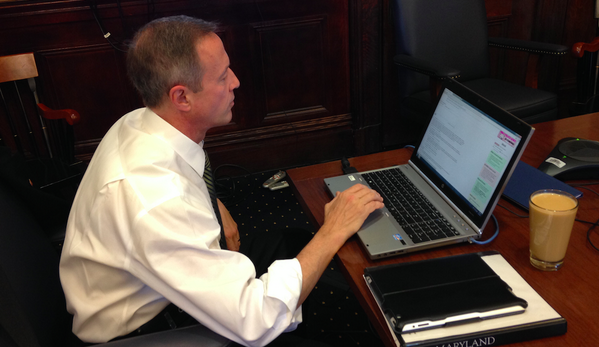
Maryland Governor Martin O’Malley asks Reddit to ‘Ask Me Anything’

omalley-ama

I generally agree with the assessment of Washington Post, with respect to how well Maryland Governor Martin O’Malley’s “Ask Me Anything” on Reddit went for him, though I give him far more credit for venturing onto the unruly social news platform than the reporter did. The Post’s report that he only answered 5 questions was just plain incorrect.

O’Malley answered 19 questions this morning, not 5, a fact that could be easily and quickly ascertained by clicking on GovMartinOMalley, the username he used for the AMA, including a (short) answer to a question on mental health that the Post said went unanswered. (An editor made multiple corrections and updates to the Post’s story after I pointed that out.)

He subsequently logged back on in the afternoon to answer more questions, rebutting the Post’s assessment and that of a user: “I don’t know, I’m having fun! This is my first AMA. I had to step away to sign a bunch of bills, and I’m glad to be back,” he commented.

He answered at least one tough question (from a questioner who appears to have joined Reddit today) after doing so, although the answer hasn’t been highly rated:

@bmoreprogressive91: Thanks for doing an AMA. Just one question: How does the Maryland healthcare exchange, which cost taxpayers $90 million to implement before your administration found that it would be cheaper (at an additional $40-50 million) to just replace it than to fix it, show that your Administration has been effectively using taxpayer dollars to better the lives of individual citizens?

http://www.washingtonpost.com/local/md-politics/md-spent-90-million-on-health-exchange-technology-according-to-cost-breakdown/2014/04/18/5f2e7600-c722-11e3-8b9a-8e0977a24aeb_story.html

O’Malley: No one was more frustrated than I was about the fact that our health exchange website didn’t work properly when we launched. But our health exchange is more than a web site, and we worked hard to overcome the technical problems. We have enrolled about 329,000 people thus far, exceeding the goal we set of 260,000. I often say that we haven’t always succeeded at first, but we have never given up. We learn from both success and failure.

By the end of the day, Maryland’s governor answered 36 questions in total. (You can read a cleanly formatted version of O’Malley’s AMA at Interview.ly). Reddit users rated the quality of some answers much higher than others, with the most popular answer, “Yes,” coming in response to whether he would support a constitutional amendment to reverse the Citizens United decision by the Supreme Court.

To be fair — and reasonable observers should be — Reddit’s utility for extracting answers from a politician isn’t so great, as Alexis Madrigal pointed out after President Barack Obama did an AMA, back in 2012. That said, I’m generally supportive of elected leaders engaging directly with constituents online using the tools and platforms that citizens are active upon themselves.

Popular questions that go unanswered can be instructive and offer some insight into what issues a given politician would rather not talk about in public. As such, they’re fine fodder for media to report upon. The record online, however, also means that when a reporter botches the job or misrepresents an interaction, question or answer, we can all see that, too.

Postscript: Andrew MacRae was critical of the governor and his team’s approach to Reddit and offered a tip for other politicians that venture onto the social news platform for an AMA. More on that in the embedded tweets, below:

This post was further updated after the Governor went back online in the afternoon.

[Image Credit: Governor O’Malley]

After a false positive, Twitter suspends open government blog for being too social

Twitter’s best practices for tweeting don’t appear to mix well with its rules for tweeting, as I found out last month when the social networking company briefly suspended the Twitter account for this blog. While I was able to quickly get the account back online, the episode raises somr issues regarding how Twitter’s algorithm flags media accounts and some contradictions in the company’s guidance for new users.

When I found that I couldn’t file a help request to Twitter Support to appeal the suspension of @e_pluribusunum_ through that account, I used my main account (@digiphile).

Initially, I thought the suspension was due to spam, similar to the situation David Seaman encountered in 2011.

After I directly contacted Twitter for help, the account went back online later that day:

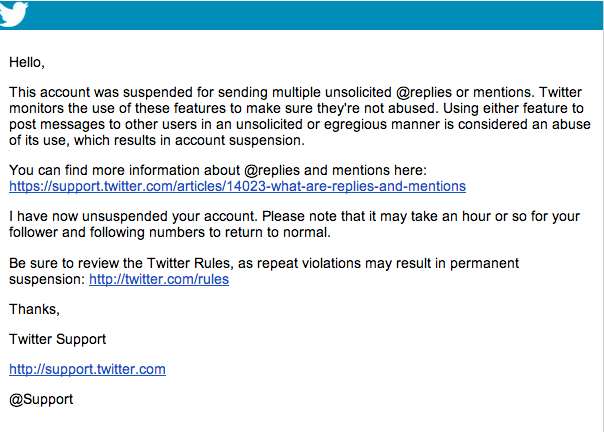
As I found out days later, however, the suspension was for “sending multiple unsolicited @replies or mentions,” per the statement I have from Twitter Support on @e_pluribusunum_:
“This account was suspended for sending multiple unsolicited @replies or mentions. Twitter monitors the use of these features to make sure they’re not abused. Using either feature to post messages to other users in an unsolicited or egregious manner is considered an abuse of its use, which results in account suspension. You can find more information about @replies and mentions here:https://support.twitter.com/articles/14023-what-are-replies-and-mentions

I have now unsuspended your account. Please note that it may take an hour or so for your follower and following numbers to return to normal. Be sure to review the Twitter Rules, as repeat violations may result in permanent suspension: http://twitter.com/rules”

suspension-notice

The tweets in question, however, are extremely similar to the way I’ve been using Twitter for years, advise others to use Twitter, and that Twitter itself recommends to new users.

Here are the tweets sent the day before the suspension and the three that morning, which I have to assume triggered the suspension.

The seventh tweet, embedded above, had six different @names in it, but it was appropriate: I was attributing the source of the information, referring to an NPR program (The Kojo Nnamdi Show) and naming the 4 guests who were on it. The eighth tweet had three @mentions in it, as I had retweeted a media account that referred to a reporter and added the subject of the story for context.

So: Were there a lot of @mentions? Yep. Were they “unsolicited?” Yep.  That accurately describes tens of thousands of tweets that I’ve sent over the past seven years. In this case, they were far from “abuse.”

That led me to wonder how many people, journalists, government or media companies or nonprofit organizations a Twitter account is allowed to @mention before it’s suspended. Should any of the categories of users I listed now have to actively ask followers for feedback or allow others to talk about them? That doesn’t seem practical nor scalable. Are there different rules for different users, Verified or not? (I’ve asked Twitter for comment on these general questions but have received no answers after two weeks. I will update the post if I do.)

In the meantime, I’ve tried to think them through myself. The “newness” of this account likely tripped Twitter’s automated filter, leading to the suspension. That means that other new users have to think about whether they’re sending “unsolicited replies or mentions” to keep clear.

I found that deeply jarring. I used the @E_Pluribus Unum_ account exactly as I have @digiphile, for over 7 years now, resharing tweets with attributed context and quotes, tweeting about public figures and government officials, tagging mastheads, retweeting select tweets.

That’s more or less how I define being “social” and engaging on the platform. That’s how I thought Twitter defined it, too. Twitter’s own best practices for engaging followers recommends it:

Mention high-profile users
@HillaryClinton included Secretary of State Madeleine Albright username@madeleine in a Tweet welcoming the former Secretary to Twitter. In turn, Albright replied to @HillaryClinton and also mentioned the Kennedy Center (@kencen), where she had recently performed. Including so many mentions of other users makes it more likely that people will find the conversation and join in. ”

If Twitter is suspending new accounts that @mention too many high profile users or reply to them in an “unsolicited” fashion, I can’t help but have serious concerns about Twitter’s future and commitment to being a platform for free expression, government accountability, or hosting civic dialogue.

I do see potential issues with “egregious” @mentions — “@reply spam” has been an issue on Twitter for years — but isn’t that exactly what the block button has been used for, or the new abuse reporting button should be used for? People have been tweeting “#FollowFriday” recommendations for years with many unsolicited @mentions. Are they risking suspension?

Honestly, knocking new accounts offline for being “too social” suggests a tone-deaf algorithm. Ignoring my questions regarding general standards suggests something else. (The company generally refuses to comment on individual accounts.)

Given reports of retention issues and low activity by most users, an overly aggressive approach to filtering new users that are engaging in activity that Twitter itself recommends, particularly media accounts, strikes me as actively self-defeating.

Twitter and its investors should care about the people who never tweet. This experience reminded me that those same parties should care about the people who do tweet and are caught up on algorithmic censorship, followed by vague missives not to talk about other accounts too much.

As I’ve written before, Twitter is not a public utility. It’s a private company with a Terms of Service and Rules it itself sets.  If Twitter’s users don’t like them or lose trust, their option is to stop using the service or complain loudly on other platforms.

In general, Twitter’s record on censorship, Internet freedom and privacy is the best of the big tech companies, as an analysis by the Electronic Frontier Foundation last year highlighted. They’ve gone to bat for their users, from Turkey to Washington. Today, however, I just wish they’d clarify how social those users are allowed to be.

Editor’s Note: The headline of this post has been amended, with “After a false positive” added.

Boston Mayor Marty Walsh issues open data executive order; city council ordinance to come?

5943910065_b422feecec_o

The City of Boston has joined the growing list of cities around the world that have adopted open data. The executive order issued yesterday by Mayor Marty Walsh has been hailed by open government advocates around the country. The move to open up Boston’s data has been followed by action, with 411 data sets listed on data.cityofboston.gov as of this morning. The EO authorizes and requires Boston’s chief information officer to issue a City of Boston Open Data Policy and “include standards for the format and publishing of such data and guidance on accessibility, re-use and minimum documentation for such data.”

The element on re-use is critical: the success of such initiatives should be judged based upon the network effects of open data releases, not the raw amount of data published online, and improvements to productivity, efficiency, city services, accountability and transparency.

Notably, Boston City Councilor-at-Large Michelle Wu also filed a proposal yesterday morning to create an open data ordinance that would require city agencies and departments to make open data available, codifying the executive order into statue as San Francisco, New York City and Philadelphia have done.

“Government today should center on making data-driven decisions and inviting in the public to collaborate around new ideas and solutions,” said Wu, in a statement.  “The goal of this ordinance is greater transparency, access, and innovation.  We need a proactive, not a reactive, approach to information accessibility and open government.”


Notably, she posted the text of her proposed open data ordinance online on Monday, unlike the city government, and tweeted a link to it. (It took until today for the city of Boston to post the order; city officials have yet to share it on social media. )

“Boston is a world-class city full of energy and talent,” said Wu. “In addition to promoting open government, making information available to the fullest extent possible will help leverage Boston’s energy and talent for civic innovation. From public hackathons to breaking down silos between city departments, putting more data online can help us govern smarter for residents in every neighborhood.”

As long-time readers know, I lived in Boston for a decade. It’s good to see the city government move forward to making the people’s data available to them for use and reuse. I look forward to seeing what the dynamic tech, financial, health care, educational and research communities in the greater Boston area do with it.

EXECUTIVE ORDER OF MAYOR MARTIN J. WALSH

An Order Relative to Open Data and Protected Data Sharing

Whereas, it is the policy of the City of Boston to practice Open Government, favoring participation, transparency, collaboration and engagement with the people of the City and its stakeholders; and
Whereas, information technologies, including web-based and other Internet applications and services, are an essential means for Open Government, and good government generally; and
Whereas, the City of Boston should continue, expand and deepen the City’s innovative use of information technology toward the end of Open Government, including development and use of mobile computing and applications, provision of online data, services and transactions; and
Whereas, the City of Boston also has an obligation to protect some data based upon privacy, confidentiality and other requirements and must ensure that protected data not be released in violation of applicable constraints; and
Whereas, clarification and definition of open data, privacy, security requirements, interoperability and interaction flows is necessary for the City’s Open Government agenda;
NOW THEREFORE, pursuant to the authority vested in me as Chief Executive Officer of the City of Boston by St. 1948, c. 452 Section 11, as appearing in St. 1951, c. 376, Section 1, and every other power hereto enabling, I hereby order and direct as follows:

1. The City of Boston recognizes Open Government as a key means for enabling public participation, transparency, collaboration and effective government, including by ensuring the availability and use of Open Data, appropriate security and sharing of Protected Data, effective use of Identity and Access Management and engagement of stakeholders and experts toward the achievement of Open Government.
2. The City of Boston Chief Information Officer (“CIO”), in consultation with City departments, is authorized and directed to issue a City of Boston Open Data Policy.
a) The Open Data Policy shall include standards for the format and publishing of such data and guidance on accessibility, re-use and minimum documentation for such data;

b) The Open Data Policy shall include guidance for departments on the classification of their data sets as public or protected and a method to report such classification to the CIO. All departments shall publish their public record data sets on the City of Boston open data portal to the extent such data sets are determined to be appropriate for public disclosure, and/or if appropriate, may publish their public record data set through other methods, in accordance with API, format, accessibility and other guidance of the Open Data Policy.
3. The City of Boston CIO, in consultation with City departments, is authorized and directed to issue a City of Boston Protected Data Policy applicable to non-public data, such as health data, educational records and other protected data;

a) The policy shall provide guidance on the management of Protected Data, including guidance on security and other controls to safeguard Protected Data, including appropriate Identity and Access Management and good practice guidelines for compliance with legal or other rules requiring the sharing of Protected Data with authorized parties upon the grant of consent, by operation of law or when otherwise so required;
b) The policy shall provide a method to ensure approval by the Corporation Counsel of the City of Boston to confirm Protected Data is only disclosed in accordance with the Policy.
4. This Executive Order is not intended to diminish or alter the rights or obligations afforded under the Massachusetts Public Records Law, Chapter 66, Section 10 of the Massachusetts General Laws and the exemptions under Chapter 4, Section 7(26). Additionally, this Executive Order is intended to be interpreted consistent with Federal, Commonwealth, and local laws and regulations regarding the privacy, confidentiality, and security of data. Nothing herein shall authorize the disclosure of data that is confidential, private, exempt or otherwise legally protected unless such disclosure is authorized by law and approved by the Corporation Counsel of the City of Boston.
5. This Executive Order is not intended to, and does not, create any right or benefit, substantive or procedural, enforceable at law or in equity by any party against the City of Boston, its departments, agencies, or entities, its officers, employees, or agents, or any other person.
6. The City of Boston CIO is authorized and directed to regularly consult with experts, thought leaders and key stakeholders for the purpose of exploring options for the implementation of policies and practices arising under or related to this Executive Order.

Can NewsGenius make annotated government documents more understandable?

Rap-Genius-640x325

Last year, Rap Genius launched News Genius to help decode current events. Today, the General Service Administration (GSA) announced that digital annotation service News Genius is now available to help decode federal government Web projects:

“The federal government can now unlock the collaborative “genius” of citizens and communities to make public services easier to access and understand with a new free social media platform launched by GSA today at the Federal #SocialGov Summit on Entrepreneurship and Small Business,” writes Justin Herman, federal social media manager.

“News Genius, an annotation wiki based on Rap Genius now featuring federal-friendly Terms of Service, allows users to enhance policies, regulations and other documents with in-depth explanations, background information and paths to more resources. In the hands of government managers it will improve public services through citizen feedback and plain language, and will reduce costs by delivering these benefits on a free platform that doesn’t require a contract.”

This could be a significant improvement in making complicated policy documents and regulations understandable to the governed. While plain writing is indispensable for open government and mandated by law and regulation, the practice isn’t exactly uniformly practiced in Washington.

If people can understand more about what a given policy, proposed rule or regulation actually says, they may well be more likely to participate in the process of revising it. We’ll see if people adopt the tool, but on balance, that sounds like a step ahead.

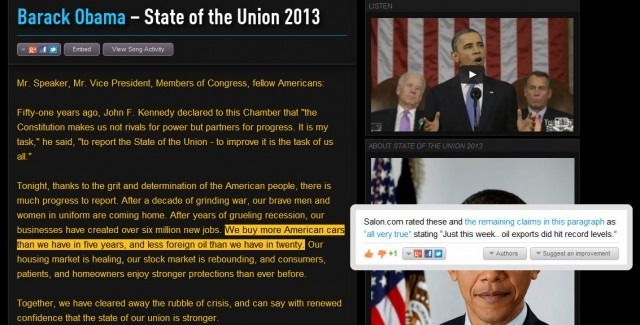
600-x-320-GSA-Mentor-Protege-Program-subpart-519-70-on-cell-phoneWhat could this look like? As Herman noted, Chicago’s SmartChicago Collaborative uses RapGenius to annotate municipal documents.

Another recent example comes from DOBTCO founder and CEO Clay Johnson, who memorably put RapGenius to good use last year decoding testimony on Healthcare.gov.

The GSA’s first use is for a mentor-protege program.

Here’s hoping more subject matter experts start annotating.

[Image Credit: Huffington Post]

Federal government agencies receive .91 GPA in FOIA compliance from Center for Effective Government

Today, the Center for Effective Government released a scorecard for access to information from the 15 United States federal government agencies that received the most Freedom of Information Act (FOIA) requests, focusing upon an analysis of their performance in 2013.

The results of the report (PDF) for the agencies weren’t pretty: if you computed a grade point average from this open government report card (and I did) the federal government would receive a D for its performance. 7 agencies outright failed, with the State Department receiving the worst grade (37%).

The grades were based upon:

  1. How well agencies processed FOIA requests, including the rate of disclosure, fullness of information provided, and timeliness of the response
  2. How well the agencies established rules of information access, including the effectiveness of agency polices on withholding information and communications with requestors
  3. Creating user-friendly websites, including features that facilitate the flow of information to citizens, associated online services, and up-to-date reading rooms

The report is released at an interesting historic moment for the United States, with Sunshine Week just around the corner. The United States House of Representatives just unanimously passed a FOIA Reform Act that is substantially modeled upon the Obama administration’s proposals for FOIA reforms, advanced as part of the second National Open Government Action Plan. If the Senate takes up that bill and passes it, it would be one of the most important, substantive achievements in institutionalizing open government beyond this administration.

The Citizens for Responsibility and Ethics in Washington have disputed the accuracy of this scorecard, based upon the high rating for the Department of Justice. CREW counsel Anne Weismann:

It is appropriate and fair to recognize agencies that are fulfilling their obligations under the FOIA. But CEG’s latest report does a huge disservice to all requesters by falsely inflating DOJ’s performance, and ignoring the myriad ways in which that agency — a supposed leader on the FOIA front — ignores, if not flouts, its obligations under the statute.

Last Friday, I spoke with Sean Moulton, the director of open government policy at the Center for Effective Government, about the contents of the report and the state of FOIA in the federal government, from the status quo to what needs to be done. Our interview, lightly edited for content and clarity, follows.

What was the methodology behind the report?

Moulton: Our goal was to keep this very quantifiable, very exact, and to try and lay out some specifics. We thought about what the components were necessary for a successful FOIA program. The processing numbers that come out each year are a very rich area for data. They’re extremely important: if you’re not processing quickly and releasing information, you can’t be successful, regardless of other components.

We did think that there are two other areas that are important. First, online services. Let’s face it, the majority of us live online in a big way. It’s a requirement now for agencies to be living there as well. Then, the rules. They’re explained to the agencies and the public, in how they’re going to do things when they get a request. A lot of the agencies have outdated rules. Their current practices may be different, and they may be doing things that the rules don’t say they have to, but without them, they may stop. Consistent rules are essential for consistent long term performance.

A few months back, we released a report that laid out what we felt were best practices for FOIA regulations. We went through a review of dozens of agencies, in terms of their FOIA regulations, and identified key issues, such as communicating with the requester, how you manage confidential business information, how you handle appeals, and how you handle timelines. Then we found inside existing regulations the best ways this was being handled. It really helped us here, when we got to the rules. We used that as our roadmap. We knew agencies were already doing these things, and making that commitment. The main thing we measured under the rules were the items from that best practices report that were common already. If things were universal, we didn’t want to call a best practice, but a normal practice.

Is FOIA compliance better under the Obama administration, more than 4 years after the Open Government Directive?

Moulton: In general, I think FOIA is improving in this administration. Certainly, the administration itself is investing a great deal of energy and resources in trying to make greater improvements in FOIA, but it’s challenging. None of this has penetrated into national security issues.

I think it’s more of a challenge than the administration thought it would be. It’s different from other things, like open data or better websites. The FOIA process has become entrenched. The biggest open government wins were in areas where they were breaking new ground. There wasn’t a culture or way of doing this or problems that were inherited. They were building from the beginning. With FOIA, there was a long history. Some agencies may see FOIA as some sort of burden, and not part of their mission. They may think of it as a distraction from their mission, in fact. When the Department of Transportation puts out information, it usually gets used in the service of their mission. Many agencies haven’t internalized that.

There’s also the issue of backlogs, bureaucracy, lack of technology or technology that doesn’t work that well — but they’re locked into it.

What about redaction issues? Can you be FOIA compliant without actually honoring the intent of the request?

Moulton: We’re very aware of this as well. The data is just not there to evaluate that. We wish it was. The most you get right now is “fully granted” or “partly granted.” That’s incredibly vague. You can redact 99% or 1% and claim it’s partially redacted, either way. We have no indicator and no data on how much is being released. It’s frustrating, because something like that would help us get a better sense on whether agencies would benefit would new policies

We do know that the percentage of full grants has dropped every year, for 12 years, from the Clinton administration all the way through the Bush administration to today. It’s such a gray area. It’s hard to say whether it’s a terrible thing or a modest change.

Has the Obama administration’s focus on open government made any difference?

Moulton: I think it has. There were a couple of agencies that got together on FOIA reform. The EPA led the team, with the U.S. National Archives and the Commerce Department, to build a new FOIA tool. The outward-facing part of the tool enables a user to go to a single spot, request and track it. Other people could come and search FOIA’ed documents. Behind the scenes, federal workers could use the tool to forward requests back and forth. This fits into what the administration has been trying to do, using technology better in government

Another example, again at the EPA, is where they’ve put together a proactive disclosure website. They got a lot of requests, like if there are inquiries about properties, environmental history, like leaks and spills, and set up a site where you could look up real estate. They did this because they went to FOIA requests and see what people wanted. That has cut down their requests to a certain percentage.

Has there been increasing FOIA demand in recent years, affecting compliance?

Moulton: I do think FOIA requests have been increasing. We’ll see what this next year of data shows. We have seen a pretty significant increase, after a significant decrease in the Bush administration. That may be because this administration keeps speaking about open government, which leads to more hopeful requestors. We fully expect that in 2013, there will be more requests than the prior year.

DHS gets the biggest number of all, but that’s not surprising when we look at the size of it. It’s second biggest agency, after Defense, and the biggest domestic facing agency. when you start talking about things like immigration and FEMA, which go deep into communities and people’s lives, in ways that have a lot impact, that makes sense.

What about the Department of Justice’s record?

Moulton: Well, DoJ got the second highest rating, but we know they have a mixed record. There are things you can’t measure and quantify, in terms of culture and attitude. I do know there were concerns about the online portal, in terms of the turf war between agencies. There were concerns about whether the tech was flexible, in terms of meeting all agency needs. If you want to build a government-wide tool, it needs to have real flexibility. The portal changed the dialogue entirely

Is FOIA performance a sufficient metric to analyze any administration’s performance on open government?

Moulton: We should step back further and look at the broader picture, if we’re going to talk about open government. This administration has done things, outside of FOIA, to try to open up records and data. They’ve built better online tools for people to get information. You have to consider all of those things.

Does that include efforts like the Intelligence Community Tumblr?

Moulton: That’s a good example. One thing this administration did early on is to identify social media outlets. We should be going there. We can’t make citizens come to us. We should go to where people are. The administration pushed early on that agencies should be able to use Tumblr and Twitter and Facebook and Flickr and so on.

Is this social media use “propaganda,” as some members of the media have suggested?

Moulton: That’s really hard to decide. I think it can result in that. It has the potential to be misused to sidestep the media, and not have good interaction with the media, which is another important outlet. People get a lot of their information from the media. Government needs to have good relationship.

I don’t think that’s the intention, though, just as under Clinton, when they started setting up websites for the first time. That’s what the Internet is for: sharing information. That’s what social media can be used for, so let’s use what’s there.


AskThem.io launches to enable citizens to ask public officials anything

badgeToday, the Participatory Politics Foundation launched AskThem.io, a new online tool focused upon structured questions and answers with elected officials.

As David Moore, founder of PPF, put it, AskThem is like a version of the White House’s “We The People” petition platform, but for over 142,000 elected officials nationwide.” 

The platform is an evolution from earlier attempts to ask questions of candidates for public office, like “10 Questions” from Personal Democracy Media, or the myriad online town halls that governors and the White House have been holding for years. 

AskThem enables anyone to pose a question to any elected official or Verified Twitter account. Notably, the cleanly designed Web app uses geolocation to enable users to learn who represents them, in of itself a valuable service.

As with e-petitions, AskThem users can then sign questions they support, voting them up and sharing the questions with their social networks. When a given question hits a preset threshold, the platform delivers the questions to to the public figure and “encourages a public response.”

That last bit is key: there’s no requirement for someone to respond, for the response itself to be substantive, nor for the public figure to act. There’s only the network effect of public pressure to make any of that happen.

After a year of development, Moore was excited to see the platform go live today, noting a number of precedents set in the process.

“I believe we’re the first open-source web app to support geolocation of elected officials, down to the municipal level, from street address,” he said, via email. “And I believe we’re the first to offer access to over 142,000 elected officials through our combined data sources. And I believe we’re the first to incorporate open government data for informed questions of elected officials at every level of government.”

Moore referred to AskThem’s use of the Google Civic Information API, which provides the data for the platform.

AskThem goes online just in time for tomorrow’s day of action against mass surveillance, where over 5,000 websites will try to activate their users to contact their elected representatives in Washington. Whether it gets much use or not will depend on awareness of the new tool.

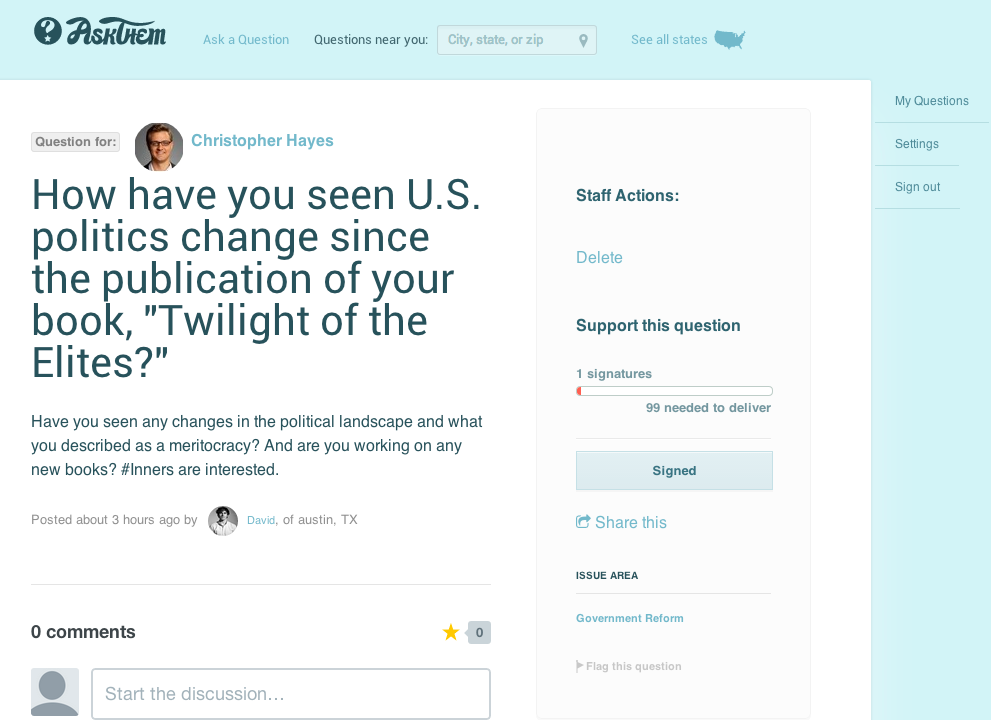
That could come through use by high-profile early adopters like Chris Hayes (@chrislhayes), of MSNBC’s “All In with Chris Hayes,” or OK Go, the popular band.

Chris_Hayes_AskThem_TOtE_sampleQ


At launch,  66 elected officials nationwide have signed on to participate, though more may join if it catches on. In the meantime, you can use AskThem’s handy map to find local elected officials and see a listing of all of the questions to date across the USA — or pose your own.