What is open government data? What is it good for? [FILM]

Open government data broadly refers to public sector records that have been made available to citizens. For a canonical resource on what makes such releases truly “open,” consult the 8 principles of open government data. Today, the Open Knowledge Foundation has released a terrific new short film entitled “#opendata” that offers expert perspectives on what open government data is and how it can be useful to society.

#opendata from Open Knowledge Foundation on Vimeo.

For more information, visit OpenGovernmentData.org. The film has already been translated into Czech, Spanish, Hungarian and Chinese. If you’d like to volunteer to translate it into another language, the makers of the film are actively seeking help.

In the broader context, The Economist‘s support for open government data remains salient today: “Public access to government figures is certain to release economic value and encourage entrepreneurship. That has already happened with weather data and with America’s GPS satellite-navigation system that was opened for full commercial use a decade ago. And many firms make a good living out of searching for or repackaging patent filings.”

In the United States, the open data story in healthcare is particularly compelling, from new mobile apps that spur better health decisions to data spurring changes in care at the Veterans Administration.

As Clive Thompson reported at Wired this month, public sector data can help fuel jobs, “shoving more public data into the commons could kick-start billions in economic activity.” In the transportation sector, for instance, transit data is open government fuel for economic growth.

Thompson focused on the story of Brightscope, where government data drives the innovation economy. “That’s because all that information becomes incredibly valuable in the hands of clever entrepreneurs,” wrote Thompson. “Pick any area of public life and you can imagine dozens of startups fueled by public data. I bet millions of parents would shell out a few bucks for an app that cleverly parsed school ratings, teacher news, test results, and the like.”


First Ignite Smithsonian spreads enlightened ideas from the “nation’s attic”

Today in Washington, Ignite Smithsonian is bringing innovative ideas about museums, design, art, technology and culture to life. As with every Ignite, each speaker had 5 minutes and 20 slides to communicate his or her message.

Ignite Smithsonian is being streamed live online from the stage of the National Museum of the American Indian this morning from 10 AM EST to 12 PM EST.

“It is the responsibility of museum as stewards of memory to help citizens think critically,” said Neal Stimler in the first talk

The archive is embedded below.

http://www.ustream.tv/flash/viewer.swf

The Ignite format has been earning more interest in Washington and government in general over the past year or so. Last May, the State Department hosted a Haiti tech meetup that Brady Forrest helped to host “Ignite style.”

Here’s the lineup for this morning

.

  • Phillip Auerswald: Creating a Place for the Future

    Phillip is an entrepreneurship enthusiast and aspiring innovation insurgent. Associate Professor, School of Public Policy, George Mason University; Associate, Belfer Center for Science and International Affairs, Harvard University; Co-Founder and Co-Editor, Innovations journal (MIT Press). Follow @auerswald on Twitter.
  • Brett Bobley: Digging into Data Challenge

    Brett is Chief Information Officer for the U.S. National Endowment for the Humanities (NEH) and is also the Director of the agency’s Office of Digital Humanities (ODH). Follow @brettbobley on Twitter.
  • Katie Filbert and Sarah Stierch: Be GLAMorous: Join WikiProject GLAM/SI

    Katie and Sarah are long-time Wikipedians. Follow @filbertkm and @Sarah_Stierch on Twitter.
  • Vanessa Fox

    Vanessa is a Google alumni, author of Marketing in the Age of Google, Entrepreneur In Residence for Ignition Partners, founder of Nine By Blue. Follow @vanessafox on Twitter.
  • Elissa Frankle: Citizen History: Making History with the Masses

    Elissa is an education consultant at the United States Holocaust Memorial Museum. Follow @museums365 on Twitter.
  • Tim Hart: Cultural Data Sculpting

    Tim is the Director of Information, Multimedia and Technology at Museum Victoria, Australia. Follow @timh01 on Twitter.
  • David Hart: The Cleveland Dilemma, Or How To Stop Making Things People Don’t Want

    David works in the Digital Media Department at MoMA, producing content for exhibitions and programs. Follow @senorcorazon on Twitter.
  • Carmen Iannacone: Hello, I’m a knowledge worker

    Carmen is the Chief Technology Officer at the Smithsonian Institution. Follow @SI_CTO on Twitter.
  • Clay Johnson

    Clay is a polycareerist: Founder of Blue State Digital, former Director of Sunlight Labs, government transparency and open data activist, Founder of Big Window Labs, Director of Engagement for ExpertLabs, and current author at infovegan.com. Follow @cjoh on Twitter
  • Martin Kalfatovic: ebooks for everybody

    Martin is a featherless bipedal librarian attempting to avoid extinction. Habitat: Smithsonian Institution Libraries. Follow @udcmrk on Twitter.
  • Steve Midgley: Learning Registry: free to be you and me

    Steve is the Deputy Director for Education Technology at the US Dept of Education, Education Director, FCC., Principal Mixrun. Program officer, Stupski Foundation. VP Engineering LoopNet. Grad school drop out. Follow @stevemidgley on Twitter.
  • Kevin Novak: The New White Space

    Kevin is the Vice President of Integrated Web Strategy and Technology for the American Institute of Architects, Co-chair of the W3C Electronic Government workgroup, Chair of the National Research Council/National Academies Panel on Communicating and Disseminating Engineering and Scientific Data for the National Science Foundation, former chair of the Internet in Developing Countries Task Force under the .MOBI Foundation, former Director of Web Services at the Library of Congress. Follow @NovakKevin on Twitter
  • Fiona Rigby: Making New Zealand Content Easier to Find, Share, Use

    Fiona is the Content Manager at DigitalNZ. Follow @nzfi on Twitter.
  • Margriet Schavemaker: The Museum as InnovatAR

    Margriet is an art historian, philosopher and media specialist. She’s the Head of Collections and Research at the Stedelijk Museum, Amsterdam. Follow @marschave on Twitter.
  • Camilla SDO: Camilla – The Who & Why!

    Camilla is the mission mascot for the NASA Solar Dynamics Array. Follow @Camilla_SD on Twitter.
  • Simon Sherrin: Giving everyone a bite of the Apple

    Simon is the Technical Manager for the Victorian Cultural Network, Australia. Follow @thesherrin on Twitter.
  • Koven Smith: What’s the Point of a Museum Website?

    Koven is a composer, drummer, and Director of Technology at the Denver Art Museum. Follow @5easypieces on Twitter.
  • Neal Stimler: Renewing American Democracy Through Museums & Digital Culture

    Neal is the Associate Coordinator of Images in The Image Library at The Metropolitan Museum of Art. Follow @nealstimler on Twitter.
  • Kate Theimer: How I Got Over My Hatred of "Archive" as a Verb, and Other Stories of Words and Evolutions

    Kate is the author of “Web 2.0 Tools and Strategies for Archives and Local History Collections” and the ArchivesNext blog. Former National Archives and Smithsonian Institution employee. Follow @archivesnext on Twitter.
  • Jasper Visser: A look at the wondrous world of automatic vending machines through the eyes of a museum professional

    Jasper is the project manager for new technology and media projects at the Museum of National History of the Netherlands. Follow @jaspervisser on Twitter.

Enjoy! You can follow the backchannel for the event at #IgniteSmithsonian on Twitter.

http://widgets.twimg.com/j/2/widget.js

new TWTR.Widget({
version: 2,
type: ‘search’,
search: ‘ignitesmithsonian’,
interval: 6000,
title: ‘What\’s happening at’,
subject: ‘Ignite Smithsonian’,
width: ‘auto’,
height: 400,
theme: {
shell: {
background: ‘#990000’,
color: ‘#ffffff’
},
tweets: {
background: ‘#ffffff’,
color: ‘#444444’,
links: ‘#1985b5’
}
},
features: {
scrollbar: false,
loop: true,
live: true,
hashtags: true,
timestamp: true,
avatars: true,
toptweets: true,
behavior: ‘default’
}
}).render().start();

Videos from the Web were interspersed with the speakers, like “Trade School.”

Or a flash mob doing the Hammer Dance.

Week in Review: Top Gov 2.0 and Open Government Stories

US Capitol Blooms

Open government made an appearance in popular culture, albeit not in an admiring sense. At the start of the week, Jon Stewart and the Daily Show mocked the Obama administration and the president for a perceived lack of transparency.

Stewart and many other commentators have understandably wondered why the president’s meeting with open government advocates to receive a transparency award wasn’t on the official schedule or covered by the media. A first hand account of the meeting from open government advocate Danielle Brian offered useful perspective on the issues that arose that go beyond a soundbite or one liner:

Gary, OMB Watch’s executive director, focused on the places where we have seen real change, including the Open Government Directive, the Executive Orders on Classified National Security and Controlled Unclassified Information, emphasis on affirmative disclosures of government information; and the President’s support of reporters’ privilege and shield law, as well as whistleblower protections.

Lucy, executive director for Reporters Committee for Freedom of the Press, pointed out that this was the first president in her 30 years of working in this field who had invited open government advocates into the Oval Office. She specifically thanked him for his strong support of a reporters’ shield law, which he affirmed he continues to support. Tom, executive director for the National Security Archive, emphasized that when it comes to FOIA reform and implementation we know it isn’t just a ship of state, but an entire flotilla including rowboats. And that while there has been notable improvement according to the National Security Archive’s survey of agencies, there continues to need be a need for leadership from the top to change cultures across the vast swath of government agencies. He also noted that we all believe the information we want to see is not simply that which is useful for consumers, but also that which holds the government accountable.

I knew my topic was likely to be sensitive. I began by thanking the President for his strong support of whistleblower protections, and noted that it was not for lack of effort on the part of the White House that the legislation didn’t pass at the end of the last Congress.

I noted, however, that the current aggressive prosecution of national security whistleblowers is undermining this legacy. That we need to create safe channels for disclosure of wrongdoing in national security agencies. That we need to work harder to shrink the amount of over-classified materials that unnecessarily prompt leak prosecutions.

The President shifted in his seat and leaned forward. He said he wanted to engage on this topic because this may be where we have some differences. He said he doesn’t want to protect the people who leak to the media war plans that could impact the troops. He differentiated these leaks from those whistleblowers exposing a contractor getting paid for work they are not performing. I was careful not to interrupt the President, but waited until he was done. I pointed out that few, if any, in our community would disagree with his distinction—but that in reality the current prosecutions are not of those high-level officials who regularly leak to the press to advance their policy agendas. Instead, the Department of Justice (DOJ) is prosecuting exactly the kind of whistleblower he described, for example one from the National Security Agency.

The President then did something that I think was remarkable. He said this is an incredibly difficult area and he wants to work through how to do a better job in handling it. He also agreed that too much information is classified, and asked us to work with his office on this. He wasn’t defensive nor was he dismissive. It was perhaps the dream moment for an advocate—hearing the most senior policymaker agree with you and offer to work together to tackle the problem.

Brian’s account is the most comprehensive account of the meeting on open government online. The irony that it was not recorded and released to the American people is, however, inescapable. For anyone tracking the progress of the Open Government Directive, the last six months have been an up and down experience. It was clear back in September that in the United States, open government remains in beta.

According to doctoral research by University of Texas academic, there are 358 open government projects in federal government. Former White House deputy chief technology officer Beth Noveck wrote about the semantics and the meaning of good government and open government mean in this context. One takeaway: don’t mistake open innovation policies for transparency guarantees.

The current White House deputy CTO for innovation, Chris Vein, wrote on the White House blog this week that the one year anniversary of open government plans were “a testament to hard work” at the agencies. As Vein acknowledged, “while there is always more to be done, we are proud of the important work that agencies have done and are doing to change the culture of government to one that encourages transparency and facilitates innovation.  We are committed to maintaining and building upon this momentum to make our Nation stronger and to make the lives of Americans better.”

Naturally, some projects are always going to be judged more as more or less effective in delivering on the mission of government than others. An open government approach to creating a Health Internet may be the most disruptive of them. For those that expected to see rapid, dynamic changes in Washington fueled by technology, however, the bloom has long since come off of the proverbial rose. Open government is looking a lot more like an ultramarathon than a 400 yard dash accomplished over a few years.

That said, something different is going on during what Micah Sifry has aptly called the age of transparency. We’re in new territory here, with respect to the disruption that new connection technologies represent to citizens, society and government. It’s worth taking stock of what’s happened recently. It’s been a while since I first posted a Gov 2.0 Week in Review at Radar, and three months since the 2010 Gov 2.0 year in review.

There’s a lot happening in this space. Following is a quick digest that might provide some perspective to those who might think that open government is a better punchline than policy.

1. The government stayed open. The budget crisis on Capitol Hill overshadowed every other issue this past week. It’s harder for a government to be open if it’s closed. The secrecy of the shutdown negotiations left folks over at the Sunlight Foundation wondering about how open government principles matched up to reality.

2. Proposed deep cuts to funding for open government data platforms like Data.gov or the IT Dashboard appear to be least partially restored in the new budget. That will likely salve (some of) the concerns of advocates like Harlan Yu, who wrote about what we would lose if we lost Data.gov. John Wonderlich’s questions on the budget deal, however, include one on exactly how much funding was restored.

3. FCC.gov relaunched as an open government platform. In any other week, this story would have led the list open government news. Having sat out the Aughts, FCC.gov stepped into the modern age FCC managing director Steve Van Roekel and his team worked hard to bring Web 2.0 principles into the FCC’s online operations. Those principles include elements of open data, platform thinking, collective intelligence, and lightweight social software. What remains to be seen in the years ahead is how much incorporating Web 2.0 into operations will change how the FCC operates as a regulator. The redesign was driven through an open government process that solicited broad comment from the various constituencies that visit FCC.gov. The beta.FCC.gov isn’t just a site anymore, however: it’s a Web service that taps into open source, the cloud, and collective intelligence. In the world of Gov 2.0, that’s a substantial reframing of what government can do online.

4. What happens to e-government in a shutdown? This near miss forced hundreds of thousands of people to consider how to make wired government go dark. That discussion should not end with this latest resolution.

5. The first NASA Open Source Summit explored why open source is a valuable tool for the space agency. Open source is a pillar of NASA’s open government plan.

6. The Russian blogosphere came under attack, quashing an online parliament initiative. Needless to say, it will be interesting to see if a Russian Gov 2.0 conference next week addresses the issue of press freedoms or open government transparency.

7. Simpl launched as platform to bridge the connection between social innovators and government.

8. National Builder launched as a new online activism platform.

9. Senator Jon Tester (D-MT) and Representative Steve Israel (D-NY) reintroduced the Public Online Information Act. With this transparency bill, the federal government would acknowledge the Internet, opined Mother Jones.

10. SeeClickFix launches its Facebook app.. “It looks like the entire SeeClickFix experience has been ported over to the Facebook environment,” writes Dan Kennedy. “Users can report problems and pinpoint them on a Google map, thus alerting government officials and the news media. I am far from being the world’s biggest Facebook fan, but it’s a smart move, given how much time people spend there.”

Editor’s Note This is by no means a definitive, comprehensive list. For instance, there’s plenty of open government news happening in countries around the world, from corruption mashups in India to the transparency challenges in various states. For a daily dose of transparency, make sure to read the Sunlight Foundation’s blog IBM’s Business of Government blog has also posted a weekly round up. If you have more stories that came across your desktop, inbox or television this week, please share them in the comments.

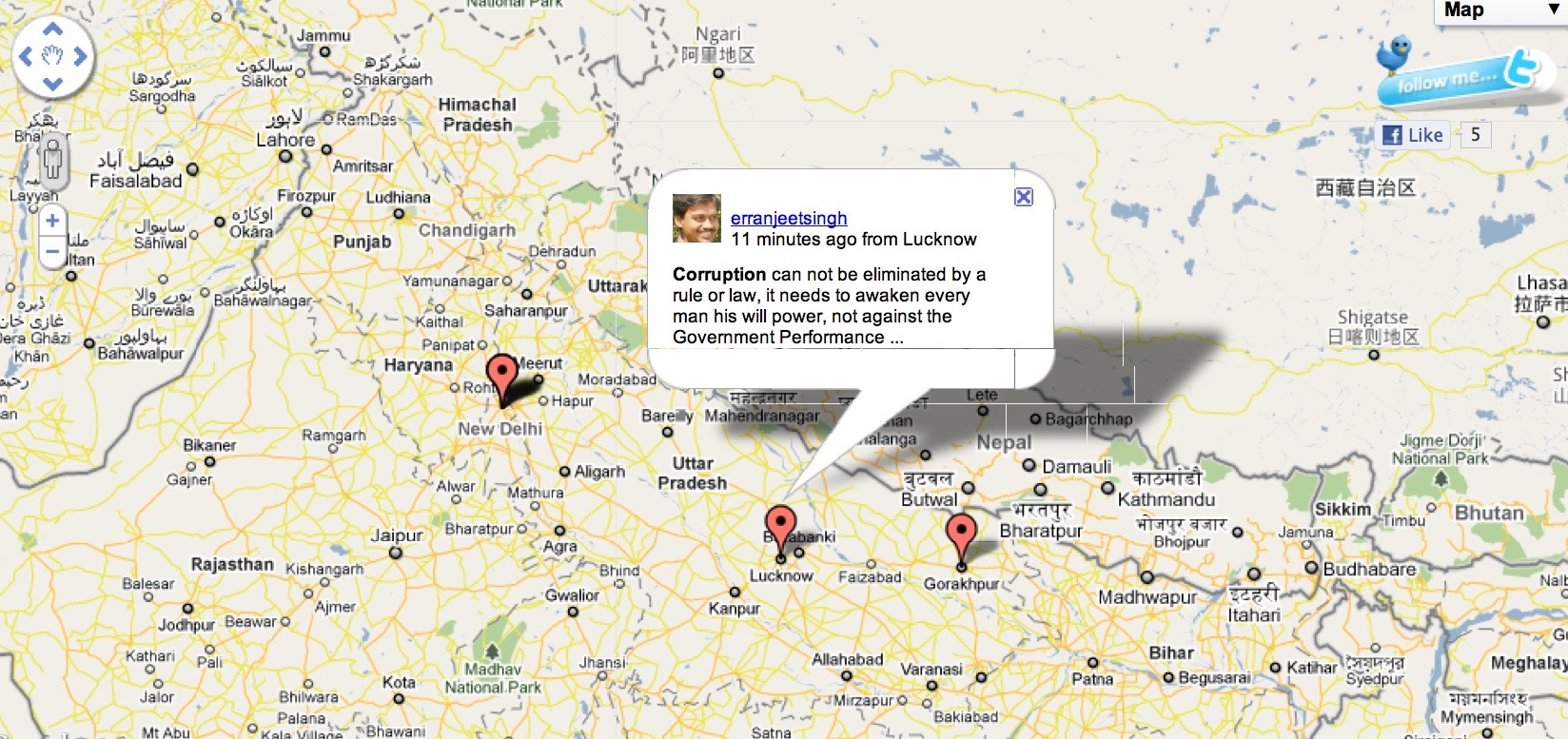
Mapping corruption tweets in real-time in India [MASHUP]

Transparency has gone global. Today, there’s a mashup of corruption-related tweets in India and Google Maps to explore.

Add an expanding number of data points in how Gov 2.0 and open government are taking root in India.

Hat tip to Andrew McLaughlin.

The State Department is tumbling

Have no fear – or hope, depending upon your perspective: the United States Department of State is not undergoing a revolution. They have, however, added one more tool to the digital diplomacy toolkit: they’ve started a new blog on Tumblr, a rapidly growing blogging platform.

The State Department started tumbling at StateDept.tumblr.com on Monday, a few weeks after Tumblr was added to Apps.gov. The General Services Administration started the first federal agency Tumblr last month for the new USA.gov blog.

So far, the folks over at Foggy Bottom have tumbled about relief efforts in Japan, aid for Africa, a partnership in Ukraine, shared video of Secretary of State Hillary Clinton talking with Israeli President Shimon Peres and posted a dispatch from EWC in the Pacific.

In the process, they’ve integrated pictures from Flickr, text from state.gov and video from YouTube – a reminder of how much of a pastiche creating and publishing media in a Gov 2.0 world has become.

Tumblr looks like a good platform for the diversity of content and context that State has to share. Sharp-eyed observers will have to wait to see if they are willing to fully engage with the Tumblr community reblogging other posts as well. For instance, if any digital diplomats come across the map of a tweet that I found through Stowe Boyd, they should feel more than welcome to reblog it. (I hear the State Department finds Twitter pretty interesting these days.)

Disaster 2.0: UN OCHA releases report on future of information sharing in crisis

The emergence of crisiscamps and subsequent maturation of CrisisCommons into a platform for civic engagement were important developments in 2010. Hearing digital cries for help has never been more important. A year after the devastating earthquake in Haiti, a new report by a team at the Harvard Humanitarian Initiative analyzes how the humanitarian, emerging volunteer and technical communities collaborated in the aftermath of the quake. The report recommends ways to improve coordination between these groups in future emergencies. There are 5 specific recommendations to address the considerable challenges inherent in coordinating crisis response:

  1. A neutral forum to surface areas of conflict or agreement between the volunteer/technical community and established humanitarian institutions
  2. An space for innovation where new tools and approaches can be experimented with before a crisis hits
  3. A deployable field team with the mandate to use the best practices and tools established by the community
  4. A research and development group to evaluate the effectiveness of tools and practices
  5. An operational interface that identifies procedures for collaboration before and during crises, including data standards for communication

Disaster Relief 2.0: The Future of Information Sharing in Humanitarian Emergencies” was commissioned by the United Nations Foundation and Vodafone Foundation Technology Partnership in collaboration with the UN Office for the Coordination of Humanitarian Affairs (OCHA). You can find more discussion of the report in a series of posts on disaster relief 2.0 at UNDispatch.com, like this observation from Jen Ziemke:

…a substantial majority of members on the Crisis Mappers Network have held positions in formal disaster response, some for several decades. Volunteers in groups like the Standby Task Force include seasoned practitioners with the UNDP or UN Global Pulse. But what is really needed is a fundamental rethinking of who constitutes the “we” of disaster response, as well as dispensing with current conceptions of: “volunteers”, “crowds,” and “experts.” While distinctions can be endlessly debated, as humans, we are far more the same than we are different.

Whether it’s leveraging social media in a time of need or geospatial mapping, technology empowers us to help one another more than ever. This report offers needed insight about how to do it better.

Building a revolution in relevance in an age of information abundance

Revolutions rooms“We’ve had a decade’s worth of news in less than two months,” Mike Allen, chief White House correspondent for Politico. In the Saturday edition of Politico’s Playbook, Allen looked back at the Arab Spring and Japanese ongoing challenges:

It was Feb. 11 – seven weeks ago — that Mubarak fled the Arab spring, a rolling reordering of Middle East power that could wind up affecting global security as profoundly as 9/11.

It was March 11 – 15 days ago – that we woke to the news of the Japanese earthquake and tsunami, which will have ripple effects on the fragile global economy for months to come.

And, oh, we’re in three hot conflicts at once, for the first time since World War II.”

Related, in the NEW YORK TIMES: “Inundated With News, Many Find It Difficult to Keep Up on Libya

“People interviewed across four states said that at a time when the world seems to stagger from one breathtaking news event to another — rolling turmoil across the Middle East, economic troubles at home, disaster upon disaster in Japan — the airstrikes on military targets in Libya can feel like one crisis too many.”

Through it all, I’ve been following Andy Carvin (@acarvin), whose Twitter feed has been a groundbreaking curation of the virtual community and conversation about the Middle East, including images, video, breaking news and unverified reports.

To wax metaphorical, his account has become a stream of crisis data drawn from from the data exhaust created by the fog of war across the Middle East, dutifully curated by a veteran digital journalist for up to 17 hours a day.

Carvin has linked to reports, to video and images from the front lines that are amongst the most graphic images of war I have ever seen. While such imagery is categorically horrific to view, they can help to bear witness to what is happening on the ground in countries where state media would never broadcast their like.

The vast majority of the United States, however, is not tracking what’s happening on the ground in the region so closely. NEW YORK TIMES:  

“A survey by the Pew Research Center — conducted partly before and partly after the bombing raids on Libya began on March 19 — found that only 5 percent of respondents were following the events ‘very closely.’ Fifty-seven percent said they were closely following the news about Japan.”

Understanding the immensity of the challenges that face Japan, Egypt and Libya is pushing everyone’s capacity to stay informed with day to day updates, much less the larger questions of what the larger implications of these events all are for citizens, industry or government. In the context of the raw information available to the news consumer in 2011, that reality is both exciting and alarming. The tools for newsgathering and dissemination are more powerful and democratized than ever before. The open question now is how technologists and journalists will work together to improve them to provide that context that everyone needs.

Finally, an editor’s note: My deepest thanks to all of the brave and committed journalists working long hours, traveling far from their families and risking their lives under hostile regimes for the reporting that helps us make it so.

Micah Sifry on “Wikileaks and the Age of Transparency”

The emergence of Wikileaks as a global player in technology-fueled transparency was one of the biggest stories of 2010. Micah Sifry, co-founder of the Personal Democracy Forum and editor of techPresident, used Wikileaks as a peg to explore the new information ecosystem in his excellent new book, “Wikileaks and the Age of Transparency.” Last night in Washington, Sifry spoke about why he wrote the book and offered some cogent reflections about how transparency has gone global. Video of his talk is embedded below.

Few people have as rich an understanding of the intersection of technology and politics than Sifry. I’m looking forward to reading my new copy of the book immensely and, of course, to following his chronicling of the age of transparency in realtime at @mlsif.

Samantha Power: Transparency has gone global

Innovations in democratic governance have been and likely always will be a global phenomenon. Samantha Power, senior director and special assistant for multilateral affairs and human rights at the White house, highlighted the ways in which platforms and initiatives for transparency in other countries are growing on the White House blog yesterday.

While “Sunshine Week” may be an American invention, the momentum for greater transparency and accountability in government is a global phenomenon. In countries around the world, governments and civil society groups are taking new and creative steps to ensure that government delivers for citizens and to strengthen democratic accountability.

From Kenya to Brazil to France to Australia, new laws and platforms are giving citizens new means to ask for, demand or simply create greater government transparency. As Power observed, open government is taking root in India, where the passage of India’s Right to Information Act and new digital platforms have the potential to change the dynamic between citizens and the immense bureaucracy.

Power listed a series of global transparency efforts, often empowered by technology, that serve as other useful examples of “innovations in democratic governance” on every continent

  • El Salvador and Liberia recently passed progressive freedom of information laws, joining more than 80 countries with legislation in place, up from only 13 in 1990;
  • A few weeks ago in Paris, six new countries from Europe, Africa, Central Asia, and the Middle East met the high standards of the Extractive Industries Transparency Initiative (EITI), empowering citizens with unprecedented information about payments made for the extraction of natural resources;
  • Brazil and South Africa are pioneering innovative tools to promote budget transparency and foster citizen engagement in budget decision-making, along with tens of other countries that are making budget proposals and processes open to public input and scrutiny;
  • Civil society groups are developing mechanisms to enable citizens to keep track of what happens in legislatures and parliaments, including impressive web portals such as votainteligente.cl in Chile and mzalendo.com in Kenya; and
  • Experiments in citizen engagement in Tanzania, Indonesia, and the Philippines, are demonstrating that citizen efforts to monitor the disbursement of government funds for education, health, and other basic services, actually decrease the likelihood of corruption and drive better performance in service delivery.

There’s a long road ahead for open government here in the United States. While improving collaboration and transparency through open government will continue to be difficult nuts to crack, it looks like “Uncle Sam” could stand to learn a thing or two from the efforts and successes of other countries on transparency. Addressing FOIA reform and better mobile access to information are two places to start.

For more on how open government can have a global impact, click on over to this exclusive interview with Samantha Power on national security, transparency and open government.

Vint Cerf talks to the CFR about Internet freedom and foreign policy

In a new video interview from the Council on Foreign Relations (CFR), Google’s Internet evangelist, Vint Cerf talks with CFR’s Hagit Bachrach about the future of the Internet and what that could mean for international development and foreign policy. He spoke about the importance of an “Internet without borders” last year.

Earlier in the month, Cerf spoke with USAID’s Alex O. Dehgan about technology as a tool for foreign policy, discussing the ability of science and information technology to connect political leaders, diplomats and innovators around the globe.

Last year, Cerf made it clear that he believed that governments shouldn’t control the Web, at least with respect to the governance of ICANN, the organization that has responsibility for the Internet domain system. In the wake of the Internet shutdown in Egypt and ongoing online censorship around the globe, that perspective has gained more prominence.