D.C. and Moscow to host bilateral open government codeathon

In less than two weeks, there will be an unprecedented bilateral codeathon between the United States and Russia held in both Washington, D.C. and Moscow, Russia.

The event will last between September 24 at 9AM until September 25 at 5:00 PM and will be held at American University in D.C. and in the offices of Yandex in Moscow.

More details coming soon.

For now, check out Code4Country.org and submit your ideas for civic applications that can help make Russian civil society stronger, solve problems for citizens and enable more government transparency,

Agenda and details of Open Government Partnership “Power of Open” event announced

The details of the launch of the Open Government Partnership on September 20th are now public. Under Secretary of State Maria Otero, Brazilian Minister of State Jorge Hage and President Benigno S. Aquino III will be making keynote speeches, followed by senior government officials, business leaders and technologists, including eBay founder Pierre Omidyar, World Wide Web creator Tim Berners-Lee and Celtel founder Mo Ibrahim.

As I reported yesterday, 22 countries have committed to participate in the partnership now, with more to come.

The “Power of Open” event will be hosted by Google NYC. Given limited capacity for live attendance, a live stream of the event at the Open Gov Partnership YouTube channel will substantially increase the forum’s reach. The “Power of Open” agenda is embedded below.

Power of Open Agenda 9.6.11//

Open Government Partnership expands to include at least 22 countries at launch

With two weeks left before a historic announcement in New York City at the United Nations, the international Open Government Partnership (OGP) has expanded to include fourteen more countries. The news of the expansion was first reported by FreedomInfo.org, which quoted an unnamed U.S. official.

The newly added countries include Kenya, Guatemala, Honduras, Albania, Macedonia, Malta, Georgia, Moldova, Slovakia, Bulgaria, Israel, Croatia, Mongolia and Lithuania. The original eight country members of the OGP are the United States and Brazil (co-chairs of OGP), South Africa, the United Kingdom, Norway, Mexico, Indonesia and the Philippines.

“These are governments from whom we’ve received formal letters of intent,” said Caroline Mauldin, special assistant to Under Secretary for Democracy and Global Affairs Maria Otero at U.S. Department of State. “We’re very energized by the number of countries who are ready to step up to the Open Government Partnership plate.” Mauldin tells me that more letters of intent are still coming in, which will add further to the participants.

Expanding the number of countries committing to more open government is not in principle a bad thing, although the devil is the details, as ever. Brazil and the Philippines, for instance, are still working on Freedom of Information laws. We’ll learn more over the next two weeks, until the official Heads of State launch on the margins of the opening of the United Nations General Assembly in New York City. I’ll be sharing news and information as I go during the next 14 days and from the Big Apple on September 20th.

“All of the new countries are committing to developing their own country action plans in consultation with civil society, which they will announce at an OGP meeting in March 2012,” said Mauldin. “The ‘consultative process’ is the part of OGP that guarantees an ongoing, iterative dialogue with civil society.”

These letters will commit participating countries to broad principles but leave many specifics to individual governments. “OGP is structured to foster accountability between a government and its people,” said Mauldin. “A country can design their own mechanisms, so they’ll likely vary from one place to the next; of course, one key reason why countries are joining is so they can learn from one another.” That flexibility could be important in many contexts, as Gartner analyst Andrea Di Maio observed in his post on the Open Government Partnership:

Open government can be used to fight corruption, to increase the trust in government, to counterbalance the effects of excessive churn in government, to reduce the cost of government, and so forth. But in order to deliver on these different objectives, it does require different approaches.

The risk – like similar initiatives on e-government led by the UN or the EU have clearly shown – is that leading countries tend to showcase their approaches, which are almost automatically taken as best practices. But what is a best practice for a federal agency in the US or a large city in the UK may be either irrelevant or even counterproductive in a place like Moldova or Albania, just to name two.

All that said, it bears noting that the OGP is substantially expanding and the news seems to have been leaked without attribution initially, as opposed to an official announcement by the White House, State Department or OGP or anyone else on the record. The open government community should expect ongoing announcement regarding new participants, the September 20th event, a declaration and all letters to go up on OpenGovPartnership.org — but it’s not there yet, and the @OpenGovPart Twitter account has gone silent. In the U.S., the recommendations that have been collected by the White House as part of its consultation for the U.S. National Plan are only public if the entities submitting them have published them, like the open government recommendations by Clay Johnson at Expert Labs.

For more context, Nick Judd has published a comprehensive report on the expansion of the OGP roster over at techPresident and my notes from the White House open government partnership consultation. FreedomInfo.org also collected more OGP news from South Africa, India and the new White House’s epetition initiative.

MySociety launches FixMyTransport to solve transit problems with microactivism

Over in the United Kingdom, MySociety had launched FixMyTransport, a Web application to help citizens solve persistent public transit issues.

According to Tom Steinberg, FixMyTransport is the biggest project for MySociety since they launched WhatDoTheyKnow in 2008.

“This is a huge accomplishment — a nationwide UK system for individuals to document and report problems with any kind of public transportation system,” wrote CivicCommons executive director Andrew McLaughlin this morning. “MySociety has figured out how to route every kind of report to the responsible agency (or even person) — “the service works everywhere in Great Britain, our database has over 300,000 stops and routes for train, tube, tram, bus, coach and ferry.” Great design and interface. Congratulations, +Tom Steinberg and team!”

“We’ve never before launched a site that took so much work to build, or that contained so much data,” writes Steinberg at the MySociety blog, where he explained more about what it’s for. (The emphasis below is mine.)

FixMyTransport has two goals – one in your face, and the other more subtle.

The first goal, as the site’s name suggests, is to help people get common public transport problems resolved. We’re talking broken ticket machines, gates that should be open and stations without stair-free access. We’ll help by dramatically lowering the barrier to working out who’s responsible, and getting a problem report sent to them – a task that would have been impossible without the help of volunteers who gathered a huge number of operator email addresses for us. Consequently the service works everywhere in Great Britain, our database has over 300,000 stops and routes for train, tube, tram, bus, coach and ferry.

The second goal – the subtle one – is to see if it is possible to use the internet to coax non-activist, non-political people into their first taste of micro-activism. Whilst the site intentionally doesn’t contain any language about campaigning or democracy, we encourage and provide tools to facilitate the gathering of supporters, the emailing of local media, the posting of photos of problems, and the general application of pressure where it is needed. We also make problem reports and correspondence between operators and users public, which we have frequently seen create positive pressure when used on sister sites FixMyStreet and WhatDoTheyKnow.

Steinburg goes much deeper into the thinking and process behind FixMyTransport over at Radar today, where he writes about how to create sustainable open data projects with purpose:

I’m not saying it is impossible to hack brilliant things without piles of VC gold. But if you are going to hack something really, genuinely valuable in just a couple of weeks, and you want it to thrive and survive in the real Internet, you need to have an idea that is as simple as it is brilliant. Matthew Somerville’s accessible Traintimes fits into this category, as does FlyOnTime.us, E.ggtimer.com and doodle.ch. But ideas like this are super rare — they’re so simple and powerful that really polished sites can be built and sustained on volunteer-level time contributions. I salute the geniuses who gave us the four sites I just mentioned. They make me feel small and stupid.

If your civic hack idea is more complicated than this, then you should really go hunting for funding before you set about coding. Because the Internet is a savagely competitive place, and if your site isn’t pretty spanking, nobody is going to come except the robots and spammers.

To be clear — FixMyTransport is not an example of a super-simple genius idea. I wish it were. Rather it’s our response to the questions “What’s missing in the civic web?” and “What’s still too hard to get done online?”

As we say here on the Internet, go read the whole thing. If you’re interested in working on stuff making stuff that matters to citizens and make the world a better place, instead of, say, getting them to click on ads, you’ll be glad you did.

Carmi Levy: open government is about leveraging technology and citizens to do more with less

It looks like the dog days of August 2011 may be the month when the meme of a citizen-centric government gets some traction in the business world. Over on the finance section of Yahoo Canada, Carmi Levy writes that the future of government is citizen-focused.

Levy cites open government in British Columbia and initiatives in New Zealand, Toronto, and Lousiana as case studies for his thinking and then connects the dots with the big idea: that technology enables officials to empower citizens to work with government in new ways, driven by macrotrends towards open data, mobile connectivity, social media and austerity measures.

…governments are increasingly giving citizens free rein to do as they wish with previously inaccessible data. Costs are significantly reduced as big, conventional IT projects are replaced by more on-the-fly approaches to resource management. Timelines are also cut down to size thanks to the use of agile development methods and more collaborative models. Crowdsourcing also maximizes the use of newer technologies, thanks to home-based developers looking to market their prowess to a broader audience. This all translates into more bang for the public buck.

Proponents of open data initiatives claim they increase government efficiency and effectiveness by encouraging greater levels of citizen participation in the creation and delivery of public services. But in light of the just-completed U.S. deal to restructure its debt ceiling and begin trimming the federal budget, it’s difficult to ignore the cost side of the equation, as well.

As governments on both sides of the border find themselves increasingly pressured to deliver the same — or more — services for less, open data and so-called Government 2.0-based initiatives could hold the key to taxpayers having their cake and eating it, too. As government shrinks, citizens willingly take up the slack using rapidly evolving development and social media tools.

Open government isn’t just a philosophical concept designed to drive democracy.

It’s really about leveraging technology — and technologically enabled citizens — to do more with less. By throwing data out there and seeing what develops, governments can reduce spend and enable business in ways they simply wouldn’t be able to do if they functioned conventionally. They can leverage the motivations and skills of interested members of the public to create value that conventionally hired departmental resources have never been able to achieve; at least not at this level of efficiency.

Carmi Levy (@CarmiLevy)

It’s a bold vision, although perhaps a familiar one to those who have been following the narrative that runs through these open government stories. The notable connection is connecting this approach to the need that governments have now.

If open government is going to work better, however, citizens will have to become more civically engaged — and their governments will need to both listen to them and work with them.

Notes from the third White House Open Government Partnership consultation

In July 2011, the State Department hosted an historic gathering in Washington to announce an Open Government Partnership with Brazil and six other nations. For background on the initiative, read this digest on Open Government Partnership analysis for context.

This new new open government partnership could drive U.S. commitments, according to OMB Watch.

What those commitments will be is still unclear. Given that they’re due by September’s Open Government Summit at the United Nations in New York City, the timeline for drafting them is quite limited.

Last week, when the White House asked for ideas on the National Plan for open government, the community learned a bit more about what’s on the table: improving public services and increasing public integrity.

Clay Johnson has since offered the White House a deep set of recommendations for open government in response to the three questions it posed, including better ways to use open data, social media, improving regulations, public comment, and the developer community better. If you’re interested in open government, it’s a must-read.

Those are not the limit of potential commitments on the table, at least as evidenced by what we know about the series of three consultations with open government stakeholders in Washington that the White House Office of Information and Regulatory Affairs held this July, on the 22nd, 25th and 29th. These consultations were not livestreamed or otherwise recorded, however, nor have OIRA’s notes been released to the public yet. That said, we have at least two accounts of what happened in July, from:

I attended the July 29th consultation and, while I did not record video or audio, can share the following written notes.

Attendees

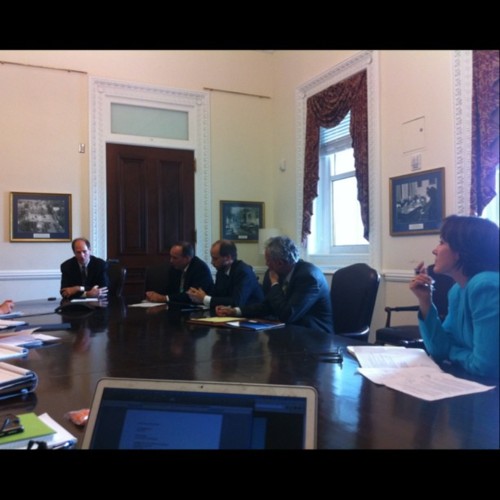
As with the previous meetings, OIRA administrator Cass Sunstein led the discussion. White House OSTP deputy CTO for public sector innovation Chris Vein was also there, along with half a dozen OIRA staff and a representative of the National Security Archive.

Seated around the table were representatives from America Speaks, OMB Watch, the Center for Technology in Government at the University of Albany, Sunshine in Government. University of Pennsylvania professor Cary Coglionese and a board member from the International Association for Public Participation, Leanne Nurse, dialed into a conference speaker phone line.
Past meetings included representatives from the Revenue Watch Institute, Code for America, Harvard’s Kennedy School of Government, Open Plans, Civic Commons, the Sunlight Foundation, Citizens for Responsibility and Ethics in Washington and the Project for Government Oversight, in addition to Open the Government and NCDD.

Open Government Consultation

Sunstein started the meeting by offering high level context for the OGP and thanks to the organizations around the table.

When the OGP was devised, he said, it was done with background experience from the Open Government Directive that came President Barack Obama and the White House Office of Management and Budget.

Many of your organizations were “indispensable” during that process, Sunstein said, and even though what happened with the open government directive “wasn’t perfect,” there has been “tremendous progress.” He thought from the beginning, with regard to the OMB open government project, that it would be a work in progress, with plans scrutinized and improved over time.

Sunstein laid out the reason for the consultation: the White House has national action plan due in September, with an event at the UN as the president promised. The White House wants the national action plan to be as good as possible, “improving on what we’ve got so far as we can.” Reflecting his comments at the previous two consultations, Sunstein said that one way to think of the meeting is generating ideas through three stages, given the temporal and feasibility constraints posed by the short deadline for UN recommendations. He observed that where would be opportunities moving forward in the medium term, over a 3-5 month time period to do more.

Katherine McFate, the executive director of OMB Watch, asked a question about the parameters for the consultation, noting that if you go back and look at the open government partnership, there are five different challenges for countries. If you only have to pick one or two, she suggested, improving public services is one, and may be improving public integrity is another. Increasing accountability, likely to be three. (Given the recent White House blog post, OIRA may have taken that suggestion.)

In response, Sunstein replied that there are surely things that have budgetary repercussions, which you then have to answer for, although in open government, sometimes it’s possible to improve public services without stretching the budget.

Theresa Pardo, director of the CTG at Albany, after thanking OIRA for the opportunity to speak and to listen, focused on the some of the issues that have arisen during implementation of the open government directive, including the role of citizen engagement. One tension is how to think about citizen participation, versus accountability imperatives.

One of the things that we hear quite regularly when we talk to practitioners at federal, local, and state level, along with academics, is a lot of confusion about concepts underlying open government directive. There’s pressure towards clarity, and still a lot of ambiguity. One of the ways to push through in creating that clarity, she suggested, would be to focus a bit more on the conversation, on figuring out what the problems that citizens are seeking open government to solve. Pardo said that in their experience, in various jurisdictions in US and outside of the US, it’s a challenge to connect what’s happening in government agencies with what citizens are talking about in public. Over the long term, the opportunity for open government, she explained, is to move towards deeper engagement with citizens themselves about what problems are they experiencing.

Professor Coglianese, speaking over the phone, agreed with Pardo and McFate. He also suggested that the White House clearly take stock of where open government is currently. We’re seeing great things, in taking stock of regulations, he said. It would make sense to something similar with taking stock of public participation now, defining a better baseline of where to assess what kinds of reform are making changes.

The point, about defining a baseline for public participation, was taken up and emphasized by many of those invited to the July 29 consultation. One of our major tools is the public participation spectrum, said Douglas Sarno of IAP2 USA. No systematic approach to what we’re trying to do or what’s been achieved has been defined by the White House, he said, and no way of qualifying bonafide public participation versus hackneyed participation defined. There are good challenges in finding metrics.

Sunstein agreed that the regulatory process requires significant public participation. This week, the Regulations.gov team acknowledged the need to do more in that regard.

In response, Pardo cited a number of studies in which communications scholars and computer scientists are using machine language processing to analyze online rulemaking to see if it results in changing in deliberation or positive social interaction. Such studies can be expensive but useful. Part of the issue in integrated such work, however, is getting real movement in processes in partnership with academics, she said.

Pardo focused further upon the role of citizen engagement, both around rulemaking and the large context of open government. Nowhere, until just recently, she said, do we teach our public managers about how to look, engage, and use citizen participation tools. “There’s a capability gap at all levels of government. How do public managers in local governments and cities, think about their jobs in different ways?”

The National Association of State CIOs and others are looking at building capability to understand how to use data and engagement tools better, said Pardo, but across the board there’s lack of ability in these core competencies. Maybe building ability as with cybersecurity skills would make sense, she suggested, including professional standards for citizen participation.

Coglianese similary focused more on baseline assessments for public participation. There are some political scientists who have tried to assess the actual impact of public comment and proposed rulemaking, he said. In terms of what to look to as baseline, what is it you want to accomplish with this national action plan? Is the goal to increase public participation? What is the level right now? We don’t have a way of saying what the volume of interaction is across the federal government, he asserted.

We do know, however, that rulemaking tends to be more something that organizations participated in more than individual citizens, Coglionese said, citing a recent article on public participation that he’d authored law journal. “We need a baseline of who’s participating and at what level,” he said. “Is the goal of participation to increase the quality of public decision making? That’s hard to assess. To enhance public virtue? That’s much harder to assess. Until it’s clear exactly what it is you would want to do, you can’t answer these questions.”

David Stern, director on online engagement at America Speaks, validated Coglionese’s words, observing that his organization had recently looked at all open government plans by agencies and came to the same conclusion. There’s a lack of consistency in metrics used to evaluate projects, said Stern, and no standards about what defines good participation. Number of people, diversity, number of instances policy influenced? Standards and best practices, in this area, would be helpful coming from White House and OMB. Every open government project contains response to the most popular proposals, he said, which means that every public engagement initiative has a public engagement component.

Rick Blum of Sunshine in Government raised another issue: FOIA exemptions, including agencies proposing them independently. The Department of Defense is overclassifying, said Blum, and it’s very hard to track what’s happening. The Department of Justice has put up a FOIA dashboard but it’s “plagued with tech glitches and bad data,” he said. This has become a public debate about secrecy or disclosure, with some half a billion dollars being spent annually fulfilling FOIA requests, said Blum. There’s also concern about the impact of the recent Supreme Court decision in Milner vs the Navy.

On my part, I offered feedback that I’d collected from the broader open government community ahead of time and over the previous year.

First, the White House has not explicitly separated open government innovation, in terms of open data about the business of government, from “good government” initiatives that transparency advocates expect and demand, in terms of accountability to the people. Misset expectations around the goals the White House has set out have created widespread dissatisfaction and harsh criticisms of an administration that promised to be “most transparent ever.” The open government initiative in the province of British Columbia offers a potential model for the White House to consider, in terms of this separation.

Second, as the federal government moves forward with its ongoing review of .gov websites, there are opportunities to work with civil society and civic developers to co-create better e-services.

Third, opportunities exist for the White House to partner with entrepreneurs, media or nonprofits that are making government data open, useful and searchable. For instance, BrightScope has made financial advisor data from the SEC and FINRA available to the public. The work of Code for America and others on farmers market open data is another example.

Finally, there continue to be serious issues raised by developers about the quality of open government data on Data.gov. In general, public servants continue to release PDFs, as opposed to machine-readable structured data, and cite the language in the Open Government Directive for support. If government wishes developers and businesses to use its data for accountability, civic utility or economic value, then releasing data in the open formats that these communities find most useful makes logical sense.

Pardo took up the issues raised with good government versus open innovation, noting that the two aren’t necessarily against each other. The idea of high value data wasn’t well defined, she said. For instance, the calendars of public officials are nothing more than a dataset.

Sunstein asked after the data issues and the one of his deputies specifically asked about the language in the OGD. He brought up the work that the federal government has done on regulations.gov – which was a persistent focus from the OIRA administrator – and asked whether it was good enough, and over what time limit? And for whom?

The general answer there was clear enough: “we the people.”

Coglianese offered more feedback on regulations.gov: it’s not enough. There are data fields are not filled in, missing information, and things remain incomprehensible, he said. “Imagine how it is for many others coming for first time?” Coglianese endorsed the recommendations of ADA blue ribbon commission for a dedicated overseer of data quality, although such a role would require congressional authorization.

There are some really important opportunities to leverage data in regulations.gov, he emphasized. Leverage that data to extract it automatically, display the data on websites. For instance, many members of congress have a button on their websites forlegislation they’re sponsoring, which then takes visitors to data automatically etxtracted from Thomas.gov. Imagine a similar system for agencies and regulators, he suggested, or consider the EPA, which is trying to display every rule that the agency is working on., which is being developed in addition to regulations.gov.

Agencies right now are building websites around current uses, said Coglionese. That makes a lot of senses, and it’s what one would hope, but doesn’t go to the “separate question of who do they want their users to be.” He criticized the design of the new FCC.gov, although I pointed out that the process that preceded the FCC relaunch was focused on the most common purposes of the site’ visitors.

What was left unsaid in these open government partnership consultations? A great deal, due to the length of time allowed. The voices that were heard around this table were also those of advocates, policy, experts, academics, and technologists: not citizens, and by and large not those of the media, whose function in representative democracies been to hold government accountable on behalf of the public.

As the White House considers its commitments in advance of the September meeting at the United Nations, the people will have a window of opportunity to tell their elected officials what open government means to them and how they woud like their federal government to be more transparent, participatory or collaborative.

If you have feedback on any of those accounts, send it to opengov@omb.gov.

Al Gore, Vint Cerf and Tim Berners-Lee on Internet freedom and democracy [VIDEO]

Last month, Cory Doctorow talked with Al Gore, Vint Cerf and Tim Berners-Lee in Mexico City about privacy, freedom, neutrality and democracy in the context of the Internet and the Web. Shaky handheld video is embedded below — the audio is worth tuning in, however, even if the video is a bit jumpy.

Hat tip to Cory Doctorow at BoingBoing, who writes:

We had a wide-ranging discussion, but kept circling back to the threats and promises for the net — copyright wars, privacy wars, government and grassroots. It was a lot of fun, and quite an honor, and I’m happy to see they’ve got the video online.

“Let’s honor Alan Turing not with a code of conduct, but with our code”

This morning, John Graham-Cumming delivered a stirring keynote at the Open Source Conference (OSCON) in Portland, Oregon. He challenged the open source community to honor computing pioneer Alan Turing not simply with a code of conduct but with the software they build. The five minute video is well worth your time.

Graham-Cumming also shared the story of how he leveraged the power of social media, open source software and the Internet to honor his petition to apologize for the treatment of Turing. For those who follow the path of e-democracy, this is fascinating stuff:

In 2009, I petitioned the UK to government to apologize for the treatment of Alan Turing. To my surprise over 32,000 people in the UK signed the petition and on September 10 of that year then Prime Minister Gordon Brown called me at home to tell me that the apology text was being issued that night.

I harnessed this great crowd of ordinary people and celebrities by myself. Using a mixture of Twitter and Facebook and old fashioned press and television the word spread quickly. I have written about how I achieved this on O’Reilly Radar. The campaign grew slowly at first as only a small number of people in the computer world, who already knew about the Turing story, signed. But a big break came when The Independent newspaper wrote about the campaign and shortly after Richard Dawkins lent his name. As Twitter amplified stories in the press more and more people signed until the BBC decided to cover the story first on its web siteand then on television.

With the weighty BBC story to tweet the petition quickly grew and got the attention of Downing Street. The petition itself was all managed electronically through open source software created by the British non-profit My Society. With an open source petition platform the British government has enabled direct, electronic democracy.

UN: Disconnecting Internet users is a breach of human rights [REPORT]

As the role of the Internet as a platform for collective actions grows, access to the rest of wired humanity becomes more important. Today, United Nations special rapporteur Frank La Rue released a report on freedom of expression and the Internet that described cutting off Internet access as a breach of human rights. The report, which was presented to the Human Rights Council in Geneva, is an important data point as governments around the globe decide how to legislate, regulate or moderate the disruptive impact of the Internet.

The UN report comes at an important time. As Mathew Ingram wrote at GigaOm, reporting on the recently released UNESCO report on freedom of expression online, governments are still trying to kill, replace or undo the Internet.

“The report provides initial guidance for countries that are grappling with how to address complex Internet policy challenges while upholding their obligations to human rights,” said Leslie Harris, president and CEO of the Center for Democracy and Technology, in a statement released to the media.

“As Rapporteur La Rue affirms, the Internet’s unique ability to provide ample space for individual free expression can lead to the strengthening of other human rights, including political, economic and social rights,” said Cynthia Wong, director of the Center for Democracy and Technology’s Project on Global Internet Freedom. “In order for these rights to be realized, governments, civil society and industry must all continue to build on the work begun by the Special Rapporteur.”

Both reports and the recent eg8 Summit shows online innovation and freedom of expression still need strong defenders. “The primary reason we need to support the Net is because it is a foundational part of how we have our democracy,” said Yochai Benkler, co-director of the Berkman Center for Internet and Society, speaking in Paris.

What’s at stake today has been what’s at stake for more than 15 years, said Benkler: The possibility that a coalition of forces who are afraid of the internet will shut it down.”There is still a very powerful counter argument, one that says both for innovation and for freedom, we need an open Net.”

If an open Internet is the basis for democracy flourishing around the world, billions of people will be counting upon our leaders to keep it open and accessible.

Report of the Special Rapporteur on the promotion and protection of the right to freedom of opinion and exp…

[Hat Tip: TorrentFreak and Mathew Ingram]

G8: the Internet has become the public arena for our time

President Barack Obama and other world leaders walk to the first working session at the G8 summit in Deauville, France, May 26, 2011. Pictured, from left are: European Commission President Jose Manuel Barroso; President Obama; French President Nicolas Sarkozy; Canadian Prime Minister Stephen Harper; Japanese Prime Minister Naoto Kan; German Chancellor Angela Merkel; and British Prime Minister David Cameron. May 26, 2011. (Official White House Photo by Official White House Photo by Lawrence Jackson)

President Barack Obama and other world leaders walk to the first working session at the G8 summit in Deauville, France, May 26, 2011. Pictured, from left are: European Commission President Jose Manuel Barroso; President Obama; French President Nicolas Sarkozy; Canadian Prime Minister Stephen Harper; Japanese Prime Minister Naoto Kan; German Chancellor Angela Merkel; and British Prime Minister David Cameron. May 26, 2011. (Official White House Photo by Official White House Photo by Lawrence Jackson)

At this year’s meeting of the “Group of 8” (G8) nations in France, a declaration about the Arab Spring included a “Deauville Partnership” with the people of the Middle East to support the growth of “democratic, open societies and inclusive economic modernisation.”

For the first time, the 2011 G-8 Summit included discussion of the Internet as a top-level issue, alongside the ongoing conflict in Libya, economic growth, nuclear safety, climate change, foreign aid and national security.

The G8 released an official communique that pledging renewed commitment for freedom and democracy that included a substantial section on the Internet. The communique included this summary of the principles discussed:

We discussed new issues such as the Internet which are essential to our societies, economies and growth. For citizens, the Internet is a unique information and education tool, and thus helps to promote freedom, democracy and human rights. The Internet facilitates new forms of business and promotes efficiency, competitiveness, and economic growth. Governments, the private sector, users, and other stakeholders all have a role to play in creating an environment in which the Internet can flourish in a balanced manner. In Deauville in 2011, for the first time at Leaders’ level, we agreed, in the presence of some leaders of the Internet economy, on a number of key principles, including freedom, respect for privacy and intellectual property, multi-stakeholder governance, cyber-security, and protection from crime, that underpin a strong and flourishing Internet. The “e-G8” event held in Paris on 24 and 25 May was a useful contribution to these debates.

That eG8 showed that online innovation and freedom of expression still need strong defenders. Some of the concerns will be assuaged in this communique.

While the body of the communique is comprised of high level principles and does not contain specific prescriptions, it does not specifically reference to international human rights laws or a “freedom to connect,” an exception that supporters of free expression like Article 19 have criticized as unsufficient. In addition, paragraph 15, below, renews a “commitment to ensuring effective action against violations of intellectual property rights in the digital arena, including action that addresses present and future infringements” that may obliquely refer to the Anti-Counterfeiting Trade Agreement, or “ACTA,” that the Electronic Frontier Foundation and others have expressed concerns about as it has moved through drafting stages.

That said, there is much in the official communique about the Internet that celebrates its power and choices that have driven its growth, including:

  • “The openness, transparency and freedom of the Internet have been key to its development and success. These principles, together with those of non-discrimination and fair competition, must continue to be an essential force behind its development.”
  • “The Internet has become the public arena for our time, a lever of economic development and an instrument for political liberty and emancipation. Freedom of opinion, expression, information, assembly and association must be safeguarded on the Internet as elsewhere. Arbitrary or indiscriminate censorship or restrictions on access to the Internet are inconsistent with States’ international obligations and are clearly unacceptable. Furthermore, they impede economic and social growth.

Coming on a week when Iran vowed to unplug the Internet, disconnecting Iranian citizens from the rest of the world, holding up those principles is both timely and notable. The full section of the communique regarding the Internet follows.

II. INTERNET

4. All over the world, the Internet has become essential to our societies, economies and their growth.

5. For citizens, the Internet is a unique information and education resource and thus can be a helpful tool to promote freedom, democracy and human rights.

6. For business, the Internet has become an essential and irreplaceable tool for the conduct of commerce and development of relations with consumers. The Internet is a driver of innovation, improves efficiency, and thus contributes to growth and employment.

7. For governments, the Internet is a tool for a more efficient administration, for the provision of services to the public and businesses, and for enhancing their relations with citizens and ensuring respect for and promotion of human rights.

8. The Internet has become a major driver for the global economy, its growth and innovation.

9. The openness, transparency and freedom of the Internet have been key to its development and success. These principles, together with those of non-discrimination and fair competition, must continue to be an essential force behind its development.

10. Their implementation must be included in a broader framework: that of respect for the rule of law, human rights and fundamental freedoms, the protection of intellectual property rights, which inspire life in every democratic society for the benefit of all citizens. We strongly believe that freedom and security, transparency and respect for confidentiality, as well as the exercise of individual rights and responsibility have to be achieved simultaneously. Both the framework and principles must receive the same protection, with the same guarantees, on the Internet as everywhere else.

11. The Internet has become the public arena for our time, a lever of economic development and an instrument for political liberty and emancipation. Freedom of opinion, expression, information, assembly and association must be safeguarded on the Internet as elsewhere. Arbitrary or indiscriminate censorship or restrictions on access to the Internet are inconsistent with States’ international obligations and are clearly unacceptable. Furthermore, they impede economic and social growth.

12. The Internet and its future development, fostered by private sector initiatives and investments, require a favourable, transparent, stable and predictable environment, based on the framework and principles referred to above. In this respect, action from all governments is needed through national policies, but also through the promotion of international cooperation.

13. We commit to encourage the use of the Internet as a tool to advance human rights and democratic participation throughout the world.

14. The global digital economy has served as a powerful economic driver and engine of growth and innovation. Broadband Internet access is an essential infrastructure for participation in today’s economy. In order for our countries to benefit fully from the digital economy, we need to seize emerging opportunities, such as cloud computing, social networking and citizen publications, which are driving innovation and enabling growth in our societies. As we adopt more innovative Internet-based services, we face challenges in promoting interoperability and convergence among our public policies on issues such as the protection of personal data, net neutrality, transborder data flow, ICT security, and intellectual property.

15. With regard to the protection of intellectual property, in particular copyright, trademarks, trade secrets and patents, we recognize the need to have national laws and frameworks for improved enforcement. We are thus renewing our commitment to ensuring effective action against violations of intellectual property rights in the digital arena, including action that addresses present and future infringements. We recognize that the effective implementation of intellectual property rules requires suitable international cooperation of relevant stakeholders, including with the private sector. We are committed to identifying ways of facilitating greater access and openness to knowledge, education and culture, including by encouraging continued innovation in legal on line trade in goods and content, that are respectful of intellectual property rights.

16. The effective protection of personal data and individual privacy on the Internet is essential to earn users’ trust. It is a matter for all stakeholders: the users who need to be better aware of their responsibility when placing personal data on the Internet, the service providers who store and process this data, and governments and regulators who must ensure the effectiveness of this protection. We encourage the development of common approaches taking into account national legal frameworks, based on fundamental rights and that protect personal data, whilst allowing the legal transfer of data.

17. The security of networks and services on the Internet is a multi-stakeholder issue. It requires coordination between governments, regional and international organizations, the private sector, civil society and the G8’s own work in the Roma-Lyon group, to prevent, deter and punish the use of ICTs for terrorist and criminal purposes. Special attention must be paid to all forms of attacks against the integrity of infrastructure, networks and services, including attacks caused by the proliferation of malware and the activities of botnets through the Internet. In this regard, we recognize that promoting users’ awareness is of crucial importance and that enhanced international cooperation is needed in order to protect critical resources, ICTs and other related infrastructure. The fact that the Internet can potentially be used for purposes that are inconsistent with the objectives of peace and security, and may adversely affect the integrity of critical systems, remains a matter of concern. Governments have a role to play, informed by a full range of stakeholders, in helping to develop norms of behaviour and common approaches in the use of cyberspace. On all these issues, we are determined to provide the appropriate follow-up in all relevant fora.

18. We call upon all stakeholders to combat the use of Internet for trafficking in children and for their sexual exploitation. We will also work towards developing an environment in which children can safely use the Internet by improving children’s Internet literacy including risk awareness, and encouraging adequate parental controls consistent with the freedom of expression.

19. We recognize the importance of enhanced access to the Internet for developing countries. Important progress has been achieved since the Okinawa Summit and we pay tribute to the efforts made by developing countries in this regard as well as the various stakeholders, governments, the private sector and NGOs, which provide resources, expertise and innovation. We encourage initiatives, in partnership with the private sector, on the use of the Internet with a development purpose, particularly for education and healthcare.

20. As we support the multi-stakeholder model of Internet governance, we call upon all stakeholders to contribute to enhanced cooperation within and between all international fora dealing with the governance of the Internet. In this regard, flexibility and transparency have to be maintained in order to adapt to the fast pace of technological and business developments and uses. Governments have a key role to play in this model.

21. We welcome the meeting of the e-G8 Forum which took place in Paris on 24 and 25 May, on the eve of our Summit and reaffirm our commitment to the kinds of multi-stakeholder efforts that have been essential to the evolution of the Internet economy to date. The innovative format of the e-G8 Forum allowed participation of a number of stakeholders of the Internet in a discussion on fundamental goals and issues for citizens, business, and governments. Its free and fruitful debate is a contribution for all relevant fora on current and future challenges.

22. We look forward to the forthcoming opportunities to strengthen international cooperation in all these areas, including the Internet Governance Forum scheduled next September in Nairobi and other relevant UN events, the OECD High Level Meeting on “The Internet Economy: Generating Innovation and Growth” scheduled next June in Paris, the London International Cyber Conference scheduled next November, and the Avignon Conference on Copyright scheduled next November, as positive steps in taking this important issue forward.