If you’re a regular reader of Govfresh or the O’Reilly Radar, you know how the chief technology officer of the U.S. Department of Health and Human Services, Todd Park ,is focused on unleashing the power of open data to improve health. If you aren’t familiar with this story, go read Simon Owen’s excellent feature article that explores his work on revolutionizing the healthcare industry. Part of unlocking innovation through open health data has been a relentless promotion and evangelization of the data that HHS has to venture capitalists, the healthcare industry and developers. It was in that context that Park visited New York’s Hacks and Hackers meetup today. The video of the meeting is embedded below, including a lengthy question and answer period at the end.
NYC Hacks and Hackers co-organizer Chrys Wu was kind enough to ask my questions, posed over Twitter. Here were the answers I pulled out from the video above:
How much data has been released? Park: “A ton.” He pointed to HealthData.gov as a scorecard and said that HHS isn’t just releasing brand new data. They’re “also making existing data truly accessible or usable,” he said. They’re taking “stuff that’s in a book or website and turning it into machine readable data or an API.”
What formats? Park: Lots and lots of different formats. “Some people put spreadsheets online, other people actually create open APIs and open services,” he said. “We’re trying to migrate people as much towards open API as possible.”
Impact to date? “The best quantification that I can articulate is the Health data-palooza,” he said. “50 companies and nonprofits updated and deployed new versions of their platforms and services. The data already helping millions of Americans in all kinds of ways.”
Park emphasized that it’s still quite early for the project, at only 18 months into this. He also emphasized that the work isn’t just about data: it’s about how and where it’s used. “Data by itself isn’t useful. You don’t go and download data and slather data on yourself and get healed,” he said. “Data is useful when it’s integrated with other stuff that does useful jobs for doctors, patients and consumers.”
Last month, Cory Doctorow talked with Al Gore, Vint Cerf and Tim Berners-Lee in Mexico City about privacy, freedom, neutrality and democracy in the context of the Internet and the Web. Shaky handheld video is embedded below — the audio is worth tuning in, however, even if the video is a bit jumpy.
Hat tip to Cory Doctorow at BoingBoing, who writes:
We had a wide-ranging discussion, but kept circling back to the threats and promises for the net — copyright wars, privacy wars, government and grassroots. It was a lot of fun, and quite an honor, and I’m happy to see they’ve got the video online.
This Thursday at 4 PM EST, the EPA is hosting a webinar for developers to hear more from the community about what the government can do to make data more usable by developers. (Heads up, government folks: Socrata’s open data study found progress but a long road ahead, with clear need for improvement: only 30 percent of developers surveyed said that government data was available, and of that, 50 percent was unusable.)
Today in Colorado, the Aspen Institute is continuing its week long Forum on Communications and Society. You can learn more about the FOCAS 2011 here; it’s the sort of high level gathering of leaders from public sector, private industry and academy you expect to see at the Aspen Institute. If you’d like to tune in, there’s a livestream available, embedded below.
Over the course of the last year, the White House has experimented with each of the leading social media platforms to solicit questions and host conversations around events. This week in Silicon Valley, the nation could watch online to see if a LinkedIn forum could generate useful results. The White House Council on Jobs and Effectiveness hosted a session on job creation that featured questions submitted from LinkedIn. Archived video from the forum is embedded below, with an updated discussion at the end of the post.
Federal CTO Aneesh Chopra wrote more about this Palo Alto jobs session at the White House blog:
I’ll be joining Jobs Council Members Steve Case, John Doerr, Sheryl Sandberg, as well as Netflix CEO Reed Hastings on a panel moderated by the Editor-in-Chief of Wired Magazine Chris Anderson. The panel will focus on issues that impact entrepreneurs and high growth businesses, as well the importance of innovation, entrepreneurship and high growth companies to our economy. During the Session, Council members will respond to questions and comments from people across the country submitted via LinkedIn and Facebook.
Add your voice to the dialogue by sending us your questions and comments:
What questions do you have for Steve Case, John Doerr, Reed Hastings and Sheryl Sandberg about accelerating growth and job creation for innovative companies?
What policy recommendations would you want them to consider for their report to the President?
What are some of the obstacles you’re facing with regard to your workforce and finding talent?
What have you found to be successful practices in hiring and managing your workforce
Given that LinkedIn is focused on professional social networking, it’s not unreasonable to look there for questions on job creation. Whether tapping into that network works any better for soliciting questions or moderating them then ideation tools like Google Moderator, IdeaScale or UserVoice is unclear, given that the forums are not expressly designed for that purpose.
New social media platforms have emerged over the past year, of course. As the White House continues to experiment with social media, perhaps we’ll find out if Quora does politics at the White House — Congressional leaders like Paul Ryan are already there — or if the communications team tries a Google Plus Hangout, as Newt Gingrich tried earlier this summer. Given the interest that White House staff expressed in the latter platform during the White House tweetup at the recent (real life) presidential town hall at the University of Maryland, keep your eyes open.
UPDATE: Chris Anderson did a creditable job pulling from the questions on LinkedIn. After listening to them posed at the forum, however, it’s not at all clear to me that using a LinkedIn group was the ideal way to enable a distributed audience to submit questions. There are many platforms that have been built specifically for ideation that might make more sense to apply. Still, as a first experiment, this produced a series of questions for the moderator to pose that might not otherwise have been posed.
“First, we’re clarifying what it means to declare entrepreneurship in the national interest. Second, in an H1B visa, typically temporary in nature, the question is: Can you come in as an immigrant founder? If there’s a way to demonstrate that there’s a separation between your role as founder and that role as employee, you have the ability to pursue that existing avenue. Third, we have a category that exists called the EB5 visa for immigrant investors. If you’re willing to invest 1 million dollars in the United States and create 10 new jobs you have the authority to come in under this condition. But it’s a complicated process and we only use half the alloted slots. So we’re streamlining the process and making this more attractive for folks who want to create jobs in industries for the future”
This week, Luke Fretwell suggested that “instead of building apps, civic hackathons should focus on redesigning websites, then turning them over to gov.” Today in New York City, the first day of the Revinvent NYC.gov hackathon started work on just that. (NYC had been working on this open government event long before Fretwell’s suggestion, but the confluence is worth noting.)
They’re using a combination of digital and analog tools, including blackboards, projection screens, laptops and Post-Its. You can track the progress of the hackathon over at the NYC Digital Tumblr.
The formula here seems to be: Reserve space, provide coffee, bagels, electricity and Internet access and use the power of modern social networking, publishing tools and the New York City Mayor’s to convene the community.
If New Yorkers end up with a rethought, redesigned and relaunched NYC.gov, maybe other cities will try out that formula themselves.
To those in media, government or commentariot who think that cloud computing or open data might be going away in federal government after the departure of federal CIO Vivek Kundra next month, Dave McClure offered a simple message today: these trends are “inevitable.”
Cloud computing, for instance, will “survive if we change federal CIOs,” he said. “It’s here, and it’s not going away. McClure describes cloud computing as a worldwide global development in both business and government, where the economics and efficiencies created are “compelling.” The move to the cloud, for instance, is behind US plans to close or consolidate some 800 data centers,, including hundreds by the end of 2011.
Cloud computing was just one of five macro trends that McClure “listed at this year’s FOSE Conference in Washington, D.C. FOSE is one of the biggest annual government IT conferences.
inevitable. Here’s the breakdown:
1) Cloud computing
The GSA is the “engine behind the administration’s ‘cloud-first’ strategy,” said McClure, lining up the procurement details for government to adopt it. He said that he’s seen “maturity” in this area in the past 18-24 months. Two years ago, National Institute of Standards and Technology (NIST) was spending time at conferences and panels defining it. Now we have cloud deployments that are robust and scalable, said McClure, including infrastructure as a service and email-as-a-service.
Government cloud deployments now includes public facing websites, storage, disaster recovery andare beginning to move into financial apps.
2) Collaboration and engagement
The cloud is teaching us that once we free data, make it accessible, and make it usable, it’s
creating opportunities for effective collaboration with citizens, said McClure, noting that this trend is in its “early stages.”
3) Open data and big data
Data.gov has “treasure troves” of data that entrepreneurs and citizens are turning into hundreds of applications and innovations, said McClure. Inside of government, he said that access to data is creating a “thirst” for data mining and business intelligence that help public servants work more efficient.
4) Mobile
Mobile computing will be the next wave of innovation, said McClure, delivering value to ourselves and delivering value to citizens. Government is “entrenched in thinking about creation of data on websites or desktop PCs,” he said. That perspective is, in this context, dated. Most of the audience here has a smartphone, he pointed out, with most interactions occurring on the hip device. “That’s going to be the new platform,” a transition that’s “absolutely inevitable,” he said, “despite arguments about digital divide and broadband access.”
5) Security
As McClure noted, you have to include security at a government IT conference. The need for improved security on the Web, for critical infrastructure, on email and where ever else government has exposed attack surface is clear to all observers.
The federal government is hosting a hackathon focused on unlocking the value from the newly opened click data from its URL shortener. Organizers hope the developer community can create apps that provide meaningful information from the online audience’s activity. Later this month, USA.gov has organized a nationwide hack day, inviting software developers, entrepreneurs, and citizens to engage with the data produced by 1.USA.gov, its URL shortener.
The USA.gov hackathon fits into a larger open government zeitgeist. Simply put, if you enjoy building applications that improve the lives of others, there may never have been a better time to be alive. Whether it’s rethinking transportation or convening for a datacamp, every month, there are new hackathons, challenges, apps contests and code-a-thons to participate in, contributing time and effort to the benefit of others. This July is no exception. Last Saturday, Google Chicago hosted a hackathon to encourage people to work on Apps for Metro Chicago. On the Saturday after OSCON, an API Hackday in Portland, Oregon for “an all-day coding fest focused on building apps and mashups.” If you’re free and interested in participating in a new kind of public service, on July 29th, hack days will be hosted by USA.gov in Washington, D.C., Measured Voice in San Diego, bitly* in New York City, and SimpleGeo in San Francisco. If New Yorkers still have some fire in your belly to collaborate with their local government, the city of New York is hosting its first-ever hackathon to re-imagine NYC.gov on July 30-31.
How URL shorteners and 1.USA.gov work
To understand why this particular set of open data from USA.gov is interesting, however, you have to know a bit more about USA.gov and how social media has changed information sharing online. A URL is the Web address, like, say, oreilly.com, that a citizen types into a Web browser to go to a site. Many URLs are long, which makes sharing them on Twitter or other mobile platforms awkward. As a result, many people share shortened versions. (O’Reilly Media links are shortened to oreil.ly, for instance.) One of the challenges that face users is that, unless a citizen uses one of several tools to view what the actual hyperlink is below the link, he or she might be led astray or exposed to malicious code that was included in the original link. In other words, this is about being able to trust a link.
Last year, the United States General Services Administration (GSA) launched a Go.USA.gov URL shortener at the Gov 2.0 Expo in Washington, D.C. Whenever a government employee used Bit.ly (or any service that uses Bit.ly to shorten URLs, like Tweetdeck) to shorten a .gov or .mil URL, the link will be converted to a short go.USA.gov. That meant that whenever a citizen saw a go.usa.gov short URL on a social network, she knows the content came from an official government source.
For more on how Go.USA.gov URLs work, watch Michele Chronister’s presentation from the last year’s Gov 2.0 Expo, below. Chronister is a presidential management fellow and Web content manager for USA.gov in the Office of Citizen Services and Innovative Technologies at the GSA.
This March, the GSA added a 1.USA.gov URL shortener for civilian use. “The whole idea is to improve people’s experience when dealing with government information online,” explained Jed Sundwall, a contractor for USA.gov and GobiernoUSA.gov, via email. “We keep USA.gov in the domain for usability reasons. It’s crystal clear, worldwide, that 1.USA.gov URLs point to trustworthy government information.”
According to Sundwall, ABC senior White House correspondent Jake Tapper was the first to use it when he tweeted out a link to a PDF containing new unemployment information at the Bureau of Labor and Statistics: “For those asking follow-ups on unemployment, here’s the BLS link http://1.usa.gov/XUtpL“
Months later, Tapper has been followed by thousands of other people that have used the 1.USA.gov URL shortener simply by using the tools there already knew.”The beauty is that Jake used it without knowing he was using it,” writes Sundwall.”We’re trying making it easy for anyone to identify .gov information as it’s being shared online.”
That easy identification is quite helpful given the increasing pace of news and information sharing on the Web. “Trust is a valuable thing online, and being able to know that the information you’re receiving is reliable and accurate is difficult yet essential — especially so for government websites, where people go for critical information, like health services and public safety,” wrote Abhi Nemani, director of strategy and communications for Code for America.
Code for America is “excited to be partnering them to help bring together passionate developers, designers, and really anyone interested to see what we can hack together with the data,” wrote Nemani. The 1.USA.gov hackathon will tap into “a huge and growing resource for new and really interesting apps,” he wrote at the Code for America blog. “See, this data gives a lens into how people are interacting with government, online; an increasingly important lens as citizen/government interaction moves from the front desk or the phone line to the web browser.”
To learn a bit(ly) more about the hackathon and its goals, I conducted an email interview with Michele Chronister and Sundwall.
What does the GSA hope to achieve with this hackathon? How can open data help the agency achieve the missions taxpayers expect their dollars to be applied towards?
Chronister: We hope to encourage software developers, entrepreneurs, and curious citizens to engage with the data produced by 1.USA.gov. 1.USA.gov data provides real-time insights into the government content people are sharing online and we know hack day participants will surprise us with creative new uses for the data. We anticipate that what’s produced will benefit the government and the public. Making this data public expands GSA’s commitment to open, participatory and transparent government.
What hacks can come of this that aren’t simply visualizing the most popular content being shared using 1.USA.gov?
Sundwall: First of all, the issue of popular content is an important one. Before this data set, no one has had such a broad view of how government information is being viewed online. Getting a view of what’s popular across government in real time is a big deal, but a big list of popular URL’s isn’t killer per se.
The data from 1.USA.gov includes a lot of data beyond just clicks, including clickers’ browser version (firefox v ie, mobile v desktop, etc) and IP-derived geo data. It’s also real time. This allows people to look at the data across a number of different dimensions to get actionable meaning out of it. A few ideas:
1. Geo data. The geo data included in the 1.USA.gov feed is derived from IP addresses, which makes it intentionally imprecise for privacy reasons (we don’t show the IP address of each click), but precise enough to spot location-based trends.
One of the reasons we brought SimpleGeo on as a collaborator for the hack day is because they’re really good at making location data easy to work with. Their Context product makes it easy to filter clicks through a number of geographic boundaries including legislative districts. They also make it easy to mash the data up with Census demographic data.
We want to let journalists, analysts, campaign strategists, and other researchers know that 1.USA.gov data is a powerful tool to spot trends in the areas where they work. I gave a demo of 1.USA.gov to Richard Boly at the State Dept soon after we launched 1.USA.gov and thought it could be a tool for country desk officers to spot trends in their countries. Hint: if you’re coming to the hack day, think about building something like this.
We hacked together a quick video showing click data mapped out across the US for most of June: red dots are non-mobile clicks and green are mobile. It’s a blunt visualization, but it’s fascinating to watch the clicks pulse across the country, from the east to west in the morning, and then from red to green when people leave their desks and get on their phones.
We could enhance visualizations like this to see if there are trends in how particular kinds of information are shared throughout cities and across the country. I wouldn’t be surprised if clicks on certain links from certain agencies turn out to be leading indicators—perhaps municipal leaders should pay attention to spikes in clicks on hud.gov links.
2. Browser data. We log, on average, about 56,000 clicks on 1.USA.gov links per day. It’s not a ton of data like Google, but the 1.USA.gov dataset provides a really nice sample of user behavior—particularly social media users because the short URLs are most frequently shared and clicked via Twitter and FB.
I’m hoping 1.USA.gov data can be useful to people tracking trends in browser adoption and trends in mobile usage. The data science team at bitly is already doing this kind of analysis with their much larger set of click data, but we’re really excited to give a slice of that data out to researchers for free.
3. Contextual data. Each link points to a file that is likely to include some amount of machine readable content such as an HTML page title, meta description, body content, etc. Many links, if not most, are shared via Twitter. Both the content of the link’s file and the content of the tweet that included the link when it was shared provide insight into not just what links people are sharing, but what topics people are talking about.
What are some of the early successes — and failures — that inform how the GSA is approaching its open data initiatives? And how will it all relate to citizen engagement?
Chonister: Data.gov has successfully built a community of people interested in government data and we hope to expand on that by making USA.gov’s data more available. One part of this is releasing the 1.USA.gov click data to the public. We also provide XML for all of our frequently asked questions on answers.usa.gov and a product recall API. These resources can be found at www.usa.gov/About/developer_resources/developers.shtml
We know that raw government data is not interesting or useful to everyone which is why we are trying to engage specific communities with the hack day. Hopefully any tools created in the hack day will help engage a larger audience and show what’s possible when government opens their data and makes it available.
What are some useful examples of “infohacks” where someone can easily find useful information already?
Sundwall: USA.gov actually used a method to finding useful government information from 1.USA.gov (and Go.USA.gov) by instructing people to search for USA.gov + tsunami on Twitter after the Japan earthquake in early March — this was the best way for people to find the best government information about the tsunami at the time. It allowed us to crowdsource the best government resources about the tsunami by relying on what everyone on Twitter was already finding and sharing. You won’t see this now, but at the time, the search results featured a few “top tweets” pointing to useful government information. 1.USA.gov let us know it was authoritative even though it was being shared from non-govt Twitter accounts like @BreakingNews.
This Twitter search trick is one of my favorite hacks. I subscribe to RSS feeds of USA.gov + awesome and USA.gov + cool and find great crowdsourced govt information every day. Just last week, this tweet inspired this blog post, which ended up being the most popular post on the USA.gov blog ever.
How else could this bit.ly data be made more useful to citizens – or government?
Sundwall: Researchers could use this Twitter search method to be notified of new information by subscribing to searches like USA.gov + cancer, USA.gov + human rights, USA.gov + Afghanistan, etc. I sometimes get a kick out of searching “USA.gov + wtf.” I’m a nerd.
What’s the incentive for developers to donate their time and skill to hacking on this data?
Sundwall: This is the best question. I hope some of the ideas I’ve presented above give an idea of how powerful this dataset is. This is the kind of information that organizations usually regard as proprietary because it gives them intelligence that they don’t want their competitors to have. I’m really really proud to work with the folks at USA.gov because opening up this dataset reveals a deep understanding of how open data can work.
USA.gov wants to help people by helping them find the government information they need. This data will allow other people to join them in this endeavor. As Tim says, “Create more value than you capture.” I hope that people will recognize the value in this data and create tools, apps, more efficient research methods, and perhaps even businesses based on it. I’m certain this data will prove to be valuable to many people who will discover applications of it that we haven’t imagined yet.
*Editor’s Note: bit.ly is funded by O’Reilly AlphaTech Ventures.
As social media becomes more integrated into the world’s political, educational and economic fabric, more and more organizations have moved from asking “what it is” to “how to do we use it?”
Today in Big Sky, Montana, the Western Association of Fish and Wildlife Agencies hosted a summer meeting with a plenary session on Gov 2.0 that included:
a talk on about rethinking a more mobile government from Peter Corbett, “Apps for Fish & Wildlife”
a discussion of social media and the FBI
a talk on “Citizen 2.0” from Microsoft’s Mark Drapeau
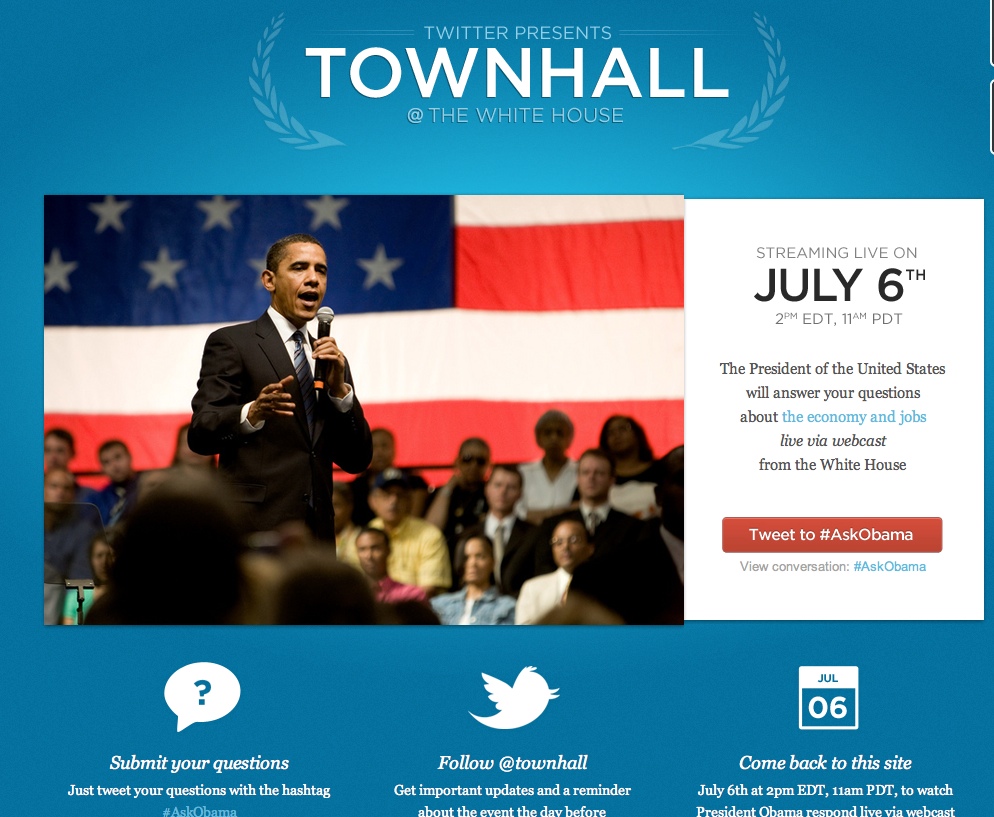
In coordinated tweets with Twitter, the White House announced that it will be holding a town hall on Twitter on July 6th, 2011 at 2 ET. Twitter launched a new @TownHall account for the event and a subdomain, AskObama.Twitter.com to host the live webcast.
According to Macon Phillips, director of digital for the White House, and Sean Garrett, Twitter’s vice president of communications, the digital town hall will be hosted by Twitter co-founder Jack Dorsey, who will provide the questions.
Phillips tweeted that “@Twitter has a cool approach to surfacing questions,” clarifying that “choosing the Q’s will be done by @twitter. Garrett tweeted that “there will be a fairly involved process by which they are selected” and more details and background on said process is on the way. UPDATE: Garrett emailed me “the basics”
“There will be multiple ways that questions will get to the President,” he wrote. “Twitter users will begin asking questions via the #AskObama hashtag today. To identify popular and relevant questions, Twitter is engaging with a third-party Twitter measurement company called Mass Relevance to provide a view on the most frequent topics and their geographical distribution. Additionally, Twitter will invite a group of highly active and engaged Twitter users (called “curators”) to help choose questions and comments both prior to and during the event. Twitter will collect questions in the days leading up to the Town Hall and in real-time during the event.”
Garrett also added some information regarding how Twitter will select this team of “question curators”:
“These curators will be a diverse group from around the country that are also active and engaged on Twitter,” he wrote. “These curators will ask those in their particular communities to also highlight what they think are the most important questions for the President. Curators will retweet questions and pose their own.”
The Twitter TownHall follows a Facebook TownHall earlier this year, in which Facebook founder Mark Zuckerberg posed live questions to President Obama. Nancy Scola wondered how much of a “TownHall” the event actually offered. With this Twitter version, the interesting detail will be in how much transparency goes into question selection, particularly with respect to how exact or tough they are. When the White House turned to Twitter to discuss President Obama’s Middle East speech, they included NPR’s Andy Carvin and Foreign Policy’s Mark Lynch as trusted interlocutors. It’s less clear how Dorsey will moderate, given his considerable different style of tweeting, but on one count there is no doubt: this will be interesting.
UPDATE: In his post on President Obama taking questions on Twitter, Nick Clark Judd raises similar questions over at techPresident on moderation. (And no, he didn’t call the event a “TownHall.”)
UPDATE II: The New York Times published more details on the “Twitter Town Hall,” including the news that there will be a “White House Tweetup,” the first of its kind. In terms of process, here’s what Twitter told the Times. (Spoiler: it’s quite similar to what Garrett told me, above).
Twitter will select the questions, using curation tools and a group of Twitter users to help identify the most popular questions raised both before and during the event. Twitter will be relying on its own search and curation features as well as a company called Mass Relevance to help find questions and topics that are most frequently mentioned.
… Adam Sharp, Twitter’s manager of government and political partnerships, said that the curators chosen by Twitter to help select the questions would be a politically and geographically diverse group. He said the curators would ask the people in their communities to highlight what they think are the most important questions for the president to address.
Curators will also be retweeting questions and posting their own.
“We will have highly-engaged Twitter users from around the country to provide that geographic diversity to help identify good questions, “ he said. “This helps us make sure that we are addressing the concerns that the Twitter universe cares about. “
Less clear whether the President of the United States will actually be doing any of the tweeting himself, as opposed to dictating a reply, which means we may not get to see any real-time presidential typos. According to reports by Paul Boutin, President Obama started tweeting for himself at @BarackObama over the Father’s Day Weekend, signing the tweet “-BO.”
CBS News White House correspondent and keeper of presidential lore Mark Knoller cautioned, however, that “Obama won’t be typing his responses.” Looking back at that Father’s Day tweet, Knoller tweeted that “a tweet was sent in his name by his campaign. He was not at a computer typing a tweet.”
We’ll see if the President decides to get more personally involved or not in the technology. Given that the presidential iPad appears to travel with him these days, it could happen.
[Photo Credit: President Barack Obama sits alone on the patio outside the Oval Office, following a meeting with his senior advisors, April 4, 2011. (Official White House Photo by Pete Souza)]
UPDATE III: Politico White House correspondent Mike Allen led his Tuesday’s Playbook with more details about Wednesday’s Twitter event:
The audience for tomorrow’s hour-long TWITTER TOWN HALL in the East Room (2 p.m. ET) will consist of 140 characters — er, people – in a nod to the maximum length of a tweet. President Obama, however, will face no such limit: He’ll answer questions for the audience, and @TownHall will carry summaries of what he says. Twitter co-founder and Executive Chairman Jack Dorsey will ask the questions. Three screens will be behind Obama and Dorsey: one with the current question; another will have a heat map of the U.S., showing where the town-hall tweets are concentrated; and the third will show the volume of tweets, by topic (jobs, taxes, spending, health care, etc.) Mass Relevance, a company that has worked with the broadcast networks on real-time Twitter data, will supply the analytics. Later, Radian6 will study the demographics of participants.
Representative questions will be chosen partly on how often they’re retweeted. The White House has also reached out to about 10 Twitter leaders in different parts of the country to help surface questions by curating themes and topics that are big among their followers and in their communities. So Dorsey may say: “We’re hearing a lot about the extension of unemployment benefits, especially from the upper Midwest, and here’s a question from Bob in Chicago.” The audience will include 20 people from around the country chosen through the White House Tweetups page, and they’ll also get to meet with Dorsey and with U.S. Chief Technology Officer Aneesh Chopra and perhaps other policy officials.
UPDATE IV: Twitter has blogged about the “Twitter Town Hall,” including a link to the 7 “curators” on Twitter who are selecting questions and a new study from Radian6 that found that “financial security is one of the most frequent topics of political conversation on Twitter.”
Tomorrow’s Town Hall is an invitation from the White House for anyone on Twitter to participate in an open exchange about the national and global economic issues facing the United States.
Questions addressed during the Town Hall will be selected both in advance and in real-time during the event. To narrow down the list of popular, relevant questions to ask on behalf of Twitter users, we’re doing the following:
• We’ve partnered with the visualization experts at Mass Relevance to identify the themes and regions driving the conversation.
• Algorithms behind Twitter search will identify the Tweets that are most engaged with via Retweets, Favorites and Replies.
• A team of seasoned Twitter users with experience discussing the economy will help flag questions from their communities through retweets.






 E Pluribus Unum