AP covers Gov 2.0 and open government in US cities as citizensourcing grows

QR Codes on NYC building permits

Mayor Bloomberg, Deputy Mayor for Operations Goldsmith and Buildings Commissioner LiMandri announced the use of Quick Response (QR) codes on all Department of Buildings permits, providing New Yorkers with instant access to information related to buildings and construction sites throughout New York City.

As people who follow this blog know well, there’s a new movement afoot to make government work better through technology. This week, Samantha Gross covered the trend for the Associated Press, publishing a widely syndicated piece on how cities are using tech to cull ideas from citizens. In the private sector, leveraging collective intelligence is often called crowdsourcing. In open government, it’s citizensourcing — and in cities around the country, the approach is gaining traction:

Government officials tout such projects as money-savers that increase efficiency and improve transparency. Citizen advocates for the programs argue they offer something deeper — an opportunity to reignite civic responsibility and community participation.

In some ways, the new approach is simply a high-tech version of an old concept, says Ben Berkowitz, the CEO of SeeClickFix, which helps citizens post pothole-type complaints and track whether they’ve been addressed.

“It’s participatory democracy,” he says. “Open government … is something that was laid out by Thomas Jefferson pretty early on. This is just a way to realize that vision.”

Efforts towards open government in the United States remain in beta. It’s early days yet for all of these trends. On this day, however, it’s good news for the community that the AP reported a “Gov 2.0” approach took off in Manor, Texas because of financial concerns.

As Gross reported, city officials in Manor “decided they wanted to engage residents and beef up services beyond the means of their modest budget.” The approaches they chose to tap into the local civic surplus, including ideation platforms, QR codes and open source publishing, have been widely documented. Over the past month, QR codes and citizensourcing have been adopted in New York City.

Below, one of the officials – former Manor CIO Dustin Haisler – talks about what Manor did to implement Gov 2.0, speaking from a business perspective:

There’s a long road ahead for citizens, government and technology. This story in the Associated Press, however, will means that a few more citizens will be aware that change is afoot.

Ignite Philly: Code for America’s Pete Fecteau on being the “dumbest guy in the room

Last week, Code for America Fellow Pete Fecteau gave a great five minute talk at Ignite Philly 7. Fecteau about why he’s participating in the program and what he’s hoping to accomplish.

Code for America IgnitePhilly talk from @peterfecteau from Uploaded by: Tyler Stalder on Vimeo.

“Code for America is not about building some shiny piece of technology. It’s about spreading both collaborative and cognitive knowledge. As many questions as we hope to ask in Philly, we hope to answer that many questions,” he said. “”What we build in Philly we share with the rest of the nation’s struggling cities. We’re opening data, plugging it in, and releasing it as an open source platform.”

[Hat tip Code for America]

Civic coders for America gather in DC for a Presidents’ Day datacamp

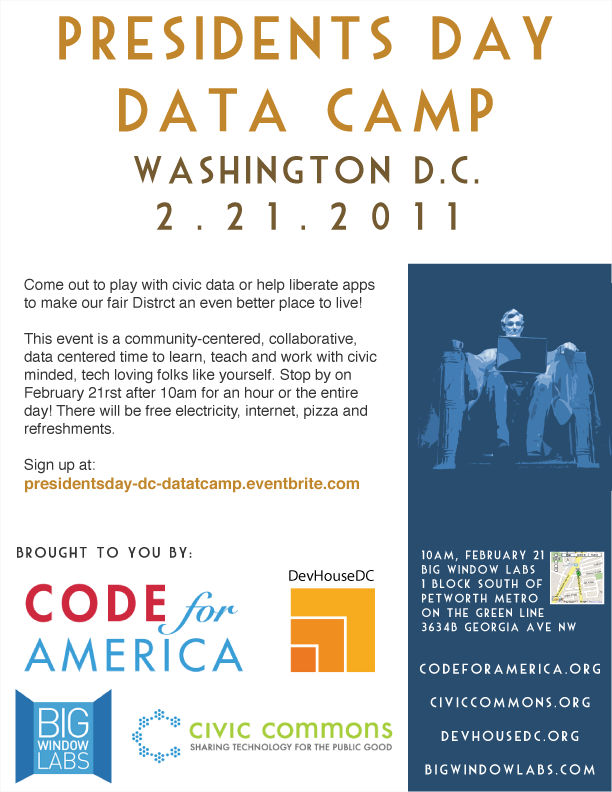
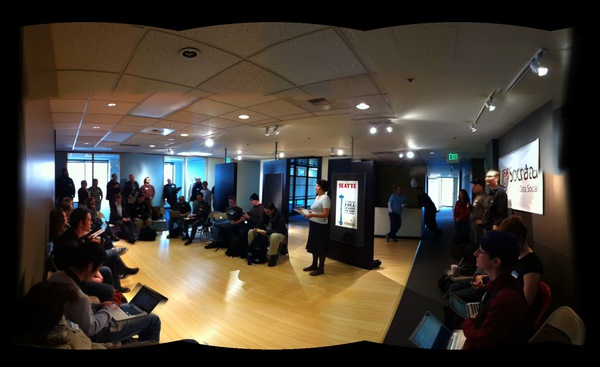
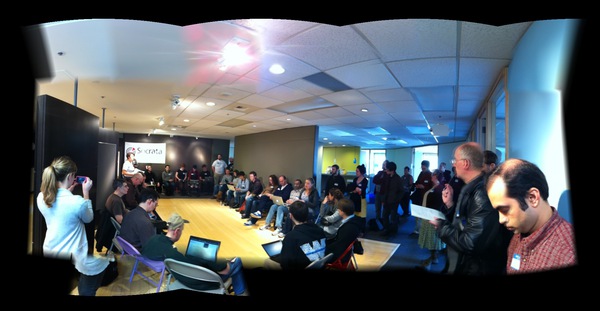
This past weekend, civic developers gathered at a Seattle data camp to code for America. This Presidents’ Day, the day before George Washington’s Birthday, dozens of government technologists, data nerds, civic hackers and citizens from around the District of Columbia, Virginia and Maryland will join Code for America fellows for a datacamp at Big Window Labs.

The attendees of the Washington datacamp can look to the Seattle Data Camp for inspiration. The civic hacktivism on display there led to engaged discussions about Seattle’s South Park neighborhoodmobile damage assessment appstransit apps, mobile / geolocation appsdata mininginformation visualization.

Perhaps even more impressive, one of those discussions lead to the creation of a new smartphone application. Hear Near pushes alerts about Seattle events nearby to iPhone or Android device users using text messages. Hear Near is now available from iTunes and Android.

Joe McCarthy published a terrific post about Data Camp Seattle that offers a great deal of insight into why the event worked well. McCarthy helped the HearNear team by identifying and defining mappings between the GeoLoqi API and the iCal feed.

McCarthy describes how a creative discussion amongst talented, civic-minded people enabled them to donate their skills to putting the open data from Seattle’s data repository to work for its citizens. He also explored what inspires him about Code for America:

I wasn’t sure what to expect going into the event, but was greatly impressed with the interactions, overall experience and outcomes at Data Camp Seattle. I’ve admired the Code for America project since first learning about it, and have been a proponent of open data and platform thinking (and doing) on my blog. It was inspiring and empowering to have an opportunity to do more than simply blog about these topics … though I recognize the potential irony of writing that statement in a new blog post about these topics.

I suspect that one of the most durable outcomes of the Code for America project will be this kind of projection or radiation of civic empowerment through – and beyond – the efforts of the CfA fellows and their collaboration partners. In The Wealth of Networks, Yochai Benkler writes about how “[t]he practice of producing culture makes us all more sophisticated readers, viewers, and listeners, as well as more engaged makers”. In Program or Be Programmed, Doug Rushkoff warns against “relinquishing our nascent collective agency” to computers and the people who program them by engaging in “a renaissance of human capacity” by becoming programmers ourselves.

While many – or even most – of the specific applications we designed and developed during the Data Camp Seattle civic hackathon may not gain widespread traction and use, if the experience helps more of us shift our thinking – and doing – toward becoming co-creators of civic applications – and civic engagement – then the Code for America project will have succeeded in achieving some grand goals indeed.

This example of directed action at an unconference has fast become the next step in the evolution of camps, where a diverse set of volunteers come together to donate more than money or blood: they exchange information and then apply their skills to creating solutions to the needs defined by a given set of societal challenges.

This model of directed civic involvement has became a global phenomenon in wake of the crisiscamps that sprung up after the earthquake in Haiti last year. The cultural DNA of these camps has evolved into CrisisCommons, which has acted as platform for volunteers to donate their skills to help in natural disasters and other crises.

As the role of the Internet as a platform for collective action grows, those volunteers are gaining more ability to make a difference using powerful lightweight collaboration tecnology and open source data tools.

From the towns of the United States to cities in Denmark, Brazil, Kenya, Illinois and India, people interested in local Gov 2.0 have been gathering to to create applications that use open public data. In December, Around the world, the International Open Data Hackathon convened participants in over 56 cities in 26 countries on 5 continents.

As Seattle CIO Bill Schrier put it this past weekend, they’re turning data into information. Federal CTO Aneesh Chopra has praised these kinds of efforts “hacking for humanity.” An event like Random Hacks of Kindness “brings together the sustainable development, disaster risk management, and software developer communities to solve real-world problems with technology.”

On President’s Day, another datacamp will try to put that vision into action.

http://widgets.twimg.com/j/2/widget.js //

Civic developers gather to code for America at data camps

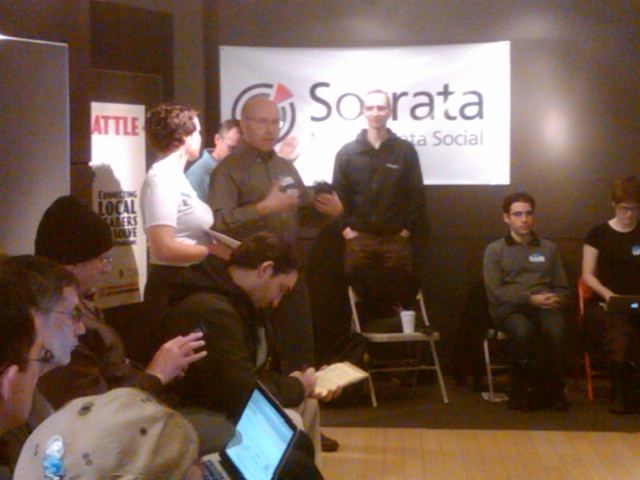
Today in Seattle, over 50 civic developers have gathered at Socrata to work on coding applications from the city’s open data repository at data.seattle.gov. Today’s Seattle datacamp, organized by Code for America, is just one of several data camps that the new civic service is convening in host cities around the United States. Chacha Sikes, a 2011 Code for America fellow, explains what’s behind these data camps:

City governments have a lot of information which is useful to all of us. This ranges from maps of local parks to building footprints to real-time 911 calls. We all have an interest in our budget information, legislative documents and other resources that we use in collective decision-making and deliberation. Not all of this information is currently available for all cities, even though much of it is public record. The “Open Data” movement is a way to work on getting information into machine-readable formats, allowing for easy publishing, sharing, and reuse.

We’re hosting DataCamps in CfA’s cities this year to build communities around making city data more open and accessible to allow citizens to help cities work better.

DataCamp is a event focusing on skill-building and collaborative work on city data. It is an opportunity for interested parties in a city to work together, and build a network of people with shared interested in improving civic communications and information management.

Sanjay B. Hyatt, a writer at the Seattle Times, is at the data camp in the Pacific Northeast. He reported back that CTO Bill Schrier said that Seattle has 100 data sets. “Turn that data into information.”

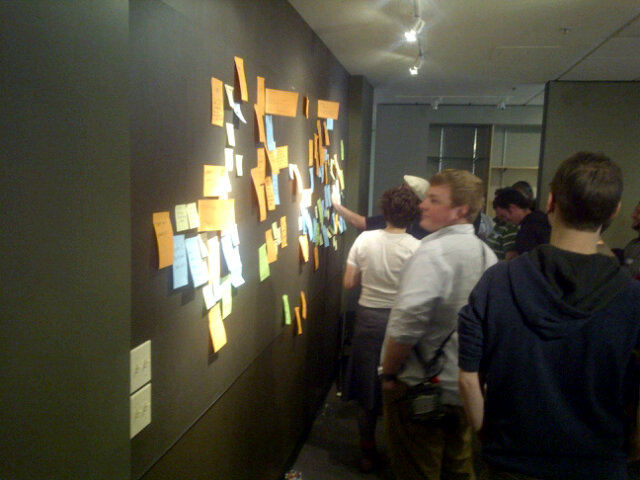
DataCamp Seattle is using a Drupal site and a DataCamp Seattle Google group to coordinate and share notes. In the tradition of unconferences and barcamps, they’re also using a more analog method to sort out ideas and projects: sticky notes. Virtual observers can see the various projects going up, including calendars, an impact survey, an apps workshop and a “pimp my blog” to help stimulate the creation of hyperlocal blogs.

More data camps are coming soon to Seattle and Washington, D.C.

UPDATE: A day after the datacamp, a new app is available to Seattle residents. Hear Near pushes alerts about Seattle events nearby to mobile phone users using text messages.

Hear Near is available from iTunes and Android.

Hear Near was created by a team that included Amber Case (whose geolocation startup, Geoloqi, powers it), Aaron Parecki, Joe McCarthy, Jesse Kocher, Gene Homicki, Naoya Makino, Steve Ripley, Rebecca Gutterman and Jenny Frank.

Frank, a self-identified “non-techie” who attended the camp, came away with the feeling that “nothing is impossible.”

Panoramic image credits to Chris Metcalf.

New York City launches 311 online service request map

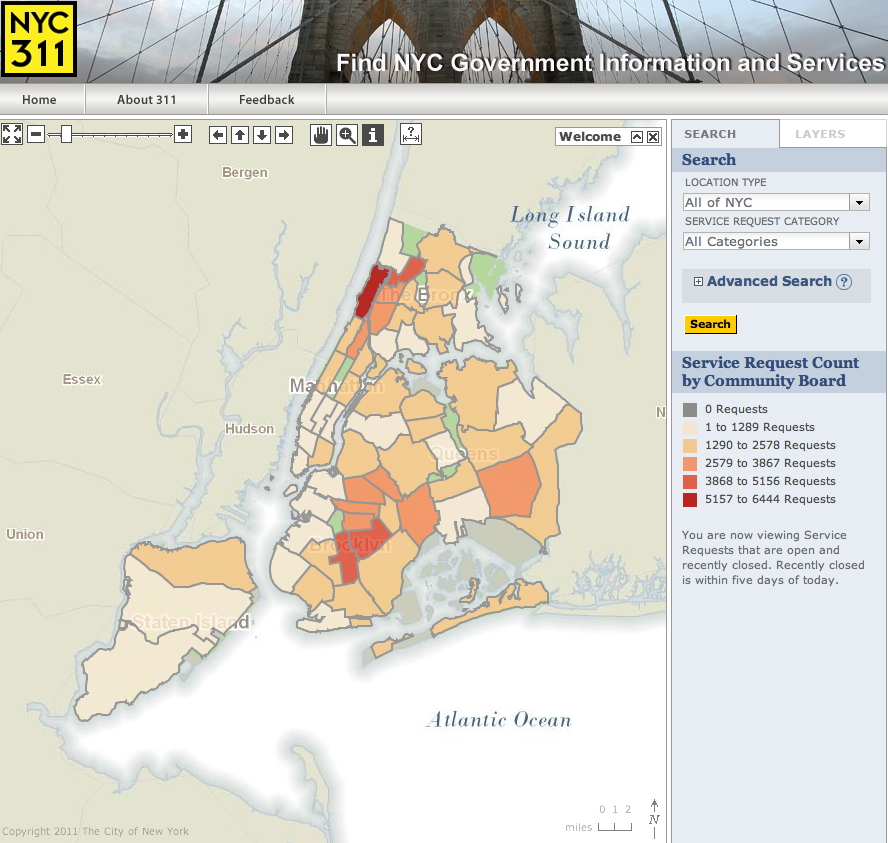
If you read Steven B. Johnson, you know that 100 million 311 calls reveal a lot about New York. Now citizens can surf over to look at those 311 requests every day. Today, New York City launched a 311 online service request map.

“The launch of the 311 Service Request Map is another milestone in the City’s efforts to improve the way we report 311 data to the public,” said Deputy Mayor Stephen Goldsmith in a prepared statement. “The release of this information will better enable the public and elected officials to hold the City accountable for the services we provide. Putting better information into the hands of community leaders across the five boroughs increases transparency and allows us to collaboratively address the problems that neighborhoods face.”

It appears that Inwood and Washington Heights are making the most 311 service requests, according to the latest version of the map.

This 311 online service request map is a good start, with layers, custom searches and a clean design. Querying for those layers is a bit slow but returns relevant results for bike parking or continuing education, although many of the other layers appear to be grayed out and “coming soon.” Querying for specific request types was even slower, so for the moment I can’t find out where complaints about poison ivy, illegal animals or noisy church services are concentrated.

Early reviews have generally been positive but guarded, with room to grow. It’s a “huge step forward, long way to go,” tweeted Philip Ashlock. They “could get something better for free (eg mobile) by doing #Open311 API instead,” referring to the idea of government as a platform.

I “would much rather have the data raw via an API in an open [format] than the map UI (which isn’t all bad) in the way,” tweeted Mark Headd.

The “NYC 311 map is impressive technically, but lacks context (time period?), a legend (Maps 101), & metadata. I wonder if they talked to users before implementing it,” tweeted Steven Romalewski. “Also, the city obviously has the address-level 311 data. It’d be nice if they published the raw data so others could analyze it (residents & NYC Council reps have been asking for this for years). That would indicate a real commitment to transparency.”

UPDATE: Nick Judd published an excellent post on the New York City 311 map at techPresident, where he reports that “raw complaint data from 311 on the city’s data repository, the NYC DataMine, later this year, according to a city spokesman.” Judd also fills in a couple of key details, like:

  • The application was built using the city’s public city-wide geospatial information system, CityMap
  • Requests for literature are not included in the NYC 311 map
  • Deputy Mayor Stephen P. Goldsmith acknowledged in a press conference today, reported on by the New York Times, “this addition to the city’s open data efforts was a nod to transparency advocates.”

“Some of this will not be entirely exciting for those of us whose job it is to make sure that the holes in the street are filled and the trash is picked up because it’ll provide visibility to what we are or not doing,” Mr. Goldsmith said. “And some of you will enjoy that visibility.”

As Judd links out, in the New York Times Cityroom blog has good coverage of the step towards getting a visual on New Yorkers’ 311 calls.

Solving your neighbor’s possum problem in the dark? There’s an app for that.

One of the most common aphorisms heard around the Gov 2.0 world is that “potholes are the gateway drugs to civic engagement.”

After a recent report in Boston, maybe Hub pundits can add a new phrase to the lexicon: “possums are the gateway animal to citizens connecting.

As the indefatigable Adam Gaffin reported at Universal Hub, the wonderful hyperlocal blog in Beantown, the Citizens Connect app has now been deployed as Boston’s high tech possum saver.

According to Gaffin’s post, Susan Landibar of South Boston saw a possum report:

“Possum in my trash can. Can’t tell if it’s dead. Barrel in back of 168 west 9th. How do I get this removed?”

And acted upon it:

Labandibar reports:
11:15PM Walked over to West Ninth Street. It’s about three blocks from my house. Locate trash can behind house. Possum? Check. Living? Yep.

Turned the trash can on its side. Walked home. Good night, sweet possum.

When the city of Boston released the Citizens Connect application, which works on Android phones and iPhones, officials no doubt expected it to help constituents report potholes, graffiti, unplowed snow and trash removal.

And indeed, if you look through the list of reported issues, that’s the bulk of it.

After today, however, the city can add “possum problems” to the list of resolved issues. Crucially, however, it wasn’t the city that fixed it: it was a fellow citizen who saw an issue using the app and then went and took care of it herself.

For good or ill, this example of “do it ourselves” government is a data point that may be increasingly relevant. Plummeting city budgets mean smarter cities will need citizen sensors to detect issues and take civic pride into their own hands. As Gov 2.0 goes local, applications that connect citizens to one another in crises may become as important as technologies that connect citizens to government, like Citizens Connect.

As the role of the Internet as a platform for collective action grows, Clay Shirky may be proven prescient: “We have historically overestimated the value of access to information and underestimated the value of access to one another.”

3 words from the Tech@State unconference

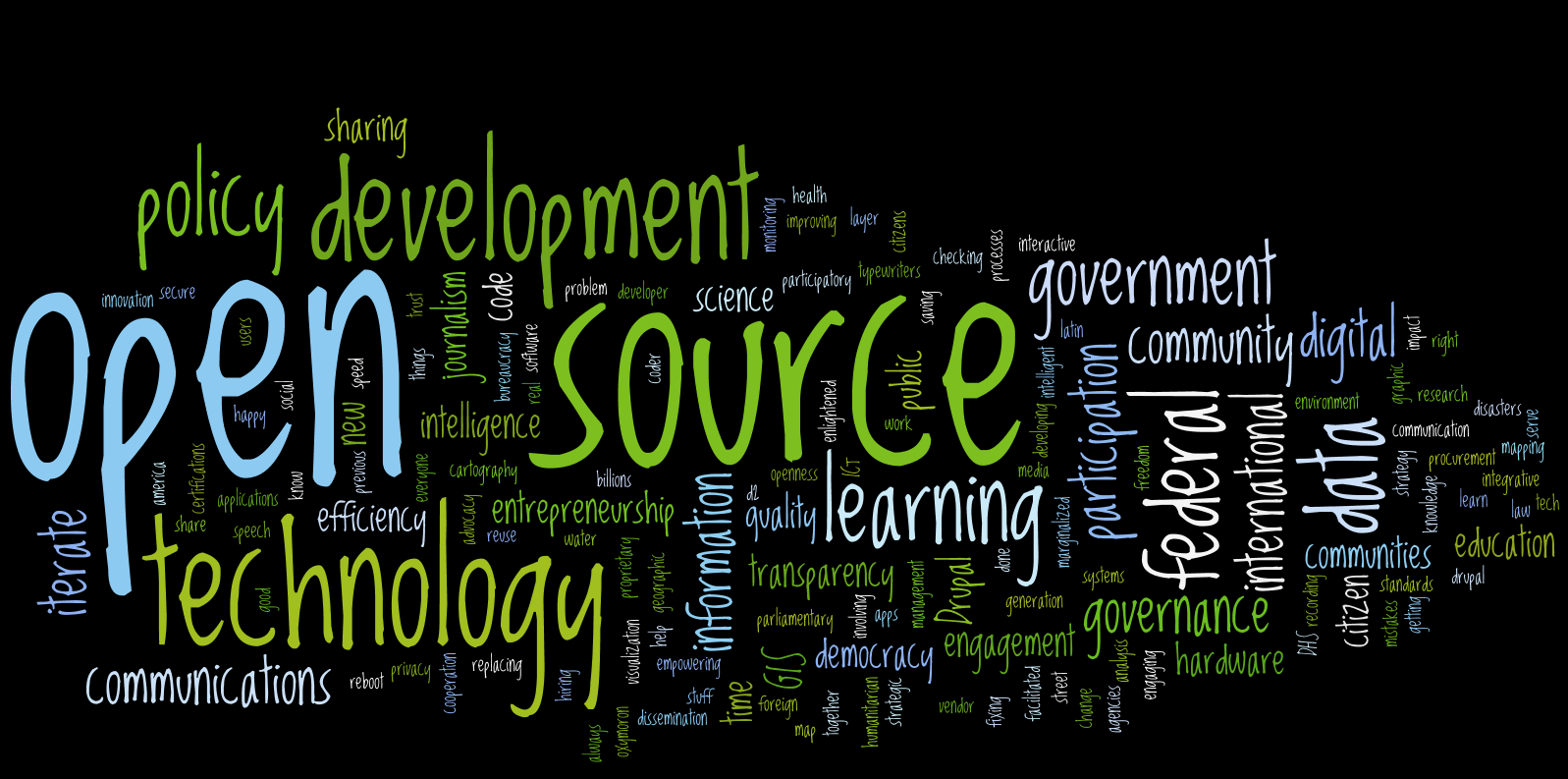
On Friday, the fifth Tech@State conference at the United States Department at State focused on the role of open source in government, industry and society. Today, there is a Tech@State unconference on open source at the National Democratic Institute. In keeping with the tradition of an unconference – sometimes called a barcamp – the day kicked off with a introduction where every attendee shared his or her name, affiliation and three words that describe who they are, what they care about, what they’ve come to learn or what they do. Or all three. Below is a wordle that shows the frequency of words used.

The schedule for the Tech@State unconference is evolving at Open4m.org/NDI. It bids to be an interesting day.

2011 Gov 2.0 and Open Government Events Calendar

Tomorrow, another great Tech@State event kicks off at the State Department in Washington, D.C. In New York City, the city’s first chief digital officer, will put on the capstone on Social Media Week at an open government forum. Out in Los Angeles, people will gather at KPCC for a digital diplomacy forum. It will be a busy Friday but these three events are only a few coming up that sit in the intersection of technology, citizens and government coming up this year.

As J.D. Lasica reported in his comprehensive Socialbrite list of 2011 social media, tech marketing conferences, there won’t be a Gov 2.0 Expo. (For an explanation of why O’Reilly won’t be doing the Expo this year, visit Quora.) There will, however be many other places for people to gather, talk and learn about Gov 2.0 in 2011 — just take a look through the many Govloop event listings. For a broader selection, Socialbrite has a terrific calendar of calendar of 2011 nonprofit conferences.

There will be any number of citizen-generated unconferences around the world in 2011, where the attendees generate the program. They’ll include CityCamps, BarCamps, PodCamps or MobileCamps. Check out the CityCamp calendar to find one near you and keep an eye out for CityCamp meetups in February.

The following listings are by no means comprehensive but should serve as a starting point if you’re wondering what’s happening, when and where. If you know about more Gov 2.0 events that should be listed here, please let me know at alex@oreilly.com or @digiphile.

Gov 2.0 LA

This Los Angeles conference brings a “West Coast” sensibility to the Gov 2.0 conversation, with a particular emphasis on social media and speakers from the diplomatic, marketing and consulting worlds. For a sense of what the 2010 event held, read On Language: Government 2.0 jargon and technology or a history lesson in disruptive innovation applied to modern government at Gov 2.0 LA.

Website: gov20la.org

DataCamp

February 13, Boston, MA
February 19, Seattle, WA
Philadelphia and DC TBD.

Code for America is hosting a set of “data camps” in its host cities this winter. Here’s why: “City governments have a lot of information which is useful to all of us. This ranges from maps of local parks to building footprints to real-time 911 calls. We all have an interest in our budget information, legistlative documents and other resources that we use in collective decision-making and deliberation. Not all of this information is currently available for all cities, even though much of it is public record. The “Open Data” movement is a way to work on getting information into machine-readable formats, allowing for easy publishing, sharing, and reuse. We’re hosting DataCamps in CfA’s cities this year to build communities around making city data more open and accessible to allow citizens to help cities work better. DataCamp is a event focusing on skill-building and collaborative work on city data. It is an opportunity for interested parties in a city to work together, and build a network of people with shared interested in improving civic communications and information management.”

Website: Code for America datacamps

2011 Computer-Assisted Reporting Conference

Feb. 24 to 27, 2011 — Raleigh, N.C.
Data journalism is a key component of the Gov 2.0 world. If government releases data, data journalism must evolve to validate, analyze and tell stories with it.

Website: www.ire.org/training/conference/

Social Media for Government Conference

February 14-17, 2011
Social media is but one component of Gov 2.0, alongside open data, collective intelligence or a rethinking of how services are provided, but it’s clear that it’s important.

Website: www.aliconferences.com/conf/social_media_govt0211/index.htm

Intelligent Cities Meetup

February 23rd, Washington, DC
“Intelligent Cities, a National Building Museum initiative, supported by its partners TIME and IBM and funded by The Rockefeller Foundation, explores the intersection of IT and urban design to understand where we are, where we want to be, and how to get there.” Meetups are planned for San Francisco, NYC and Chicago.

Website: Meetup.com/Intelligent-cities

Transportation Camp

March 5-6, NYC, New York
March 19-20, San Francisco, CA
TransportationCamp is a new unconference about transportation and technology.

Website: transportationcamp.org

South by Southwest Interactive Festival

March 10-15, Austin, Texas
This year’s SXSWi will include many sessions that fall under the umbrella of Gov 2.0, including government officials talking about open government, citizens talking about new apps or platforms, and new services or applications that will be relevant to both. Here’s just a sampling.

Website: sxsw.com/interactive

2011 Web and New Media Conference

March 17–18, 2011, Washington, DC
This conference is for government new media managers and webmasters, many of whom are wearing both hats in 2011. It’s proven to be an excellent networking and educational forum.

Website: http://www.usa.gov/webcontent/wmu/conference/2011/index.shtml

Web 2.0 Expo

March 28-31, San Francisco, CA
October 10-13, NYC, NY
There are many lessons for Gov 2.0 from Web 2.0, including the power of platforms to catalyze innovation, investment and more agile government.

Website: web2expo.com

NASA Open Source Summit

March 29-30, Mountain View California

From the organizers: “On March 29 & 30, NASA will host its first Open Source Summit at Ames Research Center in Mountain View California. This event will bring together engineers and policy makers across NASA and respected members of the open source community to discuss the challenges with the existing open source policy framework, and propose modifications that would make it easier for NASA to develop, release, and use open source software.”

Website: NASA Open Source Summit

Media Access to Government Information Conference (MAGIC)

April 12, National Archives, Washington, D.C.

From the organizers: “MAGIC is a collaborative, one-day conference sponsored by the National Archives and Records Administration (NARA) and Duke University’s DeWitt Wallace Center for Media and Democracy that will:

  • Explore obstacles and opportunities for access to government information by journalists and others writing about public affairs in the digital age;
  • Include government officials, reporters, scholars, and Non Government Organization (NGO) leaders who can contribute insights into how journalists can better discover, access, and use digital government information; and
  • Inform government professionals about the use of technology to provide better access to government information

The conference is free and open to the public, though registration is required. Breakfast, lunch, and refreshments are included. The conference sessions will be videotaped and made available for viewing at a later date. For more information, please contact MAGIC@nara.gov.”

Website: MAGIC

Mobile Citizen Summit

April 16, Washington, D.C.

From the organizers: “You have heard the word, mobile is the new hot thing. You have convinced your management to start using mobile, but how do you actually use mobile to engage citizens and create impact? The Mobile Citizen Summit is a one-day learning laboratory for those interested in applying mobile technologies to empower, fuel and drive citizen engagement in the public good. Our focus is on providing you with informative and practical discussions.”

Website: Mobile Citizen Summit

Transparency Camp

April 30-May 1, Washington, DC
The 2010 Transparency Camp delved into open data, coffee, open government, culture and yes, transparency. Look for more of the same.

Website: transparencycamp.org

Open Government and Innovations Conference

Likely in May 2011, Washington, DC
Applied uses of platforms, social media, culture change and more, all relevant transparency and open government

Website: http://events.1105govinfo.com/events/ogi-open-government-2010/home.aspx

Gov 2.0a

May 6-7, Oklahoma City, Oklahoma

From the organizers: “The second annual Gov 2.0a conference is focused on applications of technology to government problems. The conference will be a forum to learn about successful Gov 2.0 applications through case studies, to learn about best practices for Gov 2.0 applications, and to network with other professionals from city and state organizations, community groups, non-profits and the private sector who share interest in the application of technology to improve the functioning of our government.”

Website: Gov20a.com

Fedtalks Open Government Summit

May 11, Washington, D.C.

From the organizers: “FedScoop’s Open Government & Citizen Engagement Summit, part of the FedTalks event series, will bring together leading federal government and industry experts to discuss the state of open government and tech solutions to better engage citizens.”

Website: Fedscoop.com/fedtalks/opengov2011

OpenGov West

May 13-14, Portland, OR
Open government and Gov 2.0 community leaders, public officials, citizens and technologists from all over the West Coast.

Website: opengovwest.org

Local Open Government Summits

May 13-22, 2011, 35+ cities
In 2011, there will be a host of other camps too, as readers will find below, and a new initiative: local open government innovation summits. According to the organizers, “The summits’ overarching objective is to gather citizens and local government staff together in dialogue for knowledge-sharing and relationship-building. It is not necessary to include action planning, identification of next steps, or decision-making into your local summit. A successful outcome is raising awareness of local gov officials that they are not alone as they implement open government programs and that they can access the expertise of the broader open government community. The target is 50+ local summits across the US and internationally.”

Website: opengovplaybook.org

OpenGov Camp

June 4-5, NYC

From the organizers: “OpenGov Camp is a one day conversation on how participation builds transparency to deliver efficiency. We are a community of doers and decision-makers talking about what works—and what doesn’t. Whether you are a developer, journalist, activist, organizer or government employee, you should attend. For one day, we ask you three questions:

  • Where is “local” Open Government going?
  • How can we deepen the knowledge of what Open Government can be?
  • What are the social and technical tools affecting Open Government’s development?”

Website OpenGovNYC

Personal Democracy Forum

June 6-7, New York City, NY
This world-class conference exploring and analyzing technology’s impact on politics and government is back for the 8th year in New York City.

Website: personaldemocracy.com

OSCON 2011

July 25-29, 2011, Portland, OR
The O’Reilly Open Source Convention is the crossroads of all things open source. Open source plays an increasingly important role in government. The processes involved in open source itself have served as a model for open government.

Website: oscon.com/oscon2011

Supernova Hub

Likely in July 2011 in Philadelphia, PA (Unconfirmed)
Technologists, entrepreneurs, business executives, investors, and policy-makers have come to Supernova for strategic insights on our increasingly interconnected world

Website: supernovahub.com

Strata NYC

September 19-21, NYC, NY
To say that big data is a big deal for government is an obvious understatement. Government, after all, has extraordinary amount of data, with much more becoming available as open data initiatives move forward. The first Strata Conference in February 2011 was a sold-out hit. Strata NYC will pull together global leaders in big data in the Big Apple.

Website: strataconf.com

Fedtalks 2011

October 12th, Washington, DC

Open government went to the theater at the first Fedtalks. In 2011, look for more federal government and industry experts to discuss the state of innovation in government.

Website: Fedscoop.com/fedtalks/fedtalks2011

GOSCON

October 2011, Portland, OR
If 2010 was a year where open government moved “beyond plans to practice,” by late 2011 there should be many more case studies of implementation. GOSCON – the government open source conference – will feature discussions and presentations about how government leaders, innovators and smart operations are using open source.

Website: goscon.org

Digital Capital Week

November 4 – November 11, Washington, DC

Last year, the inaugural Digital Capital Week showcased tech innovation in Washington. The 2011 version of Digital Capital Week bids to be even bigger.
Website: digitalcapitalweek.org

Web 2.0 Summit

November 15-17, San Francisco
This event brings together business leaders, big thinkers, and innovative technologists who are shaping the future of the Web. In 2011, it’s clear that the shape of that future matters for government and citizens alike.

Website: web2summit.com
Live from the Newseum: Jobs and the Economy of the Future

In February of 2011, the effects of the The Atlantic has released a special report on jobs and the economy. This morning, the report and the prospects for growth will be discussed at a digital town hall on at the Newseum, “Jobs and the Economy of the Future.

Guests include:

  • Timothy Geithner, Secretary of the Treasury
  • Julius Genachowski, Chairman, FCC
  • Sen. Orrin Hatch
  • Jon Huntsman, US Ambassador to China
  • Gov. Bob McDonnell, Virginia
  • Brian Deese, Deputy Director, NEC

    The event’s digital component includes a livestream and a new instance of Microsoft’s Town Hall platform for collecting feedback from the online audience. There is also an active backchannel on Twitter aggregated at the #USFutureEconomy hashtag:

    http://widgets.twimg.com/j/2/widget.js

    new TWTR.Widget({
    version: 2,
    type: ‘search’,
    search: ‘USFutureEconomy’,
    interval: 6000,
    title: ‘What is the discussion about the’,
    subject: ‘Jobs of the Future?’,
    width: ‘auto’,
    height: 300,
    theme: {
    shell: {
    background: ‘#004869’,
    color: ‘#ffffff’
    },
    tweets: {
    background: ‘#ffffff’,
    color: ‘#444444’,
    links: ‘#1985b5’
    }
    },
    features: {
    scrollbar: false,
    loop: true,
    live: true,
    hashtags: true,
    timestamp: true,
    avatars: true,
    toptweets: true,
    behavior: ‘default’
    }
    }).render().start();

    The Atlantic will be liveblogging the event as well.

  • Nicholas Gruen on Gov 2.0 in Australia and cultural change

    “I began the Gov 2.0 taskforce thinking that open government was a kind of civil rights agenda, even if it has economic costs,” said Nicholas Gruen last week in Santa Clara at the Strata Conference. Gruen headed Australia’s Gov 2.0 taskforce. “At the end of it, I realized that open government was actually a really powerful economic driver.”

    Why? Gruen pointed to the efficiencies presented inside of government by improved communication and the opportunities to ask citizens for ideas and solutions to problems. “Even if our team said we couldn’t do it technically, I just said we’ll tell everyone that we need help and approach it that way.” Asking questions was, he said, an effective means of accomplishing many tasks much faster than they would have been otherwise.

    In a video interview, embedded below, Gruen talked more about the state of Gov 2.0 in Australia and some of his thoughts of the economics involved His comments on cultural change will be of particular interest those focused on technology as a panacea to inefficiency or engagement.

    The recent historic flooding in Australia created an urgent use case for improved communications between the public and government. “When you look at the Queensland floods, the Facebook of the police department use blew people away,” said Gruen. “Their links got many comments and compliments.”

    For more about how social media combine with geospatial mapping in crisis response, read about a new online application from geospatial mapping giant ESRI that applies trend analysis to help responders to Australia’s recent floods create relevance and context from citizen-generated reports.

    Achieving better outcomes through technology isn’t just about setting up a Facebook page or Twitter account, emphasized Gruen. Public servants have to be willing to share information that matters to citizens and in turn listen to feedback from the public to create better feedback loops.

    “This is a cultural transformation,” said Gruen. “You can’t impose that. You can’t dictate it.”

    Further reading:Gov 2.0 Down Under: Australia and Open Government