Regulations.gov relaunches with APIs, integrates social media, hopes for public participation

President Barack Obama signs H.R. 2751, the “FDA Food Safety Modernization Act,” in the Oval Office, Jan. 4, 2011. (Official White House Photo by Pete Souza)

President Barack Obama in the Oval Office, Jan. 4, 2011. (Official White House Photo by Pete Souza)

On January 18, 2011, President Obama issued an executive order directing that regulations shall be adopted through a process that involves participation. 13 months later, the nation’s primary online regulatory website received an overdue redesign and, significantly, a commitment from the administrator of the White House Office of Information and Regulatory Affairs (OIRA) to make regulatory data available to the public.

Today, the White House announced the relaunch of Regulations.gov in a post on remaking public participation by Cass Sunstein, the administrator of the OIRA:

…the President issues Executive Order 13563, in which he directed regulatory agencies to base regulations on an “open exchange of information and perspectives” and to promote public participation in Federal rulemaking.  The President identified Regulations.gov as the centralized portal for timely public access to regulatory content online.

In response to the President’s direction, Regulations.gov has launched a major redesign, including innovative new search tools, social media connections, and better access to regulatory data.  The result is a significantly improved website that will help members of the public to engage with agencies and ultimately to improve the content of rules.

The redesign of Regulations.gov also fulfills the President’s commitment in The Open Government Partnership National Action Plan to “improve public services,” including to “expand public participation in the development of regulations.” This step is just one of many, consistent with the National Action Plan, designed to make our Federal Government more transparent, participatory, and collaborative.

I’ve embedded the video that Regulations.gov released about the launch below:

The relaunch includes the following changes:

  • New Regulations.gov and Web design.
  • A new “Browse” tab that groups regulations into 10 categories, sorted by industry
  • A new “Learn” tab that describes the regulatory process
  • Improved search
  • Integrated social media tools (Twitter, Facebook, YouTube and Regulations.gov Exchange)
  • New Application Programming Interfaces (APIs) and standard, Federal Register-specific URLs.

That last detail will be of particular interest to the open government and open data community. Sunstein explained the thinking behind the role of APIs at the WhiteHouse.gov blog:

Application Programming Interfaces (APIs) are technical interfaces/tools that allow people to pull regulatory content from Regulations.gov. For most of us, the addition of “APIs” on Regulations.gov doesn’t mean much, but for web managers and experts in the applications community, providing APIs will fundamentally change the way people will be able to interact with public federal regulatory data and content.

The initial APIs will enable developers to pull data out of Regulations.gov, and in future releases, the site will include APIs for receiving comment submissions from other sites. With the addition of APIs, other web sites – ranging from other Government sites to industry associations to public interest groups – will now be able to repurpose publicly-available regulatory information on Regulations.gov, and format this information in unique ways such as mobile apps, analytical tools, “widgets” and “mashups.” We don’t know exactly where this will lead us – technological advances are full of surprises – but we are likely to see major improvements in public understanding and participation in rulemaking.

While the APIs will need to be explored and the data behind them assessed for quality, releasing regulatory data through APIs could in theory underpin a wide variety of new consumer-facing services. If you’re interested in the APIs, click on “Developers – Beta” at Regulations.gov to download a PDF with that contains API directions, URLs and information about an API Key.

A time for e-rulemaking

This move comes as part of a larger effort towards e-rulemaking by this White House that will almost certainly be carried over into future administrations, regardless of the political persuasion of the incumbent of the Oval Office. In the 21st century, the country desperately needs a smarter approach to regulations.

As the Wall Street Journal reported last year, the ongoing regulatory review by OIRA is a nod to serious, long-standing concerns in the business community about excessive regulation hampering investment and job creation as citizens struggle to recover from the effects of the Great Recession.

As the cover story of this month’s issue of The Economist highlights, concerns about an over-regulated America are cresting in this election year, with headlines from that same magazine decrying “excessive environmental regulation” and calling for more accurate measurement of the cost of regulations. Deleting regulations is far from easy to do but there does appear to be a political tailwind behind doing so.

We’ll see if an upgraded online portal that is being touted as a means to include the public in participating in rulemaking makes any difference in regulatory outcomes. Rulemaking and regulatory review are, virtually by their nature, wonky and involve esoteric processes that rely upon knowledge of existing laws and regulations.

While the Internet could involve many more people in the process, improved outcomes will depend upon an digitally literate populace that’s willing to spend some of its civic surplus on public participation.

To put it another way, getting to “Regulations 2.0” will require “Citizen 2.0” — and we’ll need the combined efforts of all our schools, universities, libraries, non-profits and open government advocates to have a hope of successfully making that upgrade.

FEMA administrator Craig Fugate [@CraigAtFEMA] on real-time awareness and social media [#TechAtState]

http://storify.com/digiphile/fema-administrator-craig-fugate-on-real-time-aware.js[View the story “FEMA administrator Craig Fugate on real-time awareness and social media” on Storify]

Expert Labs data: How does the @WhiteHouse drive engagement on Twitter? [INFOGRAPHIC]

Over at ExpertLabs, Andy Baio created a snazzy infographic of engagement around the White House’s Twitter account using data collected through the ThinkUp App.

There are lots of views into engagement on Twitter, but we have the data to give a unique view into what it looks like from the @whitehouse perspective.

We’ve tracked their activity for the last couple years using ThinkUp to analyze and publicly release large datasets. We decided it might be nice show how the White House engaged their audience last year — without resorting to cheap gimmicks like linkbait infographics.

As Baio points out, if you want to work some mojo on this data set, you can download the .CSV file and have some fun. Kudos to the Expert Labs team for making both the open data and visualization available to all.

Open Government News on Gov 2.0 TV: The Year in Review, SOPA and POTUS on Google+

On Thursday, I joined Edmonton-based social media consultant and digital strategist Walter Schwabe on “Gov 2.0 TV” to talk about what’s new in open government since our last interview.

Over the course of the show, we talked about the following stories:

Jack Dangermond on mapping, government transparency and accountability

Writing over at the ESRI blog today, founder and president Jack Dangermond shared his thoughts on how maps and GIS information can contribute to improving government transparency and accountability:

Born out of the Gov 2.0 movement, the terms transparency and accountability have become part of the daily vernacular of governments and the citizens they serve. One might even suggest these words have become a new expectation of governing. Transparency and accountability began with a simple concept of openly communicating public policy to the taxpayer. Today, these concepts are thriving within a growing emphasis on developing an interactive dialog between governments and the people.

Maps can be a very valuable part of transparency in government. Maps give people a greater understanding of the world around them. They can help tell stories and many times be more valuable than the data itself. They provide a context for taxpayers to better understand how spending or decisions are being made in a circumstance of where they work and live. Maps help us describe conditions and situations, and help tell stories, often related to one’s own understanding of content.

I spoke with Dangermond about precisely this subject last year at the Gov 2.0 Summit in Washington. I believe the interview holds up and remains relevant to the conversation around open government today.

Presentation: Health Data Innovation at the Wolfram Data Summit

Earlier today, Peter Speyer gave a great talk about the Global Health Data Exchange and health data innovation at the Wolfram Data Summit in Washington, D.C.

For more context, read: about unlocking innovation through opening health data, better mobile healthcare decisions through open data and “Can Todd Park revolutionize the health care industry?

Open government innovation from NASA fuels launch of OpenStack and Nebula

Earlier today, a new startup emerged from stealth at OSCON in Portland, Oregon. Nebula looks to democratize cloud computing with open source hardware.

Nebula appliance As Venturebeat reported, by combining OpenStack with Facebook’s OpenCompute project, Nebula could bring cloud computing to everyone with a cloud appliance.

It’s going to be a while before we’ll know if this bold vision comes to pass, but it’s important to be clear: this private sector innovation and startup is the outgrowth of one of NASA’s open government initiatives, where a technology developed by the government was released to the public to innovate upon.

That outcome can be at least partially attributed to Nebula CEO Chris Kemp, the former NASA CTO for IT, built a cloud “dream team” for Nebula’s launch from Kleiner Perkins’ basement. Nebula has the potential to bring cheaper private clouds to enterprises and small to medium-sized business to government, which could stand to leapfrog a generation of technology. (Putting a cloud behind an organization’s firewall could also address the security and compliance challenges that have hampered adoption of public cloud by enterprise and government users.) You can watch the announcement of Nebula at OSCON in the video below:

I talked with Kemp yesterday about OpenStack, his new startup, enterprise IT and innovation in government. “I am just unbelievably excited about all of the innovation that’s going to happen, he said. “When I left NASA, there was an open playing field. Citrix has bet their company on a tech that emerged out of NASA. Rackspace has incorporated it as well. Dell and HP are working with OpenStack too.”

Kemp, at least for now, doesn’t appear to be looking towards acquisition as his exit strategy. “We’re building a whole new company,” he said. “It’s not going to acquired by Dell or another large vendor. It’s too important to be lost in a big organization. The opportunity here is to build a lasting company that plays a key role in how computing unfolds.”

It’s the potential to change the world that seems to have brought a glint to Kemp’s eye. “This is why I left NASA,” he said. “I had this idea, this concept, I knew it had the potential to change the world, I knew it was time to build that. There are things you can only do inside of government, and there are things you can only do outside of government.”

In at least one sense, this outcome is about Gov 2.0 versus the beast of bureaucracy, once again. “The thing I learned at NASA is the biggest barrier to this stuff is the culture within the organization,” said Kemp. “It’s people. In a federal agency, people have been there forever and have spent tons of money on tools. What we’re doing with this appliance will disrupt a lot of that.”

Kemp also offered a suggestion to government agencies with innovators trying to make a difference. “The real shame is that you take the most risk-averse people in the world – government civil servants – and make them take the most dangerous leap, to end their careers, to be entrepreneurs. Imagine if government allowed people to take one year without pay, try to create something, and then return to public service.”

While that may be an unlikely dream, Kemp has left government himself, jumping to an endeavour that has the potential to disrupt the future of computing. “We want people to build on a platform that isn’t unnecessarily expensive or reliable,” he said. “We’re selling a little box that creates an infrastructure service and supporting it. You plug it in at the top of the rack where basically joins ‘the collective.’ It becomes part of a massive compute and storage cloud that’s compatible with Amazon and allows anyone to use a cloud that based on standards.
And they can do it with the cheapest hardware.”

Open source has been a key component of NASA’s open government work. Now one of its open source projects may become part of the work of many other people in industries unrelated to aerospace. With the launch of Nebula, an open government initiative looks set to create significant value — and jobs — in the private sector, along with driving open innovation in information technology.

GSA’s McClure: Cloud computing and open data in federal government aren’t going away

To those in media, government or commentariot who think that cloud computing or open data might be going away in federal government after the departure of federal CIO Vivek Kundra next month, Dave McClure offered a simple message today: these trends are “inevitable.”

Cloud computing, for instance, will “survive if we change federal CIOs,” he said. “It’s here, and it’s not going away. McClure describes cloud computing as a worldwide global development in both business and government, where the economics and efficiencies created are “compelling.” The move to the cloud, for instance, is behind US plans to close or consolidate some 800 data centers,, including hundreds by the end of 2011.

Cloud computing was just one of five macro trends that McClure “listed at this year’s FOSE Conference in Washington, D.C. FOSE is one of the biggest annual government IT conferences.
inevitable. Here’s the breakdown:

1) Cloud computing

The GSA is the “engine behind the administration’s ‘cloud-first’ strategy,” said McClure, lining up the procurement details for government to adopt it. He said that he’s seen “maturity” in this area in the past 18-24 months. Two years ago, National Institute of Standards and Technology (NIST) was spending time at conferences and panels defining it. Now we have cloud deployments that are robust and scalable, said McClure, including infrastructure as a service and email-as-a-service.

Government cloud deployments now includes public facing websites, storage, disaster recovery andare beginning to move into financial apps.

2) Collaboration and engagement

The cloud is teaching us that once we free data, make it accessible, and make it usable, it’s
creating opportunities for effective collaboration with citizens, said McClure, noting that this trend is in its “early stages.”

3) Open data and big data

Data.gov has “treasure troves” of data that entrepreneurs and citizens are turning into hundreds of applications and innovations, said McClure. Inside of government, he said that access to data is creating a “thirst” for data mining and business intelligence that help public servants work more efficient.

4) Mobile

Mobile computing will be the next wave of innovation, said McClure, delivering value to ourselves and delivering value to citizens. Government is “entrenched in thinking about creation of data on websites or desktop PCs,” he said. That perspective is, in this context, dated. Most of the audience here has a smartphone, he pointed out, with most interactions occurring on the hip device. “That’s going to be the new platform,” a transition that’s “absolutely inevitable,” he said, “despite arguments about digital divide and broadband access.”

5) Security

As McClure noted, you have to include security at a government IT conference. The need for improved security on the Web, for critical infrastructure, on email and where ever else government has exposed attack surface is clear to all observers.

Happy July 4th! (There’s a patriotic app for that, too.)

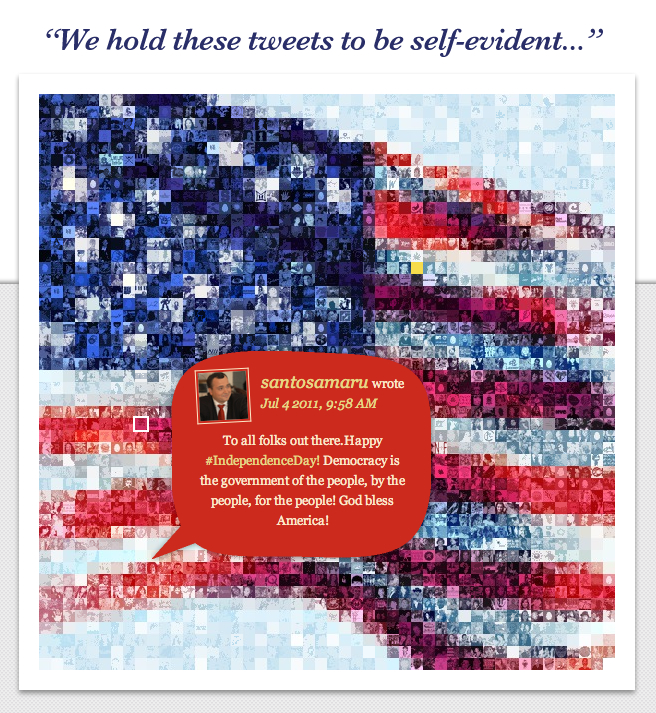
Civic developers at Code at America created a Web application in honor of this year’s Independence Day that features a number of patriotic values around: creativity, technical expertise and interest in the public discourse of their fellow citizens. Flag.CodeForAmerica.org aggregates Twitter avatars from users who tweet using the hashtag #July4th and mashes them up into a mosaic representing the Stars and Stripes. The first flag of the United States of America had a star and a stripe for each state. This flag has a tile for each human’s account.

“I have had the idea to do this for a while,” writes in Abhi Nemani, director of strategy and communication at Code for America, “soon after last year’s binary art campaign, but had to wait until we got the code infrastructure in place to be able to execute it at scale.”

Fortunately, Nemani said, the Mozilla Foundation worked with a development shop, Quodies, to create a similar mosaic when they launched Firefox 4 – check out their Firefox Tweet Machine.

“Given that it’s Mozilla, the code was open source of course,” said Nemani.”We rewired it some to get it working for us and added in some documentation so it should be easier for the next deployment,” said Nemani. Tyler Stadler was the development lead and Karla Macedo the designer.

If you want to check out the code for Twitter Collage, you can find it at Github. There’s no cap on #July4th responses, so tweet away.

The avatar mosaic is a 21st century update that captures some of the diversity and unity of that first flag by featuring some of the many voices that now can be heard on the public square of our time, the Internet. Not all of the tweets captured are positive. Some include strident political messages, divisive rhetoric or commercial promotions. It’s the public, in all of its uncensored, unvarnished, raw glory. The republic that the founding fathers fought and died for included the freedom of speech for its citizens. Over two centuries later, we’re seeing it today, coalesced around a national holiday.

“We hold these tweets to be self evident, that all humans are created equal…”

Tim O’Reilly on the power of platforms – from Web 2.0 to Gov 2.0 [VIDEO]

Earlier this spring, Tim O’Reilly gave a talk about how Web 2.0 relates to Gov 2.0 to an ESRI conference. He explores how the idea of the Internet as an operating system and the role of data in future of society.

http://video.esri.com/embed/236/000000/width/600

O’Reilly ended with an encouragement to the conference of mapping professionals and developers there and at large: “We really need to focus on what matters.”