The consequences of connectivity in an information age

win 7 devicesLast night, author Sean Power (@seanpower) was able to recover his lost laptop and belongings using the tracking software (@preyproject), Twitter and some brave, helpful human beings. It’s a fascinating outcome. As Power tweeted afterwards, this is “a great story, and brings up many implications re: vigilantism, crime in the era of realtime, and findability.”

In many ways, this story of loss and recovery serves as a fascinating insight into the century ahead in an increasingly networked society. There’s Orwell’s Big Brother, created by a growing number of cameras, satellite photos, wiretaps and intercepts, and there’s Little Brother, made up of citizens toting mobile phones. When the TSA patted down a baby this week at an airport, a pastor (@JacobJester) in line saw it, snapped a picture and tweeted it.

This is, to be fair, a leading edge case. Power is more connected online than many of his fellow citizens, technically proficient enough to install open source tracking software and sufficiently deft to leverage his distributed network of friends in real-time.

That said, it’s a reasonable expectation that we’ll be seeing variants of these kinds of stories in the years ahead. They’ll often end with the same moral: <a href="don’t steal computers from people who know how to use computers. Freelance journalist Branden Ballenger (@btballenger) used Storify to document Power’s story, which I’ve embedded below.

http://storify.com/btballenger/man-tracks-stolen-laptop-thousands-of-miles-away.js[View the story “Man tracks stolen laptop hundreds of miles away, calls thief” on Storify]

Britain seeks alpha

In the United States, government agencies like the FCC have launched open government websites in beta. In the United Kingdom, the United Kingdom is rolling back one more version and seeking alpha.

Alpha.gov 404 error page

Alpha.gov.uk is an experimental prototype of a new, single website for government in the United Kingdom that the Government Digital Service developed over the course of three months, working from the recommendations of Martha Lane-Fox’s Review. That service is located within the UK Cabinet Office. As its designers emphasize, “the site is a demonstration, and whilst it’s public it’s not permanent and is not replacing any other website.” (The hilarious 404 graphic above was designed by Matt Blease.)

There are some interesting semantics to consider here. In software development, “alpha” refers to the initial release in a software development cycle. In machine learning, alpha is “the degree to which a learning agent takes into account new information.”

In either sense, a government seeking alpha in rebooting its online presence is both taking risks and revisiting what government websites should do in the 21st century. The trial of Alpha.gov.uk offers a toolkit of simple, reusable functions that are oriented around the most common needs that citizens go online to address, like lost passports.

To date, the British plan to reinvent websites has received good press, including an excellent post what Alpha.gov gets right. One notable choice in age of austere budgets: going with an open source platform and using next generation web development tools and languages, including a mix of Ruby and Python. Says Wired UK:

This isn’t the first time that the government has experimented with creating a single site for all departments. From URL directories to public service hubs, sites like direct.gov.uk have often tried to shove the whole shebang into one, hulking site with varying degrees of success.

But Alpha.gov.uk’s daring design, 21st century architecture and expansive ambitions (the content can be easily syndicated to new internet platforms, like apps or IPTV),  could be the way forward.

The Alpha.gov team continues to share more about how Alpha.gov was developed at the project blog, encouraging citizens to play with the prototype and send feedback to Get Satisfaction or to @AlphaGov on Twitter or Facebook.

[Image Credit for Alpha.gov Error Page designed by Matt Blease: Ben Terrett]

Gov 2.0 gets applied in Oklahoma [#Gov20a]

In the Gov 2.0a conference going on today and tomorrow in Oklahoma, the “a” stands for “applied,” as in implementing technology, processes and people strategy to make government work better. There should be some video going up later, along with pictures from Adriel Hampton and a blog post or three from from the attendees. Until that goes online, the tweetstream has told the best tale of what’s been happening at the conference. I used Storify to chronicle the story online.

http://storify.com/digiphile/gov20a-gov-20-goes-to-oklahoma.js[View the story “Gov20a: Gov 2.0 Goes to Oklahoma” on Storify]

WhiteHouse.gov puts data to use in its new federal property map.

As I reported at the O’Reilly Radar, The White House used interactive mapping and open data illustrate excess federal property around the United States. Check out the White House excess property map to see what that means in practice. I’ve embedded a similar map from MapBox below.

Selling excess federal property will be challenging. In contrast, open source mapping tools are making storytelling with data easier – and cheaper.

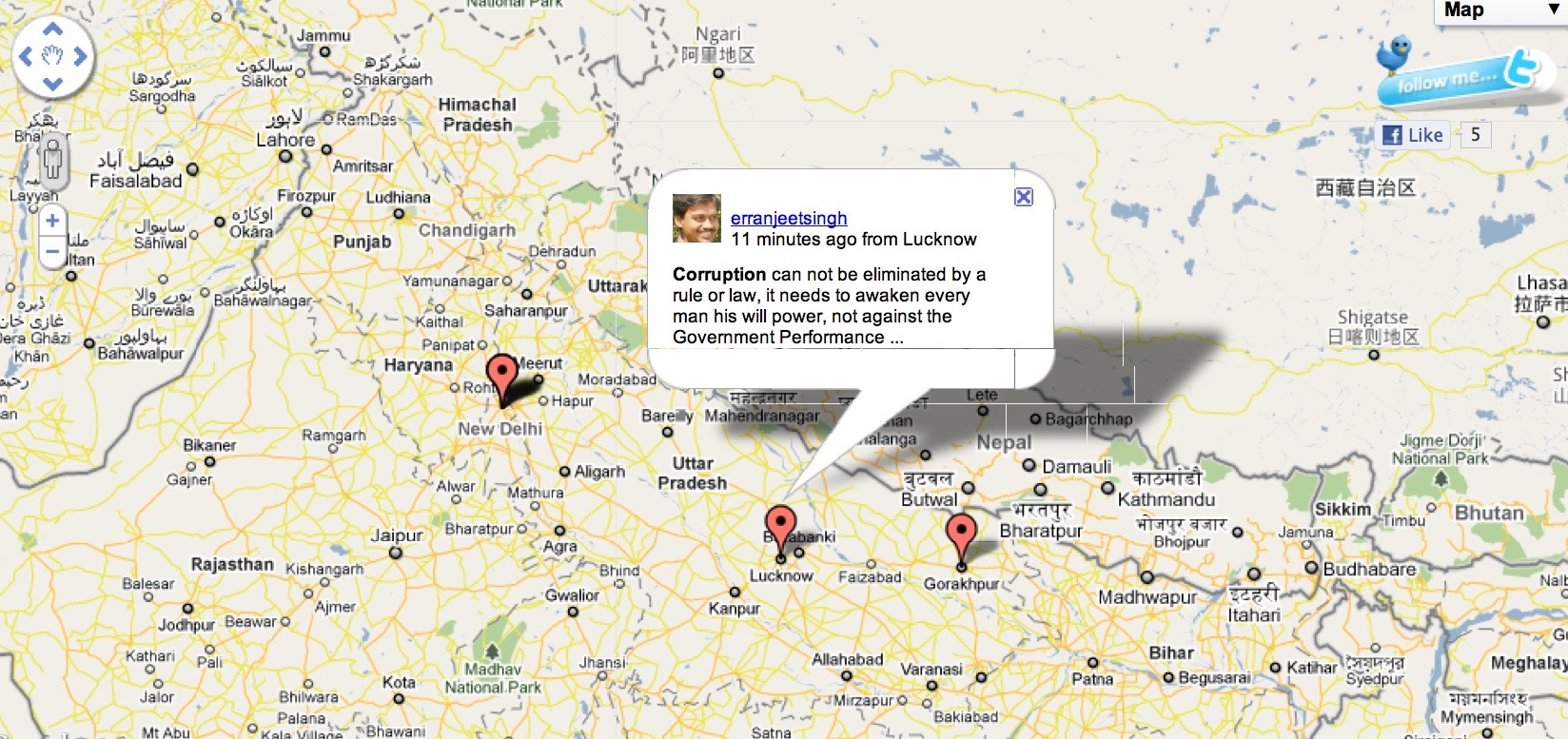
Mapping corruption tweets in real-time in India [MASHUP]

Transparency has gone global. Today, there’s a mashup of corruption-related tweets in India and Google Maps to explore.

Add an expanding number of data points in how Gov 2.0 and open government are taking root in India.

Hat tip to Andrew McLaughlin.

The State Department is tumbling

Have no fear – or hope, depending upon your perspective: the United States Department of State is not undergoing a revolution. They have, however, added one more tool to the digital diplomacy toolkit: they’ve started a new blog on Tumblr, a rapidly growing blogging platform.

The State Department started tumbling at StateDept.tumblr.com on Monday, a few weeks after Tumblr was added to Apps.gov. The General Services Administration started the first federal agency Tumblr last month for the new USA.gov blog.

So far, the folks over at Foggy Bottom have tumbled about relief efforts in Japan, aid for Africa, a partnership in Ukraine, shared video of Secretary of State Hillary Clinton talking with Israeli President Shimon Peres and posted a dispatch from EWC in the Pacific.

In the process, they’ve integrated pictures from Flickr, text from state.gov and video from YouTube – a reminder of how much of a pastiche creating and publishing media in a Gov 2.0 world has become.

Tumblr looks like a good platform for the diversity of content and context that State has to share. Sharp-eyed observers will have to wait to see if they are willing to fully engage with the Tumblr community reblogging other posts as well. For instance, if any digital diplomats come across the map of a tweet that I found through Stowe Boyd, they should feel more than welcome to reblog it. (I hear the State Department finds Twitter pretty interesting these days.)

Simpl tries to make connecting innovation to local government easier

There’s a new platform to bridge the connection between social innovators and government. Simpl, a joint project between FutureGov and Rock Creek Strategic Marketing, is short for “Social Innovation Marketplace.” As of last Friday, are Simpl is open for ideas in both the United Kingdom and United States.

For now, this open government startup is bootstrapping and focused on local government. “We’ll be exploring a bunch of avenues over the coming months, but for certain we see cities as important and the local as being the right level for being able to support this kind of action,” said co-founder Dominic Campbell. “That’s why we’re launching it with Code for America.” Craiglist founder Craig Newmark described the “social innovation speed dating” that’s set to take place in San Francisco tonight in more detail, for those interested in learning more or attending.

“We are committed to helping government embrace social innovation, handing over power to citizens,” said Campbell. “We see Simpl as a key tool to support the work we do with city governments to open up, connect and innovate.” His presentation from last year’s Open Cities Conference in the UK, embedded below, offers some more insight on that vision.

Campbell offered more insight into what Simpl is all about in a brief interview.

What is Simpl all about?

DC: It’s not about competition, it’s not (really) about money. It’s about peer to peer support and collaboration putting social innovator in touch with government. Not top down, not predetermined parameters by government – but instead gives people the opportunity to say, “Hey, this is a great idea I’m working on to fix a problem that you probably didn’t even know existed. How about you help me make it happen?” It’s mostly aimed at government but much wider. It’s more about meeting a social need as defined by the people who have that need and know what they need to make it happen. That’s often access to people in power more than money, or some borrowed skills, etc. It builds on the challenge model and says, “Hey, perhaps government doesn’t know the problems, so how can it set challenges to meet them? Who better than to define the problem/challenge/wish the person on the receiving end?”

What makes Simpl different from other platforms?

The competitive differentiator is that it is entirely agnostic. It’s about bringing people together, whoever they are, whether in government or out of government, to identify and solve challenges, meeting their own goals with or without the help of government. Frankly, Scott, me, Carrie, and most people we know have more ideas than time to make them happen so this is a vehicle to made that happen.

Why does Simpl matter to citizens?

The key is that this is all about the average citizen. They are the captive audience. They are the people on the site shaping the site from the start. Government is a key partner. That’s something we’ll be working very hard to do to connect our good government (and more than government) network into the ideas to help elevate them and help them meet their goals.

What’s else is ahead?

There’s tech development, in response to a number of requests we’ve already had for people wanting to use our matching software. We’re considering the possibility of adding some paid-for features over time. But all the functionality you see today will remain free.
John Wonderlich on the aspirations and limitations of open data initiatives

New abilities given to citizens and open government watchdogs through the lens of technology means sunlight can be applied to government transparency in powerful ways. This past weekend, John Wonderlich, policy director for the Sunlight Foundation, spoke about open data and transparency at the slashroots ./roots/DEV in Jamaica. His keynote is embedded below.

./roots/Dev Conference 2011 – Keynote Day 2 Pt 1/2 from slashroots on Vimeo.

Google Public Data Explorer adds Census Bureau data, state government statistics

Last month, the Google Public Data Explorer went public. Today, Google added U.S. Census Bureau and state government finance statistics to the database, allowing everyone to gain new insight into our present.

The numbers may be beautifully displayed but they tell a grim tale when it comes to state budgets. The crisis in state budgets across the country will be the primary driver for the adoption of new approaches to governance and service delivery in 2011. If Gov 2.0 goes local, citizensourcing smarter government couldn’t come at a more timely moment.

Disaster 2.0: UN OCHA releases report on future of information sharing in crisis

The emergence of crisiscamps and subsequent maturation of CrisisCommons into a platform for civic engagement were important developments in 2010. Hearing digital cries for help has never been more important. A year after the devastating earthquake in Haiti, a new report by a team at the Harvard Humanitarian Initiative analyzes how the humanitarian, emerging volunteer and technical communities collaborated in the aftermath of the quake. The report recommends ways to improve coordination between these groups in future emergencies. There are 5 specific recommendations to address the considerable challenges inherent in coordinating crisis response:

  1. A neutral forum to surface areas of conflict or agreement between the volunteer/technical community and established humanitarian institutions
  2. An space for innovation where new tools and approaches can be experimented with before a crisis hits
  3. A deployable field team with the mandate to use the best practices and tools established by the community
  4. A research and development group to evaluate the effectiveness of tools and practices
  5. An operational interface that identifies procedures for collaboration before and during crises, including data standards for communication

Disaster Relief 2.0: The Future of Information Sharing in Humanitarian Emergencies” was commissioned by the United Nations Foundation and Vodafone Foundation Technology Partnership in collaboration with the UN Office for the Coordination of Humanitarian Affairs (OCHA). You can find more discussion of the report in a series of posts on disaster relief 2.0 at UNDispatch.com, like this observation from Jen Ziemke:

…a substantial majority of members on the Crisis Mappers Network have held positions in formal disaster response, some for several decades. Volunteers in groups like the Standby Task Force include seasoned practitioners with the UNDP or UN Global Pulse. But what is really needed is a fundamental rethinking of who constitutes the “we” of disaster response, as well as dispensing with current conceptions of: “volunteers”, “crowds,” and “experts.” While distinctions can be endlessly debated, as humans, we are far more the same than we are different.

Whether it’s leveraging social media in a time of need or geospatial mapping, technology empowers us to help one another more than ever. This report offers needed insight about how to do it better.