The US CIO goes to the white board to describe good government

Earlier this week, United States CIO Vivek Kundra turned to the White House whiteboard to talk about sunshine, savings and service. If you’re unfamiliar with Kundra, he’s the man who has proposed and now is entrusted with implementing sweeping federal IT reform. One of the tools he’s been applying to the task is the so-called IT dashboard, which helps the White House Office of Management and Budget, where he serves to track IT spending. He claims to have reduced federal IT spending by some $3 billion dollars over the past two years with increased tracking and scrutiny.The federal CIO explains more about the results from that work, below.

http://www.whitehouse.gov/sites/all/modules/swftools/shared/flash_media_player/player5x2.swf

UPDATE: As open data consultant Dan Morgan pointed out, however, the Government Accountability Office reported that while OMB has made improvements to its dashboard, “further work is needed by agencies and OMB to ensure data accuracy.”

…inaccuracies can be attributed to weaknesses in how agencies report data to the Dashboard, such as providing erroneous data submissions, as well as limitations in how OMB calculates the ratings. Until the selected agencies and OMB resolve these issues, ratings will continue to often be inaccurate and may not reflect current program performance. GAO is recommending that selected agencies take steps to improve the accuracy and reliability of Dashboard information and OMB improve how it rates investments relative to current performance and schedule variance. Agencies generally concurred with the recommendations; OMB did not concur with the first recommendation but concurred with the second. GAO maintains that until OMB implements both, performance may continue to be inaccurately represented on the Dashboard.

One question left unanswered: Is /good the new /open? Decide for yourself at the newGood Government” section at WhiteHouse.gov.
At the @NASATweetup, @Astro_Wheels shares the view from space

http://storify.com/digiphile/nasa-tweetup-with-astrowheels-shares-the-view-from.js

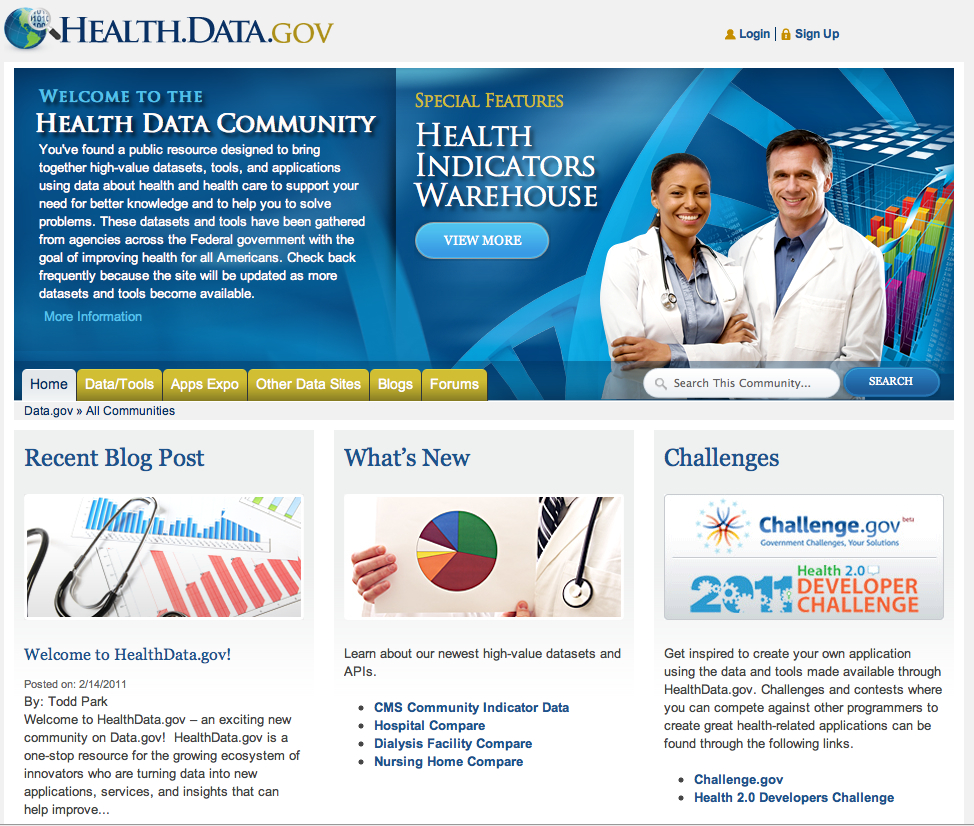
HHS launches Health.Data.gov

Last October, Todd Park, the chief technology officer at the Department of Health and Human Services (HSS) announced HealthData.gov at the HealthCamp in San Francisco. Today, Health.Data.gov went live. When the domain name propagates properly through the Internet, HealthData.gov will send online users directly to the new community at Data.gov.

Park blogged about HealthData.gov and the open health data initiative on Data.gov this morning.

“HealthData.gov is a one-stop resource for the growing ecosystem of innovators who are turning data into new applications, services, and insights that can help improve health,” he wrote.

The new open health data site includes community features and links to more than a thousand indicators at HealthIndicators.gov and a health apps showcase.

New apps like iTriage have the potential to turn open health data to better decisions and build new businesses. Speaking at the State Department’s open source conference last week, Park said that tens of thousands of citizens have now used the health data in iTriage to find community health centers.

Park has been working to make community health information as useful as weather data through the release of open health data from HSS. Today, the nation now can see more about what the tech community has come up since this spring, when the question of whether “there’s a healthcare app for that” was answered the first time. “Social value and economic value can go hand in hand,” he told a health IT summit in San Francisco.

Below, Park speaks more about what open health data could mean at last weekend’s health 2.0 code-a-thon in Washington, DC.

http://c.brightcove.com/services/viewer/federated_f9?isVid=1&isUI=1

Here come the healthcare apps.

Deb Bryant on open source at the Tech@State unconference

Deb Bryant, public sector communities manager at the Oregon State University Open Source Lab, kicked off the Tech@State unconference on open source at the National Democratic Institute today.

The short video below, capturing some of her thoughts on the evolution of open source in government, are worth considering, particularly with respect its use internationally. As Bryant pointed out, for instance, Brazil has been doing open source for a decade. “They’re really the Simon Bolivar of software down there.”

The schedule for the Tech@State unconference is evolving at Open4m.org/NDI. It bids to be an interesting day.

President Obama to take questions on YouTube after State of the Union

Next Tuesday January 25 at 9 p.m. EST, President Obama will deliver his 2011 State of the Union Address, which will be streamed live at WhiteHouse.gov and on the major television networks. Today, Steve Grove announced a YouTube interview with President Obama next Thursday, January 27, with questions coming from the online audience. The deadline for questions is Wednesday, January 25 at midnight EST.

Once again, YouTube is taking questions using Google Moderator, which allows people to vote questions up and down. Before anyone jumps and calls this “Obama 2.0,” the president sat down for a similar live interview with Grove in the White House last year, and used a similar mechanism for an online town hall in 2009. The Google Moderator instance for last year’s YouTube interview on the CitizenTube channel received over 11,600 questions and over 660,000 votes. While the number of questions submitted the last time around suggest the odds aren’t terrific for the average citizen to see a question asked, it’s worth noting that a good pertinent question about the economy, energy, healthcare or foreign policy could be voted up for the president’s consideration (along with the persistent questions about legalizing marijuana.)

For a look back at last year’s YouTube interview, including a sense of how Grove pulls from the public’s questions. watch the video below.

House 2.0: Livestreams of special session on Tucson Shooting on Facebook, CSPAN.org

Today, C-SPAN’s Facebook page will host streaming video coverage of Wednesday’s special U.S. House session on the Tucson shootings. The livestream will start at 10 AM ET, when the House will consider a resolution on the shootings. The session is also … Continue reading

House 2.0: A Congressional transition is livestreamed, tweeted and Facebooked

From my National Journal article today on the GOP transition in the House:

Today is the first day of the 112th Congress of the United States of America. One way that the incoming Republican majority will embrace innovation and transparency in the legislative process will be increased use of video and new media. As Marshall Kirkpatrick wrote at ReadWriteWeb, commenting on CNN’s report yesterday, Facebook will livestream the opening day of Congress.

In a post on Speaker.gov, the incoming speaker invited people to visit the “Pledge to America” Facebook page to view the transition to a GOP-controlled House and comment on the feed.

Key detail: you don’t have to be on Facebook to watch. You can see it right here. As Nick Schaper, the speaker’s director of new media, explained, the speaker’s staff is using the LiveStream.com plugin, available on Facebook, with the standard House of Representatives floor feed available on Capitol Hill to put the feed online. Notably, that also means that citizens and other interested parties don’t have to join Facebook, log in or “Like” the page to watch the transition. The feed at Livestream.com/SpeakerBoehner is available on the open Web and can be embedded on any blog or article.

Livestream.com and Facebook won’t be the only options used by the new speaker’s office either, according to Schaper. When asked whether the speaker would use Current.tv or UStream or YouTube, Schaper said that “we’ve never limited ourselves or worked exclusively with any technology partners on efforts such as this. We’ve used all of the above and I look forward to finding more new tools that can help our members more efficiently connect with those they represent.”

UPDATE: Notably, the new speaker’s remarks were livetweeted in sync with his speech by the new @SpeakerBoehner account on Twitter. It’s safe to say that, at least at this moment, Boehner was not tweeting himself.

new TWTR.Widget({
version: 2,
type: ‘profile’,
rpp: 5,
interval: 6000,
width: 600,
height: 300,
theme: {
shell: {
background: ‘#1d0087’,
color: ‘#ff0a0a’
},
tweets: {
background: ‘#fcfcff’,
color: ‘#a60c13’,
links: ‘#303df0’
}
},
features: {
scrollbar: false,
loop: false,
live: false,
hashtags: true,
timestamp: true,
avatars: false,
behavior: ‘all’
}
}).render().setUser(‘speakerboehner’).start();

For more on social media, transparency and the 112 Congress, click on over the full article at National Journal.

Cisco CTO Padmasree Warrior on the power of video

Last month, I interviewed Cisco CTO Padmasree Warrior about technology, gov 2.0 and open government. In the excerpt below, we talk about some lessons for the public sector from her experience in the business of technology, particularly around distributed collaboration using video conferencing. “The power of video is that it really allows us to extend the abstract notions of text-based technology and replaces that with much more human way of communicating,” said Warrior. “It’s more natural.”

Warrior, who went to Russia this past winter on a State Department “TechDel,” leveraged telepresence to collaborate with her fellow travelers after they dispersed. She’ll be talking more about more about similar lessons from the private sector in her conversation with Tim O’Reilly at the Gov 2.0 Summit next week. I’ll be posting more excerpts from our interview at Radar on Monday.

Cisco CTO on telepresence and the use of tech in natural disasters

Last month, I interviewed Cisco CTO Padmasree Warrior about technology, gov 2.0 and open government. In the excerpt below, we talked about on the use of telepresence in government – over telepresence – and the opportunities around teleworking.

I’m very much looking forward to her conversation with Tim O’Reilly at the Gov 2.0 Summit on private sector lessons that translate to the public sector next week. I’ll be posting more excerpts from our interview on Monday.

We also talked about the role of technology in natural disasters. An excerpt from that conversation is embedded below:

CrisisCommons and floods in Pakistan

What Warrior and I didn’t discuss then, with respect to the floods in Pakistan, is the CrisisCommons Marathon Weekend that begins today. It’s an international effort that spans the globe, from Canada to London to Bangkok to Sydney, leveraging the distributed efforts of concerned citizens and technology to provide aid in the massive disaster. For more information – and to help – consult the links below:

We will be working to assist our friends and partner organizations: OpenStreetMapSahana and Crowdmap (Ushahidi). Each individual city may also be working on tasks listed on the CrisisCommons wiki for pkfloods.

We’ll be working in a number of countries and timezones with staggered over three days. CrisisCamps in Canada and CrisisCamp Virtual will start on the evening of Friday, September 3, 2010. This is the same start time for CrisisCamp Sydney where the time will be Saturday, September 4, 2010 : 08:00 AEST. As we collaborate work across North America, we will run overnight and link to the CrisisCamp London team. The Canadian and Uk teams finish on Saturday, September 4, 2010 while the Sydney team will continue throughout Sunday, September 5, 2010.

Register for the Sydney, Australia CrisisCamp: Saturday, September 4, 2010: 08:00 AEST

Join CrisisCamp Bangkok for Saturday, September 4, 2010

Register for the Toronto, Canada CrisisCamp: Friday, September 3, 2010: 18:00 ET

Join Silicon Valley on Friday, September 3, 2010 5-10pm Pacific Time at 650 Castro, Mountain View

Register for the London, UK CrisisCamp: Saturday, September 4,2010: 10am GMT

Join us virtually:

Register to be a Virtual Crisis Camper