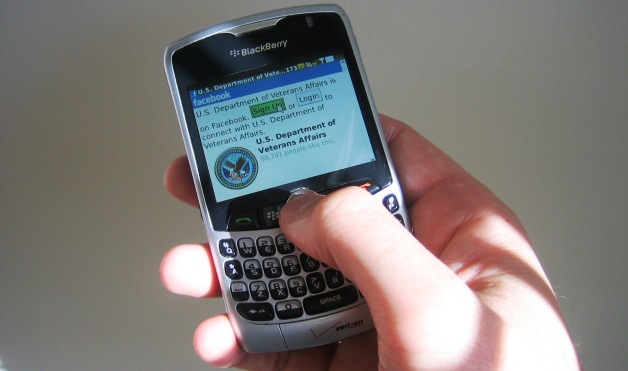
Department of Veterans Affairs releases progressive, structured social media policy

In 2011, it might feel a little late for federal agencies to be issuing social media policies. How governments use social media has shifted from a niche concern, debated by new media and policy wonks, to an issue that makes international headlines when global leaders alternately decry or celebrate the impact of connection technologies upon their countries.

Think again.

As anyone who has worked in a federal bureaucracy will tell you, squaring usage policies with rules, regulations and laws is a fundamental need if there’s going to be any progress towards 21st century governance.

“One of the biggest, long-standing complaints about VA is how it’s an opaque, monolithic bureaucracy that doesn’t respond to the needs of vets,” writes Brandon Friedman (@BrandonF), director of online communications for the U.S. Department of Veterans Affairs, in an email today. “We’re finally putting a human face on it. Everything we post on our blog or our main Facebook page or Twitter feed has a name attached to it. This shows even the largest, slow-moving federal agencies can make progress in becoming more agile and responsive.”

There’s also a matter of default for usage of these tools: open, versus closed. Consider that the emphasis below is the VA’s:

The use of Web-based collaboration tools such as social media tools is highly encouraged. Web-based collaboration is intended for information sharing within and outside of VA. To increase accountability, promote informed participation by the public, and create economic opportunity, the presumption shall be in favor of openness (to the extent permitted by law and subject to the exclusions noted in this Directive or other policy)

The entire policy, which has to be considered progressive for an organization with military DNA, is embedded below or available as a PDF. Given the stance that other federal agencies have taken recently on social media usage, this policy is not a watershed but is extremely important to over 300,000 VA employees and the millions veterans they serve. If access to Internet-based capabilities is critical at the Department of Defense, similar access for veterans is important.

Today’s announcement also serves as a reminder that the VA has come a long way in a short time, particularly in the context of an enormous government institution. “Less than two years ago, VA’s primary method of engagement with the public consisted of telephone calls and the USPS,” wrote Friedman. “Today, hundreds of thousands of veterans can get help navigating the bureaucracy via social media. We can also make a direct difference in peoples’ lives. One example I use concerns suicidal ideation on Facebook and Twitter. We’ve actually intervened in at least half a dozen instances where veterans have talked about killing themselves. We’ve been able to jump in and link them up with assistance. As we always say here, it’s about leveraging new technology to get the right information to the right veteran at the right time. For so long, many veterans have lost out on the benefits to which they’re entitled because they weren’t even aware of them—or they didn’t want to deal with a complex bureaucracy. Social media allows us to get them the information and to help ease the transition from the military into the VA system.”

It’s an important shift. Next up? Work to leverage technology better to reduce the backlog in veterans’ benefit applications and help vets who have returned from service abroad get back to work in a down economy.

Getting social with security and privacy

Embedded in this policy is are security and privacy provisions that instruct to the deputy assistant secretary for information security to issue an information protection policy, do a risk assessment, provide patching, training and a “Trusted Internet Connection” for the desktop images of VA users.

There is also instruction for the director of the VA privacy service to address policy concerns and to public affairs, granting “the authority to disapprove any outward-facing content on official VA blogs and social media sites which do not meet accepted standards of quality,” along with audits to ensure same.

For a deeper dive into what social media means to the military, read this talk on connection technologies and global organizations. It’s by U.S. Navy Chief of Naval Operations Roughead, a title which effectively makes him the “CEO” of that global enterprise. He talked about “burning the boats” as the Navy enters this operational space — an extremely powerful metaphor, given his occupation — but perhaps a fitting one, given that achieving and maintaining situational awareness in a changing information environment has become a strategic capability.

As the VA looks to support the considerable needs of the men and women who have served their country, it looks like social media will be a part of the plumbing that connects them together.
Department of Veterans Affairs Social Media Policy//

@Jack to moderate questions for President Obama in @Twitter @Townhall with @WhiteHouse [#AskObama]

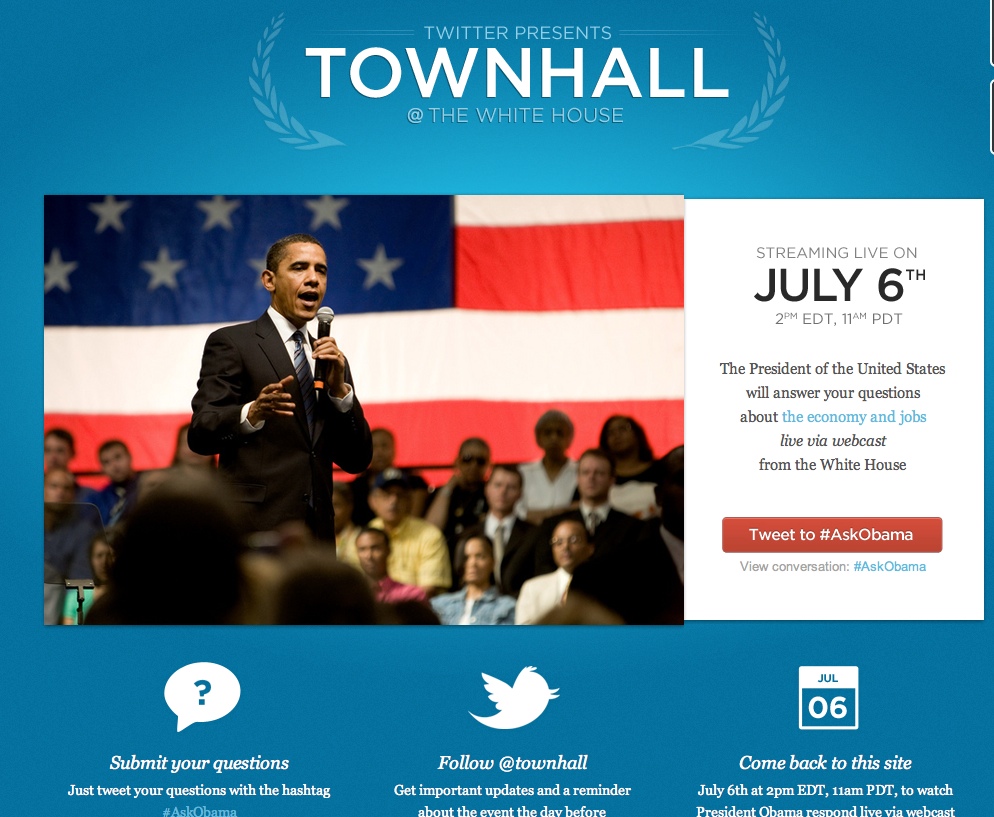
In coordinated tweets with Twitter, the White House announced that it will be holding a town hall on Twitter on July 6th, 2011 at 2 ET. Twitter launched a new @TownHall account for the event and a subdomain, AskObama.Twitter.com to host the live webcast.

According to Macon Phillips, director of digital for the White House, and Sean Garrett, Twitter’s vice president of communications, the digital town hall will be hosted by Twitter co-founder Jack Dorsey, who will provide the questions.

Phillips tweeted that “@Twitter has a cool approach to surfacing questions,” clarifying that “choosing the Q’s will be done by @twitter. Garrett tweeted that “there will be a fairly involved process by which they are selected” and more details and background on said process is on the way. UPDATE: Garrett emailed me “the basics”

“There will be multiple ways that questions will get to the President,” he wrote. “Twitter users will begin asking questions via the #AskObama hashtag today. To identify popular and relevant questions, Twitter is engaging with a third-party Twitter measurement company called Mass Relevance to provide a view on the most frequent topics and their geographical distribution. Additionally, Twitter will invite a group of highly active and engaged Twitter users (called “curators”) to help choose questions and comments both prior to and during the event. Twitter will collect questions in the days leading up to the Town Hall and in real-time during the event.”

Garrett also added some information regarding how Twitter will select this team of “question curators”:

“These curators will be a diverse group from around the country that are also active and engaged on Twitter,” he wrote. “These curators will ask those in their particular communities to also highlight what they think are the most important questions for the President. Curators will retweet questions and pose their own.”

The Twitter TownHall follows a Facebook TownHall earlier this year, in which Facebook founder Mark Zuckerberg posed live questions to President Obama. Nancy Scola wondered how much of a “TownHall” the event actually offered. With this Twitter version, the interesting detail will be in how much transparency goes into question selection, particularly with respect to how exact or tough they are. When the White House turned to Twitter to discuss President Obama’s Middle East speech, they included NPR’s Andy Carvin and Foreign Policy’s Mark Lynch as trusted interlocutors. It’s less clear how Dorsey will moderate, given his considerable different style of tweeting, but on one count there is no doubt: this will be interesting.

UPDATE: In his post on President Obama taking questions on Twitter, Nick Clark Judd raises similar questions over at techPresident on moderation. (And no, he didn’t call the event a “TownHall.”)

UPDATE II: The New York Times published more details on the “Twitter Town Hall,” including the news that there will be a “White House Tweetup,” the first of its kind. In terms of process, here’s what Twitter told the Times. (Spoiler: it’s quite similar to what Garrett told me, above).

Twitter will select the questions, using curation tools and a group of Twitter users to help identify the most popular questions raised both before and during the event. Twitter will be relying on its own search and curation features as well as a company called Mass Relevance to help find questions and topics that are most frequently mentioned.

… Adam Sharp, Twitter’s manager of government and political partnerships, said that the curators chosen by Twitter to help select the questions would be a politically and geographically diverse group. He said the curators would ask the people in their communities to highlight what they think are the most important questions for the president to address.

Curators will also be retweeting questions and posting their own.

“We will have highly-engaged Twitter users from around the country to provide that geographic diversity to help identify good questions, “ he said. “This helps us make sure that we are addressing the concerns that the Twitter universe cares about. “

Less clear whether the President of the United States will actually be doing any of the tweeting himself, as opposed to dictating a reply, which means we may not get to see any real-time presidential typos. According to reports by Paul Boutin, President Obama started tweeting for himself at @BarackObama over the Father’s Day Weekend, signing the tweet “-BO.”

CBS News White House correspondent and keeper of presidential lore Mark Knoller cautioned, however, that “Obama won’t be typing his responses.” Looking back at that Father’s Day tweet, Knoller tweeted that “a tweet was sent in his name by his campaign. He was not at a computer typing a tweet.”

We’ll see if the President decides to get more personally involved or not in the technology. Given that the presidential iPad appears to travel with him these days, it could happen.

[Photo Credit: President Barack Obama sits alone on the patio outside the Oval Office, following a meeting with his senior advisors, April 4, 2011. (Official White House Photo by Pete Souza)]

UPDATE III: Politico White House correspondent Mike Allen led his Tuesday’s Playbook with more details about Wednesday’s Twitter event:

The audience for tomorrow’s hour-long TWITTER TOWN HALL in the East Room (2 p.m. ET) will consist of 140 characters — er, people – in a nod to the maximum length of a tweet. President Obama, however, will face no such limit: He’ll answer questions for the audience, and @TownHall will carry summaries of what he says. Twitter co-founder and Executive Chairman Jack Dorsey will ask the questions. Three screens will be behind Obama and Dorsey: one with the current question; another will have a heat map of the U.S., showing where the town-hall tweets are concentrated; and the third will show the volume of tweets, by topic (jobs, taxes, spending, health care, etc.) Mass Relevance, a company that has worked with the broadcast networks on real-time Twitter data, will supply the analytics. Later, Radian6 will study the demographics of participants.

Representative questions will be chosen partly on how often they’re retweeted. The White House has also reached out to about 10 Twitter leaders in different parts of the country to help surface questions by curating themes and topics that are big among their followers and in their communities. So Dorsey may say: “We’re hearing a lot about the extension of unemployment benefits, especially from the upper Midwest, and here’s a question from Bob in Chicago.” The audience will include 20 people from around the country chosen through the White House Tweetups page, and they’ll also get to meet with Dorsey and with U.S. Chief Technology Officer Aneesh Chopra and perhaps other policy officials.

UPDATE IV: Twitter has blogged about the “Twitter Town Hall,” including a link to the 7 “curators” on Twitter who are selecting questions and a new study from Radian6 that found that “financial security is one of the most frequent topics of political conversation on Twitter.”

Tomorrow’s Town Hall is an invitation from the White House for anyone on Twitter to participate in an open exchange about the national and global economic issues facing the United States.

Questions addressed during the Town Hall will be selected both in advance and in real-time during the event. To narrow down the list of popular, relevant questions to ask on behalf of Twitter users, we’re doing the following:

• We’ve partnered with the visualization experts at Mass Relevance to identify the themes and regions driving the conversation.
• Algorithms behind Twitter search will identify the Tweets that are most engaged with via Retweets, Favorites and Replies.
• A team of seasoned Twitter users with experience discussing the economy will help flag questions from their communities through retweets.

The consequences of connectivity in an information age

win 7 devicesLast night, author Sean Power (@seanpower) was able to recover his lost laptop and belongings using the tracking software (@preyproject), Twitter and some brave, helpful human beings. It’s a fascinating outcome. As Power tweeted afterwards, this is “a great story, and brings up many implications re: vigilantism, crime in the era of realtime, and findability.”

In many ways, this story of loss and recovery serves as a fascinating insight into the century ahead in an increasingly networked society. There’s Orwell’s Big Brother, created by a growing number of cameras, satellite photos, wiretaps and intercepts, and there’s Little Brother, made up of citizens toting mobile phones. When the TSA patted down a baby this week at an airport, a pastor (@JacobJester) in line saw it, snapped a picture and tweeted it.

This is, to be fair, a leading edge case. Power is more connected online than many of his fellow citizens, technically proficient enough to install open source tracking software and sufficiently deft to leverage his distributed network of friends in real-time.

That said, it’s a reasonable expectation that we’ll be seeing variants of these kinds of stories in the years ahead. They’ll often end with the same moral: <a href="don’t steal computers from people who know how to use computers. Freelance journalist Branden Ballenger (@btballenger) used Storify to document Power’s story, which I’ve embedded below.

http://storify.com/btballenger/man-tracks-stolen-laptop-thousands-of-miles-away.js[View the story “Man tracks stolen laptop hundreds of miles away, calls thief” on Storify]

Taking stock of global freedom of expression on World Press Freedom Day

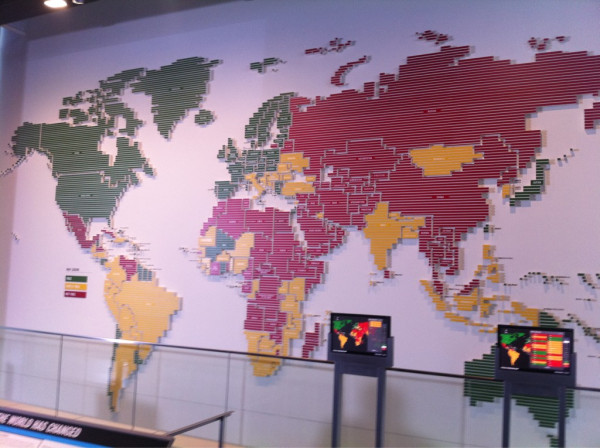
In 2010, only 1 in 6 people lives in countries with a free press, according to a new report on press freedom from Freedom House. There is a long road ahead to establishing and protecting freedom of expression for humanity.

This week, defenders of free expression are celebrating the progress of press freedom and recognizing the challenges that persist globally on World Press Freedom Day 2011. This is the 20th anniversary of the Windhoek Declaration that helped to establish UNESCO’s World Press Freedom Day. The United States is hosting this year’s World Press Freedom Day in Washington, D.C. at the Newseum. You can watch the livestream below and follow the conversation on Twitter on the #wpfd hashtag, both of which are embedded below.

wpfd2011 on livestream.com. Broadcast Live Free

new TWTR.Widget({
version: 2,
type: ‘search’,
search: ‘#wpfd OR #pressfreedom’,
interval: 6000,
title: ‘What\’s happening on’,
subject: ‘World Press Freedom Day’,
width: ‘auto’,
height: 500,
theme: {
shell: {
background: ‘#004382’,
color: ‘#ffffff’
},
tweets: {
background: ‘#ffffff’,
color: ‘#444444’,
links: ‘#1985b5’
}
},
features: {
scrollbar: false,
loop: true,
live: true,
hashtags: true,
timestamp: true,
avatars: true,
toptweets: true,
behavior: ‘default’
}
}).render().start();

To learn more about global freedom of expression and and the organizations that protect journalists and support the collection and dissemination of news about our world, visit:

Can open government be embedded?

This morning, the White House posted President Obama’s long form birth certificate to the public. Now that the White House has released the president’s long form birth certificate to the media (and directly over Twitter to everyone) I hope that the country can move on to the much greater issues that confront the country and humanity as a whole.

Honestly, it was much cooler to watch Mr. Obama speak live using the White House iPhone application than to see the President of the United States take time to debunk the issue that has been settled for years. His remarks are embedded below:

It’s also worth noting the evolution of the White House’s new media strategy, where a government document was not only released directly to the American people as a PDF over social networks but was uploaded to Slideshare where it can be embedded on other webpages to be spread even further, as I have done below.

The White House is not alone in using SlideShare to create embeddable documents. The Congressional Budget OfficeDepartment of EnergyU.S. Environmental Protection Agency and U.S. National Library of Medicine are sharing information there as well. The military has created channels there too, including the Department of Defense and the U.S. Navy.

To be clear, releasing documents online in of itself is not nor will ever be a full measure of government transparency. Open government is a mindset, not just a matter of adopting new tools. For open government to endure in an era of budget austerity, it will need to be baked in to how government operates, with a clear connection to how it helps deliver on the mission of agencies and officials.

That said, creating online channels with embeddable content is taking more than a few steps forward from paper memos dropped into file cabinets or proclamation read over the radio.

Here’s to moving forward to work on the stuff that matters.

Talking about crisis data, social media and GIS on Federal News Radio

American Red Cross Conference On Use Of Intern...

Image by ShashiBellamkonda via Flickr

Earlier this week, the O’Reilly Radar published a new article about how the Red Cross and the Los Angeles Fire Department integrate social tools into crisis response. This afternoon, I talked with Federal News Radio‘s anchor Chris Dorobek about crisis data for the Dorobek Insider:

Have a crisis? Don’t worry, there’s an app for that.

With the emergence of social media tools, emergency responders have been forced to integrate social media into their crisis response.

During the Gulf Coast oil spill last year, the Coast Guard launched an app where you could actually track the oil. Now the Red Cross and the Los Angeles Fire Department are using Twitter and Facebook in their emergency response.

If you’re in the Washington, D.C. listening area, our interview was on at 4:05 and will be rebroadcast at 6:05 PM EST. For online listeners (that’s you, dear reader) you can listen to the show on crisis data here.

Enhanced by Zemanta

USA.gov adds 1.USA.gov URL shortener for civilian use

Last year, the United States General Services Administration (GSA) launched the Go.USA.gov URL shortener at the Gov 2.0 Expo in Washington, D.C. Today, USA.gov soft-launched a way for citizens to create shortened USA.gov URLs as well. Whenever someone uses Bit.ly (or any service that uses Bit.ly, like Tweetdeck or the Twitter app for iPhone) to shorten a .gov or .mil URL, the link will be converted to a short 1.USA.gov.

For those feeling a bit dizzied by acronyms, URL stands for “uniform resource locator.” A URL is the Web address, like, say, govfresh.com, that a citizen types into a Web browser to go to a site. Many URLs are long, which makes sharing them on Twitter or other mobile platforms awkward. As a result, many people share shortened versions. One of the challenges that face users is that, unless a citizen uses one of several tools to view what the actual hyperlink is below the link, he or she might be led astray or exposed to malicious code that was included in the original link.

This new service will make it easier for people to know when a short URL will direct them to a trustworthy official U.S. government site. “The whole idea is to improve people’s experience when dealing with government information online,” said Jed Sundwall, a contractor for USA.gov and GobiernoUSA.gov. “We keep USA.gov in the domain for usability reasons. It’s crystal clear, worldwide, that 1.USA.gov URLs point to trustworthy governmentt information.” Adriel Hampton talked with Jed Sundwall about Go.USA.gov on Gov 2.0 Radio last year. For more on how Go.USA.gov URLs work, watch Michele Chronister’s presentation from the last year’s Gov 2.0 Expo, below:

The new shortener began appearing online this Friday. According to Sundwall, ABC senior White House correspondent Jake Tapper was the first to use it when he linked to a PDF containing new unemployment information at the Bureau of Labor and Statistics: “For those asking follow-ups on unemployment, here’s the BLS link http://1.usa.gov/XUtpL

Tapper is not alone, as many others have used the 1.USA.gov URL shortener simply by using the tools there already knew. “The beauty is that Jake used it without knowing he was using it,” said Sundwall. “We’re trying making it easy for anyone to identify .gov information as it’s being shared online,” said Sundwall.

<

1.USA.gov FAQ

Following are the GSA’s answers to frequently asked questions about 1.USA.gov.

Why did we use 1.USA.gov when go.gov or 1.us.gov would be shorter?
Including USA.gov in the shortened URLs makes them more intuitive and meaningful to users worldwide. Many Internet users may not realize that .gov is the exclusive top-level domain of the U.S. government, and USA.gov adds valuable context to the short URLs.

What if I don’t want a 1.USA.gov URL?

You can replace 1.USA.gov with bit.ly or j.mp. For example 1.USA.gov/12345 will go to the same place as j.mp/12345 or bit.ly/12345.

Is Bit.ly owned by the Libyan government?

No. Bit.ly (@bitly is an American-owned company based in New York City. While .ly is the top level Internet domain assigned to Libya, this does not mean that Libya has any stake at all in Bit.ly, the ability to access Bit.ly’s data, or the ability to control Bit.ly’s servers. On the Quora website, Bit.ly’s CEO has addressed what would happen to Bit.ly if Libya were to shut off Internet access in Libya. Regardless, we use .gov URLs, and none of the servers that power this service (or any of Bit.ly’s servers) are located in Libya.

Who uses a similar service with Bit.ly?

C-SPAN: http://cs.pn
NY Times: http://nyti.ms
NPR: http://n.pr
Facebook: http://fb.me
Pepsi: http://pep.si
Economist: http://econ.st

What does this mean for Go.USA.gov?

We will still maintain Go.USA.gov as an option for government employees to use as a URL shortener, and Go.USA.gov URLs will continue to work.

Correction: an earlier version of this story referred to the new shortener as 1.GO.USA.gov, as opposed to the shorter version. We regret the error.

Congress faces challenges in identifying constituents using social media

Citizens are becoming more influential through social networks and influencing their peers. Research from the The Pew Research Center’s Internet & American Life Project suggests that government 2.0 an important trend, with respect to our understanding of what it means to be a citizen and how our actions influence those of our fellow citizens. The role of the Internet as a platform for collective action is growing but the authorities that control the levers of power offline still matters immensely.

Today, Politico reported that social media isn’t so hot on the Hill. Or, as FierceGovernmentIT.com reported, “Congress is using social media to talk, not listen.” Both media outlets were reporting on survey results conducted by the Congressional Management Foundation on perceptions of citizen advocacy by Congressional staffers.

A better headline, however, might have been “Twitter isn’t so hot on the hill with lawmakers,” given myriad challenges around identifying constituents online, automated campaigns and what Representative Culberson (R-TX) described as a “lot of trolls on Twitter.” (It’s even worse on YouTube, Congressman.) The question posed at the end of the Politico article — “Are lawmakers putting too much time — or staff resources — into social media?” is followed with Pew stats on *Twitter* use and penetration, not Facebook.

The complaints from numerous anonymous Congressional staffers about the time it takes to maintain social media are likely honest and parallel the experiences of higher-paid contemporaries in private industry, academia, media, fashion and the nonprofit worlds. Managing multiple social media presences can, indeed, be a pain in the a–. And it takes resources, in terms of time, that may be scarcer than ever. That said, social media is now part of the lexicon of Congressional staff trusted with constituent communications. If a Representative or Senator is speaking anywhere in DC, there’s an increasingly good chance that snippets of it may tweeted, unusual pictures will be tagged on Facebook and that any gaffes will be up on YouTube later.

Doing more than trying to fit the 20th century model of broadcasting to these platform requires time, expertise and commitment, along with a thick skin. Opening up these new online channels for Congressional communications created challenges, to be sure, but then so did adding the telegraph, radio, television, fax machines, cellphones and email. It’s not hard to find past news reports of Senators resisting the addition of dial phones to the Hill.

Every new communications technology has had an impact on Congress. In 2011, Twitter, Facebook and YouTube do each come with new wrinkles. YouTube and Twitter can work in concert to share video and share it instantly with the world. At the same time, on the Hill, automated campaigns using social media have followed the path of email and faxes deluges. Carefully edited videos can trim key context from statements, or audio from broadcasts. The risks and rewards for the use of Web 2.0 that pertain to federal and state agencies also pertain to Congress.

Take, for instance, Facebook, which is generally tied to the real identities of citizens. Engaging with citizens carries with it identity and privacy issues for constituents. That’s the rub, and it won’t come out easily. Look at how San Francisco integrated city services with 311 and Facebook for an example of how government can mitigate and address some of those issues. The National Strategy for Trusted Identities in Cyberspace might address some of the challenges as well.

In the meantime, Congresional staffers and citizens alike can hope that new, improved architectures for participatory democracy online come along soon to upgrade the status quo in Washington.

Platforms for citizensourcing emerge in Egypt


As people watching the impact of social media in the events in Egypt know, Facebook, Twitter and YouTube played a role. Today, Microsoft’s director of public sector engagement, Mark Drapeau, sent word that the Redmond-based software company’s open source ideation platform, Town Hall, has been deployed at nebnymasr.org to collect ideas.

The highest profile implementation of Town Hall to date was for crowdsourcing ideas in Congress for the incoming Republican majority in Congress at “America Speaking Out.

This Town Hall instance and others show how citizensourcing platforms can be tailored to channel feedback around specific topics, as opposed to less structured platforms. As governments and citizens try to catalyze civic engagement using the Internet, creating better architectures for citizen participation will be critical. Clay Shirky’s talk about the Internet, citizenship and lessons for government agencies at the Personal Democracy Forum offered some insight on that count. Using taxonomies to aggregate ideas instead of a single list was a key takeaway.

To date, the Egyptian citizensourcing site has logged a few dozen questions and votes. Whether usage of the site will grow more or not is up for debate. The network effect may working against it. As ReadWriteWeb reported last week, Egyptians are using Google Moderator to brainstorm Egypt’s future. Wael Ghonim, the Google executive who played a role in Egypt’s recent revolution, started a Google Moderator page for Egypt entitled, “Egypt 2.0, what does we need? What are our dreams?!.” To date, the Moderator instance has logged 1,361,694 votes for more than 50,000 of the ideas submitted by nearly 40,000 users.

Why does government social media use matter to citizens?

An important role of technology journalists in the 21st century is to explain how broader trends that are changing technology, government and civic society relate to average citizens. Some have called this broader trend towards smarter, more agile government that leverage technology “Gov 2.0.” (Readers of this blog are no doubt familiar with the term.) When you dig into the topic, you can get stuck in a lot of buzzwords and jargon quickly. Most people don’t care about how a satellite gets into orbit, the release of community health data or the standards of an API for product recalls. They care quite a bit, however, about whether their GPS receiver enables them to get to a job interview, if a search engine can show them ER waiting room times and quality statistics, or if a cradle for their baby is safe. Those wonky policies can lead to better outcomes for citizens.

If you follow Mashable, you might have read about the ways that social media promotes good health or how government works better with social media.

The following stories have little to do with technology buzzwords and everything to do with impact. Following are five stories about government 2.0 that matter to citizens, with issues that literally come home to everyone.

1) The Consumer Product Safety Commission has launched a public complaints database at SaferProducts.gov. You could think of it as a Yelp for government, or simply as a place where consumers could go to see what was safe. Add that to the mobile recalls application that people can already use to see whether a product has been recalled.

2) The new Consumer Financial Protection Bureau will use technology to listen to citizens online to detect fraud. If you haven’t heard, DC has a new startup agency. That hasn’t happened in a long time. Your could think of it as Mint.gov mashed up with HealthCare.gov. The CFPB plans to use technology in a number of unprecedented ways for fraud detection, including crowdsourcing consumer complaints and trends analysis. Given how much financial fraud has affected citizens in recent years,and how much of the anger that the public holds for the bailouts of banks remains, whether this agency leveraging technology well will matter to many citizens.

3) Social data and geospatial mapping join the crisis response toolset. Historic floods in Australia caused serious damage and deaths. Government workers used next-generation technology that pulled in social media in Australia and mapped the instances using geospatial tools so that first responders could help citizens faster, more efficiently and more effectively. It’s an excellent example of how an enterprise software provider (ESRI) partnered with an open source platform (Ushahidi) to help government workers use social media to help people.

4) New geolocation app connects first responders to heart attack victims.The average citizen will never need to know what Web 2.0 or Gov 2.0 means. Tens of thousands, however, will have heart attacks every year. With a new geolocation mobile application that connects citizen first responders to heart attack victims, connected citizens trained in CPR now have a new tool to help them save lives.

Better access to information about food safety, product recalls and financial fraud will help citizens around the country. Improvements to the ability of government workers to direct help in a disastrous flood or for citizens to receive immediate help from a trained first responder in an emergency are important developments. As 2011 takes shape, the need for government to use social media well has become more important than ever. That’s why the perspective of government officials like FEMA administrator Craig Fugate matter.

“We work for the people, so why can’t they be part of the solution? “
said Fugate, speaking to delegates from the distributed chapters of Crisis Commons assembled at FEMA headquarters. “The public is a resource, not a 
liability.”

For example, Fugate said that FEMA used reporters’ tweets during Hurricane Ike for
 situational awareness. “We’ve seen mashups providing better info than
 the government.” Listening and acting upon those digital cries for help on social media during crisis could literally be a matter of life and death.

Whether government can adapt to a disrupted media landscape and the new realities of information consumption is of substantial interest to many observers, both inside and out of government. Whether government can be smarter, agile and more effective is a great interest to all.