This week, I was proud to be one of two speakers for a session on social media and government at the Council on Governmental Ethics Laws (COGEL) conference in Washington, D.C. I delivered an adapted version of the talk on social media and government I gave the Social Security Administration’s Open Government Awareness Day earlier this year, focusing on the elements that would be of greatest interest to a group of lawyers, regulators and academics. The presentation is embedded below:
The speaker that followed me, however, was able to share a fascinating view of what social media looks like from inside of government, specifically in the District of Columbia. Alysoun McLaughlin, the public affairs manager for the District of Columbia Board of Elections and Ethics. Here’s her bio, from the COGEL session description:
She joined the District last year, just in time to implement a long list of reforms for the 2010 election including new voting equipment, early voting and same-day registration. Prior to becoming an election official, she was a project manager for Election Initiatives at the Pew Center on the States. She previously spent a decade as a Washington lobbyist, focusing on election issues for the National Conference of State Legislatures and the National Association of Counties. She is here today to share her experience with social media during the 2010 election.
And share she did. Over the course of half an hour, she talked about Facebook, Twitter, local media, citizen engagement and much more. I captured most of her presentation on my iPhone (sorry about the unsteady hand) and have embedded her presentation, “To Tweet or not to Tweet: Engaging the Public through Social Media,” below.
If you want an excellent, practical perspective of the local government side of social media, these are worth watching. A couple of key takeaways from her presentation:
How can governments get insights from Twitter without using it? “Just type in the name of your agency and see what they’re saying.”
On D.C. elections: “We know there are going to be lines. Come to the website to see what they are.”
Don’t trust this to an intern. You “need someone skilled in crisis communications.”
“The days that I’m heavy on Twitter are the days my phone rings less.”
Viral tweets can raise awareness: “…and we just confirmed that a voter used a write-in stamp. on a touch screen.”
Part 1: Introductions
Part 2: Reflections on Twitter and Facebook
Part 3: Twitter and the 2010 DC Election
Part 4: Who follows @DCBOEE
Part 5: Listening and using social media in government
The digital divide in D.C. is an issue that has been receiving increased sunlight under the District’s chief technology officer, Bryan Sivak. As the Kojo Nnamdi Show episode on the D.C. digital divide reported, “a 2009 study by the OCTO found that the digital divide runs very deep in the city – 90% of residents in Northwest D.C. have high-speed internet access in their homes, but in Southeast, that figure falls to just 36% – 40%.”
Earlier this year, Washington became the recipient of stimulus funding for a digital divide initiative. This summer, the city turned on free wifi in many neighborhoods, which can be viewed at DC.wifi.gov. Today, Sivak announced D.C.’s first digital divide strategy:
.bbpBox12514372882534400 {background:url(http://s.twimg.com/a/1291760612/images/themes/theme1/bg.png) #C0DEED;padding:20px;} p.bbpTweet{background:#fff;padding:10px 12px 10px 12px;margin:0;min-height:48px;color:#000;font-size:18px !important;line-height:22px;-moz-border-radius:5px;-webkit-border-radius:5px} p.bbpTweet span.metadata{display:block;width:100%;clear:both;margin-top:8px;padding-top:12px;height:40px;border-top:1px solid #fff;border-top:1px solid #e6e6e6} p.bbpTweet span.metadata span.author{line-height:19px} p.bbpTweet span.metadata span.author img{float:left;margin:0 7px 0 0px;width:38px;height:38px} p.bbpTweet a:hover{text-decoration:underline}p.bbpTweet span.timestamp{font-size:12px;display:block}
It’s embedded below in the post. Interestingly, the digital divide strategy announcement at the Office of the Chief Technology Officer of D.C. indicated that it would be a “living document,” much like the Web itself:
OCTO is pleased to release a public draft of the District of Columbia’s first ever strategic plan to address the digital divide. This is intended to be a living document, updated quarterly or bi-annually as conditions warrant, and will reflect the current high-level vision of the District Government as it relates to tackling this important issue. Feedback is welcome so please feel free to share your thoughts and help us bridge this gap.
For a feel for the thinking of the DC CTO on this count, watch Sivak’s closing statement from the District of Columbia’s first-ever “Community Broadband Summit” (DC-CBS) is embedded below. The summit was a public forum designed to address the city’s digital divide.
It’s not clear whether Sivak will stay on under incoming Mayor-Elect Vincent Gray’s administration. If not, here’s hoping his replacement works with the D.C. tech community to connect more citizens to the Internet. Online access has become a vital link for information, services, access to jobs, education and communication with family, friends, teachers and coworkers in the 21st century. The District should be commended for continuing to working to bridge it.
What do you think of the strategy? Leave your thoughts in the comments.
Tomorrow, December 8, is the one year anniversary of the White House Open Government Directive, which which required federal agencies to take steps to achieve key milestones in transparency, participation, and collaboration. At 2:00 PM EST, the first United States chief technology officer, Aneesh Chopra, will join OMB chief information officer Vivek Kundra and Cass Sunstein, administrator of the Office of Information and Regulatory Affairs, in a live web chat at WhiteHouse.gov/live. Video of the webcast is embedded below:
The Sunlight Foundation released the following statement on the one year anniversary of the open government directive:
“In its first year, the Open Government Directive made government transparency a priority and encouraged federal agencies to put important information online. While more government information is now available online, the Directive’s limitations have also become clearer. Simply put, the president’s commitment to transparency is not yet living up to its full potential. The Open Government Directive is a great starting point, but the hard work that is needed to create a truly open government is still ahead of us.
“Agencies such as the Department of Labor, Health and Human Services and NASA have led the way in releasing data, and the working groups created among key staff have brought about real cultural change within agencies. But all of these initiatives need a steady hand and a clear commitment from the White House to mature into permanent, reliable, effective policies that result in meaningful data online.
“More concentrated work is needed to move beyond the easy wins. The administration has to give stronger direction and urge the agencies to move forward if the promise of an open government is to be realized.”
The Federal Trade Commission released an online privacy report today that will reshape how companies, consumers and businesses interact on the Internet. The agency will take questions from reporters at 1 PM EST and from the public on Twitter in its first Twitter chat at 3 PM EST. The recommendation that “companies should adopt a ‘privacy by design’ approach by building privacy protections into their everyday business practices” is a key direction to every startup or Global 1000 corporation that comes under the FTC’s purview as the nation’s top consumer protection regulator.
The new FTC privacy report proposes a framework that would “balance the privacy interests of consumers with innovation that relies on consumer information to develop beneficial new products and services,” according to the agency’s statement, and recommends the implementation of a “Do Not Track” mechanism, which the agency describes as “a persistent setting on consumers’ browsers – so consumers can choose whether to allow the collection of data regarding their online searching and browsing activities.”
“Technological and business ingenuity have spawned a whole new online culture and vocabulary – email, IMs, apps and blogs – that consumers have come to expect and enjoy. The FTC wants to help ensure that the growing, changing, thriving information marketplace is built on a framework that promotes privacy, transparency, business innovation and consumer choice. We believe that’s what most Americans want as well,” said FTC Chairman Jon Leibowitz.
The report states that industry efforts to address privacy through self-regulation “have been too slow, and up to now have failed to provide adequate and meaningful protection.” The framework outlined in the report is designed to reduce the burdens on consumers and businesses.
“This proposal is intended to inform policymakers, including Congress, as they develop solutions, policies, and potential laws governing privacy, and guide and motivate industry as it develops more robust and effective best practices and self-regulatory guidelines,” according to the report, which is titled, “Protecting Consumer Privacy in an Era of Rapid Change: A Proposed Framework for Businesses and Policymakers.”
“Self-regulation has not kept pace with technology,” said David Vladeck, director of the FTC’s Consumer Protection Bureau, speaking this morning about the proposed online privacy rules. “We have to simplify consumer choice and ‘do not track’ will achieve that goal,” he said. “I don’t think that under the FTC authority we could unilaterally mandate ‘do not track.'”
One of the nation’s top technology policy advocates approved. “The FTC report hits all the right notes. It sets out a modern and forward looking framework for privacy protection that moves beyond a narrow focus on notice and choice toward a full set of fair information practices and accountability measures,” said Center for Democracy and Technology president Leslie Harris. “The FTC has provided the blueprint. Now it is time for Congress and industry to follow suit.”
“We are very pleased to see the FTC exerting strong leadership on privacy,” said CDT Privacy Project Director Justin Brookman. “This report should bolster efforts to enact a privacy bill next Congress. Its recommendations are consistent with what is being discussed on the Hill.”
In a novel move, the FTC tweeted out “key points” from the report, embedded below, using @FTCGov.
“FTC proposes new framework 2 guide policymakers & industry as they develop legislation & other solutions. Self-regulation on privacy has been too slow. Important privacy choices should be presented in relevant context, not buried in privacy policy. Baseline protections of FTC’s proposed framework include reasonable security & accuracy, confidence that data collected or kept only 4 legitimate needs & privacy considered at every stage of product development. Privacy notices should be clearer, shorter & more standardized to better understand privacy practices & promote accountability. Consumers should have reasonable access to data upon request. Commission supports a more uniform mechanism for behavioral advertising: a so-called “Do Not Track”. Do Not Track could signal consumer’s choices about being tracked & receiving targeted ads.”
Below are the prepared remarks of the FTC chairman, followed by a liveblog of the press call. Audio of the FTC online privacy press call is available as an MP3.
Aeschylus wrote nearly 2,500 years ago that in war, “truth is the first casualty.” His words are no doubt known to another wise man, whose strategic “maneuvers within a changing information environment” would not be an utterly foreign concept to the Greeks in the Peloponnesian War. Aeschylus and Thucydides would no doubt wonder at the capacity of the Information Age to spread truth and disinformation alike. In November 2010, it’s clear that legitimate concerns about national security must be balanced with the spirit of open government expressed by the Obama administration.
The issues created between Wikileaks and open government policies are substantial. As Samantha Power made clear in her interview on open government and transparency: “There are two factors that are always brought to bear in discussions in open government, as President Obama has made clear from the day he issued his memorandum. One is privacy, one is security.”
As the State Department made clear in its open letter to Wikileaks, the position of the United States government is that the planned release of thousands of diplomatic cables by that organization today will place military operations, diplomatic relationships and the lives of many individuals at risk.
As this post went live, the Wikileaks website is undergoing a massive distributed denial of service (DDoS) attack, though the organization’s Twitter account is far from silenced. A tweet earlier on Sunday morning noted that “El Pais, Le Monde, Speigel, Guardian & NYT will publish many US embassy cables tonight, even if WikiLeaks goes down.”
In fact, Wikileaks’ newest leak, through the early release of Der Spiegel, had long since leaked onto Twitter by midday. Adrien Chen’s assessment at Gawker? “At least from the German point of view there are no earth-shattering revelations, just a lot of candid talk about world leaders.”
The New York Times offered a similar assessment in its own report on Wikileaks, Cables Shine Light Into Secret Diplomatic Channels: “an unprecedented look at backroom bargaining by embassies around the world, brutally candid views of foreign leaders and frank assessments of nuclear and terrorist threats.”
The Lede is liveblogged reaction to Wikileaks at NYTimes.com, including the statement to Fareed Zakaria by the chairman of the Joint Chiefs of Staff, Admiral Mullen, that “the leak would put the lives of some people at risk.”
Despite that dire warning, Robert Gates, the defense secretary, told Congress in October that a Pentagon review “to date has not revealed any sensitive intelligence sources and methods compromised by the disclosure,” of the war logs by WikiLeaks.
The Guardian put today’s release into context, reporting that the embassy cable leaks sparks a global diplomatic crisis. Among other disclosures, the Guardian reported that the cables showed “Arab leaders are privately urging an air strike on Iran and that US officials have been instructed to spy on the UN’s leadership … a major shift in relations between China and North Korea, Pakistan’s growing instability and details of clandestine US efforts to combat al-Qaida in Yemen.” The Guardian’s new interactive of diplomatic cables is one of the best places online to browse the documents.
Is the “radical transparency” that Wikileaks both advocates for – and effectively forces – by posting classified government information “open government?” The war logs from Afghanistan are likely the biggest military intelligence leak ever. At this point in 2010, it’s clear that Wikileaks represents a watershed in the difficult challenge to information control that the Internet represents for every government.
On the one hand, Open Government Directive issued by the Obama administration on December 8, 2009 explicitly rejects releasing information that would threaten national security. Open government expert Steven Aftergood was crystal clear in June on that count: Wikileaks fails the due diligence review.
On the other hand, Wikileaks is making the diplomatic and military record of the U.S. government more open to its citizens and world, albeit using a methodology on its own site that does not appear to allow for the redaction of information that could be damaging to the national security interests of the United States or its allies. “For me Wikileaks is open govt,” tweeted Dominic Campbell. “True [open government] is not determined and controlled by govts, but redistributes power to the people to decide.”
The New York Times editorial board explored some of these tensions in a note to readers on its decision to publish Wikileaks.
The Times believes that the documents serve an important public interest, illuminating the goals, successes, compromises and frustrations of American diplomacy in a way that other accounts cannot match… The Times has taken care to exclude, in its articles and in supplementary material, in print and online, information that would endanger confidential informants or compromise national security. The Times’s redactions were shared with other news organizations and communicated to WikiLeaks, in the hope that they would similarly edit the documents they planned to post online.
…the more important reason to publish these articles is that the cables tell the unvarnished story of how the government makes its biggest decisions, the decisions that cost the country most heavily in lives and money. They shed light on the motivations — and, in some cases, duplicity — of allies on the receiving end of American courtship and foreign aid. They illuminate the diplomacy surrounding two current wars and several countries, like Pakistan and Yemen, where American military involvement is growing. As daunting as it is to publish such material over official objections, it would be presumptuous to conclude that Americans have no right to know what is being done in their name.
It seems that the Times and Guardian decided to make redactions from the diplomatic cables before publication. It’s not clear how that will compare to what will be posted on Wikileaks.org alongside the War Logs and Afghan Diaries.
Open government, radical transparency and the Internet
More transparency from the military, Congress and the White House regarding the progress of wars is important, desirable and perhaps inevitable. Accountability to civilian leadership and the electorate is a bedrock principle in a representative democracy, not least because of the vast amounts of spending that has been outlaid since 9/11 in the shadow government that Dana Priest reported out in Top Secret America in the Washington Post.
Wikileaks and the Internet together add the concept of asymmetric journalism to the modern media lexicon. File asymmetric journalism next to the more traditional accountability journalism that Priest practices or the database journalism of the new media crew online at the Sunlight Foundation and similar organizations are pioneering.
As Tim O’Reilly tweeted, “wikileaks *challenges* [open government government 2.0] philosophy. Challenges are good if we rise to them.” No question about the former point. Governments that invest in the capacity to maneuver in new media environment might well fare better in the information warfare the 21st century battlefield includes.
Open government is a mindset, but goes beyond new media literacy or harnessing new technologies. The fundamental elements of open government, as least as proposed by the architects of that policy in Washington now, do not include releasing diplomatic cables regarding espionage or private assessments of of world leaders. Those priorities or guidelines will not always be followed by the governed, as Wikileaks amply demonstrates.
Increasingly, citizens are turning to the Internet for data, policy and services. Alongside the efforts of government webmasters at .gov websites, citizens will find the rich stew of social media, media conglomerates or mashups that use government and private data. That mix includes sites like Wikileaks, its chosen media partners, the recently launched WLCentral.org or new models for accountability like IPaidABribe.com.
That reality reinforces that fact that information literacy is a paramount concern for citizens in the digital age. As danah boyd has eloquently pointed out, transparency is not enough. The new media environment makes such literacy more essential than ever, particularly in the context of the “first stateless news organization” Jay Rosen has described. There’s a new kind of alliance behind the War Logs, as David Carr wrote in the New York Times.
There’s also a critical reality: in a time of war, some information can and will have to remain classified for years if those fighting them are to have any realistic chances of winning. Asymmetries of information between combatants are, after all, essential to winning maneuvers on the battlefields of the 21st century. Governments appear to be playing catchup given the changed media environment, supercharged by the power of the Internet, broadband and smartphones. This year, we’ve seen a tipping point in the relationship of government, media and techology.
Comparing the Wikileaks War Logs to the Pentagon Papers is inevitable — and not exactly valid, as ProPublica reported. It would be difficult for the military to win battles, much less wars, without control over situational awareness, operational information or effective counterintelligence.
Given the importance of the ENIGMA machine or intercepts of Japanese intel in WWII, or damage caused by subsequent counterintelligence leaks from the FBI and elsewhere, working to limit intelligence leaks that damage ongoing ops will continue to be vitally important to the military for as long as we have one. Rethinking the definitions for secrecy by default will also require hard work. As the disclosures from the most recent release continue to reverberate around the globe, the only certainty is that thousands of State Department and Defense Department workers are going to have an extra headache this winter.
For government to be more open, the language it uses must be understandable to all citizens. For those who cover government technology, or the many who tried to interpret the healthcare or financial regulatory reform legislation posted online over the past year, the issue is familiar. Government documents, written by lawyers or functionaries, is all too often dense and extremely difficult to understand for regular citizens.
With the passage of the Plain Writing Act of 2010 and a stroke of President Obama’s pen on October 13, 2010, there’s a new reason to hope that the business of government will be more understandable to all.
As a report on the Plain Language Act by Joel Siegel at ABC News reminded citizens, however, this law follows decades of similar efforts that haven’t achieved that desired outcome.
The movement to bring clarity to complex government documents began decades ago, when a Bureau of Land Management employee named John O’Hayre wrote a book after World War II called “Gobbledygook Has Gotta Go.”
In the 1970s, President Richard Nixon ordered that the “Federal Register” be written in “layman’s terms.”
The Clinton administration even issued monthly “No Gobbledygook Awards” to agencies that ditched the bureaucratese. Vice President Al Gore, who oversaw the effort, called plain language a civil right, and said it promoted trust in government. The effort gave birth to a government Web site that still operates, www.plainlanguage.gov.
There are reasons to be hopeful. For one, the Federal Register was relaunched this year, in a “historic milestone in making government more open.” “Federal Register 2.0” itself only came about after an effort that deputy White House CTO Beth Noveck observed is “collaborative government at its best. The new beta of the FederalRegister.gov continues to evolve.
This week, Cass Sunstein, administrator of the Office of Information and Regulatory Affairs, issued a memorandum that provided further guidance.
Plain writing is concise, simple, meaningful, and well-organized. It avoids jargon, redundancy, ambiguity, and obscurity. It does not contain unnecessary complexity.
Plain writing should be seen as an essential part of open government. In his January 21, 2009 Memorandum on Transparency and Open Government, President Obama made a commitment to establish “a system of transparency, public participation, and collaboration.” Transparency, public participation, and collaboration cannot easily occur without plain writing. Clear and simple communication can eliminate significant barriers to public participation in important programs for benefits and services. Avoiding ambiguity and unnecessary complexity can increase compliance simply because people understand better what they are supposed to do. Plain writing is no mere formal requirement; it can be essential to the successful achievement of legislative or administrative goals, and it promotes the rule of law.
Among other things, the memorandum provides initial guidance to federal agencies on where to start with plain language, including making government officials accountable for implementing plain language and resources for advice. Key documents are also designated as necessary, each of which includes processes citizens need to understand:
“those that are necessary for obtaining any Federal Government benefit or service, or filing taxes; those that provide information about any Federal Government benefit or service; or those that explain to the public how to comply with a requirement that the Federal Government administers or enforces.”
If you can’t understand how to do something, good luck accomplishing the task. The same is true of benefits or legal requirements. To date, there are few aspects of regulations as clear as a red light or Stop sign. If the requirements of this law are carried out in good faith, perhaps more Americans will see more of them.
Today at George Washington University, GW Office of Entrepreneurship & iStrategyLabs is hosting a “Gov 2.0 Startup Lab” to highlight the opportunities around civic entrepreneurship. According to the event organizers, the event “will stimulate new ideas and bring together collaborators for the 2011 GW Business Plan Competition with $50,000 in prizes, and further establish GW as a hotspot for innovation and entrepreneurship.” The livestream is embedded below:
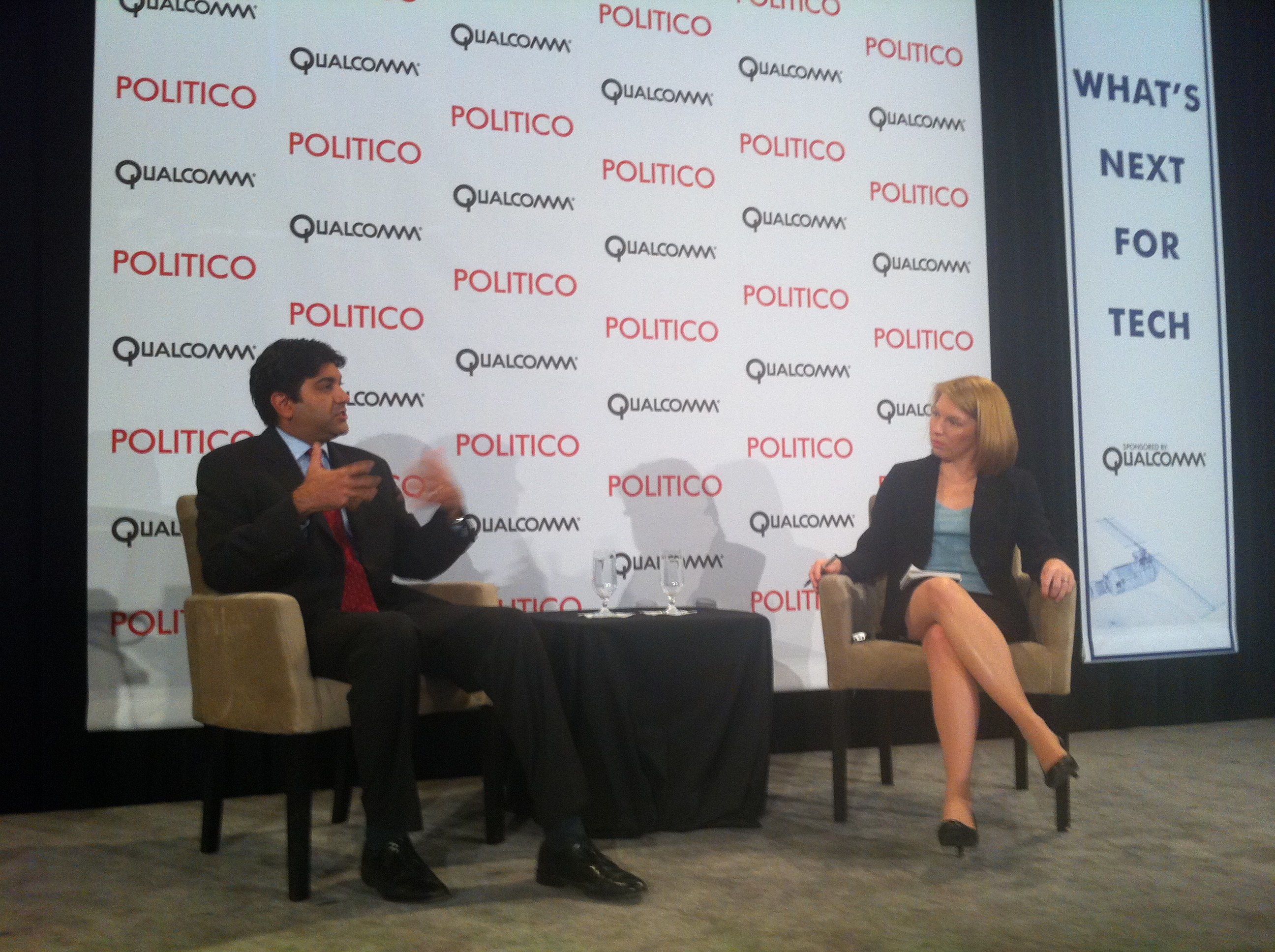
“The single best thing we could do in open government is to get the American people engaged in the question of what high value data is,” said Aneesh Chopra, the first United States chief technology officer, speaking at this morning’s Politico “What’s Next in Tech” forum in Union Station. Video is below:
In an interview with Politico’s technology editor, Kim Hart, Chopra looked back at the lessons learned from his first two years on the job and ahead, appropriately, to what to expect in tech policy from the Obama administration. They covered a lot of ground, from open government successes to what’s next in Congress (hint: watch the push to open up spectrum for first responders) to supporting entrepreneurial growth.
Lessons learned
What were Chopra’s lessons learned? He offered up three examples.
First, with support from the President, Chopra said that they’ve been able to open up discussion and build trusted relationships across the federal government, which has been “critical” to improving the way technology could be used and the long term policy posture.
Second, with that support, he’s been surprised on seeing the pace of response become fast. There’s a “lesson on balance of getting long term balance, versus getting results in 90 days,” he said, referring to the turnaround on projects like HealthCare.gov.
Third, Chopra emphasized the role of “government as a convener,” where the administration can use its influence to bring people together to accomplish goals with technology without new regulations or legislation.
Working tech policy levers
What are the levers that the first US CTO has worked to try to galvanize action on the administration’s priorities?
First, a commitment to openness. From Manor, Texas, to inner cities, “people have found ways to tap into info in ways that helps them do something different,” said Chopra, speaking to the phenomenon of Gov 2.0 going local. “85 to 90% of that activity is happening in places we wouldn’t have imagined,” not gathering in Washington.
Second, Chopra cited the White House’s work towards “voluntary, consensus-driven standards,” noting that he was ” very proud of the work on NHIN Direct.”
Finally, Chopra noted that there’s some $150 billion spent on research and development every year, which offers a number of ways to push forward with innovation in priorities like healthcare IT, energy, smart grid or communications.
Making meaningful use modular
Given the new Congress coming in to Washington, Chopra’s description on the bipartisan agreement on tech policy from his time in Virginia under Republican leadership has to be more than a little strategic. He talked about “getting to the right answer,” referring back to an former manager, David Bradley, and his management strategy of “True North.”
That approach will be rested in the next Congress, on rulemaking. and in moving forward with the tech policy decisions. Outside of the healthcare bill that President Obama signed into law, which continues to meet with significant opposition in Congress, Chopra noted that “healthcare is signature part of President’s agenda,” specifically advanced by more than 20 billion dollars in Recovery Act spending on healthcare IT.
Chopra looked back at two decisions related to approaching technology policy a bit differently. “Rather than walking into Best Buy and buying software, we created more flexible standards for meaningful use,” he said. As a result, “entrepreneurs that never thought of themselves as EMR companies are entering the market.”
The decision to make meaningful use more modular was also significant, asserted Chopra. “We opened up the regulatory regime so you could certify each and every regulatory module.”
In aggregate, Chopra associated that R&D investment, work to convene conversations, open up data and create more flexible regulatory regimes with a better outcomes: venture capital investment in HIT going up by 39%, citing a statistic from the National Venture Capital Association.
How did Chopra respond? He asked for more criticism, responding that you “must listen to people who are frustrated” and consider that much of the tech platform is in the space “where the plane is yet to land.” If you go through campaign promises, and look at executive ability to move the needle on different areas, Chopra asserted that the
biggest part of that – open government – has gone ahead. “It’s not ‘mom and apple pie perfect’,” he said, but they’re proud of delivering on 90 day deliverables like standards, or websites.
Part of the challenge of delivering on campaign promises is that budgetary or legislative action requires different stakeholders, observed Chopra, a reality that will become even more sharply defined in the next Congress. “The Recovery Act is a unique moment in time,” which, as he argued is “overwhelmingly the vehicle for campaign promises” in health IT and clean tech.
What’s next in United States technology policy?
First, it’s clear that Chopra and the Obama administration is thinking about online privacy, with the recently announced Internet privacy committee. There are open questions about how much portfolio, budget, subpoena power or other authority any new position would hold, but it’s an area to watch. Chopra said that he had met with Representative Bob Goodlatte (R-VA) and had found him supportive of privacy policy.
Chopra also met with Representative Darrell Issa (R-CA), who is very supportive of increased government transparency through technology. Issa, a successful technology entrepreneur, is one of the most knowledgeable members of Congress when it comes to technology. Whatever comes out of his his legislative staff, or the new House Oversight committee, which he will chair, could represent a step forward for open government after the 2010 election.
Chopra also emphasized “modest but significant actions” that could improve the conditions for tech entrepreneurs in the United Stats, from open government data to regulatory action to smart grid or support for new learning technologies. On that count, Chopra offered up a “scoop” to Kim Hart, observing that the next area where he will focus on driving innovation will be into learning technologies, with more news coming at a Brookings Institute event in December.
The top opportunities that Chopra sees for entrepreneurs are in healthcare and energy, the former of which is already becoming hot with more healthcare apps provisioned with open healthcare data
“One policy lever is the role of public-private partnerships,” observed Chopra, highlighting the growth in STEM education, with over half a billion dollars in investment. “It’s not the money, it’s the platforms,” he said.
Chopra fielded a question Congressman Wu (D-OR), the current chairman of the House technology and innovation committee. After a discursion into what went wrong for the Democratic Party in the midterm, Wu asked what the next priority will be for Congress and Chopra to work together upon. His answer was simple: spectrum policy, emphasizing voluntary processes for formulating solution. The priority, he said, was to get a broadband network for public safety that’s interoperable for first responders.
Finally, Chopra talked about the story of the Alfred brothers, who founded Brightscope in California in 2008. The story of Brightscope is important: data driving the innovation economy. They knew about key data on 401(k) plan fees at the Department of Labor, worked hard to liberate it and now have a successful, growing startup as a result.
Is sunlight the best disinfectant, as Supreme Court Justice Brandeis famously said?
This week in Washington, D.C., hundreds of experts have come together at the International Open Government Data Conference (IOGDC) to explore how data can also help citizens to make better decisions and underpin new economic growth. The IOGDC agenda is online, along with the presenters.
“Since the United Kingdom and United States movement started, lots of other countries have followed,” said Tim Berners-Lee, the inventor of the World Wide Web. Canada, New Zealand, Australia, France and Finland are all working on open data initiatives.
As he noted with a smile, the “beautiful race” between the U.S. and U.K. on the Data.gov and Data.gov.uk websites was healthy for both countries, as open data practitioners were able to learn from one another and share ideas. That race was corked off when former British Prime Minister Gordon Brown asked Tim Berners-Lee how the United Kingdom could make the best use of the Internet. When Berners-Lee responded to “put government data on the Web,” Brown assented, and Data.gov.uk was born.
Berners-Lee explored the principles of open linked data that underpin data.gov.uk and open government. Specifically, he emphasized his support for open standards and formats over proprietary versions of either, inviting everyone present to join the W3C open government data working group.
1 Stars for putting data on the Web at all, with an open license. PDFs get 1 star.
2 Stars if it’s machine-readable. Excel qualifies, though Berners-Lee prefers XML or CSVs.
3 Stars for machine-readable, non-proprietary formats
4 Stars if the data is converted into open linked data standards like RDF or SPARQL
5 Stars when people have gone through the trouble of linking it
“The more transparency there is, there more likely there is to be external investment,” said Berners-Lee, highlighting the potential for open government data to make countries more attractive to the global electronic herd.
Will open data spread to more cities, states and countries, as HTML did in the 1990s? If the open standards and technologies that Berners-Lee advocates for are adopted, perhaps. “The Web spread quickly because it was distributed,” said Berners-Lee. “The fact that people could put up Web servers themselves without asking meant it spread more quickly without a centralized mandate.”
Putting open government data to work
Following Berners-Lee, federal CIO Vivek Kundra highlighted how far the open government data movement has come in the short time since President issued his open government memorandum in January 2009.
Kundra remarked that he’s “seeing more and more companies come online” in the 7 countries have embarked on an open government movement that involves democratizing data. He also reeled off a list of statistics to highlight the growth of the Data.gov platfrom.
Within the boundaries of the United States, Kundra observed that 16 states and 9 cities have stood up open data platforms
256 applications have now been developed on top of the Data.gov platform
There are now 305,692 data sets available on Data.gov
Since Data.gov was launched in 2009, it has received 139 million hits.
The rapid growth of open government data initiatives globally suggests that there’s still more to come. “When I look at Data.gov platform and where we are as a global community, we’re still in the very early days of what’s possible,” said Kundra.
He emphasized that releasing open data is not just a means of holding government accountable, focusing three lenses on its release:
Accountability, both inside of government and to citizens
Utility to citizens, where, as Kundra said, “data is used in the lives of everyday people to improve the decisions they makes or services they receive on a daily basis
Economic opportunities created as a results of open data.
“The simple act of opening up data has had a profound impact on the lives of ordinary people,” said Kundra, who pointed to the impact of the Veterans Administration’s Blue Button. Over 100,000 veterans have now downloaded their personal health records, which tundra said has stimulated innovation in blue button readers to connect systems from Google or Microsoft.
“I predict that we’ll have an industry around data curation and lightweight applications,” said Kundra. “The intersection of multiple data sets are where true value lies.” The question he posed to the audience is to consider how the government will move to towards an API-centric architecture that allows services to access data sets on a real-time basis.
When asked about that API strategy and the opportunity costs of pursuing it by open government advocate Harlan Yu, Kundra said that he follows an “80/20” rule when it comes to the government building apps vs third parties. “Do we want to be a grocery store or a restaurant when it comes to the Data.gov platform and movement?” he asked.
As a means of answering that question, Jeanne Holm, the former chief knowledge architect at the NASA Jet Propulsion and current Data.gov evangelist, announced a new open government open data community at Data.gov that will host conversations about the future of the platform.
A United States-United Kingdom partnership on open government, which will include an open government data camp later this week
The release of a concept of operations for Data.gov, embedded below, which includes strategic goals for the site, an operation overview and a site architecture.
What do the two technology leaders see as a vision for success for open government data?
For Berners-Lee, it was to be able to directly access data from a dashboard on laptop, rather than indexes and catalogs on Data.gov and data.gov.uk. He talked about accessing open government data that wasn’t just machine-readable or linked to other sets but directly accessed from his local machine, called through powerful Python scribts.
In contrast, Kundra talked about being able to go to a store like Brookstone and “in the same way you can buy alarm clocks with data in the weather channel,” how data from federal agencies had been employed to provision objects from everyday life.
To be fair, there’s a long way to go yet before that vision becomes reality. As Andrew Odewahn pointed out at Radar, earthquakes are HUGE on Data.gov, consistently bringing in the most downloads, even ahead of those product recall data sets. While provisioning recurring visualization in the Popular Mechanics iPad App might be useful to the publisher, it’s also a reminder that the full vision for delivering utility to citizens through open data that Kundra hopes for hasn’t come to fruition as a result of Data.gov – yet.


 E Pluribus Unum
