White House moves to bash patent trolls, though Congress still must enact trollbane

This morning, President Obama moved to curb suits from “patent trolls,” entities that many observers of the technology industry have been warning have increasingly been harming innovation across the United States. As it turned out, those concerned parties have been right to decry the trend: a report (PDF) contained a startling statistic: the number of lawsuits brought by patent trolls has nearly tripled in the past 2 years, now accounting for 62% of all patent lawsuits in America. As Edward Wyatt pointed out in the New York Times, this surge in patent lawsuits is directly related to the passage of a 2011 law that was designed to address the trouble.

The White House announced several executive actions today to take on patent trolls, including a series of workshops, scholarship opportunities, a consumer-facing website and a review of exclusion orders. The administration will also begin a rulemaking process at the U.S. Patent Office to that would “require patent applicants and owners to regularly update ownership information when they are involved in proceedings before the PTO, specifically designating the ‘ultimate parent entity’ in control of the patent or application.”

One interesting additional outcome of the day’s news is that White House Google+ Hangouts matter. Entrepreneur Limor Fried’s unexpected question to President Obama on patent trolls during a White House Hangout in February 2013 led to a frank answer and contributed to the White House’s action today, a connected directly made by the @WhiteHouse Twitter account. Here’s what the president said, back in February:

A couple of years ago we began the process of patent reform. We actually passed some legislation that made progress on some of these issues, but it hasn’t captured all the problems. And the folks that you’re talking about are a classic example. They don’t actually produce anything themselves, they’re just trying to essentially leverage and hijack somebody else’s idea and see if they can extort some money out of them. And, you know, sometimes these things are challenging, because we also want to make sure that the patents are long enough that, you know, people’s intellectual property is protected. We’ve got to balance that with making sure that they’re not so long that innovation is reduced. And, but I do think that our efforts at patent reform only went about halfway to where we need to go. And what we need to do is pull together, you know, additional stakeholders, and see if we can build some additional consensus on some smarter patent laws. This is true, by the way, across the board when it comes to high tech issues. The technology’s changing so fast. We want to protect privacy, we want to protect people’s civil liberties, we want to make sure the Internet stays open. And I’m an ardent believer that what’s powerful about the Internet is its openness and the capacity for people to get out there and just introduce a new idea with low barriers to entry.

I hope President Obama does more Google+ Hangouts and is asked more tough questions regarding drones, patents and other issues on the minds of the People, far outside of the DC media bubble.

Hangouts aside, as Greg Ferenstein pointed out at TechCrunch, the administration is going to need Congress to effectively curb these abuses: the president can’t simply declare an end to this mess: Congress must be involved.

Five relevant bills have been introduced recently, as Michelle Quinn noted out at Politico and Joe Mullen emphasized at Ars Technica, and while the legislative reforms suggested by the White House could make a real difference in curbing the worst of patent troll abuses, it’s not at all clear what this Congress is capable of passing through both chambers at this point.

Timothy Lee, newly ensconced at Wonkblog at the Washington Post, isn’t convinced that such legislation, even if passed, will effectively smash patent trolls. Lee would like to see the federal government fix a broken patent system. Unfortunately for that aspiration, Washington recently passed an America Invents Act and is now moving forward on implementation. It’s not at all clear how soon substantial reform will end up on a president’s desk again soon.

[Animated GIF credit: White House Tumblr. Oh yes, there will be GIFs. ]

Proposed fracking rule from Interior Department needs more liquid data

A proposed rule on hydraulic fracking from the United States Department of the Interior Bureau of Land Management is now online. As of May 24, the comment period has begun, although the American Petroleum Institue is pressuring Interior to slow down the fracking rule.

You can read the proposed rule and comment at Regulations.gov, which was relaunched last year with an eye on public participation in rulemaking.

While the closely watched regulation has drawn qualified praise from the oil and gas industry, it includes a notable flaw with respect to how technology is used to oversee fracking. The Center for Effective Government is arguing that the BLM fracking rule violates the recent White House executive order on open data:

…instead of establishing a modern example of government information collection and sharing, BLM’s proposed rule would allow drilling companies to report the chemicals used in fracking to a third-party, industry-funded website, called FracFocus.org, which does not provide data in machine-readable formats. FracFocus.org only allows users to download PDF files of reports on fracked wells. Because PDF files are not machine-readable, the site makes it very difficult for the public to use and analyze data on wells and chemicals that the government requires companies to collect and make available.

Although FracFocus.org has recently improved some of its search features, the oil and gas industry opposes making chemical data easier to download or evaluate for fear that the public “might misinterpret it or use it for political purposes.” (subscription required) Citizens need to have adequate, accurate information about the chemicals they may be exposed to in order to evaluate the potential risks and rewards of allowing fracking in their communities.

“It is particularly disappointing that the first new information proposal since the open data executive order completely ignores the new requirements,” said Sean Moulton, Director of Open Government Policy at the Center for Effective Government. “This proposal doesn’t just fail to comply with the new open data policy, it represents a step in the wrong direction since it abdicates control of and access to the data to an industry website.”

Data formats aside, every person in a state where fracking is taking place should care about how it will be regulated, including the way information regarding which chemicals are used in the process.

This is an opportunity to play the role of an informed, engaged citizen that goes beyond a periodic visit to the ballot box every two years.

If you don’t and dislike the outcome, you may be left asking “why wasn’t I consulted?

If you feel strongly, one way or the other, about fracking or federal oversight of industry, should it be approved and come to your state, there is literally no time better than than now to weigh in.

UPDATE: Kyle Smith, writing for the Sunlight Foundation, reports that the fracking debate has been extended until the end of the summer:

Under pressure from the oil industry, Interior Department Secretary Sally Jewell has extended the comment period on a controversial final “fracking” regulation by 60 days, promising two more months of maneuvering over a rule that, in its earlier incarnations, drew more than 177,000 public comments. The bulk of those appeared to be the product of letter-writing campaigns by environmental groups, according to analysis of comments on Sunlight’s Docket Wrench and conversations with agency officials.

Who are the open data entrepreneurs?

reagan-quoteDay by day, we are gaining better maps and tools to navigate the complexities of world around us. The ways that open data is finding its way into the hands of citizens and consumers were described today in a new report from a federal interagency task force on “smart disclosure.”

Smart disclosure, for those unfamiliar, is a term of art for when a private company or government agency provides you with access to your own data in a format that enables you to put the data to use.

When distributed this way, personal data ownership improves market transparency, empowers consumers and drives the nascent open data economy.

According to federal officials, this report from the National Science and Technology Council is the “first comprehensive description of the Federal Government’s efforts to promote the smart disclosure of information that can help consumers make wise decisions in the marketplace.” If you’re interested in the topic, it’s one of the most clearly written government documents I’ve come across lately: give it a read.

As Alex Fitzpatrick pointed out in his post on the ways companies are using government data, however, the report didn’t include the names of specific companies.

Given my research on the open data economy, I think I can fill in a few more of them, looking across sectors. (The administration itself identified Billguard, OPower and iTriage in February, in a post on open government data and jobs.)

In education, check out startups like Better Lesson and SoFi.

In energy, look at WattzOn, PlotWatt, SimpleEnergy and FirstFuel, in addition to OPower.

In consumer finance, evaluate HelloWallet, Brightscope and CalcBench, in addition to Billguard.

In real estate, look to Zillow and Trulia.

In healthcare, consider mHealthCoach, Kyruus or the growing number of health care apps and services on display at next week’s “Health Datapalooza.”

The administration’s top IT officials — chief information officer Steven VanRoekel and chief technology officer Todd Park — say that open data is good for America. If its release supports or leads to the creation of more startups that create products and services that improve people’s lives, that assertion will be born out.

If you recognize other startups from the descriptions in Alex’s post, please drop him a comment or a tweet — and if you use open government data in your startup, nonprofit or enterprise, please let us know in the comments.

Putting personal open data in the hands of consumers targets transparency where it matters

“…a few companies are challenging the norm of corporate data hoarding by actually sharing some information with the customers who generate it — and offering tools to put it to use,” writes Natasha Singer in the New York Times. “It’s a small but provocative trend in the United States, where only a handful of industries, like health care and credit, are required by federal law to provide people with access to their records.”

I’m a little perplexed by this story. It’s like the author goes out of her way to be skeptical of “open data” but then writes a piece that explored how data is being (wait for it) opened up to consumers.

On the one hand, Singer is 100% right: much of the data collected about consumers is not available to them, from shopping to telecom to energy to healthcare, much less data collected in the business of government. For them, an “open data society” is a long way off. On the other hand, I’m perplexed about where this society has been proposed or by whom. There’s a bit of a whiff of straw here.

All that being said, that Singer identified consumer data disclosure as a trend in the New York Times Sunday Business section is notable, given the influence of that perch.

Of course, if you’ve been reading Radar, you knew about smart disclosure and targeted transparency, knew personal data ownership was a trend to watch, and learned more about the acceleration of consumer data releases this February.

If you missed those pieces, I hope they’re useful to you today.

Personal data ownership is an idea that numerous people have been advancing and advocating for years. (I was glad to see Doc Searls cited in the Times). It’s an important principle.

The idea of a “right to data” has also received high-level support (if not legislation and regulation): last year, former Federal Trade Commission chairman Leibowitz said that American citizens should be able to learn see what information is held by them and “have the right to correct inaccurate data,” much as they do with credit reports.

While there’s still a long way to go before a majority of the private sector acknowledges such access as an a privilege, there’s good reason to see a shift that will benefit consumers in the long-run.

Over time, it’s even possible that such open data will benefit society. (Just don’t go overboard on the hoopla about it.)

Will Mayor-Elect Eric Garcetti reboot Los Angeles government for the 21st century?

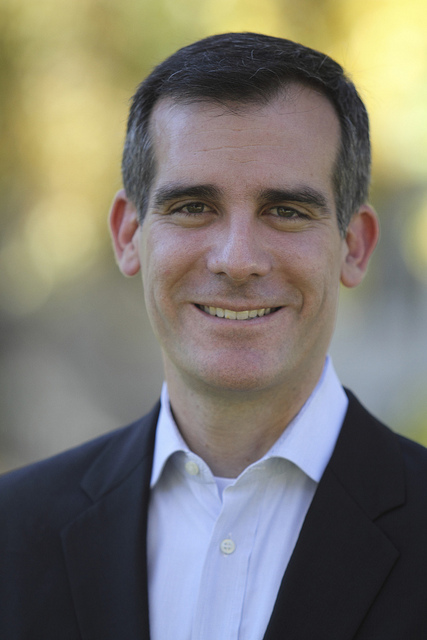
eric-garcettiYesterday, Los Angeles city councilman Eric Garcetti won the Los Angeles mayor’s race.

Garcetti, at 42, is the youngest LA mayor in half a century and will be the city’s first Jewish mayor. LA’s new mayor is also a former Rhodes scholar, a member of the Screen Actor’s Guild, Naval Reservist and supporter of modernizing technology in city government.

Garcetti’s history on that last count had some observers wondering whether Los Angeles’ next mayor would ‘go geek’. He told “Neon Tommy,” a digital publication from the University of Southern California’s Annenberg program, that “he would make data a priority by creating a new position for it and appointing a ‘true’ chief technology officer.”

As a city councilman, Garcetti called for LA city data to be opened up to its people and authored a motion that will go before the council this spring.

“I look forward this fall to seeing the city opening the doors to data sharing, citizen participation, hackathons, and other ways we can build a truly 21st-century government,” said Garcetti at a campaign event prior to his election, according to Neon Tommy.

How fluent is LA’s new mayor on the language of technology and digital governance?

You can judge for yourself in the video embedded below, filmed during July 2012 at the Silicon Beach Fest.

Under this new mayor, will the second-most populous city in the United States take substantive steps to improve civic services and accountability?

While there’s reason to be hopeful, any new initiatives will have to be balanced against the city’s growing budget deficit and calibrated to a highly mobile, multi-lingual population.

As Paresh Dave explored in his feature, other cities are experimenting with open data, mobile applications and citizen engagement to varied effect.

Garcetti’s administration would benefit from taking pages from the technology playbooks of other cities, in particular Boston, Philadelphia, San Francisco, New York and Portland. Angelenos will need him to learn (quickly) from the mistakes of other cities and expand upon their success.

Tying the issues that Garcetti ran on to the goals the new administration will set priorities for legislation, policy and initiatives.

Given the considerable economic and cultural diversity of the City of Angels, his administration will need to support fundamental democratic principles in any new initiatives, from a participation divide to plain language in multiple languages to disparities in broadband Internet. LA will need a better digital divide strategy, perhaps centered upon libraries, schools and community centers, to ensure that more equitable civic participation in open government efforts around policies, regulations or proposed council orders.

His campaign promises on technology reflect some of those priorities and an appreciation of the challenges. Implementation will, as always, be another matter.

Russia withdraws from Open Government Partnership. Too much transparency? [UPDATED]

russia-OGP

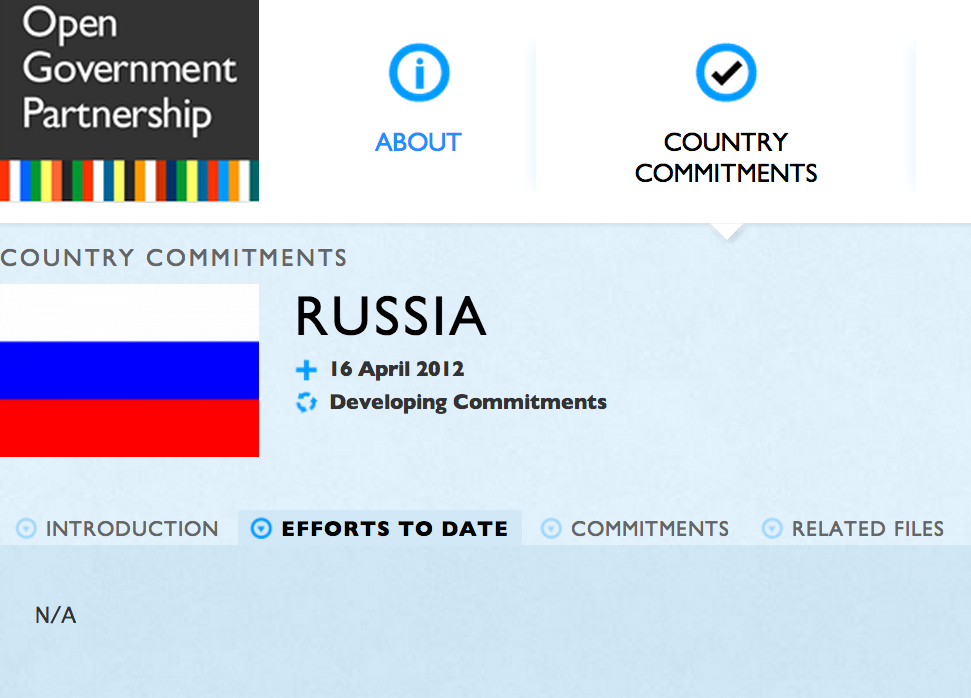
“Inevitably, there will be questions about what we are each prepared to sign up to,” said British Prime Minister David Cameron in January, in his letter to his fellow G8 leaders. For months later, Russia has made clear it clear what it wasn’t willing to sign onto: the Open Government Partnership (OGP). The most recent update on Russia is that the Kremlin will be pursuing “open government” on its own terms. Russia has withdrawn the letter of intent that it submitted on April 2012 in Brazil, at the first annual meeting of the Open Government Partnership.

Update: On May 23, The Moscow Times reported that Russia had just “postponed” its entry into OGP. Presidential spokesman Dmitry Peskov told Russian daily newspaper Kommersant that “we are not talking about winding up plans to join, but corrections in timing and the scale of participation are possible.” Open government advocate  David Eaves interprets this state of affairs to mean A) “transparency matters” and B) that “Russia may still be in OGP. Just not soon. And maybe never.” For now, Russia has withdrawn its letter of intent to join the Open Government Partnership and with that action, its commitments to transparency. OGP itself has  “adjusted” its website to reflect the change, which is to say that the former page for Russia can no longer be found. So what will open government mean in the largest country in the world? Read on.

If the dominant binary of the 21st century is between open and closed, Russia looks more interested in opting towards more controllable, technocratic options that involve discretionary data releases instead of an independent judiciary or freedom of assembly or the press.

One of the challenges of the Open Government Partnership has always been the criteria that a country had to pass to join and then continue to be a member. Russia’s inclusion in OGP instantly raised eyebrows, doubts and fears last April, given rampant corruption in the public sector and Russia’s terrible record on press freedom.

“Russia’s withdrawal from the OGP is an important reminder that open government isn’t easy or politically simple,” said Nathaniel Heller, executive director of Global Integrity. “While we don’t yet fully understand why Russia is leaving OGP, it’s safe to assume that the powers that be in the Kremlin decided that it was untenable to give reformers elsewhere in the Russian government the freedom to advance the open government agenda within the bureaucracy.”

The choices of Russian Prime Minister Dimitri Medvedev, who had publicly supported joining the OGP and made open government a principle of his government, may well have been called into question by Russia’s powerful president, Vladimir Putin.

Medvedev had been signaling a move towards adopting more comfortable sorts of “openness” for some time, leading up to and following Russia joining the Open Government Partnership in December 2012. Russia’s prime minister has sought to position himself as a reformer on the world stage, making a pitch at Davis for Russia being “open for business” earlier this year at the Davos economic forum. Adopting substantive open government reforms could well make a difference with respect to foreign investors concerns about corruption and governance.

While the Kremlin shows few signs of loosening its iron grip on national security and defense secrets, Russia faces the same need to modernize to meet the increasing demand of its citizens for online services as every developed nation.

Even if Russia may not be continue its membership in the Open Government Partnership, the Russian government’s version of “openness” may endure, at least with respect to federal, city and state IT systems. Over the winter, a version of “Open Government a la Russe” – in Cyrillic, большоеправительство or “big government” — seemed to accelerating at the national level and catching on in its capital. Maybe that will still happen, and Russion national action plan will go forward.

“While Russia’s approach to open government may be primarily technocratic, there’s a sense in which even the strongest legal requirements are only tools we give to our allies in governments,” said John Wonderlich, policy director at the Sunight Foundation. “FOI officers analyzing records, or judges deciding whether or not to enforce laws are embodying both legal and cultural realities when they determine how open a country will be, just as much as policy makers who determine which policies to pass. While Russia’s initial commitment to OGP was likely a surprising boon for internal champions for reform, its withdrawal will also serve as a demonstration of the difficulty of making a political commitment to openness there.”

What is more clear, however, is that the Kremlin seems much more interested the sort of “open government” that creates economic value, as opposed to sustaining independent auditors, press or civil society that’s required in functional democracies. Plutocracy and kleptrocacy doesn’t typically co-exist well open, democratic governments — or vice versa.

Given that the United States efforts on open government prominently feature the pursuit of similar value in releasing government data, Russia’s focus isn’t novel. In fact, “open data” is part of more than half of the plans of the participating countries in OGP, along with e-government reforms. In May of 2012, a presidential declaration directed governmental bodies to open up government data.

In February, Moscow launched an open data platform, at data.mos.ru, that supplied material for digital atlas of the city. Russia established an “open data council” the same month. Those steps forward could stand to benefit Russian citizens and bring some tangential benefits to transparency and accountability, if Russia and its cities can stomach the release of embarrassing data about spending, budgets or performance.

While some accounts of open government in Russia highlighted the potential of Russia to tap into new opportunities for innovation afforded by connected citizenry that exist around the world, crackdowns on civil society and transparency organizations have sorely tested the Russian government’s credibility on the issue. This trial of anti-corruption blogger Alexey Navalny for corruption this spring showed how far Russia has to go.

“Open government isn’t just open data nor is it e-government, two areas in which the Russian Federal had appeared to be willing to engage on the open government agenda,” said Heller. “Many observers doubted how far Russia could take open government in a climate of political repression, civil society crackdowns, and judicial abuse of power.”

Today’s news looks like a victory of conservatives in the Kremlin over government reformers interested in reducing corruption and adopting modern public sector management techniques. “We need to use modern technologies, crowd sourcing,” said Medvedev said in January 2013. “Those technologies change the status and enhance the legitimacy of decisions made in government.”

Changes in technology will undoubtedly influence Russia, as they will every country, albeit within the cultural and economic context of each. This withdrawal from OGP, however, may be a missed opportunity for civil society, at least with respect to losing a lever for reform, reduced corruption and institutions accountable to the people. Leaving the partnership suggests that Russia may be a bit scared of real transparency, or least the sort where the national government willing allows itself to be criticized by civil society and foreign non-governmental organizations.

It’s something of a mixed victory for the Open Government Partnership, too: getting to be a member and stay one means something, after all.

“For the Open Government Partnership, this will be seen as a bit of a blow to their progress, but its success was never predicated on getting every qualifying government to join,” said Wonderlich. “In a sense, Russia’s withdrawal may alleviate the need for OGP to grapple with Russia’s recent, severe treatment of NGOs there. More broadly, Russia’s withdrawal may better define the space in which the OGP mechanism can function well. Building a movement around commitments from heads of state has allowed OGP’s ranks to rapidly grow, but we’re also probably entering a new time for OGP, where the depth and reliability of those commitments will become clearer. Transitions between governments, domestic politics, corruption scandals, hypocritical behavior, uncooperative legislatures, exclusion of domestic NGOs, and internal power struggles may all threaten individual national commitments, and OGP will need to determine how to adapt to each of these challenges. OGP will need to determine whether it wants to be the arbiter of appropriate behavior on each of these dimensions, or whether its role is better left to the commitments and National Action Plans on which it was founded. ”

If OGP is to endure and have a meaningful impact on the world, its imprimatur has to have integrity and some weight of moral justice, based upon internationally shared norms on human rights and civil liberties. As press freedom goes, so to does open government and democracy.

“International boosters of open government may want to remain cautious at embracing open government reformers at the first whiff of ‘openness’ or rhetorical commitment to the agenda,” said Heller. “Within weeks of Russia first making noise around joining OGP, the World Bank and others rushed to assemble a major international conference in the country around open government to boost reformers inside the bureaucracy as they sought to move the country into OGP. While no one should criticize those efforts, they are a sobering reminder that initial rhetorical commitment to open government can only take us so far, and it’s wise to keep the political powder dry for other downstream fights.”

Given the scale of bribery and the impact of corruption on growth, Russians can only hope that more “openness” with teeth comes to their country soon.

As press freedom goes, so too does open government and democracy

I’m on the brink of having a Howard Beale moment.

This morning, Al Thompkins wrote that the Justice Department ‘better have a damned good explanation’ for seizing AP phone records. The nation is still waiting. So is the world.

This week, my Poynter colleagues and I are teaching on three continents. One of my colleagues is teaching in China. Another is in South Africa. I’m in Canada. Everywhere we go, we hear stories of governments trying to restrict journalists. South Africa has a new government secrecy bill; Turkey is trying to restrict reporting from border-town bombing sites; Pakistan ejected an American journalist trying to cover elections; and a Chinese journalist is in jail accused of publishing video that caused “a bad impression abroad.”

Recently, Reporters Without Borders ranked the U.S. 32nd on its list of countries in terms of press freedom. When I saw that the U.S. was ranked below Ghana and barely above El Salvador, I wondered if there must be some mistake. But now I wonder if that survey ranked our press freedom too high.

Thompkins is right. We need to know why notifying the Associated Press in advance of getting the records from Verizon “would pose a substantial threat to the integrity of the investigation.”

Deputy United States Attorney General James Cole stated that such an intrusion was warranted and were “consistent with department policy.” Walter Pincus agrees.

US Attorney General Eric Holder, who recused himself from the investigation, said that “this was a very serious leak — a very, very serious leak,” “among the top two or three serious leaks that I’ve ever seen,” putting the American people “at risk” and that “trying to determine who was responsible for that required very aggressive action.”

Should that action have included a judge?

In the absence of a federal shield law for journalists, judicial oversight is a bulwark against tyranny.

As New Yorker general counsel Lynn Oberlander on the law behind the Justice Department seizure of AP phone records, the courts do not appear to have been involved:

If subpoenas had been served directly on the A.P. or its individual reporters, they would have had an opportunity to go to court to file a motion to quash the subpoenas. What would have happened in court is anybody’s guess—there is no federal shield law that would protect reporters from having to testify before a criminal grand jury—but the Justice Department avoided the issue altogether by not notifying the A.P. that it even wanted this information. Even beyond the outrageous and overreaching action against the journalists, this is a blatant attempt to avoid the oversight function of the courts.

The nation is seeing that the balance between government secrecy, civil liberties and freedom of the press has become far too weighted in favor of the federal government. Attorney General Holder defended the independence of the leak investigation last year before Congress.

If President Obama wants to retain credibility on the world stage or at home when he talks about open government and the rule of law, his administration will need to take a strong stance, as it did with respect to management flaws at the I.R.S. that allowed conservative groups to be targeted for tax audits.  As Nathaniel Heller pointed out this week, there’s some cognitive dissonance going on:

This administration’s track record on what can be argued are the easier bits of open government is more than laudable. An initial Open Government Directivehas been augmented with the new open data policy, and we’ve witnessed the launch of an international Open Government Partnership, which began as a White House brainchild. But during that very same period we’ve witnessed the administration getting worse on the politically harder bits: freedom of information response times have deteriorated, reporters are being chased down to divulge their sources, and now entire newsrooms are apparently being targeted in broad, scarily police state-style monitoring. What the heck is going on here?

There’s a lot at stake here, to dramatically understate the obvious.

As New York Times public editor Margaret Sullivan wrote today, “The ability of the press to report freely on its government is a cornerstone of American democracy. That ability is, by any reasonable assessment, under siege. Reporters get their information from sources. They need to be able to protect those sources and sometimes offer them confidentiality. If they can’t be sure about that – and it looks increasingly like they can’t – the sources will dry up. And so will the information.”

The White House, Congress, Department of Justice and the American people cannot afford to let that happen. Information is the life blood of democracy. A free press is core to its gathering and dissemination, as are whistleblowers who tell the nation when crimes and fraud are being committed behind closed doors. Prosecuting whistleblowers is antithetical to open government.

Our founding fathers understood this dynamic well:

“The functionaries of every government have propensities to command at will the liberty and property of their constituents,” wrote Thomas Jefferson. “There is no safe deposit for these but with the people themselves, nor can they be safe with them without information. Where the press is free, and every man able to read, all is safe.”

We need to know more about why this action was taken by the Department of Justice. We also need to know why there is a disconnect between the rhetoric expressed by the President of the United States, a constitutional law professor, regarding freedom of the press and the zealous actions of the Department of Justice towards leaks.

Josh Gerstein reports that the issue may lie with the White House’s “hands off style” with respect to the DoJ:

”This White House, out of concern to distance itself from what was seen as excess politicization of DOJ by the Bush administration, had not engaged DOJ at all on leak cases,” said Columbia University law professor David Pozen, who spent several months conducting a major review of the federal government’s love-hate relationship with national security leaks. ”

In previous White Houses, even those railed publicly against leaks, officials sent “cautionary signals to the Justice Department … urging restraint and sensitivity to political, policy and constitutional concerns,” Pozen said. But the administration’s distancing policy, said Pozen, meant that prosecutors were “being given more leash than they had previously to do what they do.”

If so, it’s long past time for President Obama to get more hands-on.

UPDATE: Both the president and his attorney general have acknowledged the criticism. In his remarks to the National Defense University on May 23rd, President Obama said that he was “I’m troubled by the possibility that leak investigations may chill the investigative journalism that holds government accountable” and told AG Holder to take action on the issue.

The Justice Department’s investigation of national security leaks offers a recent example of the challenges involved in striking the right balance between our security and our open society.  As Commander-in-Chief, I believe we must keep information secret that protects our operations and our people in the field.  To do so, we must enforce consequences for those who break the law and breach their commitment to protect classified information.  But a free press is also essential for our democracy.  That’s who we are.  And I’m troubled by the possibility that leak investigations may chill the investigative journalism that holds government accountable.

Journalists should not be at legal risk for doing their jobs.  Our focus must be on those who break the law.  And that’s why I’ve called on Congress to pass a media shield law to guard against government overreach.  And I’ve raised these issues with the Attorney General, who shares my concerns.  So he has agreed to review existing Department of Justice guidelines governing investigations that involve reporters, and he’ll convene a group of media organizations to hear their concerns as part of that review.  And I’ve directed the Attorney General to report back to me by July 12th.

According to David Klaidman’s reporting, AG Holder regrets at least some of how the DoJ has proceeded, with respect to prosecuting leaks. (He personally approved a search-warrant application that equated the newsgathering activities of Fox News reporter James Rosen with criminal conduct.)

“While both of these cases were handled within the law and according to Justice Department guidelines,” he told The Daily Beast, “they are reminders of the unique role the news media plays in our democratic system, and signal that both our laws and guidelines need to be updated…This is an opportunity for the department to consider how we strike the right balance between the interests of law enforcement and freedom of the press.”

This morning, a Justice Department official told Mike Allen that the AG will be meeting with members of the media this week:

“Attorney General Eric Holder will hold meetings with several Washington bureau chiefs of national news organizations in the next two days as part of the review of existing Justice Department guidelines governing investigations that involve reporters. This review, which was announced by President Obama last Thursday, is consistent with the Attorney General’s long standing belief that protecting and defending the First Amendment is essential to our democracy. These meetings will begin a series of discussions that will continue to take place over the coming weeks. During these sessions, the Attorney General will engage with a diverse and representative group of news media organizations, including print, wires, radio, television, online media and news and trade associations. Further discussions will include news media executives and general counsels as well as government experts in intelligence and investigative agencies.”

Per Michael Calderone, however, “the actual discussion is expected to be off the record.”

UPDATE 2: The Department of Justice released a report on news media policies (PDF) on July 12th.

“The Department of Justice is firmly committed to ensuring our nation’s security, and protecting the American people, while at the same time safeguarding the freedom of the press,” said United States Attorney General Eric Holder, in a prepared statement. “These revised guidelines will help ensure the proper balance is struck when pursuing investigations into unauthorized disclosures. While these reforms will make a meaningful difference, there are additional protections that only Congress can provide. For that reason, we continue to support the passage of media shield legislation. I look forward to working with leaders from both parties to achieve this goal, and am grateful to all of the journalists, free speech advocates, experts, and Administration leaders who have come together in recent weeks – in good faith, and with mutual respect – to guide and inform the changes we announce today.”

Excerpt from report (emphases are mine):

First, the Department will modify its policy concerning search warrants covered by the PPA involving members of the news media to provide that work product materials and other documents may be sought under the “suspect exception” of the PPA only when the member of the news media is the focus of a criminal investigation for conduct not connected to ordinary newsgathering activities. Under this revised policy, the Department would not seek search warrants under the PPA’s suspect exception if the sole purpose is the investigation of a person other than the member of the news media.

Second, the Department would revise current policy to elevate the current approval requirements and require the approval of the Attorney General for all search warrants and court orders issued pursuant to 18 U.S.C. directed at members of the news media. In addition, as part of the new approval process the Attorney General would consider the factors in 28 CFR. 50.10 — which currently apply to subpoenas to members of the news media or to communication service providers for the telephone toll records of members of the news media, but not to search warrants or 2703(d) orders — including demonstrating that the information sought is essential to a successful investigation, that other reasonable alternative investigative steps to obtain the information have been exhausted, and that the request has been narrowly tailored to obtain only the information necessary for the investigation (including the use of search methods that limit any intrusion into potentially protected materials, as described above). The presumption of notice, and standards applicable to requests for delayed notice, will also apply to search warrants and 2703(d) orders that seek access to records of members of the news media related to newsgathering activities. A thorough evaluation of relevant considerations, including these factors, will be presented to the Deputy Attorney General, and ultimately the Attorney General, for authorization. This policy change will bring the approval protocols for search warrants issued under the PPA and 27D3(d) orders in line with those required for other investigative tools that implicate records of members of the news media.
 

The complete report and set of revised policies are online on Document Cloud, via New York Times reporter Charlie Savage, or at Justice.gov. For more analysis, read his report for the New York Times regarding AG Holder tightening the rules for obtaining reporters’ data. Now, the onus to protect freedom of the press in the United States is now upon Congress, including recognizing the public interest of preserving acts of journalism through enactment of a federal shield law. How Congress or the DoJ defines journalists will have real consequences, in terms of how their electronic communications are acquired or monitored. Marcy Wheeler reads this policy as the DoJ moving closer to instituting a physical press. Journalism professor Dan Gillmor reads that to mean that licensing journalists will be proposed in the United States.

Historical parallels aside…

…the question of “who is a journalist?” is of vital public interest, as Jeff Jarvis explored in The Guardian today. A 2010 report from the Center for International Media Assistance (CIMA) concluded that licensing journalists threatens independent media and press freedoms. The First Amendment Center similarly argues that licensing journalists is a bad idea. Congress and the Department of Justice would be well advised to steer clear of registering the media, which has historically been used around the world by governments to delegitimize reporting and speech officials do not wish published, from reporting on corruption to waste, fraud or embarrassing actions.

At a time when technology has democratized reporting in unprecedented ways, enabling individuals to commits acts of journalism around the world, perhaps it’s time to acknowledge that freedom of the press now applies to everyone.

UPDATE:

UPDATE: On January 14, 2015, U.S. Attorney General Holder issued a memorandum (PDF) laying out new guidelines for how the Department of Justice will obtain information or records from the media.

“These revised guidelines strike an appropriate balance between law enforcement’s need to protect the American people, and the news media’s role in ensuring the free flow of information,” Holder said, in a statement. “This updated policy is in part the result of the good-faith dialogue the department has engaged in with news industry representatives over the last several months. These discussions have been very constructive and I am grateful to the members of the media who have worked with us throughout this process.”

These guidelines broaden protections for the media, as Josh Gerstein reported for Politico, with caveats:

…the revised guidelines make clear that Justice Department personnel must get high-level approval—usually from the attorney general personally—before going to court to enforce subpoenas other federal agencies sometimes issue to reporters or their phone or internet providers. Such disputes have arisen or loomed with various agencies, including the Department of Homeland Security, whose officials subpoenaed travel bloggers in 2009 and took part in the search of a Washington Times writer’s home in 2013.

Details of the new policy made public late Wednesday showed it also satisifed a particular request media advocates had made: that department lawyers be required to get a second round of high-level approvals before moving to enforce a subpoena that was authorized at some earlier time. DOJ attorneys will have to check in with the Criminal Division in Washington before making such a move, the revised guidelines say.

The revised rules continue to give prosecutors more leeway in pursuing journalists whom the U.S. Government believes are part of a foreign country’s intelligence services or tied to some other foreign power.

Fung outlines principles for democratic transparency and open government

Archon Fung has published a new paper” [PDF] on open government, information and democracy. The abstract includes a useful breakdown of the components of democratic transparency:

In Infotopia, citizens enjoy a wide range of information about the organizations
upon which they rely for the satisfaction of their vital interests. The provision of
that information is governed by principles of democratic transparency. Democratic
transparency both extends and critiques current enthusiasms about transparency. It
urges us to conceptualize information politically, as a resource to turn the behavior of
large organizations in socially beneficial ways. Transparency efforts have targets, and we
should think of those targets as large organizations: public and civic, but especially private
and corporate. Democratic transparency consists of four principles. First, information
about the operations and actions of large organizations that affect citizens’ interests
should be rich, deep, and readily available to the public. Second, the amount of available
information should be proportionate to the extent to which those organizations
jeopardize citizens’ interests. Third, information should be organized and provided in
ways that are accessible to individuals and groups that use that information. Finally, the
social, political, and economic structures of society should be organized in ways that
allow individuals and groups to take action based on Infotopia’s public disclosures.

Fung’s paper focuses on focus upon “information about the activities of
large organizations—especially corporations and governments—rather than individuals” and “the important, defensive, face of the informational problem: information that people need to protect themselves against the actions of large organizations and to navigate the terrain created by such organizations,” as opposed to the myriad positive uses of open government data.

President Obama issues historic executive order making open data the new default in federal government

This morning, the White House released a new executive order from President Barack Obama that makes “open and machine readable” the new default for the release of government information.

The White House also published a memorandum regarding the policy that goes with it and a new website on Github that offers more context and resources on Project Open Data.

Below, U.S. CTO Todd Park and U.S. CIO Steven VanRoekel talk about landmark steps to liberate more open data defined in the new order and what the new policy will mean:

One big question is whether data that is currently being bought by big business and startups — or obtained under FOIA — is now identified and released. Business interest in government data is longstanding, from Bloomberg to Reuters to Lexis-Nexis. New players exist now, particularly Google, and I expect them to consume data as it becomes available and make it usable, useful and economically significant.

At a broader level, the new policy defines machine-readable as the default and instructs agencies to do data inventories. That may sounds simple, to a layman, but it’s a big deal, if the administration can drive implementation and make this more than another compliance exercise.

We’ll see. John Wonderlich is right: this open data executive order is a step in the right direction and shows a path forward.

Later today, the President is going to talk about this order in Texas, elevating open data into the national discussion. I expect the conversation that results to be interesting. I’ll be speaking with the US CIO as well, so if you have questions, please let me know at @digiphile on Twitter or weigh in in the comments.

Will Maryland’s new open data initiative be a platform for a more open government?

Maryland joined 39 other states in the union when it officially launched its open data inititive on Wednesday.

Governor Martin O’Malley unveiled Data.Maryland.gov at a panel discussion in Annapolis on Wednesday, at a panel discussion hosted in conjunction with the Future of Information Alliance (FIA), an inter-disciplinary partnership between the University of Maryland, College Park and 10 founding partners.

“Big data is forever changing the way we manage, market, and move information, and in Maryland, it is also changing the way we govern with better choices and better results,” said Governor O’Malley. “Together, we set public goals, relentlessly measure government performance on a weekly basis, broadly share information, and put it on the internet for all to see. We publicly identify our problems and crowd source the solutions with open access to data. That’s why today we’re launching data.maryland.gov – a movement away from ideological, hierarchal, bureaucratic governing and toward information-age governing that is fundamentally entrepreneurial, collaborative, relentlessly interactive and performance driven.”

The path to standing up Maryland’s new open data platform extends back into the last decade when the O’Malley administration and the state’s legislature first started taking substantive steps towards putting more government data online.

These efforts were preceded by two important open government laws that laid a foundation for transparency in the 21st century:

1970: Maryland passes Public Information Act that established the public’s right to inspect public records, providing that “[a]ll persons are entitled to have access to information about the affairs of government and the official acts of public officials and employees.”

1977: Maryland passes an Open Meetings Act to “allow the general public to view the entire deliberative process.”

2008: Governor O’Malley launched StateStat, publishing performance and management statistics online. The governor subsequently touted the use of performance data a year later as a way to save taxpayer dollars. “RSS, XML, GIS, API: this is what smart, transparent governance will look like in the years ahead,” he said.

2010: Maryland webcasts more hearings and meetings online.

June 2011: Maryland General Assembly establishes a Joint Committee on Transparency and Open Government

April 2012: (Former) Maryland chief innovation officer Bryan Sivak hosts open data roundtable. [Baltimore Sun]

December 2012: Maryland Governor Martin O’Malley establishes an open data working group with an executive order. [Maryland.gov]

May 2013: Maryland launches data.maryland.gov using Socrata’s cloud-based open data platform.

Whither open government?

While the launch of an open data platform is an important digital milestone, it doesn’t in of itself address substantive concerns about Maryland’s open government challenges. TechPresident asked whether Maryland becoming the open government state in 2011, a question that came loaded with decades of context.

On the one hand, the new open data is a substantive step towards addressing the criticisms of open government advocates who noted that Maryland was lagging other states in the nation in its digital initiatives.

On the other, the 236 datasets on data.maryland.gov at launch do not include spending data. Many transparency advocates would like to see that change: Maryland received a low grade in PIRG’s annual report on government spending, as examined through the prism of  data delivering online.

According to PIRG, “Maryland’s transparency website, which garnered a ‘C’ grade, provides checkbook-level information on contracts and other expenditures. However, it lacks detailed information on economic development tax credits and the projected and achieved benefits of economic development subsidies.”

The state government’s compliance with Maryland’s Freedom of Information Act (PDF) is also unclear. While journalists, researchers and other freedom of information requestors now have a new way to ask for data (a nominate button on the new open data website) if they don’t receive an immediate reply, they’ll be hard-pressed to know who to turn to in individual agencies. There is, as of yet, no comprehensive list of Maryland FOIA officers online yet, nor independent institution, auditor or ombudsman with statutory authority to ensure that FOIA requests are complied with in a timely or effective manner.

It’s unclear whether any of this new open data will substantially mitigate Maryland’s record on transparency. According to report card by State Integrity, Maryland ranks 40th in the nation when assessed on 14 different categories</a.

While access to electronic information may improve, Maryland’s story includes a political history rife with corruption in the latter part of the 20th century and a present marked by murky procurement policies, oft-ignored auditors’ reports, spotty access to information and limitied executive and legislative branch accountability.

As Christian Borge detailed for Public Integrity in August of 2012, Maryland faces open government challenges around lobbying, contracting and political cronyism. Websites like StateStat, BayStat, and GreenPrint have featured data disclosures made at the discretion of the O’Malley administration, as is the case with this new open data platform. The state of play in Maryland is an excellent example of the ambiguity of open government and open data, where states release data relevant to services, performance or of economic value but not requests from the media for information related to the exercise (or abuse) of power, the existence of policial corruption or potentially embarrassing errors.

This state of affairs is what led to iSolon.org president Jim Snider to decry Maryland’s fake open government in 2010, much as open government advocates have criticized the Obama administration’s record on open data, open government and FOIA compliance. As Snider pointed out in March, Maryland’s Board of Elections also has serious open government issues.

Whether any of this figures into the 2014 election for governor remains to be seen. Maryland Attorney General Doug Gansler is a leading contender in the crowded field in the developing 2014 MD gubernatorial race. Whether the leading law enforcement official in Maryland chooses to make open data or open government part of the issues in his campaign is, like the political winds in Annapolis, not clear. To date, Gansler’s record on technology primarily has focused upon targeting sexual predators on social networking sites, not using digital technology to make Maryland government more open, transparent or accountable to its 5.8 million people.

None of this means that Maryland’s new open data initiative won’t matter for government transparency, improved civic services or economic activity in the private sector. This step forward does matter and adds what increasingly looks like a basic building block for governance to Maryland’s toolkit. It just means that the citizens of the Old Line State by the Bay need to keep asking for more than data from their elected officials.