U.S. House of Representatives publishes U.S. Code as open government data

us capitol

Three years on, Republicans in Congress continue to follow through on promises to embrace innovation and transparency in the legislative process. Today, the United States House of Representatives has made the United States Code available in bulk Extensible Markup Language (XML).

“Providing free and open access to the U.S. Code in XML is another win for open government,” said Speaker John Boehner and Majority Leader Eric Cantor, in a statement posted to Speaker.gov. “And we want to thank the Office of Law Revision Counsel for all of their work to make this project a reality. Whether it’s our ‘read the bill’ reforms, streaming debates and committee hearings live online, or providing unprecedented access to legislative data, we’re keeping our pledge to make Congress more transparent and accountable to the people we serve.”

House Democratic leaders praised the House of Representatives Office of the Law Revision Counsel (OLRC) for the release of the U.S. Code in XML, demonstrating strong bipartisan support for such measures.

“OLRC has taken an important step towards making our federal laws more open and transparent,” said Whip Steny H. Hoyer, in a statement.

“Congress has a duty to publish our collective body of enacted federal laws in the most modern and accessible way possible, which today means publishing our laws online in a structured, digital format. I congratulate the OLRC for completing this significant accomplishment. This is another accomplishment of the Legislative Branch Bulk Data Task Force. The Task Force was created in a bipartisan effort during last year’s budget process. I want to thank Reps. Mike Honda and Mike Quigley for their leadership in this area, and Speaker Boehner and Leader Cantor for making this task force bipartisan. I also want to commend the dedicated civil servants who are leading the effort from the non-partisan legislative branch agencies, like OLRC, who work diligently behind the scenes – too often without recognition – to keep Congress working and moving forward.”

The reaction from open government advocates was strongly positive.

“Today’s announcement is another milestone in the House of Representatives efforts to modernize how legislative information is made available to the American people,” said Daniel Schuman, policy director at Citizens for Responsibility and Ethics in Washington (CREW). “The release of the US Code in Bulk XML is the culmination of several years of work, and complements the House’s efforts to publish House floor and committee data online, in real time, and in machine readable formats. Still awaiting resolution – and the focus of the transparency community’s continuing efforts — is the bulk release of legislative status information.” (More from Schuman at the CREW blog.)

“I think they did an outstanding job,” commented Eric Mill, a developer at the Sunlight Foundation. “Historically, the U.S. Code has been extremely difficult to reliably and accurately use as data. These new XML files are sensibly designed, thoroughly documented, and easy to use.”

The data has already been ingested into open government websites.

“Just this morning, Josh Tauberer updated our public domain U.S. Code parser to make use of the new XML version of the US Code,” said Mill. “The XML version’s consistent design meant we could fix bugs and inaccuracies that will contribute directly to improving the quality of GovTrack’s and Sunlight’s work, and enables more new features going forward that weren’t possible before. The public will definitely benefit from the vastly more reliable understanding of our nation’s laws that today’s XML release enables.” (More from Tom Lee at the Sunlight Labs blog.)

Jim Harper, Director of Information Policy Studies at the Cato Institute, similarly applauded the release.

“This is great progress toward better public oversight of government,” he said. “Having the U.S. Code in XML can allow websites, apps, and information services to weave together richer stories about how the law applies and how Congress is thinking about changing it.”

Harper also contrasted the open government efforts of the Obama administration, which has focused more upon the release of open government data relevant to services, with that of the House of Representatives. While the executive and legislative branches are by definition apples and oranges, the comparison has value.

“Last year, we reported that House Republicans had the transparency edge on Senate Democrats and the Obama administration,” he said. “(House Democrats support the Republican leadership’s efforts.) The release of the U.S. Code in XML joins projects like docs.house.gov and beta.congress.gov in producing actual forward motion on transparency in Congress’s deliberations, management, and results.

For over a year, I’ve been pointing out that there is no machine-readable federal government organization chart. Having one is elemental transparency, and there’s some chance that the Obama administration will materialize with the Federal Program Inventory. But we don’t know yet if agency and program identifiers will be published. The Obama administration could catch up or overtake House Republicans with a little effort in this area. Here’s hoping they do.”

This article has been updated with additional statements over time.

What is the return on investment (ROI) of open government?

Putting a dollar value on clean water, stable markets, the quality of schooling or access to the judiciary is no easy task. Each of these elements of society, however, are to some extent related to and enabled by open government.

If we think about how the fundamental democratic principles established centuries ago extend today purely in terms of the abstraction of transparency, the “business value” of open government isn’t always immediately clear, at least with respect to investment or outcomes.

Transparency and accountability are core to how we think about government of, by and for the people, where a polity elects representative government. When budgets are constrained, however, city managers, mayors, controllers and chief information officers question the value of every single spending decision. (Or at least they should.)

It’s that context, of course, that’s driving good, hard questions about the business case for open government. Tim Berners-Lee, the inventor of the World Wide Web, said in 2011, at the launch of the Open Government Partnership in New York City, said that increased transparency into a state’s finances and services directly relates to the willingness of the businesses and other nations to invest in a country.

That’s the kind of thinking that has driven the World Bank to open up its data, to give people access to more information about where spending is happening and what those funds are spent upon. While transparency into government budgets varies immensely around the world, from frequently updated portals to paper records filed in local county offices, technology has given states new opportunities to be more accountable — or to be held accountable, by civic media and the emerging practice of data journalism.

The challenges with releasing spending data, however, are manifold, from quality assurance to the (limited) costs of publishing to access to making it comprehensible to taxpayers through visualizations and calculators.

People in and outside of government are working to mitigate these issues, from using better visualization tools to adopting Web-based online platforms for publishing. The process of cleaning and preparing data to be published itself has returns for people inside of government who need access to it. According to the McKinsey Global Institute, on average, government workers spend 19% of their days simply looking for information.

In other words, opening information government to citizens also can mean it’s more available to government itself.

Organizing and establishing governance practices for data, even if some of it will never be published online, also has significant returns. Chicago chief data officer Brett Goldstein established probability curves for violent crime, explained John Tolva, the chief technology officer of the city of Chicago, when we talked in 2011. Since then, “we’re trying to do that elsewhere, uncovering cost savings, intervention points, and efficiencies,” he said.

“We have multiple phases for how we roll out data internally, starting with working with the business owner,” said Goldstein, in an interview. “We figure out how we’ll get it out of the transactional database. After that, we determine if it’s clean, if it’s verified, and if we can sign off on it technically.”

Tolva makes the business case for open data by identifying four areas that support investment, including an economic rationale.

  1. Trust
  2. Accountability of the work force
  3. Business building
  4. Urban analytics

After New York City moved to consolidate and clean its regulatory data, city officials were able to apply predictive data analytics to save lives and money. According to Mike Flowers, the chief analytics officer of NYC, the city achieved:

  • A five-fold return on the time of building inspectors looking for illegal apartments
  • An increase in the rate of detection for dangerous buildings that are highly likely to result in firefighter injury or death
  • The discovery of more than twice as many stores selling bootlegged cigarettes
  • A five-fold increase in the detection of business licenses being flipped

California’s recent budget woes coincided with unprecedented demand for government to be more and efficient online. The state connected citizens to e-services with social media. Both California Unemployment Office and the Department of Motor Vehicles were able to deliver better services online without additional cost.

“You can tweet @CA_EDD and get answers like how long until you get a check, where to go on the website or job fairs,” said Carolyn Lawson, the former deputy director for the technology services governance division in the eServices Office of California, in an interview. “I don’t think the creators of Twitter thought it would be a helpdesk for EDD.”

These kinds of efforts are far from the only places where there are clear returns for investments. A world away from big cities and states in the United States and urban data analytics, the World Bank found the ROI in open government through civic participation and mobile phones. Mobile participatory budgeting helped raise tax revenues in Congo, combining technology, public engagement and systems thinking to give citizens a voice in government.

“Beyond creating a more inclusive environment, the beauty of the project in South Kivu is that citizen participation translates into demonstrated and measurable results on mobilizing more public funds for services for the poor,” said Boris Weber, team leader for ICT4Gov at the World Bank Institute for Open Government, in an interview in Washington. “This makes a strong case when we ask ourselves where the return of investment of open government approaches is.”

This post originally appeared on LaserFiche.

United Kingdom looks to put 50 million health records online and increase patient data rights

This Monday, Minister of Parliament Jeremy Hunt, the United Kingdom’s Secretary of State for Health, delivered a keynote address at the fourth annual Health Datapolooza in Washington, DC. In a rhetorical turn that would be anathema for any national conservative politician on this side of the Atlantic, Hunt commended the United States for taking steps towards providing universal health insurance to its people.

Hunt outlined three major elements in a strategy to improve health care in the UK: 1) applying data more effectively 2) improving transactional capabilities and 3) putting patients in the “driver’s seat” of their own health care. He pointed to several initiatives that support that strategy, from extending electronic health records to 50 million people to sequencing the genomes of 100,000 people and developing telemedicine capabilities for 3 million patients. Given the focus of the datapalooza, however, perhaps his most interesting statement came with respect to personal data ownership:

After the keynote, I interviewed Secretary Hunt and Tim Kelsey, the first national director for patients and information in the National Health Service. Our discussion, lightly edited, follows.

What substantive steps has the UK taken to actually putting health data in the hands of patients?

Hunt: Basically, I have given an instruction that everyone should be able to access their own health record online before the next general election, which means that I will be accountable for delivering that promise. There’s no wiggle room for me. That’s a big change, and it’s also a big change for the system because, basically, it means that every hospital and every general practitioner has to get used to the idea that the data they write about patients will be able to be accessed by patients. It’s a small but very significant first step.

There’s sometimes a disconnect between what politicians direct and what systems actually do. What’s happening with the UK’s long-delayed EHR system?

Hunt: I’ve given a pretty accountable timeframe for this: May 2015. I’ll be facing a general election campaign then. If we don’t deliver, then my head’s going to be on the block. I think it is a valid question, because of course once you set these objectives, then you start to look underneath it. One of the questions that we have to ask ourselves is how many have actually used this. We want everyone to be able to use this, but in practice, if the way they use it is they’re going to have to go into their GP, they’ve got to sign a consent form, there’s some complex procedure, then actually it’s not going to change people’s lives. The next question is about take-up, and that’s what we’re exploring at the moment.

Are there any aspects of the U.S. healthcare system that you think might be worth adopting and bringing back to the U.K.? Or vice versa?

Well, it’s quite interesting. We just had a really good meeting with [US CTO] Todd Park. I don’t think the differences are so great. I mean, on one level, yes, hospitals here are private or charitable, so they can’t be mandated by the government to do anything. And yet, they’ve succeeded in getting 80% of them to adopt EHRs through setting a standard and a certain amount of financial incentive. We can tell our hospitals to do things, but actually, as you said earlier, that’s not the same as them actually doing it.

I think in the end, in both countries, what you have to do is make it so that it’s in the hospitals’ own interest. In our case, the way that we’re doing that is trying to demonstrate that sensibly embracing the technology agenda has a massive effect on reducing mortality rates and improving clinical outcomes. By publishing all of the data about those outcomes, we’re creating competition between hospitals. That, I hope, will drive this agenda.

At the same time, we need to change public awareness. This is the big challenge – this sense that you can actually be in charge of your own health is just, surprisingly, absent in large numbers of people. There’s a very strong sense that lots of people have that “health is something that’s done to me” by NHS.

In the U.S has released data on the disparities in pricing for hospital procedures and comparisons of hospital quality — but you still need to go to places that take your health insurance. In the NHS, is that as much of an issue?

Hunt: That’s a really good question to ask because, in the U.K, for virtually any procedure, you have the right to have it done in any hospital in the country — and yet, very few people avail themselves of that right. So, by publishing surgical survival rates, we’re hoping to create pressure, where people actually say “I’m going to have this heart operation, and I’m not going to go to my local hospital, I’m going to go to this one a bit farther away that has higher success rates.” At the moment, people don’t actually do that; they tend to go where they’re recommended to. That’s where this information revolution can take hold.

What is the most unexpected thing that has happened since the U.K. began releasing more open data about health?

Tim Kelsey: I don’t know if this is unexpected or not, but the most startling thing is that we’ve moved from having one of the worst heart surgery survival rates in Europe to being the best. Heart surgery is the only speciality where we’ve published comparative data by heart surgeons across the whole country.

Do you think that’s an accident?

Tim Kelsey: No, I don’t think it’s an accident at all. Within that data, if you look at what has actually happened, the assumption of the geniuses who actually pioneered the program was that the gap between the best surgeons and the worst surgeons would narrow, because the weaker surgeons would raise their game. That didn’t happen. What happened was that the best surgeons got even better, and the underperforming surgeons also raised their game. The truth is that they want to be the winner, and open data has had a massive impact in driving outcomes and standards.

What are the most important principles or substantive steps that you’re applying at the NHS to mitigate risks or harms from privacy breaches?

Hunt: We have to carry the public with us. We have a very strong free press, as you do, and we’re very proud of that. If they believe that people’s data is going to be used to infringe their privacy, then public confidence in the huge revolution that the dataaplooza is all about will be shaken and lack a massive impact. I think that there’s a very simple way that you maintain public confidence, which is by making it absolutely clear that you own that data. You can choose, if you don’t want that data to be used, in even in an anonymized form, you can say I’m not going to share my data. I think once you do that, you create a discipline in the system to make sure that the anonymization of data is credible, because people can withdraw their consent if they don’t believe it.

Also, you put people in the driver’s seat, because I think people’s motives are different. You and I, as young and hopefully healthful individuals, we’re thinking about privacy. If somebody’s got terrible cancer, he’s actually thinking, ‘well, I would really like my data to be used for the benefit of humanity.’ They’re actually very, very happy to have their data shared. They have a different set of concerns.

I don’t think you’ll have any trouble, for example, getting 100,000 people to consent to have their genome sequenced. These will be people who have cancer, and once you have cancer, you think, ‘what can I do to help future generations conquer cancer?’ The mentality changes. We have to maintain people’s confidence.

I think the best analogy, though, is banking. Perhaps the second thing people care about most after their health is their money, and the banks have been able to maintain people’s confidence. They’re actually doing banking online, so that you can access your bank account from any PC, anywhere in the world. It’s something you can do with confidence. They’ve done that because they’ve thought through the procedures.

In the U.S., you’re entitled to access a free copy of your credit report once a year. Consumers, however, still don’t have access to their own data across much of the private sector. Will the British government support “rights to data for its citizens?”

Hunt:: We are hoping to preempt the worry about that by instructing the NHS that everyone has a right of veto over the use of their own data. You own your own medical record. If you don’t want that shared, then that’s your decision, and you’re able to do that. If we didn’t do that, I think the courts might make us do that.

Kelsey: Just to clarify that point: The Data Protection Act, which is effectively a European piece of legislation, says that people have the right to object to data being shared, in any context, private sector or health or otherwise, or to opt out. We’ve said, because of the rights priority we’re giving to patients as the de facto owner of the data, which is different from the American situation so far.

We’re setting a global standard here, which will be interesting experiment for the rest of the world to watch, that people will have the right to say “I don’t want my data shared” — and people will respect that. Now, at the moment that is not a legal right, that is a de facto right that will be expected. It may well be that we’ll need to simply write down a law that this is an individual’s data and rights flow from that. At the moment, there’s no law that gives an individual patient the right to their own data nor to opt out out of its sharing.

Proposed fracking rule from Interior Department needs more liquid data

A proposed rule on hydraulic fracking from the United States Department of the Interior Bureau of Land Management is now online. As of May 24, the comment period has begun, although the American Petroleum Institue is pressuring Interior to slow down the fracking rule.

You can read the proposed rule and comment at Regulations.gov, which was relaunched last year with an eye on public participation in rulemaking.

While the closely watched regulation has drawn qualified praise from the oil and gas industry, it includes a notable flaw with respect to how technology is used to oversee fracking. The Center for Effective Government is arguing that the BLM fracking rule violates the recent White House executive order on open data:

…instead of establishing a modern example of government information collection and sharing, BLM’s proposed rule would allow drilling companies to report the chemicals used in fracking to a third-party, industry-funded website, called FracFocus.org, which does not provide data in machine-readable formats. FracFocus.org only allows users to download PDF files of reports on fracked wells. Because PDF files are not machine-readable, the site makes it very difficult for the public to use and analyze data on wells and chemicals that the government requires companies to collect and make available.

Although FracFocus.org has recently improved some of its search features, the oil and gas industry opposes making chemical data easier to download or evaluate for fear that the public “might misinterpret it or use it for political purposes.” (subscription required) Citizens need to have adequate, accurate information about the chemicals they may be exposed to in order to evaluate the potential risks and rewards of allowing fracking in their communities.

“It is particularly disappointing that the first new information proposal since the open data executive order completely ignores the new requirements,” said Sean Moulton, Director of Open Government Policy at the Center for Effective Government. “This proposal doesn’t just fail to comply with the new open data policy, it represents a step in the wrong direction since it abdicates control of and access to the data to an industry website.”

Data formats aside, every person in a state where fracking is taking place should care about how it will be regulated, including the way information regarding which chemicals are used in the process.

This is an opportunity to play the role of an informed, engaged citizen that goes beyond a periodic visit to the ballot box every two years.

If you don’t and dislike the outcome, you may be left asking “why wasn’t I consulted?

If you feel strongly, one way or the other, about fracking or federal oversight of industry, should it be approved and come to your state, there is literally no time better than than now to weigh in.

UPDATE: Kyle Smith, writing for the Sunlight Foundation, reports that the fracking debate has been extended until the end of the summer:

Under pressure from the oil industry, Interior Department Secretary Sally Jewell has extended the comment period on a controversial final “fracking” regulation by 60 days, promising two more months of maneuvering over a rule that, in its earlier incarnations, drew more than 177,000 public comments. The bulk of those appeared to be the product of letter-writing campaigns by environmental groups, according to analysis of comments on Sunlight’s Docket Wrench and conversations with agency officials.

Who are the open data entrepreneurs?

reagan-quoteDay by day, we are gaining better maps and tools to navigate the complexities of world around us. The ways that open data is finding its way into the hands of citizens and consumers were described today in a new report from a federal interagency task force on “smart disclosure.”

Smart disclosure, for those unfamiliar, is a term of art for when a private company or government agency provides you with access to your own data in a format that enables you to put the data to use.

When distributed this way, personal data ownership improves market transparency, empowers consumers and drives the nascent open data economy.

According to federal officials, this report from the National Science and Technology Council is the “first comprehensive description of the Federal Government’s efforts to promote the smart disclosure of information that can help consumers make wise decisions in the marketplace.” If you’re interested in the topic, it’s one of the most clearly written government documents I’ve come across lately: give it a read.

As Alex Fitzpatrick pointed out in his post on the ways companies are using government data, however, the report didn’t include the names of specific companies.

Given my research on the open data economy, I think I can fill in a few more of them, looking across sectors. (The administration itself identified Billguard, OPower and iTriage in February, in a post on open government data and jobs.)

In education, check out startups like Better Lesson and SoFi.

In energy, look at WattzOn, PlotWatt, SimpleEnergy and FirstFuel, in addition to OPower.

In consumer finance, evaluate HelloWallet, Brightscope and CalcBench, in addition to Billguard.

In real estate, look to Zillow and Trulia.

In healthcare, consider mHealthCoach, Kyruus or the growing number of health care apps and services on display at next week’s “Health Datapalooza.”

The administration’s top IT officials — chief information officer Steven VanRoekel and chief technology officer Todd Park — say that open data is good for America. If its release supports or leads to the creation of more startups that create products and services that improve people’s lives, that assertion will be born out.

If you recognize other startups from the descriptions in Alex’s post, please drop him a comment or a tweet — and if you use open government data in your startup, nonprofit or enterprise, please let us know in the comments.

Putting personal open data in the hands of consumers targets transparency where it matters

“…a few companies are challenging the norm of corporate data hoarding by actually sharing some information with the customers who generate it — and offering tools to put it to use,” writes Natasha Singer in the New York Times. “It’s a small but provocative trend in the United States, where only a handful of industries, like health care and credit, are required by federal law to provide people with access to their records.”

I’m a little perplexed by this story. It’s like the author goes out of her way to be skeptical of “open data” but then writes a piece that explored how data is being (wait for it) opened up to consumers.

On the one hand, Singer is 100% right: much of the data collected about consumers is not available to them, from shopping to telecom to energy to healthcare, much less data collected in the business of government. For them, an “open data society” is a long way off. On the other hand, I’m perplexed about where this society has been proposed or by whom. There’s a bit of a whiff of straw here.

All that being said, that Singer identified consumer data disclosure as a trend in the New York Times Sunday Business section is notable, given the influence of that perch.

Of course, if you’ve been reading Radar, you knew about smart disclosure and targeted transparency, knew personal data ownership was a trend to watch, and learned more about the acceleration of consumer data releases this February.

If you missed those pieces, I hope they’re useful to you today.

Personal data ownership is an idea that numerous people have been advancing and advocating for years. (I was glad to see Doc Searls cited in the Times). It’s an important principle.

The idea of a “right to data” has also received high-level support (if not legislation and regulation): last year, former Federal Trade Commission chairman Leibowitz said that American citizens should be able to learn see what information is held by them and “have the right to correct inaccurate data,” much as they do with credit reports.

While there’s still a long way to go before a majority of the private sector acknowledges such access as an a privilege, there’s good reason to see a shift that will benefit consumers in the long-run.

Over time, it’s even possible that such open data will benefit society. (Just don’t go overboard on the hoopla about it.)

Will Mayor-Elect Eric Garcetti reboot Los Angeles government for the 21st century?

eric-garcettiYesterday, Los Angeles city councilman Eric Garcetti won the Los Angeles mayor’s race.

Garcetti, at 42, is the youngest LA mayor in half a century and will be the city’s first Jewish mayor. LA’s new mayor is also a former Rhodes scholar, a member of the Screen Actor’s Guild, Naval Reservist and supporter of modernizing technology in city government.

Garcetti’s history on that last count had some observers wondering whether Los Angeles’ next mayor would ‘go geek’. He told “Neon Tommy,” a digital publication from the University of Southern California’s Annenberg program, that “he would make data a priority by creating a new position for it and appointing a ‘true’ chief technology officer.”

As a city councilman, Garcetti called for LA city data to be opened up to its people and authored a motion that will go before the council this spring.

“I look forward this fall to seeing the city opening the doors to data sharing, citizen participation, hackathons, and other ways we can build a truly 21st-century government,” said Garcetti at a campaign event prior to his election, according to Neon Tommy.

How fluent is LA’s new mayor on the language of technology and digital governance?

You can judge for yourself in the video embedded below, filmed during July 2012 at the Silicon Beach Fest.

Under this new mayor, will the second-most populous city in the United States take substantive steps to improve civic services and accountability?

While there’s reason to be hopeful, any new initiatives will have to be balanced against the city’s growing budget deficit and calibrated to a highly mobile, multi-lingual population.

As Paresh Dave explored in his feature, other cities are experimenting with open data, mobile applications and citizen engagement to varied effect.

Garcetti’s administration would benefit from taking pages from the technology playbooks of other cities, in particular Boston, Philadelphia, San Francisco, New York and Portland. Angelenos will need him to learn (quickly) from the mistakes of other cities and expand upon their success.

Tying the issues that Garcetti ran on to the goals the new administration will set priorities for legislation, policy and initiatives.

Given the considerable economic and cultural diversity of the City of Angels, his administration will need to support fundamental democratic principles in any new initiatives, from a participation divide to plain language in multiple languages to disparities in broadband Internet. LA will need a better digital divide strategy, perhaps centered upon libraries, schools and community centers, to ensure that more equitable civic participation in open government efforts around policies, regulations or proposed council orders.

His campaign promises on technology reflect some of those priorities and an appreciation of the challenges. Implementation will, as always, be another matter.

New York City moves to apply predictive data analytics to preventing fires

“The total embedding of analytics in New York City has just really passed the tipping point,” related Michael Flowers, in an email last week. Flowers, the Big Apple’s first “chief analytics officer, discussed how predictive data analytics were saving lives and taxpayer dollars with me last year. In the months since, he has continued to apply data science to regulatory data in the public sector. The work of “Mayor Bloomberg’s Geek Squad” finally drew major media notice in March, when the New York Times featured their accomplishments.

Last week, New York City went further into its data-driven future when it announced plans to reduce deaths from fires by applying new risk-based fire inspection system. Essentially, NYC is applying the same predictive data analytics to assess and prioritize the buildings that firefighters inspect every year.

“Uniformed firefighters currently perform 50,000 full-building fire safety inspections every year and until now, fire officers had very limited information about how to prioritize buildings for inspection in the districts they protect,” said Mayor Bloomberg, in a statement. “Our new system changes that. Drawing on building information from many sources, the Risk Based Inspection System enables fire companies to prioritize the buildings that pose the greatest fire risk—and that means we’ll stop more fires before they can start.”

Instead of cyclical inspections, the new NYC Fire Department system “tracks, scores, prioritizes, and then automatically schedules a building for inspection.”

While this kind of algorithmic regulation may send off warning bells in some observers, the use of such technology to score risk and, crucially, send trained human beings to investigate.

Flowers pointed out other areas where this kind of complementary action matter.

“To me, the Hurricane Sandy Administration Action Plan released [last week] is the most powerful expression of what’s happened here in the last 18 months or so,” he said. “We essentially served as the primary intelligence center for Sandy response and recovery. It speaks to things we are doing internally or externally with regards to data leveraging, synthesis, analysis and sharing to get to the most critical need the fastest. It shows how quickly we’ve rooted the concept into how the city does business.”

New Yorkers should expect more of this approach to governance in the future — and to gain more insight as the city’s developers and media analyze datasets released to the public.

“Up next is to roll out of the platform to the rest of the city, pushing all this data dynamically to the open data portal,” related Flowers, “which itself is being redone to reflect curated data, a development portal, and risk-based resource allocation over the Departments of Buildings, Fire, Finance, Housing and a few others.”

In the video below, recorded at the Strata Conference in NYC last year, Flowers talks more about his work.

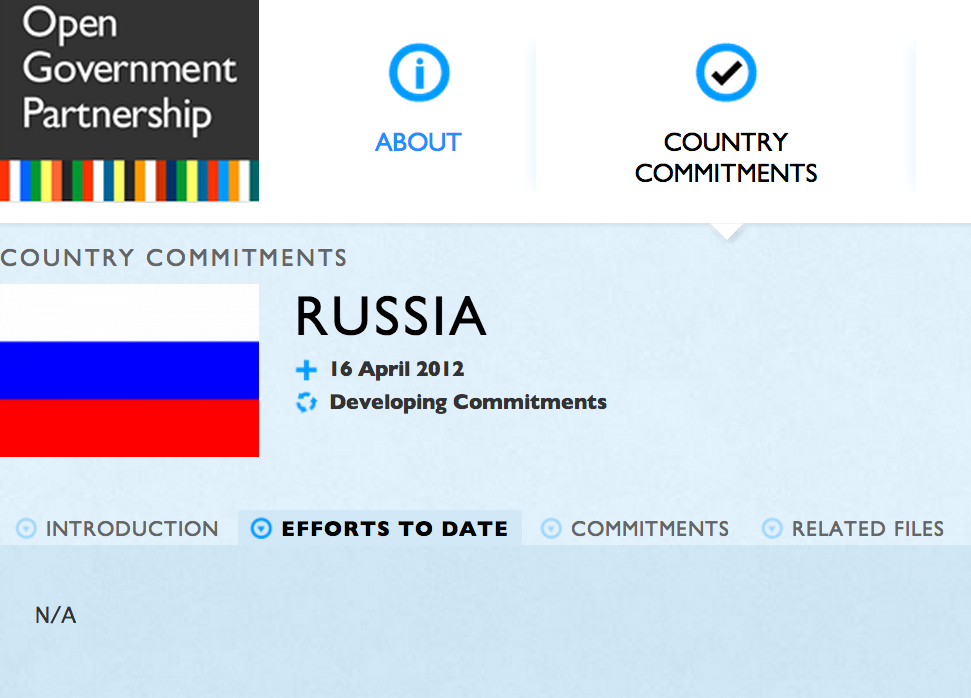
Russia withdraws from Open Government Partnership. Too much transparency? [UPDATED]

russia-OGP

“Inevitably, there will be questions about what we are each prepared to sign up to,” said British Prime Minister David Cameron in January, in his letter to his fellow G8 leaders. For months later, Russia has made clear it clear what it wasn’t willing to sign onto: the Open Government Partnership (OGP). The most recent update on Russia is that the Kremlin will be pursuing “open government” on its own terms. Russia has withdrawn the letter of intent that it submitted on April 2012 in Brazil, at the first annual meeting of the Open Government Partnership.

Update: On May 23, The Moscow Times reported that Russia had just “postponed” its entry into OGP. Presidential spokesman Dmitry Peskov told Russian daily newspaper Kommersant that “we are not talking about winding up plans to join, but corrections in timing and the scale of participation are possible.” Open government advocate  David Eaves interprets this state of affairs to mean A) “transparency matters” and B) that “Russia may still be in OGP. Just not soon. And maybe never.” For now, Russia has withdrawn its letter of intent to join the Open Government Partnership and with that action, its commitments to transparency. OGP itself has  “adjusted” its website to reflect the change, which is to say that the former page for Russia can no longer be found. So what will open government mean in the largest country in the world? Read on.

If the dominant binary of the 21st century is between open and closed, Russia looks more interested in opting towards more controllable, technocratic options that involve discretionary data releases instead of an independent judiciary or freedom of assembly or the press.

One of the challenges of the Open Government Partnership has always been the criteria that a country had to pass to join and then continue to be a member. Russia’s inclusion in OGP instantly raised eyebrows, doubts and fears last April, given rampant corruption in the public sector and Russia’s terrible record on press freedom.

“Russia’s withdrawal from the OGP is an important reminder that open government isn’t easy or politically simple,” said Nathaniel Heller, executive director of Global Integrity. “While we don’t yet fully understand why Russia is leaving OGP, it’s safe to assume that the powers that be in the Kremlin decided that it was untenable to give reformers elsewhere in the Russian government the freedom to advance the open government agenda within the bureaucracy.”

The choices of Russian Prime Minister Dimitri Medvedev, who had publicly supported joining the OGP and made open government a principle of his government, may well have been called into question by Russia’s powerful president, Vladimir Putin.

Medvedev had been signaling a move towards adopting more comfortable sorts of “openness” for some time, leading up to and following Russia joining the Open Government Partnership in December 2012. Russia’s prime minister has sought to position himself as a reformer on the world stage, making a pitch at Davis for Russia being “open for business” earlier this year at the Davos economic forum. Adopting substantive open government reforms could well make a difference with respect to foreign investors concerns about corruption and governance.

While the Kremlin shows few signs of loosening its iron grip on national security and defense secrets, Russia faces the same need to modernize to meet the increasing demand of its citizens for online services as every developed nation.

Even if Russia may not be continue its membership in the Open Government Partnership, the Russian government’s version of “openness” may endure, at least with respect to federal, city and state IT systems. Over the winter, a version of “Open Government a la Russe” – in Cyrillic, большоеправительство or “big government” — seemed to accelerating at the national level and catching on in its capital. Maybe that will still happen, and Russion national action plan will go forward.

“While Russia’s approach to open government may be primarily technocratic, there’s a sense in which even the strongest legal requirements are only tools we give to our allies in governments,” said John Wonderlich, policy director at the Sunight Foundation. “FOI officers analyzing records, or judges deciding whether or not to enforce laws are embodying both legal and cultural realities when they determine how open a country will be, just as much as policy makers who determine which policies to pass. While Russia’s initial commitment to OGP was likely a surprising boon for internal champions for reform, its withdrawal will also serve as a demonstration of the difficulty of making a political commitment to openness there.”

What is more clear, however, is that the Kremlin seems much more interested the sort of “open government” that creates economic value, as opposed to sustaining independent auditors, press or civil society that’s required in functional democracies. Plutocracy and kleptrocacy doesn’t typically co-exist well open, democratic governments — or vice versa.

Given that the United States efforts on open government prominently feature the pursuit of similar value in releasing government data, Russia’s focus isn’t novel. In fact, “open data” is part of more than half of the plans of the participating countries in OGP, along with e-government reforms. In May of 2012, a presidential declaration directed governmental bodies to open up government data.

In February, Moscow launched an open data platform, at data.mos.ru, that supplied material for digital atlas of the city. Russia established an “open data council” the same month. Those steps forward could stand to benefit Russian citizens and bring some tangential benefits to transparency and accountability, if Russia and its cities can stomach the release of embarrassing data about spending, budgets or performance.

While some accounts of open government in Russia highlighted the potential of Russia to tap into new opportunities for innovation afforded by connected citizenry that exist around the world, crackdowns on civil society and transparency organizations have sorely tested the Russian government’s credibility on the issue. This trial of anti-corruption blogger Alexey Navalny for corruption this spring showed how far Russia has to go.

“Open government isn’t just open data nor is it e-government, two areas in which the Russian Federal had appeared to be willing to engage on the open government agenda,” said Heller. “Many observers doubted how far Russia could take open government in a climate of political repression, civil society crackdowns, and judicial abuse of power.”

Today’s news looks like a victory of conservatives in the Kremlin over government reformers interested in reducing corruption and adopting modern public sector management techniques. “We need to use modern technologies, crowd sourcing,” said Medvedev said in January 2013. “Those technologies change the status and enhance the legitimacy of decisions made in government.”

Changes in technology will undoubtedly influence Russia, as they will every country, albeit within the cultural and economic context of each. This withdrawal from OGP, however, may be a missed opportunity for civil society, at least with respect to losing a lever for reform, reduced corruption and institutions accountable to the people. Leaving the partnership suggests that Russia may be a bit scared of real transparency, or least the sort where the national government willing allows itself to be criticized by civil society and foreign non-governmental organizations.

It’s something of a mixed victory for the Open Government Partnership, too: getting to be a member and stay one means something, after all.

“For the Open Government Partnership, this will be seen as a bit of a blow to their progress, but its success was never predicated on getting every qualifying government to join,” said Wonderlich. “In a sense, Russia’s withdrawal may alleviate the need for OGP to grapple with Russia’s recent, severe treatment of NGOs there. More broadly, Russia’s withdrawal may better define the space in which the OGP mechanism can function well. Building a movement around commitments from heads of state has allowed OGP’s ranks to rapidly grow, but we’re also probably entering a new time for OGP, where the depth and reliability of those commitments will become clearer. Transitions between governments, domestic politics, corruption scandals, hypocritical behavior, uncooperative legislatures, exclusion of domestic NGOs, and internal power struggles may all threaten individual national commitments, and OGP will need to determine how to adapt to each of these challenges. OGP will need to determine whether it wants to be the arbiter of appropriate behavior on each of these dimensions, or whether its role is better left to the commitments and National Action Plans on which it was founded. ”

If OGP is to endure and have a meaningful impact on the world, its imprimatur has to have integrity and some weight of moral justice, based upon internationally shared norms on human rights and civil liberties. As press freedom goes, so to does open government and democracy.

“International boosters of open government may want to remain cautious at embracing open government reformers at the first whiff of ‘openness’ or rhetorical commitment to the agenda,” said Heller. “Within weeks of Russia first making noise around joining OGP, the World Bank and others rushed to assemble a major international conference in the country around open government to boost reformers inside the bureaucracy as they sought to move the country into OGP. While no one should criticize those efforts, they are a sobering reminder that initial rhetorical commitment to open government can only take us so far, and it’s wise to keep the political powder dry for other downstream fights.”

Given the scale of bribery and the impact of corruption on growth, Russians can only hope that more “openness” with teeth comes to their country soon.

Fung outlines principles for democratic transparency and open government

Archon Fung has published a new paper” [PDF] on open government, information and democracy. The abstract includes a useful breakdown of the components of democratic transparency:

In Infotopia, citizens enjoy a wide range of information about the organizations
upon which they rely for the satisfaction of their vital interests. The provision of
that information is governed by principles of democratic transparency. Democratic
transparency both extends and critiques current enthusiasms about transparency. It
urges us to conceptualize information politically, as a resource to turn the behavior of
large organizations in socially beneficial ways. Transparency efforts have targets, and we
should think of those targets as large organizations: public and civic, but especially private
and corporate. Democratic transparency consists of four principles. First, information
about the operations and actions of large organizations that affect citizens’ interests
should be rich, deep, and readily available to the public. Second, the amount of available
information should be proportionate to the extent to which those organizations
jeopardize citizens’ interests. Third, information should be organized and provided in
ways that are accessible to individuals and groups that use that information. Finally, the
social, political, and economic structures of society should be organized in ways that
allow individuals and groups to take action based on Infotopia’s public disclosures.

Fung’s paper focuses on focus upon “information about the activities of
large organizations—especially corporations and governments—rather than individuals” and “the important, defensive, face of the informational problem: information that people need to protect themselves against the actions of large organizations and to navigate the terrain created by such organizations,” as opposed to the myriad positive uses of open government data.