United States releases second Open Government National Action Plan

This morning, the White House released its second action plan (PDF) for improving the state of open government in the United States. The action plan is required for U.S. participation in the Open Government Partnership, an international, multilateral initiative that seeks to push nations to make and keep commitments to open government.

“This second National Action Plan is another opportunity to set concrete and measurable goals for achieving a more transparent, participatory, and collaborative government,” wrote Nick Sinai, United States deputy chief technology officer and Gayle Smith, special assistant to the president and senior director for development and democracy, at the White House blog. “We look forward to working alongside civil society to carry out these commitments and continue identifying new ways to open our government in the future.”
open gov nap 2.0

As I previously reported, the action plan commits to modernizing the Freedom of Information Act, open more government data, improve the management of natural resources and engage citizens in innovation. Additionally, the final plan (a draft was released earlier this fall) includes commitments to join the Global Initiative on Fiscal Transparency  (GIFT), promote participatory budgeting, increase the transparency of spending and foreign assistance, improve the participation of the public in rulemaking and a number of other measures that expand existing commitments.

Initial reactions from open government advocates — many of whom, it must be said, worked to shape the contents of the plan — are strongly positive.

“The United States helped found the Open Government Partnership to challenge other countries to make concrete commitments to make themselves more transparent and accountable to the people,” said Patrice McDermott, executive director of OpenTheGovernment.org, in a statement.

“This plan shows that the US is also serious about challenging itself. While we have been critical of some of this Administration’s decisions, particularly its continued insistence on walling off all information related to national security, this plan begins to break down that wall and advance open government.”

Sean Moulton, director of open government policy at the Center for Effective Government, was similarly positive about the plan:

We are impressed by the scope and detail of the plan, as well as the administration’s commitment to continue to engage and refine those commitments for which detailed goals are not yet available. This broad and ambitious plan tackles important open government issues that we have long been advocating, including: 1) strengthening the Freedom of Information Act (FOIA), 2) improving information about government spending, and 3) continuing to open government data to the public. Properly implemented, these commitments can make government openness work for the public and change how government operates. The Center for Effective Government looks forward to working with the administration to ensure the outlined goals are executed over the next two years.

Sunlight Foundation policy director John Wonderlich balanced good with the bad in the plan:

There are some new and meaningful commitments. The proposed FOIA advisory board and committee could be transformative, and commitments to greater transparency in the extractives industry extend the significant new commitments that began in the US’s last plan.

More disappointing are the commitments around spending transparency, which would build on existing efforts to improve federal spending transparency in Congress and the federal government, but but offer only vague commitments. The National Action Plan also outlines a process to ensure federal agencies treat their data as an asset that should be open to the public, (long a Sunlight priority), but without adding much new detail to a process that is already well along its path.

And money in politics, like in the first National Action Plan, is missing entirely.

The measures that are likely to draw the most attention are those that relate to electronic surveillance and national security, and to whistleblower protections.

On that count, the second U.S. national action plan for open government includes measures to increase the transparency of foreign intelligence surveillance activities (largely mirroring the measures President Obama has already introduced this fall and repackaging the commitments made by the intelligence community) and to “strengthen and expand whistleblower protections for government personnel.” I include both below:

6. Increase Transparency of Foreign Intelligence Surveillance Activities
In June 2013, the President directed the U.S. Intelligence Community to declassify and make public as much information as possible about certain sensitive intelligence collection programs undertaken under the authority of the Foreign Intelligence Surveillance Act (FISA), while being mindful of the need to protect national security. Nearly two thousand pages of documents have since been released, including materials that were provided to Congress in conjunction with its oversight and reauthorization of these authorities. As information is declassified, the U.S. Intelligence Community is posting online materials and other information relevant to FISA, the FISA Court, and oversight and compliance efforts. The Administration has further committed to:

• Share Data on the Use of National Security Legal Authorities. The Administration will release annual public reports on the U.S. Government’s use of certain national security authorities. These reports will include the total number of orders issued during the prior twelve-month period and the number of targets affected by them.

• Review and Declassify Information Regarding Foreign Intelligence Surveillance Programs. The Director of National Intelligence will continue to review and, where appropriate, declassify information related to foreign intelligence surveillance programs.

• Consult with Stakeholders. The Administration will continue to engage with a broad group of stakeholders and seek input from the Privacy and Civil Liberties Oversight Board to ensure the Government appropriately protects privacy and civil liberties while simultaneously safeguarding
national security.

9. Strengthen and Expand Whistleblower Protections for Government Personnel
Employees with the courage to report wrongdoing through appropriate, legally authorized channels are a government’s best defense against waste, fraud, and abuse. Federal law prohibits retaliation against most government employees and contractors who act as whistleblowers, and those protections were strengthened by recent legislation and Executive action. However, some who work for the Government still have diminished statutory protections. The Government must also ensure that Federal employees know their rights. Therefore, the Administration will:

• Mandate Participation in the Office of Special Counsel Whistleblower Certification Program. To ensure that Federal employees understand their whistleblower rights and how to make protected disclosures, the Administration will require covered agencies to complete the U.S. Office of Special Counsel’s program to certify compliance with the Whistleblower Protection Act’s notification requirements.

• Implement the Presidential Directive on Protecting Whistleblowers. The U.S. Government will continue to work to implement the President’s October 2012 Policy Directive on Protecting Whistleblowers with Access to Classified Information (PPD-19), including by ensuring strong, independent due process procedures; awareness of protections; and agency understanding of the protections available to government contractors under the directive.

• Advocate for Legislation to Expand Whistleblower Protections. With the Administration’s support, Congress recently enacted legislation to strengthen whistleblower protections for most Federal Government employees and contractors, but there are still gaps in statutory protections available to certain government employees and contractors. The Administration will continue to work with Congress to enact appropriate legislation to protect these individuals.

• Explore Executive Authority to Expand Whistleblower Protections if Congress Does Not Act. While statutory protections are preferable, the Administration will explore additional options for utilizing Executive authority to further strengthen and expand whistleblower protections if Congress fails to act further.

“This is big news in my mind,” writes Nathaniel Heller, executive director of Global Integrity. “Yes, the commitments to greater disclosure around surveillance activities are largely retread and don’t go nearly far enough. But for these issues to have made their way into a US National Action Plan is an important first step towards broadening the open government agenda to include “new frontiers” or “thorny” issues. That’s a big deal and a win.”

As with so many aspects of government announcements regarding measures to hold themselves more accountable or become more transparent, the most important part of this plan will be not be the words themselves but in how they are interpreted and implemented by this administration and those to follow. To date, after bold rhetoric in 2009, the Obama administration’s record on open government is mixed, with ongoing challenges regarding transparency on Healthcare.gov’s performance. There’s also precious little acknowledgment of concerns about press freedoms in the plan. Heller would also have liked to have seen something on corporate ownership:

The administration remains silent on public registries of beneficial owners of companies,” he writes. “Sigh. David Cameron and the UK government made a pioneering commitment to public registries of who really owns UK companies at the OGP summit in London. The US is now in the awkward position of having to defend keeping this valuable data private to only government regulators and investigators. That’s an increasingly thin reed. There’s certainly opposition to public registries in Congress, but the White House could have at least committed to publicly pushing for public registries. Instead, mum’s the word.

Steven Aftergood expressed some concerns about the administration’s new goals on open government, focusing on his wheelhouse, overclassification and pervasive secrecy. As he noted, the plan also includes a measure to improve declassication:

…a new interagency Classification Review Committee is being established with White House leadership to evaluate proposals for classification reform, and to coordinate their implementation throughout the executive branch.  The creation of such a body was the primary recommendation of the Public Interest Declassification Board last year, and it was strongly endorsed by public interest groups.

Both because of its interagency character and especially due to its White House leadership, the new Committee has the potential to overcome the autonomous classification practices of individual agencies that have contributed to the explosive growth in secrecy.

Positive results are naturally not guaranteed.  The Administration has not embraced an explicit theory of how overclassification occurs, or even how overclassification is to be defined, and therefore it is not yet well-equipped to address the problem.

The new Plan notes that in June of this year President Obama directed the Intelligence Community to declassify and make public “as much information as possible” about intelligence surveillance programs. But in an optimally functioning classification system, the President’s directive would have been redundant and unnecessary; the system would already be declassifying as much information as possible.

Of course, the existing classification system is not functioning optimally. That is the problem.  So either the President needs to issue individualized directives to all agencies on every conceivable classified topic to “declassify as much as possible,” or else the new White House interagency Committee needs to find alternate means to effectively communicate the same imperative.

Wonderlich also expressed a deeper concern about the plan: its lack of ambition, focus upon political power and personal investment or commitment of political capital from President Obama.

Unfortunately, if we imagine what a National Action Plan could be with a committed, engaged President, and senior political staff at the White House who discuss and engage with integrity issues, rather than treating them as political liabilities, we imagine a wholly different world. Incremental working groups and vaguely redundant reporting procedures would be replaced by bold proposals that affect political and state power, and we’d see a White House that talks more about the transparency we’re building than the transparency they use as a shield against critics. That’s clearly not the National Action Plan the White House released today.

All that being said, the fact that these measures are in the plan shows that the Obama administration has heard the criticism of civil society regarding secret surveillance laws, overclassification, and prosecuting whistleblowers and included elements addressing them.

That’s better. Let’s see what they do next.

This post has been updated with reactions from  open government advocates over time.
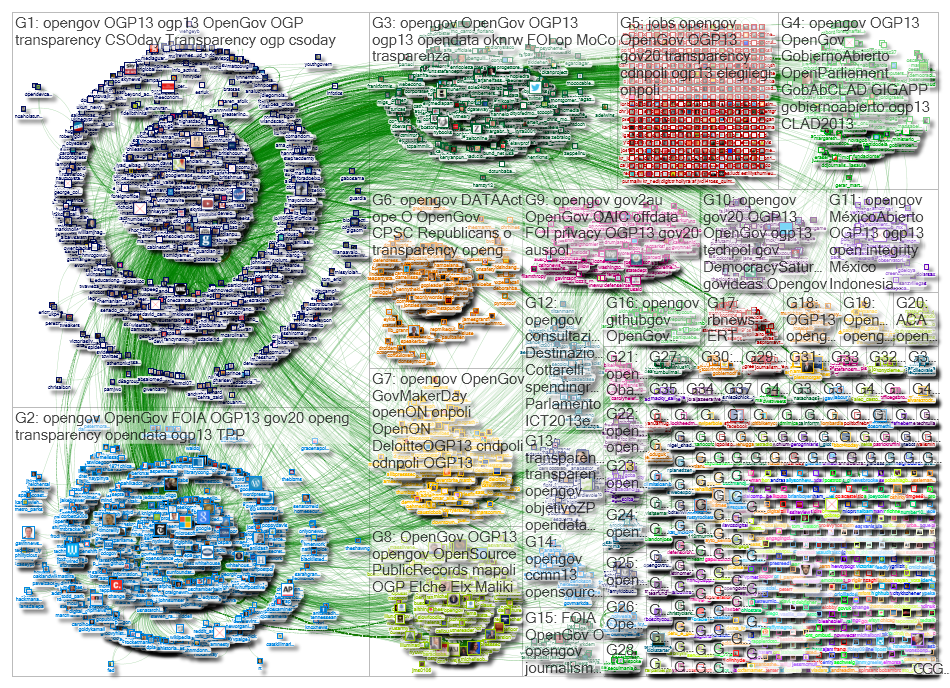
Map of open government communities generated by social network analysis of Twitter

Graph-12287

The map above was created on November 20 by researcher Marc Smith using a dataset of tweets that contained “opengov” over the past month. You can explore an interactive version of it here.

The social network analysis is, by its nature, a representation of only the data used to create it. It’s not a complete picture of open government communities offline, or even the totality of the communities online: it’s just the people who tweeted about open gov.

That said, there are some interesting insights to be gleaned.

1) The biggest network is the one for the Open Government Partnership (OGP), on the upper left (G1), which had its annual summit during the time period in question. That likely affected the data set.

2) I’m at the center of the U.S. open government community on the bottom left (G2) (I’m doing something right!) and am connected throughout these communities, though I need to work on my Spanish. This quadrant is strongly interconnected and includes many nodes linked up to OGP and around the world. (Those are represented by the green lines.)

3) Other communities include regional networks, like Spain (G4) and Spanish-speaking (G11) open government organizations, Germany (G3), Italy (G12), Canada (G7), Greece (G5) and Australia (G9), and ideological networks, like the White House @OpenGov initiative (G8) and U.S. House Majority Leader (G6). These networks have many links to one another, although Mexico looks relatively isolated. Given that Indonesia has a relatively high Twitter penetration, its relative absence from the map likely reflects users there not tweeting with “opengov.”

4) The relative sparseness of connections between the Republican open government network and other open government communities strongly suggests that, despite the overwhelming bipartisan support for the DATA Act in the House, the GOP isn’t engaging and linked up to the broader global conversation yet, an absence that should both concern its leaders and advocates in the United States that would like to see effective government rise above partisan politics. This community is also only tweeting links to its own (laudable) open government initiatives and bills in the House, as opposed to what’s happening outside of DC.

5) You can gain some insight into the events and issues that matter in these communities by looking at the top links shared. Below, I’ve shared the top links from Smith’s NodeXL analysis:
Top URLs in Tweet in Entire Graph:

https://healthcare.gov/
http://www.opengovguide.com/
https://www.gov.uk/government/topical-events/open-government-partnership-summit-2013
http://www.opengovpartnership.org/get-involved/london-summit-2013
https://govmakerday.eventbrite.com/
http://blogs.worldbank.org/youthink/can-young-people-make-your-government-more-accountable
http://www.opengovpartnership.org/london-summit-2013
http://paper.li/DGateway/1350366870
https://www.thunderclap.it/projects/5907-more-open-government-ogp13
http://www.youtube.com/playlist?feature=edit_ok&list=PLMDgGB-pYxdFNupM0kiHFPjwv8by2alxY

Top URLs in Tweet in G1 (Open Government Partnership):

https://www.gov.uk/government/topical-events/open-government-partnership-summit-2013
https://www.thunderclap.it/projects/5907-more-open-government-ogp13
http://www.opengovpartnership.org/london-summit-2013
http://www.thunderclap.it/tipped/5907/twitter
http://www.opengovpartnership.org/get-involved/london-summit-2013
http://www.youtube.com/playlist?feature=edit_ok&list=PLMDgGB-pYxdFNupM0kiHFPjwv8by2alxY
https://www.thunderclap.it/projects/5907-more-open-government-ogp13?locale=en
http://www.opengovguide.com/
https://www.gov.uk/government/consultations/open-government-partnership-uk-national-action-plan-2013
http://www.opengovpartnership.org/open-government-awards-launched-reward-transparent-accountable-and-effective-public-programs#sthash.xl5Bwn5D.dpuf

Top URLs in Tweet in G2 (US OpenGov Community):

http://www.usgovernmentmanual.gov/
http://www.huffingtonpost.com/danielle-brian/in-wake-of-snowden-us-mus_b_4192804.html?utm_hp_ref=tw
http://e-pluribusunum.com/2013/11/05/farm-bill-foia-open-government-epa/
http://www.knightfoundation.org/blogs/knightblog/2013/10/28/new-project-aims-connect-dots-open-data/
http://www.whitehouse.gov/lWV7k
http://sunlightfoundation.com/blog/2013/11/15/opengov-voices-pdf-liberation-hackathon-at-sunlight-in-dc-and-around-the-world-january-17-19-2014/
http://sunlightfoundation.com/blog/2013/11/14/recent-developments-show-desire-for-trade-talk-transparency/
http://sunlightfoundation.com/blog/2013/10/22/how-much-did-healthcare-gov-actually-cost/
http://www.consumerfinance.gov/blog/making-regulations-easier-to-use/
http://sunlightfoundation.com/blog/2013/11/19/house-keeps-data-act-momentum-moving/

Top URLs in Tweet in G3 (Germany):

http://paper.li/DGateway/1350366870
http://oknrw.de/
http://www.opengovpartnership.org/blog/christian-heise/2013/11/18/german-grand-coalition-might-agree-joining-ogp
http://dati.comune.bologna.it/node/962
http://www.globalhealthhub.org/thehive/
https://www.facebook.com/events/1431657647046016
http://aiddata.org/blog/this-week-open-data-for-open-hearts-and-open-minds
http://www.opengovpartnership.org/get-involved/london-summit-2013
http://www.freiburg.de/pb/,Lde/541381.html
http://digitaliser.dk/resource/2534864

Top URLs in Tweet in G4 (Spain):

http://www.opengovguide.com/
http://www.cepal.org/cgi-bin/getprod.asp?xml=/ilpes/capacitacion/0/50840/P50840.xml&xsl=/ilpes/tpl/p15f.xsl&base=/ilpes/tpl/top-bottom.xsl
https://vine.co/v/hpZErXPd6rq
http://thepowerofopengov.tumblr.com/
http://es.scribd.com/collections/4376877/Case-Studies
https://vine.co/v/hpZiw7TXanI
https://vine.co/v/hpZIV002zar
http://aga.org.mx/SitePages/DefinicionGob.aspx
http://www.opengovpartnership.org
http://inicio.ifai.org.mx/Publicaciones/La%20promesa%20del%20Gobierno%20Abierto.pdf

Top URLs in Tweet in G5 (Greece):

https://healthcare.gov/
http://venturebeat.com/2013/10/23/so-much-for-opengov-quantcast-traffic-on-healthcare-gov-hidden-by-the-owner/
http://elegilegi.org/
http://opengov.seoul.go.kr/
http://venturebeat.com/2013/10/23/so-much-for-opengov-quantcast-traffic-on-healthcare-gov-hidden-by-the-owner/?utm_source=twitterfeed&utm_medium=twitter
http://www.aspeninstitute.org/about/blog/biases-open-government-blind-us?utm_source=as.pn&utm_medium=urlshortener
http://www.opengov.gr/consultations/?p=1744
http://www.aspeninstitute.org/about/blog/biases-open-government-blind-us
http://www.opengov.gr/minfin/?p=4076
http://OpenGov.com

Top URLs in Tweet in G6 (GOP):

http://houselive.gov/
https://www.cosponsor.gov/details/hr2061
http://oversight.house.gov/release/oversight-leaders-introduce-bipartisan-data-act/
http://instagram.com/p/g3uvs_sYYr/
http://cpsc.gov/live
https://cosponsor.gov/details/hr2061-113
http://www.youtube.com/watch?v=Bnn3IsOhulE&feature=youtu.be
http://www.cpsc.gov/en/Regulations-Laws–Standards/Rulemaking/Final-and-Proposed-Rules/Hand-Held-Infant-Carriers/
http://www.speaker.gov/press-release/opengov-house-representatives-makes-us-code-available-bulk-xml
http://docs.house.gov/billsthisweek/20131118/BILLS-113hr2061XML.xml

Top URLs in Tweet in G7 (Canada):

https://govmakerday.eventbrite.com/
http://www.ontario.ca/government/open-government-initial-survey
http://govmakerday.eventbrite.com
http://www.thestar.com/opinion/commentary/2013/10/29/the_promise_and_challenges_of_open_government.html
http://www.marsdd.com/2013/10/31/open-government-three-stages-for-codeveloping-solutions/
http://www.thestar.com/opinion/commentary/2013/11/09/rob_ford_and_the_emerging_crisis_of_legitimacy.html
https://www.ontario.ca/government/open-government-initial-survey
http://govmakerday-estw.eventbrite.com
http://www.ontario.ca/open
http://gov20radio.com/2013/10/gtec2013/

Top URLs in Tweet in G8 (@OpenGov):

https://healthcare.gov/
http://www.whitehouse.gov/lWV7k
http://www.consumerfinance.gov/blog/making-regulations-easier-to-use/
http://aseyeseesit.blogspot.com/2012/01/economy-hasnt-stalled-for-members-of.html
http://www.commonblog.com/2013/10/23/eagle-tribune-editorial-public-records-need-to-be-available-to-its-citizenry/
http://mobile.twitter.com/OpenGov
http://blogs.state.gov/stories/2013/10/31/making-governments-more-open-effective-and-accountable
http://open.dc.gov/
http://www.sielocal.com/SieLocal/informe/1025/Ingresos-por-el-concepto-de-multas
http://mei-ks.net/?page=1,5,787

Top URLs in Tweet in G9 (Australia):

http://paper.li/cortado/1291646564
http://icma.org/en/icma/knowledge_network/documents/kn/Document/305680/Transparency_20_The_Fundamentals_of_Online_Open_Government
http://www.oaic.gov.au/about-us/corporate-information/annual-reports/oaic-annual-report-201213/
https://controllerdata.lacity.org/
http://cogovsnapshot.cofluence.co/
https://info.granicus.com/Online-Open-Gov-October-29-2013.html?page=Home-Page
http://www.oaic.gov.au/news-and-events/subscribe
https://oaic.govspace.gov.au/2013/10/30/community-attitudes-to-privacy-survey-results/
http://www.cebit.com.au/cebit-news/2013/towards-open-government-esnapshot-australia-2013
http://journalistsresource.org/studies/politics/digital-democracy/government-transparency-conflicts-public-trust-privacy-recent-research-ideas

Top URLs in Tweet in G10:

http://on.undp.org/pUdJj
http://europeandcis.undp.org/blog/2013/10/17/a-template-for-developing-a-gov20-opengov-project/?utm_source=%40OurTweets
http://www.govloop.com/profiles/blogs/12-favorite-quotes-from-code-for-america-summit
http://www.accessinitiative.org/blog/2013/10/east-kalimantan-community%E2%80%99s-struggles-underscore-need-proactive-transparency-indonesia
http://www.scribd.com/doc/178983441/Montenegro-Inspiring-Story-open-government
http://www.scribd.com/doc/178988676/Indonesia-case-study-open-government
http://www.setimes.com/cocoon/setimes/xhtml/en_GB/features/setimes/features/2013/10/18/feature-01?utm_source=%40OurTweets
http://www.opengovpartnership.org/summary-london-summit-commitments
http://feedly.com/k/1arGpdC
http://slid.es/kendall/open-records

Why HealthSherpa.com is not a replacement for Healthcare.gov [UPDATED]

UPDATE: In June 2014, Ning Liang, one of the founders of HealthSherpa, wrote in about updates to the site. Ling said that they can now enroll people in ACA marketplace plans, including subsidies. According to Liang, “we are the only place besides Healthcare.gov where this is possible. We have signed an agreement with CMS as a web based entity to do this. We are directly integrated with the federal data hub, so going through us is identical to going through Healthcare.gov.”

Earlier tonight, Levick director of digital content Simon Owens discovered HealthSherpa.com, thought it was cool, and read a Daily Dot post about it that framed it as 3 20-something San Francisco Bay-area resident coding up an alternative to Healthcare.gov.

Could it be that easy, wondered Owens? Could these young coders have created a simpler, better way to shop for health insurance than the troubled Healthcare.gov?

healthsherpa

Well, yes and no. As is so often the case, it’s not quite that simple, for several reasons.

1) As always, note the disclaimer at the bottom of HealthSherpa.com: “The information provided here is for research purposes. Make sure to verify premiums and subsidies on your state exchange or healthcare.gov, or directly with the insurance company or an agent.”

Why? The site is based upon the publicly available data published by the Department for Health and Human Services, individual state exchanges and Healthcare.gov for premium costs, like this dataset of premiums by county at data.healthcare.gov.

Unfortunately, there appear to be data quality issues, as CBS News reported, that may be an issue on both sites.

When I compared searches for the same zipcode in Florida for a 35 year old, single non-smoking male, I found the same 106 plans but was quoted different premiums: $128.85 on HC.gov vs $150.24 on HealthSherpa. Hmm.

That could be user error, but… it looks like Healthcare.gov continues to underestimate costs.

Healthsherpa may actually be doing better, here. Good job, guys.

2) Regardless, this is not a replacement for everything Healthcare.gov is supposed to do.

The federal and state exchanges aren’t just about browsing plans and comparing premiums for options in a given zipcode in the “marketplace.” After a user knows decides which plan he or she want, the software is supposed to:

1) Register them as a user (registration was up front initially, which was a controversial, important choice, relevant to the site crashing at launch)
2) Authenticate them against government data bases
3) Verify income against government data bases
4) Calculate relevant subsidies, based upon income
5) Guide them through the application process
6) Send that form data on to insurance companies for enrollment.

The tech that underpins the test and graphics website on the front end of those process continues to hold up well.

The rest of the software that is supposed to enable visitors to go through steps 1-6 software, not so much. 16 state exchanges and DC are having varying degrees of success, with HHS Secretary Kathleen Sebelius acknowledging issues with data quality in Step 6 in her testimony to Congress.

3) While it has a subsidy calculator, otherwise Healthsherpa doesn’t replace Healthcare.gov.

Healthsherpa enables you to find a relevant plan and then gives you contact info for the relevant insurer.

For instance:

“Call Humana Medical Plan, Inc. at (800) 448-6262.
Use their menu or ask the operator to speak to someone about purchasing coverage.
Tell them you would like to purchase health exchange coverage, specifically the Humana Connect Basic 6350/6350 Plan for Hillsborough County, FL.
Follow their instructions to complete the application process.”

It does not place calls to the data hub to calculate steps 1-6.

That limited functionality, however, has been good enough for U.S. Senator Angus King to recommend HealthSherpa as a temporary alternative to Healthcare.gov.

“HealthSherpa offers a user-friendly platform to quickly browse through available health insurance plan options, including monthly premium costs, coverage plans, and possible premium subsidies,” Senator King said. “I recommend that Mainers who are having trouble with Healthcare.gov use HealthSherpa as a temporary alternative until the federal website functions properly.”

4) There are OTHER private healthcare insurance brokers that could be doing this.

Back in May 2013, the Center for Medicare and Medicaid Services issued official guidance for private sector brokers in online health insurance marketplaces. (PDF)

Former U.S. chief technology officer Aneesh Chopra said that these “Web-based entities” will be online this fall, operated by entities like eHealthInsurance.com and GetInsured.

For some reason, however, private sector insurance brokers have been stymied by the federal government from selling ACA insurance policies.

That’s unfortunate, given that the Obama administration could use a Plan B, just in case the progress on Healthcare.gov doesn’t lead to a functional federal health insurance exchange twenty days from now.

Update: Jonathan Cohn, writing for the New Republic, looked into Healthcare.gov’s backup plan and comes up with an interesting detail: issues with the so-called data hub could be holding back deployment of private online health insurance brokers.

…administration officials have been huddling with insurers about how to make more use of direct enrollment. Step one is to make sure that “side door” enrollment works smoothly. It doesn’t function well right now, because—you guessed it—it relies on the same information technology system that powers healthcare.gov. Fixing that portal, which techies tell me is called an “application programming interface,” is high on the administration’s to-do list. But it’s not clear (to me) whether improving the portal might require design modifications—or to what extent its success depends upon other, ongoing repairs to the federal website.

So, here’s some speculation: While it’s hard to know for sure, but it’s quite likely that that “portal” is the data hub that’s behind Healthcare.gov, and that it may not be up to additional volume from private sector demand.

The federal exchange and state exchanges both rely upon it, and, while federal officials have said that it’s working, a report by the New York Times yesterday that some state health insurance exchange are continuing to battle tech problems indicated that it’s not holding up under demand:

Even states whose websites are working well say they are hampered by a common problem: the federal website, particularly the data hub that checks every applicant’s identity and eligibility. That hub has stopped working on several occasions, preventing applications in the states from being completed.

If that’s happening now, concerns about the ability of the hub to hold up under the pressure of private sector online insurance brokers could well be justified. If I learn anything more definitive, I’ll share it.

When digital government supports open government

photo (17)

As I looked back at the annual Open Government Partnership Summit in London, I was struck by how much technology continues to dominate discussion, particularly when many of the issues that confront people and governments around the world are political or systemic, and thus resistant to simply “fixes.”

Given that so many of the new country commitments for the partnership either involve improving the use of technology or are enabled by technology, it’s tempting to frame the release of government data and other digital efforts as efforts that will primarily serve elites, not the poor, and to warn of the encroachment of commercial interests in that delivery.

The years ahead will be messy, full of anger, violence, ignorance and the worst of human nature, expressed in political conflicts and entrenched institutions and industries fighting against a rising tide of populism and industrial disruption fueled by an explosion of connection technologies.

Near the end of 2013, the majority of humanity is living through the consequences of wars, natural disasters, disease, food shortages or inequality in access to resources. On many days, access to healthy food, electricity and clean water are critical needs. Access to information, however, has rapidly become critical in this new millennium.

That such information will be delivered through the Internet and mobile devices is clearly one of the megatrends of this decade. Similarly, access to one another through those same devices, mediated by social media and video, is shifting how we all can understand, document and experience the world.

While 56% of American adults now own a smartphone, the rest of the world hasn’t hasn’t caught up yet. That’s changing quickly, however, as the cost of mobile hardware continues to drop. There have now been over 1 billion Android activations worldwide. As cheaper smartphones and tablets become available, and more wireless Internet access rolls out through ISPs, mesh networks and perhaps even Google blimps, the pressure to provide digital services will only increase.

Why all the hullabaloo? Isn’t this just “e-government redux,” with phones? It would also be a gross mistake to view digital government as simply rebranding or scaling the existing approaches to buying, building and maintaining government IT.

Unfortunately, the bad news here is that government technology around the world is dominated by regulations, tangled hiring practices and procurement policies that get in the way of building important software, along with politics and poor management. The good news is that the example of the United Kingdom’s new Government Digital Services team shows a potential way forward for building a digital core for 21st century government online.

Adopting a digital government strategy is not the same as moving to a system of government more open and accountable to the people, as a comparison of the democratic accountability in countries as diverse as Singapore, Denmark, Iran and Brazil demonstrate.

Given that technology can and will underpin many efforts to reduce corruption, improve accountability and empower citizen activism and public engagement, dismissing the importance of public-private partnerships or digital government initiatives as inherently “ephemeral” would be a mistake in this young century.

As the DATA Act goes up for markup in Senate, will its Recovery.gov model survive?

rotunda-dome-capital (1)

There will be a markup for the DATA Act (S.994) in U.S. Senate today. The bill, which passed the House, would standardize federal spending and publish it in a similar way as the Recovery Act, which proved to be a successful test case for open data. A proposed amendment to the DATA Act, however, is facing opposition from the same good government groups that supported its passage in the House of Representatives.

Update: The DATA Act passed markup with the amendment.

The amendment, which removes the “accountability platform” from the legislation, faced criticism from the author of the original bill, Hudson Hollister. Hollister emailed the following comment to Federal News Radio:

“Without the accountability platform, there will be no mechanism for inspectors general to use the newly-standardized federal spending data, combined with public and private data sources, to suss out waste and fraud. If the final version of the bill fails to expand the Recovery Operations Center to cover all federal spending, taxpayers’ interests will be hurt in two ways. First, waste and fraud that could have been illuminated and eliminated will go undetected. Second — and perhaps more important — without any internal government effort to use the newly-standardized spending data for any purpose, there will be no internal pressure to improve the quality of data published on USASpending.gov. We recognize that the accountability platform was removed in order to reduce the bill’s Congressional Budget Office score. We hope that an offset large enough to restore those provisions can be included in the bill at a later stage.”

A coalition of good government groups are calling for the the DATA Act to be passed as introduced, not “as amended,” submitting a letter to the Senate Homeland Security and Government Affairs Committee to that effect. (Below.)

DATA Act – Letter of Support to Homeland Security and Government Affairs Committee – 11-05-2013

Prospects for the DATA Act’s passage in the Senate do appear improved over last year, where it foundered in committee, but the form it will emerge from today’s markup in is unclear.

Hollister is warning that the removal of the requirement for a data analytics platform from the bill, modeled on Recovery.gov, would be a mistake and lead to same kinds of data quality issues that exist at the SEC.

Citing a study from Columbia Business School which evaluates the state and future of interactive data at the SEC, Hollister says the platform is a key tool for government inspectors general to examine spending data, which then creates an internal incentive to correct errors. Given the reality that “armchair auditors” have yet to emerge in the United Kingdom to look at similar data, improving the capacity of the IGs to find fraud, waste and abuse is critical.

In advocating for retention of the platform (the “accountability hub”), Hollister suggested that its estimated $20 million dollar cost will be more than balanced by the amount of fraud detected.

“Open data is no good unless it’s accurate,” writes Hollister. “The SEC’s experience shows that the only way to generate internal pressure for accurate spending data will be if the federal government is actively using that data.”

2013 Code for America Summit convenes civic innovators in San Francisco [LIVEBLOG]

cfa-2013-theater
Hello from San Francisco! I’ll be liveblogging from the 2013 Code for America Summit for the next 2 days. You can tune in here.

Readers should also be aware of an important disclosure: Code for America paid for the costs of my travel to and from San Francisco and has further engaged me to produce paid analysis of the themes extant at the event. Part of our agreement, however, was that the organization would have no editorial control or discretion with respect to what I write about the event, organization, partners or constituents.

Digging in open data dirt, Climate Corporation finds nearly $1 billion in acquisition

“Like the weather information, the data on soils was free for the taking. The hard and expensive part is turning the data into a product.”-Quentin Hardy, in 2011, in a blog post about “big data in the dirt.”

soil-type-graphic_wide-7a4e4709ff8554fc2abafaa342589fccf0524189-s6-c30

The Climate Corporation, acquired by Monsanto for $930 million dollars on Wednesday, was founded using 30 years of government data from the National Weather Service, 60 years of crop yield data and 14 terabytes of information on soil types for every two square miles for the United States from the Department of Agriculture, per David Friedberg, chief executive of the Climate Corporation.

Howsabout that for government “data as infrastructure” and platform for businesses?

As it happens, not everyone is thrilled to hear about that angle or the acquirer. At VentureBeat, Rebecca Grant takes the opportunity to knock “the world’s most evil corporation for the effects of Monsanto’s genetically modified crops, and, writing for Salon, Andrew Leonard takes the position that the Climate Corporation’s use of government data constitutes a huge “taxpayer ripoff.”

Most observers, however, are more bullish. Hamish MacKenzie hails the acquisition as confirmation that “software is eating the world,” signifying an inflection point in data analysis transforming industries far away from Silicon Valley. Liz Gannes also highlighted the application of data-driven analysis to an offline industry. Ashlee Vance focused on the value of Climate Corporation’s approach to scoring risk for insurance in agribusiness. Stacey Higginbotham posits that the acquisition could be a boon to startups that specialize in creating data on soil and climate through sensors.

[Image Credit: Climate Corporation, via NPR]

City of Los Angeles launches open data pilot and survey

Upon election, I wondered whether Mayor-Elect Eric Garcetti would reboot Los Angeles city government for the 21st century. After 4 months, there are several promising green shoots to report.

First, Mayor Garcetti vowed to modernize city government in the City of Angels, posting agency performance statistics online and reviewing all departments. Now, the City of Los Angeles has launched its own open data pilot project using ESRI’s ArcGIS platform.

laskyline_logo_final_7_1

For veterans of such efforts, a portal to mapping data may not be particularly exciting or useful, but it’s a start. Notably, the city has put up an online survey where people can request other kind of city data and suggest changes or improvements to the pilot website.

Here’s a few suggestions:

1) Study how the cities of Chicago and New York cleaned, published and used data, including market demand.

2) Talk to the data desk at the Los Angeles Times. If you want your city’s performance data to be used by media for accountability and transparency, address their concerns.

3) Make a list of every single request for data made by journalists in Los Angeles under the California Records ActRelease the data and proactively publish that type of data going forward.

4) If your goal is economic outcomes from open data, review all requests for city data from businesses and prioritize release of those data sets. Engage startups and venture capitalists who are consuming open data and ask about quality, formats and frequency of release.

5) Check out New York City’s gorgeous new open data site and the ongoing release of more data sets. Set those free, too.

6) Check out the new NYC.gov, Utah.gov and gov.uk in the United Kingdom for ideas, principles and models. Of note: the use of open standards, citizen-centricity, adaptive Web design, powerful search, focus on modern design aesthetic.

Good luck, LA!

Does privatizing government services require FOIA reform to sustain open government?

I read an editorial on “open government” in the United Kingdom by Nick Cohen today, in which he argues that Prime Minister David Cameron is taking “Britain from daylight into darkness. Cohen connects privatization to the rise of corporate secrecy … Continue reading

Hedge fund use of government data for business intelligence shows where the value is

money vortexThis week, I read and shared a notable Wall Street Journal article on the value of government data in that bears highlighting: hedge funds are paying for market intelligence using open government laws as an acquisition vehicle.

Here’s a key excerpt from the story: “Finance professionals have been pulling every lever they can these days to extract information from the government. Many have discovered that the biggest lever of all is the one available to everyone—the Freedom of Information Act—conceived by advocates of open government to shine light on how officials make decisions. FOIA is part of an array of techniques sophisticated investors are using to try to obtain potentially market-moving information about products, legislation, regulation and government economic statistics.”

What’s left unclear by the reporting here is if there’s 1) strong interest in data and 2) deep pocketed hedge funds or well-financed startups are paying for it, why aren’t agencies releasing it proactively?

Notably, the relevant law provides for this, as the WSJ reported:

“The only way investors can get most reports is to send an open-records request to the FDA. Under a 1996 law, when the agency gets frequent requests for the same records—generally more than three—it has to make them public on its website. But there isn’t any specific deadline for doing so, says Christopher Kelly, an FDA spokesman. That means first requesters can get records days or even months before they are posted online.”

Tracking inbound FOIA requests from industry and responding to this market indicator as a means of valuing  “high value data” is a strategy that has been glaringly obvious for years. Unfortunately, it’s an area in which the Obama administration’s open data policies look to have failed over the last 4 years, at least as viewed through the prism of this article.

If data sets that are requested multiple times are not being proactively posted on Data.gov and tracked there, there’s a disconnect between what the market for government data is and the perception by officials. As the Obama administration and agencies prepare to roll out enterprise data inventories later fall as part of the open data policies, here’s hoping agency CIOs are also taking steps to track who’s paying for data and which data sets are requested.

If one of the express goals of the federal governments is to find an economic return on investment on data releases, agencies should focus on open data with business value. It’s just common sense.

[Image Credit: Open Knowledge Foundation, Follow the Money]