The 2012 Barack Obama campaign joined Google+. When will he host his first @WhiteHouse hangout?

As 2011 comes to a close, the Internet and social media are playing an increasingly big role in Politics.  Google has been trying to attract politicians to Plus, with mixed success. That’s changed rapidly over the last month. Google’s published a guide to Google+ for politicians to help them on their way. With the addition of the president’s campaign this morning, I think it’s likely that today will be a tipping point for Google Plus adoption in the political space.

As Drew Ulanoff reported at the Next Web, the 2012 +Barack Obama campaign for president joined Google Plus today. The Page has been verified by Google: this is the real thing.

The president’s campaign will be able to do more than ask questions on Twitter or post a picture of Bo on Facebook with Plus, however: he’s be able to host a Hangout with and then broadcast it live through Google’s platform using improved features that rolled out this fall. In the future, that might include mobile hangouts with the president through Android devices.

Of course, that’s already true for all of the leading Republican contenders to be next president of the United States. All of campaigns of the candidates currently leading in the polls to be the Republican nominee for president are on Google+, including +Mitt Romney, +Herman Cain, +Newt Gingrich +Ron Paul. Romney participated in the first of a series of Hangouts with candidates from the GOP primary. Bachmann, Santorum, We can expect more of them this winter.

Politicians, by nature, are drawn to crowds — particularly registered voters from their home districts. For Plus to be worth the additional time of elected officials or their staff, they’ll need to get substantial returns on that investment. If the presidential campaigns are there, it will show what’s possible to others and draw politically engaged citizens in.

The prospects for that outcome are looking better recently: Google Plus traffic surged after the addition of brands and media companies this fall. If people see it as an attractive destination to interact with candidates and their campaigns, that’s likely to continue. To date, aside from notable exceptions like +Bernie Sanders, congressmen, mayors, governors and other elected officials have not yet joined in bulk. We’ll see if that changes after the Thanksgiving holiday.

When is the first presidential Hangout?

Chris Taylor (“Barack Obama joins Google+“) writes that “at least one prominent user was making active use of the site Wednesday: President Barack Obama.” Ulanoff at The Next Web? “it’s definitely the President himself.”

Well, not so much. It’s campaign staffers, not the leader of the free world, just as it is on @BarackObama on Twitter or the Obama 2012 Facebook page. The only tweet the president has composed and sent went out from the @WhiteHouse account (more on that later).

Taylor makes it clear that he knows that Obama is not using the account himself — “it isn’t being run by the President himself, but by his reelection campaign” — but the imprecision here doesn’t help matters for readers. That’s doubly so when Google executive +Vic Gundotra writes “Welcome Mr. President! Follow the President at +Barack Obama” in introducing the new page.

As is often the case, Nick Judd has some of the smartest analysis of the intersection of campaigns and politics, over at techPresident. In his post on team Obama joining Google+, he gets to the heart of the issue: whether candidates or sitting elected officials use a given social platform to its fullest capacity to engage constituents and built community, as opposed to yet another (virtual) podium to deliver messages and speeches. So far, the Obama campaign isn’t going there.

Campaigns are using these channels primarily as another outlet for information to reach a different audience — if any candidate has used a brand page to actually go back and forth with constituents, beyond hangouts by Gingrich and Romney, it hasn’t appeared on the techPresident radar. But that isn’t stopping the hopey-changey crowd from asking: One of the most prevalent comments on Obama 2012’s first post, from around 9:17 a.m., is a request for a Google Hangout with the commander-in-chief.

There’s nothing wrong with reaching new audiences, of course — particularly for those trying to get elected — but how political accounts use social media will factor into whether they’re successful reaching and engaging them, much less influencing them. Each platform has developed its own culture and styles, from the reblogs and retweets of Tumblr and Twitter to the “Ask Me Anything” forum — or AMAs – on Reddit. (For an interesting thought experiment, imagine if the president did an AMA like former Secretary of Labor Robert Reich.)

As Carl Franzen points out at TPM IdeaLab, as Google+ gets political it’s encouraging politicians to create pages, not profiles. Future analysis of the social network’s political prospects might dwell upon that initial choice. Facebook, by way of contrast, has been transitioning many fans of pages to subscribers of profiles. Senator Sanders has a profile, although the use of the third person makes it clear that its’ staffers that are updating his page.

Danny Sullivan makes another important point at SearchEngineLand: while Barack Obama joins Google, White House is still not there. (It may be a while yet, depending upon how quickly the respective legal teams at 1600 Pennsylvania Avenue and 1600 Amphitheatre Parkway can work out an agreement. They did it for YouTube eventually, so stay tuned.)

There’s a larger point to make about how, where and why our elected leaders choose to use social media. Radio and television dramatically changed how political leaders could communicate with citizens domestically and humanity globally during the 20th century, both for good and ill.  In the 21st century, that capacity has further expanded and will continue to do so, in ways both expected and unexpected. Politicians can speak to the electorate whenever and where ever they are, if they choose to subscribe emails or follow profiles. Citizens can, in return, speak back using new connection technologies and, of course, speak to one another. That conversation is ongoing, whether or not an elected leader chooses to participate in it.

When President Obama stepped to the podium in the first Twitter Town Hall, he did something unexpected: he asked a question. In return, he received a selection of answers that Jack Dorsey shared at the end of the event. For this remote participant, that moment was the most interesting aspect of event, singular as it was in many respects. The president asked a question, the public replied and he read the responses.

http://www.whitehouse.gov/sites/all/modules/swftools/shared/flash_media_player/player5x2.swf

Given the demands on the president’s time, using Twitter like this all day isn’t likely to be scalable (he might consult with Newark Mayor @CoryBooker about his experience) but it’s not hard to see the potentially utility of asking a good question occasionally and collecting the answers with ThinkUpApp or something similar. The same is true for other elected leaders too, naturally.

Given that Plus enables comments and Hangouts, there are new possibilities for sharing presidential questions and answers there as well. If the president decides to “Hangout” at the White House* himself, he’d be tapping into a new form of the potential of the Internet to connect him with the people he was elected to serve. Given the president’s current job approval ratings, he could expect to encounter some discontent, but then that’s part of the role. As with any position of great responsibility, it has its pluses and minuses.

*Mike Kruger, director of new media at the Department of Commerce, pointed out a key stumbling block for the use of Hangouts by federal agencies and the White House: they’re “easier for campaign to do. Hangouts fail 508 compliance/accessibility.”

The Internet will ask (some of) the questions in the Fox News/Google Republican debate

On September 22, the Republican candidates for president will be in Orlando, Florida for the next debate. Unlike the last debate, where moderators from NBC and Politico chose the questions, Google-Fox News debate will use Google Moderator and YouTube to bubble up questions from the Internet. Questions can be submitted as text or video through the Fox News YouTube channel. The deadline is September 21st. The video embedded below introduces the concept:

Fox News anchor Brett Baer explains the process below and encourages people to submit questions “creatively” — which means that former Massachusetts governor Mitt Romney could potentially be confronted by a YouTube snowman of the sort he didn’t care much for in 2007.

For good or ill, that kind of question in that kind of costume is likely to be part of the warp and weft of presidential politics in the 21st century. President Obama’s Twitter townhall” featured several questions from people with quirky account names or avatars. Bringing YouTube into the discussion will allow even more self expression and, while Fox News has the ability not to broadcast a video, millions of connected Americans can go watch the videos themselves if they choose. At the moment, the top-rated questions are substantive ones:

Google reaches agreement with FTC on Buzz privacy concerns

Google has agreed to an independent review of its privacy procedures once every two years and to ask it users to give “affirmative consent” before it changes how it shares their personal information. The agreement raises the bar for the way that companies handle user privacy in the digital age.

Alma Whitten, director of privacy, product and engineering, announced that that Google had reached the agreement with the United States Federal Commission in an update in Buzz posted to Google’s official blog this morning.

“The terms of this agreement are strong medicine for Google and will have a far-reaching effect on how industry develops and implements new technologies and services that make personal information public,” said Leslie Harris, president of the Center for Democracy and Technology.  “We expect industry to quickly adopt the new requirement for opt-in consent before launching any new service that will publicly disclose personal information,” Harris said.

In a statement posted to FTC.gov, the FTC charged deceptive privacy practices in Google’s rollout of its buzz social network. (Emphasis is mine):

The agency alleges the practices violate the FTC Act. The proposed settlement bars the company from future privacy misrepresentations, requires it to implement a comprehensive privacy program, and calls for regular, independent privacy audits for the next 20 years. This is the first time an FTC settlement order has required a company to implement a comprehensive privacy program to protect the privacy of consumers’ information. In addition, this is the first time the FTC has alleged violations of the substantive privacy requirements of the U.S.-EU Safe Harbor Framework, which provides a method for U.S. companies to transfer personal data lawfully from the European Union to the United States.

“When companies make privacy pledges, they need to honor them,” said Jon Leibowitz, Chairman of the FTC. “This is a tough settlement that ensures that Google will honor its commitments to consumers and build strong privacy protections into all of its operations.”

The FTC turned to Twitter for a live Q&A with the Web. Here’s a recap of the conversation:

http://storify.com/digiphile/ftc-hosted-privacy-chat-around-google-buzz-settlem.js

In her post, Whitten highlighted the efforts that the search engine has made in this intersection of Google, government and privacy:

For example, Google Dashboard lets you view the data that’s stored in your Google Account and manage your privacy settings for different services. With our Ads Preferences Manager, you can see and edit the data Google uses to tailor ads on our partner websites—or opt out of them entirely. And the Data Liberation Front makes it easy to move your data in and out of Google products. We also recently improved our internal privacy and security procedures.

Google Public Data Explorer adds Census Bureau data, state government statistics

Last month, the Google Public Data Explorer went public. Today, Google added U.S. Census Bureau and state government finance statistics to the database, allowing everyone to gain new insight into our present.

The numbers may be beautifully displayed but they tell a grim tale when it comes to state budgets. The crisis in state budgets across the country will be the primary driver for the adoption of new approaches to governance and service delivery in 2011. If Gov 2.0 goes local, citizensourcing smarter government couldn’t come at a more timely moment.

Platforms for citizensourcing emerge in Egypt


As people watching the impact of social media in the events in Egypt know, Facebook, Twitter and YouTube played a role. Today, Microsoft’s director of public sector engagement, Mark Drapeau, sent word that the Redmond-based software company’s open source ideation platform, Town Hall, has been deployed at nebnymasr.org to collect ideas.

The highest profile implementation of Town Hall to date was for crowdsourcing ideas in Congress for the incoming Republican majority in Congress at “America Speaking Out.

This Town Hall instance and others show how citizensourcing platforms can be tailored to channel feedback around specific topics, as opposed to less structured platforms. As governments and citizens try to catalyze civic engagement using the Internet, creating better architectures for citizen participation will be critical. Clay Shirky’s talk about the Internet, citizenship and lessons for government agencies at the Personal Democracy Forum offered some insight on that count. Using taxonomies to aggregate ideas instead of a single list was a key takeaway.

To date, the Egyptian citizensourcing site has logged a few dozen questions and votes. Whether usage of the site will grow more or not is up for debate. The network effect may working against it. As ReadWriteWeb reported last week, Egyptians are using Google Moderator to brainstorm Egypt’s future. Wael Ghonim, the Google executive who played a role in Egypt’s recent revolution, started a Google Moderator page for Egypt entitled, “Egypt 2.0, what does we need? What are our dreams?!.” To date, the Moderator instance has logged 1,361,694 votes for more than 50,000 of the ideas submitted by nearly 40,000 users.

For #AskObama on YouTube, a RT is a vote on Google Moderator

Designing digital democracy is hard. The structures and conventions that have evolved for deliberative democracy, as messy as it can be offline, don’t transfer perfectly into machine code. Many different companies, civic entrepreneurs, nonprofits and public servants are working to create better online forums for discussion that make better use of technology. This morning, New York City’s new chief digital officer, Rachel Sterne, asked how NYC could use technology to serve citizens. In 2011, the White House is using an unprecedented mix of Web 2.0 platforms at its new State of the Union page for tonight’s speech, integrating graphs and other elements to the WhiteHouse.gov livestream.

Tonight, a new alpha feature in Google Moderator is adding some social signals to help identify the questions that citizens want President Obama to answer in his YouTube interview on Thursday night. Every tweet with an #askObama hashtag will be added to the Google Moderator instance at YouTube.com/AskObama. And every retweet of an #AskObama tweet will count as vote in the Moderator instance. (For the uninitiated, a retweet on Twitter is when a user reshares another user’s tweet. To count as a vote on Moderator, the retweet has to be a “native RT,” not the older manual version where text is copied.)

It’s a simple tweak but it’s one that could make the tool more useful for people who wish to crowdsource questions. “There’s a lot of experimentation going on with Gov 2.0,” said Ginny Hunt, product manager for Google Moderator. “There’s a lot of people on all sides trying to figure out how to involve people in a more useful, participatory, exciting way.”

Hunt looks at Moderator as a way to aggregate and rank answers from many different places across the Web. “We don’t see Moderator as a Q&A platform in quite the same way that you might look at Yahoo Answers or Quora,” she said. “We see it as a way to have an ongoing conversation with constituents in a way that’s efficiently organized. That’s why it fits so naturally with YouTube, because there’s a very clear connection with engaging content.”

Hunt emphasized that what people will see on Moderator tonight “is really alpha” and isn’t available on the standard module on YouTube. “It’s a small step in the evolution of social engagement,” she said. “The more we can simplify the process for government and partners, the better. What you’ll see with Twitter tonight is just the first step. Tweets will get integrated into Moderator with your Twitter identity. It’s just a tiptoe into how we can aggregate ideas in a smarter way and is highly experimental, which is why it’s in Google Labs.”

Part of that process is in making the Google Moderator API available to developers. For instance, Google Moderator powers 10 Questions, which the Personal Democracy Forum relaunched in an effort to reboot citizen to candidate engagement.

“We’ve now used the API to kick of something called YouTube World View, which will be a monthly interview with a world leader,” said Hunt. “You can use the API to plug into anything you want to socialize to allow ranking. We made it open because we expect people to be more innovative than we can anticipate in terms of easily crowdsourcing within a community.”

The content from a Moderator series can also be exported as comma-separated values (CSV) files, which allows developers and designers to take the information and do analysis with the raw data.

There are many challenges in creating platforms for civic discourse, including building in incentives for participation, mitigating identity or privacy issues, addressing vocal minorities overwhelming the system, or ensuring systems scale under heavy traffic. (On that last count, Google’s servers have had little trouble keeping up the load: the Google Moderator instance for last year’s YouTube interview on the CitizenTube channel received over 11,600 questions and over 660,000 votes.)

Even as the role of the Internet as a platform for collective action is growing, however, the technical challenges of getting this right include numerous design, community and cultural challenges. The ways that connection technologies can be turned to governance, versus campaigning, will become increasingly critical as more people go online. Many of the social platforms that are in current use give their users substantial ability to personalize what information or conversations they receive.

Clay Shirky, speaking at this year’s State of the Internet Conference, said that government and technologists have systematically undersigned social spaces where hard choices are addressed. “We have, thanks to James Madison, lots of well designed systems to do that [offline]” he said. “We don’t have as many online. The tendency to rant or opt out prevents the kind of bargaining or horsetrading that’s important.”

The Google Moderator team has made an effort to address some of those issues. “We’ve tried to address that by giving everyone a way to let their voices be heard and to weigh in on the process. Ideally, a small, loud, organized group wouldn’t block the virtual room for others,” said Hunt. “The online systems haven’t caught up to the checks and balances that exist in an in-person town hall. Sometimes, they can be more disruptive. We’re still figuring that out. We do care that people have fair space to have their voice heard.”

Hunt posits that when you ask community about not just what they want to say but what they care about, you’ll get more useful results. “We’re not just inviting people here to post something. We’re asking them to contribute and then vote on something they care about. Freedom of speech in a representative democracy can be messy but that’s part of the process that makes it what it is. The challenge is getting closer to giving people who are busy, with a lot on their minds, a way to get involved.”

The real time Web needs to become the right time Web for most of those citizens to find it relevant in their everyday lives, as it did today when a new geolocation app launched that connected trained citizens with heart attack victims. People need actionable intelligence. Geeks hacking smarter government to make asking questions and gathering feedback simpler can and will make a difference. “If we can make it simpler for folks to plug in, that’s a good thing for everyone,” said Hunt. For those that want to #askObama a question about his plans for 2011, that Moderator instance closes at midnight on Wednesday.

Google Maps Mashup: World Map of Open Government Data Initiatives

Pretty cool. According to the page, it’s from Semantic-Web.at. It’s a good bet that the growth of open data and open government initiatives around the world will be a topic of conversation for the community the International Data Summit this month in Washington, D.C.

Apps for California Winners Feature Innnovative Mashups Of Open Government Data

Today, California announced the winners of its Apps for California challenge. As the summer comes to an end, there will indeed be an open government app for that in California. As I reported earlier this year at Radar, the app contest was targeted at catalyzing innovative uses of a refreshed Data.CA.gov, which included over 400 major data sources, including XLS, CSV and XML formats, and over 100 million records. The winners will be honored and given prizes at an awards gala hosted by Government Technology’s Best of the Web Competition on September 17, 2010.

Who are the Winners?

So who won and why? According to the Apps for California rules, each entry was judged according to the following criteria:

  1. Providing value to California’s residents and businesses;
  2. Demonstrating Innovation;
  3. Promoting Collaboration and Government Efficiency; and
  4. Ensuring Accessibility and Usability.

WIthout further ado, here are the five winners:


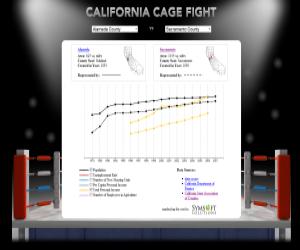
California Cage Fight
(info page) allows residents to compare their counties with other California counties and the state as a whole, including population growth, per capita income, unemployment, new houses and more.


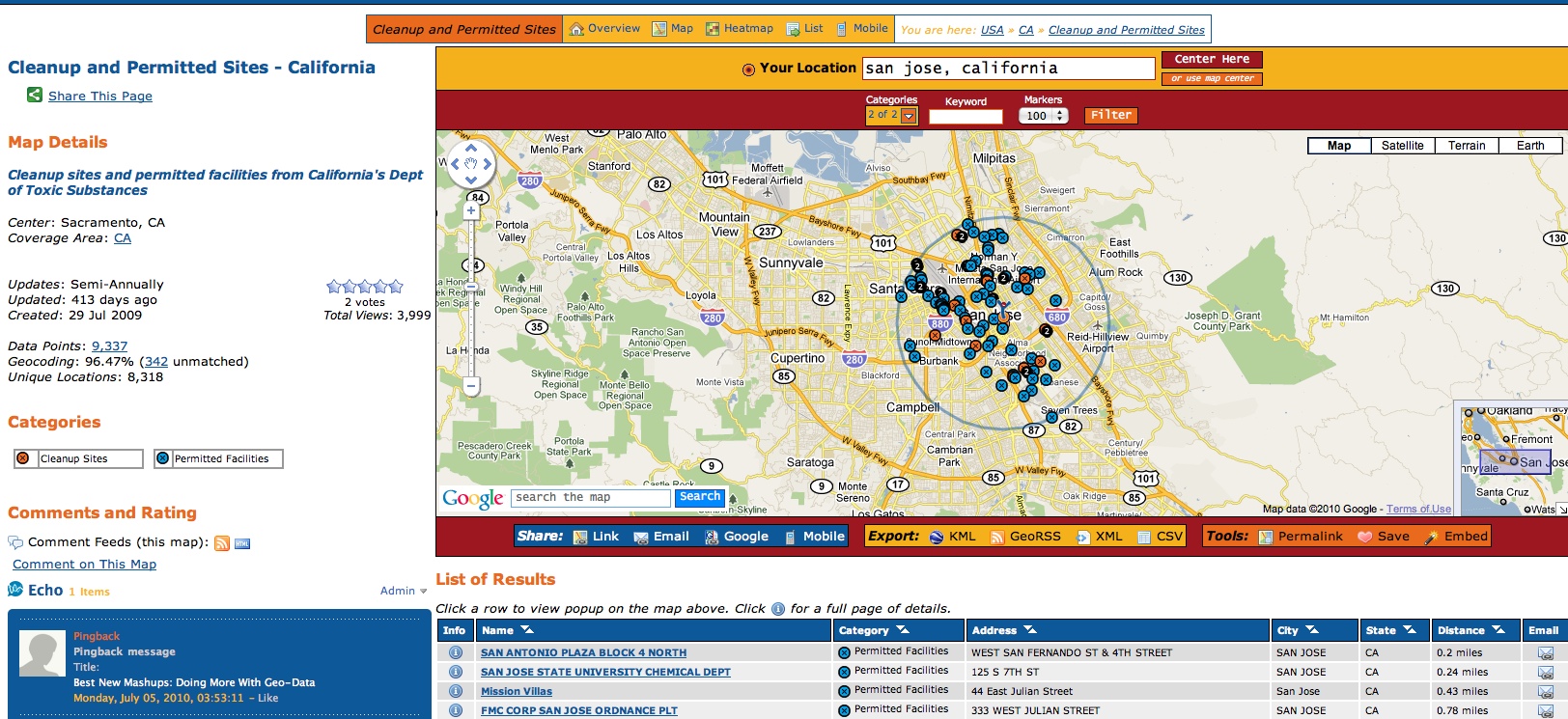
California Environment Report: Cleanup Sites and Permitted Facilities
(info page) provide residents with an interactive map that includes heatmaps, a mobile version with geolocation, data feeds, and detail pages for every cleanup site and permitted dacility from the CA Department of Toxic Substances Control Datasets.


California View
(info page) is a simple mapping tool that displays the locations of California state parks, fishing holes and boating facilities.


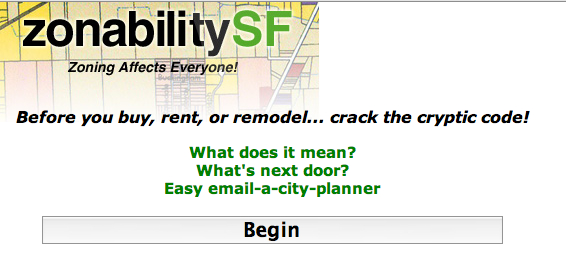
ZonabilitySF
(info page) provides mobile access to San Francisco zoning ordinance information. This app includes geolocation, interactive zoning maps, resources about code and a mechanism to ask a city planner questions.


DataCalifornia
(info page) provides a browser for California education, health and current legislation. The mashup allows users to “submit ideas on how the government should spend taxpayer money. Notably, it also has a constant stream of updates from schools, first responders and local politics. The site features Facebook integration, and a “Fix” button  that should be familiar to SeeClickFix users.

People’s Choice Award


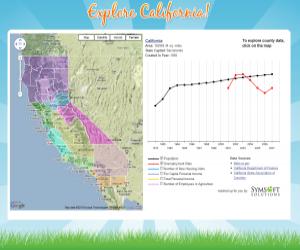
Explore California” (info page) and the California Cage Fight mashups won the People’s Choice Awards. Explore California is similar to Data California, providing users with an interactive map and visualizations population, income, unemployment, new housing units, and other trends over time. Visitors can “compare and contrast the patterns of growth and decline in various categories and the relationships between them.”

What’s do Apps for California mean for Gov 2.0?

At review time, the winners seems like it might have the most potential to enable better outcomes for citizens to engage with government, given the tool. The zoning app could potentially be quite useful to builders or homeowners. And if you’re also an angler, the easy lookup of potential hotspots could be of interest, though old salts might not want the increased competition. A complete list of Apps for California finalists is available at CA.gov.

The contest was conducted by the Center for Digital Government in collaboration with the state of California, the city of Los Angeles, the county of Los Angeles, the city and county of San Francisco, Google, Microsoft and ProgrammableWeb.com. That collaboration featured some of the nation’s biggest tech companies partnering with public institutions to create mashups that of open public data that would provide more value to citizens.

Overall, the state saw over a dozen applications developed over the summer that might have taken it much longer to build internally, and at substantially great cost. Beyond stimulating that activity, however, the success or failure of the contest will likely be judged not upon the prices awarded or the number of apps built but rather whether these applications make the lives of citizens easier or provide more frictionless access to information. That’s a judgement that will only be rendered with time.