If the American public wants to see meaningful progress on transparency, accountability or ethics in U.S. government, it should call on Congress to act, not the Trump White House. With little fanfare or notice, the United States of America has … Continue reading →
What’s next for open data in the United States? That was the open question posed at the Center for Data Innovation (CDI) last week, where a panel of industry analysts and experts gathered to discuss the historic open government data … Continue reading →
Livestreaming is not new to American politics in 2019. presidential candidates started using uStream in 2008. But it is much easier than ever before. Recent advances in smartphones and wirelesss Internet access have radically improved the capacity of politicians and … Continue reading →
In March 2018, three public policy scholars posted a provocative question: could the open government movement shut the door on freedom of information? At the time, I let it flow without refuting it from the Sunlight Foundation’s platform, but it’s … Continue reading →
Today, President Donald J. Trump signedH.R. 4174, the Foundations for Evidence-Based Policymaking Act of 2018, which, as the White House release summarized, “improves evidence-based policy through strengthening Federal agency evaluation capacity; furthering interagency data sharing and open data efforts; and improving access to data for statistical purposes while protecting confidential information.”
Two canonical principles for open, digital government in the 21st century are now the default in the United States:
public information should be open by default to the public in a machine-readable format, where such publication doesn’t harm privacy or security
federal agencies should use evidence when they make public policy
As I’ve said before, this reform represents “agenuine opportunityto not only improve how the nation makes decisions but embed more openness into how the federal government conducts the public’s business.”
This is a historic, bipartisan win for open government data, after years of trying. It is a milestone for the open movement, codifying core principles into code.
Thank you to all of the advocates, legislators, watchdogs and journalists who played an essential role in making open government data the law of the land.
The leadership of the Open Government Partnership has now confirmed that the United States is under review after it has failed to deliver commitments in good faith for two years.
“Having failed to submit an Action Plan by 12/31, the US will automatically be placed under ‘Review’ for procedural violations,” tweeted Nathaniel Heller, co-chairman of the Open Government Partnership. “That Review process can ultimately lead to being rendered ‘Inactive’ in OGP, or resolved with the eventual submission of a NAP in the coming months.”
In followuptweets, Heller clarified that there is now a strong precedent that, if a country fails to deliver the NAP during the Review period (here, Aug 2019), the Steering Committee would be very likely to agree to inactivity.
Aidan Eyakuze, co-chairman of the OGP Criteria and Standards subcommittee, clarified the next steps in a 5-part series of tweets, which add up to the following statement, condensed.
“The United States did not deliver an Open Government Partnership Action Plan (NAP) by the December 31, 2018 deadline. This delay means the US has not delivered an Action Plan for two consecutive cycles. As a result, the US will be placed under review by the Open Government Partnership Criteria & Standards subcommittee (C&S). This review process involves enhanced support by C&S, the Open Government Partnership Support Unit and the full Open Government Partnership Steering Committee to resolve issues that have delayed the submission of the NAP. The US will continue to be a full member of Open Government Partnership as the review process progresses, and a NAP for 2019 – 2021 is expected by August 31, 2019. If a NAP is not submitted by this date, C&S may consider recommending to the full Open Government Partnership Steering Committee that the US be designated as inactive.”
The consequence of missing the deadline are unclear.
“In the summer of 2018, an increasing proportion of the American public now tells Pew Research that President Trump “has definitely or probably not run “an open and transparent administration.” But there also has been an increase in the proportion of people who think that Trump definitely has done so, likely in part because the president has made that claim repeatedly.
In fact, in 2018 more Republicans now say Trump has run an open and transparent administration, over a time period when his administration’s record on open government if anything, grew worse in its second year: secretive, corrupt, hostile to journalism and whistleblowers, mired in scandal, shadowed by foreign entanglements, and characterized by false and misleading claims made to the public by a president whose tangled relationship with the truth is unprecedented in American history.”
As with President Trump’s corruption, his administration’s failure to deliver a new plan for open government and commit to democratic governance should speak for itself.
But in our age of partisan polarization and presidential disinformation, the news that the Trump administration failed to deliver new commitments on open government is likely to be dismissed by supporters and buried behind the President’s prime time address on immigration tonight, particularly if he invokes the emergency powers of his office. The public deserves better.
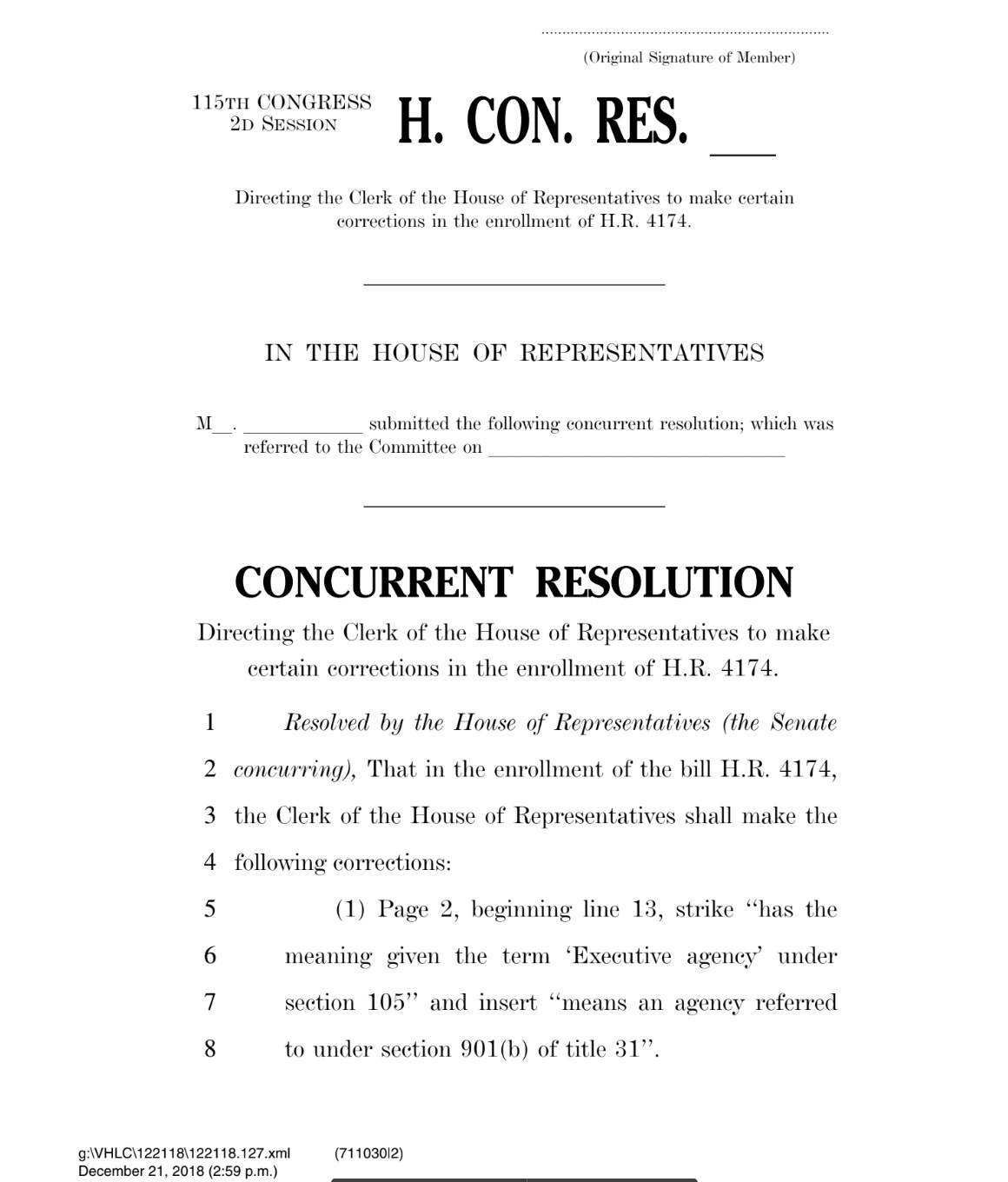
It’s worth noting that last minute objection did result in two amendments that the Senate had to act upon. Thankfully, on Saturday, December 22nd, the Senate acted, passing the resolution required to send the bill onwards to the president’s desk.
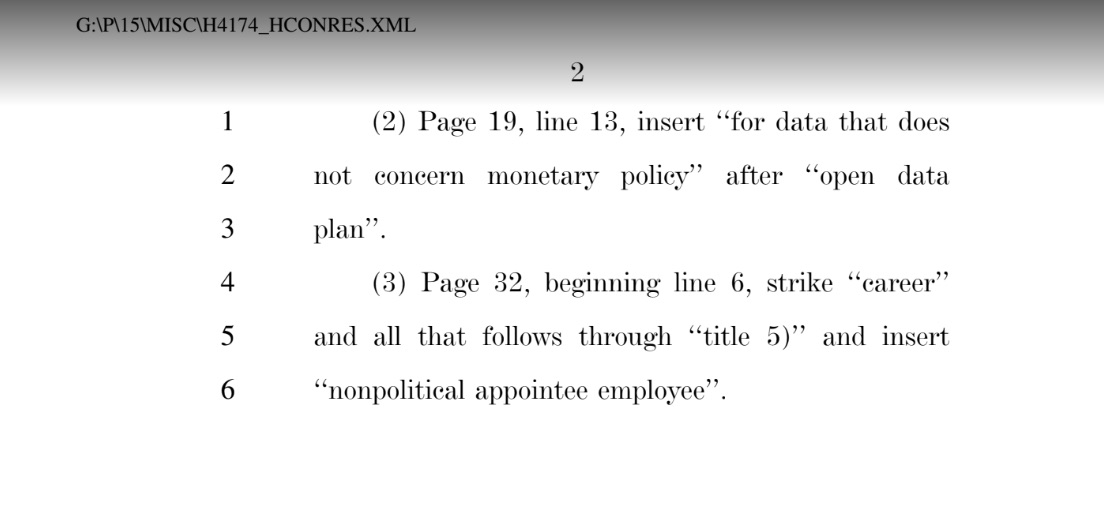
Here’s what changed: First, the text of Title I was amended so that it only applied to CFO Act agencies, not the Federal Reserve or smaller agencies. Title II (the Open Government Act) still applies to all federal agencies.
Second, there was a carve out in Title I “for data that does not concern monetary policy,” which relates to the Federal Reserve, among others.
While the shift weakened the first title of the bill a bit, this was still a historic moment: Congress has passed a law to make open data part of of the US Code.
While the United States is not the first or even the second democracy to pass an open data law – France and Germany have that distinction – this is a welcome advance, codifying the open government data policies, practices, roles and websites (looking at you, Data.gov) that the federal government had adopted over the past decade.
Open government activists, advocates and champions continue to celebrate, online and off.
Victory! Last night the @DataCoalition got the #OPENGovData Act through the Senate, as part of H.R. 4174. Expected to sail through the House TODAY. Sets a presumption, in law, that govt info ought to be published as #opendata, using data standards. https://t.co/jTdM1rIVTW
Excited to see the Open Government Data Act pass the House today! H.R. 4174 will enable libraries to provide businesses, researchers and students with valuable data that fuels innovation and economic growth. #OPENGovData#opendata
“The bipartisan passage of the Foundations for Evidence-Based Policymaking Act is a significant step toward a more efficient, more effective government that uses evidence and data to improve results for the American people,” said Michele Jolin, CEO and co-founder of Results for America, in a statement. “We commend Speaker Ryan, Senator Murray and their bipartisan colleagues in both chambers for advancing legislation that will help build evidence about the federally-funded practices, policies and programs that deliver the best outcomes. By ensuring that each federal agency has an evaluation officer, an evaluation policy and evidence-building plans, we can maximize the impact of public investments.”
“The OPEN Government Data Act will ensure that the federal government releases valuable data sets, follows best practices in data management, and commits to making data available to the public in a non-proprietary and electronic format,” said Daniel Castro, in a statement. “Today’s vote marks a major bipartisan victory for open data. This legislation will generate substantial returns for the public and private sectors alike in the years to come.”
“The passage of the OPEN Government Data Act is a win for the open data community”, said Sarah Joy Hays, Acting Executive Director of the Data Coalition, in a statement. “The Data Coalition has proudly supported this legislation for over three years, along with dozens of other organizations. The bill sets a presumption that all government information should be open data by default: machine-readable and freely-reusable. Ultimately, it will improve the way our government runs and serves its citizens. This would not have been possible without the support of Speaker Paul Ryan (WI-1-R), Senators Patty Murray (WA-D), Brian Schatz (HI-D), Ben Sasse (NE-R), and Rep. Derek Kilmer (WA-6-D). Our Coalition urges the President to promptly sign this open data bill into law.”
Congratulations to everyone who has pushed for this outcome for years.
[Image Credit: Sunlight Foundation]
This post has been updated, and corrected: France was ahead of Germany in enacting an open data law.
The arc of open government in United States is long, but perhaps it will bend towards transparency and accountability as 2018 comes to a close, in an unlikely moment in our history. After years of dedicated effort by advocates and bipartisan leadership in both houses of Congress, the Open, Public, Electronic, and Necessary Government Data Act (AKA the OPEN Government Data Act) is about to become law after the United States Senate passed the bill as part of H.R. 4174 on December 19.
Senator Brian Schatz (D-HI) shared the news in a tweet last night:
We just passed a bill that requires all data the govt collects (that isn’t secret or private) to be machine readable and interoperable. It’s data that taxpayers paid for and they deserve access – weather, traffic, census, budget numbers – it’s your info and you should have it.
Last night the Senate passed a bill I introduced in the House called the Open Government Data Act! There are so many possibilities for our economy when folks can access data they paid to develop and fund through the nation’s largest angel investor, Unce Sam. https://t.co/BvMX54mcCY
Here’s Schatz speaking about the bill at a Data Coalition event last winter:
Two steps remain: passage of the bill in the House and President Donald J. Trump signing it into law. Barring a scheduling issue or unexpected change (keep an eye out for shenanigans on the House floor today), the nation is close to a historic codification of two powerful principles:
public information should be open by default to the public in a machine-readable format, where such publication doesn’t harm privacy or security
federal agencies should use evidence to make public policy
Along with making open government data the default in U.S. government and requiring the White House Office of Management and Budget to oversee enterprise data inventories for every agency, the bill would require federal agencies to do the following, as listed in the summary from the Law Library of Congress:
This bill requires departments and agencies identified in the Chief Financial Officers Act to submit annually to the Office of Management and Budget (OMB) and Congress a plan for identifying and addressing policy questions relevant to the programs, policies, and regulations of such departments and agencies.
The plan must include: (1) a list of policy-relevant questions for developing evidence to support policymaking, and (2) a list of data for facilitating the use of evidence in policymaking.
The OMB shall consolidate such plans into a unified evidence building plan.
The bill establishes an Interagency Council on Evaluation Policy to assist the OMB in supporting government-wide evaluation activities and policies. The bill defines “evaluation” to mean an assessment using systematic data collection and analysis of one or more programs, policies, and organizations intended to assess their effectiveness and efficiency.
Each department or agency shall designate a Chief Evaluation Officer to coordinate evidence-building activities and an official with statistical expertise to advise on statistical policy, techniques, and procedures.
The OMB shall establish an Advisory Committee on Data for Evidence Building to advise on expanding access to and use of federal data for evidence building.
Open, Public, Electronic, and Necessary Government Data Act or the OPEN Government Data Act
This bill requires open government data assets to be published as machine-readable data.
Each agency shall: (1) develop and maintain a comprehensive data inventory for all data assets created by or collected by the agency, and (2) designate a Chief Data Officer who shall be responsible for lifecycle data management and other specified functions.
The bill establishes in the OMB a Chief Data Officer Council for establishing government-wide best practices for the use, protection, dissemination, and generation of data and for promoting data sharing agreements among agencies.
While the United States would not be not the first democracy to pass such a law, it would be a welcome advance, codifying many aspects of the open government data policies that have been developed and promulgated in the federal government over the past decade.
How did open government data get into the US Code?
This was no accident of fate or circumstance: This bill, which was previously passed by the House last month, was sponsored by the Speaker of the House, Paul Ryan. It’s an important element of his legislative legacy, and one that can and should earn praise – unlike other aspects of his time with the gavel.
It’s taken years of advocacy and activism by a broad coalition to get here, including the Sunlight Foundation, the EFF, Business Software Alliance, Center for Data Innovation, the Scholarly Publishing and Academic Resources Coalition, American Library Association, the R Street Institute, among many others, and bipartisan efforts on both sides of the aisle. Senator Ben Sasse (R-NE) co-sponsored the OGDA in the Senate, with 5 others, and former Representative Blake Farenthold (R-TX) cosponsored it in House, with 12 others.
While it has been watered down a bit, what I argued then is still true today: the bill “offers a genuine opportunity to not only improve how the nation makes decisions but embed more openness into how the federal government conducts the public’s business.”
The addition of OGDA into that bill was “an important endorsement of open government data by one of the most powerful politicians in the world” and “a milestone for the open movement, an important validation of this way of making public policy, and the fundamental principles of data-driven 21st century governance.”
I picked up the transparency baton on OGDA from former Sunlight analyst Matt Rumsey, Sunlight federal policy manager Sean Vitka, OpenGov Foundation founder Seamus Kraft, and Data Coalition founder Hudson Hollister, who drafted the original open data bill, working to make the principle that “public data created with taxpayer dollars should be available to the public in open, machine-readable forms when doing so does not damage privacy or national security” the law.
This is a huge win for public access to public information that every American can and should celebrate today. Special thanks for this victory are due to Christian Hoehner, policy director for the Data Coalition, who did extraordinary yeoman’s work getting this through Congress, Sasha Moss of the R Street Institute, Hollister, Daniel Schuman of Demand Progress, Daniel Castro and Joshua New at the Center for Data Innovation, and Gavin Baker from the American Library Association, some with whom I went to Congress with me to meet with staff over the years and advocated for the bill on and offline.
The passage of this bill won’t mean that the scanned images of spreadsheets that agencies still send in response to FOIA requests will magically go away tomorrow, but journalists, watchdogs and the public can now tell civil servants that they’re now behind the times: open government data is now the default in the USA! Please publish our data on the agency website in a structured format and let the public know.
Open government endures in the nation’s capital. On November 19, the U.S. National Archives and Records Administration (NARA) hosted a meeting between the Archivist of the United States, David Ferriero, senior officials, and representatives of civil society organizations that advocate for transparency and accountable government. Ferreiro has been hosting these meetings for nine years and counting. As in the past, I shared the agenda of our discussion online on the day of the meeting.
And, as in the past, NARA told me that the information they shared with us at the meeting was public – so I’ve written up what I learned, below.
On Kavanaugh records requests
The first topic on the agenda addressed Congressional and Freedom of Information Act requests and subsequent records disclosures stemming from associate Supreme Court Justice Brett Kavanaugh’s public service at the White House.
These records were the subject of considerable interest before his nomination and continue to be relevant to public understand of his public service and legal thinking, now that he has been confirmed to a seat on the nation’s highest court. (The White House invoked executive privilege on many of these documents.)
NARA’s chief counsel, Gary Stern, said that NARA has tried to be as transparent as possible about these records in response to requests from the U.S. Senate, highlighting the landing page for Kavanaugh’s records on Archives.gov. These requests comprise some 900,000 pages from Kavanaugh’s tenure as White House counsel in the Bush administration and 20,000 from his time on the special counsel’s team, of which 300,000 were processed by the end of October.
NARA could not process and disclose all of these records in their entirety prior to the hearing, Stern said. The remainder are pending, with another tranche of documents expected to go online in mid-December.
NARA determined that it was legally obligated to respond only to requests from the chairman of a given Senate or House Committee, citing an opinion by the Department of Justice’s Office of Legal Counsel.
Stern also noted a parallel process of review in which a private attorney, Bill Burke was involved in reviewing records for disclosure.
In answer to my question, NARA’s chief counsel confirmed that this situation was unprecedented, and said the scenario was neither addressed nor precluded by the statute.
As with the issue of requests by the minority party or the transparency of presidential libraries, NARA said that Congress would need to change the statute to address any loopholes.
Updates from the National Declassification Center (NDC)
The NDC is moving forward with declassification of more records from the Nixon presidency. It is also consolidating all classified records from the libraries of former administrations. NARA said it will announce a new National Declassification Center director this calendar year.
Separately, NDC chief operating officer William Bosanko said that NDC has sent CDs with more records from the Argentina Declassification Project to the National Security Council. NARA said that President Donald J. Trump will give the CDs to Argentine President Mauricio Macri at this week’s G20 Summit in Buenos Aires, as he did in 2017. The records on them will be disclosed to the public at the end November.
These disclosures by the State Department and US intelligence agencies are the result of actions directed by President Barack Obama in 2016, when he announced that the United States would declassify records about human rights abuses during Argentina’s dictatorship, from 1976 to 1983.
Updates from the Information Security Oversight Office (ISOO)
ISOO director Mark Bradley said that the office is making slow, deliberate, ongoing progress updating a new executive order on security classification system and has found it refreshing to find support in his work across agencies on the recommendations in ISOO’s annual report to the president. He noted that ISOO is facing the challenge of declining budgets at the same time a deluge of electronic records is inbound across the federal government.
Updates on records management
Laurence Brewer, the chief records officer of the United States, said NARA is continuing to work on updating the 2005 records guidance on Web records, with a goal of getting new guidance in place before 2020. NARA is focusing on modernization and transparency, and internally discussing how technology, resources, and sustainability. The updated guidance will include not just websites, but social media, instant messaging, cloud-based collaboration software like Slack, and ephemeral apps like Snapchat.
Brewer said that there will be a follow-up “very soon” on a 2017 meeting regarding this policy with me, Gavin Baker from the American Library Association, and the former leaders of the Sunlight Foundation’s Web Integrity Project. Sunlight, the American Library Association, and OpenTheGovernment subsequently sent a letter to NARA advocating that the policy include proactive public engagement, including public explanation and narration of updates, downtime, or removals to public records online. I encouraged NARA to engage more public stakeholders in future discussions, particularly the Internet Archive and the Library of Congress.
Separately, NARA is evaluating Regulations.gov as a government-wide tool for sharing proposed schedules and gathering public comment, moving beyond email. I highlighted some concerns about the impact of limitations to the Regulations.gov API on public access to public comments, and encouraged NARA to ensure bulk open data access would be an option.
When asked about the failure of the Department of Homeland Security to create adequate documentation to enable the reunification of children with their parents when it began enforcing the Trump administration’s family separation policy, NARA’s position is that DHS should have been creating records sufficient to the need. (This fall, a former adviser in DHS’ Office for Civil Rights and Civil Liberties said Border Patrol and Immigrations Customs Enforcement agents did not consult with the office, nor create sufficient documentation to enable the Department of Health to reunite families.) Brewer said that NARA relies upon agencies to have policies in place for a given activity, although it does require agencies to conduct training at all levels and performs oversight triggered by risk assessments of self-reported data and unauthorized dispositions.
When asked about the use of phone calls to avoid creating records, Stern said that while there is a threshold need to create adequate paper documentation of public business, it’s subject to interpretation. NARA has talked with senior staff about the issue and unauthorized dispositions and will posting updates on its dashboard.
The day after a historic midterm election night brought historic changes to the composition of Congress, state and local governments that more closely reflect the extraordinary diversity of the union, the United States remains a partisan, polarized nation.
Despite references to bipartisanship by U.S. House Minority Leader Nancy Pelosi and President Donald J. Trump in press conferences today, the prospects for productive camaraderie between a White House that demonizes its political opponents, the press, and immigrants and a House of Representatives that is investigating corruption, fraud, waste, and maladministration in the institution are dim this afternoon.
That is not, however, the weather forecast for sunshine in Washington.
The public should expect the 116th Congress to obtain the president’s tax returns, which he said again today that he would not disclose. (Under the law, the House Ways and Means Committee, the Senate Finance Committee & the Joint Committee on Taxation “can obtain any of the president’s returns from the IRSwithout his consent.”) Expect genuine oversight of federal agencies and Investigations of the president’s conflicts of interest and abuses of power. Depending upon what the special counsel reports to Congress, articles of impeachment. And maybe even anti-corruption and ethics reform, in its wake.
Rep. Elijah E. Cummings, the ranking member of the House Committee on Oversight and Government Reform, shared the grave concerns I expressed before the committee in 2017 about corruption, transparency, and ethics in this administration. Nearly every one has come to pass, and worse. In 2019, the new chairman of the oversight committee will be in a position to hold the Trump administration and the president accountable in a way he has not been before. Cummings issued a statement today that makes his commitment to doing his constitutionally mandated job clear:
“I thank the voters of Maryland’s seventh district for showing their faith in me and electing me to represent them in Congress.
The American people voted to give the House of Representatives a mandate—to conduct credible, independent, robust, and responsible oversight of the Trump Administration.
I have served as the top ranking Democrat on the Oversight Committee for nearly eight years. I have served with both Republican and Democratic Chairmen, and with Republican and Democratic Presidents. I have seen oversight work well, and I have seen it work poorly. For the past two years, it has been virtually nonexistent.
Meanwhile, President Trump has been eroding the foundations of our democracy. He has been degrading the vision of our Founding Fathers—from attacking the right to vote to undermining the freedom of the press.
Yesterday, the American people voted to change that. They voted for transparency and accountability. They voted to make sure our government works effectively and efficiently for the American people. And they voted to bring integrity back to government.
As part of that mandate, I plan to shine a light on waste, fraud, and abuse in the Trump Administration. I want to probe senior Administration officials across the government who have abused their positions of power and wasted taxpayer money, as well as President Trump’s decisions to act in his own financial self-interest rather than the best interests of the American people. I also want to focus on uplifting the American people and improving their day-to-day lives, from lowering prescription drug prices to ensuring access to affordable and quality healthcare to expanding funding for the opioid epidemic.
We must now accept this mandate and fulfill our solemn duties under the Constitution. I call on all of my Republican and Democratic colleagues to join us in this effort.”
Contrary to the hypocritical contention of Senate Majority Leader Mitch McConnell, oversight is not “presidential harassment.” While threatening to investigate Members of Congress of the opposition party for holding him to account was an abuse of public power by President Trump, there is no doubt that Congressional Democrats would be fulfilling their constitutional duty.
Congressional oversight of the executive branch has occurred throughout US history under the Constitution. Unfortunately, despite warnings from watchdogs concerned about corruption, there has been an embarrassing void of meaningful oversight in first two years of the Trump administration, despite warning signs in the presidential transition and then copious examples of ethics violations and corruption.
The 115th Congress was marked by an abdication of leadership on ethics and open government, in which Speaker of the House Paul Ryan simply abdicated his Constitutional role to check and balance a president with no experience in public service who has proceeded to brazenly mix public business with private interests in the most unethical presidency in modern U.S. history.
The public should expect more from our representatives. In 2019, we are likely to be more informed about the corruption, venality, and maladministration that has marked over the past two years in “Trump Town,” all of which Congress tolerated and even enabled through deregulation and lax oversight. In order to begin to restore public trust in federal government, those revelations will need to be accompanied by accountability and ethics reforms that an angry, active citizenry demand. Our union will only be as strong as we make it, together.