President Sarkozy at the eG8 Summit [VIDEO]

Today, the eG8 is considering the future of the Internet and society in Paris, in advance of the G-8 Summit. President Nicolas Sarkozy opened the summit after an introduction by Maurice Lévy, Chairman & CEO, Publicis Groupe, holding up the power of the Internet but emphasizing the role of the state in providing security, privacy and protection for intellectual property. Video is embedded below:

The moment that many may remember from the question and answer period that followed was when professor Jeff Jarvis asked President Sarkozy whether he’d take a “Hippocratic oath” to “first, do no harm” when making policy choices that affect the Internet.

Related coverage at the Guardian: Sarkozy opens eG8 Summit

Live from DC/Boston/Canada, it’s Episode 3 of Gov 2.0 TV

Two weeks ago, Gov 2.0 TV launched to cover what’s happening in open government. Today, we’ll be talking about some of the biggest stories of the past week. Tune in to FusedLogic.tv/live to catch today’s show.

http://bitcast-b.bitgravity.com/player/6/functions.js //

Here’s a quick rundown of a few stories we’ll be talking about:

With a new road map, New York City aims to be the nation’s premier digital city

Today, New York City released its strategy to use technology to improve productivity, save money, attract startups and upgrade the services it provides to citizens. That’s a tall order, but then New Yorkers have rarely been know to think small or dream moderately.

“We want New York City to be the nation’s premier digital city – in how local government interacts with New Yorkers, in how New Yorkers have access to and capitalize on new technologies, and in how our tech and digital media sectors evolve, grow businesses and create jobs,” Mayor Michael Bloomberg said in a statement. His office released an official statement digital roadmap at MikeBloomberg.com. “NYC’s #digitalroadmap has 4 goals: access, open government, citizen engagement & expanding NYC’s digital job growth,” tweeted Bloomberg after the announcement.

Nick Judd secured an advance copy of NYC’s road map to the digital city over at techPresident, which I’ve embedded below, and has this analysis of some of the important bytes.

There are no explicit plans in the report for increasing the number of available datasets — such as more detailed city budget data — but do include an “apps wishlist” to streamline the process of requesting more data.

Implementing the recommendations in the report will in large part be the responsibility of city Department of Information Technology and Telecommunications Commissioner Carole Post, who is already in the process of pushing internally for updated city IT.

Archived video of today’s announcement by Mayor Bloomberg and NYC chief digital officer Rachel Sterne (which was, appropriately, livestreamed online) is embedded below.

Watch live streaming video from nycgov at livestream.com

While some media outlets will focus on NYC embracing Twitter, Facebook and Foursquare as digital partners, a notable aspect of today’s news that may fly under the radar may be that NYC.gov will be adding APIs for Open311, its open data mine and other Web efforts. Those are the open government pillars that will support New York City’s effort to architect a city as a platform. For more on how New York City is citizensourcing smarter government, head on over to Radar.

Social media will play a role in the months ahead. When Adam Sharp, Twitter’s government guy, tweeted out the Wall Street Journal above, he highlighted a feature that melds social media with old school mobile technology: the use of “Fast Follow,” a function that goes back to Twitter’s earliest days.

“New Yorkers who want to follow @nycgov by SMS can text “follow nycgov” to 40404. No @Twitter acct or computer needed,” tweeted Sharp.

That means that every resident with a phone call can receive updates from the city’s official account. It will be interesting to see if city government advertises that to its residents over the coming months, particularly in areas where Internet penetration rates are lower.

Anil Dash, native New Yorker, blogger and entrepreneur, highlighted something important in the plan that transcended any particular initiative, technology or policy: it captures New York City government thinking about the Web as a public space.

It’s an extraordinary document, and as someone who loves the web, civic engagement, public infrastructure and New York City, it feels like a momentous accomplishment, even though it marks the beginning of a years-long process, not just the end of a months-long one.

But the single biggest lesson I got from the 65-page, 11.8mb PDF is a simple one: The greatest city in the world can take shared public spaces online as seriously as it takes its public spaces in the physical world.

As you’d expect, there’s a press release about the Digital Road Map, but more reassuringly, the document demonstrates the idea of the web as public space throughout, making the idea explicit on page 43:

Maintaining digital ‘public spaces’ such as nyc.gov or 311 Online is equally important as maintaining physical public spaces like Prospect Park or the New York Public Library. Both digital and physical should be welcoming, accessible, cared for, and easy to navigate. Both must provide value to New Yorkers. And for both, regular stewardship and improvements are a necessity.

New York City’s road map for a digital city plan is embedded below. You also can download the digital city roadmap as a PDF.

NYC ODC 90day Report 5-15C(function() { var scribd = document.createElement(“script”); scribd.type = “text/javascript”; scribd.async = true; scribd.src = “http://www.scribd.com/javascripts/embed_code/inject.js”; var s = document.getElementsByTagName(“script”)[0]; s.parentNode.insertBefore(scribd, s); })();

UPDATE: There are some concerns about what happens next out there in the community. New York City resident and director of the CUNY Mapping Service at the Graduate Center of the City University of New York (CUNY) Steven Romalewski also listened in on the announcement and blogged his concerns about ‘open data fatigue“:

I always worry when I see the city touting its technology efforts without also including local Community Boards, neighborhood groups, business advocates, urban planners, other elected officials, etc. who rely on access to public data so they can hold government accountable and do their jobs better. In my view, these groups need the data moreso than app developers. That is why open data efforts and policies are so important.

But the city seems more focused on apps than on community. I understand the economic development appeal of fostering startups. But the open data movement long predated apps.  I highlighted this in my post last year (see the “Misplaced Priorities” section).

Apps are great (I use them constantly, and I’ve even developed one myself). And kudos to the city and its agencies for responding to app developers and making data more open so the developers can do great things with the data (things even the city might not do).

I just hope the latest announcements by the city will result in more real and lasting efforts to make data easier to access than the latest check-in craze. The Mayor already expressed some hesitation to making data accessible when a reporter asked him about CrashStat. CrashStat is a great example of my point — it wasn’t created to be an “app” per se; it’s an effort by a local nonprofit group to use public data to educate the public and hold government agencies more accountable about traffic injuries and fatalities. But the Mayor said he didn’t even know what CrashStat was, while making excuses about not making data available if it’s not in electronic format, or needs to be vetted, or is “sensitive”.  Blah blah blah – we’ve heard all that before and it undermines my confidence in the city’s pronouncements that more data will really be made open.

Architecting a city as a platform [VIDEO]

The 21st century metropolis can be a platform for citizens, government and business to build upon. The vision of New York City as a data platform has been getting some traction of late as the Big Apple’s first chief digital officer, Rachel Sterne, makes the rounds on the conference circuit. In the video below, Sterne gives a talk the recent PSFK Conference where she highlights various digital initiatives that NYC has rolled out.

PSFK CONFERENCE NYC 2011: Rachel Sterne from Piers Fawkes on Vimeo.

During her talk, Sterne talks about “The Daily Pothole,” how NYC is tumbling, QR code technology on building permits, a NYC 311 app and using Twitter, amongst other themes.

For more on how New York City is citizensourcing smarter government, head on over to Radar.

[Hat tip: PSFK]

Todd Park and Tim O’Reilly on collaboration and healthcare [VIDEO]

What if open health data were to be harnessed to spur better healthcare decisions and catalyze the extension or creation of new businesses? That potential future exists now, in the present.

Todd Park, chief technology officer of the Department of Heath and Human Services, has been working to unlock innovation through open health data for over a year now. On many levels, the effort is the best story in federal open data. In the video below, he talks with my publisher, Tim O’Reilly, about collaboration and innovation in the healthcare system.

PHARM FRESH: Todd Park and Tim O’Reilly Discuss How Collaboration Leads To Healthcare Innovation from Zemoga on Vimeo.

The next big event in this space on June 9 at the NIH. If you’re interested in what’s next for open health data, track this event closely.

[Hat tip: PharmFresh]

US Senate hears testimony on the role of social media in crisis response

If you watched today’s hearing in the United States Senate on the role of social media in emergency management, “you witnessed a turning point in Gov 2.0,” says Brian Humphrey of the Los Angeles Fire Department. It’s certainly an important moment for the global community that has used these channels to communicate, coordinate and response to both recognize and share. CPAN’s video of the event is embedded below:


http://www.c-spanvideo.org/videoLibrary/assets/swf/CSPANPlayer.swf?pid=299342-1 

The Social Media for Emergency Management (SM4EM) blog has a great summary of SMEM on Capitol Hill, including a link to Crisis Commons co-founder Heather Blanchard’s written testimony.

The excellent speakers provided key examples of use and statistics on the use of social media during crisis situations. Some of these incredible examples included:

  • Direct communication between an eyewitness & Director Fugate during an emergency
  • Pace of fundraising that the Red Cross has experienced through their text campaign
  • The use of iPhone applications to share information about shelters
  • Google’s Person Finder application supporting recent disasters which was active 90 minutes after Japan’s earthquake
  • Skype use between communication between disaster victims and their families at home
  • Use of Google Maps by soldiers for planning

Here’s a few other insights that stuck me, along with related coverage:

  • “it’s not the technology tool, it’s the data behind it, and the people able to coordinate info”-Heather Blanchard (@poplifegirl)http://j.mp/fHhN2R
  • “The best thing would be no “social media” people but that it’s an integral part of every position”- Wendy Harman (@wharmanhttp://oreil.ly/gsocRc
  • “geotagged social media and data can provide real-time, on the ground situational information”-Heather Blanchard, http://oreil.ly/9VRguV
  • “When we talk about information overload, what we’re really talking about is a lack of filters”-Heather Blanchard http://oreil.ly/gsocRc
  • FEMA Administrator Craig Fugate (@CraigatFEMA) said under oath that he tweets himself. http://bit.ly/muJd9O
  • Fugate also said that some of his peers now rate social media and mobile as important a revolution as radio

Read more:

A little sweat never hurt nobody

The White House partnered with superstar musician Beyoncé Knowles and the National Association of Broadcasters on a “flash workout” that’s actually fun. First Lady Michelle Obama is using it as part of her Lets Move! campaign against child obesity.

The official dance video with Beyoncé and wide selection of teens is, in this thirtysomething correspondent’s opinion, both fun and well edited.

It says something about 2011 that the First Lady of the United States went out and danced around a bit herself.

My favorite video, by far, however, is when Beyoncé showed up and surprised students at PS/MS 161 Don Pedro Albizu Campus in New York City.

I can’t help but wish more celebrities donated their time, passion and interest to inspiring kids to get up and move more. Well played.

Taking stock of global freedom of expression on World Press Freedom Day

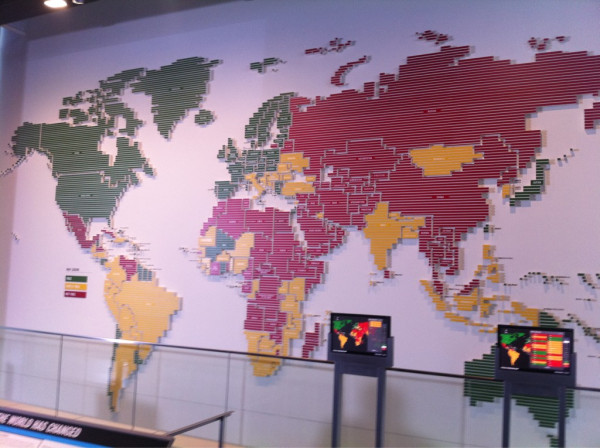
In 2010, only 1 in 6 people lives in countries with a free press, according to a new report on press freedom from Freedom House. There is a long road ahead to establishing and protecting freedom of expression for humanity.

This week, defenders of free expression are celebrating the progress of press freedom and recognizing the challenges that persist globally on World Press Freedom Day 2011. This is the 20th anniversary of the Windhoek Declaration that helped to establish UNESCO’s World Press Freedom Day. The United States is hosting this year’s World Press Freedom Day in Washington, D.C. at the Newseum. You can watch the livestream below and follow the conversation on Twitter on the #wpfd hashtag, both of which are embedded below.

wpfd2011 on livestream.com. Broadcast Live Free

new TWTR.Widget({
version: 2,
type: ‘search’,
search: ‘#wpfd OR #pressfreedom’,
interval: 6000,
title: ‘What\’s happening on’,
subject: ‘World Press Freedom Day’,
width: ‘auto’,
height: 500,
theme: {
shell: {
background: ‘#004382’,
color: ‘#ffffff’
},
tweets: {
background: ‘#ffffff’,
color: ‘#444444’,
links: ‘#1985b5’
}
},
features: {
scrollbar: false,
loop: true,
live: true,
hashtags: true,
timestamp: true,
avatars: true,
toptweets: true,
behavior: ‘default’
}
}).render().start();

To learn more about global freedom of expression and and the organizations that protect journalists and support the collection and dissemination of news about our world, visit:

White House Office of Management and Budget hosts forum on federal IT reform

Last December, the White House proposed sweeping IT reforms. Today in Washington, the nation’s top IT executives will discuss progress on those proposals and assess the challenges that lie ahead. The livestream is embedded below:

http://www.whitehouse.gov/sites/default/modules/wh_multimedia/EOP_OVP_player.swf

This morning, President Obama issued an executive order streamlining service delivery and improving customer service.

Government managers must learn from what is working in the private sector and apply these best practices to deliver services better, faster, and at lower cost. Such best practices include increasingly popular lower-cost, self-service options accessed by the Internet or mobile phone and improved processes that deliver services faster and more responsively, reducing the overall need for customer inquiries and complaints. The Federal Government has a responsibility to streamline and make more efficient its service delivery to better serve the public.”

The White House Office of Management and Budget’s Jeff Zients, the national chief performance officer, will talk about productivity and efficiency enabled by information technology. As the Washington Post reported, Zients will unveil a new customer service initiative this afternoon as well.

According to Politico’s Morning Tech, federal “CIO Vivek Kundra will offer an update on the administration’s IT plans; Deputy Energy Secy Daniel Poneman will focus his remarks on cloud use and adoption; Deputy USDA Secy Kathleen Merrigan will chat about data centers; VA’s Roger Baker will discuss the administration’s plans to eliminate or revise underperforming IT projects and DHS CIO Richard Spires will outline efforts to set up IT best practices.”

More to come as the event goes forward.

Editor’s Note: The White House livestream went down about 18 minutes in and then went on and off. Unfortunately, as this correspondent did not attend in person, other first accounts will have to capture much of what occurred.

What is open government data? What is it good for? [FILM]

Open government data broadly refers to public sector records that have been made available to citizens. For a canonical resource on what makes such releases truly “open,” consult the 8 principles of open government data. Today, the Open Knowledge Foundation has released a terrific new short film entitled “#opendata” that offers expert perspectives on what open government data is and how it can be useful to society.

#opendata from Open Knowledge Foundation on Vimeo.

For more information, visit OpenGovernmentData.org. The film has already been translated into Czech, Spanish, Hungarian and Chinese. If you’d like to volunteer to translate it into another language, the makers of the film are actively seeking help.

In the broader context, The Economist‘s support for open government data remains salient today: “Public access to government figures is certain to release economic value and encourage entrepreneurship. That has already happened with weather data and with America’s GPS satellite-navigation system that was opened for full commercial use a decade ago. And many firms make a good living out of searching for or repackaging patent filings.”

In the United States, the open data story in healthcare is particularly compelling, from new mobile apps that spur better health decisions to data spurring changes in care at the Veterans Administration.

As Clive Thompson reported at Wired this month, public sector data can help fuel jobs, “shoving more public data into the commons could kick-start billions in economic activity.” In the transportation sector, for instance, transit data is open government fuel for economic growth.

Thompson focused on the story of Brightscope, where government data drives the innovation economy. “That’s because all that information becomes incredibly valuable in the hands of clever entrepreneurs,” wrote Thompson. “Pick any area of public life and you can imagine dozens of startups fueled by public data. I bet millions of parents would shell out a few bucks for an app that cleverly parsed school ratings, teacher news, test results, and the like.”