President Obama: Such a senseless and terrible act of violence has no place in a free society

Earlier today, Congresswoman Giffords was shot in Tucson, Arizona, along with over a dozen other people, at least two of whom have died. On this tragic day, many citizens and media alike are trying to filter fact from fiction. Both the president and the speaker of the House have issued statements condemning the violence.

President Barack Obama takes part in a conference call in the Situation Room of the White House concerning the shooting of Rep. Gabrielle Giffords and others in Tucson, Az., Saturday, Jan. 8, 2011. Pictured, left to right, National Security Advisor Tom Donilon, incoming Chief of Staff Bill Daley, Deputy Chief of Staff Jim Messina, Director of Communications Dan Pfeiffer, and Assistant to the President for Legislative Affairs Phil Schiliro. Also taking part in the call were Attorney General Eric H. Holder, Jr., Homeland Security Secretary Janet Napolitano, and FBI Director Robert Mueller (Official White House Photo by Pete Souza)

President Barack Obama takes part in a conference call in the Situation Room of the White House concerning the shooting of Rep. Gabrielle Giffords and others in Tucson, Az., Saturday, Jan. 8, 2011. Pictured, left to right, National Security Advisor Tom Donilon, incoming Chief of Staff Bill Daley, Deputy Chief of Staff Jim Messina, Director of Communications Dan Pfeiffer, and Assistant to the President for Legislative Affairs Phil Schiliro. Also taking part in the call were Attorney General Eric H. Holder, Jr., Homeland Security Secretary Janet Napolitano, and FBI Director Robert Mueller (Official White House Photo by Pete Souza)

From WhiteHouse.gov:

“This morning, in an unspeakable tragedy, a number of Americans were shot in Tucson, Arizona, at a constituent meeting with Congresswoman Gabrielle Giffords. And while we are continuing to receive information, we know that some have passed away, and that Representative Giffords is gravely wounded.

We do not yet have all the answers. What we do know is that such a senseless and terrible act of violence has no place in a free society. I ask all Americans to join me and Michelle in keeping Representative Giffords, the victims of this tragedy, and their families in our prayers.”-President Barack Obama

President Obama made a short statement to the nation from the White House in a live video address regarding the shooting in Tucson.

http://www.whitehouse.gov/sites/all/modules/swftools/shared/flash_media_player/player5x2.swf

The president confirmed the death of at least five people in the shooting in this tragedy, among them federal judge John Roll, and a nine year old girl. [Emphases that follow are mine-Ed.]

THE PRESIDENT: As many of you are aware, earlier today a number of people were shot in Tucson, Arizona, including several who were meeting at a supermarket with their congresswoman, Gabrielle Giffords. We are still assembling all the facts, but we know that Representative Giffords was one of the victims. She is currently at a hospital in the area, and she is battling for her life.

We also know that at least five people lost their lives in this tragedy. Among them were a federal judge, John Roll, who has served America’s legal system for almost 40 years; and a young girl who was barely nine years old.

I’ve spoken to Arizona governor Jan Brewer and offered the full resources of the federal government. A suspect is currently in custody, but we don’t yet know what provoked this unspeakable act. A comprehensive investigation is currently underway, and at my direction, Director Bob Mueller is en route to Arizona to help coordinate these efforts. I’ve also spoken to the Democratic and Republican leaders in the House.

Gabby Giffords was a friend of mine. She is not only an extraordinary public servant, but she is also somebody who is warm and caring. She is well liked by her colleagues and well liked by her constituents. Her husband, Mark Kelly, is a Navy captain and one of America’s valiant astronauts.

It’s not surprising that today Gabby was doing what she always does — listening to the hopes and concerns of her neighbors. That is the essence of what our democracy is all about. That is why this is more than a tragedy for those involved. It is a tragedy for Arizona and a tragedy for our entire country.

What Americans do at times of tragedy is to come together and support each other. So at this time I ask all Americans to join me and Michelle in keeping all the victims and their families, including Gabby, in our thoughts and prayers. Those who have been injured, we are rooting for them. And I know Gabby is as tough as they come, and I am hopeful that she’s going to pull through.

Obviously our hearts go out to the family members of those who have been slain. We are going to get to the bottom of this, and we’re going to get through this. But in the meantime, I think all of us need to make sure that we’re offering our thoughts and prayers to those concerned.

Thank you.

Today, the Speaker of the House, the President of the United States, and his opponent from the last election spoke from a united position. From Speaker.gov:

I am horrified by the senseless attack on Congresswoman Gabrielle Giffords and members of her staff. An attack on one who serves is an attack on all who serve. Acts and threats of violence against public officials have no place in our society. Our prayers are with Congresswoman Giffords, her staff, all who were injured, and their families. This is a sad day for our country.” – Speaker of the House John Boehner

U.S. Senator John McCain (R-AZ) made the following statement

“I am horrified by the violent attack on Representative Gabrielle Giffords and many other innocent people by a wicked person who has no sense of justice or compassion.  I pray for Gabby and the other victims, and for the repose of the souls of the dead and comfort for their families.  I beg our loving Creator to spare the lives of those who are still alive, heal them in body and spirit, and return them to their loved ones.

“Whoever did this; whatever their reason, they are a disgrace to Arizona, this country and the human race, and they deserve and will receive the contempt of all decent people and the strongest punishment of the law.” – Senator John McCain

Senator McCain also made the following statement regarding the passing of Chief Judge John Roll:

“I am deeply saddened to hear that Chief Judge John Roll was killed today during the senseless act of violence against Congresswoman Giffords and other Arizonans. Words are inadequate to express such a profound loss to his family, friends, state and country, but it is appropriate to note that a man of great qualities and character was struck down today, and the wickedness of this atrocity, which included the murder of a small child, has broken the hearts of many and will be mourned for years to come. I am proud to have recommended Judge Roll to President Bush for the federal bench in 1991 and have been extremely proud of his work on the bench since then. I am most proud to have called him a friend. Judge Roll dedicated his life to public service and was admired by many for his integrity, kindness and love for the law, for the state of Arizona and our country. He began his career as a bailiff in the Pima County Superior Court and was at his death the Chief Judge for the District of Arizona since 2006. He distinguished himself in every office he held. He will be missed very much. Cindy and I are praying for his soul and for his beloved wife and children and the families of all the victims in this terrible moment of sorrow. Our state has lost a good man, a true and able advocate for justice for all and a great Arizonan. May God grant him perpetual peace.”

The White House blog also linked to statements from Vice President Joe BidenHomeland Security Secretary Janet Napolitano, Attorney General Eric Holder, and NASA Administrator Charles Bolden.

Giffords online

Shortly before the shooting, Congresswoman Giffords tweeted that “My 1st Congress on Your Corner starts now. Please stop by to let me know what is on your mind or tweet me later.” The tweet will serve as a poignant reminder of the day. There will be a vigil at the Capitol and in Tucson for Giffords and other victims.

The first quote on Congresswoman Giffords’ Facebook page holds additional resonance today:

“With malice toward none, with charity for all, …let us strive on to finish the work we are in, …to do all which may achieve and cherish a just and lasting peace among ourselves and with all nations.” — President Abraham Lincoln

NPR’s Andy Carvin covered the emerging story using Storify:

http://storify.com/acarvin/rep-gifford.js

Extended thoughts on Twitter and the White House from the first @PressSec

Today, news that White House press secretary Robert Gibbs will be leaving to become an outside political adviser to the president and his re-election campaign. In the White House press briefing today, Gibbs reflected upon several ways that his role has changed as the speed of reporting has increased, particularly in the context of Twitter. Gibbs was the first White House press secretary to tweet, at @PressSec.

The two questions Gibbs answered today for #1Q centered on exactly the question: what’s next for Gibbs – and for his @PressSec account?

“None of these tools were developed for me,” said Gibbs. “They were developed for you.”

He implied that @PressSec will continue, though it’s not immediately clear whether he’ll transition the account. For more on his thinking on social networking, relevant excerpts from the transcript from the briefing follow.

Q: Thank you. Having been at this for two years, can you talk to us a bit about the value of the daily briefing? Do you think it’s helpful to the general public? Is it helpful to reporters? Is it helpful to the White House? Would you make any changes? Would you take it off camera? Do you like it being on camera?

MR. GIBBS: Look, we’ve experimented with a couple different things like — I do think there’s a great utility in doing some off-camera gaggles. We probably, truth be told, haven’t done enough of those. I think there’s an ability to talk about things slightly differently without all these fancy lights.

I think it’s important, though, as I said — I alluded to earlier, it’s important to, as a government, to come out here and talk about and answer the — talk about the policies and decisions that are being made and to answer the questions surrounding those.

Like I said, there are days in which — my guess is it will happen again this week — where you pick up that newspaper or you turn on your computer at 4:30 a.m. in the morning while your coffee is still brewing and you groan and, oh, God, what — you know, great, this is going — and then you get on your BlackBerry.

But I think there’s a usefulness to that. I think there’s a reason that this has been an enduring quality. I do think there is — look, I think there has to be — I think there should continue to be experimentation, again, with gaggles. We’ve tried more stuff on social networking that I think will continue long past my existence inside this building because that, too, is important.

You now have the ability to — look, I got on something like Twitter largely from watching you guys tweet while the President was standing right here. And it’s a fascinating concept. All this stuff moves much faster. I think that will endure. And I think the briefing will endure. And I think what gets added to and what complements the briefing in terms of breaking down any walls that exist between the people and their government will only accelerate.

Gibbs then took a question on his use of social media platforms, which, as the questioner pointed out, he used to call “the Twitter” and YouTube. Gibbs said that was “a joke.” Take a look at WhiteHouse.gov/1Q for an archive of his use of the two platforms.

Q: The use of these kind of platforms, to what degree can you gauge its effectiveness in terms of sort of bypassing us, who are filters —

MR. GIBBS: Well, here’s I think a great misnomer, because I think it’s important — social networking and the use of those type of tools I think — I don’t look at it as, boy, I can now talk to people and you guys — I’m going to go around you. I’ve neversaid that. Because, quite frankly, I subscribe to what you write; youguys subscribe to what I write. And I think what’s unique is we’ve done recently — and I’ve greatly enjoyed them, though I realize that — and I know you all agree — that very few of my answers conform to 140 characters. But I think it’s interesting that you can have a dialogue with people who are going about their daily lives, who have questions for the administration about what it’s doing, and you guys have written off of that.

And I think that’s — I just don’t think people should look at the increased transparency in their government, a greater explanation of the decisions that we’re making, as an effort to move around and go around you guys.

Food for thought. Hat tip to Nancy Scola at techPresident, who offers additional analysis. If you’re at all interested in what happens next to @PressSec, or how the new media aspects of today’s transition were handled, Scola’s post on the 112th Congress’ great Twitter handover is an absolute must-read.

If you missed the first two rounds of Gibbs taking extended questions from the public over Twitter, they’re captured here, along with analysis of what transparency really means in this context.

Defining Gov 2.0 and Open Government

Fireworks begin as the Killers perform on the South Lawn of the White House, July 4, 2010, during the Fourth of July celebration. (Official White House Photo by Pete Souza)

Fireworks begin as the Killers perform on the South Lawn of the White House, July 4, 2010, during the Fourth of July celebration. (Official White House Photo by Pete Souza)

Exploring what this year will hold for the intersection of government, technology, citizens and business is a fascinating – and immense – challenge.

That is, however, precisely what I plan on doing,  here, at the Gov 2.0 section of O’Reilly RadarThe Huffington PostReadWriteWeb, National Journal, Mashable, Forbes and other outlets.

Yesterday, I participated in a discussion on Twitter that touched upon “Gov 2.0,” open government and social media. I include explanations for those terms below. Dozens of people participatedusing the #SMfastfwd hashtag on Twitter or at the #SMFastFWD room at TweetChat.com.

Be forewarned: there’s some jargon below, but then the organizer of the chat specifically asked for explanations. My answers and key considerations raised by several participants for the year ahead follow.

How do you define Gov 2.0? What about open government? What’s the difference? How do these relate to transparency?

What is government 2.0? Government social software expert Maxine Teller described the concept succinctly: Gov 2.0 equals “leveraging emerging tools, techs & collaboration PRINCIPLES to improve efficiency & effectiveness,” she tweeted. “Today’s tools & tech enable us to return to founding principles: government for, by & of the people.”

That’s useful, since many days it can seem like there are as many definitions for Gov 2.0 as there are people. That’s what happens when a term edges towards becoming a buzzword, particularly anything with a “2.0” added on.

Tim O’Reilly, my publisher, has explained how Gov 2.0 is all about the platform. In many ways, Gov 2.0 could be simply described as putting government in your hands.

As I’ve previously observed in writing about language, government 2.0, jargon and technology, I believe the term should be defined primarily by its utility to helping citizens or agencies solve problems, either for individuals or the commons. Defining it in gauzy paeans evangelizing world-shaking paradigm shifts from the embrace of social media by politicians isn’t helpful on that level.

That’s particularly true when politicians are using platforms to broadcast, in the model of 20th Century, not having iterative conversations that result in more agile government or participatory democracy.

Craigslist founder Craig Newmark put it another way yesterday: “Open government includes much greater gov’t transparency, that is, tell citizens what’s going on,” he tweeted. “Gov 2.0 includes gov’t and citizens working together for better customer service, more accountability.”

That melds well with O’Reilly’s perspective, where government 2.0 is the “idea of the government as platform: how can government design programs to be generative, […] building frameworks that enable people to build new services of their own.”

In a Forbes column in 2009, he’d framed this as “the opportunities inherent in harnessing a highly motivated and diverse population not just to help [politicians] get elected, but to help them do a better job.”

“Citizens are connected like never before and have the skill sets and passion to solve problems affecting them locally as well as nationally. Government information and services can be provided to citizens where and when they need it. Citizens are empowered to spark the innovation that will result in an improved approach to governance.

In this model, government is a convener and an enabler–ultimately, it is a vehicle for coordinating the collective action of citizens.

This is the right way to frame the question of “Government 2.0.” How does government itself become an open platform that allows people inside and outside government to innovate? How do you design a system in which all of the outcomes aren’t specified beforehand, but instead evolve through interactions between the technology provider and its user community?

Open government relates to that but isn’t necessarily grounded in technology, although certain aspects of it under the Obama administration absolutely have been.

As Chris Kemp, NASA’s chief technology officer for IT, put it last year, “The future of open government is allowing seamless conversations to occur between thousands of employees and people … You can’t divorce open government from technology. Technology enables the conversation and supports the conversation. We’re finding that if we don’t stand in the way of that conversation, incredible things can happen.”

If you’ve been tracking the progress of the Open Government Directive since 2009, you know that it required federal agencies to take steps to achieve key milestones in transparency, participation, and collaboration. As 2011 begins, more of those plans are still, for the most part, evolving towards implementation.

The progress of open government in the United States has beeen slowed by bureaucracy, culture, and the context of a White House balancing wars abroad and immense macroeconomic pressures, a populace deeply distrustful of many institutions,  and, at the end of 2010, the emergence and disruption presented by the more “radical openness” of Wikileaks.

It was clear back in September that in the United States, open government is still very much in its beta period. It was in that context, that, in December, the White House made a new, ambitious request of the American people: help them to design digital democracy by creating a platform for expert consultation on policy.

In doing so, the architects of initiative embraced the notion government acting as a convener or collaborator, trying to co-create better policy or outcomes. By its nature, such open government platforms are expressed as top down, where officials work to create more participatory, collaborative model of governance.

Gov 2.0, by contrast, is more often conceived as expressly technology driven, founded in the platform principles of Web 2.0, and buoyed by the efforts of citizens and civic entrepreneurs to build “do-it-ourselves” government. Both Gov 2.0 and open government can and do increase transparency.

Consider this detail from a webcast, “What is Gov 2.0?,” which combines open government and Gov 2.0 in action:

“The first person who really put Gov 2.0 on my radar was Carl Malamud. Carl is really the father of this movement in so many ways. Back in 1993, that’s pretty darn early in the history of the World Wide Web, he put the SEC online.He got a small planning grant from the  National Science Foundation, which he used to actually license the data, which at that point the SEC was licensing to big companies.

He got some servers from Eric Schmidt, who was the chief technology at Sun. And he basically put all this data he’d gotten from the SEC online, and he operated that for something like two years, and then he donated it to the federal government. Carl’s idea was that it really mattered for the public to have access to SEC data.”

In that moment, citizens in the private sector helped government do something it had trouble accomplishing. That’s still happening today, as evidenced by Malamud’s work on Law.gov and House.Resources.org.

What is the relationship between Gov 2.0, open government, and social media? How do tools go beyond Twitter, Facebook, etc.?

Ben Berkowitz, the founder of SeeClickFix, put it this way yesterday in a tweet: “Don’t just use social web platforms to communicate, restructure government to operate like a social platform.”

To extend that, and reiterate elements of the earlier answer, Gov 2.0 is a frame to rethink how citizens to participate in government using technology. Open government has been around for decades as both a philosophy and a practice.

Awareness of the concept was rebooted under the White House Open Government Initiative and new Gov 2.0 technologies and events, including numerous camps and the O’Reilly conferences in Washington.

Open government also relates to Federal Register 2.0, rules, passage of new legislation, and culture, a key aspect that requires change management that extends far beyond technology:

Social media is a key element of many emerging citizen engagement platforms. These platforms give citizens new voices and provides new channels for government workers and elected officials to to talk with them. Aides for the new Speaker of the House, John Boehner, say that he reads Facebook and constituents, as do many of his colleagues in Congress. While Facebook is an imperfect platform for government engagement, with respect to privacy or identity issues, given the hundreds of millions of users and global reach, elected officials have effectively been forced to at least pay attention to what is being said about them there. Some politicians, like former Alaska governor Sarah Palin, are shaping the national media conversation through Facebook and other media channels.

Social media, however, goes far beyond giving politicians or workers new platforms to broadcast, though that has been the approach for many first use cases. In 2011, for instance, Twitter is now home to emergency social data, including earthquake warning systems, crowdsourced weather alerts and other disaster-related information.

That’s why social media and FEMA now mix, among other reasons. Deciding to use these platforms creates complex decisions around terms of service and commercial speech, however, since civic discourse is being hosted by a third party. Those issues won’t go away in 2011.

Enterprise versions of these tools also provide the means for government to government communications, just as they do in businesses. That includes blogs, wikis, social networks, video or new forms of social media. For instance, ediplomacy at the State Department is doing behind firewall is in many ways at least as interesting as external social media use.

What should the goals of Gov 2.0 and open government be? How are you working toward those ends?

Smarter, leaner, more transparent, accountable, efficient and agile government, with data-driven policy. I’m sharing the stories of innovators.

What changes will 2011 bring in the Gov 2.0 or open government arena?

Open government will move more from theory to practice in 2011.

Certain policies, like net neutrality, will test open government goals in 2011.

In 2011, the growth of edemocracy platforms *abroad* will be fascinating.

The themes that made 2010 a huge year for Gov 2.0 will continue to matter:

Wikileaks will impact open government in the United States in 2011, as t affects “need to know” vs. “need to share.”

There will be both positive and negative outcomes from that emergence.

What are the obstacles and challenges to success with Gov 2.0 and open government?

Gov 2.0 advocate and San Francisco public servant Adriel Hampton identified a key issue here: “Education. Negative perception of gov still huge, citizens unaware of gov 2. efforts, excited when informed,” he tweeted.

Privacy and identity will be a huge issue for Gov 2.0 and open government in 2011. Follow the FTC Do No Track debate for more there.

There will be significant challenges around open government data, given the role controlling costs will play in 2011.

Another point made about accepting failures came from Newmark: “lots of Gov 2.0 open gov challenges, including normal big organizational inertia. Also, failure is stigmatized.” A more agile government would require tolerating mistakes and iterating faster based upon the lessons learned.

Government social media consultant Maxine Teller raised another angle: “Challenge is: what incentive do existing gov leaders have to embrace collaborative principles. Current system=self-perpetuating,” she tweeted. “Too much focus has been on citizen engagement. Need more on enterprise 2.0 — INSIDE government.” That goes back to the work at the State Department referenced earlier.For context on that challenge, read MIT professor Andrew Mcafee‘s piece on Gov 2.0 vs the beast of bureaucracy.

A final consideration is an open question: will open government be able to tap into the “civic surplus” to solve big problems. That’s Clay Shirky‘s “cognitive surplus,” applied to citizens and government. For open government to succeed, conveners need to get citizens to participate.  That won’t be easy, with historic frustration and lack of trust in institutions in many parts of the country.

What seem to be the biggest misperceptions in the public re: Gov 2.0 or open government? What should the public know?

For me, that’s easy: That Gov2.0 equals = social media. Many members of the media, marketers or consultants have further entrenched that perception, which is not true for Web 2.0 either.

There’s also a misperception that Gov 2.0 is all about D.C., or the White House. The state and local stories of Gov 2.0 are absolutely fascinating, as are international stories.

The public should know about Challenge.gov and the potential for everyone to work on huge issues using crowdsourcing and open government.

What takeaways do you have from the 01.05 edition of #SMfastfwd on Gov 2.0, open government and social media?

The conversation pulled in many informed voices but clearly showed the need to extend much further to resonate with the public. We “need to mainstream the discussion by focusing on impact of Gov 2.0 concepts on agency, community missions,” tweeted Teller.

Covering Open Government in 2011

The “sweeping Gov 2.0 concept isn’t newsworthy,” tweeted Teller. We “need to show RESULTS and impact of Gov 2.0 principles on gov MISSIONS.”

It’s substantially hard to argue with that assessment, although some tech news outlets have covered it. That’s why the Veterans Administration’s Blue Button is a genuinely big deal. Newsworthy, real impact.

So here’s my goal for 2011: explain what Gov 2.0 means for citizens, how it’s impacting agencies, communities, relates to mission and outcomes, and do so in outlets that extend awareness beyond Twitter or blogs. The good news is that other outlets are waking up, as legislation and initiatives move through Congress and pilots: the Washington Post covered the COMPETES Act and Challenge.gov recently.

Kevin Rose interviews @Jack Dorsey on Twitter, @Square and entrepreneurship

From the show notes:

In this series premiere of Foundation, Kevin Rose interviews Jack Dorsey, the creator, co-founder and chairman of Twitter and the CEO of Square. The conversation talks of entrepreneurship, decision making, trial and error, and the path Jack took that lead to the creation of Twitter and Square.

TechCrunch covered the launch of Foundat.io/n, the Digg founder’s new venture, earlier this week. It’s a private email newsletter with a 20-30 minute interview like the one above. Some of these will be of more interest to the Gov 2.0 community than others but this one is worth watching.

As NYU professor Jay Rosen pointed out this morning on Twitter (how meta), “Jack Dorsey listened to the radio calls from emergency vehicles when he was a kid. The idea for Twitter was born there.” In 2011, Twitter is now a home to emergency social data, including earthquake warning systems, crowdsourced weather alerts and other disaster-related information. That’s why social media and FEMA now mix, among other reasons.

It’s a great first interview from Rose. Enjoy.

Christmas Eve Twitter Q&A with @WhiteHouse @PressSec features plenty of holiday cheer

http://storify.com/digiphile/second-twitter-qa-with-the-white-house-press-secre.js

#1Q grows to many: The @WhiteHouse @PressSec takes questions live on Twitter, makes @AP news

http://storify.com/digiphile/live-twitter-qa-with-the-us-press-secretary.js

Advice for federal agencies on social media records management [REPORT]

One of the risks and rewards for the use of Web 2.0 that came up in the July hearing on “government 2.0” technology in the House of Representatives had nothing to do with privacy, secrecy, security or embarrassment. Instead, it was a decidedly more prosaic concern, and one that is no surprise to anyone familiar with governmental institutions: record keeping. And no, this is not another story about how the Library of Congress is archiving the world’s tweets.

IBM’s Business of Government Center has released a new report on social media (PDF) records management, focusing on some best practices for harried federal employees faced with rapidly expanding troves of tweets, Facebook status updates, blog posts or wikis. For those keeping track, 22 of 24 agencies now, at the minimum, have a Facebook presence.

If you’re interested in the evolution of social media in government, a lot of what’s in here won’t be new to you. If not, the report provides a useful framework for why using social media presents headaches for federal records keeping and quite a few best practices and suggestions for mitigating them. As the preamble to the report allows, “this report does not solve the many challenges it identifies. However, it serves as a useful guide for federal managers attempting to use social media to engage citizens while meeting the statutory requirement to preserve historical records for future generations.”

If you’re still wondering what social media is at this point in 2010, Dr. Patricia Franks, the author of the report and a professor at San Jose State University in California, considers exactly that, with judicious references to experts. She offers a number of definitions and then provides her own summary: “‘social media’ encompasses a number of emerging technologies that facilitate interaction between individuals and groups both inside and outside an organization. The best return on an agency’s investment of resources in social media is realized when the goal of the social media initiative is clearly identified and clearly related to the agency’s core mission.”

And that last point is particularly interesting, and frames where much of the federal government stands at the end of 2010 well. The observation was preceded by an apt observation sourced by “insiders”: that the Obama administration’s Open Government Directive created a “Wild West” atmosphere around social media. In that content “eager individuals, embracing the freedom to innovate, moved quickly to use social media both within their departments and agencies and with the outside world. Early government enthusiasts of social media endeavored to establish a presence without first identifying a goal. Only recently have those responsible for social media initiatives begun to ask what needs to be accomplished before selecting the appropriate tool for the task.”

Some new media directors and communication staff have been aligning tools with mission for some time. Others have simply set up the accounts and then pushed updates to them. From what this correspondent hears around Washington, that “Wild West” is getting civilized, with this report representing the latest push to absorb social media into the business of government, replete with established policies, procedures and, yes, reporting standards.

“It’s not OK just to check a box and set up a Facebook page anymore,” said Cammie Croft, director of new media a the Department of Energy, last week at a forum on citizen engagement. “You have to have an idea for what you want to accomplish.” That reflects what Booz Allen social media strategist Steve Radick wrote last month, when he observed that the “new media director position is a means to an end.”

Speaking at the same event, Jack Holt, senior strategist for emerging media at the Department of Defense, reflected on how federal social media use has evolved from “no way, no how” to “accepted procedure” to “standard operating procedure.”

“These are not new tools we need to learn how to use,” he said. “It’s a new environment in which we need to live.”

As the year comes to an end, in other words, the federal government is learning how to live in the same new media world its citizens are grappling with comprehending, where “We the People” has newfound resonance. Yet again, we’re all in it together.

For more on the report, Brian Kalish has a full writeup of social media and agency records management over at NextGov.

A President and his BlackBerry

President Barack Obama checks his BlackBerry en route to the Oval Office, Dec. 13, 2010. (Official White House Photo by Pete Souza)

President Barack Obama checks his BlackBerry en route to the Oval Office, Dec. 13, 2010. (Official White House Photo by Pete Souza)

White House photographer Pete Souza captured this striking nighttime silhouette of President Obama and his “ObamaBerry this week. Despite the connection this image implies, don’t expect to get a reply from questions directed to BHO44@whitehouse.gov answered any time soon. President Obama is less reachable than, say, Steve Jobs, as several people who have written to sjobs@apple.com have found. As Engadget reported earlier this year, after President Obama said that presidential BlackBerry ownership is no fun, he probably not exchanging email with more than a dozen other people on Earth.

If you’ll recall, Obama fought hard early on for the privilege of maintaining his prized BlackBerry, and while he eventually won out, we learned today that a grand total of ten individuals are authorized to ping it. Yeah, ten. Needless to say, he described that depressing fact as “no fun,” and even the folks that are cleared to make contact with it won’t send over anything juicy. Why? They know that messages sent to it “will probably be subject to the presidential records act,” so those lucky enough to have the digits are also smart enough to divert their ramblings to Texts From Last Night.

While President Obama tweeted once on the Red Cross acount, it’s also a safe bet that he’s not having any fun tweeting as @BarackObama either, nor that it will be replacing the Red Phone to Russia. That said, the vision of a more digitally connected president fits the moment in history, with nearly 30 % of Americans toting smartphones at the end of 2010, with 50% penetration estimated for 2011.

Despite the potential IT security risks for the president and other government workers that smartphones present, as Chris Soghioan pointed out last year at CNET,  that hasn’t stopped them from making their way into the hands of tens of thousands of Washingtonians in the District of Columbia. Last night, I watched and smiled as new hires at the local startup agency poked and prodded at their new BlackBerrys, getting comfortable with the functions of one what has become an important communication tools for their trade.

President Barack Obama answers questions about the economy from local families as, from left, Senior Advisor David Axelrod, Deputy Press Secretary Bill Burton, Director of Speechwriting Jon Favreau, and Trip Director Marvin Nicholson wait in a hallway of the Southhampton Recreation Association in Richmond, Va., Sept. 29, 2010. (Official White House Photo by Pete Souza)

President Barack Obama answers questions about the economy from local families as, from left, Senior Advisor David Axelrod, Deputy Press Secretary Bill Burton, Director of Speechwriting Jon Favreau, and Trip Director Marvin Nicholson wait in a hallway of the Southhampton Recreation Association in Richmond, Va., Sept. 29, 2010. (Official White House Photo by Pete Souza)

As I observed at O’Reilly Answers earlier this year, when it comes smartphone market share, the BlackBerry still rules Washington.

Instead of 2:1 ratio of BlackBerry to iPhone users, it’s more like 106 to 1. As a recent story in the Washington Post that explored whether iPhones will edge out BlackBerrys in Washington reported, there are currently 86 iPhone users at work amongst the aides, staff and officials in the House of Representatives, versus some 9,140 BlackBerry users. There are tens of thousands more spread among the other federal agencies.

That’s changing, albeit more slowly in official Washington than it is in the rest of the country. “This quarter saw Apple and Android drive record smartphone sales. Apple’s share of the smartphone market surpassed Research In Motion (RIM) in North America to put it second behind Android while Android volumes also grew rapidly making it the No. 2 operating system worldwide,” said  Carolina Milanesi, research vice president at Gartner.

Over the course of the past year, this correspondent has seen many more iPhones in evidence here in Washington, along with a surge of Android devices in the falll. As Politico reported earlier this month, a tech overhaul may allow both iPads, iPhones and BlackBerrys on to the floor of the Senate. This summer, Rep. Charles Djou made history when he tweeted that “The House Parliamentarian told me that I’m the first Member of Congress to ever use an iPad” during a floor speech.” There are reports that the iPad is popular with White House staff and in the Cabinet is using iPads. In the judicial branch of government, the competition is between iPad and the Kindle in the Supreme Court, with Justice Kagan leaning Kindle and Justice Scalia leaning iPad for reading their briefs.

One point of clarity exists with respect to Washington and smartphones: it’s generally not an “either/or” proposition in this city. Most of official Washington travels with both a work BlackBerry and another device for personal use, for any number of pragmatic records and security reasons.

It’s likely that a paperless Congress is still a few years away, but who knows: maybe the increase of smartphones will be a boon to get more Washingtonians shifting their thinking from “there’s a form for that” to “there’s an app for that” in 2011.

[Hat tip to Nancy Scola for the image and caption. This may have been one the most apt finds ever for at blog named “techPresident.”]

National Archives launches redesigned Archives.gov under open government plan

Today the National Archives launched its redesign of Archives.gov redesign.

“It’s essential for the National Archives to have a user-friendly online presence,” said Archivist of the United States David S. Ferriero in a prepared statement. Ferriero is the first Archivist to blog, tweet (@dferriero), and launch a Facebook page. “We hope to reach new audiences while still engaging our long-time users, researchers and visitors. This redesign – part of the National Archives flagship Open Government Initiative – reflects the ongoing effort to engage the public and make records of the National Archives easier to find and use.”

If you’re not following the work of the National Archivist, today is a good day to reflect on his progress and the importance of his work. Reflect on what he told the New York Times:

How many digitized records should be available online? “If I had my way,” he replied, “everything.”

The Obama administration has also given the National Archives responsibility for reviewing the declassification of 400 million pages of secret documents by the end of 2013.

Mr. Ferriero’s goal, he said, is “to ensure that we have the user at the center of our thinking — historians, genealogists, open government folks. What can we do to make their lives easier?”

Each of these flagship initiatives, many of which are listed at the WhiteHouse.gov open government innovations gallery, are supposed to deliver upon the signature elements of each agency’s mission. In terms of the National Archives, the redesign was “intended to encourage online user participation in the redesign of our website.” Does it deliver?

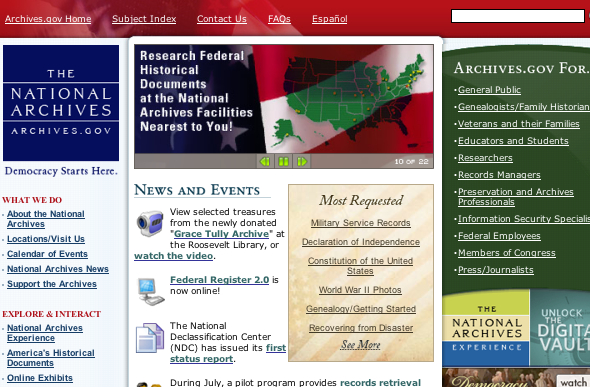
Here’s the old design of Archives.gov:

The research that preceded the redesign looked at what people do when they come to Archives.gov and what they do there.

Here are the results of the National Archives’ data analysis of Archives.gov “customers”:

How frequently do you visit this site?
69% First time
14% Every 6 months or less
9% About once a month
5% About once a week

In what role are you using the web site today?
30% Veteran or Veteran’s family
23% Genealogist or family historian
14% Educator or student
14% Researcher

What were you primarily looking for today?
28% Historical Documents
25% Veterans’ Service Records
19% Genealogy or family history information
9% Other

How would you most like to interact with this site?
41% Bookmark or tag pages
35% None
15% Receiving newsletters/email updates
8% Watching Vodcasts or video

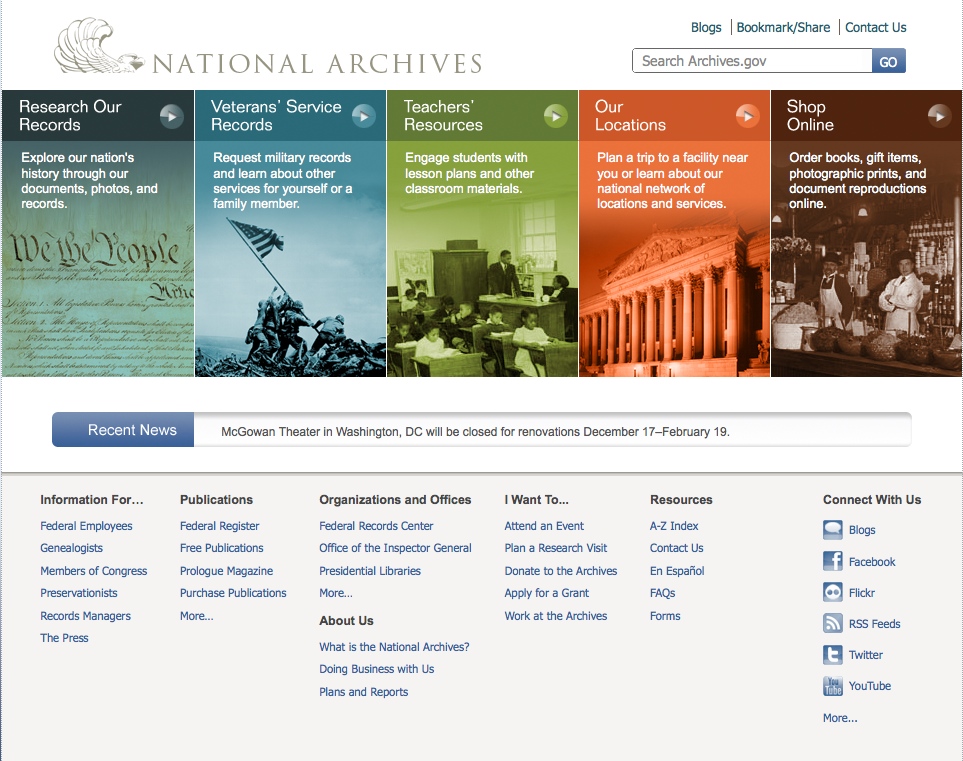
The new Archives.gov was based in part on that feedback and user need:

On first glance, and after some time clicking around, the answer is a qualified “yes.” This version of the Archives.gov redesign came about through a vote on the homepage design using Ideascale and in-person events, receiving in total some 3,257 votes. The redesign includes streamlined access to historical documents and military service records, an important improvement, given the eye-opening statistic that 81 percent of Archives.gov visitors are looking for this information.

The new design is cleaner, features clearer organization of content and loaded more quickly on my mobile device. The search field, one of the critical features of any modern website, is larger and raised to greater prominence in the redesign. I don’t see a mobile version of the site yet, and there is as of yet “no app for that,” unlike, say, the Library of Congress. That may change.

With respect to another stated aim of the project, the redesign does prominently display the Archives.gov social media accounts, although in muted colors that, while fitting look and feel, don’t catch the eye. No social content is featured on the homepage or the dedicated section, though it’s not hard to find those accounts on the master list of social media. There are some real gems to be fond in there, particularly in the NARA Flickr feed.

Archives Wiki: Our Archives Wiki
Blog – NARAtions, the U.S. National Archives: Blog - NARAtions, the U.S. National Archives
Facebook – US National Archives: Facebook - US National Archives
Flickr – US National Archives Photostream: Flickr - US National Archives Photostream
RSS Feed – News from the U.S. National Archives: RSS Feed - News from the U.S. National Archives
Twitter – @ArchivesNews: Twitter - @archivesnews
YouTube – US National Archives Channel: YouTube - US National Archives Channel

There are a host of other accounts in there for regional archives, presidential libraries or specific topics. For more on the back story behind the design, read over the minutes from last month’s researcher meeting:

The website was last updated several years ago. This time, we are revising it to focus on tasks that people are trying to accomplish when they come to our website.

We collected information from researchers on what you wanted in a variety of ways over several months including asking staff, researchers, veterans, patrons in line at exhibits, etc. This is part of Open Government from December 2009. The Flagship initiative is to redesign by matching the needs of all users (researchers, educators, students, and those just browsing to see the founding documents).

We have the new website categorized into sections. There are five main sections: veterans, researchers, educators and students, locations, and our online store.

Other pages will focus on genealogy, Congress, records preservation, Federal records managers, publications, offices in NARA, and information about us in general. It also includes an agency index, FAQs, and social media (e.g., blogs like NARAtions and AOTUS).

The research section has basic information on how to do research at each of the facilities and links to specific topics like the Civil War.

The new website rolls out next month in December. This is the first phase of the redesign. The focus is on the home page, researchers, veterans, education, and will then move onto other areas.

The 1940s census will be available online in 2012 spring.

“Hire a Researcher” will still be available. All content will migrate over. You do not need to resubmit information. All current information will come over. If you need to resubmit information, we will let you know. We do an annual contact check to revise the list.

This is a significant improvement and one that the Archives staff should be commended upon. If you have feedback, they’ve made it clear that they’re listening: comment on the NARAtions Blog or write to webprogram@nara.gov.

Social media, local government and elections: reflections on COGEL and @DCBOEE

This week, I was proud to be one of two speakers for a session on social media and government at the Council on Governmental Ethics Laws (COGEL) conference in Washington, D.C. I delivered an adapted version of the talk on social media and government I gave the Social Security Administration’s Open Government Awareness Day earlier this year, focusing on the elements that would be of greatest interest to a group of lawyers, regulators and academics. The presentation is embedded below:

The speaker that followed me, however, was able to share a fascinating view of what social media looks like from inside of government, specifically in the District of Columbia. Alysoun McLaughlin, the public affairs manager for the District of Columbia Board of Elections and Ethics. Here’s her bio, from the COGEL session description:

She joined the District last year, just in time to implement a long list of reforms for the 2010 election including new voting equipment, early voting and same-day registration. Prior to becoming an election official, she was a project manager for Election Initiatives at the Pew Center on the States. She previously spent a decade as a Washington lobbyist, focusing on election issues for the National Conference of State Legislatures and the National Association of Counties. She is here today to share her experience with social media during the 2010 election.

And share she did. Over the course of half an hour, she talked about Facebook, Twitter, local media, citizen engagement and much more. I captured most of her presentation on my iPhone (sorry about the unsteady hand) and have embedded her presentation, “To Tweet or not to Tweet: Engaging the Public through Social Media,” below.

If you want an excellent, practical perspective of the local government side of social media, these are worth watching. A couple of key takeaways from her presentation:

  • How can governments get insights from Twitter without using it? “Just type in the name of your agency and see what they’re saying.”
  • On D.C. elections: “We know there are going to be lines. Come to the website to see what they are.”
  • Don’t trust this to an intern. You “need someone skilled in crisis communications.”
  • “The days that I’m heavy on Twitter are the days my phone rings less.”
  • Viral tweets can raise awareness: “…and we just confirmed that a voter used a write-in stamp. on a touch screen.”

Part 1: Introductions

Part 2: Reflections on Twitter and Facebook

Part 3: Twitter and the 2010 DC Election

Part 4: Who follows @DCBOEE

Part 5: Listening and using social media in government