Much of this won’t be new to those who have been tracking secrecy, over-classification, prosecution of whistleblowers and selective disclosure of favorable information using new media and leaks — all core open government issues — but this pulls together those issues into a coherent whole. Abstract:
“U.S. President Barack Obama came into office pledging open government, but he has fallen short of his promise. Journalists and transparency advocates say the White House curbs routine disclosure of information and deploys its own media to evade scrutiny by the press. Aggressive prosecution of leakers of classified information and broad electronic surveillance programs deter government sources from speaking to journalists.”
“The administration’s war on leaks and other efforts to control information are the most aggressive I’ve seen since the Nixon administration,” writes Downie
“Like the weather information, the data on soils was free for the taking. The hard and expensive part is turning the data into a product.”-Quentin Hardy, in 2011, in a blog post about “big data in the dirt.”
The Climate Corporation, acquired by Monsanto for $930 million dollars on Wednesday, was founded using 30 years of government data from the National Weather Service, 60 years of crop yield data and 14 terabytes of information on soil types for every two square miles for the United States from the Department of Agriculture, per David Friedberg, chief executive of the Climate Corporation.
As it happens, not everyone is thrilled to hear about that angle or the acquirer. At VentureBeat, Rebecca Grant takes the opportunity to knock “the world’s most evil corporation for the effects of Monsanto’s genetically modified crops, and, writing for Salon, Andrew Leonard takes the position that the Climate Corporation’s use of government data constitutes a huge “taxpayer ripoff.”
For veterans of such efforts, a portal to mapping data may not be particularly exciting or useful, but it’s a start. Notably, the city has put up anonline survey where people can request other kind of city data and suggest changes or improvements to the pilot website.
Here’s a few suggestions:
1) Study how the cities of Chicago and New York cleaned, published and used data, including market demand.
3) Make a list of every single request for data made by journalists in Los Angeles under the California Records ActRelease the data and proactively publish that type of data going forward.
4) If your goal is economic outcomes from open data, review all requests for city data from businesses and prioritize release of those data sets. Engage startups and venture capitalists who are consuming open data and ask about quality, formats and frequency of release.
6) Check out the new NYC.gov, Utah.gov and gov.uk in the United Kingdom for ideas, principles and models. Of note: the use of open standards, citizen-centricity, adaptive Web design, powerful search, focus on modern design aesthetic.
I read an editorial on “open government” in the United Kingdom by Nick Cohen today, in which he argues that Prime Minister David Cameron is taking “Britain from daylight into darkness. Cohen connects privatization to the rise of corporate secrecy … Continue reading →
Here’s a key excerpt from the story: “Finance professionals have been pulling every lever they can these days to extract information from the government. Many have discovered that the biggest lever of all is the one available to everyone—the Freedom of Information Act—conceived by advocates of open government to shine light on how officials make decisions. FOIA is part of an array of techniques sophisticated investors are using to try to obtain potentially market-moving information about products, legislation, regulation and government economic statistics.”
What’s left unclear by the reporting here is if there’s 1) strong interest in data and 2) deep pocketed hedge funds or well-financed startups are paying for it, why aren’t agencies releasing it proactively?
Notably, the relevant law provides for this, as the WSJ reported:
“The only way investors can get most reports is to send an open-records request to the FDA. Under a 1996 law, when the agency gets frequent requests for the same records—generally more than three—it has to make them public on its website. But there isn’t any specific deadline for doing so, says Christopher Kelly, an FDA spokesman. That means first requesters can get records days or even months before they are posted online.”
Tracking inbound FOIA requests from industry and responding to this market indicator as a means of valuing “high value data” is a strategy that has been glaringly obvious for years. Unfortunately, it’s an area in which the Obama administration’s open data policies look to have failed over the last 4 years, at least as viewed through the prism of this article.
If data sets that are requested multiple times are not being proactively posted on Data.gov and tracked there, there’s a disconnect between what the market for government data is and the perception by officials. As the Obama administration and agencies prepare to roll out enterprise data inventories later fall as part of the open data policies, here’s hoping agency CIOs are also taking steps to track who’s paying for data and which data sets are requested.
Here are the questions that they’d like help answering:
How can we better encourage and enable the public to participate in government and increase public integrity? For example, in the first National Action Plan, we required Federal enforcement agencies to make publicly available compliance information easily accessible, downloadable and searchable online – helping the public to hold the government and regulated entities accountable.
What other kinds of government information should be made more available to help inform decisions in your communities or in your lives?
How would you like to be able to interact with Federal agencies making decisions which impact where you live?
How can the Federal government better ensure broad feedback and public participation when considering a new policy?
The American people must be able to trust that their Government is doing everything in its power to stop wasteful practices and earn a high return on every tax dollar that is spent. How can the government better manage public resources?
What suggestions do you have to help the government achieve savings while also improving the way that government operates?
What suggestions do you have to improve transparency in government spending?
The American people deserve a Government that is responsive to their needs, makes information readily accessible, and leverages Federal resources to help foster innovation both in the public and private sector. How can the government more effectively work in collaboration with the public to improve services?
What are your suggestions for ways the government can better serve you when you are seeking information or help in trying to receive benefits?
In the past few years, the government has promoted the use of “grand challenges,” ambitious yet achievable goals to solve problems of national priority, and incentive prizes, where the government identifies challenging problems and provides prizes and awards to the best solutions submitted by the public. Are there areas of public services that you think could be especially benefited by a grand challenge or incentive prize?
What information or data could the government make more accessible to help you start or improve your business?
The White House is asking that feedback be sent to opengov@ostp.gov by September 23 and states that it will post a summary of submissions online in the future.
A note on email, public engagement and transparency
In a post regarding the White House’s call for input, Nextgov reporter Joseph Marks is skeptical about using email to solicit feedback, suggesting instead that the administration return to the approach of 2009, when the transition team asked the public at large to weigh in on open government.
“When seeking advice on open government, it seems natural to make that advice itself open and transparent,” writes Marks. “This could be done using a plain old comments section. Even better, the White House could have engaged the public with a crowdsourcing platform such as IdeaScale, which allows users to vote ideas up and down. That way the public could participate not just in offering ideas but in choosing which ones merit further consideration.”
People who have been following the thread around the drafting of the U.S. “national action plans” for open government know, however, that a similar call for feedback went out two years ago, when the White House asked for comments on the first version of the plan. At the time, I was similarly skeptical of using email as a mechanism for feedback.
Writing on Google+, however, open government researcher Tiago Peixto, however, posited some reasons to look at email in a different light:
My first reaction was similar to that of some other observers: e-mail consultations, in most cases, are not transparent (at least immediately) and do not foster any kind of collaboration/deliberation.
But this comes rather as a surprise. Even though Sunstein might have some reserves towards deliberative models he is a major scholar in the field of decision-making and – to put it in fashionable terms – solutions to tap the crowd’s expertise. In fact, judging from this, one might even expect that Sunstein would take the opportunity offered by the OGP to create some sort of “prediction market”, one of his favorite mechanisms to leverage the knowledge dispersed across the public. In this case, why would they solicit online feedback via e-mail?
Thinking of email as a practical, last-minute choice is a possible explanation. But in the spirit of open interpretation (nowadays everything needs to be preceded by the word “open”), I am thinking of an alternative scenario that may have led to the choice of e-mail as the channel to gather input from the public online:
A possible hypothesis is that Sunstein might have been confronted by something that is no news to federal government employees: they have a very limited number of tools that they are actually allowed to use in order to engage with the public online. Having a limited number of options is not a bad thing per se, provided the options available are good enough. In this sense, the problem is that most of the tools available (e.g. ranking, ideation) do not meet reasonable standards of good “choice architecture”, to use Sunstein’s terms. One might imagine that as Sunstein went through the different options available, he foresaw all the effects that could be generated by the tools and their design: reputational cascades, polarization, herding… In the end, the only remaining alternative, although unexciting, was e-mail. In this case at least, preferences are independently aggregated, and the risks of informational and social influence are mitigated.
Maybe the option of using e-mail to solicit inputs from the public was just a practical solution. But thinking twice, given the options out there, I guess I would have opted for e-mail myself.
From where I sit today, the White House might be better off trying a both/and strategy: solicit feedback via email, but also post the draft action plan to Github, just like the open data policy, and invite the public to comment on proposals and add new ones.
The lack of public engagement around the plan on the primary White House Twitter, Facebook and Google+ accounts, however, along with the rest of the administration’s social media channels, suggests that feedback on this plan may not a top priority at the moment. To date, federal agencies are not using social media to ask for feedback either, including the Justice Department, which plays an important role in Freedom of Information Act policy and requests.
At least they’re using the @OpenGov and @WhiteHouseOSTP accounts:
Yesterday afternoon, the Office of the Director of National Intelligence began tumbling towards something resembling more transparency regarding the National Security Agency’s electronic surveillance programs.
Launched the website POTUS promised on August 9 as part of an effort to bring greater transparency to intel programs http://t.co/94xLtnZQ9Q
In the context of the global furor over electronic surveillance that began this summer when the Washington Post and Guardian began publishing stories based upon the “NSA Files” leaked by former NSA contractor Edward Snowden, the new tumblr has been met with a rather …skeptical reception online.
US spy agency now using Tumblr to publish official documents in lame attempt to seem cool. Marissa Mayer overjoyed. http://t.co/QcYJhdZCtl
Despite its reception, the new site does represent a followthrough on President Obama’s commitment to set up a website to share information with the American people about these programs. While some people in the federal technology sector are hopeful:
…the site won’t be enough, on its own. The considerable challenge that it and the intelligence community faces is the global climate of anger, fear and distrust that have been engendered by a summer of fiery headlines. Despite falling trust in institutions, people still trust the media more than the intelligence community, particularly with respect to its role as a watchdog.
Second, Jennifer Valentino and Siobhan Gorman Carpenter reported at The Wall Street Journal that the National Security Agency can reach 75% of Internet traffic in the United States. Using various programs, the NSA applies algorithms to filter and gather specific information from a dozen locations at major Internet junctions around North America. The NSA defended these programs as both legal and “respectful of Americans’ privacy,” according to Gorman and Valentino: According to NSA spokeswoman Vanee Vines, if American communications are “incidentally collected during NSA’s lawful signals intelligence activities,” the agency follows “minimization procedures that are approved by the U.S. attorney general and designed to protect the privacy of United States persons.”
The story, which added more reporting to confirm what has been published in the Guardian and Washington Post, included a handy FAQ with a welcome section detailed what was “new” in the Journal’s report. The FAQ also has clear, concise summaries of fun questions you might still have about these NSA programs after a summer of headlines, like “What privacy issues does this system raise?” or “Is this legal?”
The NSA subsequently released a statement disputing aspects of the Journal’s reporting, specifically the “the impression” that NSA is sifting through 75% of U.S. Internet communications, which the agency stated is “just not true.” The WSJ has not run a correction, however, standing by its reporting that the NSA possesses the capability to access and filter a majority of communications flowing over the Internet backbone.
Reaction to the disclosures has fallen along pre-existing fault lines: critical lawmakers and privacy groups are rattled, while analysts point to a rate of legal compliance well above 99%, with now-public audits showing most violations of the rules and laws that govern the NSA coming when “roamers” from outside of the U.S.A. traveled to the country.
Thousands of violations a year, however, even if they’re out of more than 240,000,000 made, is still significant, and the extent of surveillance reported and acknowledged clearly has the potential to have a chilling effect on free speech and press freedom, from self-censorship to investigative national security journalism. The debates ahead of the country, now more informed by disclosures, leaks and reporting, will range from increased oversight of programs to legislative proposals to update laws for collection and analysis to calls to significantly curtail or outright dissolve these surveillance programs all together.
Given reports of NSA analysts intentionally abusing their powers, some reforms to the laws that govern surveillance are in order, starting with making relevant jurisprudence public. Secret laws have no place in a democracy.
Setting all of that aside for a moment — it’s fair to say that this debate will continue playing out on national television, the front pages of major newspapers and online outlets and in the halls and boardrooms of power around the country — it’s worth taking a brief look at this new website that President Obama said will deliver more transparency into surveillance programs, along with the NSA’s broader approach to “transparency”. To be blunt, all too often it’s looked like this:
…so heavily redacted that media outlets can create mad libs based upon them.
That’s the sort of thing that leads people to suggest that the NSA has no idea what ‘transparency’ means. Whether that’s a fair criticism or not, the approach taken to disclosing documents as images and PDFs does suggest that the nation’s spy agency has not been following how other federal agencies are approaching releasing government information.
As Matt Stoller highlighted on Twitter, heavily redacted, unsearchable images make it extremely difficult to find or quote information.
Docs released by intelligence agencies are heavily redacted, are not searchable, and there's no copy/paste allowed. http://t.co/R7cy9LEr7u
Unfortunately, that failing highlights the disconnect between the laudable efforts the Obama administration has made to release open government data from federal agencies and regulators and the sprawling, largely unaccountable national security state aptly described as Top Secret America.”
Along with leak investigations and prosecution of whistleblowers, drones and surveillance programs have been a glaring exception to federal open government efforts, giving ample ammunition to those who criticize or outright mock President Obama’s stated aspiration to be the “most transparent administration in history.” As ProPublica reported this spring, the administration’s open government record has been mixed. Genuine progress on opening up data for services, efforts to leverage new opportunities afforded by technology to enable citizen participation or collaboration, and other goals set out by civil society has been overshadowed with failures on other counts, from the creation of the Affordable Care Act to poorcompliance with the Freedom of Information Act and obfuscation of the extend of domestic surveillance.
In that context, here’s some polite suggestions to the folks behind the new ODNI tumblr regarding using the Web to communicate:
Post all documents as plaintext, not images and PDFs that defy easy digestion, reporting or replication. While the intelligence budget is classified, surely some of those untold billions could be allotted to persons taking time to release information in both human- and machine-readable formats.
Put up a series of Frequently Asked Questions, like the Wall Street Journal’s. Format them in HTML. Specifically address that reporting and provide evidence of what differs. Posting the joint statement on the WSJ stories as text is a start but doesn’t go far enough.
Post audio and plaintext transcripts of conference calls and all other press briefings with “senior officials.” Please stop making the latter “on background.” (The transcript of the briefing with NSA director of compliance John DeLong is a promising start, although getting it out of a PDF would be welcome.
Take questions on Twitter and at questions@nsa.gov or something similar. If people ask about programs, point them to that FAQ or write a new answer. The intelligence community is starting behind here, in terms of trust, but being responsive to the public would be a step in the right direction.
Link out to media reports that verify statements. After DNI Clapper gave his “least untruthful answer” to Senator Ron Wyden in a Congressional hearing, these “on the record” statements are received with a great deal of skepticism by many Americans. Simply saying something is true or untrue is unlikely to be received as gospel by all.
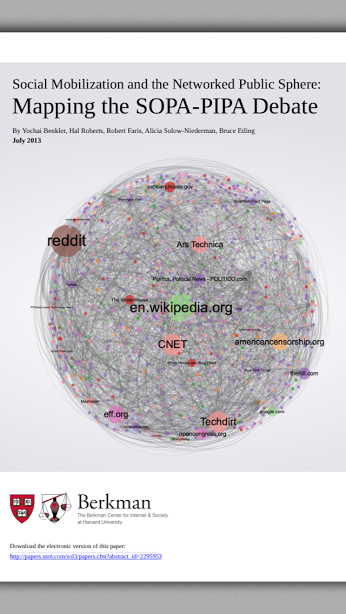
A new paper from Yochai Benkler and co-authors at the Berkman Center maps how the networked public sphere led to the Stop Online Piracy Act and Protect IP Act being defeated in the U.S. Congress.
“Abstract: “This paper uses a new set of online research tools to develop a detailed study of the public debate over proposed legislation in the United States designed to give prosecutors and copyright holders new tools to pursue suspected online copyright violations.”
Key insight: “We find that the fourth estate function was fulfilled by a network of small-scale commercial tech media, standing non-media NGOs, and individuals, whose work was then amplified by traditional media. Mobilization was effective, and involved substantial experimentation and rapid development. We observe the rise to public awareness of an agenda originating in the networked public sphere and its framing in the teeth of substantial sums of money spent to shape the mass media narrative in favor of the legislation. Moreover, we witness what we call an attention backbone, in which more trafficked sites amplify less-visible individual voices on specific subjects. Some aspects of the events suggest that they may be particularly susceptible to these kinds of democratic features, and may not be generalizable. Nonetheless, the data suggest that, at least in this case, the networked public sphere enabled a dynamic public discourse that involved both individual and organizational participants and offered substantive discussion of complex issues contributing to affirmative political action.”
One data set, however, was missing from the paper: the role of social media, in particular Twitter, in reporting, amplifying and discussing the bills. The microblogging platform connected many information nodes mapped out by Berkman, from hearings to activism, and notably did not shut down when much of the Internet “blacked out” in protest.
As I wrote then, we’re in unexplored territory. We may have seen the dawn of new era of networked activism and participatory democracy, borne upon the tidal wave of hundreds of millions of citizens connected by mobile technology, social media platforms and open data.
As I also observed, all too presciently, that era will also include pervasive electronic surveillance, whether you’re online and offline, with commensurate threats to privacy, security, human rights and civil liberties, and the use of these technologies by autocratic government to suppress dissent or track down dissidents.
Finding a way for forward will not be easy but it’s clearly necessary.
Three years on, Republicans in Congress continue to follow through on promises to embrace innovation and transparency in the legislative process. Today, the United States House of Representatives has made the United States Codeavailable in bulk Extensible Markup Language (XML).
“Providing free and open access to the U.S. Code in XML is another win for open government,” said Speaker John Boehner and Majority Leader Eric Cantor, in a statement posted to Speaker.gov. “And we want to thank the Office of Law Revision Counsel for all of their work to make this project a reality. Whether it’s our ‘read the bill’ reforms, streaming debates and committee hearings live online, or providing unprecedented access to legislative data, we’re keeping our pledge to make Congress more transparent and accountable to the people we serve.”
House Democratic leaders praised the House of Representatives Office of the Law Revision Counsel (OLRC) for the release of the U.S. Code in XML, demonstrating strong bipartisan support for such measures.
“OLRC has taken an important step towards making our federal laws more open and transparent,” said Whip Steny H. Hoyer, in a statement.
“Congress has a duty to publish our collective body of enacted federal laws in the most modern and accessible way possible, which today means publishing our laws online in a structured, digital format. I congratulate the OLRC for completing this significant accomplishment. This is another accomplishment of the Legislative Branch Bulk Data Task Force. The Task Force was created in a bipartisan effort during last year’s budget process. I want to thank Reps. Mike Honda and Mike Quigley for their leadership in this area, and Speaker Boehner and Leader Cantor for making this task force bipartisan. I also want to commend the dedicated civil servants who are leading the effort from the non-partisan legislative branch agencies, like OLRC, who work diligently behind the scenes – too often without recognition – to keep Congress working and moving forward.”
The reaction from open government advocates was strongly positive.
“Today’s announcement is another milestone in the House of Representatives efforts to modernize how legislative information is made available to the American people,” said Daniel Schuman, policy director at Citizens for Responsibility and Ethics in Washington (CREW). “The release of the US Code in Bulk XML is the culmination of several years of work, and complements the House’s efforts to publish House floor and committee data online, in real time, and in machine readable formats. Still awaiting resolution – and the focus of the transparency community’s continuing efforts — is the bulk release of legislative status information.” (More from Schuman at the CREW blog.)
“I think they did an outstanding job,” commented Eric Mill, a developer at the Sunlight Foundation. “Historically, the U.S. Code has been extremely difficult to reliably and accurately use as data. These new XML files are sensibly designed, thoroughly documented, and easy to use.”
The data has already been ingested into open government websites.
“Just this morning, Josh Tauberer updated our public domainU.S. Code parser to make use of the new XML version of the US Code,” said Mill. “The XML version’s consistent design meant we could fix bugs and inaccuracies that will contribute directly to improving the quality of GovTrack’s and Sunlight’s work, and enables more new features going forward that weren’t possible before. The public will definitely benefit from the vastly more reliable understanding of our nation’s laws that today’s XML release enables.” (More from Tom Lee at the Sunlight Labs blog.)
Jim Harper, Director of Information Policy Studies at the Cato Institute, similarly applauded the release.
“This is great progress toward better public oversight of government,” he said. “Having the U.S. Code in XML can allow websites, apps, and information services to weave together richer stories about how the law applies and how Congress is thinking about changing it.”
Harper also contrasted the open government efforts of the Obama administration, which has focused more upon the release of open government data relevant to services, with that of the House of Representatives. While the executive and legislative branches are by definition apples and oranges, the comparison has value.
“Last year, we reported that House Republicans had the transparency edge on Senate Democrats and the Obama administration,” he said. “(House Democrats support the Republican leadership’s efforts.) The release of the U.S. Code in XML joins projects like docs.house.gov and beta.congress.gov in producing actual forward motion on transparency in Congress’s deliberations, management, and results.
For over a year, I’ve been pointing out that there is no machine-readable federal government organization chart. Having one is elemental transparency, and there’s some chance that the Obama administration will materialize with the Federal Program Inventory. But we don’t know yet if agency and program identifiers will be published. The Obama administration could catch up or overtake House Republicans with a little effort in this area. Here’s hoping they do.”
This article has been updated with additional statements over time.
On June 27, the White House asked for nominations for civic hackers that have built tools that helped to meet the needs of the public. This morning, the Obama administration honored 15 different Americans for their work on open government and “civic hacking.”
Politico’s Morning Tech reported that Intel will fund some of the projects created at the National Day of Civic Hacking to the tune of some $20,000 – a piece. “It’s unclear how many they’ll support, but the chipmaker will pick projects that envision a more data-oriented society and use datasets from a diverse array of industries,” wrote Alex Byers. “They’ll announce the recipients over the next few weeks.” (If any readers hear of such grants, please let me know.)
Following is a small sample of tweets from or about the event, followed by a list of the men and women who were honored today, biographies provided by the White House press office, and links to their organizations and/or work. I’ll post video when it’s available.
Steve Spiker (Spike) is the Director of Research & Technology at the Urban Strategies Council, a social change nonprofit supporting innovation and collaboration based in Oakland for almost 25 years. He leads the Council’s research, spatial analysis, civic innovation, open data, and technology efforts. Spike has research experience in community development, housing, criminology, spatial epidemiology and reentry issues. He loves data, visualization, GIS and strategic technology implementation, especially open source tech. Spike is the co-founder of OpenOakland, a Code for America Brigade and is helping guide government technology decisions and civic engagement in the East Bay. In 2012 Spike was chosen as one of the Next American City Vanguard class. He is an outspoken supporter of open data and open government and speaks across the USA about data driven decision making. He also campaigns to end human trafficking and runs Stealing Beauty Photography.
Travis Laurendine, Founder and CEO of LA Labs New Orleans, LA
Travis Laurendine doesn’t fit in the typical bio box any more than his hair fits into the typical hat. As a serial entrepreneur he has been on the cutting edge of both the web startup and entertainment industry for nearly 10 years. He launched his first web startup while an Economics major at Vanderbilt University, where he was also selected as the first Vanderbilt student with a film to make it in the Nashville Film Festival. When Hurricane Katrina struck his hometown of New Orleans, he stayed back in the city and found himself wearing the hats of startup CEO, concert promoter, restaurant general manager, standup comic, film/video producer and director, MTV News journalist, band manager/agent, investor, hackathon organizer, Entrepreneur-In- Residence, and cultural ambassador. Recently, he founded Louisiana’s first hackathon organization, CODEMKRS, which is currently being transformed into Louisiana’s only modern code school. This summer he has organized hackathons for giant music festivals JazzFest and Bonnaroo and is currently planning San Francisco’s Outside Lands’ first hackathon. His official job is being the founder and CEO of LA Labs, a startup laboratory focused on the marriage of entertainment and technology that uses New Orleans as the ultimate creative incubator. He is thankful for his loving family and friends and the daily inspiration he gets from the great city of New Orleans.
Scott Phillips, Co-Founder and CEO of Isocentric Networks Tulsa, OK
Scott Phillips is the co-founder and CEO of Isocentric Networks, an advanced data center services company based in Tulsa, OK. He was previously the founder and CEO of a sensor technology company whose work included a project for NASA for use on a manned mission to Mars. Scott is also a founding board member of Fab Lab Tulsa, a 21st Century non-profit community center for innovation, entrepreneurship, and STEM education through a partnership with the Massachusetts Institute of Technology. Scott’s current passion lives at the nexus of entrepreneurship, the maker movement, and civic hacking, three transformative movements that he believes are democratizing how we live, work and play. According to Scott, it is easy to understand the impact of civic hacking on government when you view it in three steps; give citizens transparency, give citizens a voice, then give citizens ownership.
George Luc, Co-Founder and CEO of GivePulse Austin, TX
George Luc is Co-Founder and CEO of GivePulse, a social network that matches people to causes and enables nonprofits, companies and affinities to manage volunteers, list events and track service hours in one central community. GivePulse launched earlier this year in 2013 and has since tracked over 100K service hours and mobilized over 5K volunteers in Austin alone. George has a BS and MS in Computer Science from Virginia Tech with an emphasis in Human Computer Interaction. He spent much of his early career developing technology for people with disabilities and has worked with companies like Daylert, IBM, ESO and HomeAway. He serves as a board member of City of Austin Volunteer & Service, Austin Convention Center and Visitor’s Bureau, KLRU, Open Door Preschool, and was a City Commissioner for Austin Mayor’s Committee for People with Disabilities.
Craig Michael Lie Njie, CEO, Kismet World Wide Consulting Mountain View, CA
Mr. Lie Njie is CEO of Kismet World Wide Consulting, which he founded in 2002. Lie has over 20 years of professional experience and currently consults world-wide on a variety of topics including privacy, security, technology design and development, education, entrepreneurship, management, sales and marketing, and mobile application development. Lie was given his name as an honorarium for his three years of service (2005-2008) as a Peace Corps Volunteer in The Gambia, West Africa, where he designed, deployed, and taught the first two years of The Gambia’s first Bachelor’s in Computer Science program at the University of The Gambia (UTG). Today his program is still successful and sustainable. After returning from the Peace Corps, Lie recruited and managed a volunteer team to build and release the free WasteNot iOS app to help people world-wide share their good ideas for reducing environmental impact. He furthermore helped the United Nations as a technology consultant and researched and documented the privacy risks of health and fitness mobile apps.
Christopher Whitaker, Project Management Consultant at the Smart Chicago Collaborative, Chicago, IL
— Christopher Whitaker (@CivicWhitaker) July 23, 2013
Christopher Whitaker is a project management consultant at the Smart Chicago Collaborative, utilizing his experience in government and community organizing to advance civic innovation in Chicago. Whitaker also serves as the Chicago Brigade Captain for Code for America, supporting civic hacking events and teaching a weekly Civic Hacking 101 class. He is a graduate of DePaul University (MPA) and Sam Houston State University (BA, Political Science). Previously, Whitaker served with the US Army in Iraq as a mechanized infantryman.
Jessica Klein, Co-Founder of Rockaway Help, Brooklyn, NY
Together with a group of journalists and residents, civic hacker and designer Jessica Klein co-founded “Rockaway Help” in the wake of Hurricane Sandy. Rockaway Help is committed to empowering the community to find solutions for emergency response, preparedness and rebuilding through hyperlocal open news and the development of innovative community-designed technologies. As part of the National Day of Civic Hacking, Jessica lead workshops and hackathons for designers, engineers and Rockaway Beach, New York residents to identify problems and prototype design or technology solutions in the devastated coastal community. Jessica is currently the Creative Lead of the Mozilla Open Badges project where she promotes openness and creativity in formal and informal learning environments and develops ways for learners to design their own unique narrative around their credentials. Jessica created the Hackasaurus project, the Web X-Ray Goggles and Thimble tools to help teens learn how to code through hacking. Over the last decade, she has worked at a variety of institutions dedicated to learning including the Museum of Arts & Design, The Rubin Museum of Art, The Institute of Play, Startl, The Hive and Sesame Workshop. She also founded OceanLab NYC, a project which asked parents, teachers and kids in the NYC community to investigate their urban coastal environment through casual interaction and play.
Caitria O’Neill, Co-Founder of Recovers San Francisco, CA
Hooray for the #WHChamps Open Gov panel – championing people who aren’t tech savvy, rural communities, and working within and outside of gov
Caitria O’Neill is a co-founder of Recovers, a disaster preparedness and recovery technology company in San Francisco. After a tornado struck her hometown, Monson, MA in 2011, Caitria and her sister Morgan worked within their community to connect survivors with local skills and donations. This kind of seat-of-the-pants organizing happens in every neighborhood, after every storm. The Recovers team has turned the best practices of many efforts into a user-friendly tech toolkit for risk mitigation and community response. In less than two years they have helped hundreds of thousands of people find information, aid, and ways to pitch in. Caitria holds a BA in Government from Harvard University, FEMA NIMS/ICS certifications, and was named an Up-and- Coming CEO by Forbes Magazine. Her work has been featured by CNN Opinion, TED.com, and Bloomberg Businessweek.
Steven Clift, Founder of E-Democracy Minneapolis, Minnesota
White House Champions of Change – Open Government and Civic Technology – Announced, Webcast, I’m one 🙂 http://t.co/dl8tZcvf62#edem
Steven Clift is @democracy on Twitter. He launched E-Democracy.org in 1994 and it is the world’s first election information website. His “government by day, citizen by night” insights were built as leader of the State of Minnesota’s first e-government initiative. He spoke across 30 countries for over a decade from Estonia to Libya to Mongolia on open government and civic participation to support non-partisan, volunteer-powered efforts for inclusive online local democracy. An Ashoka Fellow, today he is E-Democracy’s Executive Director. He leads a dedicated team with the BeNeighbors.org effort to connect all neighbors online (and off) in public life across race and ethnicity, generations, immigrant and native-born, and more. He lives with his lovely wife and two children in Minneapolis, Minnesota.
Gerrie Schipske, Councilwoman on the Long Beach City Council Long Beach City, CA
At white house for champions of change award #whchamps
Councilwoman Gerrie Schipske is currently serving her second term on the Long Beach City Council. She has championed open, transparent and accountable local government since she took office in 2006 by being the first elected official in Long Beach to disclose their calendar and to communicate daily via blog, email, Facebook and Twitter. In January 2012, she took public education and transparency efforts one step further with her “Open Up Long Beach” initiative and website which provide residents increased access to the city’s every day affairs and documents, and includes opportunities for residents to “ go behind the scenes” of city operations. These efforts were lauded in California Forward’s report: The State of Transparency in California: 2013. Gerrie also brought transparency to the Medical Board of California on which she serves by initiating the requirement that members disclose each meeting any contacts they have had with interested parties. Gerrie earned her JD from Pacific Coast University School of Law, her MA from George Washington University, her BA from University of California, Irvine and her RNP from Harbor UCLA Women’s Health Care Nurse Practitioner Program. She is the author of three books on the history of Long Beach, California.
Brad Lander, New York City Council Member Brooklyn, NY
Listening to #CivicHacker panel at #whchamps. They tap the power of social media + tech + boots-on-the-ground compassion we saw after Sandy.
Brad Lander is a New York City Council Member representing Brooklyn’s 39th District, and a leader on issues of affordable housing, livable communities, the environment, and public education. Named one of “Today’s Social Justice Heroes” by The Nation magazine, Lander is co-chair of the Council’s Progressive Caucus and was one of the first councilmembers to bring “participatory budgeting” to his district, giving residents the power to decide which projects to support with their tax dollars. Prior to serving in the City Council, Brad directed the Pratt Center for Community Development and the Fifth Avenue Committee, a nationally-recognized community development organization.
Robert Davis, Co-Founder of RadSocial Cooper City, FL
Robert Davis is a recent marketing graduate from Nova Southeastern University in Davie, FL. His day job consists of managing a social media consultancy for small to medium sized businesses, and at night one can find him at the local maker and hacker spaces around Fort Lauderdale and Miami. Robert is a Code for America intern alumni (’12) and an avid supporter of creating civic tools with open data for the public good. Along with fellow Floridian Cristina Solana, the two created the Florida Bill Tracker, forked from the MinnPost and redeployed to easily track controversial Florida legislation. Robert is also an avid traveler and surfer, and hopes to inspire others to change their world regardless of age or expertise.
Alderman Joe Moore, City of Chicago, 49th Ward Chicago, IL
Known as a pioneer for political reform, governmental transparency and democratic governance, Joe Moore represents Chicago’s 49th Ward, one of the nation’s most economically and racially diverse communities. Moore became the first elected official to bring “participatory budgeting” to the United States. Each year, Moore turns over $1 million of his discretionary capital budget to a process of democratic deliberation and decision-making in which his constituents decide through direct vote how to allocate his budget. Moore’s participatory budgeting model has since been adopted by four of his Chicago City Council colleagues, as well as city council members in New York City, San Francisco, and Vallejo, California.
Anita Brown-Graham, Director of the Institute for Emerging Issues at NC State University, Raleigh, NC
A big thank you to Facebook co-founder @chrishughes talking with me today about the Emerging Issues Commons! http://t.co/B4FVKDHq
Anita Brown-Graham is Director of the Institute for Emerging Issues (IEI) at NC State University, a think-and-do tank focused on tackling big issues that affect North Carolina’s future growth and prosperity. From energy, to fiscal modernization, to improving our systems of higher education, IEI takes the lead in convening state leaders in business, higher education and government to address these issues in a comprehensive, long-term way to prepare the state for future challenges and opportunities. In her role at IEI, Anita led the development of the Emerging Issues Commons, a first of its kind civic engagement tool – both a physical space and an online hub that stands to transform how citizens across the state connect with each other, access information, and take action in the decades to come. Prior to her leadership at IEI, Anita worked as faculty of the School of Government at UNC Chapel Hill for 13 years, training communities in strategic planning to revitalize their distressed rural communities. Her work inspired both rural and urban communities to work together for a better future for the state. Anita is a William C. Friday Fellow, American Marshall Fellow, and Eisenhower Fellow.
Deborah Parker, Tulalip Tribes Vice Chair Tulalip, WA
Deborah Parker Tsi-Cy-Altsa (Tulalip/Yaqui) was elected to the Tulalip Tribes Board of Directors in 2012. As Vice-Chairwoman, Deborah brings to Tulalip leadership nearly two decades of experience as a policy analyst, program developer, communications specialist, and committed cultural advocate and volunteer in the tribal and surrounding communities. Serving as a Legislative Policy Analyst in the Office of Governmental Affairs for the Tulalip Tribes from 2005-2012, Deborah engaged in the legislative process on behalf of the Tulalip Tribes by providing quality analysis of issues most pertinent to the exercise of sovereignty and tribal governance, with particular emphasis in the areas of education, finance, taxation, and healthcare. Before joining legislative affairs Deborah developed two unique outreach and education programs for the Tulalip Tribes. Young Mothers was a culturally relevant program for teen mothers, and the Tribal Tobacco Program sought to inspire responsible tobacco use among tribal members, while acknowledging tobacco’s sacred place in Indigenous cultures. Prior to her work for the Tulalip Tribes Deborah served as Director of the Residential Healing School of the Tseil-Waututh Nation in Canada, and in the Treaty Taskforce Office of the Lummi Nation, where she was mentored by American Indian leaders such as Joe Delacruz, Billy Frank, Henry Cagey and Jewell James. As a passionate advocate for improved education for tribal members, and a belief in the inherent right of all Native Americans to expect and receive a quality education, one that is free from racial or cultural bias, Deborah is focused on educational reform, which includes developing curriculum that is a true reflection of an Indigenous ethics and knowledge system. Deborah remains committed to education by volunteering her time in the local schools where her children are enrolled. Deborah graduated from the University of Washington with a Bachelor of Arts degree in American Ethnic Studies and Sociology where she distinguished herself as a scholar and a young Indigenous leader. Deborah lives in Tulalip with her husband Myron Dewey (Paiute/Shoshone) and their five children.









 E Pluribus Unum