
U.S. publishes new “Open Data Action Plan,” announces new data releases

On the one year anniversary of President Barack Obama’s historic executive order to open up more government data, U.S. chief information officer Steven VanRoekel and U.S. chief technology officer Todd Park described “continued progress and plans for open government data” at the WhiteHouse.gov blog:

Freely available data from the U.S. government is an important national resource, serving as fuel for entrepreneurship, innovation, scientific discovery, and economic growth. Making information about government operations more readily available and useful is also core to the promise of a more efficient and transparent government. This initiative is a key component of the President’s Management Agenda and our efforts to ensure the government is acting as an engine to expand economic growth and opportunity for all Americans. The Administration is committed to driving further progress in this area, including by designating Open Data as one of our key Cross-Agency Priority Goals.

Over the past few years, the Administration has launched a number of Open Data Initiatives aimed at scaling up open data efforts across the Health, Energy, Climate, Education, Finance, Public Safety, and Global Development sectors. The White House has also launched Project Open Data, designed to share best practices, examples, and software code to assist federal agencies with opening data. These efforts have helped unlock troves of valuable data—that taxpayers have already paid for—and are making these resources more open and accessible to innovators and the public.

Other countries are also opening up their data. In June 2013, President Obama and other G7 leaders endorsed the Open Data Charter, in which the United States committed to publish a roadmap for our nation’s approach to releasing and improving government data for the public. Building upon the Administration’s Open Data progress, and in fulfillment of the Open Data Charter, today we are excited to release the U.S. Open Data Action Plan.

The new Open Data Action Plan (which was, ironically, released as a glossy PDF*, as opposed to a more machine-readable format) details a number of significant steps, including:

  • Many releases of new data and improved access to existing databases. These include more climate data, adding an API to Smithsonian artwork and the Small Business Administration’s database of suppliers and making data available for re-use. *Late in the day, with a “thanks to the open data community for their vigilance,” The White House posted the list of “high value data sets” in the plan as a .CSV.
  • A roadmap with deadlines for the release of these datasets over the course of 2014-2015. Some data releases are already online, like Medicare physician payment data. I’ve created an online spreadsheet that should act as a dashboard for U.S. National Open Data Action Plan Deadlines.
  • A policy that “new data sets will be prioritized for release based on public feedback.
  • New open data projects at federal agencies, each of which will be led by a Presidential Innovation Fellow. According to the plan, the agencies will include NOAA, the Census Bureau, NASA, IRS, Interior, Labor, Energy and HHS.

Compliance with the executive order on open data has been mixed, as the Sunlight Foundation detailed last December. While all executive branch agencies were required to develop a machine-readable catalog of their open data at [department].gov/data.json  and stand up /developer pages, it took until February 2014 for all Cabinet agencies to publish their open data inventories. (The government shutdown was a factor in the delay.)

The federal government’s progress on this open data action plan is likely to be similar, much as it has been for the past five years under the Obama administration: variable across agencies, with delays in publishing, issues in quality and carve outs for national security, particularly with respect to defense and intelligence agencies. That said, progress is progress: many of the open data releases detailed in the plan have already occurred.

If the American people, press, Congress and public worldwide wish to see whether the administration is following through on some of its transparency promises, they can do so by visiting agency websites and the federal open data repository, Data.gov, which will celebrate its fifth anniversary next week.

Former New York City mayor Mike Bloomberg is fond of quoting William Edwards Deming: “In God we trust. All others bring data.” Given historic lows in trust in government, the only way the Obama administration will make progress on that front is if they actually release more of it.

[Image Credit: Eric Fischer/Flickr]

From broadband maps to Data.gov, WordPress looks to power more open source government

I had a blast interviewing Matt Mullenweg, the co-creator of WordPress and CEO of Automattic, last night at the inaugural WordPress and government meetup in DC. UPDATE: Video of our interview and the Q&A that followed is embedded below:

WordPress code powers some 60 million websites, including 22% of the top 10 million sites on the planet and .gov platforms like Broadbandmap.gov. Mullenweg was, by turns, thoughtful, geeky and honest about open source and giving hundreds of millions of people free tools to express themselves, along with quietly principled,  with respect to the corporate values for an organization spread between 35 countries, government censorship and the ethics of transparency.

After Mullenweg finished taking questions from the meetup, Data.gov architect Philip Ashlock gave a presentation on how the staff working on the federal government’s open data platform are using open source software to design, build, publish and collaborate, from WordPress to CKAN to Github issue tracking.

United States federal government use of crowdsourcing grows six-fold since 2011

578430main_20110809-xclass_full

Citizensourcing and open innovation can work in the public sector, just as crowdsourcing can in the private sector. Around the world, the use of prizes to spur innovation has been booming for years. The United States of America has been significantly scaling up its use of prizes and challenges to solving grand national challenges since January 2011, when, President Obama signed an updated version of the America COMPETES Act into law.

According to the third congressionally mandated report released by the Obama administration today (PDF/Text), the number of prizes and challenges conducted under the America COMPETES Act has increased by 50% since 2012, 85% since 2012, and nearly six-fold overall since 2011. 25 different federal agencies offered prizes under COMPETES in fiscal year 2013, with 87 prize competitions in total. The size of the prize purses has also grown as well, with 11 challenges over $100,000 in 2013. Nearly half of the prizes conducted in FY 2013 were focused on software, including applications, data visualization tools, and predictive algorithms. Challenge.gov, the award-winning online platform for crowdsourcing national challenges, now has tens of thousands of users who have participated in more than 300 public-sector prize competitions. Beyond the growth in prize numbers and amounts, Obama administration highlighted 4 trends in public-sector prize competitions:

  • New models for public engagement and community building during competitions
  • Growth software and information technology challenges, with nearly 50% of the total prizes in this category
  • More emphasis on sustainability and “creating a post-competition path to success”
  • Increased focus on identifying novel approaches to solving problems

The growth of open innovation in and by the public sector was directly enabled by Congress and the White House, working together for the common good. Congress reauthorized COMPETES in 2010 with an amendment to Section 105 of the act that added a Section 24 on “Prize Competitions,” providing all agencies with the authority to conduct prizes and challenges that only NASA and DARPA has previously enjoyed, and the White House Office of Science and Technology Policy (OSTP), which has been guiding its implementation and providing guidance on the use of challenges and prizes to promote open government.

“This progress is due to important steps that the Obama Administration has taken to make prizes a standard tool in every agency’s toolbox,” wrote Cristin Dorgelo, assistant director for grand challenges in OSTP, in a WhiteHouse.gov blog post on engaging citizen solvers with prizes:

In his September 2009 Strategy for American Innovation, President Obama called on all Federal agencies to increase their use of prizes to address some of our Nation’s most pressing challenges. Those efforts have expanded since the signing of the America COMPETES Reauthorization Act of 2010, which provided all agencies with expanded authority to pursue ambitious prizes with robust incentives.

To support these ongoing efforts, OSTP and the General Services Administration have trained over 1,200 agency staff through workshops, online resources, and an active community of practice. And NASA’s Center of Excellence for Collaborative Innovation (COECI) provides a full suite of prize implementation services, allowing agencies to experiment with these new methods before standing up their own capabilities.

Sun Microsystems co-founder Bill Joy famously once said that “No matter who you are, most of the smartest people work for someone else.” This rings true, in and outside of government. The idea of governments using prizes like this to inspire technological innovation, however, is not reliant on Web services and social media, born from the fertile mind of a Silicon Valley entrepreneur. As the introduction to the third White House prize report  notes:

“One of the most famous scientific achievements in nautical history was spurred by a grand challenge issued in the 18th Century. The issue of safe, long distance sea travel in the Age of Sail was of such great importance that the British government offered a cash award of £20,000 pounds to anyone who could invent a way of precisely determining a ship’s longitude. The Longitude Prize, enacted by the British Parliament in 1714, would be worth some £30 million pounds today, but even by that measure the value of the marine chronometer invented by British clockmaker John Harrison might be a deal.”

X-prize-graph-300x297Centuries later, the Internet, World Wide Web, mobile devices and social media offer the best platforms in history for this kind of approach to solving grand challenges and catalyzing civic innovation, helping public officials and businesses find new ways to solve old problem. When a new idea, technology or methodology that challenges and improves upon existing processes and systems, it can improve the lives of citizens or the function of the society that they live within.

“Open innovation or crowdsourcing or whatever you want to call it is real, and is (slowly) making inroads into mainstream (i.e. non high-tech) corporate America,” said MIT principal research professor Andrew McAfee, in an interview in 2012.” P&G is real. Innocentive is real. Kickstarter is real. Idea solicitations like the ones from Starbucks are real, and lead-user innovation is really real.”

Prizes and competitions all rely upon the same simple idea behind the efforts like the X-Prize: tapping into the distributed intelligence of humans using a structured methodology. This might include distributing work, in terms of completing a given task or project, or soliciting information about how to design a process, product or policy.

Over the past decade, experiments with this kind of civic innovation around the world have been driven by tight budgets and increased demands for services, and enabled by the increased availability of inexpensive, lightweight tools for collaborating with connected populations. The report claimed that crowdsourcing can save federal agencies significant taxpayer dollars, citing an example of a challenge where the outcome cost a sixth of the estimated total of a traditional approach.

One example of a cost-effective prize program is the Medicaid Provider Screening Challenge that was offered by the Centers for Medicare & Medicaid Services (CMS) as part of a pilot designed in partnership with states and other stakeholders. This prize program was a series of software development challenges designed to improve capabilities for streamlining operations and screening Medicaid providers to reduce fraud and abuse. With a total prize purse of $500,000, the challenge series is leading to the development of an open source multi-state, multi-program provider screening shared-service software program capable of risk scoring, credential validation, identity authentication, and sanction checks, while lowering the burden on providers and reducing administrative and infrastructure expenses for states and Federal programs. CMS partnered with the NASA Center of Excellence for Collaborative Innovation (COECI), NASA’s contractor Harvard Business School, Harvard’s subcontractor TopCoder, and the State of Minnesota. The State of Minnesota is working on full deployment of the software, and CMS is initiating a campaign to encourage other states to leverage the software. COECI estimates that the cost of designing and building the portal through crowdsourcing was one-sixth of what the effort would have cost using traditional software development methods. Through the success of this and subsequent
challenges, CMS is attempting to establish a new paradigm for crowdsourcing state and Federal information technology (IT) systems in a low-cost, agile manner by opening challenges to new players, small companies, and talented individual developers to build solutions which can “plug and play” with existing legacy systems or can operate in a shared, cloud-based environment.

As is always the nature of experiments, many early attempts failed. A few have worked and subsequently grown into sustainable applications, services, data sources, startups, processes and knowledge that can be massively scaled. Years ago, Micah Sifry predicted that the “gains from enabling a culture of open challenges, outsider innovation and public participation” in government were going to be huge. He was right.

Linked below are the administration’s official letters to the House and Senate, reporting the results of last year’s prizes.

COMPETES FY2013PrizesReport HOUSE Letter (PDF)/COMPETES FY2013PrizesReport HOUSE Letter (Text)

COMPETES FY2013 PrizesReport SENATE Letter (PDF)/COMPETES FY2013 PrizesReport SENATE Letter (Text)

[Image Credit: NASA SDO. Context: Solar flare predictive algorithm challenge]

U.S. House passes historic open government bill, sending it on to the White House

us-capitol-dome-sun

This afternoon, the United States House of Representatives passed the Digital Accountability and Transparency Act (DATA) of 2013, voting to send S.994, the bill that enjoyed unanimous support in the U.S. Senate earlier this month, on to the president’s desk.

The DATA Act is the most significant open government legislation enacted by Congress in generations, going back to the Freedom of Information Act in 1966. An administration official at the White House Office of Management and Budget confirmed that President Barack Obama will sign the bill into law.

The DATA Act establishes financial open data standards for agencies in the federal government, requires compliance with those standards, and that the data will then be published online.  The bipartisan bill was sponsored in the Senate by Senator Rob Portman (R-OH) and Senator Mark Warner (D-VA), and in the House by Representative Darrell Issa (R-CA) and Representative Elijah Cummings (D-MD).

Representative Issa, who first introduced the transparency legislation in 2011, spoke about the bill on the House floor this afternoon and tweeted out a long list of beneficial outcomes his office expects to result from its passage.

The Senators who drafted and co-sponsored the version of the bill that the House passed today quickly hailed its passage.

“In the digital age, we should be able to search online to see how every grant, contract and disbursement is spent in a more connected and transparent way through the federal government,” said Senator Warner, in a statement. “Independent watchdogs and transparency advocates have endorsed the DATA Act’s move toward greater transparency and open data. Our taxpayers deserve to see clear, accessible information about government spending, and this accountability will highlight and help us eliminate waste and fraud.”

“During a time of record $17 trillion debt, our bipartisan bill will help identify and eliminate waste by better tracking federal spending,” said Senator Portman, in a statement. “I’m pleased that our bill to empower taxpayers to see how their money is spent and improve federal financial transparency has unanimously passed both chambers of Congress and is now headed to the President’s desk for signature.”

“The DATA Act is a transformational piece of legislation that has the potential to permanently transform how the Federal government operates,” said House Majority Leader Eric Cantor, in a statement. “For the first time ever, the American people will have open, standardized access to how the federal government spends their money. Washington has an abundance of information that is often bogged down by federal bureaucracy and is inaccessible to our nation’s innovators, developers and citizens. The standardization and publication of federal spending information in an open format will empower innovative citizens to tackle many of our nation’s challenges on their own. Government of the people, by the people, and for the people should be open to the people.”

The DATA Act earned support from a broad coalition of open government advocates and industry groups. Its passage in Congress was hailed today by open government advocates and trade groups alike.

“The central idea behind the Digital Accountability and Transparency Act is simple: disclose to the public what the federal government spends,” “>said Daniel Schuman, policy council for the Citizens for Responsibility and Ethics in Washington.

“The means necessary to accomplish this purpose—increased agency reporting, the use of modern technology, implementation of government-wide standards, regular quality assurance on the data—will require government to systematically address how it stovepipes federal spending information. This is no small task, and one that is long overdue. The effort to reform transparency around federal spending arose in large part because members of both political parties concluded that their ability to govern effectively depends on making sure federal spending data is comprehensive, accessible, reliable, and timely. Currently, it is not. The leaders of the reform efforts in the Senate are Senators Mark Warner (D-VA), Rob Portman (R-OH), Tom Carper (D-DE), and Tom Coburn (R-OK), and the leaders in the House are Representatives Darrell Issa (R-CA) and Elijah Cummings (D-MD), although they are joined by many others. We welcome and applaud the House of Representative’s passage of the DATA Act. It is a remarkable bill that, if properly implemented, will empower elected officials and everyday citizens alike to follow how the federal government spends money.”

“Sunlight has been advocating for the DATA Act for some time, and are thrilled to see it emerge from Congress,” said Matt Rumsey, a policy analyst at the Sunlight Foundation. “As I wrote while describing the history of the bill after it passed through the Senate, ‘Congress has taken a big step by passing the DATA Act. The challenge now will be ensuring that it is implemented effectively.’ We hope that the President swiftly signs the bill and we look forward to working with his administration to shed more light on federal spending.

“With this legislation, big data is finally coming of age in the federal government,” said Daniel Castro, Director of the Center for Data Innovation, in a statement. “The DATA Act promises to usher in a new era of data-driven transparency, accountability, and innovation in federal financial information. This is a big win for taxpayers, innovators, and journalists.”

“After three years of debate and negotiation over the DATA Act, Congress has issued a clear and unified mandate for open, reliable federal spending data,” said Hudson Hollister, the Executive Director of the Data Transparency Coalition. Hollister helped to draft the first version of the DATA Act in 2011, when he was on Representative Issa’s staff. “Our Coalition now calls on President Obama to put his open data policies into action by signing the DATA Act and committing his Office of Management and Budget to pursue robust data standards throughout federal financial, budget, grant, and contract reporting.”

“The Administration shares Senator Warner’s commitment to government transparency and accountability, and appreciates his leadership in Congress on this issue,” said Steve Posner, spokesman for the White House Office of Management and Budget. “The Administration supports the objectives of the DATA Act and looks forward to working with Congress on implementing the new data standards and reporting requirements within the realities of the current constrained budget environment and agency financial systems.”

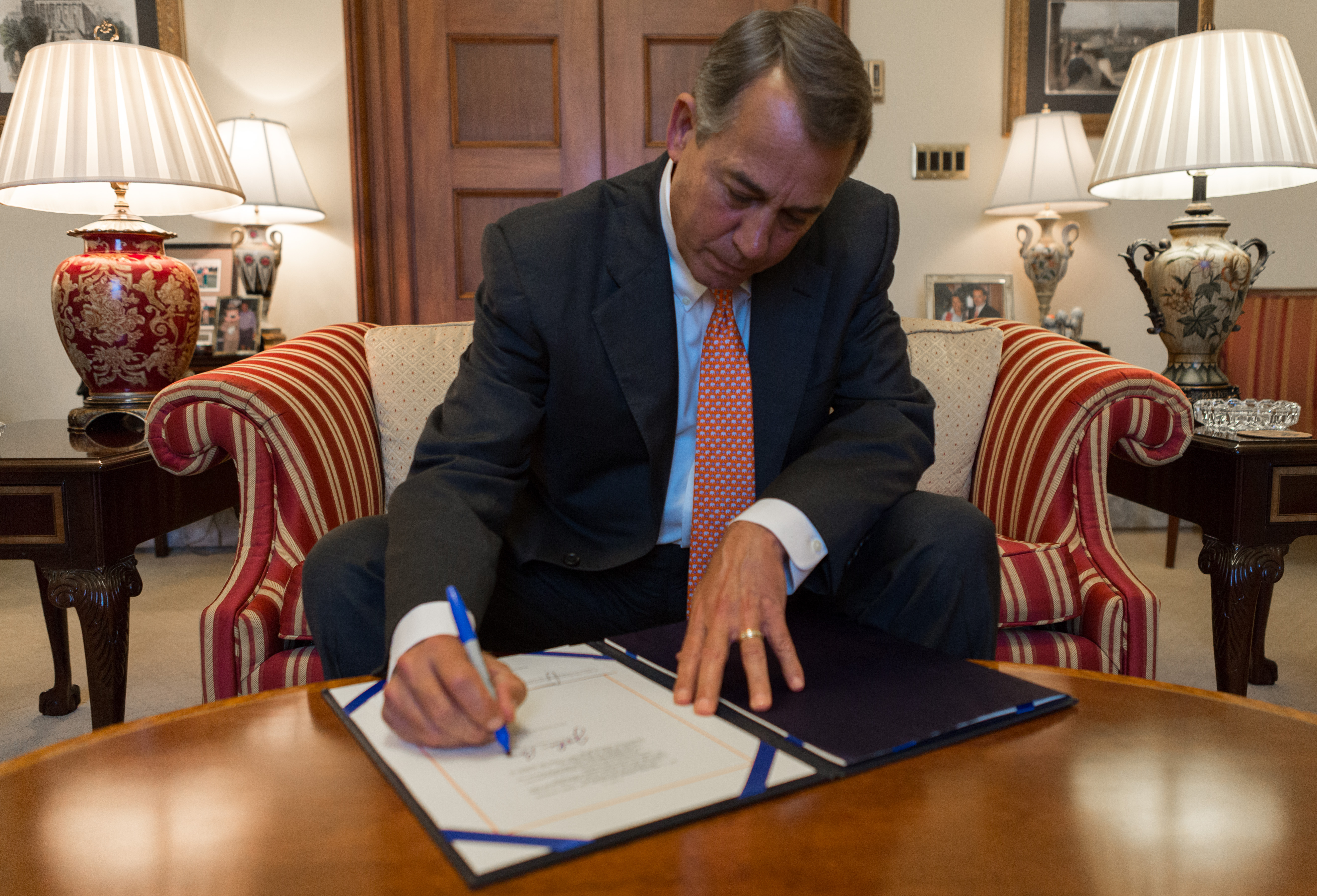
Update: Speaker of the House John Boehner (R-OH) signed the DATA Act on April 30, before sending it on to President Obama’s desk.

Digital Communications Director

“From publishing legislative data in XML to live-streaming hearings and floor debates, our majority has introduced a number of innovations to make the legislative process more open and accessible,” he said, in a statement touting open government progress in the House. “With the DATA Act, which I signed today, we’re bringing this spirit of transparency to the rest of the federal government.  For years, we’ve been able to track the status of our packages, but to this day there is no one website where you can see how all of your tax dollars are being spent.  Once the president signs this bill, that will start to change.  There is always more to be done when it comes to opening government and putting power back in the hands of the people, and the House will be there to lead the way.” 

UPDATE: On May 9th, 2014, President Barack Obama signed The DATA Act into law.

Statement by Press Secretary Jay Carney:

On Friday, May 9, 2014, the President signed into law:

S. 994, the “Digital Accountability and Transparency Act of 2014” or the “DATA Act,” which amends the Federal Funding Accountability and Transparency Act of 2006 to make publicly available specific classes of Federal agency spending data, with more specificity and at a deeper level than is currently reported; require agencies to report this data on USASpending.gov; create Government-wide standards for financial data; apply to all agencies various accounting approaches developed by the Recovery Act’s Recovery Accountability and Transparency Board; and streamline agency reporting requirements.

Rep. Darrell Issa issued the following statement in response:

“The enactment of the DATA Act marks a transformation in government transparency by shedding light on runaway federal spending,” said Chairman Issa. “The reforms of this bipartisan legislation not only move the federal bureaucracy into the digital era, but they improve accountability to taxpayers and provide tools to allow lawmakers and citizen watchdogs to root out waste and abuse. Government-wide structured data requirements may sound like technical jargon, but the real impact of this legislation on our lives will be more open, more effective government.”

Esri’s new ArcGIS feature is live. Will terabytes of new open data follow?

esri-open-data

Back in February, I reported that Esri would enable governments to open their data to the public.Today, the geographic information systems (GIS) software giant pushed ArcGIS Open Data live, instantly enabling thousands of its local, state and federal government users to open up the public data in their systems to the public, in just a few minutes.

open-data-esri

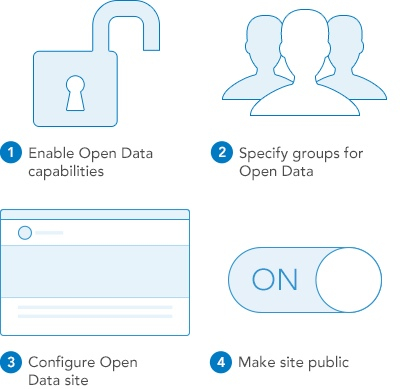
“Starting today any ArcGIS Online organization can enable open data, specify open data groups and create and publicize their open data through a simple, hosted and best practices web application,” wrote Andrew Turner, chief technology officer of Esri’s Research and Development Center in D.C., in a blog post about the public beta of Open Data ArcGIS. “Originally previewed at FedGIS ArcGIS Open Data is now public beta where we will be working with the community on feedback, ideas, improvements and integrations to ensure that it exemplifies the opportunity of true open sharing of data.”

Turner highlighted what this would mean for both sides of the open data equation: supply and demand.

Data providers can create open data groups within their organizations, designating data to be open for download and re-use, hosting the data on the ArcGIS site. They can also create public microsites for the public to explore. (Example below.) Turner also highlighted the code for Esri’s open-source GeoPortal Server on Github as a means to add metadata to data sets.

Data users, from media to developers to nonprofits to schools to businesses to other government entities, will be able to download data in common open formats, including KML, Spreadsheet (CSV), Shapefile, GeoJSON and GeoServices.

“As the US Open Data Institute recently noted, [imagine] the impact to opening government data if software had ‘Export as JSON’ by default,” wrote Turner.

“That’s what you now have. Users can also subscribe to the RSS feed of updates and comments about any dataset in order to keep up with new releases or relevant supporting information. As many of you are likely aware, the reality of these two perspectives are not far apart. It is often easiest for organizations to collaborate with one another by sharing data to the public. In government, making data openly available means departments within the organization can also easily find and access this data just as much as public users can.”

EmploymentLaborForces_B230251

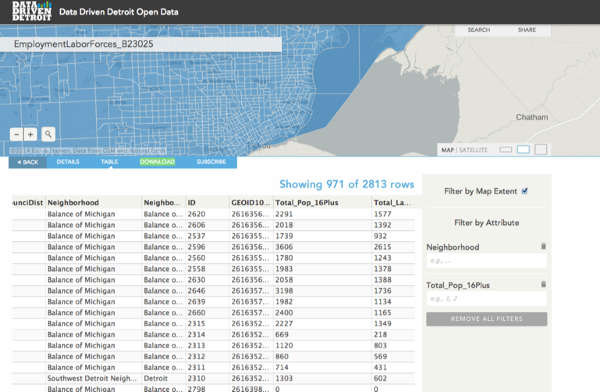
Turner highlighted what an open data site would look like in the wild:

Data Driven Detroit a great example of organizations sharing data. They were able to leverage their existing data to quickly publish open data such as censuseducation or housing. As someone who lived near Detroit, I can attest to the particular local love and passion the people have for their city and state – and how open data empowers citizens and businesses to be part of the solution to local issues.

In sum, this feature could, as I noted in February, could mean a lot more data is suddenly available for re-use. When considered in concert with Esri’s involvement in the White House’s Climate Data initiative, 2014 looks set to be a historic year for the mapping giant.

It also could be a banner year for open data in general, if governments follow through on their promises to release more of it in reusable forms. By making it easy to upload data, hosting it for free and publishing it in the open formats developers commonly use in 2014, Esri is removing three major roadblocks governments face after a mandate to “open up” come from a legislature, city council, or executive order from the governor or mayor’s office.

“The processes in use to publish open data are unreasonably complicated,” said Waldo Jacquith, director of the U.S. Open Data Institute, in an email. 

“As technologist Dave Guarino recently wrote, basically inherent to the process of opening data is ETL: “extract-transform-load” operations. This means creating a lot of fragile, custom code, and the prospect of doing that for every dataset housed by every federal agency, 50 states, and 90,000 local governments is wildly impractical.

Esri is blazing the trail to the sustainable way to open data, which is to open it up where it’s already housed as closed data. When opening data is as simple as toggling an “open/closed” selector, there’s going to be a lot more of it. (To be fair, there are many types of data that contain personally identifiable information, sensitive information, etc. The mere flipping of a switch doesn’t address those problems.)

Esri is a gold mine of geodata, and the prospect of even a small percentage of that being released as open data is very exciting.”

Code for DC launches OurDCSchools.org, an open government platform for proposed school policy

ourdcschools

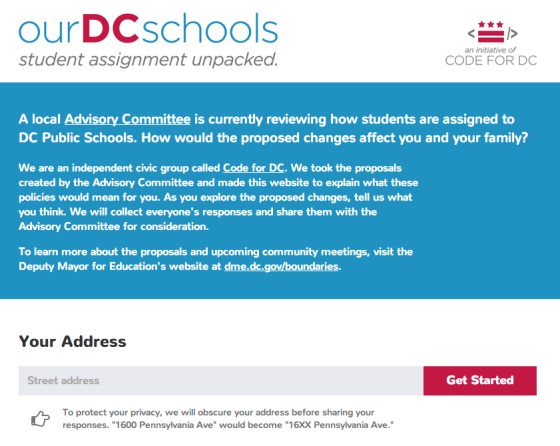
Parents, students and other members of the public can now easily see the effect of a href=”http://www.washingtonpost.com/local/education/dc-releases-proposed-school-boundaries-and-far-reaching-student-assignment-policies/2014/04/05/368521e0-bc46-11e3-96ae-f2c36d2b1245_story.html”>new proposals for elementary school boundaries and far-reaching student assignment policies in the District of Columbia using a civic app called Our DC Schools.
The new website, built by volunteers at from Code for DC, a local open government group, makes it easier for the public to understand how important changes to the boundaries of DC school districts would affect a given address, rate the assignment policies proposed by the DC government, and forward that feedback to the Deputy Mayor for Education.

According to Code for DC, their team will published all responses collected, after the street addresses are excluded, on OpenDataDC, “a public catalog of civic data built by and for the people of Washington.”  The group will continue to collect responses until mid-May 2014, sharing them with the Boundary Review Advisory Committee, the relevant government entity entrusted with working on the proposals. You can find more a bit more context about the app and the issues at WAMU.org.

Our DC Schools builds upon the data behind the Washington Post’s interactive news app, which also enables people to perform a similar geographic search, and then goes one step further than the newspaper, giving people tools to rate proposed changes and send it on to local government.


code-for-dc-logoAccording to Code for DC, the idea for the civic app came from Chris Given, when he saw how much data was available regarding the issue

“I attended a public working group meeting at Dunbar High School and while I was impressed by the dedication of the Deputy Mayor for Education and DC Public Schools staff, I was just bowled over by the scale of the challenge of getting meaningful feedback from everyone these policies affect,” said Given, in a statement. “I wanted to create an on-ramp for engaging with a really complex issue.”

In personalizing and visualizing the school district changes, unpacking these proposals for assignment and connecting feedback concerned citizens affected by the proposals to policy makers at local government, these volunteers are demonstrating how open government data and the World Wide Web can inform residents and stimulate citizen engagement in matters of great public interest.

Notably, the civic app came to life through a collaboration between Code for DC and the office of the district’s Deputy Mayor for Education (DME). It’s an effort to use modern technology to better engage the people of DC in their government.

“The Our Schools DC app is an example of what can be achieved when government collaborates with citizens to find solutions to common problems. In addition to providing valuable information, it’s a means of public engagement that will help city leaders better meet the educational needs of communities throughout the district,” said Traci L. Hughes, Director of the District of Columbia Office of Open Government, in a statement.


Sunlight Foundation highlights benefits of open data beyond the business case

Given the considerable attention that the economic outcomes of open data releases has received over the past year, with trillions of dollars in potential value flowing across headlines, it’s worth reminding everyone of the impacts of open data beyond the bottom line. Thankfully, Emily Shaw, the national policy manager at the Sunlight Foundation, did exactly that in a blog post today, including a handy briefing document that I have embedded below. She credited her colleagues for the brief:

“Democratic governance improves when people have data that helps them see how officials are doing relative to past or promised performance,” she wrote.

As Shaw highlighted in her post, open data can increase the transparency of governments, corporations, journalism or academia. Its release and analysis can and does hold those same entities accountable. Open data can enable efficiencies in information search, access and retrieval, supporting the case of those looking for the return on investment in these kinds of open government initiatives. And open data can support and enhance civic engagement and participation between the people and their government.

Liberté, Egalité, Transparencé? France joins Open Government Partnership.

data-carte

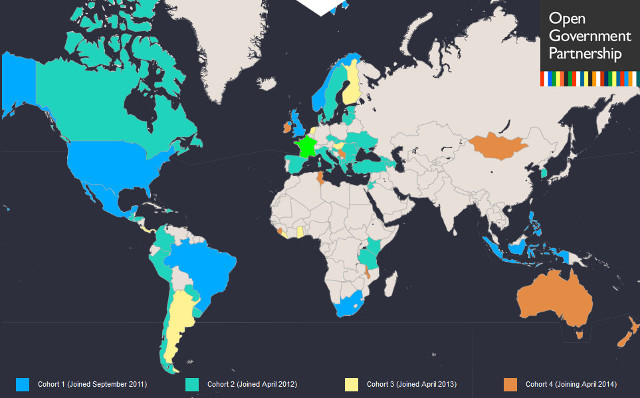
France has seen its share of revolutions, governments and leaders, from Gallic chieftains to Frankish kings, emperors to presidents, monarchy to people’s assembly, fascism to republic. Now, France will be the 64th country to join the historic Open Government Partnership that launched in September 2011.

Last week, in the 55th item in a joint statement, French president François Hollande and Mexican president Enrique Peña Nieto announced that France would be joining the Open Government Partnership:

“Persuadés que la transparence, l’intégrité et la participation des citoyens aux décisions qui les concernent sont les piliers de la démocratie, le Mexique et la France ont décidé d’adhérer à l’Initiative pour un Gouvernement ouvert, dont le Mexique assumera la présidence en 2015 et sera siège du Sommet l’an prochain. Forts de leur expérience en matière d’ouverture et de partage des données publiques, la France et le Mexique entendent encourager pleinement cette initiative.»

Roughly translated to English, that is:

“Convinced that transparency, integrity and participation of citizens in decisions that concern them are the pillars of democracy, Mexico and France have decided to join the Open Government Partnership, of which Mexico assumes the presidency in 2015 and will be the seat of the Summit next year. With their experience of the opening of materials and sharing of public data, France and Mexico agree to fully encourage this initiative.”

opgFrance1

“France is joining the Open Government Partnership with great determination,” Marylise Lebranchu, Ministre de de la Décentralisation, de la Réforme de l’Etat et de la Fonction Publique, France, said, in a statement. “France is willing to contribute to its dynamism with full commitment and by engaging in a fruitful dialogue with its partners. What’s at stake is innovation and building the public action of tomorrow. It’s not only about being accountable, it is also about deeply renewing the way we design, drive and assess public action.”

Commenting on France joining, the civil-society co-chair of OGP, Rakesh Rajani, said that “opening up government to citizen ideas and oversight is not easy and not always popular. France has shown … that it is willing to take the extra step of joining the Open Government Partnership, and putting citizens at the heart of government reform efforts.”

Minister Kuntoro, the government co-chair of OGP, in a statement, said that “OGP is stronger today with France as a participant, and I look forward to working with them to advance reform efforts in France and globally. The demand from citizens for open, innovative and accountable governments is common across the world. France can help strengthen OGP and inspire other countries to join this vibrant movement.”

Official adoption of gouvernment ouvert and open data by France means that “données publiques” (public data) and “données ouvert” (open data) will become part of the lingua franca of Francophone countries around the world. (Canada started that the ball rolling a few years ago.) Tranparence, collaboration and participation, the three pillars of open government proposed by the White House open government initiative five years ago, need far less in the way of translation, differing only in one letter.

Whether there is much of a discussion of how “libéralisme” — meaning economic liberalism and the market system — relates to données ouvert remains to be seen, particularly given that the Socialist party is currently in power in France. As the relationship between of open data and economic activity has become better established and the potential value of its release valued in the trillions of dollars (or euros), governments around the world have become interested in tapping their own national reserves.

One challenge for France, as it is everywhere the 21st century version of technology-driven open government is being embraced, will be to come to grips with the privacy rights of citizens, from surveillance to public data release, nor put critical infrastructure at risk through open data releases.

Another will be to pay equal or greater attention to the release of “données publiques” that is not only “ouvert” in the sense of format, license and reuse, but also in the sense of making the government more transparent and accountable to the citizens of the representative democratic republic, or to the oversight of their elected representatives, where public disclosures might affect national security, privacy or the trade secrets of companies under regulation.

The most uncomfortable challenge, however, may be reconciling this newfound, public commitment to more “openness” with closed or secret systems of government in France, from intelligence to criminal justice, just as it has true in other participating countries, from the United States to the Philippines.

As the Fifth French Republic submits a letter of intent and joins the Open Government Partnership, the Hollande administration is committing itself to creating a National Open Government Action Plan, following through on a public consultation and collaboration with civil society, and then to working towards milestones and goals in it.

Whether France makes meaningful commitments in its consultation, from publicizing it to giving citizens a real say in the future direction of the country, or follows through on them, will be, as is true everywhere, an open question.

[Illustration Credits: OpenDataFrance.net and Republique Citoyenne]

This post and headline have been updated, after official confirmation of France’s intent to join, with statements from government and OGP.

Applause for the passage of the DATA Act in the Senate

us-capitol-dome-sun

Over on Storify, I’ve collected applause for the passage of the DATA Act in the Senate. More to come on this landmark open government bill soon.

Update: Over at TechRepublic, I published a column asserting that the passage of the DATA Act is a major event in the age of data transparency.

Update: To date, the White House Office of Management and Budget has expressed support for Congressional attention to open government, if not the bill itself.

“We share Senator Warner’s commitment to transparency and government accountability, support the Senator and his efforts to pass the DATA Act, and appreciate his focus on the issue,” said OMB spokesman Frank Benanati.

More to come on this landmark open government bill soon.

Boston Mayor Marty Walsh issues open data executive order; city council ordinance to come?

5943910065_b422feecec_o

The City of Boston has joined the growing list of cities around the world that have adopted open data. The executive order issued yesterday by Mayor Marty Walsh has been hailed by open government advocates around the country. The move to open up Boston’s data has been followed by action, with 411 data sets listed on data.cityofboston.gov as of this morning. The EO authorizes and requires Boston’s chief information officer to issue a City of Boston Open Data Policy and “include standards for the format and publishing of such data and guidance on accessibility, re-use and minimum documentation for such data.”

The element on re-use is critical: the success of such initiatives should be judged based upon the network effects of open data releases, not the raw amount of data published online, and improvements to productivity, efficiency, city services, accountability and transparency.

Notably, Boston City Councilor-at-Large Michelle Wu also filed a proposal yesterday morning to create an open data ordinance that would require city agencies and departments to make open data available, codifying the executive order into statue as San Francisco, New York City and Philadelphia have done.

“Government today should center on making data-driven decisions and inviting in the public to collaborate around new ideas and solutions,” said Wu, in a statement.  “The goal of this ordinance is greater transparency, access, and innovation.  We need a proactive, not a reactive, approach to information accessibility and open government.”


Notably, she posted the text of her proposed open data ordinance online on Monday, unlike the city government, and tweeted a link to it. (It took until today for the city of Boston to post the order; city officials have yet to share it on social media. )

“Boston is a world-class city full of energy and talent,” said Wu. “In addition to promoting open government, making information available to the fullest extent possible will help leverage Boston’s energy and talent for civic innovation. From public hackathons to breaking down silos between city departments, putting more data online can help us govern smarter for residents in every neighborhood.”

As long-time readers know, I lived in Boston for a decade. It’s good to see the city government move forward to making the people’s data available to them for use and reuse. I look forward to seeing what the dynamic tech, financial, health care, educational and research communities in the greater Boston area do with it.

EXECUTIVE ORDER OF MAYOR MARTIN J. WALSH

An Order Relative to Open Data and Protected Data Sharing

Whereas, it is the policy of the City of Boston to practice Open Government, favoring participation, transparency, collaboration and engagement with the people of the City and its stakeholders; and
Whereas, information technologies, including web-based and other Internet applications and services, are an essential means for Open Government, and good government generally; and
Whereas, the City of Boston should continue, expand and deepen the City’s innovative use of information technology toward the end of Open Government, including development and use of mobile computing and applications, provision of online data, services and transactions; and
Whereas, the City of Boston also has an obligation to protect some data based upon privacy, confidentiality and other requirements and must ensure that protected data not be released in violation of applicable constraints; and
Whereas, clarification and definition of open data, privacy, security requirements, interoperability and interaction flows is necessary for the City’s Open Government agenda;
NOW THEREFORE, pursuant to the authority vested in me as Chief Executive Officer of the City of Boston by St. 1948, c. 452 Section 11, as appearing in St. 1951, c. 376, Section 1, and every other power hereto enabling, I hereby order and direct as follows:

1. The City of Boston recognizes Open Government as a key means for enabling public participation, transparency, collaboration and effective government, including by ensuring the availability and use of Open Data, appropriate security and sharing of Protected Data, effective use of Identity and Access Management and engagement of stakeholders and experts toward the achievement of Open Government.
2. The City of Boston Chief Information Officer (“CIO”), in consultation with City departments, is authorized and directed to issue a City of Boston Open Data Policy.
a) The Open Data Policy shall include standards for the format and publishing of such data and guidance on accessibility, re-use and minimum documentation for such data;

b) The Open Data Policy shall include guidance for departments on the classification of their data sets as public or protected and a method to report such classification to the CIO. All departments shall publish their public record data sets on the City of Boston open data portal to the extent such data sets are determined to be appropriate for public disclosure, and/or if appropriate, may publish their public record data set through other methods, in accordance with API, format, accessibility and other guidance of the Open Data Policy.
3. The City of Boston CIO, in consultation with City departments, is authorized and directed to issue a City of Boston Protected Data Policy applicable to non-public data, such as health data, educational records and other protected data;

a) The policy shall provide guidance on the management of Protected Data, including guidance on security and other controls to safeguard Protected Data, including appropriate Identity and Access Management and good practice guidelines for compliance with legal or other rules requiring the sharing of Protected Data with authorized parties upon the grant of consent, by operation of law or when otherwise so required;
b) The policy shall provide a method to ensure approval by the Corporation Counsel of the City of Boston to confirm Protected Data is only disclosed in accordance with the Policy.
4. This Executive Order is not intended to diminish or alter the rights or obligations afforded under the Massachusetts Public Records Law, Chapter 66, Section 10 of the Massachusetts General Laws and the exemptions under Chapter 4, Section 7(26). Additionally, this Executive Order is intended to be interpreted consistent with Federal, Commonwealth, and local laws and regulations regarding the privacy, confidentiality, and security of data. Nothing herein shall authorize the disclosure of data that is confidential, private, exempt or otherwise legally protected unless such disclosure is authorized by law and approved by the Corporation Counsel of the City of Boston.
5. This Executive Order is not intended to, and does not, create any right or benefit, substantive or procedural, enforceable at law or in equity by any party against the City of Boston, its departments, agencies, or entities, its officers, employees, or agents, or any other person.
6. The City of Boston CIO is authorized and directed to regularly consult with experts, thought leaders and key stakeholders for the purpose of exploring options for the implementation of policies and practices arising under or related to this Executive Order.