Multiple federal open data initiatives at risk under budget cuts

Earlier today, Virginia Carlson, president of the Metro Chicago Information Center (MCIC), commented extensively upon proposed deep Congressional cuts to funding for open government data platforms. Carlson provided more context for other federal open data initiatives that may also be cut. Her thoughts are shared below as a guest post. -Editor

Recent news that data transparency initiatives at the federal level are set to be shut down are coupled with an attack on long-standing federal data initiatives that produce critical economic and demographic data.

In March 2011, H.R. 931 was introduced to make participation in the American Community Survey voluntary by removing the legal penalty for not responding to the survey. Without compulsory participation, the ACS likely would not capture the broad swath of the American populace it needs to, –such citizens in towns and rural counties– and would become inaccurate and thus irrelevant. Congress relies on ACS data to guide the distribution of $485 billion annually in federal grants to states and localities. Already cash-strapped state and local governments would be hindered in their ability to efficiently target tax dollars in public investments such as roads, schools and health clinics. Private sector investments that rely on economic and demographic profiles of people in places (real estate and media industries for example) would also suffer.

At the same time, the Census Bureau budget for Fiscal Year 2012 submitted to Congress proposes to terminate six programs for a total of $10.3 million, about 1 percent of the Census Bureau budget. Among those items on the chopping block are online and print versions of the U.S. Statistical Abstract, State and Metropolitan Area Data Book, Population Change in Central and Outlying Counties of Metropolitan Statistical Areas, and the Consolidated Federal Funds Report.

What does this apparent diminishing commitment to federal data leadership mean for our future ability to make good policy, prioritize public investments, and compete globally? One scenario is that we turn to other, perhaps less democratic and more expensive, sources: internet-generated data (social apps, web scrapes), business-gathered data (market research firms) or harnessing administrative data (from driver’s license files, Medicare records, etc.). Who then will be counted? How do we ensure privacy?

Congress weighs deep cuts to funding for federal open government data platforms

Several core pillars of federal open government initiatives brought online by the Obama administration may be shuttered by proposed Congressional budget cuts. Data.gov, IT.USASpending.gov, and other five other websites that offer platforms for open government transparency are facing imminent closure. A comprehensive report filed by Jason Miller, executive editor of Federal News Radio, confirmed that the United States of Office of Management and Budget is planning to take open government websites offline over the next four months because of a 94% reduction in federal government funding in the Congressional budget. Daniel Schuman of the Sunlight Foundation first reported the cuts in the budget for data transparency. Schuman talked to Federal News Radio about the potential end of these transparency platforms this week.

Cutting these funds would also shut down the Fedspace federal social network and, notably, the FedRAMP cloud computing cybersecurity programs. Unsurprisingly, open government advocates in the Sunlight Foundation and the larger community have strongly opposed these cuts.

As Nancy Scola reported for techPresident, Donny Shaw put the proposal to defund open government datain perspective at OpenCongress: “The value of data openness in government cannot be overestimated, and for the cost of just one-third of one day of missile attacks in Libya, we can keep these initiatives alive and developing for another year.”

Daniel Schuman was clear about the value of data transparency funding at the Sunlight Foundation blog:

The returns from these e-government initiatives in terms of transparency are priceless. They will help the government operate more effectively and efficiently, thereby saving taxpayer money and aiding oversight. Although we have significant issues with some of these program’s data quality, and we are concerned that the government may be paying too much for the technology, there should be no doubt that we need the transparency they enable. For example, fully realized transparency would allow us to track every expense and truly understand how money — like that in the electronic government fund — flows to federal programs. Government spending and performance data must be available online, in real time, and in machine readable formats.

There is no question that Obama administration has come under heavy criticism for the quality of its transparency efforts from watchdogs, political opponents and media. OMB Watch found progress on open government in a recent report by cautioned that there’s a long road ahead. It is clear that we are in open government’s beta period. The transparency that Obama promised has not been delivered, as Charles Ornstein, a senior reporter at ProPublica, and Hagit Limor, president of the Society of Professional Journalists, wrote today in the Washington Post. There are real data quality and cultural issues that need to be addressed to match the rhetoric of the past three years. “Government transparency is not the same as data that can be called via an API,” said Virginia Carlson, president of the Metro Chicago Information Center. “I think the New Tech world forgets that — open data is a political process first and foremost, and a technology problem second.”

Carlson highlighted how some approaches taken in establishing Data.gov have detracted from success of that platform:

First, no distinction was made between making transparent operational data about how the government works (e.g, EPA clean up sites; medicaid records) and making statistical data more useful (data re: economy and population developed by the major Federal Statistical Agencies). So no clear priorities were set regarding whether it was an initiative meant to foster innovation (which would emphasize operational data) or whether it was an initiative meant to open data dissemination lines for agencies that had already been in the business of dissemination (Census, BLS, etc.), which would have suggested an emphasis on developing API platforms on top of current dissemination tools like American Fact Finder or DataFerrett.

Instead, a mandate came from above that each agency or program was responsible for putting X numbers of data sets on data.gov, with no distinction made as to source or usefulness. Thus you have weird things like cutting up geo files into many sub-files so that the total number of files on data.gov is higher.

The federal statistical agencies have been disseminating data for tens of decades. They felt that the data.gov initiative rolled right over them, for the most part, and there was a definite feeling that the data.gov people didn’t “get it” from the FSA perspective – who are these upstarts coming in to tell us how to release data, when they don’t understand how the FSAs function, how to deal with messy statistical data that have a provenance, etc. An open data session at the last APDU conference saw the beginnings of a conversation between data.gov folks and the APDU folks (who tend to be attached to the major statistical agencies), but there is a long way to go.

Second, individuals in bureaucracies are risk-averse. The political winds might be blowing toward openess now, but executives come and go while those in the trenches stay, (or would like to). Thus the tendency was to find data that was relatively low-risk. Agencies literally culled their catalogs to find the least controversial data that could be released.

Neither technical nor cultural changes will happen with the celerity that many would like, despite the realities imposed by the pace of institutional change. “Lots of folks in the open government space are losing their patience for this kind of thing, having grown accustomed to startups that move at internet speed,” said Tom Lee, director of Sunlight Labs. “But USAspending.gov really can be a vehicle for making smarter decisions about federal spending.”

“Obviously the data quality isn’t there yet. But you know what? OMB is taking steps to improve it, because the public was able to identify the problems. We’re never going to realize the incredible potential of these sites if we shutter them now. A house staffer, or journalist, or citizen ought to be able to figure out the shape of spending around an issue by going to these sites. This is an achievable goal! Right now they still turn to ad-hoc analyses by GAO or CRS — which, incidentally, pull from the same flawed data. But we really can automate that process and put the power of those analyses into everyone’s hands.”

Potential rollbacks to government transparency, if seen in that context, are detrimental to all American citizens, not just for those who support one party or the other. Or, for that matter, none at all. As Rebecca Sweger writes at the National Priorities Project, “although $32 million may sound like a vast sum of money, it is actually .0009% of the proposed Federal FY11 budget. A percentage that small does not represent a true cost-saving initiative–it represents an effort to use the budget and the economic crisis to promote policy change.”

Lee also pointed to the importance of TechStat to open government. TechStat was part of the White House making the IT Dashboard open source yesterday. “TechStat is one of the most concrete arguments for why cutting the e-government fund would be a huge mistake,” he said. “The TechStat process is credited with billions of dollars of savings. Clearly, Vivek [Kundra, the federal CIO] considers the IT Dashboard to be a key part of that process. For that reason alone cutting the e-gov fund seems to me to be incredibly foolish. You might also consider the fact pointed out by NPP: that the entire e-gov budget is a mere 7.7% of the government’s FOIA costs.”

In other words, it costs far more to release the information by the current means. This is the heart of the case for data.gov and data transparency in general: to get useful information into the hands of more people, at a lower cost than the alternatives,” said Lee. Writing on the Sunlight Labs blog, Lee emphasized today that “cutting the e-gov funding would be a disaster.”

The E-Government Act of 2002 that supports modern open government platforms was originally passed with strong bipartisan support, long before before the current president was elected. Across the Atlantic, the British parallel to Data.gov, Data.gov.uk continues under a conservative prime minister. Open government data can be used not just to create greater accountability, but also economic value. That point was made emphatically last week, when former White House deputy chief technology officer Beth Noveck made her position clear on the matter: cutting e-government funding threatens American jobs:

These are the tools that make openness real in practice. Without them, transparency becomes merely a toothless slogan. There is a reason why fourteen other countries whose governments are left- and right-wing are copying data.gov. Beyond the democratic benefits of facilitating public scrutiny and improving lives, open data of the kind enabled by USASpending and Data.gov save money, create jobs and promote effective and efficient government.

Noveck also referred to the Economist‘s support for open government data: “Public access to government figures is certain to release economic value and encourage entrepreneurship. That has already happened with weather data and with America’s GPS satellite-navigation system that was opened for full commercial use a decade ago. And many firms make a good living out of searching for or repackaging patent filings.”

The open data story in healthcare continues to be particularly compelling, from new mobile apps that spur better health decisions to data spurring changes in care at the Veterans Administration. Proposed cuts to weather data collection could, however, subtract from that success.

As Clive Thompson reported at Wired this week, public sector data can help fuel jobs, “shoving more public data into the commons could kick-start billions in economic activity.” Thompson focuses on the story of Brightscope, where government data drives the innovation economy. “That’s because all that information becomes incredibly valuable in the hands of clever entrepreneurs,” wrote Thompson. “Pick any area of public life and you can imagine dozens of startups fueled by public data. I bet millions of parents would shell out a few bucks for an app that cleverly parsed school ratings, teacher news, test results, and the like.”

Lee doesn’t entirely embrace this view but makes a strong case for the real value that does persist in open data. “Profits are driven toward zero in a perfectly competitive market,” he said.

Government data is available to all, which makes it a poor foundation for building competitive advantage. It’s not a natural breeding ground for lucrative businesses (though it can certainly offer a cheap way for businesses to improve the value of their services). Besides, the most valuable datasets were sniffed out by business years before data.gov had ever been imagined. But that doesn’t mean that there isn’t huge value that can be realized in terms of consumer surplus (cheaper maps! free weather forecasts! information about which drug in a class is the most effective for the money!) or through the enactment of better policy as previously difficult-to-access data becomes a natural part of policymakers’ and researchers’ lives.

To be clear, open data and the open government movement will not go away for lack of funding. Government data sets online will persist if Data.gov goes offline. As Samantha Power wrote at the White House last month, transparency has gone global. Open government may improve through FOIA reform. The technology that will make government work better will persist in other budgets, even if the e-government budget is cut to the bone.

There are a growing number of strong advocates who are coming forward to support the release of open government data through funding e-government. My publisher, Tim O’Reilly, offered additional perspective today as well. “Killing open data sites rather than fixing them is like Microsoft killing Windows 1.0 and giving up on GUIs rather than keeping at it,” said O’Reilly. “Open data is the future. The private sector is all about building APIs. Government will be left behind if they don’t understand that this is how computer systems work now.”

As Schuman highlighted at SunlightFoundation.com, the creator of the World Wide Web, Sir Tim Berners-Lee, has been encouraging his followers on Twitter to sign the Sunlight Foundation’s open letter to Congress asking elected officials to save the data.

What happens next is in the hands of Congress. A congressional source who spoke on condition of anonymity said that they are aware of the issues raised with cuts to e-government finding and are working on preserving core elements of these programs. Concerned citizens can contact the office of the House Majority Leader, Representative Eric Cantor (R-VI) (@GOPLeader), at 202.225.4000.

UPDATE: The Sunlight Foundation’s Daniel Schuman, who is continuing to track this closely, wrote yesterday that, under the latest continuing resolution under consideration, funding for the E-Government Fund would be back up in the tens of millions range. Hat tip to Nancy Scola.

UPDATE II: Final funding under FY 2011 budget will be $8M. Next step: figuring out the way forward for open government data.

Improving open government oversight through FOIA reform

The Freedom of Information Act is one of the primary levers by which journalists, government watchdogs and other organizations can hold the United States government accountable. Today in Washington, the U.S. House of Representatives Committee on Oversight and Government Reform held a hearing on “The Freedom of Information Act: Crowd-Sourcing Government Oversight.
Full House Oversight and Reform Committee

The testimony of the witnesses made it clear that major issues persist with the cost, mechanism and compliance with FOIA requests made to government agencies.

Public information should be online in real time, said Representative Darrell Issa (R-CA) (@DarrellIssa), chairman of the committee.

His prepared statement provided context for the focus of the hearing:

The Freedom of Information Act (“FOIA”) is one of the most important tools for government transparency and accountability. It permits the private-sector, the media, watchdog groups, and the general public to scrutinize the activities of federal agencies – from the telephone logs and email correspondence of federal employees to internal memoranda, transcripts, and meeting minutes.

Minus a few specific exemptions designed to protect narrowly-defined privacy concerns, national security and law enforcement matters, claims of executive privilege and trade secrets, information about the government’s work is required by law to be publicly accessible. Indeed, every federal agency, commission, department and corporation – as well as the White House itself – falls under FOIA’s expansive authority.

Representative Elijah Cummings (D-MD) defended the record of the Obama administration on open government and quoted President James Madison in his opening statement:

A popular government without popular information or the means of acquiring it, is but a prologue to a farce, or a tragedy, or perhaps both. Knowledge will forever govern ignorance, , and a people who mean to be their own governors, must arm themselve with the power knowledge gives.”

Rep. Cummings introduced a new bill today, entitled the “Transparency and Openness in Government Act.” (As of the time this post went live, it was not in Thomas.gov yet.) According to Rep. Cummings, the bill would make federal commissions more transparent, increase access to records, ensure government email records were preserved and improve GAO access to govt records. The legislation includes five bills that passed the House during the 111th Congress:

  • The Federal Advisory Committee Act requires agencies to disclose more information about advisory committees and closes existing loopholes;
  • The Presidential Records Act increases public access to White House records by establishing statutory procedures prior to FOIA releases;
  • The Presidential Libraries Donation Reform Act mandates greater public disclosure of library donor information;
  • The Electronic Message Preservation Act modernizesthe Federal Records Act and the Presidential Records Act to ensure that White House and agency e-mail records are preserved;
  • The GAO Improvement Act strengthens the authority of the Government Accountability Office to access agency records.

Transparency shouldn’t be a partisan issue, emphasized Cummings.

Miriam Nisbit of OGIS

The committee heard from a distinguished panel of witnesses, including Miriam Nesbit, the director of the Office of Government Information Services (OGIS) at the National Archives and Records Administration. OGIS opened in September 2009 and acts as an ombudsman for FOIA request. “OGIS encourages a more collaborative, accessible FOIA for everyone,” said Nisbet.

While both witnesses and congressmen recognized that the Department of Justice launched FOIA.gov at the outset of Sunshine Week, “there is the awkward fact the Justice Department’s own FOIA backlog has not been reduced in the past year,” observed Daniel Metcalfe, executive director of Collaboration on Government Secrecy.

The costs of FOIA are part of that story. “In 2010, agencies reported nearly $400 million to process FOIA requests,” testified Rick Blum of SunshineInGovernment.org.

There’s also the issue of agencies and officials claimed exemptions to requests. Blum noted that for Sunshine Week, ProPublica created a searchable database of FOIA exemptions.

These claimed exemptions extend to the White House. Tom Fitton of Judicial Watch challenged the Secret Services’ contention that visitor logs are not subject to FOIA.

While the Project of Government Oversight’s Angela Canterbury gave the administration credit for proactive information release at USASpending.gov, Data.gov, Recovery.gov and FOIA.gov, she acknowledged that “if FOIA is the yardstick for openness, then we haven’t gotten very far yet.”

The issue lies is in the default towards secrecy versus openness. “Too often, overt secrecy has not only impaired the promise of FOIA but also has put the American people at risk,” said Canterbury.

That said, Daniel Metcalfe did offer recognition of President Obama’s elevation of open government in his administration, including a speech at the United Nations where openness was highlighted in an “unprecedented” way.

The written testimony of the witnesses is linked below. Video of the hearing will be available through the tireless efforts of citizen archivist Carl Malamud at House.Resource.org later in the week.

Pew: More than half of US adults went online to get election news in 2010

The Pew Internet and Life Project released new research today on the Internet and Campaign 2010 that 73% of adult internet users went online to get news, information or otherwise be involved in last year’s elections. That represents some 54% of all US adults, or a majority of the population, now are turning to the Internet when election season comes around. Expect that to grow further in the presidential season next year.

“As the Internet has developed as a tool for political engagement and information-seeking, the audience for online political content has also changed,” said Aaron Smith, Pew Internet senior research specialist in a prepared statement. Smith authored the report. “These online spaces are a meeting place where politically engaged Americans of all stripes—young and old, conservative and liberal—can come to catch up on the latest events, share their thoughts on the political news of the day, and see what their friends have to say about the issues that are important to them.”

Online

Mainstream media websites occupy the top 5 spots in the list of the main sources of news cited by respondents, next to Yahoo and Google. Only 2% of those surveyed said that they visited a candidate’s website, setting a low bar for that number to explode in the 2012 cycle as both incumbents and those wishing to oust them turn to the Web to “go direct” to citizens.

For some, where they’re visiting is a little less clear. 29% of those surveyed chose “other” for their main sources of news, which could mean any number of sources in the blogosphere or the rest of the Internet.

http://widget.icharts.net

Social

Social networking is an increasingly important factor in American consumption of political news. According to eMarketer, in 2011 half of all US Internet users log in monthly to Facebook.

There are now well over than tens of million American Twitter users, though a small percentage of those users account for the bulk of the tweets. According to Pew, one in five online adults (22%) used Twitter or a social networking site for political purposes in 2010. Twitter has some 200 million users worldwide, approximately 60 million of them of which are in the United States.

Video

With more broadband access, Internet-connected flatscreen televisions, set-top boxes and an explosion of video-capable smartphones and tablets, people are also watching in more places, spaces and times than ever before. Timeshifting stopped being a science fiction phenomenon years ago with the introduction of digital video recorders, familiar now as “DVRs”, but on-demand video from Apple, Amazon, YouTube, Netflix and a host of other sites are available to those able to pay the toll for broadband Internet access.

http://widget.icharts.net

Polarized?

According to the report, some “55% of all internet users feel that the internet increases the influence of those with extreme political views, compared with 30% who say that the internet reduces the influence of those with extreme views by giving ordinary citizens a chance to be heard.”

Is the Internet polarizing? Micah Sifry of techPresident wasn’t so sure.

This could be true, or it could be a false positive. What if people are conflating things? Arguably politics in America is more polarized, but cable TV and talk radio and paid negative political advertising are driving that shift, while the Internet is just an overall disruptive force that is enabling lots of more people to speak up and connect with the like-minded and unlike-minded alike.

Groups

Polarization can express itself in how people group online and offline. As with so many activities online, political information gathering online requires news consumers to be more digitally literate.

In 2011, that may mean recognizing the potential for digital echo chambers, where unaware citizens become trapped in a filter bubble created by rapidly increasing personalization in search, commercial and social utilities like Google, Amazon and Facebook.

Pew’s research found that some of the people surveyed at least recognized the complexity of the political landscape online. With a few clicks of the mouse, keystrokes or finger taps, a news consumer can find the best and worst of humanity is mirrored online. The open platform of the Internet allows extremist views to co-exists alongside moderate perspectives. It also provides means for like-minded citizens to find one another, using the Internet as a platform for collective action.

http://widget.icharts.net

While the diversity of sources may have radically expanded and the delivery systems for them may have multiplied, finding and establishing the truth of what’s out there can be be challenging.

Caveat lector.

You can download the full report as a PDF here. For digital politicos, it’s a must read.

Open government scrutinized before the House Oversight Committee

This morning, the Oversight Committee in the United States House of Representatives held a hearing on the Obama administration’s open government efforts. The “Transparency Through Technology: Evaluating Federal Open-Government Initiatives hearing was streamed live online at oversight.house.gov.

House Oversight Chairman Darrell Issa (R-CA) asked his Twitter followers before the hearing a simple question “Have you tried to get facts on how gov’t spends your $ on USASpending.gov?” He received no answers.

The oversight committee did, however, hear extensive testimony from government IT executives and open government watchdogs. As Representative Issa probes how agencies balance their books, such insight will be crucial, particularly with respect to improving accountability mechanism and data. Poor data has been a reoccurring theme in these assessments over the years. Whether the federal government can effectively and pervasively apply open data principles appears itself to be open question.

The first half of the hearing featured testimony from Dr. Danny Harris, chief information officer for the Department of Education, Chris Smith, chief information officer for the Department of Agriculture, Jerry Brito, senior research fellow at the Mercatus Center at George Mason University and Ellen Miller, co-founder and executive director of the Sunlight Foundation.

Alice Lipowicz of Federal Computer Week tweeted out a few data points from the hearing.

  • A Sunlight Foundation audit found that the USDA spent $12.7B on school lunches but only reported $250,000 on USASpending.gov
  • According to Brito, “half of 3000 datasets on Data.gov are on EPA toxic releases, with only 200 to 300 datasets are on fed gov activity.” Lipowicz also tweeted that Brito testified that federal agencies need outside auditors and “ought to report ‘earnings’ similar to private sector.”
  • USDA CIO Chris Smith said that the agency did not report school lunch payments below $25,000 to USASpending.gov; will report in FY2012

In her testimony before the House committee on clearspending, Miller reiterated the position of the Sunlight Foundation that the efforts of the administration to make government spending data open, accurate and available have been insufficient, particularly when the data is wrong.

The Sunlight Foundation has been excited about the new promises of data transparency, but sometimes the results are nowhere near the accuracy and completeness necessary for the data to be useful for the public.

Sunlight’s Clearspending analysis found that nearly $1.3 trillion of federal spending as reported on USASpending.gov was inaccurate. While there have been some improvements, little to no progress has been made to address the fundamental flaws in the data quality. Correcting the very complicated system of federal reporting for government spending is an enormous task. It has to be done because without it there is no hope for accountability.

Miller made several recommendations to the committee to improve the situation, including:

  • unique identifiers for government contracts and grants
  • publicly available hierarchical identifiers for recipients to follow interconnected entities
  • timely bulk access to all data.

Her remarks ultimately reflect the assessment that she made at last year’s Gov 2.0 Summit, where she made it clear that open government remains in beta. Our interview is below:

Tracking the progress of the Open Government Directive requires better data, more auditors and improved performance metrics. That said, this looks like the year when many of the projects at agencies will move forward towards implementation.

Last month, the U.S. moved forward into the pilot phase of an open source model for health data systems as the fruits of the Direct Project came to Minnesota and Rhode Island. The Direct Project allows for the secure transmission of health care data over a network. Some observers have dubbed it the Health Internet, and the technology has the potential to save government hundreds of millions of dollars, along with supporting the growth of new electronic health records systems .Open source and open government have also come together to create OpenStack, an open cloud computing platform that’s a collaboration between NASA, Rackspace, Cisco and a growing group of partners.

It’s too early to judge the overall effort open government as ultimately a success or failure. That said, the administration clearly needs to do more. In 2011, the open question is whether “We the people” will use these new participatory platforms to help government work better.

Video of the hearing will be posted here when available. Testimony from today’s hearing is linked to PDFs below.

Dr. Danny Harris

Chris Smith

Jerry Brito

Ellen Miller

The Honorable Danny Werfel

Note: Video of the hearing was provided through the efforts of citizen archivist Carl Malamud at house.resource.org, the open government video website that he set up in collaboration with Speaker Boehner and Congressman Issa. While the open government efforts of the federal government have a long way to go, in this particular regard, a public-private collaboration is making the proceedings of the House Oversight committee available to the world online.

USA.gov adds 1.USA.gov URL shortener for civilian use

Last year, the United States General Services Administration (GSA) launched the Go.USA.gov URL shortener at the Gov 2.0 Expo in Washington, D.C. Today, USA.gov soft-launched a way for citizens to create shortened USA.gov URLs as well. Whenever someone uses Bit.ly (or any service that uses Bit.ly, like Tweetdeck or the Twitter app for iPhone) to shorten a .gov or .mil URL, the link will be converted to a short 1.USA.gov.

For those feeling a bit dizzied by acronyms, URL stands for “uniform resource locator.” A URL is the Web address, like, say, govfresh.com, that a citizen types into a Web browser to go to a site. Many URLs are long, which makes sharing them on Twitter or other mobile platforms awkward. As a result, many people share shortened versions. One of the challenges that face users is that, unless a citizen uses one of several tools to view what the actual hyperlink is below the link, he or she might be led astray or exposed to malicious code that was included in the original link.

This new service will make it easier for people to know when a short URL will direct them to a trustworthy official U.S. government site. “The whole idea is to improve people’s experience when dealing with government information online,” said Jed Sundwall, a contractor for USA.gov and GobiernoUSA.gov. “We keep USA.gov in the domain for usability reasons. It’s crystal clear, worldwide, that 1.USA.gov URLs point to trustworthy governmentt information.” Adriel Hampton talked with Jed Sundwall about Go.USA.gov on Gov 2.0 Radio last year. For more on how Go.USA.gov URLs work, watch Michele Chronister’s presentation from the last year’s Gov 2.0 Expo, below:

The new shortener began appearing online this Friday. According to Sundwall, ABC senior White House correspondent Jake Tapper was the first to use it when he linked to a PDF containing new unemployment information at the Bureau of Labor and Statistics: “For those asking follow-ups on unemployment, here’s the BLS link http://1.usa.gov/XUtpL

Tapper is not alone, as many others have used the 1.USA.gov URL shortener simply by using the tools there already knew. “The beauty is that Jake used it without knowing he was using it,” said Sundwall. “We’re trying making it easy for anyone to identify .gov information as it’s being shared online,” said Sundwall.

<

1.USA.gov FAQ

Following are the GSA’s answers to frequently asked questions about 1.USA.gov.

Why did we use 1.USA.gov when go.gov or 1.us.gov would be shorter?
Including USA.gov in the shortened URLs makes them more intuitive and meaningful to users worldwide. Many Internet users may not realize that .gov is the exclusive top-level domain of the U.S. government, and USA.gov adds valuable context to the short URLs.

What if I don’t want a 1.USA.gov URL?

You can replace 1.USA.gov with bit.ly or j.mp. For example 1.USA.gov/12345 will go to the same place as j.mp/12345 or bit.ly/12345.

Is Bit.ly owned by the Libyan government?

No. Bit.ly (@bitly is an American-owned company based in New York City. While .ly is the top level Internet domain assigned to Libya, this does not mean that Libya has any stake at all in Bit.ly, the ability to access Bit.ly’s data, or the ability to control Bit.ly’s servers. On the Quora website, Bit.ly’s CEO has addressed what would happen to Bit.ly if Libya were to shut off Internet access in Libya. Regardless, we use .gov URLs, and none of the servers that power this service (or any of Bit.ly’s servers) are located in Libya.

Who uses a similar service with Bit.ly?

C-SPAN: http://cs.pn
NY Times: http://nyti.ms
NPR: http://n.pr
Facebook: http://fb.me
Pepsi: http://pep.si
Economist: http://econ.st

What does this mean for Go.USA.gov?

We will still maintain Go.USA.gov as an option for government employees to use as a URL shortener, and Go.USA.gov URLs will continue to work.

Correction: an earlier version of this story referred to the new shortener as 1.GO.USA.gov, as opposed to the shorter version. We regret the error.

Congress faces challenges in identifying constituents using social media

Citizens are becoming more influential through social networks and influencing their peers. Research from the The Pew Research Center’s Internet & American Life Project suggests that government 2.0 an important trend, with respect to our understanding of what it means to be a citizen and how our actions influence those of our fellow citizens. The role of the Internet as a platform for collective action is growing but the authorities that control the levers of power offline still matters immensely.

Today, Politico reported that social media isn’t so hot on the Hill. Or, as FierceGovernmentIT.com reported, “Congress is using social media to talk, not listen.” Both media outlets were reporting on survey results conducted by the Congressional Management Foundation on perceptions of citizen advocacy by Congressional staffers.

A better headline, however, might have been “Twitter isn’t so hot on the hill with lawmakers,” given myriad challenges around identifying constituents online, automated campaigns and what Representative Culberson (R-TX) described as a “lot of trolls on Twitter.” (It’s even worse on YouTube, Congressman.) The question posed at the end of the Politico article — “Are lawmakers putting too much time — or staff resources — into social media?” is followed with Pew stats on *Twitter* use and penetration, not Facebook.

The complaints from numerous anonymous Congressional staffers about the time it takes to maintain social media are likely honest and parallel the experiences of higher-paid contemporaries in private industry, academia, media, fashion and the nonprofit worlds. Managing multiple social media presences can, indeed, be a pain in the a–. And it takes resources, in terms of time, that may be scarcer than ever. That said, social media is now part of the lexicon of Congressional staff trusted with constituent communications. If a Representative or Senator is speaking anywhere in DC, there’s an increasingly good chance that snippets of it may tweeted, unusual pictures will be tagged on Facebook and that any gaffes will be up on YouTube later.

Doing more than trying to fit the 20th century model of broadcasting to these platform requires time, expertise and commitment, along with a thick skin. Opening up these new online channels for Congressional communications created challenges, to be sure, but then so did adding the telegraph, radio, television, fax machines, cellphones and email. It’s not hard to find past news reports of Senators resisting the addition of dial phones to the Hill.

Every new communications technology has had an impact on Congress. In 2011, Twitter, Facebook and YouTube do each come with new wrinkles. YouTube and Twitter can work in concert to share video and share it instantly with the world. At the same time, on the Hill, automated campaigns using social media have followed the path of email and faxes deluges. Carefully edited videos can trim key context from statements, or audio from broadcasts. The risks and rewards for the use of Web 2.0 that pertain to federal and state agencies also pertain to Congress.

Take, for instance, Facebook, which is generally tied to the real identities of citizens. Engaging with citizens carries with it identity and privacy issues for constituents. That’s the rub, and it won’t come out easily. Look at how San Francisco integrated city services with 311 and Facebook for an example of how government can mitigate and address some of those issues. The National Strategy for Trusted Identities in Cyberspace might address some of the challenges as well.

In the meantime, Congresional staffers and citizens alike can hope that new, improved architectures for participatory democracy online come along soon to upgrade the status quo in Washington.

Building open source platforms for open government

Agency.com/open

Open Public template

As reported in Radar yesterday, Phase2 Consulting acquired two more Drupal distributions.

With the acquisition of Open Atrium and Managing News, Phase2 now has the top four Drupal distributions in use in government and the media. It already hosted the OpenPublic and OpenPublish distributions, both of which are used by government and publishing clients. AfghanistanElectionData.org was using Managing News. So was HaitiAidMap.org.

The move could pave the way for increased interoperability between federal, state and local .gov websites that use Open Atrium and Open Public. Given the economic realities that face the media industry, improvements to collaboration and functionality on the Managing News and Open Publish distributions are also likely to be of interest to online publishers.

Given the budget pressures that face all levels of government in 2011, the ability to share code between government should not be underestimated as a cost saver. Increased interoperability was one driver behind the the websites for dozens of freshman Representatives on House.gov moved to Drupal. (It’s not clear yet how developments costs were affected in the House.)

That move followed the transition of the most high profile government websites in the world to Drupal: WhiteHouse.gov. The blog post on open source at WhiteHouse.gov supported the development of projects within the Open Atrium collaboration suite.

When open source and open government took the stage at the State Department earlier this month, the White House released more open source code back into the Drupal community.

If .gov is the new .com, Drupal is now positioned to play an even bigger role in providing the infrastructure for those data driven websites.

Malamud: add bulk open government data access to Thomas.gov

An image of (insert name here), taken at about 2:30 this afternoon. (Photo by Abby Brack/Library of Congress)

An image of (insert name here), taken at about 2:30 this afternoon. (Photo by Abby Brack/Library of Congress)

Open government advocate Carl Malamud made a succinct recommendation for improving the United States House of Representatives on January 24th: “Open it up. Bulk access, developer day, an API, long-term open source model. People’s house.” Malamud linked to a letter at House.Resource.org to Representative Eric Cantor (R-VI), House Majority Leader in which he made the case for making bulk data access to bills and corollary data available to the public online through Thomas.gov:

Access to bulk data, both for the core Thomas system and for corollary databases, would have a huge and immediate effect. Hosting a developer day and making sure stakeholders are part of the long-term development will help keep the next- generation system in tune with the needs of the Congress and of the public.

As Malamud pointed out, long term plans to improve public access to the law are evolving, including the announcement that the Cornell Law Library would redesign Thomas.gov legislative/meta data models:

It’s finally official: The Library of Congress has selected us to work on a redesign of their legislative-metadata models. This sounds like really geeky stuff (and it is), but the effects for government and for citizens should be pretty big. What’s really being talked about here is (we hope) a great improvement not only in what can be retrieved from systems like THOMAS and LIS (the less-well-known internal system used by Congress itself), but also in what can be linked to and referenced. We’ll begin with a careful compilation of use cases, build functional requirements for what the data models should do, and go from there to think about prototype systems and datasets. The idea is to bring Semantic Web technology to bills, public laws, the US Code, Presidential documents, and a variety of other collections. Longtime LII friends and collaborators Diane Hillmann, John Joergensen and Rob Richards& will be working with our regular team to create the new models and systems.

Will the new GOP leadership take Malamud up on his proposal for an open developer day and bulk data? Stay tuned. As Nancy Scola wrote in techPresident that “Republicans in the House are making technology-enabled openness, transparency, and participation central to the public presentation of their core political values in a way that their Democratic counterparts never fully did.” Malamud has a track record that lends considerable credibility to his prospects: he helped to get the SEC online in 1993. More recently, “Washington’s IT guy” was able to work with the House leadership to start publishing hundreds of high-resolution videos from the House Oversight Committee hearings at House.Resource.org earlier this month.

If the new GOP leadership is serious about adopting the infrastructure to enable transparency and accountability in the House, perhaps adoption of open government data standards will be one of the enduring accomplishments of this 112th Congress.

gov.house.20110120_to http://d1.scribdassets.com/ScribdViewer.swf?document_id=47510400&access_key=key-28dgxfnpla0o1b17qgmp&page=1&viewMode=list

House 2.0: Building out the House.gov platform with Drupal and social media

As I reported for the O’Reilly Radar yesterday, when the House chose Drupal as the preferred web content management system for House.gov, it made the “People’s House” one of the largest government institutions to move to the open source web content management platform.

The House.gov platform is moving to Drupal but House.gov itself is not on Drupal quite yet. That will probably happen in the next several months, according to Dan Weiser, communications director of the Office of the Chief Administrative Officer in the United States House of Representatives.

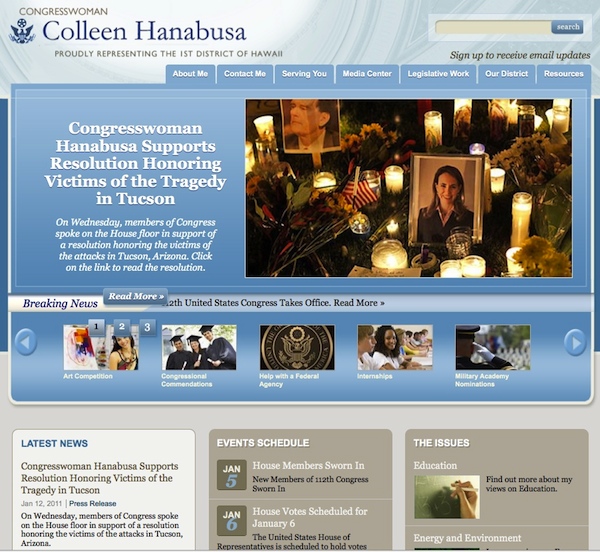
In the meantime, the incoming Congressmen and Congresswomen do appear to have adopted Drupal as the platform for their official websites. For instance, Congresswoman Colleen Hanabusa‘s site, below, uses one of several templates on the Drupal platform. Notably, each of the new sites includes default modules for the leaders in the respective verticals in the social media world: Flickr, YouTube, Twitter and Facebook.

Some questions remain about the cost and choices that representatives have as they choose their online Web presences. As NextGov reported today, while House websites can move to the open source platform – they don’t have to do so.

Given the context of citizens turning to the Internet for government information, data and services in increasing numbers, however, a well-designed Congressional website with clear connections to the various digital outposts has moved from a “nice to have” to a “must have” in the eyes of the digitally connected. (For citizens on the other side of the digital divide, the House switchboards are still available via phone call at (202) 224-3121 or TTY: (202) 225-1904).

If that’s a given, then the question is then why Drupal is now the preferred web hosting environment for the House. On that count, “Drupal was chosen because it is open source and widely accepted, therefore allows Members to leverage a large community of programmers which gives them more choices and innovation,” wrote Weiser in an email. “It should also be noted that Members still will have the option to use other platforms.”

Weiser told NextGov that, because, Drupal developers are in every member’s district, “that hopefully means expanded choice and more innovation for our members.”

The current content management system limits the choice of site programmer as well as innovation, said Dan Weiser, communications director for the chief administrative officer, in an e-mail. Drupal, which uses a common framework and code that can be customized, will allow members to leverage a large community of programmers, providing more opportunities for innovation, he added.

The House expects to save some money with the transition to Drupal, since the chief administrative officer will manage the infrastructure and members pay vendors only for development time, Weiser said.

The inclusion of social media is also no longer a novelty in the beginning of 2011. “We expected there would be interest by the incoming freshmen to have social media on their sites; it just seemed natural to offer the option,” wrote Weiser.

[Disclosure: One of the vendors involved in the House’s Drupal effort is Acquia. O’Reilly AlphaTech Ventures is an investor in Acquia.]