Today in Washington, Secretary of State Hillary Rodham Clinton is speaking about Internet freedom and technology.
http://c.brightcove.com/services/viewer/federated_f9?isVid=1
The PBS Newshour is also streaming the speech:
Today in Washington, Secretary of State Hillary Rodham Clinton is speaking about Internet freedom and technology.
http://c.brightcove.com/services/viewer/federated_f9?isVid=1
The PBS Newshour is also streaming the speech:
http://c.brightcove.com/services/viewer/federated_f9?isVid=1
2011 predictions from Deloitte Consulting:
In 2011 Deloitte predicts eGovernemt (eGov) usage will reach an inflection point. Across developed countries, the proportion of businesses that use eGov services for at least one process is expected to average over 90 percent, up from 75 percent in 2010. Similarly, the proportion of citizens that use eGov in industrialized countries should rise by at least 10 percentage points. In some countries, the importance of eGov as a way to boost public sector productivity and efficiency may even prompt the appointment of a national Chief Information Officer (CIO) where one did not exist previously.”
For those watching, the United States has had both a CIO and a chief technology officer (CTO) since the beginning of the Obama administration. Both Vivek Kundra and Aneesh Chopra, respectively CIO and CTO, have worked with their staff to go beyond traditional e-government in the context of the open government initiative, evolving from a “vending machine” model, where government simply provides e-services, to where government acts as a platform, releasing data and convening citizens, industry and policy makers to address huge challenges.
Whether Deloitte’s prediction comes true in 2011 for the world remains to be seen. It’s certainly interesting and worth taking note.

Wordle of a interview of Ghonim by Steve Garfield
Block the whole Internet, you’re gonna really frustrate people. One of the strategic mistakes of this regime was blocking Facebook. One of the reasons why they are no longer in power now is that they blocked Facebook. Why? Because they have told four million people that they are scared like hell from the revolution by blocking Facebook. They forced everyone who’s just, you know, waiting to read the news on Facebook, they forced them to go to the street to be part of this.
Ghonim, who has called the galvanic events that swept Egyptian president Hosni Mubarak out of power “Revolution 2.0,” spoke eloquently about the role of social networking in Egypt. “If there was no social networks, this would never have been sparked. Without Facebook, without Twitter, without YouTube, this would never have happened.”
Shortly after the 60 Minutes interview aired on the East Coast of the United States, Ghonim posted another tweet:
.bbpBox36944183608475650 {background:url(http://a1.twimg.com/profile_background_images/170023094/wae_clearl.jpg) #32cef9;padding:20px;} p.bbpTweet{background:#fff;padding:10px 12px 10px 12px;margin:0;min-height:48px;color:#000;font-size:18px !important;line-height:22px;-moz-border-radius:5px;-webkit-border-radius:5px} p.bbpTweet span.metadata{display:block;width:100%;clear:both;margin-top:8px;padding-top:12px;height:40px;border-top:1px solid #fff;border-top:1px solid #e6e6e6} p.bbpTweet span.metadata span.author{line-height:19px} p.bbpTweet span.metadata span.author img{float:left;margin:0 7px 0 0px;width:38px;height:38px} p.bbpTweet a:hover{text-decoration:underline}p.bbpTweet span.timestamp{font-size:12px;display:block}
My message to the dictators of the world: You should at least freak out. Block Facebook and cancel Fridays. #Jan25 #SidiBouzid #WhatsNext Wael Ghonim
Ghonim
What happens next in Egypt is not clear. As Anthony Shadid wrote this week, it’s uncharted ground. What is clear is that history has been made, and in Wael Ghonim’s eyes, “this was an Internet Revolution.”
Open source technology and collaborative models will matter in media, mapping, education, smarter cities, national security, disaster response and much more in 2011 and beyond. The success of open source in building systems that work at scale offers an important lesson to government leaders as well: to meet grand national challenges and create standards for the future, often it’s best to work collectively on them. The hundreds of people who gathered yesterday at the United States Department of State spent the day parsing open source at Tech@State, the technology conference organized by the office of eDiplomacy.
Open source is playing an important role in open government, although it’s hardly a precondition for it. Whether it’s Energy.gov or House.gov moving to Drupal, middleware for open government data or codesharing with CivicCommons, open source matters more than ever.
One challenge that Gunnar Helleksen articulated in his presentation on Open Source for America’s federal open technology report card was that while many agencies are using open source, very few are contributing code or interacting with the community. As Melanie Chernoff pointed out, the Obama administration has shown unprecedented interest in open source.
The Administration generally emphasizes transparency, participation, and collaboration as government goals while maintaining a “technology neutral” policy. Yet they have shown unprecedented interest in open source. Macon Phillips & Dave Cole of whitehouse.gov talked about how open source can help the federal government achieve its engagement and collaboration goals in their OSFA award acceptance speech.
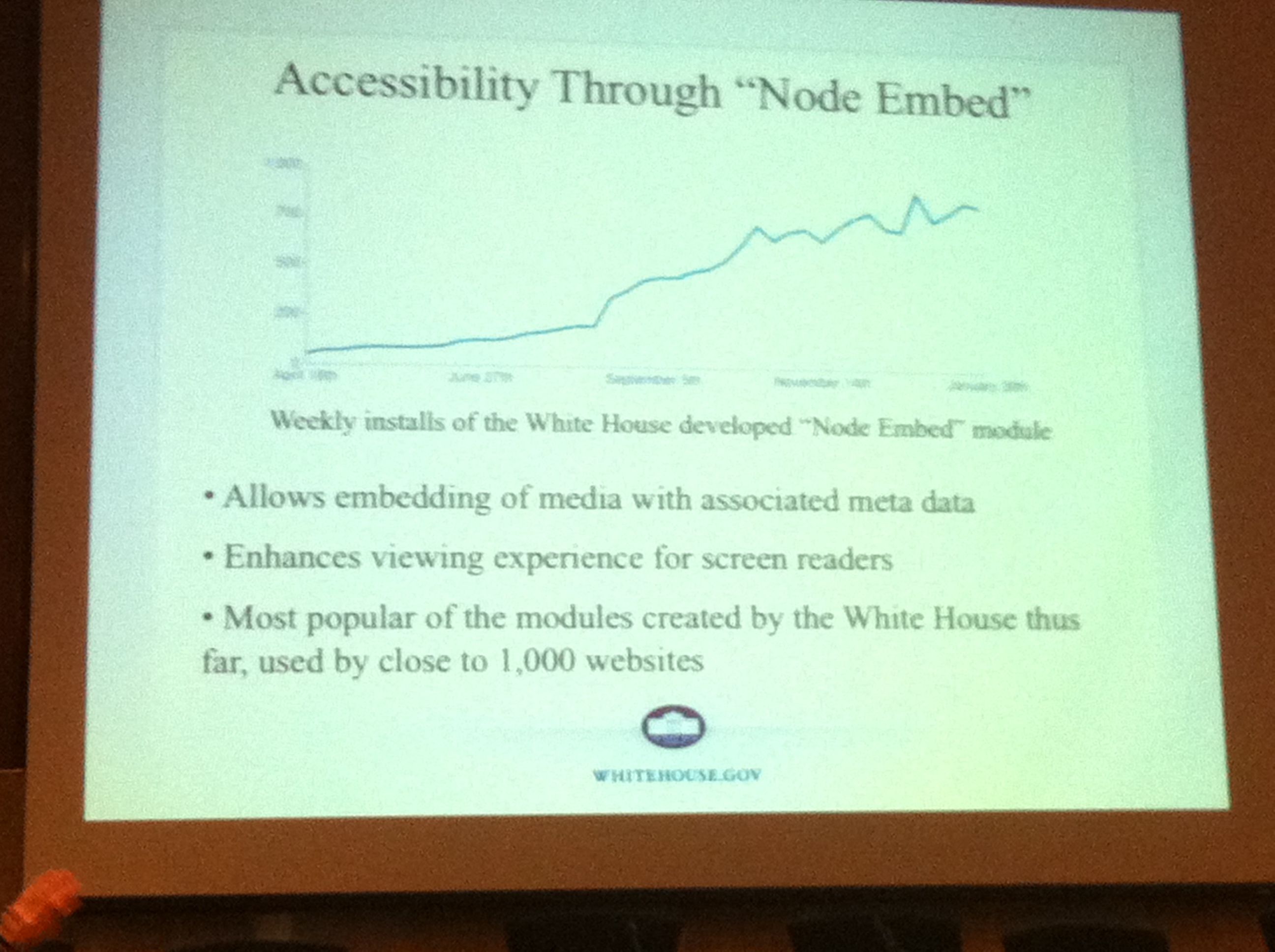
Phillips said that the White House has released more open source code this week, available at WhiteHouse.gov/tech. Perhaps one of the most important slides from the entire day came from his presentation, where he noted that the accessibility module that the White House had released was being used by nearly 1000 websites. When we work on our platform and contribute back to the public,” said Phillips, “it’s part of our service to the public.”
Given its mission, however, the State Department will likely always need place limits on the radical transparency some equate with open government, but as Susan Swart, the department CIO, observed at Dipnote, “technology is the key enabler of our information enterprise.” Open source will be a part of that enterprise going forward, whether it’s MediaWiki, WordPress or Drupal.
Many of the conversations, videos and presentations from the Tech@State open source conference are captured below.
Video of Swart, Aneesh Chopra, CTO of the United States, Macon Phillips, White House new media director, and Todd Park, CTO at HHS, is embedded below:
http://www.ustream.tv/flash/viewer.swf
Open standards matter here too. As Phillips observed, the choice to use the H.264 online video standard and develop in HTML5 meant that when Apple released the iPad, the company featured WhiteHouse.gov, since users could go and watch video there. (In this context, at least, the White House avoided “shiny app syndrome.”)
As Chopra noted, the U.S. moved forward into the pilot phase of an open source model for health data systems as the fruits of the Direct Project came to Minnesota and Rhode Island. The Direct Project allows for the secure transmission of health care data over a network. Some observers have dubbed it the Health Internet , and the technology has the potential to save government hundreds of millions of dollars, along with supporting the growth of new electronic health records systems. “Healthcare information will be shared around the United States, powered by the direct protocol,” said Chopra. He says that’s a philosophy to “engage entrepreneurs as problem solvers” in the context of open energy, transportation, where government platforms can spur innovation.
No where is that locus more dynamic that in the release of open health data from the Department of Health and Human Services (HHS). As Brian Kalish reported for NextGov, HHS wants to be a data ‘sugar daddy’, so to speak. To put it another way, HHS is making community health information as useful as weather data, and here come the healthcare apps as a result. Tens of thousands of people have used open health data in the iTriage app to find local health centers.HHS CTO Park says that the new HealthData.gov will be launching next week. In the meantime, HealthIndicators.gov is already live. Look for more activity in that space.
Jeremy Allison, creator of Samba, Chris DiBona, open source and public sector programs manager at Google, and Darren Krape, of State Department, offered up a frank discussion of the history open source and industry. Looking back, a lot of people thought that open source gathered steam because proprietary software wasn’t providing change fast enough, said DiBona. “They needed something that moved faster.”
In that context, Dibona described open source software as a “remarkable form of liberation,” with benefits wholly separate from philosophy. “As an end user, you don’t even know that you’re using it,” he said “I see it as the fruits of labor of tens of thousands of open source developers.”
Dibona asserted that open source can allow developers to move more quickly, with respect to bugs or building out features. It can also disrupt the industry. As he noted, “the computer business has been profitable but frankly some things don’t deserve to be any more.”
Allison similarly observed that lot of the time the easiest way for an organization to get needed functionality is to “just download something and make it work.” He also referred to the role of software patents in technology, with respect to the ability of their owner to shut down innovation. “Software patents handcuff entrepreneurs,” he said to scattered applause, and suggested that the issue could cost government “billions.”
http://www.ustream.tv/flash/viewer.swf
David Eaves kicked off with a great lightning talk on Code for America. After Eaves answered questions, Greg Elin, chief data architect at FCC, Dr. Linton Wells, director of center for technology and national security policy at the National Defense University, Deb Bryant, public sector communities manager at the Oregon State University Open Source Lab, and this correspondent talked about some of the fears, misconceptions and case studies that exist in the open source world.
http://www.ustream.tv/flash/viewer.swf
Key takeaways:
For Elin, open source and open data “go hand in hand.” The biggest thing he needs support for is security patching. For handing open data on the scale that the FCC requires, commercial software doesn’t address their needs; they were able to solve their issues by writing Python code, leveraging open source and integrating it with commercial software. In his view, one area where open source is superior lies in procurement and prototyping, given that you can do either for free.
For Bryant, it’s that many of the same critiques that people levy against open source exist for proprietary software. You won’t always have support, bug reports won’t always be fixed and the person who wrote code won’t always be available. Open source isn’t free, given the support requires time and money, but there’s a lot for “fear, uncertainty and doubt” out there, also known as “FUD.”
For Wells, it was that the combination of open source, social media and government that we saw in Haiti showed the promise of “what can be done” in terms of situational awareness and assistance. In 2011, that combination is being tried in many more places.
A remarkable historic confluence brought the Tech@State conferees to the State Department on the day that President Mubarak stepped down in Egypt after weeks of protests. At 3 PM, many attendees of Tech@State gathered to watch President Obama’s remarks on Egypt on the big screen in the main meeting room.
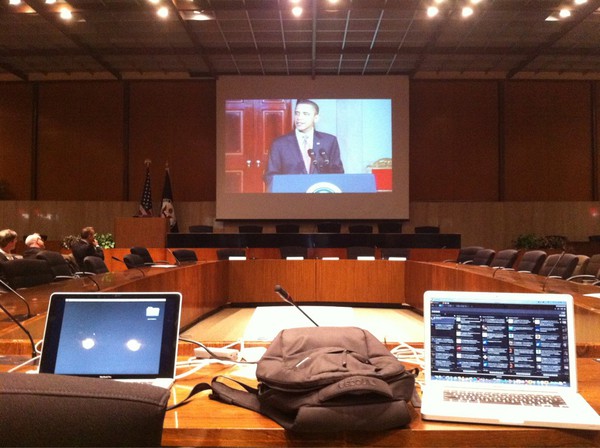
As the president observed: “There are very few moments in our lives where we have the privilege to witness history taking place. This is one of those moments. This is one of those times. The people of Egypt have spoken, their voices have been heard, and Egypt will never be the same.”
http://www.whitehouse.gov/sites/all/modules/swftools/shared/flash_media_player/player5x2.swf
The historic day framed a provocative discussion on how media has changing between Saad Khan, seed investor at CMEA Capital Katherine Maher, ICT Program Officer at National Democratic Institute, and Habib Haddad, founder YallaStartup, Yamli, co-creator Alive in Egypt. That video is embedded below.
http://www.ustream.tv/flash/viewer.swf
The culture of open source and the culture of government aren’t always aligned. As many people in those world know, open source wasn’t validated as a legitimate alternative to proprietary technologies until the middle of the last decade. Now it’s running straight into the “beast of bureaucracy,” with varying results. The conversation between Richard Boly, State Dept, Emma Antunes, NASA, Lisa Wolfisch, GSA, Matthew Burton, Dept. of Treasury, and Gwynne Kostin, GSA, is worth listening to in that context.
http://www.ustream.tv/flash/viewer.swf
 Today the conversations continue at an unconference at the National Democratic Institute. Details are at http://techatstate-oss-unconf.eventbrite.com
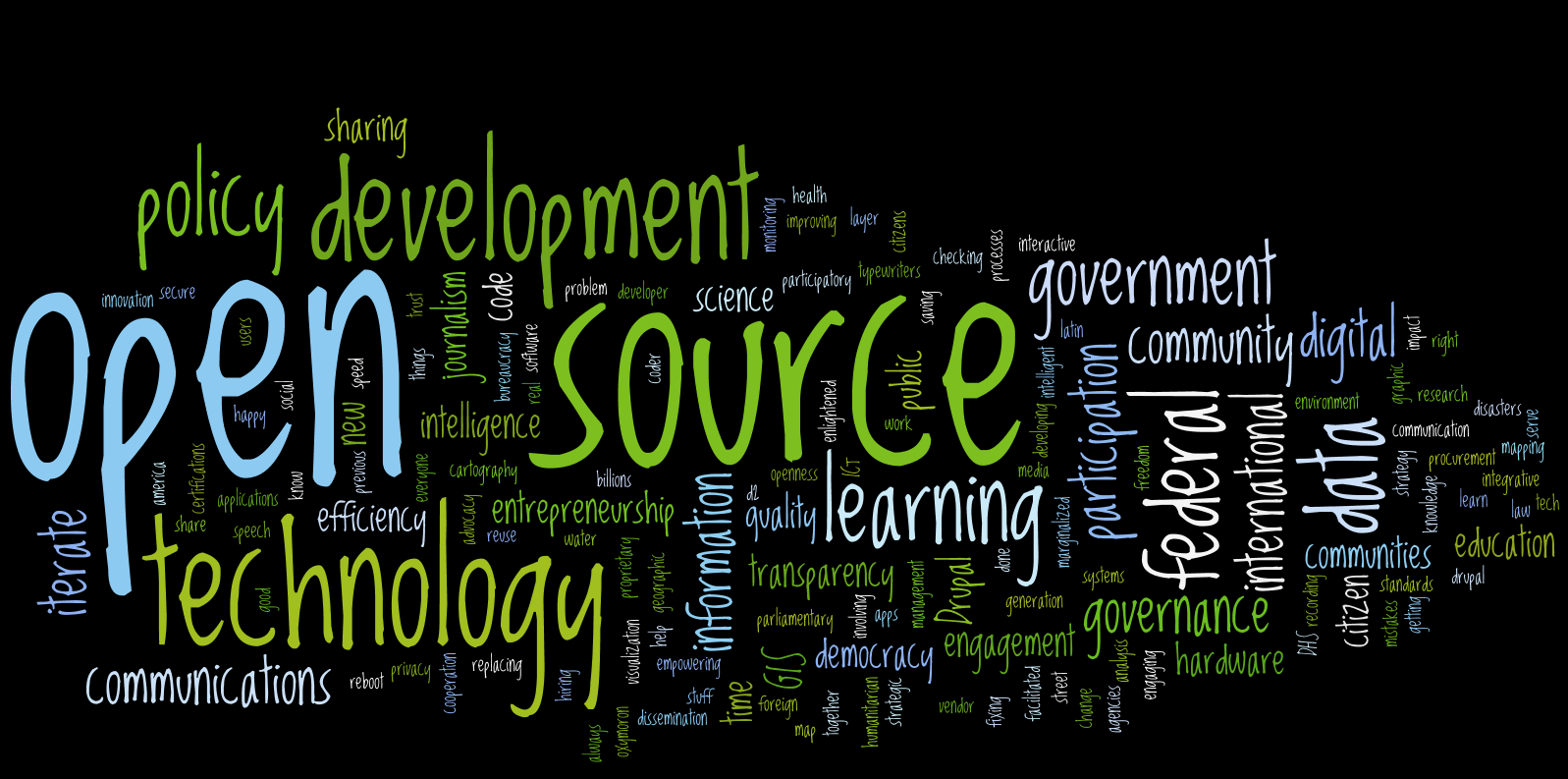
On Friday, the fifth Tech@State conference at the United States Department at State focused on the role of open source in government, industry and society. Today, there is a Tech@State unconference on open source at the National Democratic Institute. In keeping with the tradition of an unconference – sometimes called a barcamp – the day kicked off with a introduction where every attendee shared his or her name, affiliation and three words that describe who they are, what they care about, what they’ve come to learn or what they do. Or all three. Below is a wordle that shows the frequency of words used.
The schedule for the Tech@State unconference is evolving at Open4m.org/NDI. It bids to be an interesting day.

Tomorrow, another great Tech@State event kicks off at the State Department in Washington, D.C. In New York City, the city’s first chief digital officer, will put on the capstone on Social Media Week at an open government forum. Out in Los Angeles, people will gather at KPCC for a digital diplomacy forum. It will be a busy Friday but these three events are only a few coming up that sit in the intersection of technology, citizens and government coming up this year.
As J.D. Lasica reported in his comprehensive Socialbrite list of 2011 social media, tech marketing conferences, there won’t be a Gov 2.0 Expo. (For an explanation of why O’Reilly won’t be doing the Expo this year, visit Quora.) There will, however be many other places for people to gather, talk and learn about Gov 2.0 in 2011 — just take a look through the many Govloop event listings. For a broader selection, Socialbrite has a terrific calendar of calendar of 2011 nonprofit conferences.
There will be any number of citizen-generated unconferences around the world in 2011, where the attendees generate the program. They’ll include CityCamps, BarCamps, PodCamps or MobileCamps. Check out the CityCamp calendar to find one near you and keep an eye out for CityCamp meetups in February.
The following listings are by no means comprehensive but should serve as a starting point if you’re wondering what’s happening, when and where. If you know about more Gov 2.0 events that should be listed here, please let me know at alex@oreilly.com or @digiphile.
This Los Angeles conference brings a “West Coast” sensibility to the Gov 2.0 conversation, with a particular emphasis on social media and speakers from the diplomatic, marketing and consulting worlds. For a sense of what the 2010 event held, read On Language: Government 2.0 jargon and technology or a history lesson in disruptive innovation applied to modern government at Gov 2.0 LA.
Website: gov20la.org
February 13, Boston, MA
February 19, Seattle, WA
Philadelphia and DC TBD.
Code for America is hosting a set of “data camps” in its host cities this winter. Here’s why: “City governments have a lot of information which is useful to all of us. This ranges from maps of local parks to building footprints to real-time 911 calls. We all have an interest in our budget information, legistlative documents and other resources that we use in collective decision-making and deliberation. Not all of this information is currently available for all cities, even though much of it is public record. The “Open Data” movement is a way to work on getting information into machine-readable formats, allowing for easy publishing, sharing, and reuse. We’re hosting DataCamps in CfA’s cities this year to build communities around making city data more open and accessible to allow citizens to help cities work better. DataCamp is a event focusing on skill-building and collaborative work on city data. It is an opportunity for interested parties in a city to work together, and build a network of people with shared interested in improving civic communications and information management.”
Website: Code for America datacamps
Feb. 24 to 27, 2011 — Raleigh, N.C.
Data journalism is a key component of the Gov 2.0 world. If government releases data, data journalism must evolve to validate, analyze and tell stories with it.
Website: www.ire.org/training/conference/
February 14-17, 2011
Social media is but one component of Gov 2.0, alongside open data, collective intelligence or a rethinking of how services are provided, but it’s clear that it’s important.
Website: www.aliconferences.com/conf/social_media_govt0211/index.htm
February 23rd, Washington, DC
“Intelligent Cities, a National Building Museum initiative, supported by its partners TIME and IBM and funded by The Rockefeller Foundation, explores the intersection of IT and urban design to understand where we are, where we want to be, and how to get there.” Meetups are planned for San Francisco, NYC and Chicago.
Website: Meetup.com/Intelligent-cities
March 5-6, NYC, New York
March 19-20, San Francisco, CA
TransportationCamp is a new unconference about transportation and technology.
Website: transportationcamp.org
March 10-15, Austin, Texas
This year’s SXSWi will include many sessions that fall under the umbrella of Gov 2.0, including government officials talking about open government, citizens talking about new apps or platforms, and new services or applications that will be relevant to both. Here’s just a sampling.
Website: sxsw.com/interactive
March 17–18, 2011, Washington, DC
This conference is for government new media managers and webmasters, many of whom are wearing both hats in 2011. It’s proven to be an excellent networking and educational forum.
Website: http://www.usa.gov/webcontent/wmu/conference/2011/index.shtml
March 28-31, San Francisco, CA
October 10-13, NYC, NY
There are many lessons for Gov 2.0 from Web 2.0, including the power of platforms to catalyze innovation, investment and more agile government.
Website: web2expo.com
March 29-30, Mountain View California
From the organizers: “On March 29 & 30, NASA will host its first Open Source Summit at Ames Research Center in Mountain View California. This event will bring together engineers and policy makers across NASA and respected members of the open source community to discuss the challenges with the existing open source policy framework, and propose modifications that would make it easier for NASA to develop, release, and use open source software.”
Website: NASA Open Source Summit
April 12, National Archives, Washington, D.C.
From the organizers: “MAGIC is a collaborative, one-day conference sponsored by the National Archives and Records Administration (NARA) and Duke University’s DeWitt Wallace Center for Media and Democracy that will:
The conference is free and open to the public, though registration is required. Breakfast, lunch, and refreshments are included. The conference sessions will be videotaped and made available for viewing at a later date. For more information, please contact MAGIC@nara.gov.”
Website: MAGIC
April 16, Washington, D.C.
From the organizers: “You have heard the word, mobile is the new hot thing. You have convinced your management to start using mobile, but how do you actually use mobile to engage citizens and create impact? The Mobile Citizen Summit is a one-day learning laboratory for those interested in applying mobile technologies to empower, fuel and drive citizen engagement in the public good. Our focus is on providing you with informative and practical discussions.”
Website: Mobile Citizen Summit
April 30-May 1, Washington, DC
The 2010 Transparency Camp delved into open data, coffee, open government, culture and yes, transparency. Look for more of the same.
Website: transparencycamp.org
Likely in May 2011, Washington, DC
Applied uses of platforms, social media, culture change and more, all relevant transparency and open government
Website: http://events.1105govinfo.com/events/ogi-open-government-2010/home.aspx
May 6-7, Oklahoma City, Oklahoma
From the organizers: “The second annual Gov 2.0a conference is focused on applications of technology to government problems. The conference will be a forum to learn about successful Gov 2.0 applications through case studies, to learn about best practices for Gov 2.0 applications, and to network with other professionals from city and state organizations, community groups, non-profits and the private sector who share interest in the application of technology to improve the functioning of our government.”
Website: Gov20a.com
May 11, Washington, D.C.
From the organizers: “FedScoop’s Open Government & Citizen Engagement Summit, part of the FedTalks event series, will bring together leading federal government and industry experts to discuss the state of open government and tech solutions to better engage citizens.”
Website: Fedscoop.com/fedtalks/opengov2011
May 13-14, Portland, OR
Open government and Gov 2.0 community leaders, public officials, citizens and technologists from all over the West Coast.
Website: opengovwest.org
May 13-22, 2011, 35+ cities
In 2011, there will be a host of other camps too, as readers will find below, and a new initiative: local open government innovation summits. According to the organizers, “The summits’ overarching objective is to gather citizens and local government staff together in dialogue for knowledge-sharing and relationship-building. It is not necessary to include action planning, identification of next steps, or decision-making into your local summit. A successful outcome is raising awareness of local gov officials that they are not alone as they implement open government programs and that they can access the expertise of the broader open government community. The target is 50+ local summits across the US and internationally.”
Website: opengovplaybook.org
June 4-5, NYC
From the organizers: “OpenGov Camp is a one day conversation on how participation builds transparency to deliver efficiency. We are a community of doers and decision-makers talking about what works—and what doesn’t. Whether you are a developer, journalist, activist, organizer or government employee, you should attend. For one day, we ask you three questions:
Website OpenGovNYC
June 6-7, New York City, NY
This world-class conference exploring and analyzing technology’s impact on politics and government is back for the 8th year in New York City.
Website: personaldemocracy.com
July 25-29, 2011, Portland, OR
The O’Reilly Open Source Convention is the crossroads of all things open source. Open source plays an increasingly important role in government. The processes involved in open source itself have served as a model for open government.
Website: oscon.com/oscon2011
Likely in July 2011 in Philadelphia, PA (Unconfirmed)
Technologists, entrepreneurs, business executives, investors, and policy-makers have come to Supernova for strategic insights on our increasingly interconnected world
Website: supernovahub.com
September 19-21, NYC, NY
To say that big data is a big deal for government is an obvious understatement. Government, after all, has extraordinary amount of data, with much more becoming available as open data initiatives move forward. The first Strata Conference in February 2011 was a sold-out hit. Strata NYC will pull together global leaders in big data in the Big Apple.
Website: strataconf.com
October 12th, Washington, DC
Open government went to the theater at the first Fedtalks. In 2011, look for more federal government and industry experts to discuss the state of innovation in government.
Website: Fedscoop.com/fedtalks/fedtalks2011
October 2011, Portland, OR
If 2010 was a year where open government moved “beyond plans to practice,” by late 2011 there should be many more case studies of implementation. GOSCON – the government open source conference – will feature discussions and presentations about how government leaders, innovators and smart operations are using open source.
Website: goscon.org
November 4 – November 11, Washington, DC
Last year, the inaugural Digital Capital Week showcased tech innovation in Washington. The 2011 version of Digital Capital Week bids to be even bigger.
Website: digitalcapitalweek.org
November 15-17, San Francisco
This event brings together business leaders, big thinkers, and innovative technologists who are shaping the future of the Web. In 2011, it’s clear that the shape of that future matters for government and citizens alike.
Website: web2summit.com
In February of 2011, the effects of the The Atlantic has released a special report on jobs and the economy. This morning, the report and the prospects for growth will be discussed at a digital town hall on at the Newseum, “Jobs and the Economy of the Future.
Guests include:
The event’s digital component includes a livestream and a new instance of Microsoft’s Town Hall platform for collecting feedback from the online audience. There is also an active backchannel on Twitter aggregated at the #USFutureEconomy hashtag:
http://widgets.twimg.com/j/2/widget.js
new TWTR.Widget({
version: 2,
type: ‘search’,
search: ‘USFutureEconomy’,
interval: 6000,
title: ‘What is the discussion about the’,
subject: ‘Jobs of the Future?’,
width: ‘auto’,
height: 300,
theme: {
shell: {
background: ‘#004869’,
color: ‘#ffffff’
},
tweets: {
background: ‘#ffffff’,
color: ‘#444444’,
links: ‘#1985b5’
}
},
features: {
scrollbar: false,
loop: true,
live: true,
hashtags: true,
timestamp: true,
avatars: true,
toptweets: true,
behavior: ‘default’
}
}).render().start();
The Atlantic will be liveblogging the event as well.
“I began the Gov 2.0 taskforce thinking that open government was a kind of civil rights agenda, even if it has economic costs,” said Nicholas Gruen last week in Santa Clara at the Strata Conference. Gruen headed Australia’s Gov 2.0 taskforce. “At the end of it, I realized that open government was actually a really powerful economic driver.”
Why? Gruen pointed to the efficiencies presented inside of government by improved communication and the opportunities to ask citizens for ideas and solutions to problems. “Even if our team said we couldn’t do it technically, I just said we’ll tell everyone that we need help and approach it that way.” Asking questions was, he said, an effective means of accomplishing many tasks much faster than they would have been otherwise.
In a video interview, embedded below, Gruen talked more about the state of Gov 2.0 in Australia and some of his thoughts of the economics involved His comments on cultural change will be of particular interest those focused on technology as a panacea to inefficiency or engagement.
The recent historic flooding in Australia created an urgent use case for improved communications between the public and government. “When you look at the Queensland floods, the Facebook of the police department use blew people away,” said Gruen. “Their links got many comments and compliments.”
For more about how social media combine with geospatial mapping in crisis response, read about a new online application from geospatial mapping giant ESRI that applies trend analysis to help responders to Australia’s recent floods create relevance and context from citizen-generated reports.
Achieving better outcomes through technology isn’t just about setting up a Facebook page or Twitter account, emphasized Gruen. Public servants have to be willing to share information that matters to citizens and in turn listen to feedback from the public to create better feedback loops.
“This is a cultural transformation,” said Gruen. “You can’t impose that. You can’t dictate it.”
Further reading: “Gov 2.0 Down Under: Australia and Open Government“
US chief technology officer Aneesh Chopra took questions about the White House’s new innovation strategy on Twitter. Following is a report of the conversation between Chopra and the online audience. http://storify.com/digiphile/white-house-cto-aneesh-chopra-takes-questions-on-i.js
We are deluged in big data. We have become more adept, however, at collecting it than in making sense of it. The companies, individuals and governments that become the most adept at data analysis are doing more than find the signal in the noise: they are creating a strategic capability. Why?
“After Eisenhower, you couldn’t win an election without radio.
After JFK, you couldn’t win an election without television.
After Obama, you couldn’t win an election without social networking.
I predict that in 2012, you won’t be able to win an election without big data.”
–Alistair Croll, founder of bitcurrent.
In November 2012, we’ll know if his prediction came true.
All this week, I’ll be reporting from Santa Clara at the so-called “data Woodstock” that is the Strata Conference. Croll is its co-chair. You can tune in to the O’Reilly Media livestream for the conference keynotes.
For some perspective on big data and analytics in government, watch IBM’s Dave McQueeney at last year’s Gov 2.0 Summit:
Or watch how Hans Rosling makes big data dance in this TED Talk:
 E Pluribus Unum
