The report, which I’ve embedded below, was released through a blog post at Whitehouse.gov by Steven Croley, special assistant and senior counsel to the President:
President Obama has made open government a high priority. Greater openness renders our government more efficient and effective. It strengthens our democracy. It improves our citizens’ lives.
To these ends, the Administration has taken many substantial steps to promote increased participation and collaboration in government, and to make government more transparent. For example, federal agencies have increased transparency through redoubled efforts to disclose more information under the Freedom of Information Act. They have implemented ambitious Open Government Plans, and made voluminous data newly available to the public. The Administration has also made spending information more transparent, and taken steps to disclose previously sensitive government information.
Of course, creating a more open government requires sustained effort. How best to harness new technologies in the service of open government, to strike the proper balance between transparency and the protection of national security and personal privacy, to change agency culture so that openness becomes the new normal–such issues require long-term commitment.
But it is useful to take stock of the Administration’s accomplishments along the way. Accordingly, today the White House is releasing The Obama Administration’s Commitment to Open Government: A Status Report (pdf). This status report highlights the breadth of the Administration’s commitment to open government, documents the substantial progress made on many of the Administration’s open government initiatives, and anticipates continued progress. Although not an exhaustive compilation of our open government efforts, thi provides a compelling picture of how far the Administration has already come towards forging a more open government.
The 34-page report is a highlight reel of everything the administration has accomplished on open government, claiming victories in increased agency responsiveness to Freedom of Information Act requests, the release of government data online, and better communication using web tools. It comes as the Obama administration prepares to make good on a challenge the president himself issued at last year’s convening of the U.N. General Assembly to return there this month with concrete steps to make governments more open, participatory and collaborative.
“We are pleased to see the Administration undertaking this kind of review because it gives us an all opportunity to reflect on what goals have been met and what challenges we agree remain,” wrote Patrice McDermott, director of Open the Government, in a post at OpenTheGovernment.org. “We hope our advocacy and the Administration’s actions will result in an even more impressive report in the future.”
If, like me, your German isn’t so good, try reading it using Google Translate.
Key points:
Ulrich Freise, Berlin’s Secretary of State for Home Affairs, described Berlin’s open data site as base for administrative action that citizens could use to make decisions, find facts and involve themselves in decision-making processes.
Domscheit-Berg, a member of the Berlin Open Data Platform for Action, praised the launch as an important milestone on the way to a more transparent government in Germany.
An “Open Data Day” in Berlin this May helped introduce more government staff to the idea and resulted in a agenda that subsequently helped shape the release.
Much of the data is not machine-readable, at present, nor released under a Creative Commons license that would free to be used commercially or otherwise adapted for further civic use, as German civic developer Stefan Wehr Meyer pointed out to Heise.
While Open Data Berlin launches with just 18 data sets, there’s plenty of room to grow. Data.gov, in the US, went online with 49 data sets in 2009. Now there are over 400,000 listed there. If Berlin can similarly expand and open up more meaningful data in a manner that’s usable to Germany’s civic developers, there will be more Deutchland data stories to tell this year.
On September 22, the Republican candidates for president will be in Orlando, Florida for the next debate. Unlike the last debate, where moderators from NBC and Politico chose the questions, Google-Fox News debate will use Google Moderator and YouTube to bubble up questions from the Internet. Questions can be submitted as text or video through the Fox News YouTube channel. The deadline is September 21st. The video embedded below introduces the concept:
Fox News anchor Brett Baer explains the process below and encourages people to submit questions “creatively” — which means that former Massachusetts governor Mitt Romney could potentially be confronted by a YouTube snowman of the sort he didn’t care much for in 2007.
For good or ill, that kind of question in that kind of costume is likely to be part of the warp and weft of presidential politics in the 21st century. President Obama’s Twitter townhall” featured several questions from people with quirky account names or avatars. Bringing YouTube into the discussion will allow even more self expression and, while Fox News has the ability not to broadcast a video, millions of connected Americans can go watch the videos themselves if they choose. At the moment, the top-rated questions are substantive ones:
How do you intend to shift some of the power and influence of large corporations in Washington DC back to the average American and small business owner?
Would you support term limits for Congress?
As president, would you support the elimination of government agencies or departments as a means to reduce our government’s size and spending? If so, which agencies or departments would you eliminate or substantially downsize?
We’ll see if the question about marijuana legalization that has so frequently bubbled up to the top of Moderator instances for the president ends up in this one.
Designing digital democracy is hard. The structures and conventions that have evolved for deliberative democracy, as messy as it can be offline, don’t transfer perfectly into machine code. Many different companies, civic entrepreneurs, nonprofits and public servants are working to create better online forums for discussion that make better use of technology. Last week, ASU journalism professor and author Dan Gillmor commented in the Guardian that is was past time for “presidential primary debate 2.0, where the Internet would a much bigger role in the structure, format and substance of these events. As Gillmor observes, “truly using the web would mean creating a much more ambitious project.”
Imagine, for example, a debate that unfolds online over the course of days, or even weeks and months. While they’d include audio, video and other media, these debates would necessarily exist, for the most part, in the more traditional form of text, which is still by far the best for exploring serious issues in serious ways. Questions would be posed by candidates to each other, as well as by journalists and the public. But an answer would not be the end of that round; in fact, it would only be the beginning.
We’re not there yet. In less than two weeks, however, we’ll see if the hybrid Fox News-Google Moderator approach comes any closer to bringing the Internet into the debate in any sort of meaningful way than it has in the past.
Washington-based DevelopmentSeed continues to tell dazzling data stories with open source mapping tools. This week, they’ve posted a map of the local impact of unemployment and recovery spending. The map visualizes unemployment rate changes at a county level and folds in total economic recovery spending by the government under the American Recovery and Reinvestment Act of 2009. In the map embedded below, red corresponds to an increased unemployment rate and green corresponds to a lower unemployment rate or job growth. Counties that received less than $10 million dollars in recovery spending have a white pattern.
David Cole explains more in a post at DevelopmentSeed.org:
Over the last year, we see that unemployment dropped in 58% of counties by an average of 0.25 percentage points. On average the Recovery Act funded 31 projects at a total of $24,131,582.47 per county. Nationally this works out to about $282.66 in recovery spending per person.
…
Overall, it’s impossible to tell for sure how much recovery spending improved the economic situation, because we just don’t know how bad things could have been. It may be the case that without spending, this map would have a lot more red. Or maybe not. What’s interesting here is the local impact and information we are able to see from processing a few sets of open data. Check out how your county is doing compared to its surroundings. How about compared to a more or less urban county nearby?
Strata Conference New York 2011, being held Sept. 22-23, covers the latest and best tools and technologies for data science — from gathering, cleaning, analyzing, and storing data to communicating data intelligence effectively. Save 20% on registration with the code STN11RAD
In less than two weeks, there will be an unprecedented bilateral codeathon between the United States and Russia held in both Washington, D.C. and Moscow, Russia.
The event will last between September 24 at 9AM until September 25 at 5:00 PM and will be held at American University in D.C. and in the offices of Yandex in Moscow.
More details coming soon.
For now, check out Code4Country.org and submit your ideas for civic applications that can help make Russian civil society stronger, solve problems for citizens and enable more government transparency,
The details of the launch of the Open Government Partnership on September 20th are now public. Under Secretary of State Maria Otero, Brazilian Minister of State Jorge Hage and President Benigno S. Aquino III will be making keynote speeches, followed by senior government officials, business leaders and technologists, including eBay founder Pierre Omidyar, World Wide Web creator Tim Berners-Lee and Celtel founder Mo Ibrahim.
The “Power of Open” event will be hosted by Google NYC. Given limited capacity for live attendance, a live stream of the event at the Open Gov Partnership YouTube channel will substantially increase the forum’s reach. The “Power of Open” agenda is embedded below.
With two weeks left before a historic announcement in New York City at the United Nations, the international Open Government Partnership (OGP) has expanded to include fourteen more countries. The news of the expansion was first reported by FreedomInfo.org, which quoted an unnamed U.S. official.
The newly added countries include Kenya, Guatemala, Honduras, Albania, Macedonia, Malta, Georgia, Moldova, Slovakia, Bulgaria, Israel, Croatia, Mongolia and Lithuania. The original eight country members of the OGP are the United States and Brazil (co-chairs of OGP), South Africa, the United Kingdom, Norway, Mexico, Indonesia and the Philippines.
“These are governments from whom we’ve received formal letters of intent,” said Caroline Mauldin, special assistant to Under Secretary for Democracy and Global Affairs Maria Otero at U.S. Department of State. “We’re very energized by the number of countries who are ready to step up to the Open Government Partnership plate.” Mauldin tells me that more letters of intent are still coming in, which will add further to the participants.
Expanding the number of countries committing to more open government is not in principle a bad thing, although the devil is the details, as ever. Brazil and the Philippines, for instance, are still working on Freedom of Information laws. We’ll learn more over the next two weeks, until the official Heads of State launch on the margins of the opening of the United Nations General Assembly in New York City. I’ll be sharing news and information as I go during the next 14 days and from the Big Apple on September 20th.
“All of the new countries are committing to developing their own country action plans in consultation with civil society, which they will announce at an OGP meeting in March 2012,” said Mauldin. “The ‘consultative process’ is the part of OGP that guarantees an ongoing, iterative dialogue with civil society.”
These letters will commit participating countries to broad principles but leave many specifics to individual governments. “OGP is structured to foster accountability between a government and its people,” said Mauldin. “A country can design their own mechanisms, so they’ll likely vary from one place to the next; of course, one key reason why countries are joining is so they can learn from one another.” That flexibility could be important in many contexts, as Gartner analyst Andrea Di Maio observed in his post on the Open Government Partnership:
Open government can be used to fight corruption, to increase the trust in government, to counterbalance the effects of excessive churn in government, to reduce the cost of government, and so forth. But in order to deliver on these different objectives, it does require different approaches.
The risk – like similar initiatives on e-government led by the UN or the EU have clearly shown – is that leading countries tend to showcase their approaches, which are almost automatically taken as best practices. But what is a best practice for a federal agency in the US or a large city in the UK may be either irrelevant or even counterproductive in a place like Moldova or Albania, just to name two.
All that said, it bears noting that the OGP is substantially expanding and the news seems to have been leaked without attribution initially, as opposed to an official announcement by the White House, State Department or OGP or anyone else on the record. The open government community should expect ongoing announcement regarding new participants, the September 20th event, a declaration and all letters to go up on OpenGovPartnership.org — but it’s not there yet, and the @OpenGovPart Twitter account has gone silent. In the U.S., the recommendations that have been collected by the White House as part of its consultation for the U.S. National Plan are only public if the entities submitting them have published them, like the open government recommendations by Clay Johnson at Expert Labs.
With We the People,” the White House has added a new page to WhiteHouse.gov and has announced a potentially disruptive feature for an American public that increasingly turning online for government information and political action: online petitions.
“When I ran for this office, I pledged to make government more open and accountable to its citizens,” reads a statement by President Barack Obama at WhiteHouse.gov. “That’s what the new We the People feature on WhiteHouse.gov is all about – giving Americans a direct line to the White House on the issues and concerns that matter most to them.”
There’s a big idea embedded in this launch, going back to the original compact between the American people and its government. The First Amendment of United States Constitution gives citizens the right to petition their government. In the 21st century, the Internet provides a new means for such petitions to be made.
“With We the People, we’re offering a new way to submit an online petition on a range of issues — and get an official response,” writes Macon Phillips, White House director of digital in a WhiteHouse.gov blog post announcing We the People.
He explains more in the video embedded below and invites people to sign up for email updates when We The People goes live.
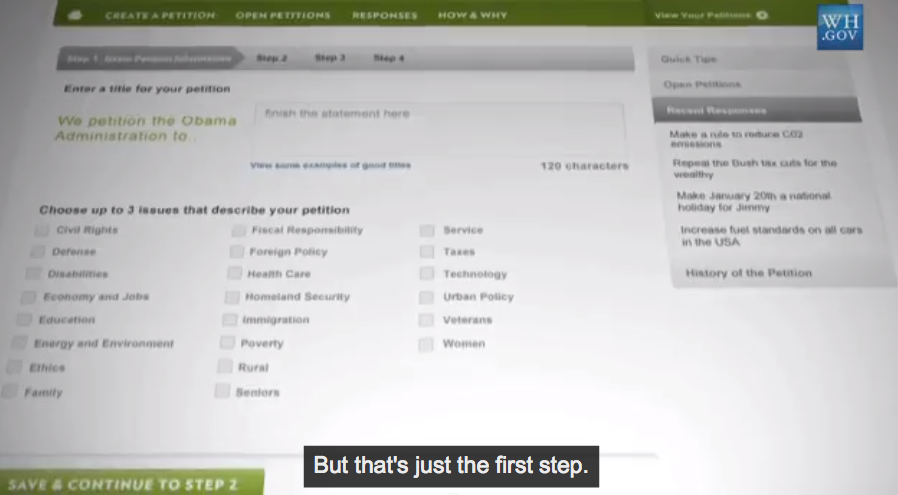
Citizens can create or sign e-petitions on a “range of issues” — it’s not clear yet whether citizens can define their own issues or will have to choose from a list.
If an e-petition gathers more than 5,000 signatures in 30 days, White House officials will review and answer it.
Initially, an e-petition will have a unique URL that only its creator knows. “It’s up to that person to share it in their network to gather an initial amount of signatures — initially 150 — before it is searchable on WhiteHouse.gov. ” It’s not clear what a “network” means but it likely refers to Twitter or Facebook, like the way act.ly works.
There are still many questions that remain in terms of how this is going to work or how it’s going to fit into a 21st century e-democracy. As Phillips recognized, the United States isn’t the first to try this: the United Kingdom offers e-petitions, and according to Phillips, “this work was very helpful as we developed our own.”
The sticky e-widget there is that the UK dropped e-petitions late last year as the new prime minister came into office, due to negative publicity and other issues. Reasonably, we can expect there to be similar challenges with the White House version. The UK has since relaunched its e-petitions site, as Phillips points out, and sharedplans to release the e-petitions code on Github.While it’s not clear yet who built the White House version, it’s possible that they used this code, given the support for open source that Philips has demonstrated over the past three years. The White House built the system in house, according to Phillips.
The initial response online ranges from celebration, including a “high five from PopVox,” to extreme skepticism.
Open government godfather Carl Malamud the long view: “Nice job on We The People,” he tweeted. “Treading in the footsteps of the Founders, petitions have a long and honorable history in our republic!”
“What difference do they make?” tweeted FutureGov Dominic Campbell. “None. Just a distraction technique to pacify the masses. Need new politics not gimmicks. Backbenchers are generally as influential over govt policy as my gran. And she’s dead. Petition / precise tech tool is irrelevant, it’s all about political culture. Petitions are lame. All power is in the hands of govt. Not game changing. More make u feel better/doing *something*.” While the UK petitions have come back, “You’d be hard pushed to find anyone in UK speak +vely of them. Waste of space… think they just reinforce status quo and reward loudest/best organised. Not democracy. ”
Former Sunlight Foundationer Jake Brewer dug into some of the structural issues that exist with this approach. The “only reason “We the People” would [be] useful vs other tools is if @WhiteHouse can convince all they are listening & meaningfully responding,” he tweeted.
“It strikes me though that “giving people a voice” is not at all the problem in gov. Many ways to talk AT gov. Few ways to do so usefully.We simply don’t need more ways to send petitions or gather ideas. We need better ways to listen & operationalize good ideas. What will be an agency’s incentive to take any action based on a petition? Will Whitehouse pressure? Petitions to Congress (theoretically) work because Reps want to be responsive/re-elected. Exec not the same, so how to handle? Guess I’m having a hard time seeing “We the People” as anything more than gov 2.0 theater, and I’d like to be wrong. We simply don’t need more ways to send petitions or gather ideas. We need better ways to listen and operationalize good ideas.”
Questions for We the People
The White House is taking questions on We the People using the feedback form at White House.gov and on Twitter, using the hashtag #WHWeb, where Phillips is listening as @macon44.
Why do petitions at all?“Online petitions are commonly understood, and petitions have been part of our democracy since the beginning,” he tweeted.
When asked by Nancy Scola whether the thinking with We the People is to “have @whitehouse act as [a] clearinghouse for petitions directed towards agencies,” Phillips replied: “People shouldn’t have to decipher how the executive branch is organized in order to speak out about an issue. Processing incoming petitions handled by WH, but relevant petitions will be coordinated w/others as needed, including Agencies.”
In response to a question by @abc4all, Phillips tweeted that “participation in We the People is open to the general public (13yrs+) & requires a valid email address.”
When Alex Rose asked if “WH have a profile of citizens based on petitions we support on We the People? Who can access aggregated data?,” Phillips replied that “only a small group of wh staff will have access to administrative data We the People will be subject to a public privacy policy.”
Here are the questions I’ve tweeted out and their answers:
Who built the e-petitions function? Is it the the same code as the UK tool?
Answer: “System design and development of We the People was developed in house,” tweeted Phillips.
How will identity be handled? How will the White House authenticate citizens to e-petitions government?
Answer: “Lightweight – participation will require an email verification step,” tweeted Phillips. “For now we are using first party WH accounts that verify an email address. Plan to incorporate NSTIC rec’s in future http://1.usa.gov/p7n8HR ”
Do you have to be a citizen?
Answer: “Right now the system only requires valid email and does not verify citizenship,” tweeted Phillips.
How will social media be integrated?
Answer: “when you create a petition you get a unique link. How you share that is up to you. Will have @facebook & @twitter share [buttons],” tweeted Phillips. yes, just like other content on wh.gov
Can citizens ask questions using We The People on whatever topic they wish or will these be predefined? The screenshot below implies the latter categorization: taxonomy, not folksonomy.
Answer: “there will be a defined set of topic people can choose from but its a wide range, and there will also be ad hoc tags,” tweeted Phillips.
Will there be an API so that civic developers can visualize and analyze them to see if there are duplicates or emerging themes?
Answer: “Not now; API’s for analysis & extending petition functionality on a long list of features we we are considering for future. With [federal CIO] Steve upstairs now, thinking through how that can best work is both a priority & more informed.”
Why build this when services like PopVox, Votizen and Change exist to create social e-petitions?
Answer: “Developing We the People ourselves […] offers the flexibility to adapt to the public response to improve engagement,” tweeted Phillips. “It’s a false choice to say _either_ We the People _or_ others – there’s lots of collaboration ahead, this space is still young.”
There’s another key detail: these e-petitions would go to the executive branch, whereas Votizen and PopVox are targeted at Congress and constituent communications.
The creator of act.ly, Jim Gilliam, offered some of his own perspective and questions. “I built a petition/priority tool White House 2 back in 2008. I learned a lot, happy to share,” he tweeted to Phillips, linking to his post on White House 2.0. On this count, the White House was listening: Phillips asked Gilliam to “dm him his email address.” Here’s a look back at “imagining White House 2.0” from the 2009 Personal Democracy Forum:
“I figured out all the problems, except for one. getting the white house to pay attention. (or maybe it just took 3yrs),” tweeted Gilliam.
He highlighted two issues, one for advocates and one for White House technologists: “”How will the white house use all the email addresses it collects with new petition tool? Advocacy groups will have to decide whether to send their people to whitehouse.gov at the expense of their own list building,” he tweeted. “White house will need some serious anti-spam jujitsu to knock back the tools that scrape congressional forms.”
Perhaps most important, how will citizens know that they’re being heard by the White House, that these e-petitions matter, and that this will not be a public relations exercise that ends with a thank you letter from staff?
This goes to the issue of connecting e-petition action to results. “OpenGov has the equivalent of a “last mile” problem: a culture+digital-infrastructure gap at the workgroup level,” tweeted Dan Latorre, leader of Digital Placemaking and creator ofFixCity.org.
For instance, if enough people sign e-petitions on withdrawing from Afghanistan, supporting gay marriage, legalizing marijuana or opposing ICE takedowns of websites without judicial review, will the White House change its policy?
Stay tuned for answers [See above] and upon launch, outcomes.
This past weekend, citizens acted as important sensors as Hurricane Irene washed up the East Coast of the United States, sharing crisis data as the storm moved through their communities and damage reports in its wake.
Baltimore has embraced the open 311 standard with a new 311 API and take a major step forward towards a collaborative approach to reporting issues with the launch of new mobile applications for the iPhone and Android devices.
“The new 311 Mobile App allows citizens to have real-time collaboration with their government,” said Mayor Rawlings-Blake in a prepared statement. “If you see a pothole, graffiti, or a broken streetlight, you can see it, shoot it, and send it to us — we have an app for that!”
As Philip Ashlock highlighted at Civic Commons in a post on open 311 in Baltimore, the city has a long history with 311:
The City of Baltimore has a long history of leading the way with 311. In 1996, they were the first city to deploy the 311 short code and unified call center, and in 1999, the city launched CitiStat, pioneering the use of statistics based performance management. Now both of these innovations can be amplified by a much more open and collaborative relationship between Baltimoreans and their government through Open311.
Ashlock highlighted another key detail about the integration of the standard by Motorola, which was crucial in DC and San Francisco, the first cities in the U.S. to embrace the Open311 standard.
The launch of Baltimore’s Open311 apps and API was aided by the fact that they were able to leverage the Open311 compliant solutions provided by Motorola CSR and Connected Bits. Baltimore CIO Rico Singleton went as far as to say that their choice of software solutions was influenced by the interoperability provided by the standard.
There are a limited number of citizens who have the time, expertise, passion and education to go clean up public data. There are quite a few more who will report issues in the neighborhoods they live in or work near and share what they see. This kind of mobile networked accountability is going to be a big deal in Africa, Asia and South America very soon. We’ve been seeing early versions of it emerge already during disasters, man-made and otherwise.
With the launch of more mobile applications that connect citizens to existing systems for accountability, city governments are empowering citizens to act as sensors, connecting the real world to the Internet and creating positive feedback loops. That’s good news for Baltimore and beyond.





 E Pluribus Unum