White House and House GOP turns to the Web to discuss jobs

It’s a tale of two parties, two social networks, live events and high stakes: creating jobs in an American economy still struggling to come out of recession. Would the American Jobs Act, introduced by President Obama earlier this month, make a difference? Can the White House or Congress do anything to create jobs, aside from directly hiring more government workers for infrastructure projects or similar initiatives? The American people will have the opportunity to hear from both sides of the aisle today and judge themselves, starting at 2 PM EST when the president will participate in a town hall hosted at LinkedIn in California.

UPDATE: Archived video from President Obama’s LinkedIn townhall is embedded below:

Notably, there will still be a live chat on Facebook at a LinkedIn townhall, along with a public “backchannel” at the #meetopportunity hashtag on Twitter.

This is the second time that the White House experiments with LinkedIn for questions, following a forum earlier this year with tech CEOs and federal CTO Aneesh Chopra. The questions are pulled from a “putting America back to work forum on LinkedIn.com. As I’ve observed before, the platform isn’t ideal for ideation and moderation of questions but LinkedIn is unquestionably targeted towards employment.

Personally, I’d like to see CEO Jeff Weiner crunch the big data the social network has collected about job openings and the skills and degrees that high school and college grads currently have. Programs and policies oriented towards matching the two would be an interesting direction.

UPDATE: Here are the questions that were asked:

UPDATE: Below is a “storified” tweetstream from the event:

[<a href=”http://storify.com/deborapetersen/obama-at-linkedin” target=”blank”>View the story “Obama and Linkedin” on Storify]</a>
 

House GOP Leaders discuss technology, transparency and jobs

At 6 PM EST, the leaders of the Republican caucus in the U.S. House of Representatives will also host an online townhall, though they’ll be doing it on Facebook Live. The event will feature House Majority Leader Eric Cantor of Virginia, Majority Whip Kevin McCarthy of California and Budget Committee Chairman Paul Ryan of Wisconsin. Facebook COO Sheryl Sandberg will moderate.

Prior to today’s event, the House GOP leaders participated in a discussion about the role social media and technology now plays in government with Politico’s senior White House correspondent, Mike Allen. Video is below:

In the interview, the House GOP’s “Young Guns” spoke at length about the role that new social and mobile technology plays in the work of Congress and government, touching upon many subjects that will be of interest to the open government community.

Such interest is hardly new — the new GOP majority came into the House with promises to embrace innovation and transparency— but given the importance of open government, it’s a useful reminder that open government is a bipartisan issue.

If you have thoughts or comments on either of the town halls or the discussion above, please share them in the comments.

UPDATE: The archived video of this congressional “Facehall” is embedded below:

UPDATE: A Storify of my own tweets during the event is embedded below:

[<a href=”http://storify.com/digiphile/house-gop-leaders-join-sheryl-sandberg-for-faceboo” target=”blank”>View the story “House GOP leaders join Sheryl Sandberg for Facebook townhall” on Storify]</a>

Vivek Kundra talks open government and data journalism at ONA 2011

Earlier today, Vivek Kundra, the first CIO of the United States, visited the Online News Association. Here’s a Storify of the tweetstream from his talk by Cristina F. Pereda.

http://storify.com/onewayoranother/vivek-kundra-ex-director-de-informacion-y-tecnolog.js[View the story “Vivek Kundra, ex director de Información y Tecnología” on Storify]

Cato study rating Congress on open legislative data gives low grades for transparency

The school year may have just begun but Congress has already received an early report card on the transparency of its legislative data. The verdict? A 2.47 GPA, on average, if you don’t include the 4 Incompletes. That’s on average a bit better than a C+, for those who’ve long since forgotten how grade point averages are computer. It also means that while Congress “passed this term,” any teacher’s note would likely include a stern warn that when it comes to legislative transparency, the student needs to show improvement before graduation.

Rate Congress Transparency Report Card(function() { var scribd = document.createElement(“script”); scribd.type = “text/javascript”; scribd.async = true; scribd.src = “http://www.scribd.com/javascripts/embed_code/inject.js”; var s = document.getElementsByTagName(“script”)[0]; s.parentNode.insertBefore(scribd, s); })();

Jim Harper, director of information policy studies at the Cato Institute, analyzed the “Publication Practices for Transparent Government” and found it a bit, well, wanting.

If you’re interested in opening up the United States federal legislative system, you can tune into a livestream of special DC forum this morning where Harper and other open government stakeholders “rates Congress. Brandon Arnold, director of government affairs at the Cato Institute, will moderate a discussion between Harper, Rep. Darrell Issa, chairman of the House Committee on Oversight and Government Reform, and John Wonderlich, policy director at the Sunlight Foundation.

new TWTR.Widget({
version: 2,
type: ‘search’,
search: ‘#ratecongress’,
interval: 30000,
title: ‘How transparency is’,
subject: ‘US legislative data?’,
width: ‘auto’,
height: 300,
theme: {
shell: {
background: ‘#07567a’,
color: ‘#ffffff’
},
tweets: {
background: ‘#ffffff’,
color: ‘#444444’,
links: ‘#b31919’
}
},
features: {
scrollbar: false,
loop: true,
live: true,
hashtags: true,
timestamp: true,
avatars: true,
toptweets: true,
behavior: ‘default’
}
}).render().start();

A better data model

The Cato paper analyzes Congressional achievement through the lens of four basic concepts in data publication: authoritative sourcing, availability, machine-discoverability, and machine-readability. “Together, these practices will allow computers to automatically generate the myriad stories that the data Congress produces has to tell,” writes Harper in a blog post today. “Following these practices will allow many different users to put the data to hundreds of new uses in government oversight.

That data model used to produce this analysis should be of interest to the broader open government data community, in terms of a good matrix for rating a given legislature. “Data modeling is pretty arcane stuff, but in this model we reduced everything to ‘entities,’ each having various ‘properties,’ explained Harper. “The entities and their properties describe the logical relationships of things in the real world, like members of Congress, votes, bills, and so on. We also loosely defined several ‘markup types’ guiding how documents that come out of the legislative process should be structured and published. Then we compared the publication practices in the briefing paper to the ‘entities’ in the model.”

While the obvious takeaway is that Congress could do better, Harper gives the Senate and House due credit and time to improve. “This stuff is tough sledding,” he allowed. “The data model isn’ the last word, and there are things happening varied places on and around Capitol Hill to improve things. Several pieces of the legislative process nobody has ever talked about publishing as data before, so we forgive the fact that this isn’t already being done. If things haven’t improved in another year, then you might start to see a little more piquant commentary.”

Open Government Week in Review: White House update, eGov setbacks and global OGP potential

Friday’s White House open government “status update” capped a historic week for open government in Washington. The Blue Button movement now has a website: BlueButtonData.org. Federal CTO Aneesh Chopra challenged the energy industry to collaborate in the design of a “green button” modeled after that Blue Button. White House director of digital Macon Phillips answered questions about “We the People” and the White House e-petitions. The Department of Transportation held a public consultation for the its Digital Transportation Exchange (DTE) open government initiative. President Obama signed the America Invents Act into law.

Progress and Setbacks

Quiet successes have been matched with setbacks to open government in Washington over the past three years, including two from this past week. Several journalism organizations have protested the U.S. federal government taking down doctor discipline and malpractice data from the Web. The Obama administration also faces an uncertain future for funding for its Office of Management and Budget’s open government initiatives after theU.S. Senate appropriations committee shortchanged the Electronic Government Fund by some $10 million dollars this week.

Global Open Government Partnership

While neither of those stories are good data points for the state of open government at the federal level, they are both part of a much larger narrative where some 40 countries (including the founding 8 members) have reportedly now submitted letters of intent to join this unprecedented international open government partnership.

Next Tuesday, I’ll be in New York on the same day that President Obama introduces the U.S. National Plan for open government as part of its commitment to the Open Government Partnership As John Wonderlich observed at the Sunlight Foundation on Friday, preparing for the U.S. National Plan and then delivering upon whatever is contains will be a “complex, ongoing effort that takes dedicated effort and attention,” adding to the progress towards a more transparent, participatory, collaborative or innovative government made to date.

In 2011, some of the most dynamic changes may be found the state and local level in the United States. After next week, the eyes of many more people will be open to the broader sweep of a global movement towards transparency. The world can watch the live streaming coverage of the “Power of Open” at Google’s YouTube channel from 9-10:30 AM and from 1:30-4:30 PM. Event details are available at OpenGovPartnership.org”>, including agenda, participants, presentations and other materials. I’m looking forward to telling that story using Twitter, Flickr, Tumblr and next Tuesday, where I’ll be liveblogging at the O’Reilly Radar all day. techPresident’s associate editor, Nick Judd, will be tweeting and liveblogging. Follow the #OGP hashtag for the real-time conversation about the Open Government Partnership:

http://widgets.twimg.com/j/2/widget.js

new TWTR.Widget({
version: 2,
type: ‘search’,
search: ‘#ogp’,
interval: 30000,
title: ‘What\’s happening with’,
subject: ‘The Open Government Partnership’,
width: ‘auto’,
height: 300,
theme: {
shell: {
background: ‘#085578’,
color: ‘#ffffff’
},
tweets: {
background: ‘#ffffff’,
color: ‘#444444’,
links: ‘#ab0916’
}
},
features: {
scrollbar: false,
loop: true,
live: true,
hashtags: true,
timestamp: true,
avatars: true,
toptweets: true,
behavior: ‘default’
}
}).render().start();

The Internet will ask (some of) the questions in the Fox News/Google Republican debate

On September 22, the Republican candidates for president will be in Orlando, Florida for the next debate. Unlike the last debate, where moderators from NBC and Politico chose the questions, Google-Fox News debate will use Google Moderator and YouTube to bubble up questions from the Internet. Questions can be submitted as text or video through the Fox News YouTube channel. The deadline is September 21st. The video embedded below introduces the concept:

Fox News anchor Brett Baer explains the process below and encourages people to submit questions “creatively” — which means that former Massachusetts governor Mitt Romney could potentially be confronted by a YouTube snowman of the sort he didn’t care much for in 2007.

For good or ill, that kind of question in that kind of costume is likely to be part of the warp and weft of presidential politics in the 21st century. President Obama’s Twitter townhall” featured several questions from people with quirky account names or avatars. Bringing YouTube into the discussion will allow even more self expression and, while Fox News has the ability not to broadcast a video, millions of connected Americans can go watch the videos themselves if they choose. At the moment, the top-rated questions are substantive ones:

Presentation: Health Data Innovation at the Wolfram Data Summit

Earlier today, Peter Speyer gave a great talk about the Global Health Data Exchange and health data innovation at the Wolfram Data Summit in Washington, D.C.

For more context, read: about unlocking innovation through opening health data, better mobile healthcare decisions through open data and “Can Todd Park revolutionize the health care industry?

D.C. and Moscow to host bilateral open government codeathon

In less than two weeks, there will be an unprecedented bilateral codeathon between the United States and Russia held in both Washington, D.C. and Moscow, Russia.

The event will last between September 24 at 9AM until September 25 at 5:00 PM and will be held at American University in D.C. and in the offices of Yandex in Moscow.

More details coming soon.

For now, check out Code4Country.org and submit your ideas for civic applications that can help make Russian civil society stronger, solve problems for citizens and enable more government transparency,

Agenda and details of Open Government Partnership “Power of Open” event announced

The details of the launch of the Open Government Partnership on September 20th are now public. Under Secretary of State Maria Otero, Brazilian Minister of State Jorge Hage and President Benigno S. Aquino III will be making keynote speeches, followed by senior government officials, business leaders and technologists, including eBay founder Pierre Omidyar, World Wide Web creator Tim Berners-Lee and Celtel founder Mo Ibrahim.

As I reported yesterday, 22 countries have committed to participate in the partnership now, with more to come.

The “Power of Open” event will be hosted by Google NYC. Given limited capacity for live attendance, a live stream of the event at the Open Gov Partnership YouTube channel will substantially increase the forum’s reach. The “Power of Open” agenda is embedded below.

Power of Open Agenda 9.6.11//

American University to host EPA Apps for the Environment hackathon

If you’d like to get your civic hacker on, American University is hosting a hackathon for the Apps for Environment on Saturday, September 3rd. Register to make green apps here.

The pitch for the hackathon includes a “green from the beginning” detail that may catch the eye of sustainable energy advocates:

The hack-a-thon will be located in the spacious new Graduate Research Center adjoining the School of International Service building, which is itself a certified LEED Gold marvel of green technology innovation. With a sustainable design and “cradle-to cradle” philosophy for recycling and reusing building materials, participants will even power their devices with solar and wind offset power so their Apps for the Environment will be green from the first idea until the last line of code.

Come one, come all

The hackathon’s organizers emphasize that this event isn’t just about the District’s local civic coders: “Whether you’re a student at any school in computer science, journalism, a professional in the field, or just have an idea to share (which you can post here http://blog.epa.gov/data/ideasforappscomments/) please join us at the hack-a-thonT”

American University journalism professor David Johnson left a comment on the event page that expands that idea:

…even if you can’t code, you can have ideas. even if you don’t have ideas, you can help spread the word. even if you can’t come to DC or AU, you can join us on twitter, ustream, IRC, GitHub, and other online hangouts… we’ll be all over it. everyone can be a part of this. spread the word to campuses and dev shops. come hack with us.

Open data webinar

Last week, I moderated an EPA webinar on open data and the Apps for the Environment challenge from the D.C. headquarters of the U.S. Environmental Protection Agency.

If you’d like to learn more about Apps for the Environment (and hear a robust conversation about open data and apps contests!) watch the webinar and presentation embedded below.

Apps for the Environment Developer Webinar(function() { var scribd = document.createElement(“script”); scribd.type = “text/javascript”; scribd.async = true; scribd.src = “http://www.scribd.com/javascripts/embed_code/inject.js”; var s = document.getElementsByTagName(“script”)[0]; s.parentNode.insertBefore(scribd, s); })();

Hackathon coordinates

If you would like to participate in the AU hackathon, you can put your civic surplus to work from 9 AM to 6 PM at the location below:

Head on over to the event page on Facebook for more details and register to make green apps at Eventbrite.

Notes from the third White House Open Government Partnership consultation

In July 2011, the State Department hosted an historic gathering in Washington to announce an Open Government Partnership with Brazil and six other nations. For background on the initiative, read this digest on Open Government Partnership analysis for context.

This new new open government partnership could drive U.S. commitments, according to OMB Watch.

What those commitments will be is still unclear. Given that they’re due by September’s Open Government Summit at the United Nations in New York City, the timeline for drafting them is quite limited.

Last week, when the White House asked for ideas on the National Plan for open government, the community learned a bit more about what’s on the table: improving public services and increasing public integrity.

Clay Johnson has since offered the White House a deep set of recommendations for open government in response to the three questions it posed, including better ways to use open data, social media, improving regulations, public comment, and the developer community better. If you’re interested in open government, it’s a must-read.

Those are not the limit of potential commitments on the table, at least as evidenced by what we know about the series of three consultations with open government stakeholders in Washington that the White House Office of Information and Regulatory Affairs held this July, on the 22nd, 25th and 29th. These consultations were not livestreamed or otherwise recorded, however, nor have OIRA’s notes been released to the public yet. That said, we have at least two accounts of what happened in July, from:

I attended the July 29th consultation and, while I did not record video or audio, can share the following written notes.

Attendees

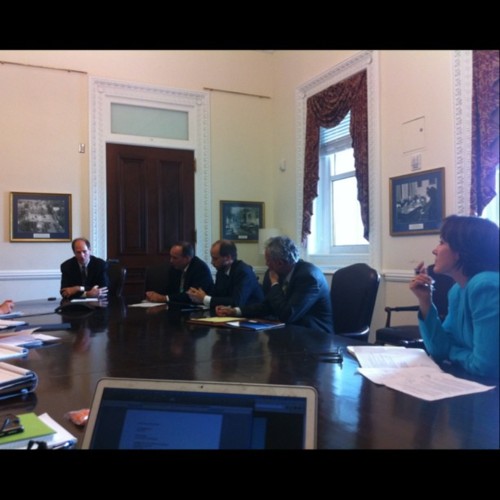
As with the previous meetings, OIRA administrator Cass Sunstein led the discussion. White House OSTP deputy CTO for public sector innovation Chris Vein was also there, along with half a dozen OIRA staff and a representative of the National Security Archive.

Seated around the table were representatives from America Speaks, OMB Watch, the Center for Technology in Government at the University of Albany, Sunshine in Government. University of Pennsylvania professor Cary Coglionese and a board member from the International Association for Public Participation, Leanne Nurse, dialed into a conference speaker phone line.
Past meetings included representatives from the Revenue Watch Institute, Code for America, Harvard’s Kennedy School of Government, Open Plans, Civic Commons, the Sunlight Foundation, Citizens for Responsibility and Ethics in Washington and the Project for Government Oversight, in addition to Open the Government and NCDD.

Open Government Consultation

Sunstein started the meeting by offering high level context for the OGP and thanks to the organizations around the table.

When the OGP was devised, he said, it was done with background experience from the Open Government Directive that came President Barack Obama and the White House Office of Management and Budget.

Many of your organizations were “indispensable” during that process, Sunstein said, and even though what happened with the open government directive “wasn’t perfect,” there has been “tremendous progress.” He thought from the beginning, with regard to the OMB open government project, that it would be a work in progress, with plans scrutinized and improved over time.

Sunstein laid out the reason for the consultation: the White House has national action plan due in September, with an event at the UN as the president promised. The White House wants the national action plan to be as good as possible, “improving on what we’ve got so far as we can.” Reflecting his comments at the previous two consultations, Sunstein said that one way to think of the meeting is generating ideas through three stages, given the temporal and feasibility constraints posed by the short deadline for UN recommendations. He observed that where would be opportunities moving forward in the medium term, over a 3-5 month time period to do more.

Katherine McFate, the executive director of OMB Watch, asked a question about the parameters for the consultation, noting that if you go back and look at the open government partnership, there are five different challenges for countries. If you only have to pick one or two, she suggested, improving public services is one, and may be improving public integrity is another. Increasing accountability, likely to be three. (Given the recent White House blog post, OIRA may have taken that suggestion.)

In response, Sunstein replied that there are surely things that have budgetary repercussions, which you then have to answer for, although in open government, sometimes it’s possible to improve public services without stretching the budget.

Theresa Pardo, director of the CTG at Albany, after thanking OIRA for the opportunity to speak and to listen, focused on the some of the issues that have arisen during implementation of the open government directive, including the role of citizen engagement. One tension is how to think about citizen participation, versus accountability imperatives.

One of the things that we hear quite regularly when we talk to practitioners at federal, local, and state level, along with academics, is a lot of confusion about concepts underlying open government directive. There’s pressure towards clarity, and still a lot of ambiguity. One of the ways to push through in creating that clarity, she suggested, would be to focus a bit more on the conversation, on figuring out what the problems that citizens are seeking open government to solve. Pardo said that in their experience, in various jurisdictions in US and outside of the US, it’s a challenge to connect what’s happening in government agencies with what citizens are talking about in public. Over the long term, the opportunity for open government, she explained, is to move towards deeper engagement with citizens themselves about what problems are they experiencing.

Professor Coglianese, speaking over the phone, agreed with Pardo and McFate. He also suggested that the White House clearly take stock of where open government is currently. We’re seeing great things, in taking stock of regulations, he said. It would make sense to something similar with taking stock of public participation now, defining a better baseline of where to assess what kinds of reform are making changes.

The point, about defining a baseline for public participation, was taken up and emphasized by many of those invited to the July 29 consultation. One of our major tools is the public participation spectrum, said Douglas Sarno of IAP2 USA. No systematic approach to what we’re trying to do or what’s been achieved has been defined by the White House, he said, and no way of qualifying bonafide public participation versus hackneyed participation defined. There are good challenges in finding metrics.

Sunstein agreed that the regulatory process requires significant public participation. This week, the Regulations.gov team acknowledged the need to do more in that regard.

In response, Pardo cited a number of studies in which communications scholars and computer scientists are using machine language processing to analyze online rulemaking to see if it results in changing in deliberation or positive social interaction. Such studies can be expensive but useful. Part of the issue in integrated such work, however, is getting real movement in processes in partnership with academics, she said.

Pardo focused further upon the role of citizen engagement, both around rulemaking and the large context of open government. Nowhere, until just recently, she said, do we teach our public managers about how to look, engage, and use citizen participation tools. “There’s a capability gap at all levels of government. How do public managers in local governments and cities, think about their jobs in different ways?”

The National Association of State CIOs and others are looking at building capability to understand how to use data and engagement tools better, said Pardo, but across the board there’s lack of ability in these core competencies. Maybe building ability as with cybersecurity skills would make sense, she suggested, including professional standards for citizen participation.

Coglianese similary focused more on baseline assessments for public participation. There are some political scientists who have tried to assess the actual impact of public comment and proposed rulemaking, he said. In terms of what to look to as baseline, what is it you want to accomplish with this national action plan? Is the goal to increase public participation? What is the level right now? We don’t have a way of saying what the volume of interaction is across the federal government, he asserted.

We do know, however, that rulemaking tends to be more something that organizations participated in more than individual citizens, Coglionese said, citing a recent article on public participation that he’d authored law journal. “We need a baseline of who’s participating and at what level,” he said. “Is the goal of participation to increase the quality of public decision making? That’s hard to assess. To enhance public virtue? That’s much harder to assess. Until it’s clear exactly what it is you would want to do, you can’t answer these questions.”

David Stern, director on online engagement at America Speaks, validated Coglionese’s words, observing that his organization had recently looked at all open government plans by agencies and came to the same conclusion. There’s a lack of consistency in metrics used to evaluate projects, said Stern, and no standards about what defines good participation. Number of people, diversity, number of instances policy influenced? Standards and best practices, in this area, would be helpful coming from White House and OMB. Every open government project contains response to the most popular proposals, he said, which means that every public engagement initiative has a public engagement component.

Rick Blum of Sunshine in Government raised another issue: FOIA exemptions, including agencies proposing them independently. The Department of Defense is overclassifying, said Blum, and it’s very hard to track what’s happening. The Department of Justice has put up a FOIA dashboard but it’s “plagued with tech glitches and bad data,” he said. This has become a public debate about secrecy or disclosure, with some half a billion dollars being spent annually fulfilling FOIA requests, said Blum. There’s also concern about the impact of the recent Supreme Court decision in Milner vs the Navy.

On my part, I offered feedback that I’d collected from the broader open government community ahead of time and over the previous year.

First, the White House has not explicitly separated open government innovation, in terms of open data about the business of government, from “good government” initiatives that transparency advocates expect and demand, in terms of accountability to the people. Misset expectations around the goals the White House has set out have created widespread dissatisfaction and harsh criticisms of an administration that promised to be “most transparent ever.” The open government initiative in the province of British Columbia offers a potential model for the White House to consider, in terms of this separation.

Second, as the federal government moves forward with its ongoing review of .gov websites, there are opportunities to work with civil society and civic developers to co-create better e-services.

Third, opportunities exist for the White House to partner with entrepreneurs, media or nonprofits that are making government data open, useful and searchable. For instance, BrightScope has made financial advisor data from the SEC and FINRA available to the public. The work of Code for America and others on farmers market open data is another example.

Finally, there continue to be serious issues raised by developers about the quality of open government data on Data.gov. In general, public servants continue to release PDFs, as opposed to machine-readable structured data, and cite the language in the Open Government Directive for support. If government wishes developers and businesses to use its data for accountability, civic utility or economic value, then releasing data in the open formats that these communities find most useful makes logical sense.

Pardo took up the issues raised with good government versus open innovation, noting that the two aren’t necessarily against each other. The idea of high value data wasn’t well defined, she said. For instance, the calendars of public officials are nothing more than a dataset.

Sunstein asked after the data issues and the one of his deputies specifically asked about the language in the OGD. He brought up the work that the federal government has done on regulations.gov – which was a persistent focus from the OIRA administrator – and asked whether it was good enough, and over what time limit? And for whom?

The general answer there was clear enough: “we the people.”

Coglianese offered more feedback on regulations.gov: it’s not enough. There are data fields are not filled in, missing information, and things remain incomprehensible, he said. “Imagine how it is for many others coming for first time?” Coglianese endorsed the recommendations of ADA blue ribbon commission for a dedicated overseer of data quality, although such a role would require congressional authorization.

There are some really important opportunities to leverage data in regulations.gov, he emphasized. Leverage that data to extract it automatically, display the data on websites. For instance, many members of congress have a button on their websites forlegislation they’re sponsoring, which then takes visitors to data automatically etxtracted from Thomas.gov. Imagine a similar system for agencies and regulators, he suggested, or consider the EPA, which is trying to display every rule that the agency is working on., which is being developed in addition to regulations.gov.

Agencies right now are building websites around current uses, said Coglionese. That makes a lot of senses, and it’s what one would hope, but doesn’t go to the “separate question of who do they want their users to be.” He criticized the design of the new FCC.gov, although I pointed out that the process that preceded the FCC relaunch was focused on the most common purposes of the site’ visitors.

What was left unsaid in these open government partnership consultations? A great deal, due to the length of time allowed. The voices that were heard around this table were also those of advocates, policy, experts, academics, and technologists: not citizens, and by and large not those of the media, whose function in representative democracies been to hold government accountable on behalf of the public.

As the White House considers its commitments in advance of the September meeting at the United Nations, the people will have a window of opportunity to tell their elected officials what open government means to them and how they woud like their federal government to be more transparent, participatory or collaborative.

If you have feedback on any of those accounts, send it to opengov@omb.gov.