Deb Bryant on open source at the Tech@State unconference

Deb Bryant, public sector communities manager at the Oregon State University Open Source Lab, kicked off the Tech@State unconference on open source at the National Democratic Institute today.

The short video below, capturing some of her thoughts on the evolution of open source in government, are worth considering, particularly with respect its use internationally. As Bryant pointed out, for instance, Brazil has been doing open source for a decade. “They’re really the Simon Bolivar of software down there.”

The schedule for the Tech@State unconference is evolving at Open4m.org/NDI. It bids to be an interesting day.

3 words from the Tech@State unconference

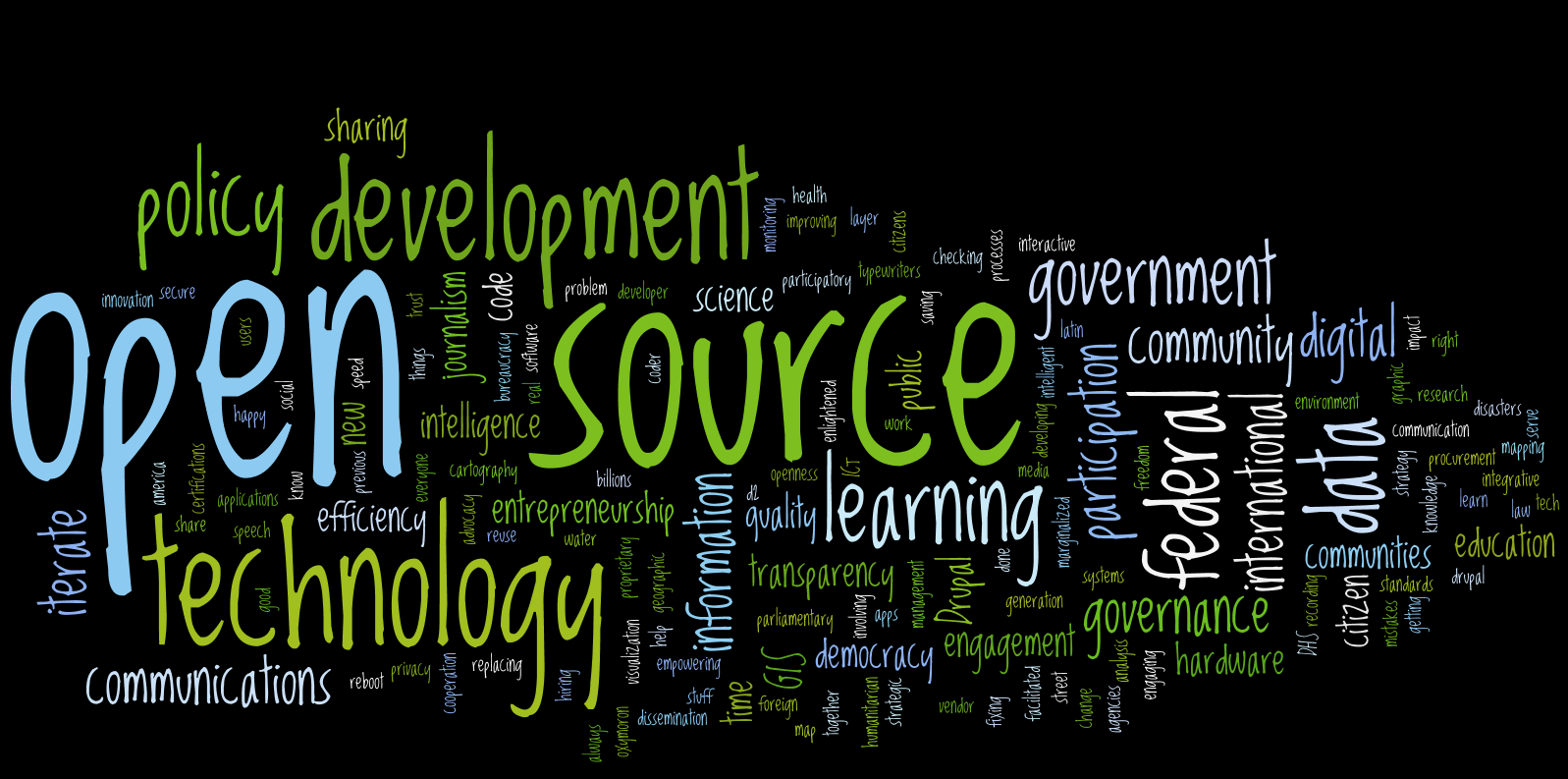
On Friday, the fifth Tech@State conference at the United States Department at State focused on the role of open source in government, industry and society. Today, there is a Tech@State unconference on open source at the National Democratic Institute. In keeping with the tradition of an unconference – sometimes called a barcamp – the day kicked off with a introduction where every attendee shared his or her name, affiliation and three words that describe who they are, what they care about, what they’ve come to learn or what they do. Or all three. Below is a wordle that shows the frequency of words used.

The schedule for the Tech@State unconference is evolving at Open4m.org/NDI. It bids to be an interesting day.

ExpertNet: What is the future of the open government platform?

The President has lunch with Sen. Bob Casey at the Famous 4th Street Deli in Philadelphia

The President has lunch with Sen. Bob Casey at the Famous 4th Street Deli in Philadelphia. (Official White House Photo by Pete Souza)

Citizen engagement platforms grew in 2010. There will be more such platforms coming from top, through open government, and from the bottom, as civic developers create, host and use their own communities. The opportunity for citizens to participate in the co-creation of the most high profile open government platforms for citizen consultation, ExpertNet, will close on January 23rd, when the White House’s Request for Information will end.

The White House has been taking public feedback on designing democracy with this citizen consultation platform for weeks. In a number of respects, the discussion on ExpertNet.wikispaces.com has resembled an unconference, where the participants themselves drive the process.

So what’s interesting here? “It is the idea that the public will be (directly) shaping policy that is intriguing, and is a critical component to bridging the gap, both the economic gap as well as the digital gap, as the average citizen is the real stakeholder, and before now has had no forum for influencing change so directly,” said Megan Eskey, OpenGov Lead at the NASA Ames Research Center.

Or put it another way, as Anil Dash did earlier today: how should a White House Quora work?

The White House is looking to build a web community to get its questions answered, sort of their own Quora, and they’re trying to do it the right way. They’re asking those who would participate to help shape how the community itself works. They’re not trying to create a network from scratch, but instead trying to connect to networks that already exist. And they’re not just making a community for the hell of it — they’re trying to build one with purpose.

But they’ve asked for our help, from those of us who build, and know, and love web communities. We’re being asked to share our expertise in what does, and doesn’t work on successful web communities. Our deadline for participating is on Monday. Giving them insights into our hard-earned lessons will only take 15 minutes of your time this weekend, and will keep us from having to wonder, “Why wasn’t I consulted?

Many lively discussion threads have emerged, including suggestion for moderation, voting, ownership of intellectual property and more, including:

“It’s not so much the idea of a wiki or whatever platform ExpertNet rolls out, but rather the format they are looking at of matching experts with those seeking to solve immense problems,” said Eskey. “Whether it is a wiki or a social site or some other crowdsourcing tool like delib’s dialogue app, that feedback loop is critical, especially if the digital divide is to be bridged via new bills that are introduced into Congress, although at this time the project is envisioned for executive agencies and departments only,” she said. Eskey noted that any ideas for using ExpertNet within the legislative branch should be directed to elected representative(s) in Congress.

For those interested in the future of open government and citizen consultation, there’s no time like the present to weigh in. Tim Bonnemann of Intellitics has also posed six questions for ExpertNet for further consideration.

House 2.0: Building out the House.gov platform with Drupal and social media

As I reported for the O’Reilly Radar yesterday, when the House chose Drupal as the preferred web content management system for House.gov, it made the “People’s House” one of the largest government institutions to move to the open source web content management platform.

The House.gov platform is moving to Drupal but House.gov itself is not on Drupal quite yet. That will probably happen in the next several months, according to Dan Weiser, communications director of the Office of the Chief Administrative Officer in the United States House of Representatives.

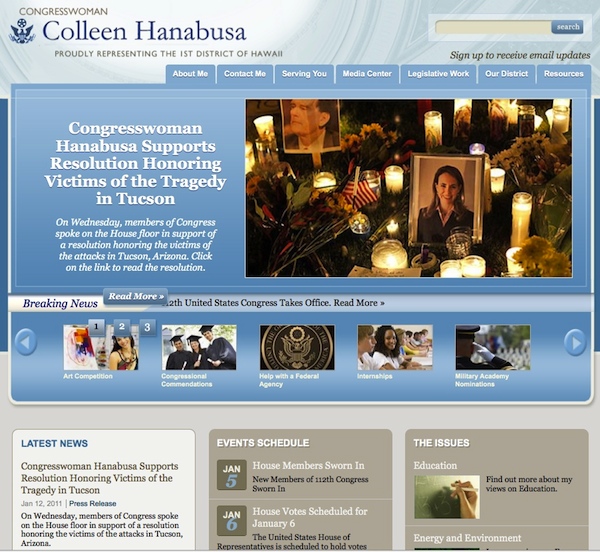
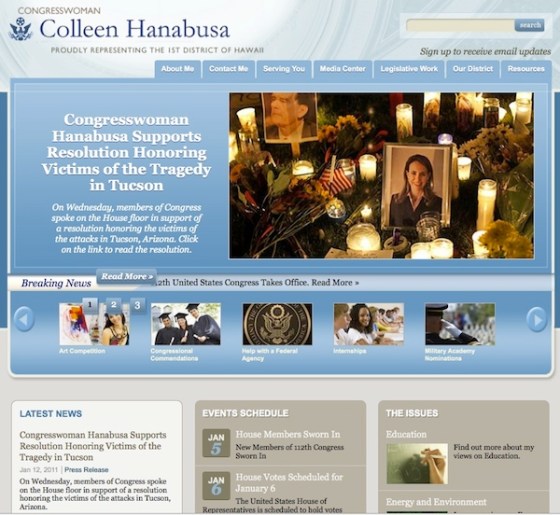
In the meantime, the incoming Congressmen and Congresswomen do appear to have adopted Drupal as the platform for their official websites. For instance, Congresswoman Colleen Hanabusa‘s site, below, uses one of several templates on the Drupal platform. Notably, each of the new sites includes default modules for the leaders in the respective verticals in the social media world: Flickr, YouTube, Twitter and Facebook.
Some questions remain about the cost and choices that representatives have as they choose their online Web presences. As NextGov reported today, while House websites can move to the open source platform – they don’t have to do so.

Given the context of citizens turning to the Internet for government information, data and services in increasing numbers, however, a well-designed Congressional website with clear connections to the various digital outposts has moved from a “nice to have” to a “must have” in the eyes of the digitally connected. (For citizens on the other side of the digital divide, the House switchboards are still available via phone call at (202) 224-3121 or TTY: (202) 225-1904).

If that’s a given, then the question is then why Drupal is now the preferred web hosting environment for the House. On that count, “Drupal was chosen because it is open source and widely accepted, therefore allows Members to leverage a large community of programmers which gives them more choices and innovation,” wrote Weiser in an email. “It should also be noted that Members still will have the option to use other platforms.”

Weiser told NextGov that, because, Drupal developers are in every member’s district, “that hopefully means expanded choice and more innovation for our members.”

The current content management system limits the choice of site programmer as well as innovation, said Dan Weiser, communications director for the chief administrative officer, in an e-mail. Drupal, which uses a common framework and code that can be customized, will allow members to leverage a large community of programmers, providing more opportunities for innovation, he added.

The House expects to save some money with the transition to Drupal, since the chief administrative officer will manage the infrastructure and members pay vendors only for development time, Weiser said.

The inclusion of social media is also no longer a novelty in the beginning of 2011. “We expected there would be interest by the incoming freshmen to have social media on their sites; it just seemed natural to offer the option,” wrote Weiser.

[Disclosure: One of the vendors involved in the House’s Drupal effort is Acquia. O’Reilly AlphaTech Ventures is an investor in Acquia.]

White House issues guidance on “technology neutral” IT acquisition

Victoria Espinel, the White House intellectual property enforcement coordinator, wrote a blog post providing guidance to federal agencies on making technology neutral IT procurement decisions.

Each year, the U.S. Government spends almost $80 billion dollars buying information technology (IT); the software, computer equipment and network devices that help the Government run efficiently. It is important that those purchases be fair, neutral and based on an objective assessment of relevant criteria. To ensure that the agencies and the public are aware of our policy, today U.S. Chief Information Officer Vivek Kundra, Administrator for Federal Procurement Policy Dan Gordon and I issued a statement to Senior Procurement Executives and Chief Information Officers reminding them to select IT based on appropriate criteria while analyzing available alternatives including proprietary, open source and mixed source technologies.

Aliya Sernstein, over at NextGov, extracted an interested headline from the guidance: “Kundra encourages open source.” Getting to that conclusion from the memo in question, embedded below, might be a stretch, though it is notable that a document signed by the United States chief information officer specifically said that agencies should “analyze alternatives” that include open source.

One key phrase in the memo gives a bit more insight here, in terms of the acquisition process: should “selecting suitable IT on a case-by-case basis to meet the particular operational needs of the agency by considering factors such as performance, cost, security, interoperability, ability to share or re-use, and availability of quality support.”

Open source software has both competitive advantages and disadvantages in those areas.

Here’s the memo from CIO.gov:

Technology Neutrality http://d1.scribdassets.com/ScribdViewer.swf

Possibly related: “Google wins: Interior forbidden to award noncompetitive contract to Microsoft” [Federal Computer Week]

And no, this isn’t the only outlet to wonder about that link: read Nancy Scola over at techPresident on the White House reminder to be technology neutral:

(So why the memo, and why today? It’s not entirely clear yet, but a smart source points out a related news item in the space: yesterday Google won a preliminary injunction in a case where it had argued that the U.S. Department of the Interior had inappropriately geared a nearly $60 million contract for cloud-based email and collaboration software tools to fit only Microsoft’s proprietary products. Again, though, we’re indulging in a bit of speculation here, and it’s worth pointing out that Google’s revelant products aren’t themselves open-source.)

By the way, if you’d like to stay instantly up on such developments, you might try following Kundra’s new Twitter feed. He’s only tweeted three times thus far, but once was an indeed a pointer to this memo. “Open source vs proprietary?,” he posted. Follow @VivekKundra here.

Open source and open government community talks innovation at first IgniteGov

http://storify.com/digiphile/tracking-the-tweets-about-the-first-ignitegov-at-g.js

New Data.WorldBank.org fuels storytelling with the power of open data

Earlier today, the new data.worldbank.org launched. As I reported for Radar this afternoon, added widgets, maps and an API make World Bank data sing.

The Bank is increasing the number of indicators available on the site from 339 to more than 1,200, and it has substantially improved its API. Four different languages are supported on the site, along with an improved data browser, feedback buttons, instant search, and embeddable widgets.

“The new site shows the art of the possibility,” said Eric Gundersen of Development Seed, the D.C.-based Drupal shop behind the World Bank’s data catalog. “This is really actionable information. So many more NGOs [non-governmental organizations] can now make data-informed decisions if they have access.”

Below, I’ve embedded a video on the power of geo-coding aid.

From the blog:

A team of researchers from Development Gateway and AidData have worked with the World Bank to add detailed subnational geographical information to all of the Bank’s active projects in the Africa and Latin America region. This isn’t just pins in a map showing the country where the money is spent: they have looked through the project documentation to find out as far as possible the geographic coordinates of the actual locations where aid the activities take place.

This video by AidData explains brilliantly what geocoding means, and why its important.

As I also reported at Radar, the World Bank wil be running an Apps for Development contest, launching on Oct. 7.  In addition to the contest, the World Bank will host an open forum on Oct. 7 that will feature experts from the open data movement via live webcasts and a 24-hour chatroom.

Gov 2.0: Applying open data to open government

http://www.viddler.com/simple/dbed5110/

Earlier this summer, the Knight Foundation convened a panel of experts on open source and open government at the 2010 Future of News and Civic Media Conference at MIT to consider whether open data can be used to fuel positive social change. If you missed the event or video when it was first posted, it’s well worth your time.

From the Knight Blog:

Ellen Miller, executive director of the Sunlight Foundation, Laurel Ruma, editor at O’Reilly Media, and Nick Grossman, director of Civic Works at OpenPlans, each gave a brief speech and answered topical questions. Although each speaker expressed different ideas about how to foster civic engagement and social change, their strategies all revolved around a similar theme: transparency. The speakers agreed that social change can be fostered by increasing the amount of quality data available and correspondence between residents and their governments.

Miller will be presenting an Open Government Scorecard at the Gov 2.0 Summit next week. It’s a good bet that John Wonderlich’s post on the White House leading practice winners might serve as a preview of her comments.

Considering open source healthcare IT standards at Transparency Camp

http://www.ustream.tv/flash/video/5759369?v3=1

A discussion of healthcare IT standards, with moderation from Brian Behlendorf. More information at healthIT.hhs.gov

DC CTO Bryan Sivak and Peter Corbett at DC Week

http://www.ustream.tv/flash/video/7701166?v3=1

A discussion of technology, open data and innovation in DC government.