A short story about Derek Willis, open data and database journalism at the New York Times

http://storify.com/digiphile/a-short-story-about-derek-willis-the-new-york-time.js

Dan Melton and Derek Willis presentations from IOGDC http://d1.scribdassets.com/ScribdViewer.swf?document_id=43042947&access_key=key-1hkrm7di0y2z92bt92iw&page=1&viewMode=slideshow

For more on how Code for America is inspiring a new generation of civic coders, tune into the webinar in the linked piece or read techPresident on how developers pledge to connect citizens.

Open data: accountability, citizen utility and economic opportunity

datagovconference.jpgIs sunlight the best disinfectant, as Supreme Court Justice Brandeis famously said?

This week in Washington, D.C., hundreds of experts have come together at the International Open Government Data Conference (IOGDC) to explore how data can also help citizens to make better decisions and underpin new economic growth. The IOGDC agenda is online, along with the presenters.

“Since the United Kingdom and United States movement started, lots of other countries have followed,” said Tim Berners-Lee, the inventor of the World Wide Web. Canada, New Zealand, Australia, France and Finland are all working on open data initiatives.

As he noted with a smile, the “beautiful race” between the U.S. and U.K. on the Data.gov and Data.gov.uk websites was healthy for both countries, as open data practitioners were able to learn from one another and share ideas. That race was corked off when former British Prime Minister Gordon Brown asked Tim Berners-Lee how the United Kingdom could make the best use of the Internet. When Berners-Lee responded to “put government data on the Web,” Brown assented, and Data.gov.uk was born.

Berners-Lee explored the principles of open linked data that underpin data.gov.uk and open government. Specifically, he emphasized his support for open standards and formats over proprietary versions of either, inviting everyone present to join the W3C open government data working group.

Berners-Lee also reiterated his five star system” for open government data:

  • 1 Stars for putting data on the Web at all, with an open license. PDFs get 1 star.
  • 2 Stars if it’s machine-readable. Excel qualifies, though Berners-Lee prefers XML or CSVs.
  • 3 Stars for machine-readable, non-proprietary formats
  • 4 Stars if the data is converted into open linked data standards like RDF or SPARQL
  • 5 Stars when people have gone through the trouble of linking it

“The more transparency there is, there more likely there is to be external investment,” said Berners-Lee, highlighting the potential for open government data to make countries more attractive to the global electronic herd.

Will open data spread to more cities, states and countries, as HTML did in the 1990s? If the open standards and technologies that Berners-Lee advocates for are adopted, perhaps. “The Web spread quickly because it was distributed,” said Berners-Lee. “The fact that people could put up Web servers themselves without asking meant it spread more quickly without a centralized mandate.”

Putting open government data to work

Following Berners-Lee, federal CIO Vivek Kundra highlighted how far the open government data movement has come in the short time since President issued his open government memorandum in January 2009.

Kundra remarked that he’s “seeing more and more companies come online” in the 7 countries have embarked on an open government movement that involves democratizing data. He also reeled off a list of statistics to highlight the growth of the Data.gov platfrom.

  • Within the boundaries of the United States, Kundra observed that 16 states and 9 cities have stood up open data platforms
  • 256 applications have now been developed on top of the Data.gov platform
  • There are now 305,692 data sets available on Data.gov
  • Since Data.gov was launched in 2009, it has received 139 million hits.

The rapid growth of open government data initiatives globally suggests that there’s still more to come. “When I look at Data.gov platform and where we are as a global community, we’re still in the very early days of what’s possible,” said Kundra.

He emphasized that releasing open data is not just a means of holding government accountable, focusing three lenses on its release:

  • Accountability, both inside of government and to citizens
  • Utility to citizens, where, as Kundra said, “data is used in the lives of everyday people to improve the decisions they makes or services they receive on a daily basis
  • Economic opportunities created as a results of open data.

Kundra pointed to a product recalls iPhone app created by a developer as an example of the second lens. The emerging ecosystem of healthcare apps is an example of both of the latter two facets, where open health data spurs better decisions and business growth.

“The simple act of opening up data has had a profound impact on the lives of ordinary people,” said Kundra, who pointed to the impact of the Veterans Administration’s Blue Button. Over 100,000 veterans have now downloaded their personal health records, which tundra said has stimulated innovation in blue button readers to connect systems from Google or Microsoft.

“I predict that we’ll have an industry around data curation and lightweight applications,” said Kundra. “The intersection of multiple data sets are where true value lies.” The question he posed to the audience is to consider how the government will move to towards an API-centric architecture that allows services to access data sets on a real-time basis.

When asked about that API strategy and the opportunity costs of pursuing it by open government advocate Harlan Yu, Kundra said that he follows an “80/20” rule when it comes to the government building apps vs third parties. “Do we want to be a grocery store or a restaurant when it comes to the Data.gov platform and movement?” he asked.

As a means of answering that question, Jeanne Holm, the former chief knowledge architect at the NASA Jet Propulsion and current Data.gov evangelist, announced a new open government open data community at Data.gov that will host conversations about the future of the platform.

Kundra also made three announcements on Monday:

  • A new Harvard Business School case study on Data.gov, available for free to government employees
  • A United States-United Kingdom partnership on open government, which will include an open government data camp later this week
  • The release of a concept of operations for Data.gov, embedded below, which includes strategic goals for the site, an operation overview and a site architecture.

Data.gov Concept of Operations v 1.0 http://d1.scribdassets.com/ScribdViewer.swf

What do the two technology leaders see as a vision for success for open government data?

For Berners-Lee, it was to be able to directly access data from a dashboard on laptop, rather than indexes and catalogs on Data.gov and data.gov.uk. He talked about accessing open government data that wasn’t just machine-readable or linked to other sets but directly accessed from his local machine, called through powerful Python scribts.

In contrast, Kundra talked about being able to go to a store like Brookstone and “in the same way you can buy alarm clocks with data in the weather channel,” how data from federal agencies had been employed to provision objects from everyday life.

To be fair, there’s a long way to go yet before that vision becomes reality. As Andrew Odewahn pointed out at Radar, earthquakes are HUGE on Data.gov, consistently bringing in the most downloads, even ahead of those product recall data sets. While provisioning recurring visualization in the Popular Mechanics iPad App might be useful to the publisher, it’s also a reminder that the full vision for delivering utility to citizens through open data that Kundra hopes for hasn’t come to fruition as a result of Data.gov – yet.

What’s the value proposition for open government data?

This weekend, I asked the Govloop community to tell me about the value proposition of open government data. Today at the International Open Government Data Conference in Washington, I’ll deliver a presentation that incorporates much of that feedback. I’ve embedded it below:

The audio livestream for my presentation and those of my fellow panelists will be available below:

http://www.ustream.tv/flash/live/1/18959?v3=1

The active backchannel on Twitter is embeddded below:

http://widgets.twimg.com/j/2/widget.js

new TWTR.Widget({
version: 2,
type: ‘search’,
search: ‘#IOGDC’,
interval: 6000,
title: ‘#IOGDC in Twitter’,
subject: ‘International Open Government Data Conference’,
width: ‘auto’,
height: 300,
theme: {
shell: {
background: ‘#004d70’,
color: ‘#ffffff’
},
tweets: {
background: ‘#ffffff’,
color: ‘#444444’,
links: ‘#1985b5’
}
},
features: {
scrollbar: false,
loop: true,
live: true,
hashtags: true,
timestamp: true,
avatars: true,
toptweets: true,
behavior: ‘default’
}
}).render().start();

San Francisco passes municipal open data law

Yesterday, the San Francisco Board of Overseers voted unanimously to approve the first municipal an open data law* in the United States. November 9, 2010 is a milestone for open government.

That said, the moment comes with major caveats on open data appetite vs reality, as John Wonderlich points out at the Sunlight Foundation.

Here are the changes that came out of the committee, though:

AMENDED on Page 2, Lines 2-6 by adding ‘make reasonable efforts to’ after ‘shall’; deleting ‘all’ after ‘available’; adding ‘and with applicable law, including laws related to privacy’ after ‘(“COIT”)’; Page 3, Line 2 by deleting ‘all’ after ‘accounting of’; and on Page 3, Line 5 by replacing ‘would’ with ‘could’.
Those changes are comical. The ordinance now mandates that agencies have to try to follow the standards set by an IT oversight body, to release some information based on an audit of some subset of public data.

This is the language of the low-hanging fruit — the kind of aspirational mandate that isn’t really a mandate at all, but more of a statement of goals and principles, lofty rhetoric with a roadmap made up of other road maps, and plans for other plans.

Again, this declaration, and the others like it, aren’t inappropriate. Their effects probably vary based on the context, based on the actual commitment of everyone involved, from government officials to citizens.
If all these declarations do is to win some of the easy fights, then they’re well worth the effort, because those obvious decisions (like open local transit data) have been gotten wrong far too often in the past, and can have significant positive effects when they’re gotten right.
We need to avoid, however, thinking that these top-level political declarations are something they aren’t. Governments have a vast stores of information, and most of it won’t be reached by these pronouncements. There’s a whole world between the initial urge for government to “put all its data online” and the “please try to put some data online better when you remember to” that that urge decays into. At the first sign of trouble, “all” disappears, “must” becomes “should,” and a mandate becomes a suggestion. The San Francisco ordinance demonstrates just how far a vision for transparency can be from the kind of nuance and structure that makes it possible.

Wonderlich is onto something here. Read the whole thing.

*CORRECTION: As Philip Ashlock pointed out, “Portland’s open data & open source legislation passed a year ago in Oregon, though it wasn’t as explicit as San Francisco’s. See open data policy [at CivicCommons].” In his comment to FreeGovInfo’s story, he notes that Portland’s “law was largely influenced by the legislation passed in Vancouver about six months before that. The major difference (and a very important one) with San Francisco’s new legislation is that it is more explicit about using open licenses with the open data.”

I regret the error; the tweet from the White House @OpenGov account (“San Francisco passes first municipal open data law”) led me astray.

The text of the law is embedded below, courtesy of Chris Dorobek at Federal News Radio.

San Francisco open data law (11.09.2010) http://d1.scribdassets.com/ScribdViewer.swf

Insight on what’s next from Bill Gates: mHealth, mCommerce and robots

“People underestimate the amount of innovation going on,” said Bill Gates at the mHealth Summit in Washington, D.C. today. “They assume tech remains the same.” Given the thousands of attendees walking around the floor to see the mobile technology on display, there will be more awareness of what’s happening by the end of the day. Those listening to Gates in person or online could take away a few more lessons as well.

First of all, the key applications in the mobile health world are those that are tied to better outcomes, said Gates. Metrics like the number of children dying is one such metric, he said, and could be mitigated by mobile apps that register every birth on a cellphone to track vaccine coverage. Tracking supply chain for medical supplies and online medical records also can lower key metrics like child mortality, said Gates. Highlights from Bill Gate’s keynote conversation with Dr. Kristin Tolle are embedded below:

“In general, the world underfunds research because the person who takes the risk doesn’t capture the full benefit,” said Gates. “Government comes in for things the market doesn’t work well on.” Some research and development simply won’t get funded otherwise, in the absence of a strong profit motive. That’s likely one reason the Gates Foundation has focused on malaria, a disease that big pharmaceutical companies haven’t put significant resources behind.

“As the world goes from 6 billion to 9 billion, all of that population growth is in urban slums,” said Gates. That context provides a target for innovation in mobile healthcare technology, particularly given the increasing penetration of cellphones. Improving mortality rates is also relevant to that burgeoning population, he reflected. “Within a decade of having better health outcomes, people decide to have less children,” said Gates. citing the research of Han Rosling. Rosling’s TED Talk is below:

http://video.ted.com/assets/player/swf/EmbedPlayer.swf

What’s the medical challenge for the aid community to target? “Funding vaccines is so clear,” said Gates. Polio may not get eradicated because of a  lack of funding, he said, reflecting on “going begging” around the world to try to get the last $800 million dollars for vaccine.

What’s next? Where will innovation be happening and change how societies work? “Now the idea is to do digital transactions where you don’t use currency at all,” said Gates, pointing to M-PESA in Africa and the huge growth in mcommerce.

Those changes may not be proportional to the greatest needs, however, nor grounded in the traditional frame of ‘first world vs developing world.’ According to Gates, “middle income countries are where the most innovation in healthcare is going to happen.” The poorest countries need to address the true basic for survival before mhealth can make progress.

In richer countries, meaningful change is already happening because of mobile apps. Some of those innovations are just beginning to filter in. “What percentage of people have to be put in longterm care, versus have someone stop by?” asked Gates. Cellphones already enable new monitoring capabilities for seniors, children and caregivers; he anticipates better sensors and connectivity to change how we communicate and watch one another even further in the decades to come.

In a bid for the hearts and minds (and perhaps wallets) of the entrepreneurs present, Gates observed that conditions like obesity, diabetes and smoking cessation are good candidates for mobile health technology to address in rich countries.

He also appealed to officials making decisions on government policy and funding decisions.  “The degree that health and education go together – I don’t think that’s surprising,” he said. “We should invest in both.”

Asked to reflect upon where to invest next, Gates was clear: “If you just pick one thing, it’s got to be robots,” citing improvements in robotic mobility, dexterity, productivity and the growing needs of both an aging population and childcare.

He also reflected upon the future hinted at by the increasing use of big data tools to deliver insight. “Our ability to discover drugs using computation – that is changing,” he said. “In a ten to fifteen year period, it will be utterly different.”

Data BBQ features District tech entrepreneurs, passion and tasty open data.

Get off your index and build your Rolodex,” read the invite to last night’s Data BBQ in Washington, D.C.

And last night, that’s exactly what over a hundred people from around D.C.’s growing tech scene did, spilling out of the revamped officers of Insomniac Design in Bladgen Alley, near Mount Vernon Square.

The crowd was leavened with many attendees from the ongoing mHealth Summit 2010, manyof DC’s open data geeks and supporters and. Expert Labs’ Gina Trapani and Waxy.org’s Andy Baio came by from the FCC’s Open Developer Day to mix and mingle too. The highlight of the Data BBQ was the lightning talks, where attendees pitched projects, ideas, jobs or even spare rooms to the crowd. The talks are embedded below:

Many of the mHealth conferees no doubt know about the Health 2.0 Developer Challenge from the Department of Health and Human Services, where health data is being mashed up into new applications.

And, judging by the show of hands, many of the Data BBQ’ers had also heard about the World Bank’s Global Apps for Development Competition, which is looking to the development and practitioner communities to create innovative apps using World Bank data.

What might have been new to a few, at least, was the upcoming Apps for Army competition for the public, where the successful apps competition that Peter Corbett and iStrategy Labs helped the Army run will be rebooted for wider participation.

Google Maps Mashup: World Map of Open Government Data Initiatives

Pretty cool. According to the page, it’s from Semantic-Web.at. It’s a good bet that the growth of open data and open government initiatives around the world will be a topic of conversation for the community the International Data Summit this month in Washington, D.C.

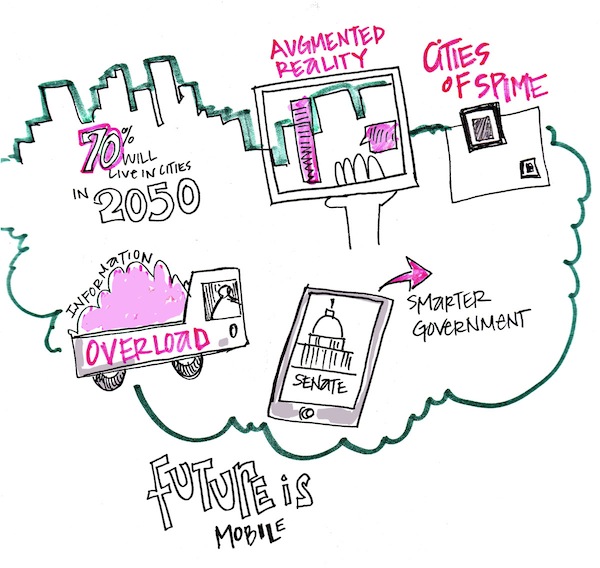
The Future is Mobile at Ignite NYC: Open Data, Open Government and Augmented Reality

“The future is already here – it’s just not evenly distributed.” —William Gibson.

http://blip.tv/play/AYKJtSgC

“An exploration of cyberpunk fiction, technology, where we’re headed, the challenges we face, and the solutions we need”-Ignite NYC. I gave a (very) similar talk called Pattern Recognition and Spimewatch at Ignite D.C. later that week. For whatever reason, this version seems to have come off much better. Rack it up to the first time on a big stage; there were close to a thousand people present in NYC.

The creative graphic recording at Ignite NYC at Web 2.0 Expo was created during the talk by Nora Herting of ImageThink.

For a great Ignite talk with a related theme, check out In Coders We Trust, by Laurel Ruma.

Open Government and Civic Innovation on Display at Portland’s CivicApps Awards

What does the innovation on display at the Civic Apps contest by developers in Portland, Oregon mean to the city’s mayor?

“It’s bringing to the world knowledge of what exists in the real world but is so often unknown,” said Mayor Sam Adams in an interview at the awards ceremony for the winners of the contest.

“In Portland, like I think most cities, when people are armed with knowledge, they make wiser choices,” he said, pointing to applications like PDX Bus as examples of innovation that actually help citizens to navigate the city better.

Does open data lead to more economic value creation in the private sector and metropolitan areas alike?

“We are seeing folks that are sole proprietorships hire folks to help them build their business, their app business, their online business with our data sets.” he said. “For us, data has always been there, in some cases for decades. Putting it to use for the public and help people make money while they do it – we intend to be the open source capitol of the nation – and this is one contribution we can make, with our data sets.”

What’s next? “What CivicApps is about in part, providing the data, is sparking relationships, relationships which lead to economic opportunities,” he said. “Webtrends, Microsoft meets the local hacker or coder tonight at this event, who knows what will happen. Our job is to provide the data, provide the opportunity for relationships to occur, provide what in comparison is a tiny litte bit of money, a little incentive for people to keep going. And it’s also fun. It make the city more fun to live in, because you know what’s there.”

That incentive, incidentally, amounted to $1000 for each of the winners of the second round of Civic Apps awards, with another $3000 going to the Best of Show winner, Loqi.me. This afternoon, Skip Newberry, economic development policy advisor to Mayor Adams, congratulated the winners of CivicApps on Twitter.

.bbpBox29117818058 {background:url(http://a3.twimg.com/profile_background_images/26879991/Downtown_Portland_-_Twitter_image.png) #9AE4E8;padding:20px;} p.bbpTweet{background:#fff;padding:10px 12px 10px 12px;margin:0;min-height:48px;color:#000;font-size:18px !important;line-height:22px;-moz-border-radius:5px;-webkit-border-radius:5px} p.bbpTweet span.metadata{display:block;width:100%;clear:both;margin-top:8px;padding-top:12px;height:40px;border-top:1px solid #fff;border-top:1px solid #e6e6e6} p.bbpTweet span.metadata span.author{line-height:19px} p.bbpTweet span.metadata span.author img{float:left;margin:0 7px 0 0px;width:38px;height:38px} p.bbpTweet a:hover{text-decoration:underline}p.bbpTweet span.timestamp{font-size:12px;display:block}

Congrats to @caseorganic @elsewisemedia @pdxmele @maxogden & John Mosser for their award-winning @civicapps! #opensource #gov20 #teamadamsless than a minute ago via TweetDeck

Most Useful App and Best of Show

Amber Case for Loqi.me

As Mayor Adams mentioned later in the program, this Web app could be useful in a snowstorm in Oregon or, if adapted more broadly, for crisis response around the country or world.

App description: “This application is a resource for citizens, medical teams and governments before, during and after disasters. Loqi.me allows mobile users to send an emergency GPS beacon to a real-time map. Crises responders can view all of the help requests on the webpage, along with hospitals and fire stations, real-time 911 calls related to natural disasters. Ground teams can easily use Loqi.me on their mobile phones to send notices of supplies and terrain reports in real time. Remote helpers can easily see the whole picture on the website’s real-time map, handle help and information requests, and send messages to the network. Loqi.me supports subscription to group messages via SMS, AIM, Jabber and Twitter. No application installation is required. Location beacons can be sent simply by going to http://loqi.me on a mobile phone.”

Most Appealing

Matt Blair for PDX Trees.

App description: “PDX Trees is an app for iPhone and iPod Touch devices that makes it easy to find and and enjoy them. With this app, you can:

  • Search for nearby trees and see them on a map.
  • Tap a pin to see the name and view details for that particular tree.
  • Take and upload a photo of a Heritage Tree you’re visiting.
  • View photos of the tree taken by other tree enthusiasts.
  • Email a friend about the tree (includes tree name and location where available)
  • Read more about a type of tree from Wikipedia, without leaving the app.”

Most Original

Melelani Sax-Barnett for Portland Bike to Transit.

App Description: “This is a simple, handy web map that helps you figure out how to ride your bike to transit. It lets you choose from a variety of base layers, and toggle transit stops, routes, and current bike routes. You can also query transit stops and routes for basic information. I made this for a Web GIS class at PSU and I’m a total beginner (with some code thanks to Professor Percy and OpenLayers).”

Best Use of Data

Max Ogden for Civic Apps Data Previewer

“This helped make our data useful to a lot of other developers and the general public,” said Mayor Adams. “Why take it on?”

“I saw all of this great data at the core when civic apps launched,” said Ogden. “When you get data into the Web format, you get Web developers who are really used to making human interfaces for things make them.”

App Description: “A web application to preview any of the public geo data on CivicApps from your web browser. You can choose a dataset and view that data on a map. Individual objects are clickable and can provide details (metadata).”

Civic Choice

Joseph Mosser for PDXTrian

App Description: “Pdxtrian is a simple utility for riders of Portland’s excellent mass transit system, TriMet.

  • Uses GPS to find nearby transit stops
  • Displays a map of the stop location
  • Displays a list upcoming arrivals
  • Allows you to save stops and look them up anytime”

The livestream of the awards ceremony is embedded below:

http://www.ustream.tv/flash/video/10487185?v3=1

Open source and open government community talks innovation at first IgniteGov

http://storify.com/digiphile/tracking-the-tweets-about-the-first-ignitegov-at-g.js