As Anil Dash blogged earlier today, Andy Baio has joined Expert Labs as a project director for ThinkUp App. According to Dash, Baio will be working as a “Director of Hacks,” focusing on making better use of the data collected by apps like ThinkUp.
Andy’s new role marks the beginning of a whole new phase for Expert Labs; We’re now very tightly focused on working with agencies that want to get crowdsourced feedback, and the biggest request those agencies make is to better understand the ideas that people submit. We’re answering those requests with smart tools for presenting, visualizing, sorting and filtering ideas and suggestions that come in through Facebook and Twitter.
In short, we’ve already got the ability to collect responses to policy questions through a social network, and now we’ll be able to turn those responses into real insights.
In his own blog post about on joining Expert Labs, Baio elaborated further on the mission he’s taking on:
Our goal’s to help government make better decisions about policy by listening to citizens in the places they already are: social networks like Twitter and Facebook.
Our first project is ThinkUp, an open-source tool for archiving and visualizing conversations on social networks. It started with Gina scratching a personal itch, a way to parse and filter @replies. But it’s grown to be something more: a tool for policy makers to harness the collective intelligence of experts.
There’s tons to do, but I’m particularly excited to tackle ThinkUp’s ability to separate signal from noise, making it easier to derive meaning from hundreds or thousands of responses, using visualization, clustering, sentiment analysis, and robotic hamsters. I’m planning on building some fun hacks on top of ThinkUp, as well as keeping an eye open for other vectors to tackle our core mission.
And his motivations for going to work in open government:
So, why would I go to a Gov 2.0 non-profit? For three main reasons:
It’s important. To tackle our most serious national issues, we need better communication between government and citizens. I want my son to grow up in a world where he doesn’t feel disconnected and disillusioned by government, and I want government to meet the needs of the people, rather than favoring those with the most money or the loudest voices.
It’s exciting. Technology is quite possibly our best hope of breaking down that divide, using social tools to disrupt the way that governments are run and policy is made. I love designing and building tools that use social connections to tackle difficult problems, and it feels like government is an area ripe for disruption.
I love the team. I’ve known Anil and Gina for years and have long admired their work. They’re both extraordinarily talented and creative people, and I feel lucky to call them both friends. The opportunity to work with them was too hard to pass up.
Welcome to the Gov 2.0 community, Andy. I saw him hard at work at the first FCC Open Developer Day in Washington this week, where we talked more about what it means to have members of the technology community work on technology to make government function more effectively.
When high profile members of the Web 2.0 community pitch in, their networks will learn more about what’s going on. Call it “digital diffusion.” That attention, scrutiny and tinkering is likely to be a good outcome for everyone.
For more on that count, I interviewed Expert Labs’ Gina Trapani at the FCC about ThinkUp app, the apps that came out of the developer day and this issue: what does it mean when geeks try to help government work better. It was a great conversation and I encourage readers of this blog to embed it elsewhere.
What do State Department officials mean when they talk about ” 21st Century Statecraft?” The PBS Newshour’s digital correspondent, Hari Sreenivasan, sat down with Alec J. Ross, senior adviser for innovation at the State Department, to learn how technology is being leveraged to accomplish foreign policy goals. Sreenivasan subsequently published an excellent post on diplomacy and 21st Century statecraft at the Rundown, the Newshour blog, that includes the video below:
What does 21st Century Statecraft mean? Sreenivasan takes a swing at reporting on Ross’s take:
In light of the seismic shifts taking place in how information and people interact and engage with one another, Ross says a broadening of the practice of statecraft is necessary. Going forward, that means using a balance of soft and hard power to enable and support relationships between non-state actors, and between representatives of governments.The prescription calls for far more than giving diplomats Twitter training, or simply using social media to push “the message” out. It is also about connecting people to resources efficiently and effectively, from NGOs to governments to people in need of aid.
In addition to spending money on new forms of digital diplomacy, the State Department has more often used its clout to convene bright minds from the private sector and the NGO world in a series of Tech@State conferences. They have included gatherings to share ideas on leveraging mobile technology, finding and empowering technology assistance in Haiti’s recovery and, more recently, rethinking Civil Society.
Sreenivasan included a host of excellent links to learn more about 21st Century statecraft, including:
An essay in Foreign Affairs entitled “America’s Edge” (requires one-time free registration) by Anne-Marie Slaughter. It was published around the same time that the former Dean of the Woodrow Wilson school at Princeton University was appointed as the new Director of Policy Planning at the State Department.
A essay by Eric Shmidt and Jared Cohen of Google titled The Digital Disruption, also in Foreign Affairs, which discusses the challenges facing diplomacy. As Sreenivasan notes, Cohen recently moved to Google from the State Department, where he had been working with Ross on 21st Century Statecraft. The New York Times Magazine covered their digital diplomacy efforts this this past summer.
Sam Dupont of NDN has gathered a list of 21st Century statecraft initiatives.
The Newshour has been extending its coverage into Gov 2.0 since Sreenivasan reported on the Gov 2.0 Expo and Summit earlier this year. For more of its past coverage, check out their conversation with Todd Park, the Chief Technology Officer of HHS, and excerpts from their conversation with White House Chief Technology Officer Aneesh Chopra and federak CIO Vivek Kundra. It’s a significant evolution to see Gov 2.0 be discussed on the Newshour, CBS or Dan Rather reports. Whether it’s enough to raise national awareness of open government challenges, success or failure is itself an open question.
What will a new US-India partnership on open government mean to the two countries? Shared resources, shared technologies, and maybe, a culture that trends towards a more open, accountable and participatory government.
No one who has watched the progress of open government in the United States would posit that it’s been an easy path. In India, the challenges are, if anything, even greater, given the immensity of the issues posed to the country’s population by poverty or literacy, a legacy of bureaucratic intransigence or outright corruption. There’s a reality behind Ipaidabribe.com Indian website that speaks volumes about that culture.
That said, there are many reasons to be hopeful about this open government partnership, particularly around the growth of mobile technology as a means of reporting issues.
Image Source: White House Flickr Account
As Nancy Scola points out at techPresident, learning Indian-style open government offers many opportunities to adopt the rapidly evolving platforms for mobile citizen participation from India.
For a sense of how such platforms can grow, look no further than Ushahidi, which was originally created to be an election reporting platform in Kenya.
Now we’ve got a joint statement from Obama and Singh, striking in how it frames the United States as a junior partner in the open government partnership. It noticeably credits the progress India has made in using technology to empower democratic engagement while striking a decidely more aspirational tone when it comes to the Obama adminstration’s work in the open government field: “This will build on India’s impressive achievements in this area in recent years and the commitments [link] that the President made to advance an open government agenda at the United Nations General Assembly.”
In the United States, my administration has worked to make government more open and transparent and accountable to people. Here in India, you’re harnessing technologies to do the same, as I saw yesterday at an expo in Mumbai. Your landmark Right to Information Act is empowering citizens with the ability to get the services to which they’re entitled — (applause) — and to hold officials accountable. Voters can get information about candidates by text message. And you’re delivering education and health care services to rural communities, as I saw yesterday when I joined an e-panchayat with villagers in Rajasthan.
Now, in a new collaboration on open government, our two countries are going to share our experience, identify what works, and develop the next generation of tools to empower citizens. And in another example of how American and Indian partnership can address global challenges, we’re going to share these innovations with civil society groups and countries around the world. We’re going to show that democracy, more than any other form of government, delivers for the common man —- and woman.
The question, as ever, is what this will practically mean when the glow induced by lofty rhetoric fades and the hard work of open government moves forward. The US-Indian open government dialog might mean more open source collaboration. As Information Week reported, a US-India partnership on open government practically includes $1 million dollars “toward public efforts to share best practices in working toward improved services and democratic accountability.” In the United States, that might not go very far. In the Indian subcontinent, it might be enough to seed funding for a number of mobile platforms to grow.
As Steve Ressler pointed out at Govloop, the mobile aspect of open government mainstream deserves special note. Why? Tom Friedman’s recent New York Times op-ed on the growth of mobile technology in India highlighted the same thing that Scola did: the potential to leapfrog a generation in wireless tech and see the creation of many new businesses:
India today is this unusual combination of a country with millions of people making $2 and $3 a day, but with a growing economy, an increasing amount of cheap connectivity and a rising number of skilled technologists looking to make their fortune by inventing low-cost solutions to every problem you can imagine. In the next decade, I predict, we will see some really disruptive business models coming out of here — to a neighborhood near you. If you thought the rate of change was fast thanks to the garage innovators of Silicon Valley, wait until the garages of Delhi, Mumbai and Bangalore get fully up to speed. I sure hope we’re ready.
If just a few of those mobile entrepreneurs focus on creating platforms for open government, the civic surplus of hundreds of millions of citizens in India and abroad could be harnessed to co-create government on a scale never witnessed before in history. There are reasons to be be skeptical, naturally, but the opportunity is there.
Will a rebooted FCC.gov become a platform for an ecosystem of applications driven by open government data? If that vision is going to come to fruition, the nation’s pre-eminent communication regulator will have to do more than just publish open data sets in machine readable formats online: it will have to develop a community of software developers that benefits to creating such applications.
Monday’s FCC developer day is a first step towards that future. Whether it’s a successful one will be in part predicated upon whether the applications created by the “civic hackers” present help citizens, businesses or other organizations do something new or ease a given process.
UPDATE: One key member of the open government community is the founder of Development Seed, Eric Gunderson. Gunderson has been involved in some of the most innovative mapping projects in open government over the past few years, along with the development of the platform for the new data.worldbank.org. If you’re looking for an unvarnished assessment of the meaning of the FCC’s effort and developer outreach, look no further:
Does it make sense to experiment? “In an online world, the best ideas can and do come from anyone, anywhere,” said FCC chairman Genachowski in a prepared statement. “Tapping into the innovation happening at the edge and in the cloud is a no brainer. The FCC’s first-ever Open Developer Day imports a best practice from the tech industry to help improve accessibility. It is part of our ongoing effort to harness technology to transform the FCC into a model of excellence in government.”
In order to meet that goal, the FCC is taking an open government tack, asking the civic development community to contribute to that effort. The agency’s first data officer, Greg Elin, explained more about the constituents for today’s dev day on the Blogband blog:
Programmers from the Yahoo! Developer Network will be on hand to demo their tools and provide guidance. They will give an overview of YQL, their query language which allows developers to “access and shape data across the Internet through one simple language, eliminating the need to learn how to call different APIs.” We will also see a demonstration of their YUI Library, a set of “utilities and controls … for building richly interactive web applications.”
An undertone, pervading a significant strand of the discussion, will be the 21st Century Communications and Video Accessibility Act. In signing the act last month, President Obama said the act “will make it easier for people who are deaf, blind or live with a visual impairment to do what many of us take for granted… It sets new standards so that Americans with disabilities can take advantage of the technology our economy depends on.”
The full day event will start at 9:00am and take place in Washington, DC at FCC headquarters. All developers are welcome free of charge. Bring a laptop and RSVP soon. If you’re not in the DC area and are unable to make it down here, we will be live streaming portions of the day. You can also join the discussion on Twitter using the hashtag #fccdevday. To email questions write to livequestions [at] fcc [dot] gov. You can participate by visiting Accessible Event, and entering the event code 00520237
For more context on what the FCC is trying to accomplish with FCC.gov/developer, watch a speech from the chairman and managing director Steve Van Roeckel at the 2010 Gov 2.0 Summit, below:
After an election that saw open government make gains in statehouses across the United States, a new transcontinental partnership offers new opportunities for international collaboration. This afternoon, Samantha Power, special assistant to the President for multilateral affairs and human rights, blogged about a new US-India partnership on open government at WhiteHouse.gov. Her post describes President Obama’s visit to an “Expo on Democracy and Open Government” at St. Xavier’s College in Mumbai and the technologies and organizations he encountered there. According to Power:
“India’s dynamism in the technology sector is well known, as is Gandhi’s legacy in India of civic action and bottom-up change, but today’s expo highlighted something very fresh: Indian civil society’s harnessing of innovation and technology to strengthen India’s democracy — by fighting corruption, holding government officials accountable, and empowering citizens to be the change they seek.”
Power’s post is thorough, descriptive and contextualizes the president’s trip and the growing use of technology to fight corruption and improve accountability in India. It also contains only one link that’s relevant to the organizations that were at said “Expo on Democracy and Open Government.” Ipaidabribe.com was created by Janagraaha to enable “Indians upload videos of their experiences in paying a bribe, in refusing to pay a bribe, and in ‘not having to pay a bribe.'”
The expo itself does not appear to have a website, or at least one that could be discovered after a few minutes of searching online.
The closest thing to an online FAQ is the White House press release on “Indian Innovations in Expo for Democracy and Open Government posted at America.gov, where the participating organizations are listed and described. Neither the WhiteHouse.gov blog post nor the release contains that most elemental of online elements: hyperlinks to the relevant person, place or thing being described. For some readers, used to the limitations of print, that may not be a huge issue. For digital natives or immigrants, the absence of links is a big missed opportunity.
The reason that critique is particularly fresh this afternoon is that one of the archetypal bloggers on the Web, David Winer, made the argument at Scripting News today that WhiteHouse.gov should be a hyperlocal blog. Specifically:
The sitting President can’t run campaign ads as an aspiring President does. But he has the ability to communicate more effectively than anyone else on the planet, if that power is developed. If you send people away to places that involve them. The White House blog should be a daily link list of ideas and perspectives on what’s happening in the world.
For instance, Power could have linked to the press briefing at USAID.gov where she, Secretary of Agriculture Tom Vilsack, USAID Administrator Raj Shah and Chief Technology Officer Aneesh Chopra talk about yesterday’s agricultural exposition, including her comments on this open government partnership. For example:
one of the things that we’ve been doing is really learning as a government just how rich the innovations are in a lot of emerging democracies, and indeed, in a lot of new democracies and transitional democracies. No one country has a monopoly on innovation in this space. And it’s indeed quite inspiring to see how even with very few resources you can see how creative nongovernmental actors are, or indeed champions within government who are stepping forward and taking advantage of new technologies and so forth to try to enhance partnership or transparency.
So having said that, I still think India has a huge number of comparative advantages. I mean, for starters it has one of the most noble traditions in human history of bottom-up change and bottom-up activism. I mean, the whole history of modern India is rooted in what you might call the original “Yes, we can” with Mr. Gandhi and the movement that he created and the billions of people that he inspired around the world, one of whom, as the President said today, was Martin Luther King, without whom, arguably, we wouldn’t be where we are in my own country.
So this tradition of bottom-up change, of citizen demand the quality of demand that one encounters out in the most rural areas and some of the most impoverished areas here, even among people who haven’t yet acquired literacy in their communities.
For an administration that’s embraced the idea and practice of Gov 2.0 in many notable ways, failing to link in even a Web 1.0 way is surprising. And to be fair, this post was an exception. The White House blog has frequently made good use of links, video and images, as shown by this week’s WhiteHouse.gov weekly wrapup.
For the sake of the broader open government community who may be interested, here’s the list of participants in that Expo from the press release, this time with links to the relevant organizations or news coverage, where such websites are not available:
An Illustrative List of Exhibitors and Roundtable Participants:
· Mazdoor Kisan Shakti Sangathana (Workers and Peasants Strength Union – MKSS) is an organization that fights against government corruption and creates channels for citizens to oversee their local governments. Its leader, Aruna Roy, is best known as a prominent leader of the Right to Information movement in India which led to Parliament’s passage of the Right to Information Act in 2005, which has empowered millions of ordinary Indians.
· Satark Nagrik Sangathan (SNS) is a New Delhi based citizen’s group with a mandate to promote accountability and transparency in government functioning. SNS’s key activities have been to promote the use of the Right to Information Act (RTI) by training citizens, particularly women in slum areas, to use the RTI and on the functioning of the government in areas such as rations, civic works, education and social welfare schemes. More recently, SNS has used the RTI to collect information on the performance of elected representatives and develop report cards.
· Janaagraha is a Bangalore-based NGO that works with citizens and government to change the quality of life in India’s cities and towns, focusing on urban infrastructure and citizen engagement with public institutions, including volunteerism. They also recently launched an exciting initiative called IPAIDABRIBE.com, a web platform for where people who have been asked for or ever had to pay a bribe are encouraged to share their experiences (after only 2 months, it gets 30,000 hits per day).
· The Hunger Project (THP) is a global organization committed to ending hunger. In India, it is committed to ignite and sustain the leadership spirit of women elected to local village councils (panchayats). THP works in 13 states of India, including Maharashtra (where Mumbai is located). By partnering with more than 90 civil society organizations, THP has worked with and supported the leadership of more than 60,000 elected women representatives.
· ASER uses simple tools to empower people nationwide to test their children’s math and reading abilities, and then hold local government accountable to outcomes. With this data, ASER creates the Annual Status of Education Report, which surveys literacy in 570 districts and 700,000 children of India with citizen participation. Each year 25,000 volunteers donate 4 days of their time to gather the data for this report.
· PRS Legislative Research (PRS) works with Members of Parliament (MPs) across party lines to provide research support on legislative and policy issues. Its aim is to complement the base of knowledge and expertise that already exists in government, citizens groups, businesses, and other research institutions. PRS also enables citizens to track the progress of legislative and policy reforms through an on-line portal.
· The Association for Democratic Reforms (ADR) works on building fair and transparent electoral and political processes in India. ADR has organized Citizen Election Watch for all major elections and discloses candidate background information in a timely manner, including through SMS technology, to the media and the public, helping them to make informed voting choices.
The takeaway for government – or any organization, for that matter – is that blogs and the Web offer new opportunities to share information, create more surface area to expose ideas to citizens and create conversations. If official accounts of new partnerships or events consist of plaintext press releases, lack a website or a post on the most prominent government blog in the world fails to include images, video or relevant links, that opportunity is being neglected.
Pretty cool. According to the page, it’s from Semantic-Web.at. It’s a good bet that the growth of open data and open government initiatives around the world will be a topic of conversation for the community the International Data Summit this month in Washington, D.C.
The Tech@State conference on Civil Society 2.0 offered insight into the future of technology and civics around the world from digital diplomats, nonprofit leaders and technologists. Tim O’Reilly delivered one of the most thoughtful lectures I’ve seen to date, exploring the factors that led to the success of the Web, Google, Microsoft, Amazon and the platforms that undergird our digital world.
“As you think about civil society 2.0, think about open ended platforms that you can build on, not just applications,” he said.
While his comments and those of the other presenters deserve more analysis and reporting, the four excerpts from O’Reilly’s talk below offer immediate access to the insight he shared. I’ll write more at Radar soon.
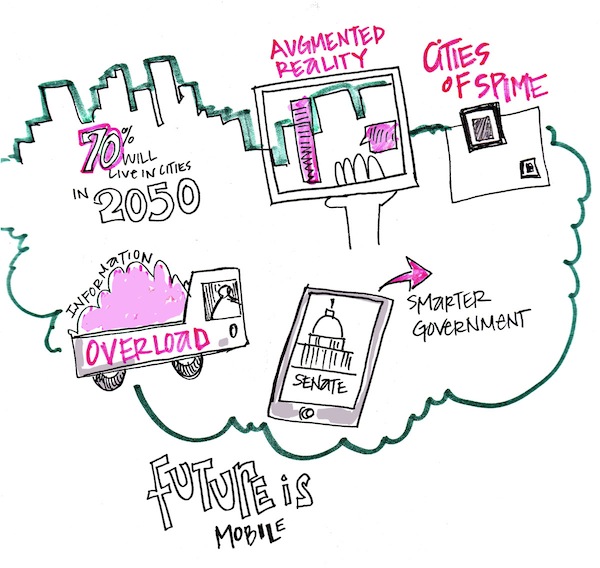
“An exploration of cyberpunk fiction, technology, where we’re headed, the challenges we face, and the solutions we need”-Ignite NYC. I gave a (very) similar talk called Pattern Recognition and Spimewatch at Ignite D.C. later that week. For whatever reason, this version seems to have come off much better. Rack it up to the first time on a big stage; there were close to a thousand people present in NYC.
“Government 2.0 is the attempt to harness the latest technology to make our government more effective, transparent and participatory,” he said.
What do the alpha geeks want to do, with respect to improving government? “They started saying, first of all, we want to open up government, we want more access to all this government data. We want to create new capabilities for citizen involvement.”
From HDNet YouTube Channel excerpt’s description:
Barack Obama’s presidential campaign was recognized for its innovative use of technology to rally voter support. But there are people out there who say that technology has the power to not only revolutionize campaigns, but the very way we view government. It’s a movement called Government 2.0 and Tim O’Reilly is one of its most vocal prophets. He has been called “the Oracle of Silicon Valley” because he saw the potential of the world wide web years before most of us had even heard of it. He’s a highly respected big thinker in the tech community. And he believes that we are at the vanguard of a radical re-think of how government works in the Internet age.
Can technology be used to create a “21st Century regulator?” Keep an eye on Elizabeth Warren as she works to stand up the new Bureau of Consumer Financial Protection over the next months. As Bill Swindell reported for NextGov, the new consumer protection agency plans to use crowdsourcing to detect issues in the market earlier. In a world where studios can use tweets to estimate movie profits or researchers can use Twitter to predict the stock market, it makes sense for government to seriously examine data mining blogs and social networks to pick up the weak signals that predate real problems. Choosing to use such a methodology is applying a lesson from Web 2.0 for Gov 2.0.
This isn’t the first time the federal government has tried to use crowdsourcing for collaborative innovation in open government, certainly, but detecting consumer fraud in a networked world is such a massive challenge that the effort deserves special attention and scrutiny. What’s the thinking here? As Warren told Swindell:
“It’s also about how we will receive information about how the world works,” she said. “It’s about how people will tell us about what is happening. I want you to think about this more like ‘heat maps’ for targeted zip codes where problems are emerging, or among certain demographic groups, or among certain issuers,” Warren said in her still-not-decorated office.
How will crowdsourcing be focused? Swindell’s article provides more insight:
“The power of enforcement will be partly about the agency. But it will be partly, in the future, be about how people crowdsource around identified problems,” Warren said. “The idea that people can talk to each other, whether it’s through the agency or from other platforms. In a sense, the whole notion of how markets work will change.”
“In the old world, it would be up for the agency to come in, and you look very slowly through a sample of the banks to see what products they mailed out. And did they add a lot of fine print, nonsense by regulation that was not supposed to be there?[Now] all of the sudden you got information, and you got it much faster, and you have it more pinpointed and that becomes relevant for purposes of where you spend enforcement resources.”
I think the tools that can be at the new agency’s disposal will have at least three kinds of implications. First, information technology can help ensure that the new agency remains a steady and reliable voice for American families. The kinds of monitoring and transparency that technology make possible can help this agency ward off industry capture.
Second, technology can be used to help the agency become an effective, high-performance institution that is able to update information, spot trends, and deliver government services twenty-four hours a day, seven days a week. If we set it up right from the beginning, the agency can collect and analyze data faster and get on top of problems as they occur, not years later. Think about how much sooner attention could have turned to foreclosure documentation (robo-signers and fake notaries) if, back in 2007 and 2008, the consumer agency had been in place to gather information and to act before the problem became a national scandal.
And third, technology can be used to expand publicly available data so that more people can analyze information, spot problems, and craft solutions. When these data are made available – while also, of course, protecting consumer privacy, shielding personal information and protecting proprietary business information – a shared opportunity arises between the agency and people outside government to have a hand in shaping the consumer credit world.
When Elizabeth Warren meets with Silicon Valley executives, certain technologies are likely to be of particular interest. As reported, she’ll be talking with Hal Varian, Google’s chief economist. Varian is behind a “Google price index” created through online shopping data that measures inflation. For some perspective on his thinking and why leveraging big data is one of the most important trends in IT, watch the video from last year’s Gov 2.0 Summit below:
For more perspective on how big data is being put to work across government, academia and big business, check out the excellent Strata Week series at O’Reilly Radar. Data science is shaping up to be one of the key disciplines of the 21st Century. Whether it can be put to good use by government regulators is a question that will be fascinating to see answered.
UPDATE: Warren delivered a speech to the University of California at Berkeley during her trip where she elaborated further on her vision for the new consumer protection agency. Full text of the speech is embedded below. Selected quotes on data follow.
Technology may provide new tools for the media and government to determine what’s happening – but they can and are used against consumers. As is so often the case, technology is agnostic to the purpose it is bent towards.
Today, information is king—but information is not evenly accessed by all. Repeat players can understand a complicated financial product that the rest of us have difficulty parsing in full. Lenders can hire teams of lawyers to work out every detail of a contract, then replicate it millions of times; a consumer doesn’t have the same option. And with technology to keep track of every purchase, to watch every payment choice, to observe and record the rhythms of our lives, a sophisticated seller can harvest that information—sometimes in ways that provide value, but sometimes in ways that manipulate customers who will never see what happened to them.
Warren also talked about how technology can be used to connect the new regulator with consumers, with respect to a “virtual shingle.” We’ll all see how big those ears can be.
When an agency loses sight of the public it is designed to serve, academics say it has been captured. The new consumer agency can develop tools to help level the playing field and discourage capture. The American people can have not just one, but thousands of seats at the table. Even before the agency officially opens its doors, it can solicit information from the American people about the challenges and frustrations that they face with consumer financial products day in and day out—and it can organize that information and put it to good use. Data from the public can inform priorities, and it can signal problems both to consumers and businesses. Information technology can allow us to hang out a virtual shingle in front the Agency and to declare our intent to the world. It’s a lot harder to let yourself fail – and a lot easier for the public to hold you accountable – when you’ve transparently declared your mission and shared information the public can use to measure your success in meeting it. Technology can force this agency to remain true to its goals.
Warren also articulated her thoughts on a “data-driven agency” and empowering citizens “to help expose, early on, consumer financial tricks,” acting as a kind of collective digital neighborhood watch. It’s an interesting vision.
In a world of experts, it’s the experts that frame the questions to be asked, isolate the problems, sort through the data (if there are any), and try to design solutions—always with the industry looking on and chiming in. But we can do this differently.
A data driven agency won’t be about conventional wisdom. It will be about data. And those data should come from many sources—from financial institutions, from academic studies and from our own independent research. We can reinforce that approach by making sure that our analysts come from a diversity of backgrounds—finance, law, economics, sociology, housing.
But we can also gather data directly from the American people by asking them to volunteer to share with us the experiences they have with consumer credit products. We can open up our platform to families across the country who want to tell us what has happened to them as they have used credit cards, tried to pay off student loans, or worked to correct errors in a credit report. We can learn more about the loan application process, about what people see on the front end and what happens on the back end. We can learn about good practices, bad practices and downright dangerous practices, and we can report on the good, the bad and the ugly to increase transparency and to push markets in the right direction.
Normally, agencies use supervision and lawsuits to enforce the law. This agency will do that as the cop on the beat watching huge credit card companies, local payday lenders, and others in between. Technology can help us do that better, by making sure our enforcement priorities are tightly connected to the financial market realities as experienced by customers every day.
New technology can help us supplement the cop on the beat by building a neighborhood watch. The agency can empower a well-‐informed population to help expose, early on, consumer financial tricks. If rules are being broken, we don’t need to wait for an expert in Washington to wake up. If we set it up right from the beginning, the agency can collect and analyze data faster and get on top of problems as they occur, not years later. Think about how much sooner attention could have turned to foreclosure documentation (robo-‐signers and fake notaries) if, back in 2007 and 2008, the consumer agency had been in place to blow the whistle before the problem became a national scandal.
The agency may also be able to demonstrate how incentives can change when people are connected not only to the government, but also to each other. Through crowd-‐sourcing technology, consumers can deal collectively with those who would take advantage of them—and can reward those who provide excellent products and services. Imagine scanning a credit agreement and uploading to a website where software can analyze the text of the agreement. A consumer could help the agency spot new agreements on the market and customers could get more information as they make decisions. The new CARD Act requires credit card issuers to submit their agreements to the Federal Reserve for posting. That’s a model we can build on. Information – fast, accurate information from a variety of sources – has the power to transform the old measures of agency effectiveness.
Warren was also thoughtful about the risks and opportunities of using government data. She also alluded to the potential for entrepreneurs to develop apps to create something of value, an aspect of Gov 2.0 that has been widely articulated through the Obama administration’s IT officials.
As a researcher, I understand that data must always be handled carefully, and protection of personal data and proprietary models is paramount. But I also believe that better data, made available to the media, private investors, scholars and others, will, over time, produce better results. When data are widely shared, others can use those data to uncover new problems, to frame those problems in different ways, to propose their own public policy solutions, and, for the entrepreneurs in the group, to develop their own private apps to create something of value. I’ve seen some good ideas in my time, and I’ve learned that those ideas can come from unlikely places. I’m hopeful that, as we drive consumer credit markets toward working better for families, the new consumer agency will be smart enough to encourage – and then to build upon – good ideas that come from far outside the government sphere.



 E Pluribus Unum