HHS launches Health.Data.gov

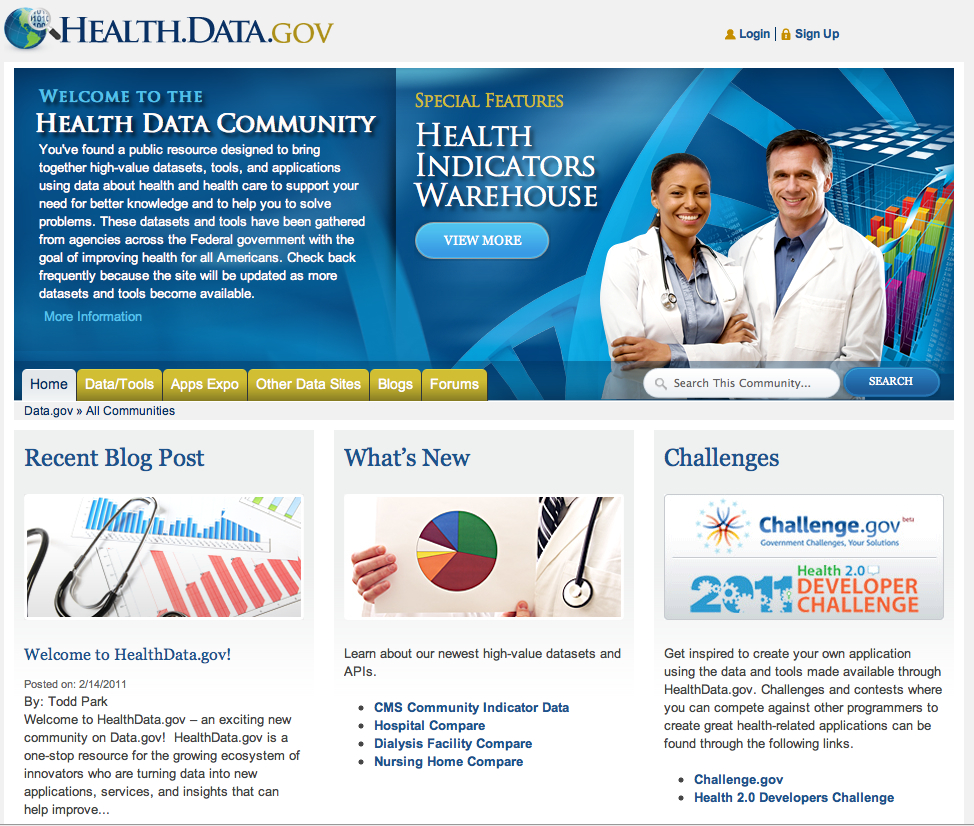
Last October, Todd Park, the chief technology officer at the Department of Health and Human Services (HSS) announced HealthData.gov at the HealthCamp in San Francisco. Today, Health.Data.gov went live. When the domain name propagates properly through the Internet, HealthData.gov will send online users directly to the new community at Data.gov.

Park blogged about HealthData.gov and the open health data initiative on Data.gov this morning.

“HealthData.gov is a one-stop resource for the growing ecosystem of innovators who are turning data into new applications, services, and insights that can help improve health,” he wrote.

The new open health data site includes community features and links to more than a thousand indicators at HealthIndicators.gov and a health apps showcase.

New apps like iTriage have the potential to turn open health data to better decisions and build new businesses. Speaking at the State Department’s open source conference last week, Park said that tens of thousands of citizens have now used the health data in iTriage to find community health centers.

Park has been working to make community health information as useful as weather data through the release of open health data from HSS. Today, the nation now can see more about what the tech community has come up since this spring, when the question of whether “there’s a healthcare app for that” was answered the first time. “Social value and economic value can go hand in hand,” he told a health IT summit in San Francisco.

Below, Park speaks more about what open health data could mean at last weekend’s health 2.0 code-a-thon in Washington, DC.

http://c.brightcove.com/services/viewer/federated_f9?isVid=1&isUI=1

Here come the healthcare apps.

3 words from the Tech@State unconference

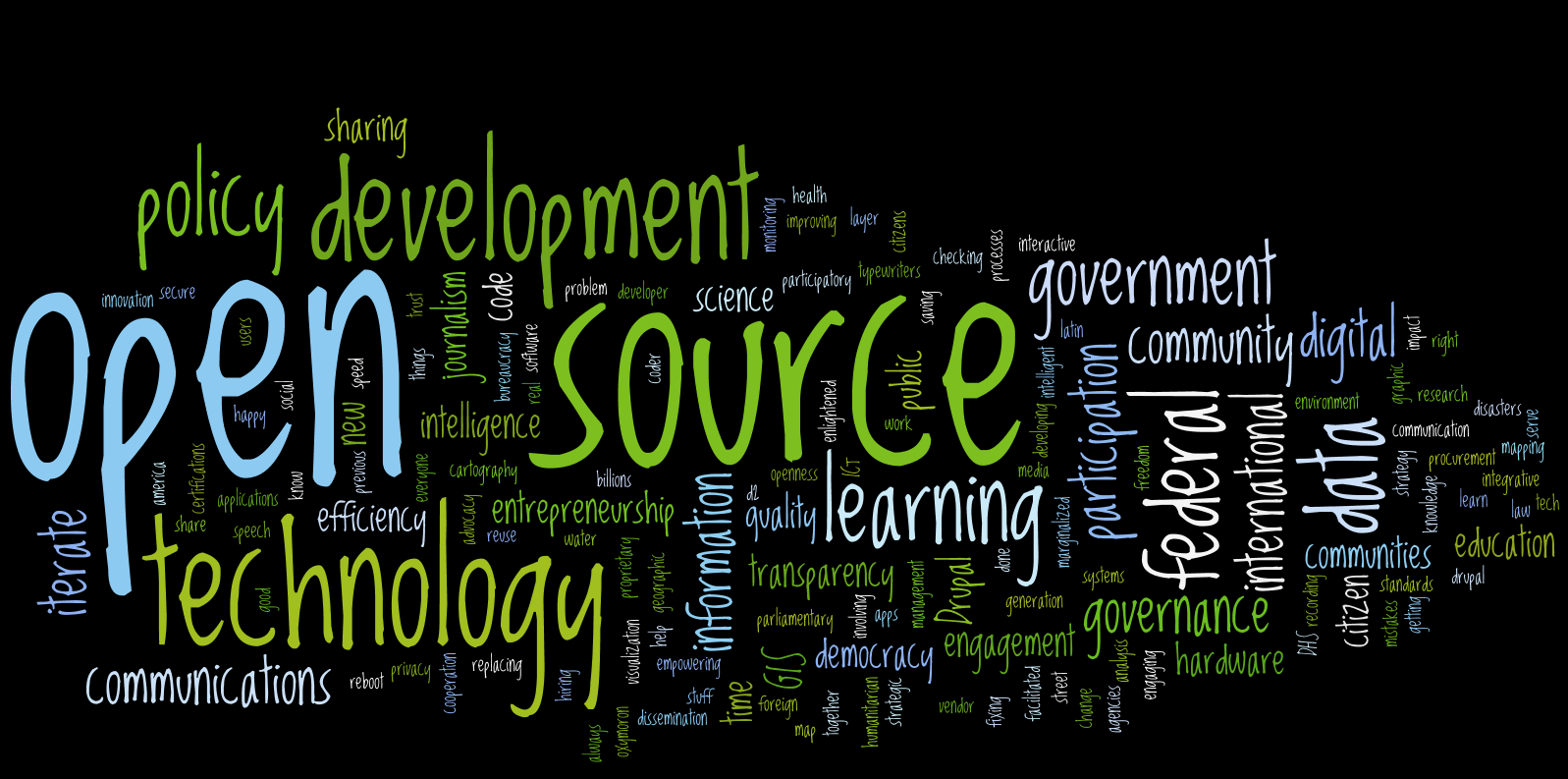
On Friday, the fifth Tech@State conference at the United States Department at State focused on the role of open source in government, industry and society. Today, there is a Tech@State unconference on open source at the National Democratic Institute. In keeping with the tradition of an unconference – sometimes called a barcamp – the day kicked off with a introduction where every attendee shared his or her name, affiliation and three words that describe who they are, what they care about, what they’ve come to learn or what they do. Or all three. Below is a wordle that shows the frequency of words used.

The schedule for the Tech@State unconference is evolving at Open4m.org/NDI. It bids to be an interesting day.

2011 Gov 2.0 and Open Government Events Calendar

Tomorrow, another great Tech@State event kicks off at the State Department in Washington, D.C. In New York City, the city’s first chief digital officer, will put on the capstone on Social Media Week at an open government forum. Out in Los Angeles, people will gather at KPCC for a digital diplomacy forum. It will be a busy Friday but these three events are only a few coming up that sit in the intersection of technology, citizens and government coming up this year.

As J.D. Lasica reported in his comprehensive Socialbrite list of 2011 social media, tech marketing conferences, there won’t be a Gov 2.0 Expo. (For an explanation of why O’Reilly won’t be doing the Expo this year, visit Quora.) There will, however be many other places for people to gather, talk and learn about Gov 2.0 in 2011 — just take a look through the many Govloop event listings. For a broader selection, Socialbrite has a terrific calendar of calendar of 2011 nonprofit conferences.

There will be any number of citizen-generated unconferences around the world in 2011, where the attendees generate the program. They’ll include CityCamps, BarCamps, PodCamps or MobileCamps. Check out the CityCamp calendar to find one near you and keep an eye out for CityCamp meetups in February.

The following listings are by no means comprehensive but should serve as a starting point if you’re wondering what’s happening, when and where. If you know about more Gov 2.0 events that should be listed here, please let me know at alex@oreilly.com or @digiphile.

Gov 2.0 LA

This Los Angeles conference brings a “West Coast” sensibility to the Gov 2.0 conversation, with a particular emphasis on social media and speakers from the diplomatic, marketing and consulting worlds. For a sense of what the 2010 event held, read On Language: Government 2.0 jargon and technology or a history lesson in disruptive innovation applied to modern government at Gov 2.0 LA.

Website: gov20la.org

DataCamp

February 13, Boston, MA
February 19, Seattle, WA
Philadelphia and DC TBD.

Code for America is hosting a set of “data camps” in its host cities this winter. Here’s why: “City governments have a lot of information which is useful to all of us. This ranges from maps of local parks to building footprints to real-time 911 calls. We all have an interest in our budget information, legistlative documents and other resources that we use in collective decision-making and deliberation. Not all of this information is currently available for all cities, even though much of it is public record. The “Open Data” movement is a way to work on getting information into machine-readable formats, allowing for easy publishing, sharing, and reuse. We’re hosting DataCamps in CfA’s cities this year to build communities around making city data more open and accessible to allow citizens to help cities work better. DataCamp is a event focusing on skill-building and collaborative work on city data. It is an opportunity for interested parties in a city to work together, and build a network of people with shared interested in improving civic communications and information management.”

Website: Code for America datacamps

2011 Computer-Assisted Reporting Conference

Feb. 24 to 27, 2011 — Raleigh, N.C.
Data journalism is a key component of the Gov 2.0 world. If government releases data, data journalism must evolve to validate, analyze and tell stories with it.

Website: www.ire.org/training/conference/

Social Media for Government Conference

February 14-17, 2011
Social media is but one component of Gov 2.0, alongside open data, collective intelligence or a rethinking of how services are provided, but it’s clear that it’s important.

Website: www.aliconferences.com/conf/social_media_govt0211/index.htm

Intelligent Cities Meetup

February 23rd, Washington, DC
“Intelligent Cities, a National Building Museum initiative, supported by its partners TIME and IBM and funded by The Rockefeller Foundation, explores the intersection of IT and urban design to understand where we are, where we want to be, and how to get there.” Meetups are planned for San Francisco, NYC and Chicago.

Website: Meetup.com/Intelligent-cities

Transportation Camp

March 5-6, NYC, New York
March 19-20, San Francisco, CA
TransportationCamp is a new unconference about transportation and technology.

Website: transportationcamp.org

South by Southwest Interactive Festival

March 10-15, Austin, Texas
This year’s SXSWi will include many sessions that fall under the umbrella of Gov 2.0, including government officials talking about open government, citizens talking about new apps or platforms, and new services or applications that will be relevant to both. Here’s just a sampling.

Website: sxsw.com/interactive

2011 Web and New Media Conference

March 17–18, 2011, Washington, DC
This conference is for government new media managers and webmasters, many of whom are wearing both hats in 2011. It’s proven to be an excellent networking and educational forum.

Website: http://www.usa.gov/webcontent/wmu/conference/2011/index.shtml

Web 2.0 Expo

March 28-31, San Francisco, CA
October 10-13, NYC, NY
There are many lessons for Gov 2.0 from Web 2.0, including the power of platforms to catalyze innovation, investment and more agile government.

Website: web2expo.com

NASA Open Source Summit

March 29-30, Mountain View California

From the organizers: “On March 29 & 30, NASA will host its first Open Source Summit at Ames Research Center in Mountain View California. This event will bring together engineers and policy makers across NASA and respected members of the open source community to discuss the challenges with the existing open source policy framework, and propose modifications that would make it easier for NASA to develop, release, and use open source software.”

Website: NASA Open Source Summit

Media Access to Government Information Conference (MAGIC)

April 12, National Archives, Washington, D.C.

From the organizers: “MAGIC is a collaborative, one-day conference sponsored by the National Archives and Records Administration (NARA) and Duke University’s DeWitt Wallace Center for Media and Democracy that will:

  • Explore obstacles and opportunities for access to government information by journalists and others writing about public affairs in the digital age;
  • Include government officials, reporters, scholars, and Non Government Organization (NGO) leaders who can contribute insights into how journalists can better discover, access, and use digital government information; and
  • Inform government professionals about the use of technology to provide better access to government information

The conference is free and open to the public, though registration is required. Breakfast, lunch, and refreshments are included. The conference sessions will be videotaped and made available for viewing at a later date. For more information, please contact MAGIC@nara.gov.”

Website: MAGIC

Mobile Citizen Summit

April 16, Washington, D.C.

From the organizers: “You have heard the word, mobile is the new hot thing. You have convinced your management to start using mobile, but how do you actually use mobile to engage citizens and create impact? The Mobile Citizen Summit is a one-day learning laboratory for those interested in applying mobile technologies to empower, fuel and drive citizen engagement in the public good. Our focus is on providing you with informative and practical discussions.”

Website: Mobile Citizen Summit

Transparency Camp

April 30-May 1, Washington, DC
The 2010 Transparency Camp delved into open data, coffee, open government, culture and yes, transparency. Look for more of the same.

Website: transparencycamp.org

Open Government and Innovations Conference

Likely in May 2011, Washington, DC
Applied uses of platforms, social media, culture change and more, all relevant transparency and open government

Website: http://events.1105govinfo.com/events/ogi-open-government-2010/home.aspx

Gov 2.0a

May 6-7, Oklahoma City, Oklahoma

From the organizers: “The second annual Gov 2.0a conference is focused on applications of technology to government problems. The conference will be a forum to learn about successful Gov 2.0 applications through case studies, to learn about best practices for Gov 2.0 applications, and to network with other professionals from city and state organizations, community groups, non-profits and the private sector who share interest in the application of technology to improve the functioning of our government.”

Website: Gov20a.com

Fedtalks Open Government Summit

May 11, Washington, D.C.

From the organizers: “FedScoop’s Open Government & Citizen Engagement Summit, part of the FedTalks event series, will bring together leading federal government and industry experts to discuss the state of open government and tech solutions to better engage citizens.”

Website: Fedscoop.com/fedtalks/opengov2011

OpenGov West

May 13-14, Portland, OR
Open government and Gov 2.0 community leaders, public officials, citizens and technologists from all over the West Coast.

Website: opengovwest.org

Local Open Government Summits

May 13-22, 2011, 35+ cities
In 2011, there will be a host of other camps too, as readers will find below, and a new initiative: local open government innovation summits. According to the organizers, “The summits’ overarching objective is to gather citizens and local government staff together in dialogue for knowledge-sharing and relationship-building. It is not necessary to include action planning, identification of next steps, or decision-making into your local summit. A successful outcome is raising awareness of local gov officials that they are not alone as they implement open government programs and that they can access the expertise of the broader open government community. The target is 50+ local summits across the US and internationally.”

Website: opengovplaybook.org

OpenGov Camp

June 4-5, NYC

From the organizers: “OpenGov Camp is a one day conversation on how participation builds transparency to deliver efficiency. We are a community of doers and decision-makers talking about what works—and what doesn’t. Whether you are a developer, journalist, activist, organizer or government employee, you should attend. For one day, we ask you three questions:

  • Where is “local” Open Government going?
  • How can we deepen the knowledge of what Open Government can be?
  • What are the social and technical tools affecting Open Government’s development?”

Website OpenGovNYC

Personal Democracy Forum

June 6-7, New York City, NY
This world-class conference exploring and analyzing technology’s impact on politics and government is back for the 8th year in New York City.

Website: personaldemocracy.com

OSCON 2011

July 25-29, 2011, Portland, OR
The O’Reilly Open Source Convention is the crossroads of all things open source. Open source plays an increasingly important role in government. The processes involved in open source itself have served as a model for open government.

Website: oscon.com/oscon2011

Supernova Hub

Likely in July 2011 in Philadelphia, PA (Unconfirmed)
Technologists, entrepreneurs, business executives, investors, and policy-makers have come to Supernova for strategic insights on our increasingly interconnected world

Website: supernovahub.com

Strata NYC

September 19-21, NYC, NY
To say that big data is a big deal for government is an obvious understatement. Government, after all, has extraordinary amount of data, with much more becoming available as open data initiatives move forward. The first Strata Conference in February 2011 was a sold-out hit. Strata NYC will pull together global leaders in big data in the Big Apple.

Website: strataconf.com

Fedtalks 2011

October 12th, Washington, DC

Open government went to the theater at the first Fedtalks. In 2011, look for more federal government and industry experts to discuss the state of innovation in government.

Website: Fedscoop.com/fedtalks/fedtalks2011

GOSCON

October 2011, Portland, OR
If 2010 was a year where open government moved “beyond plans to practice,” by late 2011 there should be many more case studies of implementation. GOSCON – the government open source conference – will feature discussions and presentations about how government leaders, innovators and smart operations are using open source.

Website: goscon.org

Digital Capital Week

November 4 – November 11, Washington, DC

Last year, the inaugural Digital Capital Week showcased tech innovation in Washington. The 2011 version of Digital Capital Week bids to be even bigger.
Website: digitalcapitalweek.org

Web 2.0 Summit

November 15-17, San Francisco
This event brings together business leaders, big thinkers, and innovative technologists who are shaping the future of the Web. In 2011, it’s clear that the shape of that future matters for government and citizens alike.

Website: web2summit.com

Live townhall from Twitter HQ with US UN @AmbassadorRice [#AskAmbRice]

Today at 1 PM EST, Susan Rice, United States Ambassador to the United Nations, participated in a live town hall on foreign policy. Archived video from the livestream is embedded below:

Here’s how Ambassador Rice described the digital town hall at the White House blog:

When I left the West Coast after college in 1986, only one in 500 Americans owned a cell phone – and these were essentially bricks about 10 inches long. IBM had just announced its first laptop, which weighed 12 pounds. The founders of Facebook, I can only imagine, were then figuring out how to master nap time and tee ball.

As I go back again this week to take part in a Twitter Town Hall in San Francisco, an event that will be carried live on Twitter and Ustream at 10:00 a.m. Pacific Time, the Bay Area looks quite a bit different. Education and innovation – “the currency of the 21st century,” in the words of President Obama – have changed the face of Silicon Valley and much of the world. But our interconnected age has also brought us new challenges. Today, transnational threats can sweep across borders as freely as a mass migration, an environmental calamity, or a deadly disease.

The Obama Administration is working every day to meet these challenges through our work at the United Nations, which plays an essential role as a keeper of peace, a provider of emergency aid, and a mediator between nations. You may agree – or disagree – with an approach to foreign policy that makes the best use of this complicated but indispensable institution. Whatever your views, I encourage you to send me your questions tomorrow at 10 a.m. Pacific Time on Twitter, using the hashtag, #AskAmbRice.

A snapshot of the conversation is featured using the Twitter search widget below.

new TWTR.Widget({
version: 2,
type: ‘search’,
search: ‘#AskAmbRice’,
interval: 6000,
title: ‘Ask’,
subject: ‘Ambassador Rice’,
width: ‘auto’,
height: 300,
theme: {
shell: {
background: ‘#0a1585’,
color: ‘#ffffff’
},
tweets: {
background: ‘#ffffff’,
color: ‘#444444’,
links: ‘#1985b5’
}
},
features: {
scrollbar: false,
loop: true,
live: true,
hashtags: true,
timestamp: true,
avatars: true,
toptweets: true,
behavior: ‘default’
}
}).render().start();

Here’s the uStream social stream:

Nicholas Gruen on Gov 2.0 in Australia and cultural change

“I began the Gov 2.0 taskforce thinking that open government was a kind of civil rights agenda, even if it has economic costs,” said Nicholas Gruen last week in Santa Clara at the Strata Conference. Gruen headed Australia’s Gov 2.0 taskforce. “At the end of it, I realized that open government was actually a really powerful economic driver.”

Why? Gruen pointed to the efficiencies presented inside of government by improved communication and the opportunities to ask citizens for ideas and solutions to problems. “Even if our team said we couldn’t do it technically, I just said we’ll tell everyone that we need help and approach it that way.” Asking questions was, he said, an effective means of accomplishing many tasks much faster than they would have been otherwise.

In a video interview, embedded below, Gruen talked more about the state of Gov 2.0 in Australia and some of his thoughts of the economics involved His comments on cultural change will be of particular interest those focused on technology as a panacea to inefficiency or engagement.

The recent historic flooding in Australia created an urgent use case for improved communications between the public and government. “When you look at the Queensland floods, the Facebook of the police department use blew people away,” said Gruen. “Their links got many comments and compliments.”

For more about how social media combine with geospatial mapping in crisis response, read about a new online application from geospatial mapping giant ESRI that applies trend analysis to help responders to Australia’s recent floods create relevance and context from citizen-generated reports.

Achieving better outcomes through technology isn’t just about setting up a Facebook page or Twitter account, emphasized Gruen. Public servants have to be willing to share information that matters to citizens and in turn listen to feedback from the public to create better feedback loops.

“This is a cultural transformation,” said Gruen. “You can’t impose that. You can’t dictate it.”

Further reading:Gov 2.0 Down Under: Australia and Open Government

White House CTO takes questions on innovation strategy on Twitter

US chief technology officer Aneesh Chopra took questions about the White House’s new innovation strategy on Twitter. Following is a report of the conversation between Chopra and the online audience. http://storify.com/digiphile/white-house-cto-aneesh-chopra-takes-questions-on-i.js

Why does government social media use matter to citizens?

An important role of technology journalists in the 21st century is to explain how broader trends that are changing technology, government and civic society relate to average citizens. Some have called this broader trend towards smarter, more agile government that leverage technology “Gov 2.0.” (Readers of this blog are no doubt familiar with the term.) When you dig into the topic, you can get stuck in a lot of buzzwords and jargon quickly. Most people don’t care about how a satellite gets into orbit, the release of community health data or the standards of an API for product recalls. They care quite a bit, however, about whether their GPS receiver enables them to get to a job interview, if a search engine can show them ER waiting room times and quality statistics, or if a cradle for their baby is safe. Those wonky policies can lead to better outcomes for citizens.

If you follow Mashable, you might have read about the ways that social media promotes good health or how government works better with social media.

The following stories have little to do with technology buzzwords and everything to do with impact. Following are five stories about government 2.0 that matter to citizens, with issues that literally come home to everyone.

1) The Consumer Product Safety Commission has launched a public complaints database at SaferProducts.gov. You could think of it as a Yelp for government, or simply as a place where consumers could go to see what was safe. Add that to the mobile recalls application that people can already use to see whether a product has been recalled.

2) The new Consumer Financial Protection Bureau will use technology to listen to citizens online to detect fraud. If you haven’t heard, DC has a new startup agency. That hasn’t happened in a long time. Your could think of it as Mint.gov mashed up with HealthCare.gov. The CFPB plans to use technology in a number of unprecedented ways for fraud detection, including crowdsourcing consumer complaints and trends analysis. Given how much financial fraud has affected citizens in recent years,and how much of the anger that the public holds for the bailouts of banks remains, whether this agency leveraging technology well will matter to many citizens.

3) Social data and geospatial mapping join the crisis response toolset. Historic floods in Australia caused serious damage and deaths. Government workers used next-generation technology that pulled in social media in Australia and mapped the instances using geospatial tools so that first responders could help citizens faster, more efficiently and more effectively. It’s an excellent example of how an enterprise software provider (ESRI) partnered with an open source platform (Ushahidi) to help government workers use social media to help people.

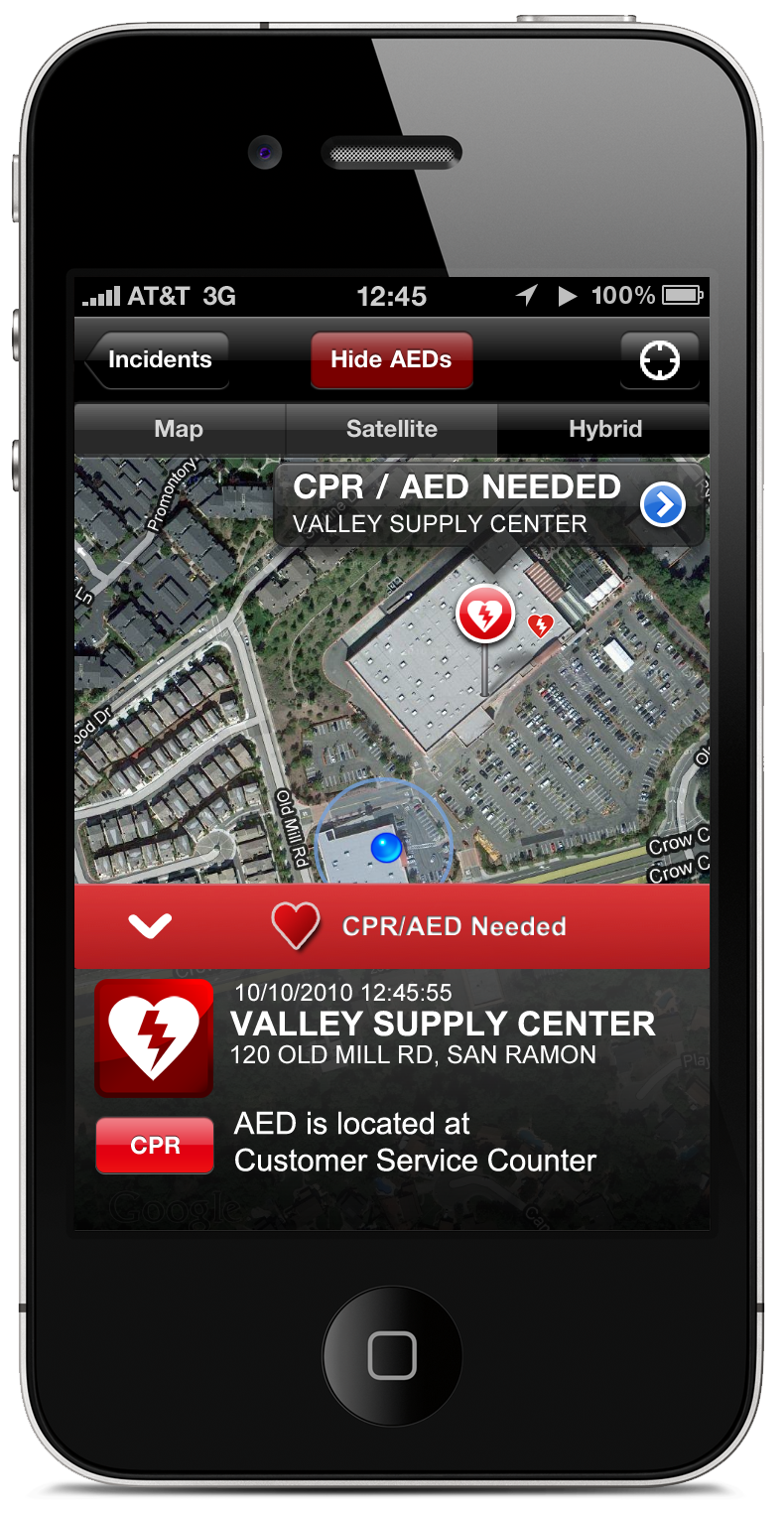
4) New geolocation app connects first responders to heart attack victims.The average citizen will never need to know what Web 2.0 or Gov 2.0 means. Tens of thousands, however, will have heart attacks every year. With a new geolocation mobile application that connects citizen first responders to heart attack victims, connected citizens trained in CPR now have a new tool to help them save lives.

Better access to information about food safety, product recalls and financial fraud will help citizens around the country. Improvements to the ability of government workers to direct help in a disastrous flood or for citizens to receive immediate help from a trained first responder in an emergency are important developments. As 2011 takes shape, the need for government to use social media well has become more important than ever. That’s why the perspective of government officials like FEMA administrator Craig Fugate matter.

“We work for the people, so why can’t they be part of the solution? “
said Fugate, speaking to delegates from the distributed chapters of Crisis Commons assembled at FEMA headquarters. “The public is a resource, not a 
liability.”

For example, Fugate said that FEMA used reporters’ tweets during Hurricane Ike for
 situational awareness. “We’ve seen mashups providing better info than
 the government.” Listening and acting upon those digital cries for help on social media during crisis could literally be a matter of life and death.

Whether government can adapt to a disrupted media landscape and the new realities of information consumption is of substantial interest to many observers, both inside and out of government. Whether government can be smarter, agile and more effective is a great interest to all.

New iPhone app connects trained citizens to others in cardiac distress

In 2011, there needs to be a better way to empower citizens trained in CPR to receive alerts about nearby cardiac arrest victims with geolocated maps and the location of electronic defribrillators to help them.

Now, there’s an app for that too: firedepartment.mobi. The new new geolocation app connects citizen first responders to heart attack victims in San Ramon. FireDepartment can be downloaded directly from iTunes.

Today the San Ramon Valley Fire Protection District (SRVFPD) in California launched a iPhone app that will dispatch trained citizens to help others in cardiac emergencies. This new application is the latest evolution of the role of citizens as sensors, where resources and information are connected to those who need it most in the moment. This FireDepartment app is also an important example of Gov 2.0, where a forward looking organization created a platform for citizens to help each another in crises and planned to make the underlying code available for civic developers to improve on. Given context and information, trained citizens in San Ramone will now be able to do more than alert authorities and share information: they can act to save lives. Here’s a demo of the app:

iPhone Demo from Fire Department on Vimeo.

Adriel Hampton called FireDepartment the perfect blend of technology, government and volunteers. Can an everyday citizen become a hero? As Joe Hackman observed, “Today it just got a lot easier.”

http://widgets.twimg.com/j/2/widget.js

new TWTR.Widget({
version: 2,
type: ‘search’,
search: ‘beahero’,
interval: 6000,
title: ‘Cardiac arrest near you?’,
subject: ‘Be a hero.’,
width: ‘auto’,
height: 300,
theme: {
shell: {
background: ‘#054766’,
color: ‘#ffffff’
},
tweets: {
background: ‘#ffffff’,
color: ‘#444444’,
links: ‘#1985b5’
}
},
features: {
scrollbar: false,
loop: true,
live: true,
hashtags: true,
timestamp: true,
avatars: true,
toptweets: true,
behavior: ‘default’
}
}).render().start();

Malamud: add bulk open government data access to Thomas.gov

An image of (insert name here), taken at about 2:30 this afternoon. (Photo by Abby Brack/Library of Congress)

An image of (insert name here), taken at about 2:30 this afternoon. (Photo by Abby Brack/Library of Congress)

Open government advocate Carl Malamud made a succinct recommendation for improving the United States House of Representatives on January 24th: “Open it up. Bulk access, developer day, an API, long-term open source model. People’s house.” Malamud linked to a letter at House.Resource.org to Representative Eric Cantor (R-VI), House Majority Leader in which he made the case for making bulk data access to bills and corollary data available to the public online through Thomas.gov:

Access to bulk data, both for the core Thomas system and for corollary databases, would have a huge and immediate effect. Hosting a developer day and making sure stakeholders are part of the long-term development will help keep the next- generation system in tune with the needs of the Congress and of the public.

As Malamud pointed out, long term plans to improve public access to the law are evolving, including the announcement that the Cornell Law Library would redesign Thomas.gov legislative/meta data models:

It’s finally official: The Library of Congress has selected us to work on a redesign of their legislative-metadata models. This sounds like really geeky stuff (and it is), but the effects for government and for citizens should be pretty big. What’s really being talked about here is (we hope) a great improvement not only in what can be retrieved from systems like THOMAS and LIS (the less-well-known internal system used by Congress itself), but also in what can be linked to and referenced. We’ll begin with a careful compilation of use cases, build functional requirements for what the data models should do, and go from there to think about prototype systems and datasets. The idea is to bring Semantic Web technology to bills, public laws, the US Code, Presidential documents, and a variety of other collections. Longtime LII friends and collaborators Diane Hillmann, John Joergensen and Rob Richards& will be working with our regular team to create the new models and systems.

Will the new GOP leadership take Malamud up on his proposal for an open developer day and bulk data? Stay tuned. As Nancy Scola wrote in techPresident that “Republicans in the House are making technology-enabled openness, transparency, and participation central to the public presentation of their core political values in a way that their Democratic counterparts never fully did.” Malamud has a track record that lends considerable credibility to his prospects: he helped to get the SEC online in 1993. More recently, “Washington’s IT guy” was able to work with the House leadership to start publishing hundreds of high-resolution videos from the House Oversight Committee hearings at House.Resource.org earlier this month.

If the new GOP leadership is serious about adopting the infrastructure to enable transparency and accountability in the House, perhaps adoption of open government data standards will be one of the enduring accomplishments of this 112th Congress.

gov.house.20110120_to http://d1.scribdassets.com/ScribdViewer.swf?document_id=47510400&access_key=key-28dgxfnpla0o1b17qgmp&page=1&viewMode=list

ExpertNet: What is the future of the open government platform?

The President has lunch with Sen. Bob Casey at the Famous 4th Street Deli in Philadelphia

The President has lunch with Sen. Bob Casey at the Famous 4th Street Deli in Philadelphia. (Official White House Photo by Pete Souza)

Citizen engagement platforms grew in 2010. There will be more such platforms coming from top, through open government, and from the bottom, as civic developers create, host and use their own communities. The opportunity for citizens to participate in the co-creation of the most high profile open government platforms for citizen consultation, ExpertNet, will close on January 23rd, when the White House’s Request for Information will end.

The White House has been taking public feedback on designing democracy with this citizen consultation platform for weeks. In a number of respects, the discussion on ExpertNet.wikispaces.com has resembled an unconference, where the participants themselves drive the process.

So what’s interesting here? “It is the idea that the public will be (directly) shaping policy that is intriguing, and is a critical component to bridging the gap, both the economic gap as well as the digital gap, as the average citizen is the real stakeholder, and before now has had no forum for influencing change so directly,” said Megan Eskey, OpenGov Lead at the NASA Ames Research Center.

Or put it another way, as Anil Dash did earlier today: how should a White House Quora work?

The White House is looking to build a web community to get its questions answered, sort of their own Quora, and they’re trying to do it the right way. They’re asking those who would participate to help shape how the community itself works. They’re not trying to create a network from scratch, but instead trying to connect to networks that already exist. And they’re not just making a community for the hell of it — they’re trying to build one with purpose.

But they’ve asked for our help, from those of us who build, and know, and love web communities. We’re being asked to share our expertise in what does, and doesn’t work on successful web communities. Our deadline for participating is on Monday. Giving them insights into our hard-earned lessons will only take 15 minutes of your time this weekend, and will keep us from having to wonder, “Why wasn’t I consulted?

Many lively discussion threads have emerged, including suggestion for moderation, voting, ownership of intellectual property and more, including:

“It’s not so much the idea of a wiki or whatever platform ExpertNet rolls out, but rather the format they are looking at of matching experts with those seeking to solve immense problems,” said Eskey. “Whether it is a wiki or a social site or some other crowdsourcing tool like delib’s dialogue app, that feedback loop is critical, especially if the digital divide is to be bridged via new bills that are introduced into Congress, although at this time the project is envisioned for executive agencies and departments only,” she said. Eskey noted that any ideas for using ExpertNet within the legislative branch should be directed to elected representative(s) in Congress.

For those interested in the future of open government and citizen consultation, there’s no time like the present to weigh in. Tim Bonnemann of Intellitics has also posed six questions for ExpertNet for further consideration.